



 Arguments







2012 SkS Weekly Digest #13
Posted on 2 April 2012 by John Hartz
SkS Highlights
Measured by number of comments posted, Kevin C's HadCRUT3: Cool or Uncool? and greenman3610's Scientist Sets Record Straight on Medieval Warming Research were the most popular and/or controversial articles d this past week, Ari Jokimäki's New research from last week 12/2012 also garnered a goodly number of comments. Ari's creative introdcutions to this weekly feature is worth the price of admission.
Toon of the Week
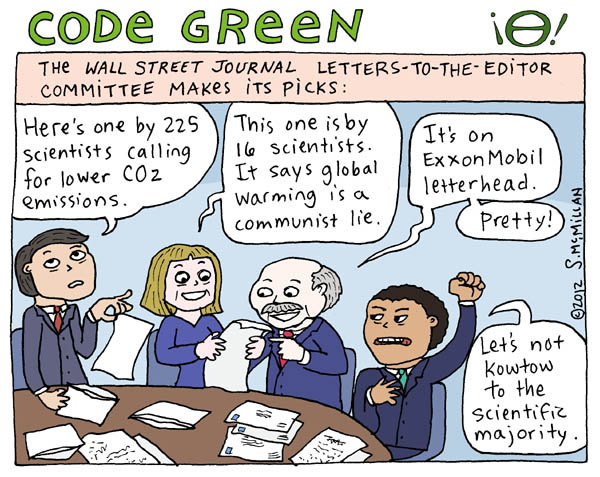
Source: Code Green, a weekly editorial cartoon focused on the environmental emergency, by Stphanie McMillan.
Issue of the Week
Do you subscribe to the daily email notice of newly posted articles on SkS? Would you subscribe to a weekly email notice of newly posted articles if the option to do so was provided? Which option do you prefer?
The Week in Review
A complete listing of the articles posted on SkS during the past week.
- Weather records due to climate change: A game with loaded dice by John Hartz
- Scientist Sets Record Straight on Medieval Warming Research by greenman3610
- Falling Cloud Height In the Last Decade: Is It Just ENSO? by Rob Painting
- Monckton Misleads California Lawmakers - Now It's Personal (Part 1) by Dana
- What We Knew in 82 By Rob Honeycutt
- HadCRUT3: Cool or Uncool? by Kevin C
- New research from last week 12/2012 by Ari Jokimäki
Coming Soon
A list of articles that are in the SkS pipeline. Most of these articles, but not necessarily all, will be posted during the week.
- Yes Happer and Spencer, Global Warming Continues (Dana)
- New research from last week 13/2012 (Ari Jokimäki)
- Why David Archibald is wrong about solar cycles driving sea levels Part 1 (Alex C)
- Monckton Misleads California Lawmakers - Now It's Personal (Part 2) (Dana)
- Welcome to Eocene Park (Andy S)
- Sea-level rise 8500 BP to now: a stark example from the coast of Wales (John Mason)
- Global Warming - A Health Warning (Agnostic)
- Advancing Climate Science, One Skeptic Talking Point at a Time (rustneversleeps)
- Methane - Part 1 (Agnostic)
- Gobal Surface Warming Since 1995 (Dana)
SkS Spotlights: 350.org
350.org is building a global grassroots movement to solve the climate crisis. Our online campaigns, grassroots organizing, and mass public actions are led from the bottom up by thousands of volunteer organizers in over 188 countries.
350 means climate safety. To preserve our planet, scientists tell us we must reduce the amount of CO2 in the atmosphere from its current level of 392 parts per million to below 350 ppm. But 350 is more than a number—it's a symbol of where we need to head as a planet.
350.org works hard to organize in a new way—everywhere at once, using online tools to facilitate strategic offline action. We want to be a laboratory for the best ways to strengthen the climate movement and catalyze transformation around the world.
We operate at a large scale to take on the world's greatest challenge. In October of 2009 we coordinated 5200 simultaneous rallies and demonstrations in 181 countries, what CNN called the 'most widespread day of political action in the planet's history.' On 10/10/10, we organized the "Global Work Party" -- a day of climate solutions projects, from solar panel installations to community garden plantings--and changed communities from the bottom up with over 7000 events in 188 countries.
In 2011, we mobilized people power in every corner of the planet. In September, we organized "Moving Planet" -- a massive day of action to move beyond fossil fuels. We also helped lead the fight to stop the Keystone XL tar sands oil pipeline -- a relentless campaign that ended in improbably victory.
In 2012, with the help of millions of people, we'll create a wave a hard-hitting climate activism all over the world that can lead to real, lasting, large-scale change. We think we can turn the tide on the climate crisis--but only if we work together. If an international grassroots movement holds our leaders accountable to realities of science and principles of justice, we can realize the solutions that will ensure a better future for all.


 0
0  0
0






Comments