





What the 2012 US Election Means for Climate Change and Denial
Posted on 15 November 2012 by dana1981
While we at Skeptical Science do not comment on politics, we do from time to time examine what various policymakers believe with regards to climate change, and what they propose to do about the problem. With the 2012 American election in the books, what does it mean for the future of the global climate?
The Winning Climate Policy
In September we examined the differences between the climate policy positions of the two presidential candidates, Barack Obama and Mitt Romney. In a nutshell, it boiled down to this:
"Our overall verdict is that President Obama's energy policies are good, although his leadership on the climate change been insufficient to take us off the potentially catastrophic climate path. Romney's plan would not only result in a failure to reduce greenhouse gas emissions, he wants to roll back emissions reduction policies implemented by the Obama Administration. Mitt Romney's energy policies would not only keep us on our current path, they would stomp on the accelerator, sending us hurtling ever faster towards climate catastrophe."
Thus the fact that Barack Obama won re-election for a second term is good news from a climate policy perspective. Indeed in his acceptance speech, Obama took the rare step of mentioning climate change.
"We want an America that isn't threatened by the destructive power of a warming planet."
This is a good sign that President Obama may be willing to tackle this critical issue which has essentially sat on the backburner since the carbon cap and trade bill which passed the House of Representatives was filibustered (blocked and prevented from coming up for a vote) in the Senate in 2010. Although as we discussed in our post on his climate policy, Obama has taken some smaller but important steps to reduce US greenhouse gas emissions.
Some Improvements in Congress
Is a carbon pricing system feasible in Obama's second term? This still depends on Congress, which has to pass a bill for the president to sign. Republicans took control of the House of Representatives in 2010 and only lost a few seats in the 2012 election. In the Senate, the Democrat majority shrunk in 2010, increased a bit in 2012, but the Democratic caucus is only likely to include 55 members, whereas 60 votes are required to break a filibuster. Barring a reform of the filibuster rule (which half of Senators now appear to support to some degree), this will allow Senate Republicans to continue blocking carbon pricing legislation from coming to a vote, if they so choose. However, at least some Republicans are seriously considering a carbon tax as a revenue source, albeit not those in charge of Congress.
With the impact of Hurricane Sandy and the potential to partially reduce the federal deficit through a carbon tax, a carbon pricing system is more plausible in 2012 than it was in 2010, but is still a very long shot. Particularly since the president does not plan to propose a carbon tax.
Climate Denial Becomes a Political Liability
However, anti-clean energy and climate denial positions may be increasingly politically damaging in the USA. For example, the League of Conservation Voters targeted what they deemed the 'dirty dozen' in the 2012 election - candidates in close races who have consistently voted against clean energy and conservation. At least 10 of those 12 lost their races, and an 11th, Dan Lungren, appears to have been defeated as well. Mitt Romney was included in the dirty dozen, and his opposition to extending the wind energy tax credit may very well have become a political liability. He lost Iowa, a state with nearly 20% of its electricity supplied by wind energy and with thousands of wind energy jobs, by six points.
Climate denial may also become a political liability, with an increasing percentage of Americans understanding the reality of global warming recently - a trend which will likely continue in the wake of Hurricane Sandy. As the latest Yale/George Mason public survey on the subject (in September 2012, prior to Hurricane Sandy) found,
"For the first time since 2008, more than half of Americans (54%) believe global warming is caused mostly by human activities, an increase of 8 points since March 2012. Americans who say it is caused mostly by natural changes in the environment have declined to 30 percent (from 37% in March)."
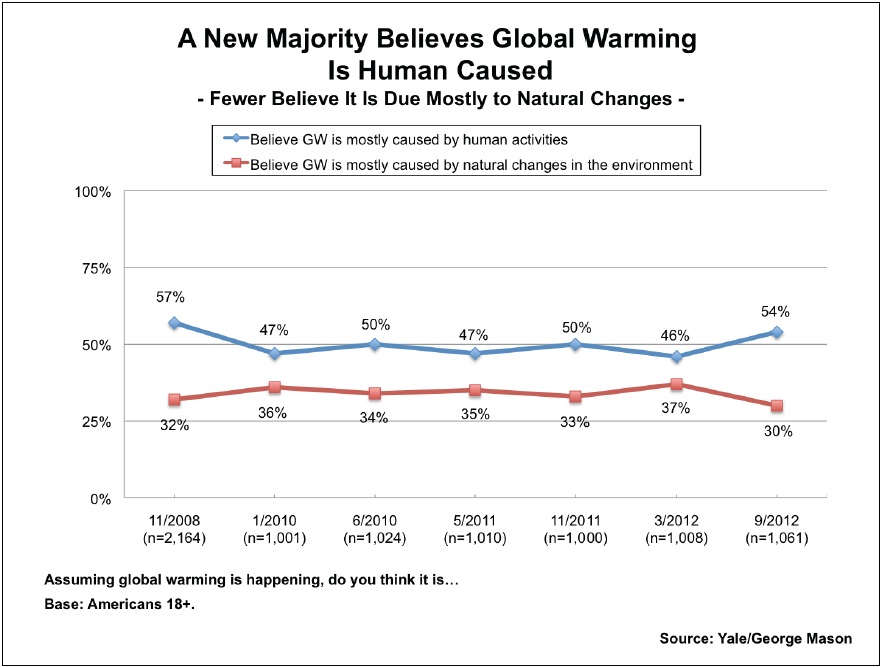
Indeed several 'climate hawks' won their elections, and 11 of 12 'climate heroes' candidates won as well.
Election Poll Denial Mirrors Climate Denial
In the lead-up to the 2012 election, there was also a denial regarding the accuracy of polling data and associated conclusions amongst many of the same individuals who deny the accuracy of climate-related data and associated conclusions. Outlying data which showed convenient results were cherrypicked to support the desired conclusion. Some went so far as to remove imagined biases from the data to create the desired outcome. Those who considered all the data were mocked and dismissed, and math and models were labeled as "voodoo", and the sound mathematical basis of their results was outright denied. The similarities to climate denial are striking.
The difference is that global warming is a relatively slow change, and so it will be many decades before climate denialists are conclusively proven entirely wrong by the increasing temperatures. Elections on the other hand are one-time short-term events in which predictions are immediately tested. As it turned out, the data- and model-based predictions were spot on (particularly those of Nate Silver at The New York Times, whose presidential predictions were darn near perfect), whereas the alternative reality and gut-based predictions were conclusively, undeniably, proven very wrong.
The question is whether the denialists will learn anything from this. As former George W. Bush speechwriter David Frum asked,
"Horrible possibility: if the geeks are right about Ohio, might they also be right about climate?"
Of course the answer is 'yes.' The question is whether those who were conclusively proven wrong in their election data denial will connect the dots to their climate data denial. As Dave Roberts put it, climate scientists are "the Nate Silvers of climate science." Will the accuracy of the "geeks" in predicting the election results, in combination with the devastating impacts of Hurricane Sandy, be a wake-up call for climate denialists?
If so, the USA has a shot at taking serious action to address the climate threat. If not, we will have another four years of steady, but too-slow progress in reducing our emissions.
Also see good posts on these subjects at RealClimate, Climate Progress (here and here), Grist, Huffington Post, and Planet 3.0.

Arguments


Obama's First Priority: Economy, Not Climate Change by Common Dreams Staff
An insightful analysis of the President’s response is contained in:
President Obama’s press conference — climate change gets some attention, but enough? by Stephen Stromberg, Washington Post, Nov 14, 2012
Looks to me like he really gets it but has become a 'policy realist' the negative comments were carefully worded to minimise offense but whole response quite brave imo. His best shot is to keep up the green job side as much as he can get away with while protecting the environment agency enough to give them room to sort out large emitters. not very democratic but hes dealing with a broken system
Fat chance! They won't even aknowledge their election data denial. Dean Chambers, of unskewedpolls infamy, is running a web poll asking "Was this election stolen by massive Democrat vote fraud?"
Now that his last election is behind him, Obama does not have to be quite as cautious in bringing the topic up. It also helps that nature is continuing to give us signs that even skeptics have trouble sweeping under the denial carpet.
If a dsicussion of climate change during the Presidential campaign would have garnered more votes for Romney in Ohio and Pennsylvania, you can bet your sweet bibby that Team Romney would have pressed the issue.
Unless I was tuned in to an alternate universe ...
To the best of my recollection, Romney did make repeated appearances in coal country in which he embraced coal as a wonderful, special, awesome energy source for the future, and he made this same delusional point rather forcefully in two of the three presidential debates.
Note too that Romney did easily win West Virginia, a coal producing state which from 1933 through 1996 was a fairly reliable Democratic state in presidential elections. Thus, I would say that had Obama taken up the issue, Romney would have engaged even more energetically.
The other corollary point is that Obama's team appears to have been right in their assessment that their base was more energized than the opposition, and we all know climate change/global warming is like red meat to the Republican base. So why would Obama want to feed the trolls?
It's also probably true that people who put global warming at the top of their list of concerns already knew who to vote for without having to hear it talked about on the campaign trail. It certainly motivated my vote for the blue candidate.
Brad Johnson, campaign manager for ClimateSilence.org, an environmental group, said he welcome Obama’s “belated call for a national conversation about how to address climate pollution.”
But Johnson said Obama’s assertion that climate change should be secondary to economic concerns was “a gross disappointment and an insult to the deep suffering of the millions of victims of climate disasters across this nation,” including Hurricane Sandy. Obama is scheduled to tour New York City Thursday to view storm damage and recovery efforts.
“While conventional D.C. wisdom is focused on the manufactured crisis of the ‘fiscal cliff,’” Johnson said, “the truth is that the most urgent threat to our national safety and economic well-being is the climate cliff that we are already beginning to tumble over.”
Source: Obama wants national ‘conversation’ on climate change; no legislation proposed, AP/Washington Post, Nov 14, 2012
BTW, Obama did not categorically dismiss coal as an unacceptable energy source. If I recall correctly, he spoke positively about "clean coal", i.e., carbon sequestration. In a similar vein, Obama touted his "all of the above" energy policy. He did not qualify "all of the above" by saying "except for coal."
Seems to me like his comments are being blown out of proportion, unless I'm misreading them.
Many environmental organizations and activists worked their butts off to get Obama re-elected because they knew he accepted the scientific consensus on climate change and the need for the US to reduce carbon emissions. These organizations and individuals have spoken out and will continue to speak out on the need to move forward on the climate change front post haste. Brad Johnson's statement is in this vein.
Sure, we ALL would like the POTUS to instantly grant us the magic ponies we want (and on both sides, there are puh-lenty who demand magic ponies!), but the exigent reality is, the financials of the country have to come first, if only by degree. I say let's see how the fiscal cliffiness works out, then we can begin bangin' away on Obama, to pay more attention to CC: my guess is, he will.
I'm not disagreeing that we need to act as soon as possible, and act in a massive way.
I am hoping that Obama does engage with global warming, and I think dealing with it is the real way to begin to fix our nation's serious and systemic economic problems, but I also think he needs to start with something along the lines of a national climate change conference in which our side calls in its experts, by the hundreds if not thousands (which he seems to be moving toward), and the other side calls in their experts, such as they are, and over the course of several months or more the evidence is piled up on the scales and then weighed at the end. I do think he needs to let the other side have a spot at the table. I'll take Hansen over Watt any day.
Without this kind of formal dog and pony show, any attempt on Obama's part to take action--say by proposing a carbon tax, which I think is the key thing that needs to be put in place, will be questioned by the people on the other side not just because they hate taxes, but because of the fact that the UN is the organization that stands behind the IPCC reports which will inevitably be referenced. Most hard-core Republicans (and these are not just the deniers) do not like, do not trust, and will not listen to anything with the UN's imprimatur on it, at least as far as I've seen to date.
There is also another serious danger: it would be a tragic mistake for Obama to try to act too soon or with too weak a hand, and because of this then fail to push us to where we need to go. If that happens, he could end up exhausting his strength in Congress and walk away from the fray with some weak, half-baked steps that only appear to help, but in fact will haunt us when they prevent further steps from being taken.
I'd rather have him spend the next four years, if that's what it takes, to lay the solid groundwork for the right course of action, than put in a shoddy foundation that screws things up for the next decade or more.
Remember, this is the same country that needed Pearl Harbor to happen before we were effectively dragged into WWII, and I'm not sure we would have even managed to go to war with Germany at that point if Hitler hadn't declared war on us first. My guess is that on the subject of climate change, there are a lot more America First-types around now than there were when it was the Nazis we were worried about.
http://www.guardian.co.uk/environment/2012/nov/01/obama-strategy-silence-climate-change?CMP=twt_gu
During the election, I think that Obama's realistic focus on climate was a huge advantage to him, post-Sandy. I don't think that Obama won on climate. I do think Romney lost on climate.
Given his strategy of not mentioning climate, I think that Obama actually delivered a lot in his first term - decelerating rates of GHG emissions, better emissions standards for vehicles, and fiscal incentives for clean energy investment.
I hope that he will now decide that real US and international action on climate issues would be recognised internationally as a lasting, priceless legacy.
More interesting, in my opinion, is the effect on the deniers.
Reading through the comments especially on several denier sites in the aftermath of the election, it became very clear that the prime motivation of many of the regulars is entirely political.
But they are apparently a political liability. How much are these brave Galileos prepared to go on challenging the views of not just the science community, but also the vast majority of the business community, the media and the defence establishment?
This to support some extreme right wing politicians, whose electoral chances appear to be severely damaged by association with these views? How does that work?
If you are a GOP candidate, who would you rather have in your corner, agreeing with you on climate change, EITHER the scientists, the Pentagon, Wall Street, and the media, OR Anthony Watts, Judith Curry and the Koch Bros?
Indeed, and, like others here and elsewhere, I was concerned that CD.o would be just another lame attempt at 'false balance,' i.e., another Intertubes 'tone troll,' of sorts. Reading along with it, it seems not to be so much: Curry's assertions of "uncertainties abound" have been met with robust data, well-spoken and *decidedly* non-ad hominem comments, from real scientists in the matter.
I have hope for CD.o!





