



 Arguments







A broader view of sea level rise
Posted on 12 May 2009 by John Cook
The last post on sea level rise emphasised that when analysing sea level rise (or any climate trends for that matter), it's inadequate to use just a few year's worth of data. However, I only went back 16 years. To obtain a more complete picture of sea level rise, I'm taking my own advice and going back to 1870.
Global mean sea level (eg - the global average height of the ocean) has typically been calculated from tidal gauges. Tide gauges measure the height of the sea surface relative to coastal benchmarks. The problem with this is the height of the land is not always constant. Tectonic movements can alter it, as well as Glacial Isostatic Adjustment. This is where land which was formerly pressed down by massive ice sheets, rebounds now that the ice sheets are gone.
To construct a global historical record of sea levels, tide gauge records are taken from locations away from plate boundaries and subject to little isostatic rebound. This has been done in A 20th century acceleration in global sea-level rise (Church 2006) which reconstructs global sea level rise from tide gauges across the globe. An updated version of the sea level plot is displayed in Figure 1:
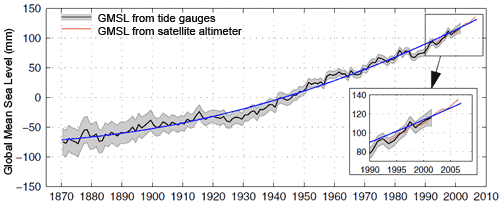
Figure 1: Global mean sea level from 1870 to 2006 with one standard deviation error estimates (Church 2008).
Tidal estimates from sediment cores go even further back to the 1300's. They find sea level rise is close to zero in the early part of the sedimentary record. They then observe an acceleration in sea-level rise during the 19th and early 20th century. Over the period where the two datasets overlap, there is good agreement between sedimentary records and tidal gauge data (Donnelly 2004, Gehrels 2006).
What we're most interested in is the long term trends. Figure 2 shows 20 year trends from the tidal data. From 1880 to the early 1900's, sea level was rising at around 1mm per year. Throughout most of the 20th century, sea levels have been rising at around 2mm per year. In the latter 20th century, it's reached 3mm per year. The five most recent 20-year trends also happen to be the highest values.
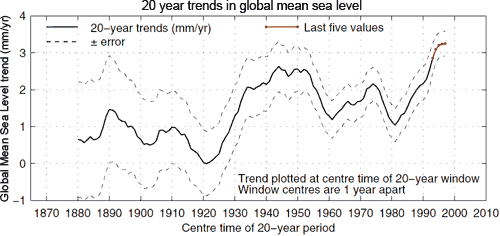
Figure 2: The linear trends in sea level over 20-year periods, with one sigma error on the trend estimates shown by the dotted lines. From 1963 to 1991, there were a series of volcanic eruptions which caused cooling and hence contraction of the upper ocean. This temporarily slowed the rate of sea level rise.
So a broader view of the historical record reveals that sea level is not just rising. The rate of sea level rise has been increasing since the late 19th century. In an upcoming post, we shall look at predictions of future sea level rise.









As for ocean heat, why would you say ocean heat needs to show monotonic increase from year to year? On the contrary, measurements over the past 50 years of ocean heat have shown a noisy signal where short periods of cooling are not unusual amidst the long term warming trend. As this post shows, look at the complete record, not a short period, before drawing conclusions.
Does rising sea levels prove that mankind is causing global warming? No. The reason we know we're causing global warming is because we're raising CO2 levels and CO2 traps heat which leads to the planet accumulating heat.