



 Arguments







New Understanding of Past Global Warming Events
Posted on 9 April 2012 by John Hartz
This is a reprint of a press release posted by the University of New Hampshire on April 2, 2012.

A series of global warming events called hyperthermals that occurred more than 50 million years ago had a similar origin to a much larger hyperthermal of the period, the Pelaeocene-Eocene Thermal Maximum (PETM), new research has found. The findings, published in Nature Geoscience online on April 1, 2012, represent a breakthrough in understanding the major “burp” of carbon, equivalent to burning the entire reservoir of fossil fuels on Earth, that occurred during the PETM.
“As geologists, it unnerves us that we don’t know where this huge amount of carbon released in the PETM comes from,” says Will Clyde, associate professor of Earth sciences at the University of New Hampshire and a co-author on the paper. “This is the first breakthrough we’ve had in a long time. It gives us a new understanding of the PETM.” The work confirms that the PETM was not a unique event – the result, perhaps, of a meteorite strike – but a natural part of the Earth’s carbon cycle.
Working in the Bighorn Basin region of Wyoming, a 100-mile-wide area with a semi-arid climate and stratified rocks that make it ideal for studying the PETM, Clyde and lead author Hemmo Abels of Utrecht University in the Netherlands found the first evidence of the smaller hyperthermal events on land. Previously, the only evidence of such events were from marine records.
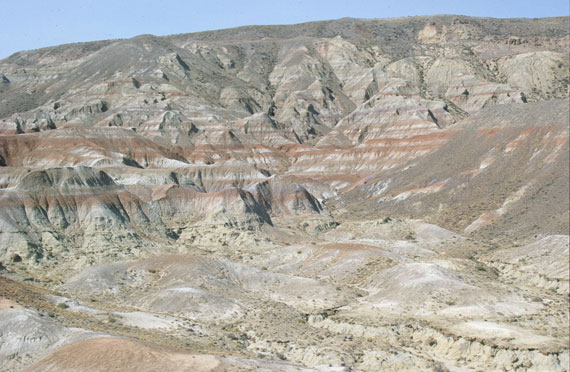
These geological deposits make the Bighorn Basin area of Wyoming ideal for studying the PETM. Credit: Aaron Diefendorf
“By finding these smaller hyperthermal events in continental records, it secures their status as global events, not just an ocean process. It means they are atmospheric events,” Clyde says.
Their findings confirm that, like the smaller hyperthermals of the era that released carbon into the atmosphere, the release of carbon in the PETM had a similar origin. In addition, the warming-to-carbon release of the PETM and the other hyperthermals are similarly scaled, which the authors interpret as an indication of a similar mechanism of carbon release during all hyperthermals, including the PETM.
“It points toward the fact that we’re dealing with the same source of carbon,” Clyde says.
Working in two areas of the Bighorn Basin just east of Yellowstone National Park – Gilmore Hill and Upper Deer Creek – Clyde and Abels sampled rock and soil to measure carbon isotope records. They then compared these continental recordings of carbon release to equivalent marine records already in existence.
During the PETM, temperatures rose between five and seven degrees Celsius in approximately 10,000 years -- “a geological instant,” Clyde calls it. This rise in temperature coincided exactly with a massive global change in mammals, as land bridges opened up connecting the continents. Prior to the PETM, North America had no primates, ancient horses, or split-hoofed mammals like deer or cows.
Scientists look to the PETM for clues about the current warming of the Earth, although Clyde cautions that “the Earth 50 million years ago was very different than it is today, so it’s not a perfect analog.” While scientists still don’t fully understand the causes of these hyperthermal events, “they seem to be triggered by warming,” Clyde says. It’s possible, he says, that less dramatic warming events destabilized these large amounts of carbon, releasing them into the atmosphere where they, in turn, warmed the Earth even more.
“This work indicates that there is some part of the carbon cycle that we don’t understand, and it could accentuate global warming,” Clyde says.
The article, “Terrestrial carbon isotope excursions and biotic change during Palaeogene hyperthermals,” was published online in Nature Geoscience. In addition to Clyde and Abels, co-authors were Philip Gingerich from the University of Michigan, Frederik Hilgen and Lucas Lourens from Utrecht University, Henry Fricke from Colorado College, and Gabriel Bowen from Purdue University. Clyde received funding for this work from the National Science Foundation.


 0
0  0
0






Comments