



 Arguments







Potential methane reservoirs beneath Antarctica
Posted on 2 September 2012 by John Hartz
This is a reprint of a news release posted by the University of Bristol (UK) on Aug 29, 2012.

The Antarctic Ice Sheet could be an overlooked but important source of methane, a potent greenhouse gas, according to research published today (Aug 29) in Nature and conducted by an international team led by Professor Jemma Wadham from the University of Bristol's School of Geographical Sciences.
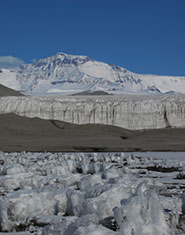
The ice margin of an Antarctic glacier, depicting frozen lake sediments in the foreground. When ice sheets form, they overrun organic matter such as that found in lakes, tundra and ocean sediments, which is then cycled to methane under the anoxic conditions beneath the ice sheet. Image by J. L. Wadham
The Antarctic Ice Sheet could be an overlooked but important source of methane, a potent greenhouse gas, according to research published today in Nature and conducted by an international team led by Professor Jemma Wadham from the University of Bristol's School of Geographical Sciences.
The new study demonstrates that old organic matter in sedimentary basins located beneath the Antarctic Ice Sheet may have been converted to methane by micro-organisms living under oxygen-deprived conditions. The methane could be released to the atmosphere if the ice sheet shrinks and exposes these old sedimentary basins.
The researchers estimate that 50 per cent of the West Antarctic Ice Sheet (1 million km2) and 25 per cent of the East Antarctic Ice Sheet (2.5 million km2) overlies preglacial sedimentary basins, containing about 21,000 billion tonnes of organic carbon.
Team leader, Professor Wadham said: "This is an immense amount of organic carbon, more than ten times the size of carbon stocks in northern permafrost regions. Our laboratory experiments tell us that these sub-ice environments are also biologically active, meaning that this organic carbon is probably being metabolised to carbon dioxide and methane gas by microbes."
The researchers then numerically simulated the accumulation of methane in Antarctic sedimentary basins using an established one-dimensional hydrate model. They found that sub-ice conditions favour the accumulation of methane hydrate (that is, methane trapped within a structure of water molecules, forming a solid similar to regular ice).
They also calculated that the potential amount of methane hydrate and free methane gas beneath the Antarctic Ice Sheet could be up to 400 billion tonnes (that is, 400 Pg of carbon), a similar order of magnitude to some estimates made for Arctic permafrost. The predicted shallow depth of these potential reserves also makes them more susceptible to climate forcing than other methane hydrate reserves on Earth.
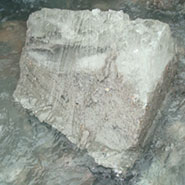
Blocks of ice containing subglacial sediments were extracted from the margins of several glaciers and used by the authors in long term incubation experiments aimed at detecting subglacial methane production. Image by E. Lawson
Dr Sandra Arndt, a NERC fellow at the University of Bristol who conducted the numerical modelling, said: "It's not surprising that you might expect to find significant amounts of methane hydrate trapped beneath the ice sheet. Just like in sub-seafloor sediments, it is cold and pressures are high which are important conditions for methane hydrate formation."
If substantial methane hydrate and gas are present beneath the Antarctic Ice Sheet, methane release during episodes of ice-sheet collapse could act as a positive feedback on global climate change during past and future ice-sheet retreat.
Professor Slawek Tulaczyk, glaciologist from the University of California, Santa Cruz, said: "Our study highlights the need for continued scientific exploration of remote sub-ice environments in Antarctica, because they may have far greater impact on Earth's climate system than we have appreciated in the past."
This research is a collaborative venture between the University of Bristol (UK), the University of California, Santa Cruz (US), the University of Alberta, Edmonton (Canada) and the University of Utrecht (The Netherlands).
It was funded principally by the Natural Environment Research Council (UK) and the Leverhulme Trust (UK), with additional funds from the National Science Foundation (US), the Natural Science and Engineering Research Council of Canada and the Netherlands Organisation for Scientific Research (NWO).
Paper
'Potential methane reservoirs beneath Antarctica' by J. L.Wadham, S. Arndt, S. Tulaczyk, M. Stibal, M. Tranter, J. Telling, G. P. Lis, E. Lawson, A. Ridgwell, A. Dubnick, M. J. Sharp, A. M. Anesio & C. Butler in Nature
Cabot Institute
The Cabot Institute at the University of Bristol carries out fundamental and responsive research on risks and uncertainties in a changing environment. Our interests include natural hazards, food and energy security, resilience and governance, and human impacts on the environment. Our research fuses rigorous statistical and numerical modelling with a deep understanding of interconnected social, environmental and engineered systems – past, present and future. We seek to engage wider society – listening to, exploring with, and challenging our stakeholders to develop a shared response to twenty-first century challenges.


 0
0  0
0






Comments