





Do we know when the Arctic will be sea ice-free?
Posted on 9 September 2012 by Verity
This is a re-post from Carbon Brief
Credit: NASA Earth Observatory
Over the past week, news that sea ice extent has fallen to a new low according to satellite measurements has prompted speculation about how long it will be before the Arctic Ocean is completely free of ice in summer.
The fate of Arctic sea ice has always captured attention. The ice grows in winter and retreats in summer. Records since 1979 show Arctic sea ice losing around 3% of its area per decade. The amount of ice at the summer minimum is shrinking faster, at around 12% per decade, and the sea ice is also becoming thinner.
This long-term decline is clear. But it's not possible to confidently predict how much ice there will be in a particular year. In 2007 Arctic sea ice coverage fell to an unusual low - unprecedented in the satellite record, and well below what was expected.
This prompted widespread coverage, a suggestion from US National Snow & Ice Data Center (NSIDC) director Mark Serreze that the sea ice had entered a " death spiral", and speculation from others that the Arctic ocean might be clear of sea ice in summer sooner than expected.
But 2008 through 2011 didn't see new records broken, although sea ice levels remained consistent with the long-term downward trend:
Subsequent studies suggest that unusual weather conditions contributed to 2007's record low, prompting more conservative predictions for when we might sea ice-free summers.
Natural variability or a 'fundamental change' in melting?
But this year has seen another dramatic sea ice low, with Arctic sea ice extent already below 2007 levels and a couple of weeks of the melt season left:
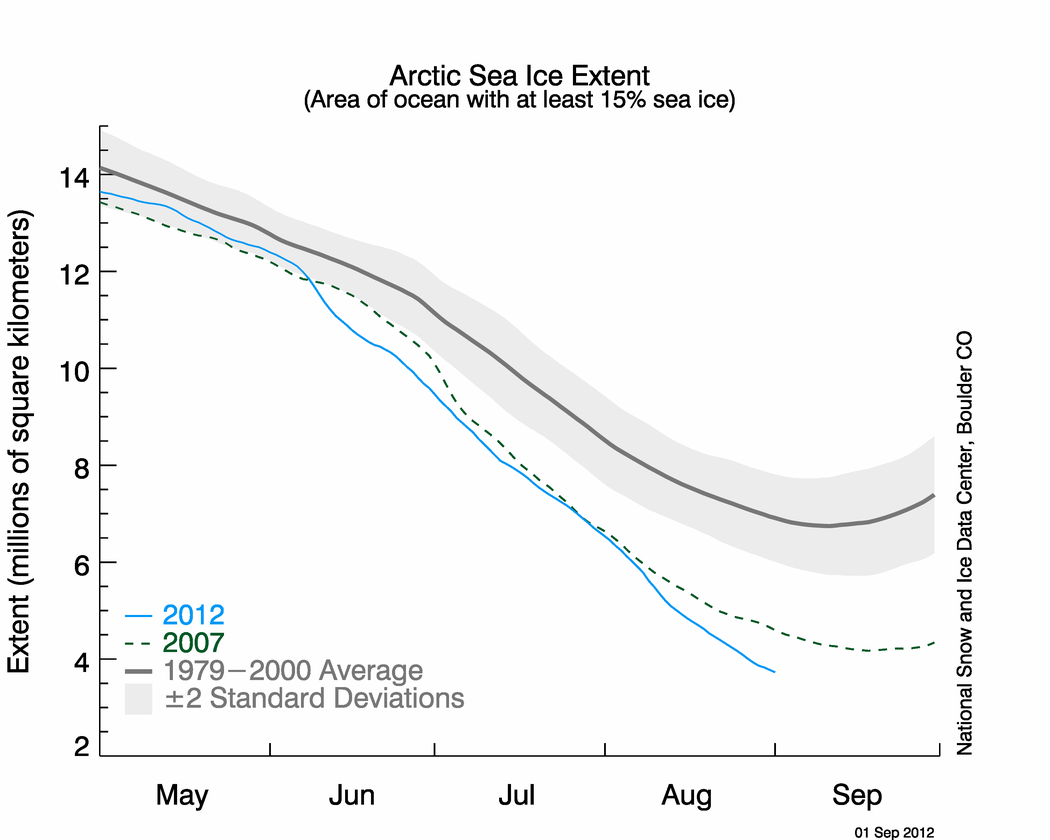
Commentators are once again questioning whether this year's fall in ice cover marks a fundamental change in the pattern of Arctic sea ice melt, or whether it's the result of natural variability. Some scientists point out that the unusual weather conditions that contributed to 2007's record low haven't happened this year. Serreze explains:
"The previous record, set in 2007, occurred because of near perfect summer weather for melting ice. Apart from one big storm in early August, weather patterns this year were unremarkable. The ice is so thin and weak now, it doesn't matter how the winds blow."
Predictions are once again being made about when the Arctic Ocean might be ice-free in summer. There's quite a range of opinions. For example, Professor Peter Wadhams, ocean physicist at the University of Cambridge, tells the Scotsman:
"The entire ice cover is now on the point of collapse [...] It is truly the case that it will be all gone by 2015."
And Mark Drinkwater, mission scientist for the European Space Agency's CryoSat satellite tells Yale Environment 360:
"If this rate of melting [in 2012] is sustained in 2013, we are staring down the barrel and looking at a summer Arctic which is potentially free of sea ice within this decade."
Other scientists offer estimates in terms of decades. Ted Scambos, NSIDC senior research scientist, suggests that Arctic sea ice-free summers aren't likely to be reached until 2030, "plus or minus a decade."
And in 2011, NSIDC director Mark Serreze wrote:
"[W]e may [...] be looking at ice-free summers only a few decades from now."
The scientific literature on the subject
Peer reviewed research in this area has developed over the last few years. In 2007, before the dramatic melt that year, the most considered scientific opinion came from the Intergovernmental Panel on Climate Change (IPCC). The worst case scenario, it said, was ice-free summer seas by the end of the century.
But a 2009 review of newer scientific literature by a group of scientists concludes:
"The observed summer-time melting of Arctic sea-ice has far exceeded the worst-case projections from climate models of IPCC AR4 … The warming commitment associated with existing atmospheric greenhouse gas levels means it is very likely that in the coming decades the summer Arctic Ocean will become ice-free, although the precise timing of this remains uncertain."
Indeed, subsequent research confirms the climate models used for IPCC's AR4 underestimate future Arctic sea ice loss.
Projections made since 2007 suggest the Arctic ocean could be seasonally free of ice sooner. A 2007 paper concludes "decreasing ice coverage might lead to an ice-free Arctic in summer sometime within the upcoming decades", whilst a 2009 paper, which uses 2007/2008 September sea ice measurments as a starting point for six IPCC climate models predicts "a nearly sea ice free Arctic in September by the year 2037."
A more recent assessment of sea ice projections using the latest generation of IPCC climate models finds that the updated models more realistically represent the present state of the sea ice cover, and projects
"[A] seasonally ice-free Arctic sooner than [the older IPCC models], leading to the conclusion that a seasonally ice-free Arctic Ocean within the next few decades is a distinct possibility."
But the paper's authors point out that the updated models have not reduced the range in model projections of when there might be a seasonally ice-free Arctic Ocean.
So there are recent climate models that project seasonal ice-free Arctic seas within the next few decades, but they cannot yet pinpoint a precise year, or even decade. Lars-Otto Reiersen, head of the Arctic Monitoring and Assessment Programme, tells Reuters most models indicate ice-free conditions in 30 to 40 years, although "there are models that indicate 2015 as an extreme."
Overall, this Reuters headline probably offers the best summary of the state of scientific opinion:
"Arctic summer sea ice might thaw by 2015 - or linger for decades"

Arguments


Here he talks to the BBC, and I gather he is making a documentary with them on the Petermann ice island. Should be interesting.
"Arctic melt is like doubling CO2"
Congratulation to the team, for our science communication having such fast impact on mainstream media, and especially to Andy for this piece of animation well done!
Basically the Soon op-ed is a joke and IMO not even worth debunking.
- No baseline indicated
-
Data appears visually to end at 2005 (hey, BEST goes through 2010, doesn't it?)- The US is only a minute fraction of the world
- BEST is land-only
The only reason to not extend the TSI & temperature data later in the decade (using all the land data), and to ignore more than a century of OHC data, is that plotting such data would be inconvenient to reaching their predetermined narrative.
The graphic is a crap exercise in curve-fitting, IMHO.
"...there has been relatively little work investigating the solar-climate connection."
Riiiight. As for the rest of the article, and considering not only the source of the 'data,' but who published and printed it, I agree w/Dana@4
If you look at either the sunspot numbers or direct TSI measurements (averaged over the 11-year solar cycle for clarity) versus temperatures (as in this plot), you see that insolation is dropping while temperatures are rising over the last 40 years or so. S&B's claims are contradicted by the evidence.
[ And yes, the Washington Times is a hyperconservative low-circulation paper, owned by the late Sun Myung Moon, not known for any balance in their views. I would not consider it a reliable source. S&B are welcome to try to publish their column in a peer-reviewed journal - it might give the editors a good laugh while getting rejected. ]
You can get the core of your answers by reading the comments and following the links posted by Lief Svalgaard at WUWT.
Short answer: Soon and Briggs manipulated/cherry-picked the data in a variety of ways to completely misrepresent things (using indefensible TSI data, using only US daytime high temperatures, etc.), and as partial evidence of this, note that their "submission" is merely an article published in the Washington Times, not a paper submitted to a journal, because it would get laughed out of just about every journal on Earth (except maybe E&E).
Long answer: Look for the post.
Like I said, just look for Lief's comments. They're vary short, simple and to the point, a lone voice of reason in a rather wild jungle. And he almost always provides links to supporting data.
Right from the start you can see that the Soon/Briggs TSI graph bears absolutely no resemblance to reality, and in fact its hard to figure out how they got it to be shaped so close to the temperatures in question (especially when those temps are only the special 2% of the Earth that is the USA).
Then of course there's always the question of why, even on their graph, as TSI goes down in the last 20 years, temps keep going up.
Lastly, for fun you can read all of the nutter comments from the WUWT regulars (particularly those aimed at Lief for having the temerity to try to point out the obvious problems with the article).
Just my opinion, but I wouldn't think so. What is surprising about the cryosphere right now is the unexpected rate of change, but in the end what we care about is climate sensitivity. What we're seeing in the Arctic will almost certainly result in positive feedbacks happening sooner and boosting temperatures sooner, but those feedbacks are basically "already included" in the estimated 2 to 4.5C climate sensitivity.
If you want to talk about an actual temperature projected for any specific year based on a model ensemble, then yes, they may need to be adjusted upwards because the models did not predict an Arctic collapse happening this fast.
But the expected end result -- the warming from X CO2 -- should be about the same.
[DB] "It has actually cooled a bit in the last 50 years"
Simply making things up does not assign you any credibility. Unless you have a source for this unsupported assertion?
I'd really love to know what TSI data Soon and Briggs used. ACRIM generally finds the biggest TSI increase in recent decades (still essentially zero). I downloaded the data (from here), and it shows essentially zero trend from 1979 to 2000. The Soon and Briggs plot on the other hand shows about a 1 W/m2 TSI increase over that period. It's nonsense.
Keep telling yourself that.
In ninth grade science we teach the students that a phase change occurs at a constant temperature. The temperature north of 80 will be approximately 1C until all the ice melts. When the energy increases the ice melts faster but the temperature stays the same. Then it will increase in temperature. Until all the ice is gone the sign of a phase change is the ice is getting thinner. Hey presto! The ice is getting thinner as expected.
-My learning curve got a bit more steep, and;
-I've set myself to studying Leif's work.
I'm embarrassed to say, but before your post I had not run into/noticed any reference to Leif; by looking at his CV, his data compilation, and reading through his measured, stridently *non* ad-hom responses on WUWT, I am *impressed.*
I also notice that, unlike many other posts at WUWT, where someone with verifiably-good chops, viz. climate science/associated fields, chime into to 'conversations,' Tony usually can't resist sticking his smarmy, ad-homm-my comments in....dead *silence* from him on this one.
I have a hypothesis: when Watts knows he's *w-w-w-way* out of his league (I know, I know, 'doesn't take much'...) he at least has the smarts to STFU.
Lastly, to adrian smits: *Really?* Have you ~read~ any receent temperature graphs?
Now, off to do some heavy reading about solar stuff.....
[Source]
We have records going back more than 50 years:
Temperatures North of 80 degree North
Unfortunately for your claim they show warming, not cooling.
As pointed out above, that warming is limited as long as the polar ice cap remains. However, since other data shows the icecap is melting (getting thinner), you'll really have to provide something more than your opinion to show that it won't ever completely melt.
Unfortunately data from the future is not yet available. The ice is collapsing as we speak. What do we know? We know that in 2007 the IPCC estimated 50-100 years before ice free in the Arctic. The current estimates are 2-40 years. If that doesn't make your blood run cold what will?
Incidentally, I really don't mind being called an alarmist. An ice-free arctic ocean will be a very alarming situation. The responsible thing to do is ring the alarms.
If next year's minima continue on the same trend as the last few years, I'd up those percentages to 90% and 99% respectively.
You're not trying to shift the goal posts, are you?
Not only is Dale prone to shifting the goal posts, he simultaneously manages to meander all over the field. As such, the "ostrich" label cannot be applied to Dale because an Ostrich cannot keep its head buried in the sand and at the same time meander all over.
I too am proud to be called an "alarmist."
In a very real sense, all SkS authors are "alarmists."
Many historical figures, including Paul Revere, were alarmists.
Since we have never had a polar ocean that was ice free, hence never really could study it well. We may have nifty models of ocean heat retention that may help us model - but there are too many loose cannon tipping points:
- Strong polar storms (slush makers),
- Methane release (how fast?),
- Strange new biomasses in the ocean (with seasons of constant sun, what can we predict?),
- Coal dust aerosol-fed albedo changes (how dark will it go?)
- Oil drill spill risk (just what would a sheen of crude do to ice formation?)
- 17,000 Russian casks of high level radioactive waste suddenly uncovered (any studies done for an enclosed ocean?)
- a few undersea earthquakes (means open water tsunamis).
Lots of questions left.
The problem is that the general public, on whom the politicians depend for votes, do not know that a body of opinion exists that "Soon and Briggs are not worth taking seriously." So when they see an article such as the one referred to, they have no reason not to believe it, and, therefore, the less reason the politicians feel the need for action.
Let's face it, if politicians were going to act responsibly of their own accord, they would have done so by now and we would not even be facing ice-free Arctic summers.
I also notice that, unlike many other posts at WUWT, where someone with verifiably-good chops, viz. climate science/associated fields, chime into to 'conversations,' Tony usually can't resist sticking his smarmy, ad-homm-my comments in....dead *silence* from him on this one.
I have a hypothesis: when Watts knows he's *w-w-w-way* out of his league (I know, I know, 'doesn't take much'...) he at least has the smarts to STFU."
Here's my hypothesis - Leif's a skeptic who thinks climate science is pretty much crap and so full of errors as to be something to ignore.
However, he can't quite bring himself to deny the fruits of his own research ...
You'll find him often saying stuff like "even though the consensus as represented by the IPCC is totally wrong, don't make yourself foolish by claiming that changes in TSI have caused recent warming, because TSI hasn't really changed significantly as my own research shows".
(that's a paraphrase based on his general position.)
He's one of the few posters there who are skeptical and have any credibility and his bottom-line conclusion doesn't differ much from Watts' even though he tries to set people straight on one specific area of denialist beliefs. Watts puts up with the latter because Leif is "reliable" on the big picture, IMO.
I first read about this at Early Warning.
Note that some of the recent weather extremes we've seen -- extended cold snaps, extended drought, extended rain and flooding -- are all consistent with this hypothesis, and they're also pretty darn expensive.
A disappearing ice cap prompts quite a few medium-term worries. #1, it's strong evidence that our climate models are overconservative. #2, it's a huge climate input that is not included in models, and it's an input that is superficially in the warming direction (reduced polar albedo). #3, there's a fear that arctic methane will be released by a warming environment, and this will lead to additional warming.
All these things lead to #4, that we may have completely botched our predictions about how quickly the Greenland ice cap may flow into the ocean, and that sea level may rise more quickly, and that we may see other effects from an infusion of fresh water into the North Atlantic.
"Here's my hypothesis - Leif's a skeptic who thinks climate science is pretty much crap and so full of errors as to be something to ignore.
However, he can't quite bring himself to deny the fruits of his own research ..."
Ah....a *really* focused denier," perhaps?
I think he deserves the "skeptic" label. He generally refuses to get drawn in on the bigger debate other than rant against the IPCC at times, so it's hard to fully understand his position. But he won't put up with bullshit that runs up against his own expertise, which puts him at odds with Lindzen, Christy, Spencer ...
Well, IMO, that makes him a valuable "skeptic:" I've run into the same, in the car game over the years, and though I hesitate to give them long shrift, as it were, I cannot give them short shrift either. I've experienced folks who were like that, and eventually, if they remain a true skeptic, they ofttimes finally, if highly begrudgingly, move over away from the Dark Side.
No thanks to 33 & 34. Can't a guy just ask a question to learn? After my drubbing on ozone there's no point to arguing, just learning.
Dale, as a working scientist, I have to respond two ways..
1) Wah. Science is a *blood sport,* pal, and I *garontee* ya, it get way more brutal than ~anything~ you've had as any "drubbing" you've gotten here. Though true scientists don't often get too caught up in the ad homs, D-K, or confirmation biases traps, we most *assuredly* will rip at another's _work_ like piranhas on a cow crossing the stream...that's just how it works, and it works quite well. To be a scientist, you need a *really* thick skin, and the ability to not take it personally.
You've made some--actually, a lot of--classical denier/fake skeptic arguments and if you've read along in this blog for any substantive time (or any credible, "real" science-based blog), you should expect to be called onto the data carpet for them. It's just how it's done, and that leads me to...
2) Having my interpretive head handed to me, on more occasions that I care to admit, *were* the pivotal "learning" moments for me. Keep learning, be willing to admit that maybe, just ~maybe~, the couple thousand climate scientists who live, eat, breathe, sleep, fart, sweat, and argue this for their livings, might just know a few more things about your many-times-debunked stands, and/or have already asked/been asked the same questions, posed the same deniers' arguments, and give them that they likely recognize when goal posts have been shifted.
I ain't been around the world, Dale, but I've been around the block, and I'll go out on a limb and say, even the most aggressive here, who 'slice-n-dice' your, and other's, arguments against the known state of the science, most likely just want learning to occur, maybe even more so to those who really are fake skeptics, but might jsut reach a 'tipping point, if I may use the term, into being true skeptics. After all, that is what a true scientist is, and is why they can spot a fake one at a country mile.
Ask questions, by all means but if, within that question you assert some D-K claptrap, or an oft-repeated, oft-debunked denier's stand, expect to be drubbed...then move on to the next step in learning.
To paraphrase a funny saying: the drubbings will continue until morale improves..;)
In the UK, possibly very wet summers and higher food prices if this year is anything to go by.
I disagree. I don't think any particular projection, or the accuracy of any projection is relevant, because no matter what happens, we don't even know at what temperature it's going to be painful.
For all we know, if we were able to stop emissions dead today and just live with all of the heating in the pipeline, it may still be too much. In fact, we may find over time that even without more warming in the pipeline, what we have now is too much.
So who really cares if AR17's Senario SXb83 projection is 3.76˚C by 2057,or whatever?
What matters is how bad the damage is to our environment, and this past year's events demonstrate that we have already played this game for far, far too long.
I would argue that looking for better accuracy in such projections (as has been Eric's bent on this recent thread) is just another red-herring, another denial method of avoiding what needs to be done.





