Subscribe in a reader


Username
Password
Keep me logged in
New? Register here


It's the sun
Climate's changed before
There is no consensus
Surface temp is unreliable
It's cooling
Models are unreliable
Ice age predicted in the 70s
Al Gore got it wrong
We're heading into an ice age
CO2 lags temperature
View All Arguments...


Latest Posts


Sunday, 11 November, 2007

Does model uncertainty exagerate global warming projections?

A common excuse given for not implementing CO2 limits is the uncertainty of climate models. While there is much empirical evidence for anthropogenic global warming independent of climate models, it's still worth exploring the question - should we wait until climate models are 100% accurate before acting on global warming?

Positive feedbacks in climate

There are numerous positive feedbacks in the climate system. As temperatures rise, more water evaporates into the atmosphere - the increased water vapor absorbs more heat, amplifying the warming. As ice melts, water and land are exposed which absorb heat more effectively than ice, again amplifying warming. Melting permafrost releases methane and carbon into the atmosphere. Warming oceans become less effective as carbon sinks.

A new paper Why is Climate Sensitivity So Unpredictable? by Roe and Baker examines the implications of positive feedbacks on model uncertainty. Imagine the climate warmed ΔT0 degrees and the net positive feedback factor from the warming was f. Ultimately, the total warming after feedback was included would be:


As f approaches 1, the change in temperature grows very large. What is the significance? The below graph shows the probability function of positive feedback hf(f) and how it translates into hT(ΔT) - the probability function of ΔT. The inverse relationship between ΔT and f means that hT(ΔT) - the probability function of ΔT - has a long tail.
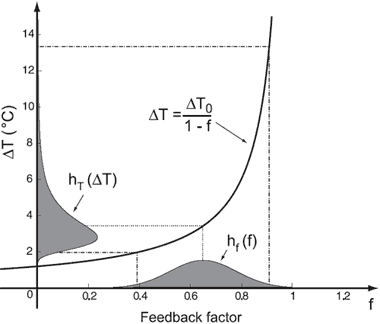

The shape of hT(ΔT) means that while there is very little probability of low climate sensitivity, the possibility of a large climate sensitivity cannot be ruled out due to the long tail. We can rule out a low climate sensitivity with greater confidence but a high climate sensitivity is still a possibility.

Skeptics argue that model uncertainty means global warming projections are likely to be exagerated. However, Roe & Baker show the uncertainty is skewed towards a more sensitive climate. This isn't a bias programmed into models but the inevitable consequence of a climate system with net positive feedback.

Posted by John Cook at 08:23 AM

Comments

  1. All the global warming theory is observation in hindsight! There is no real science in any of the assertions on Global Climate Change. Where is the foresight, where are the predictions that when tested prove theory? Unfortunately the changes in the Earth's climate are serious, more serious than any waffler has ever realised. PATHETIC.

    Life on Earth now hangs on a fraying string and scientists have no handle on what reality is throwing. Reality laughs at computer modeling when the underlying science is just hearsay. Skepticism has undone science and consequently undone LIFE when it needed science the most. TOTALLY PATHETIC
    [ Response: For examples of climate models making successful predictions both several years and several decades into the future, see our Scientists can't even predict the weather page. Theoretical models are also backed by many independent lines of empirical evidence. ]
  2. Wondering Aloud at 02:17 AM on 23 February 2008
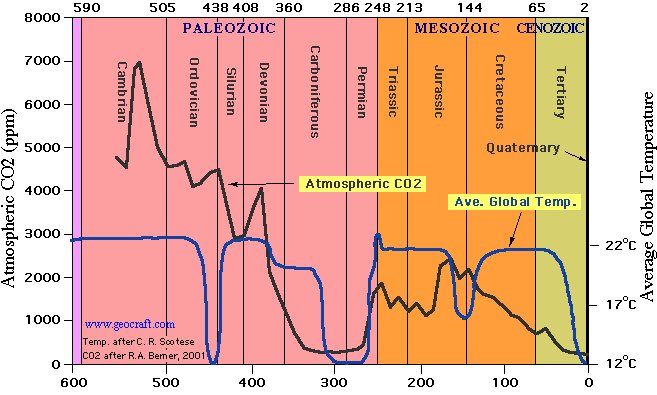
    Systems with positive feedback are inherently unstable in this context. Therefore if the feedback were large and positive as you suggest than earlier eons when we had greater CO2 in the atmosphere and/or greater water vapor would have created a run away greenhouse that would have been nearly impossible to stop. Our existence is an overwelming argument against a strong positive feedback.
    [ Response: Systems with positive feedbacks aren't necessarily unstable. It depends on the strength of the positive feedback. If it's less than a certain threshhold, the positive feedback gets less and less till a stable position is reached. Empirical observations of climate sensitivity estimate that's the case with our climate. ]
  3. Wondering Aloud at 02:58 AM on 26 February 2008
    Catastrophic warming claims all rely on strong positive feedback. You do so yourself on several threads. For it to not create a run away feedback loop it would have to be negative or tiny and decreasing to zero or negative. Both of those situations eliminste the possibility of catastrophic warming.

    You can't have strong positive feedback to create the catastrophic warming and historically no such thing existing so it didn't happen before.
  4. Wondering Aloud at 03:29 AM on 25 March 2008
    Since you reminded me of Icecap here is a fun graph on the CO2 warming relation.

    http://icecap.us/images/uploads/Monckton2.jpg
  5. This uncertainties yields also for negative feedbacks. Why are climatologist only talking about positive feedbacks? Every complex dynamic system, as climate is, has both positive and negative feedbacks. If the earth climate had only positive feedbacks live wasn't impossible.
    [ Response: A fair point - there are also negative feedbacks in the climate system. Eg - clouds have both positive feedback (trapping heat) and negative (reflecting sunlight). The question is what is the net feedback once you've added up all positive and negative feedbacks. This is looked at in Empirical evidence for positive feedback. ]
  6. "Life on Earth now hangs on a fraying string"...presumably life as we would like it to be?
    Life has survived a whole lot worse than what is being predicted. In the context of Life, mankind is just a pimple on the butt of evolution - whether we survive as a species or not; whether we seriously alter the climate will not stop the process.
    Regarding feedback: the system is interactive and thus impossible to quantify the effects of feedback of individual components. Everytime one changes, it affects another. Higher levels of CO2 accelerate plant growth and transpiration rates, locking up CO2 and recycling water vapour faster. Higher temps. affect cloud formation and generate storms/hurricanes, and so on.
    The 'climate' system has demonstrated historically that between fairly wide limits it is stable and able to absorb marked differentials in components both qualitatively and quantitatively. Life is an integral part of the system and thus affects the process.

Post a Comment

Foul language, trolling, personal attacks or non-relevant links will be deleted.

You need to be logged in to post a comment. Login via the left margin or if you're new, register here.

© John Cook 2008