





Naomi Oreskes' Merchants of Doubt Australian tour
Posted on 15 November 2010 by John Cook
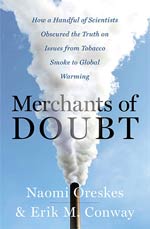
A must-read book for anyone following climate science is Merchants of Doubt by Naomi Oreskes and Erik Conway. If you're at all familiar with the arguments of global warming skeptics, you'll have many a sense of deja vu as you read through the history of the attacks on science over the last 40 years. If you're in Australia, you also have the opportunity this week to hear Naomi Oreskes speak at a series of free public talks throughout the country, starting in Sydney tonight (then onto my hometown Brisbane tomorrow).
Merchants of Doubt examines the organised attack on scientific evidence and on science itself over the last 40 years. In the 1950s, as scientific evidence began to accumulate that smoking caused cancer, a small group of scientists actively campaigned to cast doubt on the evidence. When scientists calculated that nuclear war would cause a devastating nuclear winter, the same group of scientists sought to cast doubt not only on the science but on the entire scientific establishment.
What is striking is the same scientists keep appearing, casting doubts on each scientific consensus. A name that regularly appears is Fred Singer who continues to publish articles on global warming to this day. In 1983, Singer argued that evidence of acid rain damage was lacking, that much acidification was natural and was in some cases actually beneficial. When the ozone layer was found to be shrinking, Singer argued that ozone depletion was a natural variation being exploited by scientists eager for more grant money. When second hand smoking was found to cause cancer in non-smokers, Singer blamed the messenger, attacking the EPA.
Also striking is that the arguments used against acid rain, DDT, CFCs and smoking are the same arguments encountered now in global warming skepticism. Over the last 40 years, they argued that there's no evidence. It's not us. It's beneficial. It's a conspiracy. There's no consensus. Ozone depletion was blamed on volcanoes. Human activity is too small. All the same arguments were being repeated over and over... by the same people.
So be sure to read Merchants of Doubt. If you're in Australia, don't miss Naomi Oreskes' free public talks this week. If you can't attend any of her talks, you can also hear her speak in the media:
- Interview on this morning's ABC Breakfast Radio
- Interview on ABC Lateline TV
- Profile by Adam Morton in Saturday's The Age
- Graham Readfern blogs about Australia's own Merchants of Doubt
- Australian Federal Minister for Science Industry and Innovation, Kim Carr, writes a stirring article, Science champions needed to battle merchants of doubt
- Commodity of Doubt - a blog post about a UWA panel on climate communication and Naomi Oreske's W.A. event
- Video of the Adelaide event
- Surprising article from the conservative newspaper The Australian, Some sceptics make it a habit to be wrong
- ABC Drum Unleashed, On the origin of the sceptics by Graham Readfern.
- ABC Rural Radio interview: Climate sceptics unwarranted
Details of Naomi Oreskes' Australian events
| Place | Time | Details |
| Sydney | Monday 15 Nov 6.00 to 8.00pm | Where: University of New South Wales, Law Theatre (Law Building) RSVP: No booking required. Presented by: Climate Change Research Centre and Faculty of Arts & Social Science (Prof. Oreskes will be introduced by Robyn Williams, Presenter of the ABC’s The Science Show) |
| Brisbane | Tuesday 16 Nov 5.30 to 6.30pm | University of Queensland, Abel Smith Lecture Theatre, St Lucia. VP: http://gci.uq.edu.au/naomi-oreskes Presented by: The Global Change Institute. (Prof. Oreskes will be introduced by Prof. Ove Hoegh-Guldberg, Director of the Global Change Institute. Merchants of Doubt will be available for purchase.) VIEW THIS TALK ON SLOW TV |
| Melbourne | Wednesday 17 November 5.45 to 7.00pm | Where: Experimedia, The State Library of Victoria, 328 Swanston St, Melbourne. RSVP: No booking required Presented by: The Monash Sustainability Institute & The Melbourne Sustainable Society Institute. (Prof. Oreskes will be introduced by Prof. Karoly, with Q&A moderated by Prof. Dave Griggs, MSI. Merchants of Doubt will be available for purchase before the lecture, with signing and sales afterwards.) |
| Adelaide | Thursday 18 November 6.00 to 7.30pm | Where: RIAus @ The Science Exchange, 55 Exchange Place, Adelaide. RSVP: http://www.riaus.org.au/events/2010/11/18/merchants_of_doubt.jsp Presented by: RIAus |
| Perth | Monday 22 November 6.00pm | Where: University of Western Australia, Social Sciences Lecture Theatre (parking P3, Hackett Entrance) RSVP: No booking required. Presented by: The Institute of Advanced Studies. (Merchants of Doubt will be available for purchase from 5.30pm with the author signing afterwards.) |

Arguments


Is all privately-funded research tainted? Is public funding the only “clean” source of support for scientists? Seitz saw a critical role for private funding (through companies and foundations) and saw dangers in science becoming too dependent on either private or public support. (emphasis mine)
Those are interesting recognitions of interference for an institute dedicated to decidedly conservative (economic and military) agenda. The last bit is just bizarre, given the initial warnings. What should science be "dependent on"? Backyard scientists? Or is the implication that it should be a 50-50 split between corporate and government money? Who should I trust for my climate science: government-supported scientists or corporation-funded scientists?
Not a terribly convincing argument from you. Typical so-called-sceptic approach of taking a position, emphasising a very small part of the argument (without examining the validity of the argument in the broader context) and then using that to generalise to the whole argument without justifying your case properly.
This is essentially the technique of claiming that scientists are deliberately misleading while simultaneously constructing arguments designed to mislead yourself. As DSL says, rhetorically fascinating.
Either they were deceived by their sponsors, unable to properly perform the science, or they intentionally lied for some reason. I don't know, I cannot determine their motivations - take your pick.
[Moderator - I realize I'm stating that someone may have been deceptive; please note I'm only pointing out conclusions from several law cases, which have by legal judgement been established as conclusively true]
I find it amusing that you refuse to count "think tank reports" as scientific literature, when given a new report from the heartland institute (for example) the so-called sceptics are keen to elevate that material as of equal standing to peer reviewed scientific publications.
Wow, Poptech using exactly the same 'deny the evidence', 'make it appear there's controversy' tactics pioneered by Seitz and Co.
Read RJR's words and weep:
Presently, there is a good deal of controversy in the scientific sector on the subject of smoking and health, with prominent medical authorities lining up on each side of the .... arguments. ... For every charge that has been made against cigarettes, there has emerged a strong body of scientific data or opinion in defense of the product.
In evaluating and monitoring the special projects that we fund -- particularly the sole-sponsorship programs -- R.J. Reynolds Industries has secured the services of a permanent consultant -- Dr. Frederick Seitz, former president of Rockefeller University. Dr. Seitz is with us today and has agreed to describe these various R-J-R sponsored programs for you.
So the RJR position is that there's controversy, a strong body of scientific evidence in their defense, and who is brought in to describe their funded research?
Consultancy agreements 1986
I spoke with Fred Seitz about renewing his and Mac McCarty's consultancy agreements for six months to the end of this calendar year. I said to Dr. Seitz that we would review our entire arrangement at that time and based upon the direction in which our medical research program is going.
This is silly and wildly off topic.
On Nierenberg, see Mr. Rabett.
Yes, this is silly, and it would be laughable if it were not such a serious matter. I fear that you may be wasting your time-- there is no sense arguing with those who endorse the irresponsible, criminal even, behavior of those involved in fabricating doubt concerning the existence of the link between smoke and cancer-- a link that was known to exist even according to research carried out by the tobacco companies.
Bizarre how some, despite the facts to the contrary (including court rulings), insist on defending those who were involved in delaying taking action against tobacco corporations. Disturbing too how some of the same players are now involved in delaying taking action on anthropogenic climate change.
Some seem to think that we live in a world where our actions have no negative consequences or repercussions.
Perhaps Poptech should read "Smoke Screen" (one of numerous investigative books on the subject), and s/he should also have a look here.
Great that Dr. Oreskes is in Australia. Wish that I could see her talk in person.
"Typical so-called-sceptic approach of taking a position, emphasising a very small part of the argument (without examining the validity of the argument in the broader context) and then using that to generalise to the whole argument without justifying your case properly."
Poptech's lack of a broader context is really the knockout blow to his position
Good points. Here, in my opinion, on this thread we have a perfect example of the techniques used by "skeptics" to deflect and misinform-- techniques which Oreskes and Conway speak to.
The "skeptics" supporting Seitz have not read this memorandum, or this news release.
1. "The Marshall Institute PDF you linked to confuses personality with science, and ignores/misrepresents the USDoJ's successful prosecution of the tobacco industry under racketeering laws."
There is no confusion because they do not have any published science criticizing the link between tobacco and cancer.
No, but they do sow the seeds of confusion in their reports which purport to be scientific reviews. You seem to have a rather selective view of what constitutes science, and this view seems to change depending on what you are trying to defend.
2. I've never counted any institute's report as part of the scientific literature to imply that it is peer-reviewed. I have stated repeatedly that reports that fully reference the scientific literature are on equal standing with other reports that do the same thing.
The list of "peer reviewed research" which you've referred to repeatedly in the past completely fails to discriminate scientific quality and validity. Your subsequent justification for this failure has been pathetic. Your counter-argument here is a continuation of this failure.
3. "Typical so-called-sceptic approach of taking a position, emphasising a very small part of the argument (without examining the validity of the argument in the broader context) and then using that to generalise to the whole argument without justifying your case properly."
You have presented only strawman arguments in attempting to make your point. I am em-phasing the most serious charge here as it is the knock-out blow to your position,
Where is the research that Dr. Seitz oversaw or produced that questions the link between cancer and tobacco? Why is this so hard to produce?
Your counter argument here completely fails to deal with the substance of my position by continuing to focus on the minutae rather than the big picture view which I demand from you in order for you to be able to validate your argument. I take it from this that your argument is strong on rhetoric, but that the substance is completely absent.
The remainder of your rather tedious post has nothing to do with material that I have posted, so I leave it to others to deal with (or hopefully to ignore - unfortunately I lack the self control to ignore your insightless missives).
Seitz took funding from tobacco companies and oil companies, how can he have credibilty ? Seriously Poptech ?
In an interview with PBS Frontline, he remembers receiving money for travel expenses from oil companies, but not $65000 that went directly into his pocket.
http://www.pbs.org/wgbh/pages/frontline/hotpolitics/interviews/seitz.html
He might have contributed to solid state physics, but in other areas it seems he was not ready to bite the hand that feeds.
Let's say there are no records of Seitz having directed research on the health effects of tobacco. I don't know for certain, but let's assume there aren't any.
However, there definitely ARE records of Seitz, RJR, and the George Marshall Institute having CLAIMED that he directed such research and found that there was no scientific link between tobacco and cancer. Muoncounter, Albatross, and others have linked to these records above.
So, if we accept your argument that there is no evidence of such studies then they either lied about having conducted them or have managed to destroy or suppress all records. In either case, the supposed evidence that tobacco is safe which they advertised to the public is non-existent.
Frankly, it would be better for Seitz's reputation if you were wrong and there ARE records of him having directed such research. At least then it could be pretended that the research was simply in error... rather than completely falsified.
"Initiated a strategy to publicize and communicate the results of a Marshall Institute report that challenges the scientific basis of various environmental regulations . The report was written by Dr . Frederick Seitz who is a world renowned scientist. Dr . Seitz is President Emeritus of Rockerfeller University and past President of the National Academy of Sciences . In addition to his criticisms of the global warming and ozone depletion issues, Dr . Seitz also addressed the ETS issue. With respect to ETS, Dr . Seitz concluded that ". . .there is no good scientific evidence that moderate passive inhalation of tobacco smoke is truly dangerous under normal circumstances" . The report will be used to challenge the EPA's report on ETS in domestic and nternational markets." - emphasis added.
Dr. Seitz received approximately $585,000 over his contracts with RJR (see We should like to renew the letter agreement dated July 12, 1978 between you and RJR Nabisco, Inc., and also While Washington Slept), although he denied this in several interviews.
This was a "report", not peer-reviewed. However, RJR, Philip Morris, and the other companies represented it as such, and as evidence that the science behind the tobacco/cancer link was false. That's bad science, known to be false by the tobacco companies (as per documents on record), and far outside Seitz's area of expertise; he completely compromised his integrity by doing so.
For you to defend him does not do your credibility any favors.
Did the research give the tobacco industry political cover? Seitz - “I’ll leave that to the philosophers and priests.”
Ah, so your position is pure denial. Got it.
1. Nuclear power reactors and the associated radioactive wastes.
2. The use of asbestos in any form - for example, for thermal insulation or brake linings.
3. Acidic and radioactive emissions from the combustion of fossil fuels, particularly coal.
4. The disposal of domestic waste in landfills or by combustion in waste-to-energy facilities.
5. The disposal of toxic chemical wastes.
6. Genetic engineering as applied to agriculture and medicine.
7. The employment of pesticides and fertilizers in agriculture.
8. The passive inhalation of even small amounts of tobacco smoke.
9. The addition of carbon dioxide to the atmosphere through the burning of fossil fuels with the asso- ciated hazard of global warming.
10. The use of freons, halons, and related halogenated compounds as refrigerants, fire-suppressor agents or fumigants because of their presumed depletion of the atmospheric ozone layer.
Bring a shovel.
No, no, no : no matter how many times you try to convince yourself (well, you can't convince anyone else but those who want to believe in your little list), those 'papers' 'support' YOUR own rather convoluted arguments against AGW alarm (whatever that might be) - even using papers whose original authors have told you that their particular papers do not support skepticism against AGW alarm, no matter what you think.
The Yooper
There's plenty of evidence around for Seitz' role in manufacturing uncertainty about tobacco health effects, you're just chosing to ignore it and/or deliberately avoiding doing research on the topic. It's not my (or anyone else's) job to help you with your ignorance or ideological blindness, but it's perfectly fair to point it out to others. This part of the wikipedia page on Seitz is a perfectly good place for anyone interested to begin the research process.
Seitz did say that second-hand tobacco smoke isn't harmful:
"In addition to his criticisms of the global warming and ozone depletion issues, Dr . Seitz also addressed the ETS [environmental tobacco smoke] issue. With respect to ETS, Dr. Seitz concluded that ". . . there is no good scientific evidence that moderate passive inhalation of tobacco smoke is truly dangerous under normal circumstances." The report will be used to challenge the EPA's report on ETS in domestic and international markets.""
As for complaining about moderation, I'd advise against it, but you're welcome to find out where that gets you.
Thank you for so comprehensively demonstrating that your position is so thoroughly based on denial. It's very clear to any sensible reader that you have a total inability or refusal to evaluate the evidence properly.
Once again, you try to determine events in the real world through the filter of your own personal brand of skepticism - but that's being kind : truthfully, you are in denial of the facts of AGW and the facts concerning shameful 'scientific' involvement with the tobacco industry.
I need only repeat that two authors (Pielke Jr and Harold Brooks) informed you that your papers did not do for your little list what you thought they did, i.e. argue against "AGW alarmism" (using your own personal definition). I realise you told them they were wrong and that you were going to decide what their own papers meant to you, but that is another story done to death elsewhere.
More about Seitz here, here, here, and here.
The Marchall Institutes's alleged "rebuttal" of the Oreskes-Conway book has a sort of "No, we didn't .... Oh, yes you did ... No, we didn't" back-and-forth flavour about it. they virtually repeat Oreskes-Conway's account of the facts, but putting a benign spin on every action. As a reader, admittedly with my own bias, I find the Oreskes-Conway descsription to be the more credible.
you might remember these quotes from an RJR document I found for you before that forum thread magically went poof (we never did find out what happened)...
1. "respond directly to fundamental attacks on our business", "refute the criticisms against cigarettes".
2. "Science really knows little about the causes and development mechanisms of chronic degenerative diseases imputed to cigarettes"
3. "The purpose of the RJR industries biomedical research program is to focus on the support of basic and applied scientific research regarding human, degenerative diseases."
Smokin'!
This was during an introductory speech by an RJR executive. Who were they introducing...(have a guess).
As I outlined to you, RJR had more than one arm of their obfuscatory research. The CTR funded by most american tobacco companies funded direct research (to cast doubt) on the tobacco-health issue. The RJR research which Seitz oversaw had a slightly different slant, but a similar aim (cast doubt). As the quotes show, degenerative conditions were being linked to tobacco. Seitz research focused on such conditions. And RJR were keen to 'refute criticisms' of tobacco use.
Cheers
That was brilliant!
I also found some other documents which linked Seitz to Phillip Morris' denial efforts in the realm of environmental tobacco smoke. That post also disappeared when poptech's thread went down the memory-hole. It shows they were planning a 'Seitz Symposium' a year or so before the G. Marshall Institute released the 1994 document on global warming (which included comments on ETS and, as noted earlier, a gaggle of free-marketeer bugbears).
And, of course, money. Funds from Jim Tozzi's group were passed to GMI (Seitz being a founder). Tozzi's group were funded by Phillip Morris.
"....yet there IS so little conflicting with current knowledge. The paper is full of amazing prescience and insights."
This silliness has gone on for way too long. The contrarian has latched on to one point, and is using it to dismiss all other arguments and evidence against Seitz. They are clearly not open to reason.
For example, they accuse another poster of being deceptive. The contrarian picks this quote from the Stokes memo "R.J. Reynolds Industries takes no part in the creation or performance of any research" to support their assertion.
That would be highly misleading, both on the part of Reynolds and on the part of the contrarian. Reynolds may not have done the research in house, but they certainly gave a lot of money to front groups like the Council for Tobacco Research (CTR) to do the "research".
Stokes says in the same memo being discussed above:
"Back in 1954, Reynolds joined to help form the Tobacco Industry Research Committee -- a group made up of tobacco manufacturers, growers and warehousemen to look into questions of tobacco use and health . The organization's name was changed in the early sixties to the Council for Tobacco Research -- U-S-A"
Indeed, CTR was founded by tobacco executives at an emergency meeting in 1954. Despite what the tobacco companies claimed outwardly, a memo by Panzer in 1972 betrayed the CTR's true agenda, "the CTR actually worked at "promoting cigarettes and protecting them from these and other attacks," by "creating doubt about the health charge without actually denying it, and advocating the public's right to smoke, without actually urging them to take up the practice." United States Judge Hadden Lee Sarokin, who presided over two New Jersey tobacco cases, described TIRC/CTR in 1988 as "nothing but a hoax created for public relations purposes with no intention of seeking the truth or publishing it." CTR's work was described by the Wall Street Journal in 1993 as "the longest-running misinformation campaign in US business history."[Source here]
Stokes states again states in the same document that Reynolds provided funds to the CTR:
"The Council for Tobacco Research is one of three primary avenues used by Reynolds Industries in funding biomedical research. During the past decade, our company also has become
associated with several major research studies on either a joint sponsorship or sole-sponsorship basis."
And in the next paragraph:
"In evaluating and monitoring the special projects that we fund --particularly the sole-sponsorship programs -- R .J . Reynolds Industries has secured the services of a permanent consultant -- Dr . Frederick Seitz, former president of Rockefeller University. Dr . Seitz is with us today and has agreed to describe these various R-J-R sponsored programs for you."
Seitz monitored and evaluated programs funded by big tobacco to misinform, confuse, create doubt and delay action being taken on smoking and tobacco smoke. End of story.
And now those in denial about the theory of AGW are using the exact same tactics, and even some of the same players who aided big tobacco in their misinformation campaign are (or were) involved. Oreskes and Conway, and many others have determined this.
No Poptech, you are actually the one arguing strawmen. To my knowledge Seitz was not directly affiliated with CTR, but I have not read the many thousands of confidential documents. Either way I did not say he was affiliated with CTR-- although upon reading my posts again, I can see why you might think that is what I was driving at. That was not the point of my posting about the CTR. Odd that it does not bother your conscience that the same company who paid Seitz was involved with forming and funding the CTR for decades.
The purpose of the programs which Seitz was paid by Reynolds to oversee and evaluate were part and parcel of their misinformation campaign, and their attempt to create the air of confusion and detract from the negative impacts of smoking. Seitz has admitted that "They [Reynolds] didn't want us looking at the health effects of cigarette smoking". So he knew that they were trying to hide the truth about the negative impacts of smoking and trying to blame/pin the negative health impacts of smoking on "genetics" or "degenerative diseases"--so blame anything but smoke. Kinda like "skeptics" trying to blame the warming on anything but CO2.
He made the choice to be paid by Reynolds, knowing full well about the tobacco companie's strategy (in concert with other tobacco companies) to delay action being taken on smoking.
You have been presented the facts by several people here, and choose to ignore them. Sorry, but I can't help you with that. I'm done wasting my time on you.
"Late 1st quarter/early 2nd quarter
Procedural Options for Addressing the Scientific
Issue Highlighted in Global Warming and Ozone
Hole Controversies, Dr Frederick Seitz of the
George C Marshall Institute.
40–60 regulators—Ensure credible science
TASSC"
Seitz Symposium
And the GMI document wasn't released to the public until 1994. Indicates that GMI were involved in behind the scenes attempts to challenge moves to regulate ETS, with Seitz as a major player.
Seitz has a loooooong history of advocating for tobacco companies.
1 If we accept, broadly, that Thomas Kuhn was right in his characterisation of scientific activity, then the finding that most science within a field shares a common paradigm is hardly news or proof of anything.
2 To portray science on one side and politics on the other is naive: the history and sociology of science is showing quite plausibly that science and politics are always mixed together.
Interesting question. I was considering this once and came to the conclusion that inefficient vehicles not used for productive reasons should pay a surcharge at the pump. I get up to 400 miles (st.) from a tank of gas (10.5 US gallons). A hummer gets a lot less, as do most SUVs. As a result, all the inefficient vehicles create more demand for fuel, hence increasing the price. They bear a much higher responsibility in this price than I, yet we pay the same amount per unit at the pump. In essence, I am subsidizing the use of inefficient vehicles by paying a price higher than it would be without the artificially high demand. Of course it is not practical to adjust price at the pump, but these vehicles should have some sort of compensation built in their price. Some of their cost is externalized, so at the end, everybody pays for it.
If people want to lean more about GMI, see Crescendo to Climategate Cacophony, March 2010, which includes funding flows, various key people at GMI & elsewhere, activities, etc. It overlaps a little with MoD, but is focused elsewhere.
Fortunately, Naomi&Erik had already covered a lot of the earlier material, so I didn't need to repeat that.
"I am subsidizing the use of inefficient vehicles by paying a price higher than it would be without the artificially high demand."
Not too sure about this. The price of pertol/gas is mostly market driven and rises as demand rises (production being limited). Your demand, however minimal, also helps push the price up.
The problem with allowing market forces to control the price is that the price is currently far too low for something we cannot replace and currently use profligately. A scarce and non-renewable resource should be used very sparingly or be rationed. At least a higher price will encourage alternatives to be developed and used.
Related to this - Economists need to open their eyes and see beyond their growth mantra. Reasonable people can see that continued growth cannot be sustained in a finite world.
I would like to bring the thread back on track with a couple of observations
from two separate talks the writer gave on the book which I have not read.
She states that a consensus was well established 1980's. OK fine, but what about today?
Has nothing changed? Why for instance doe she not put the last decade data in the temperate
graph that clearly shows the human signature? Has there not been a bit of action since then?
Why does she only refer to sun irradiation when the main contender is clouds moderated by
sun's magnetic atmosphere?
One question I would ask if I managed to get into the audience is
'Are you worried that the current consensus cannot be falsified when we have the
logic temperature rising it's global warming, temp cooling its weather'.
Sorry one more and it is a biggie she states that no contrarian paper has been peer reviewed.
Holy hell, surely this ends completely any debate, full stop.
Bottom line is, it's not cooling and there are at least ten different ways that this can be shown.
Away from this site, http://www.realclimate.org/index.php/archives/2010/11/so-how-did-that-global-cooling-bet-work-out/ has a pretty good article on global cooling too.
I'm not sure what you mean, but this might be a more appropriate thread.





