





Vision Prize Results
Posted on 19 July 2012 by dana1981
The Vision Prize is an online poll of scientists about climate risk. It is an impartial and independent research platform for incentivized polling of experts on important scientific issues that are relevant to policymakers. In addition to assessing the views of scientists, Vision Prize asked its expert participants to predict the views of their scientific colleagues. The participant affiliations and fields are illustrated below.
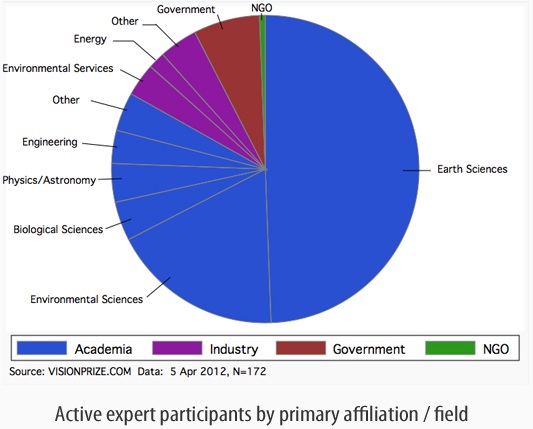
As this figure shows, the majority (~85%) of participants are academics, and approximately half of all participants are Earth Scientists. Thus the average climate science expertise of the participants is quite good. The average h-index of the participants is 12, which is pretty good considering that some private industry professionals like myself participated. As a result, the answers to the poll questions were in line with the scientific consensus on human-caused global warming.
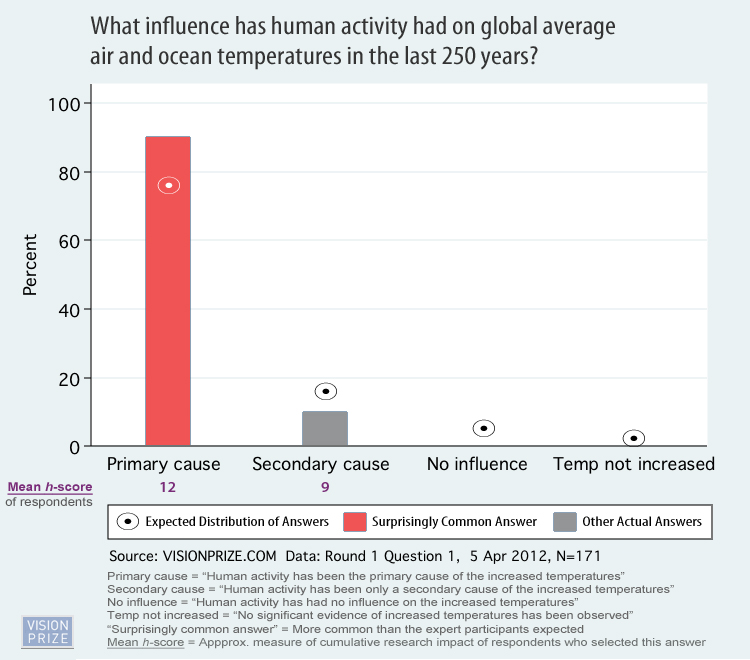
For example, approximately 90% of participants responded that human activity has had a primary influence over global temperatures over the past 250 years, with the other 10% answering that it has been a secondary cause, and none answering either that humans have had no influence or that temperatures have not increased. Note also that the participants expected less than 80% to peg humans as the primary cause, and a few percent to say humans have no influence.
Over 70% of participants also answered that an increase in atmospheric CO2 to 550 ppm would lead to a 1-3°C surface warming relative to year 2000 temperatures, with over 40% answering 2-3°C, and only ~8% answering less than 1°C.
Remember that in 2000 we had already experienced ~0.8°C surface warming, so these answers are equivalent to 70+% of participants answering that either the transient climate response or equilibrium climate sensitivity (depending on how they interpreted the question) is ~2-4°C for doubled CO2, and only about 8% answering that it's lower than ~2°C, with a further ~20% answering that sensitivity is higher than ~4°C. In other words, the 'climate sensitivity is low' crowd is very poorly represented, which is not surprising given the expertise of the participants and the preponderance of evidence that climate sensitivity is not low.
Approximately 80% of participants also answered that in a business-as-usual scenario in which governmental policies do not change, the 2000-2050 average global surface warming will be 1-3°C, with nearly 40% answering 1.5-2°C.
Regarding CO2 emissions and concentrations, approximately two-thirds of participants answered that we can only keep CO2 levels below 550 ppm with current technology if there is a change in government policy. The other one-third of participants answered that we cannot keep CO2 below 550 ppm with current technology.

You can see the other Vision Prize questions and participant answers here.
The prize aspect involved a competition amongst participants to predict how other participants would answer these questions, which formed the basis of the 'expected distribution of answers' in the graphics above. The Leaderboard contains some familiar names. Skeptical Science's own skywatcher came out on top, and I (Dana Nuccitelli) rounded out the top 25. David Karoly, Kevin Trenberth, and Bart Verheggen also made the list. The rewards are gift card prizes for the charity of our choice - skywatcher and I both chose the Union of Concerned Scientists, as it only seemed fitting to give climate-related award winnings to a group fighting against climate misinformation.
The results of the Vision Prize once again confirm the scientific consensus on human-caused global warming - in fact, more of a consensus than the participants even expected. This group of relatively well-informed scientists overwhelmingly agreed that humans are driving global warming, that climate sensitivity is within the range stated by the IPCC, and that we need to implement climate policies to avoid blowing past the 2°C 'danger limit'.
Note: the Vision Prize results have been added to the Intermediate rebuttal to "there is no consensus"

Arguments


Actually, the question posed was regarding the expected temperature if and when the CO2 concentration reached 550 ppmv. Technically, the temperature achieved when the atmosphere reaches a certain concentration would be the Transient Climate Response rather than the Equilibrium Climate Response. As such, the natural interpretation of a TCR of 1.8 to 3.8 C per doubling of CO2 is truly remarkable.
I suspect, however, that most respondents would not have known the distinction between TCR and ECR; and that consequently the answer does represent the expected ECR. A significant number of respondents are, however, likely to have known the difference. The probability is that a significant portion of respondents did understand the question. If a significant number of respondents took the question to be about the TCR, that would introduce a significant low bias to the results.
I'm pleased to see this point raised immediately after the original post.
My first thought on reading it was whether the figure to which Tom refers demonstrates a vaguely positive skew, which would suggest a bias toward a low estimate for ECR, and although there is a slight possibility of such the coarseness of the histogram makes fraught any reasonable non-null conclusion.
Another option would be if there'd been a bimodal distribution, but again the coarseness of the categorisation makes it impossible to detect.
It suggests refinement for any future survey.
On top of the 'how much of the 550ppm warming was already realised by 2000 dilemma', TCR assumes the doubling is a result of a steady rate of CO2 increase (1%p.a.) over ~70 years. 275 - 550 will have taken longer than 70 years wont it? That'd imply that 275-550 would be slightly higher than TCR.
Furthermore, TCR is not simply the surface temp anomaly relative to 70 years prior. This is only true if all other variables are held equal. The size of the anomaly vs -70yrs is heavily influenced by what level of sulfates we're still emitting by that point. If we've cleaned up our act, the 550ppm anomaly will be likely higher than the TCR. If we're still dirty, likely lower.
I don't think many people would be able to give a numerical estimate to Q3 with much confidence, but 1-2C seems by far the most likely answer according to the current state of climate science.
I can't recall my answer, but I suspect I said 1-2°C based on the "if and when" wording.
I think it would be very helpful to new folks for post writers to incorporate as many new posts as possible into the myths, according to appropriateness, of course. That is, if the writers of the new posts are aware of the totality of the myths topics, which I assume most are. Just providing links in the myth pages can help tie in new stuff to the myth topics, and give new folks like myself more continuity (if that makes any sense).
I appreciate the site a lot, and wish I could be of more help, but I'm still a novice. Have been through all the myths and making my way through the posts as time allows. The site has come in quite handy for internet spats with deniers.
Watts appears to be demonstrating a serious case of inability to understand context.
The Vision Prize is clearly targetted at a particular (expert) grade of professionals trained in climate change science, and yet Watts takes umbrage at the fact that there is an assessment process to weed out non-qualified attempts to sign on.
Why does he think that any joe from the streets should be allowed to contaminate the responses? The point is to garner an understanding of the opinions of the best-informed people in the world, and not from people who not only have no understanding, but who are actively motivated to oppose the directions and implications of reasoned understanding.
As I noted in a post at Tamino's, to hold this perspective of what constitutes reasonable behaviour one would require a total absence of shame.
Big mistake.
I despair for humanity, if that mob is representative of the lay community.
What does it say about us, that educated and trained people understand the universe in one way, and so much of the laiety crowd in layers on top of each other at the opposite side?
I sincerely hope that the Vision Prize organisers have the presence of mind to purge their surveys of the contamination introduced by Watts.
With all due respect, the "mob" posting on WUWT is an insignificant fraction of the human population.
I also echo John Hartz @15 in that WUWT commenters are the radical fringe, not at all representative of the general public.
Dana and John.
I certainly acknowledge that Watts' commenting fan-base is over-sampling from the extreme end of the anti-science pool.
My concern is that they have a disproportionate influence in policy, and this was increased recently as a result of an off-the-cuff straw-poll a colleague conducted of non science-specialised students. Around a third believed that there was a serious scientific debate about the evidence for climate change, and of those a majority thought that the science had been done incorrectly or was compromised by personal interest on the part of scientists. Most of the students referred to "the internet" as a source for their doubts of the science. Whether this is more representative of such students generally still has us scratching our heads...
Amongst my non-tertiary educated friends and relatives there is a strong propensity to believe that there is no smoke without fire in tabloid stirring of the idea of a debate about the science of climate change. It's classic fear, uncertainty, and doubt. I'm sure that they're not as extreme in their beliefs as the Watts crowd, but the issue is whether they let the fundamental notion of the 'unreliability' of the science influence their decisions when voting and 'consuming'.
The overall glacial pace of government action around the world would seem to reflect this. In the Australian context I guess that one test of the general public's ability to balance the realities of climate science against the tabloid 'uncertainties' will occur at the next federal election. One counter to the FUD campaigns of the blog science-denial industry is the presence of initiatives such as the Vision Prize, and I certainly hope that they are able to separate the denial noise from the surveying of the signal of scientifically-qualified opinion.





