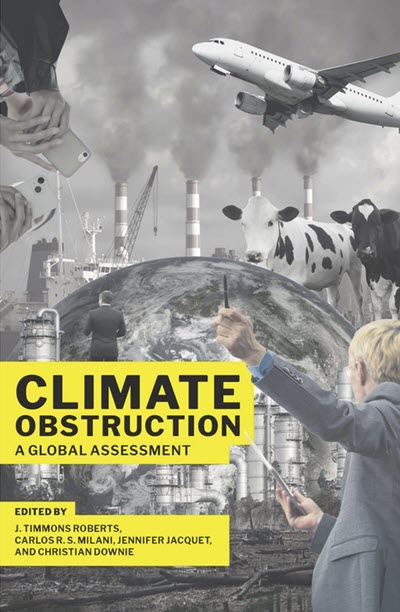
Climate Obstruction: A Global Assessment is a new book from Brown University’s global Climate Social Science Network, for which a team of more than 100 scholars explored who’s blocking action on climate change and how they’re doing it. John Cook - founder of Skeptical Science and senior research fellow with the Melbourne Centre for Behaviour Change at the University of Melbourne - co-authored chapter 7 in the book titled "Understanding the Political and Psychological Roots of Climate Misinformation and Its Impact on Public Opinion". The book is available open access for download from the Climate Social Science Network.
In addition to an introduction by the editors J. Timmons Roberts, Carlos R. S. Milani, Jennifer Jacquet, and Christian Downie the book contains 12 chapters exploring the many different shapes and forms climate obstruction takes around the globe:
The chapter "Understanding the Political and Psychological Roots of Climate Misinformation and Its Impact on Public Opinion," lead-authored by Dominik A. Stecula and John Cook, investigates how decades of climate disinformation—funded by the fossil fuel industry—have successfully sabotaged public debate. These campaigns exploited common human psychological traits, leading to widespread polarization.
The authors identify five critical climate beliefs necessary for fostering political urgency: that climate change is real, human-caused, experts agree, it's a bad thing, and that we have hope to avoid the worst-case scenarios. The climate counter-movement systematically promotes five corresponding disbeliefs to obstruct action.
The key method for cultivating these disbeliefs is by FLICCing off scientific integrity—using the five techniques of science denial:
Most excuses for inaction make use of one of these techniques. For example, the Impossible expectation is used to dismiss crucial local climate policy by arguing it won't solve the entire global problem by itself. Additionally, "Fake experts" exploit “like-me” biases, where people trust messengers who share their ideology.
Crucially, this disinformation campaign worked through political elites who serve as trusted messengers. Research on the "elite cue" effect shows that after the Kyoto Protocol, Republican elites began explicitly denying climate change, and their voters followed suit. This powerful effect means people often judge climate policies based on who proposes them, rather than their actual content. Ultimately, the industry's lies have led substantial segments of the public to hold misinformed views—knowing things that are simply not true, but are convenient for the fossil fuel industry.
John Cook participated in a panel discussion recorded in September about the book with editor Timmons Roberts and one of the lead-authors for chapter 6 "Steering the Climate Discourse: Legacy News, Social Media, Advertising, and Public Relations" Melissa Aronczyk. Their panel discussion is available on Youtube:
[youtube id="u3Z76N0GRvU"]
From the video's description:
A panel-pod on the scourge of climate disinformation and misinformation - "the firehose of falsehoods" as one panellist poetically puts it! We need to understand which groups are running climate change disinformation and misinformation campaigns - and who is funding them - if we are to make progress. "We don't need to change the minds of everyone in society to get climate action - we just need to activate enough people!" Featuring three people involved in a landmark new book called Climate Obstruction - A Global Assessment - out from Oxford University Press. Timmons Roberts is a co-editor of the book, and Melissa Aronczyk and John Cook are two of the many contributors to it.
Update Oct 30, 2025: Amy Westervelt discussed the book chapter in episode 3 (season 14) of her podcast "Drilled" with John Cook and Dominik Stecula:
If you want to understand how misinformation works in general…and anyone who cares about democracy should right now…there’s no one better to talk to than researchers who have been studying climate misinformation for years. In today's episode, John Cook (University of Melbourne) and Dominik A. Stecu?a (Colorado State University) join to walk us through everything the research is telling us so far.
Posted by BaerbelW on Wednesday, 22 October, 2025

 |
The Skeptical Science website by Skeptical Science is licensed under a Creative Commons Attribution 3.0 Unported License. |