---> UPDATE <---
Many thanks to the 11 contributors who've contributed to this mini-campaign at time of update. We're a bit under halfway to our US $1,440 / €1,215 goal for offsetting our publication fee.
Even while geometric declines abound everywhere— including responses to fundraising appeals— we're sure there are 11 more people who can step up! A handy form for kicking in is at the bottom of this article.
13 years ago the Skeptical Science team ran a research project to quantify scientific consensus on global warming, finding that 97% of relevant climate papers agreed that humans were causing global warming. We put a call out for contributions to help us cover the cost of the journal publication fee. And we reached this goal within 9 hours! The paper went on to be tweeted by President Obama the day after publication, and was cited by Prime Ministers, Senators, Congresspeople, and late night TV comedians, not to mention winning awards and being downloaded over 1.5 million times. Not bad for a crowd-funded research paper!
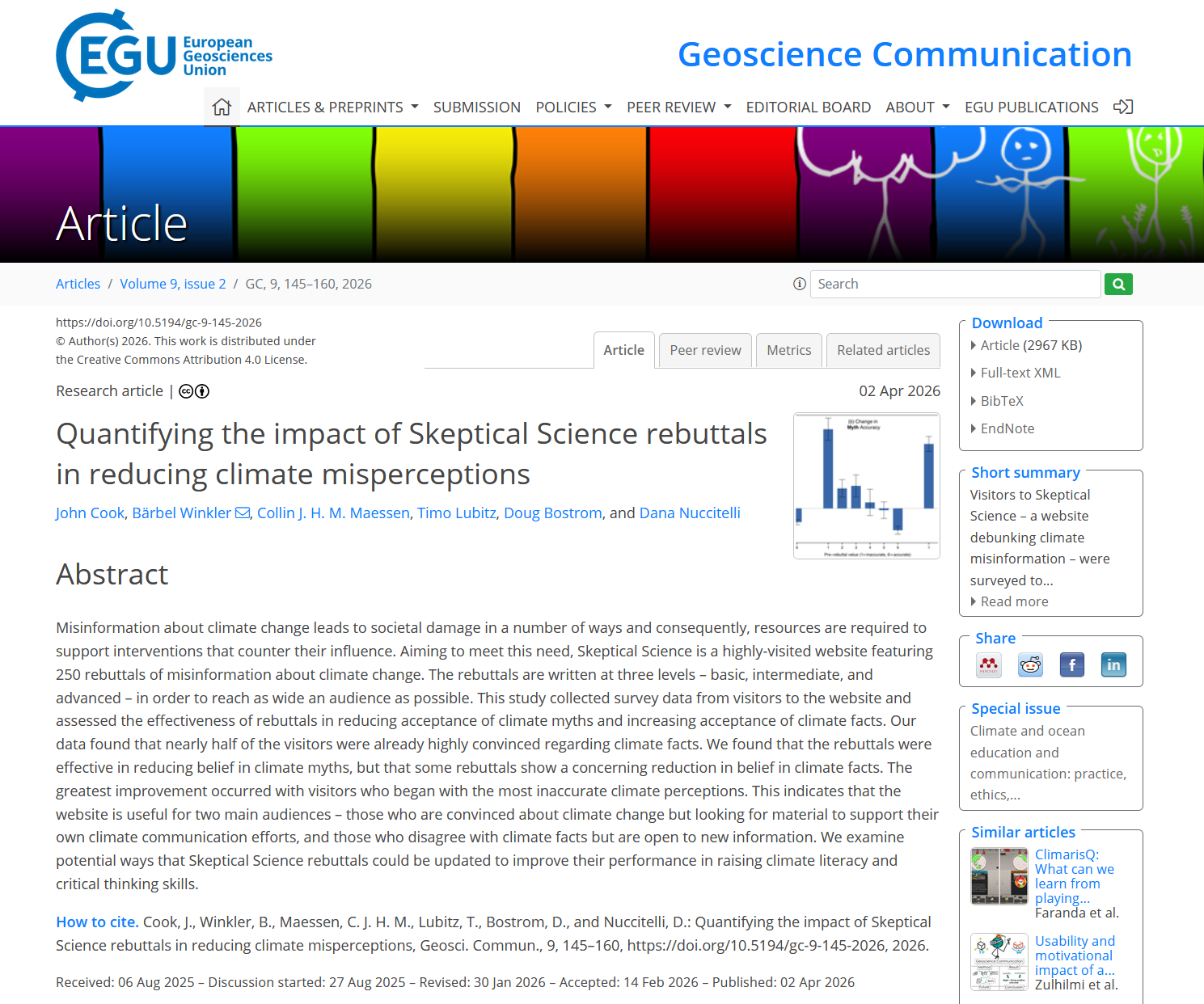
Today in 2026 we’re now delighted to announce that the Skeptical Science team has just published our results from a new research project, in Geoscience Communication. Our culminating peer-reviewed research report (Cook et al. 2026) represents years of careful data collection and analysis, and is a critical step in providing real-world evidence for effective climate communication.
Screenshot of the abstract from our paper published in Geoscience Communication (Cook et al. 2026).
We designed our study to assess the real-world effectiveness of Skeptical Science's 250+ rebuttals in reducing acceptance of climate myths and increasing acceptance of climate facts.
Over a period spanning from November 2021 to July 2025, we conducted a field experiment by collecting survey data from visitors directly on our skepticalscience.com website. Specifically, visitors who arrived at a rebuttal from a Google search in the US, UK, or Australia were invited to participate. You may even have been among readers seeing the related screens!
We used an overlay pop-up (modal) to invite visitors to participate in our research. Those who consented were given a single survey statement — either a climate fact or a myth — and asked to rate their level of agreement before reading the rebuttal. If they scrolled to the end, indicating they had read the content, they were asked the same question again after reading (post-rebuttal survey).
During this time, 858,016 visitors were shown the invitation. Out of those, 13,432 consented to participate, and a total of 6,261 people completed the full pre- and post-rebuttal survey.
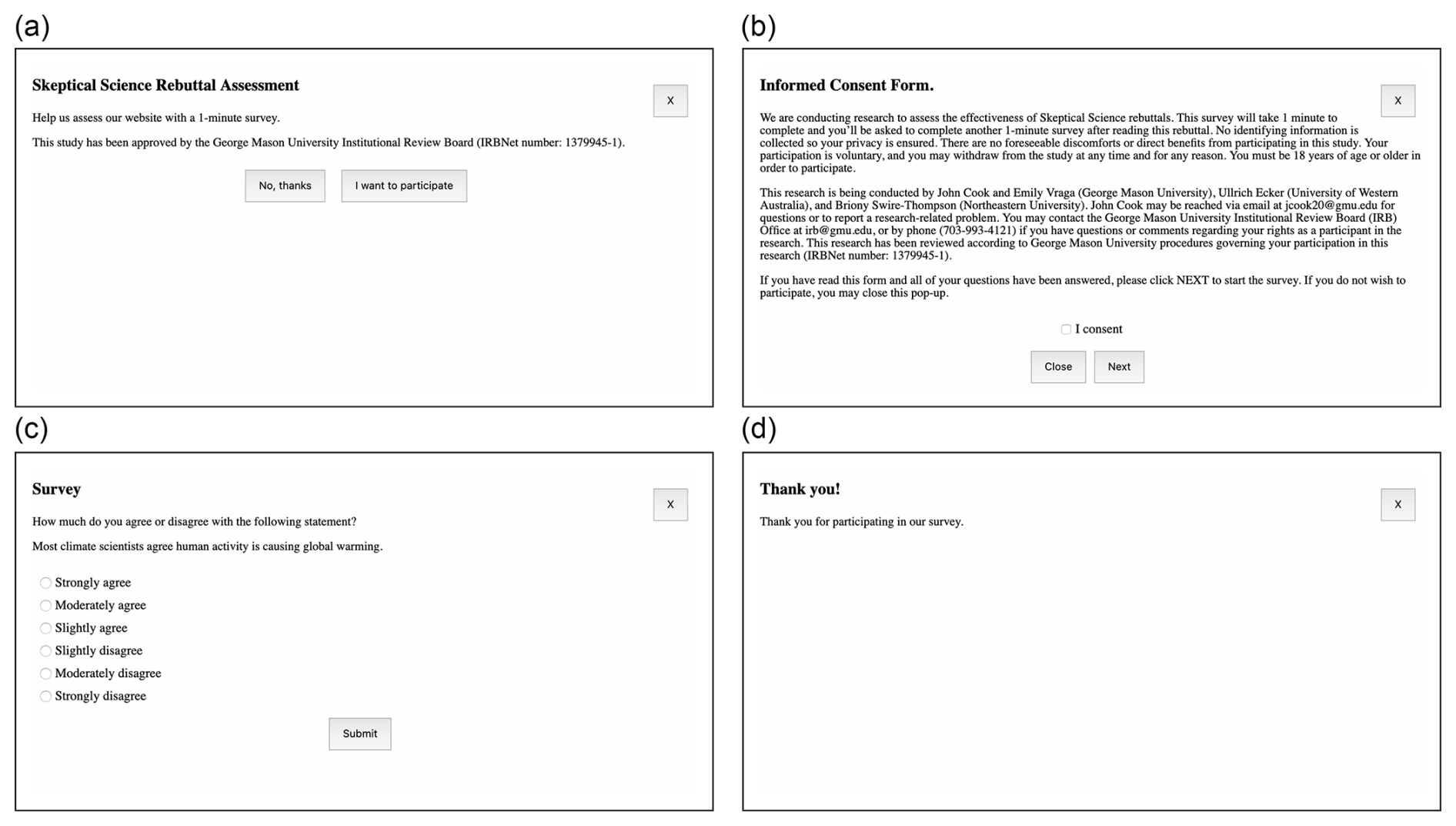
Screenshots of modals used in the experiment design. (a) Invitation to participate in research. (b) Informed consent form detailing research design. (c) Survey question. (d) Final thank you modal.
The experiment confirmed that our rebuttals are effective in reducing belief in climate myths. We found that the biggest shift toward accurate perceptions occurred among the visitors who initially held the most inaccurate climate perceptions. The study also provided vital insight into improving our rebuttals — for instance, highlighting the need for clearer explanations of "replacement facts" and the logical fallacies used by climate myths, which we are already working to integrate into our new content infrastructure for our new website.
Especially important for our mission at Skeptical Science, this formal assessment confirms that time gifted by volunteers and financial support contributed by Skeptical Science readers is having meaningful, measurable positive impact.
The entire work for this research was performed by volunteers freely contributing their relevant expertise. With our paper published and our valuable research now available to scientists, educators, and communicators around the world we still have a final step to complete, one that cannot be completed for “free”: Geoscience Communication (also a nonprofit) requires a €1,215 publication fee (US $1,440). That invoice is now in our accounts payable. With your help we hope to repeat our success of 2013 and quickly cover this expense and be able to move on to our next investigation.
If you share our passion for helping people thrive by being better informed about urgent matters shaping our present and future, please use the form below to contribute. Thank you!
[lgl form="jPgjRIxojFEZD0X9gTHPsA"]
Posted by John Cook on Thursday, 30 April, 2026

 |
The Skeptical Science website by Skeptical Science is licensed under a Creative Commons Attribution 3.0 Unported License. |