This is a re-post from By the Numbers by Hannah Ritchie
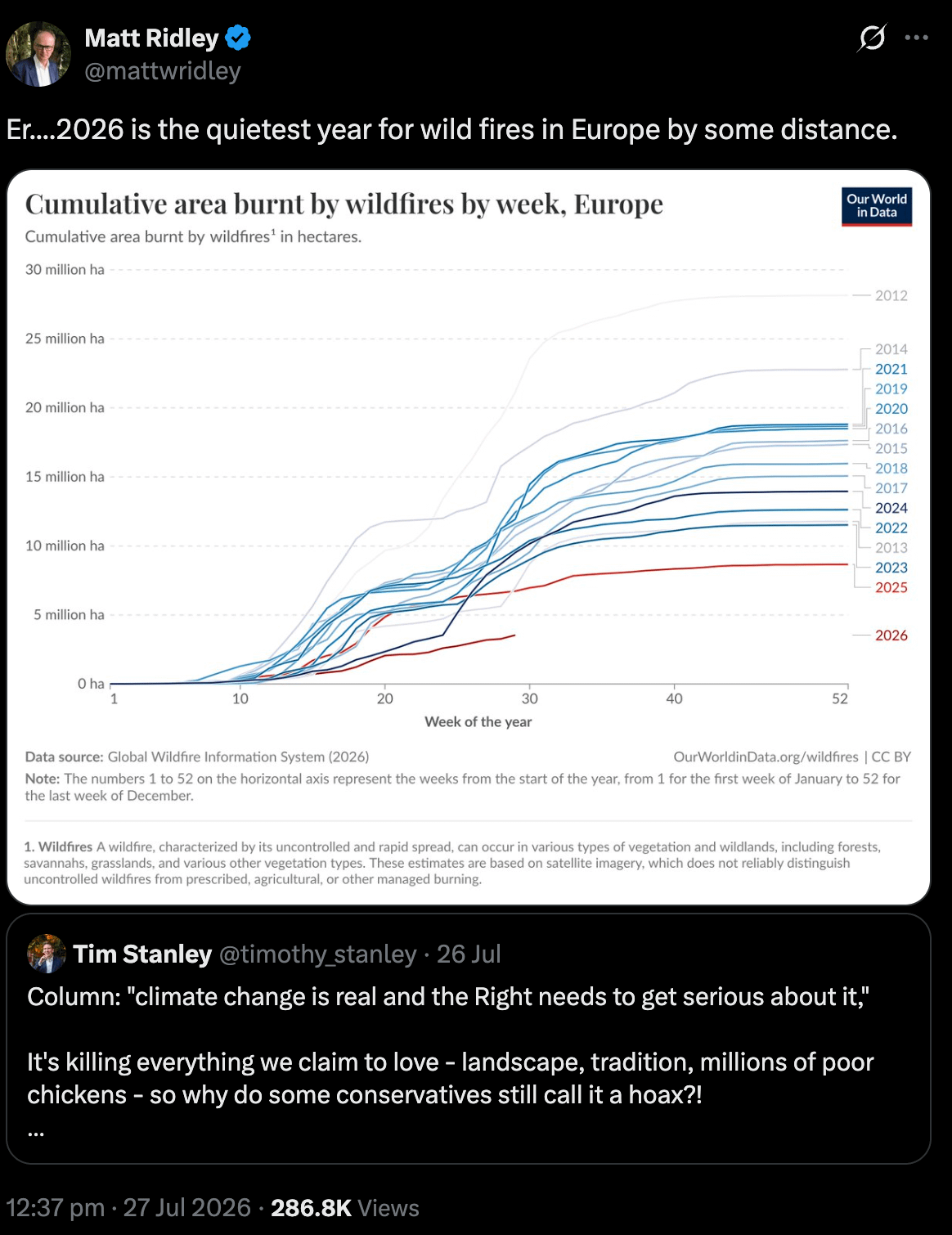
Over the last week, this chart of wildfire burn in Europe has been doing the rounds on social media and traditional media outlets. Carbon Brief goes through some of this coverage here.
The underlying narrative is that Europe is having its lowest wildfire year on record, which is quite at odds with the huge wildfires we see from France and Spain on the news.
But this data and the media headlines are not as contradictory as they first appear.
The wildfire data we present on Our World in Data comes from the Global Wildfire Information System (GWIS). This uses satellite imagery, which doesn’t distinguish, for example, between forest fires and large-scale burning of agricultural land, grasslands, or savannah.
Its aggregate category “Europe” includes Russia. On OWID, we also have predefined regions across our datasets, and Russia falls under “Europe”.
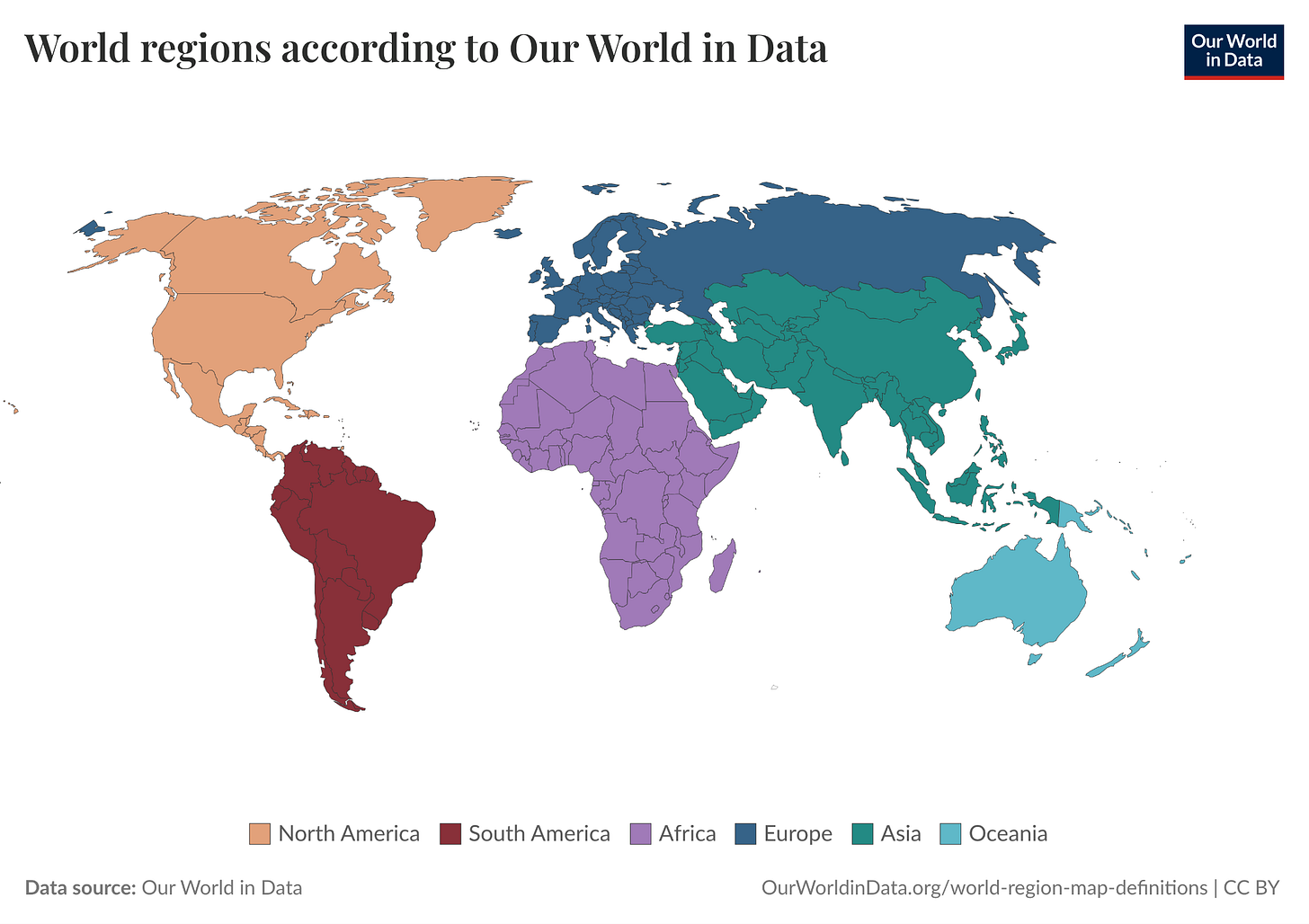
Russia, as a country, is split between Europe and Asia. Most of its landmass lies in Asia, but most of its population is on the European side. Since most of our datasets, from poverty and inequality, to health, education, energy consumption and access to resources, are about human activity and outcomes, assigning Russia to Europe usually makes more sense. That’s not so much the case for the few metrics — like wildfires — that concern land mass.
As Russia is big, the European numbers are heavily influenced by what’s happening there. This is something that’s true of aggregate wildfire data more broadly. The global numbers are heavily influenced by what’s happening in Africa, for example.
It can be true that the world is having a low wildfire year, while Europe is having a high one. Or that Europe is having a low wildfire year, and particular countries within Europe are battling huge outbreaks. There is no inconsistency there.
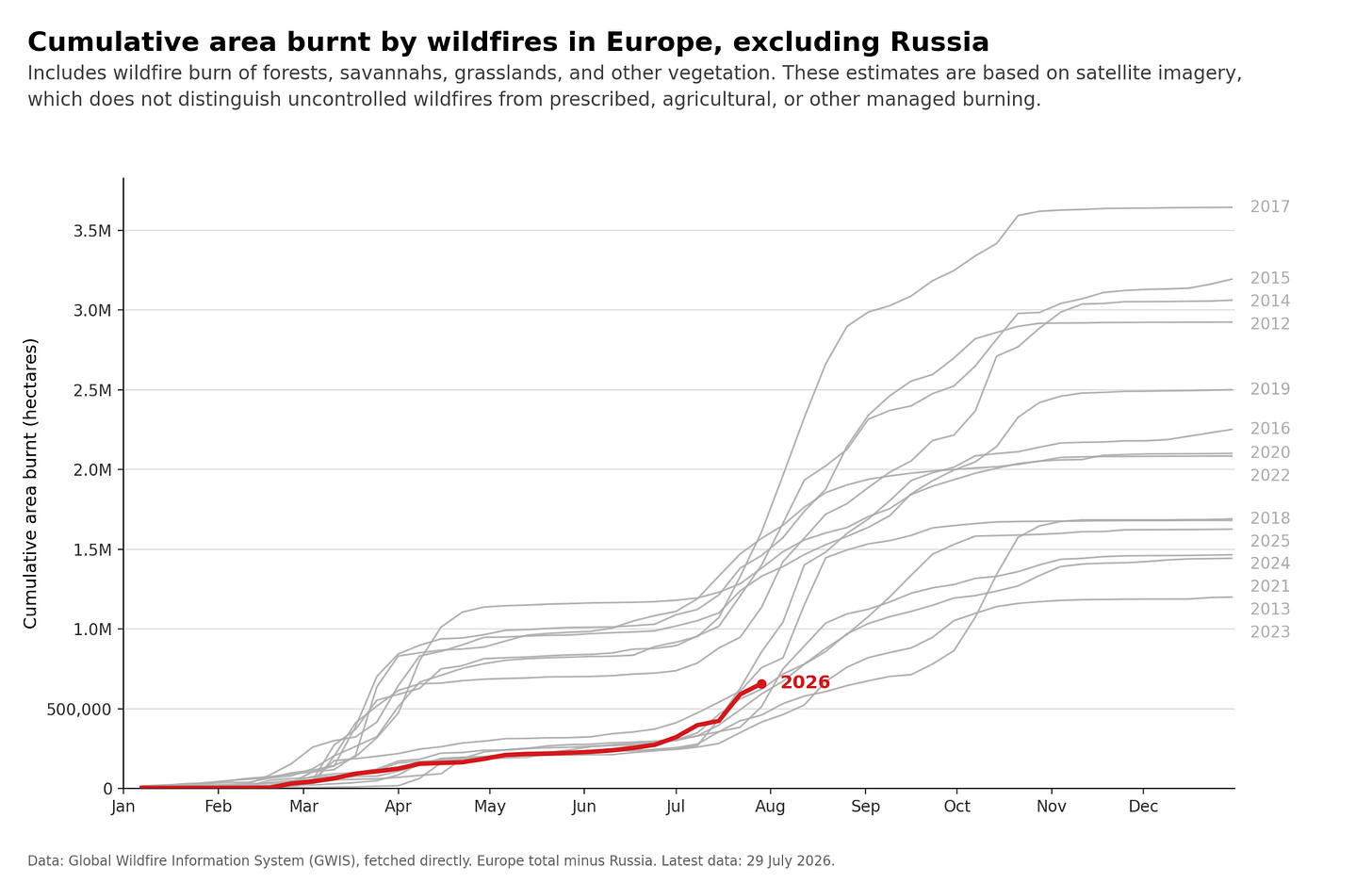
To provide more regional insight, we added an entity called “Europe (excluding Russia)” and already had one for the “European Union (27)”.
What does the European data look like if we remove Russia?
It’s no longer the lowest wildfire year on record, but still fairly quiet for this time of year. Russia is not the only explanation.
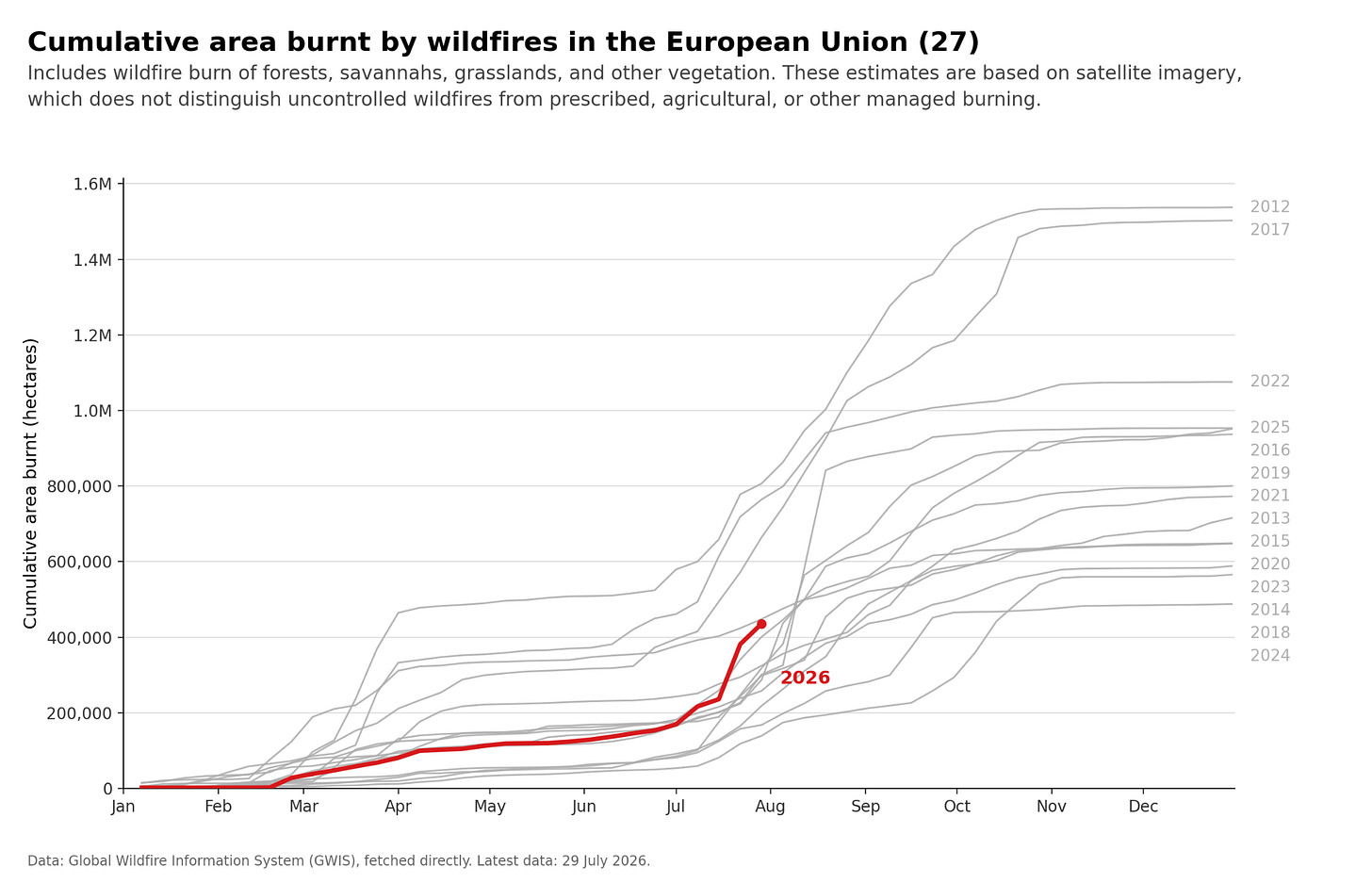
What if we look at the European Union?
It is higher again, with a particular uptick in the last week. It’s around 40% higher than the median year since 2012, and the 5th highest in that record.
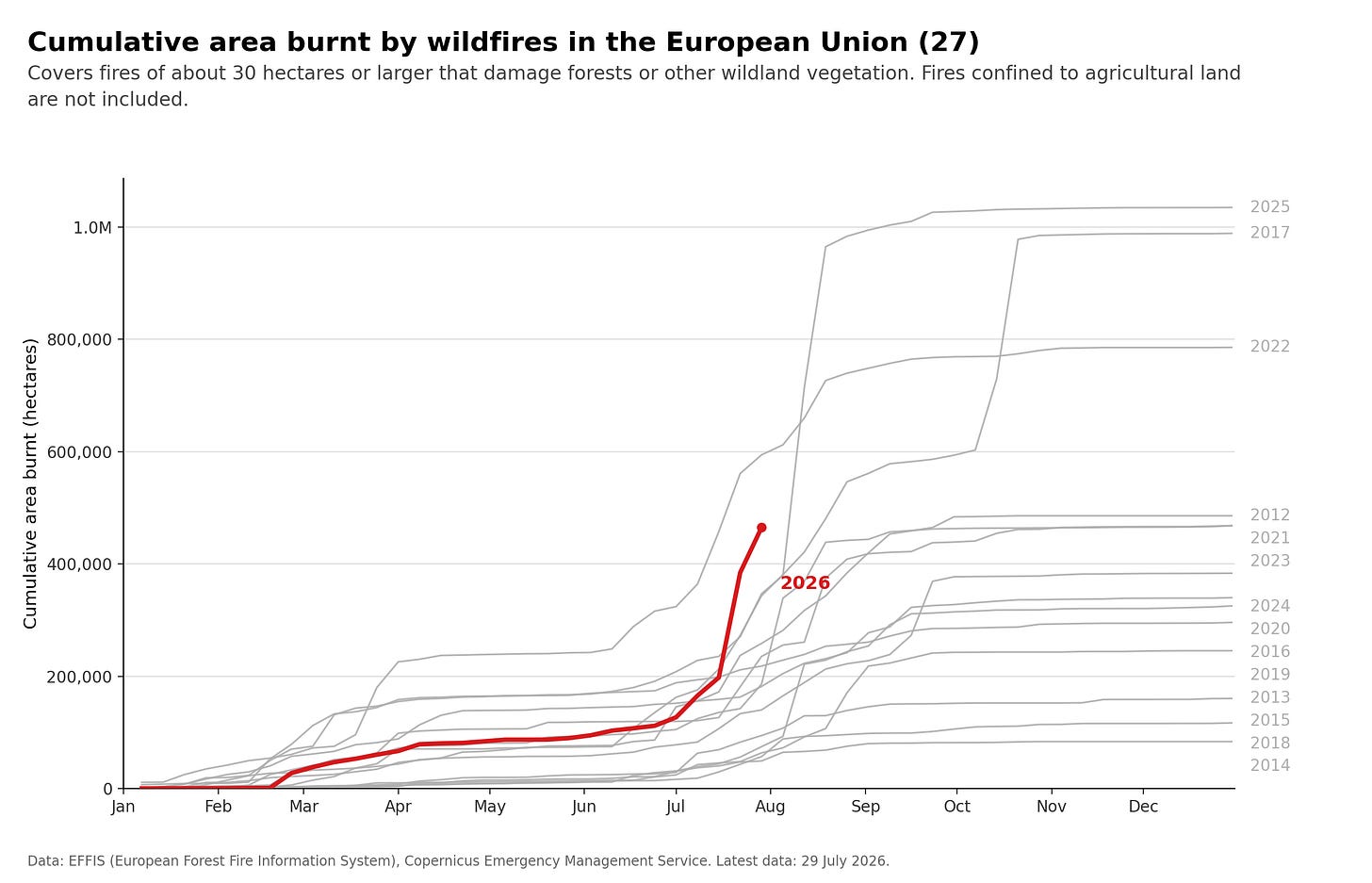
At Our World in Data we use GWIS as our main source, since we want the global picture. But Europe also has the European Forest Fire Information System (EFFIS). It stretches back to 2006, and tries to filter out agricultural burning to focus on forest fires.
Its data has the EU running at its 2nd highest level for this time of year.
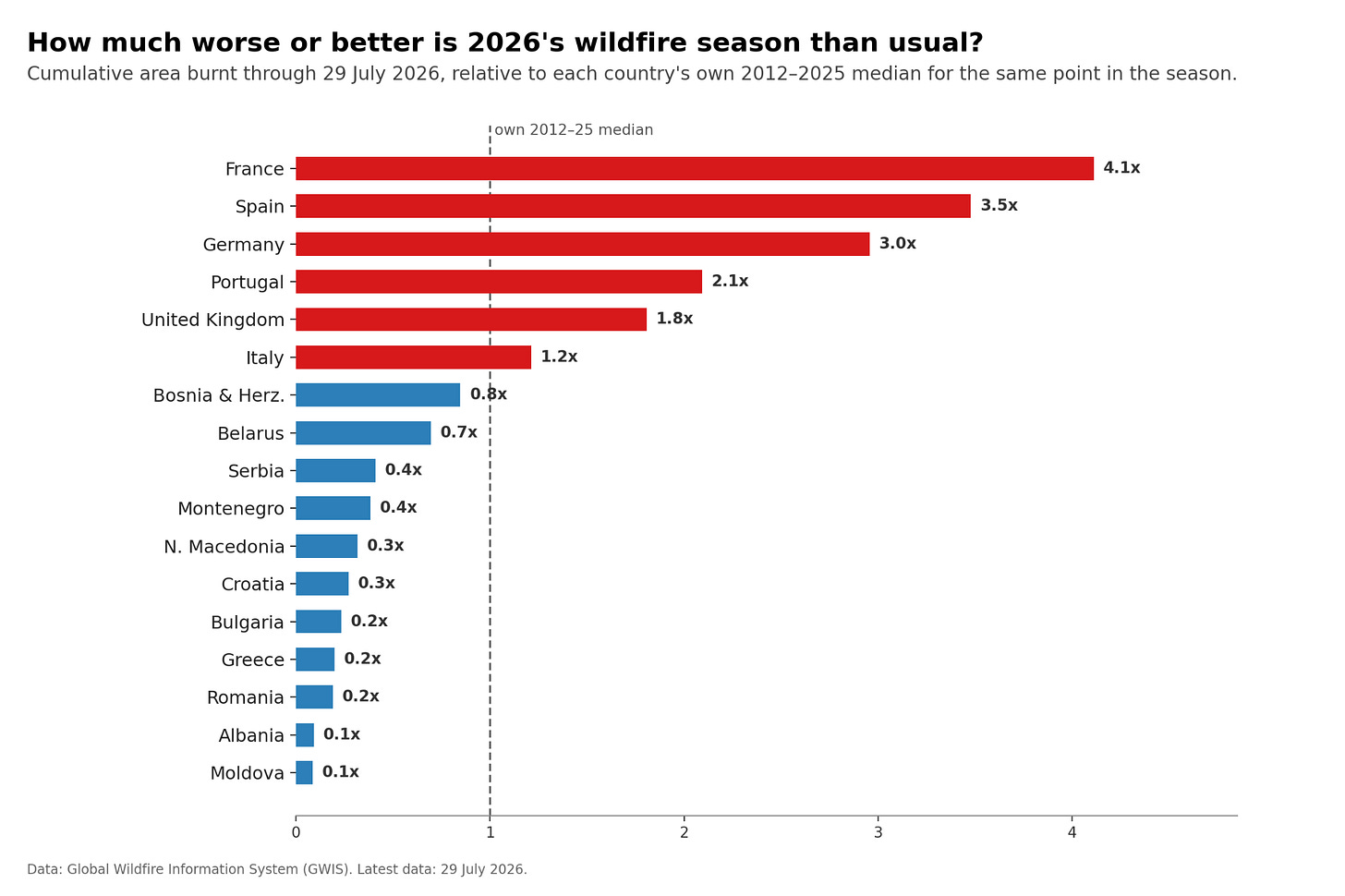
Underneath this trend from either source is a stark regional split. Many countries in Western Europe are having a bad wildfire year. Those in the Balkans and Southern Europe, a comparatively quiet one.1
The bar chart below shows how wildfire burn at this stage of the year compares to the median over the past 15 years. A figure of 2 means it’s twice as high as the median; 0.3 means wildfire burn is around one-third.
Countries such as France, Spain, Germany, and Portugal are well above the average for this time of year. But countries such as Romania, Greece, and Croatia are well below.
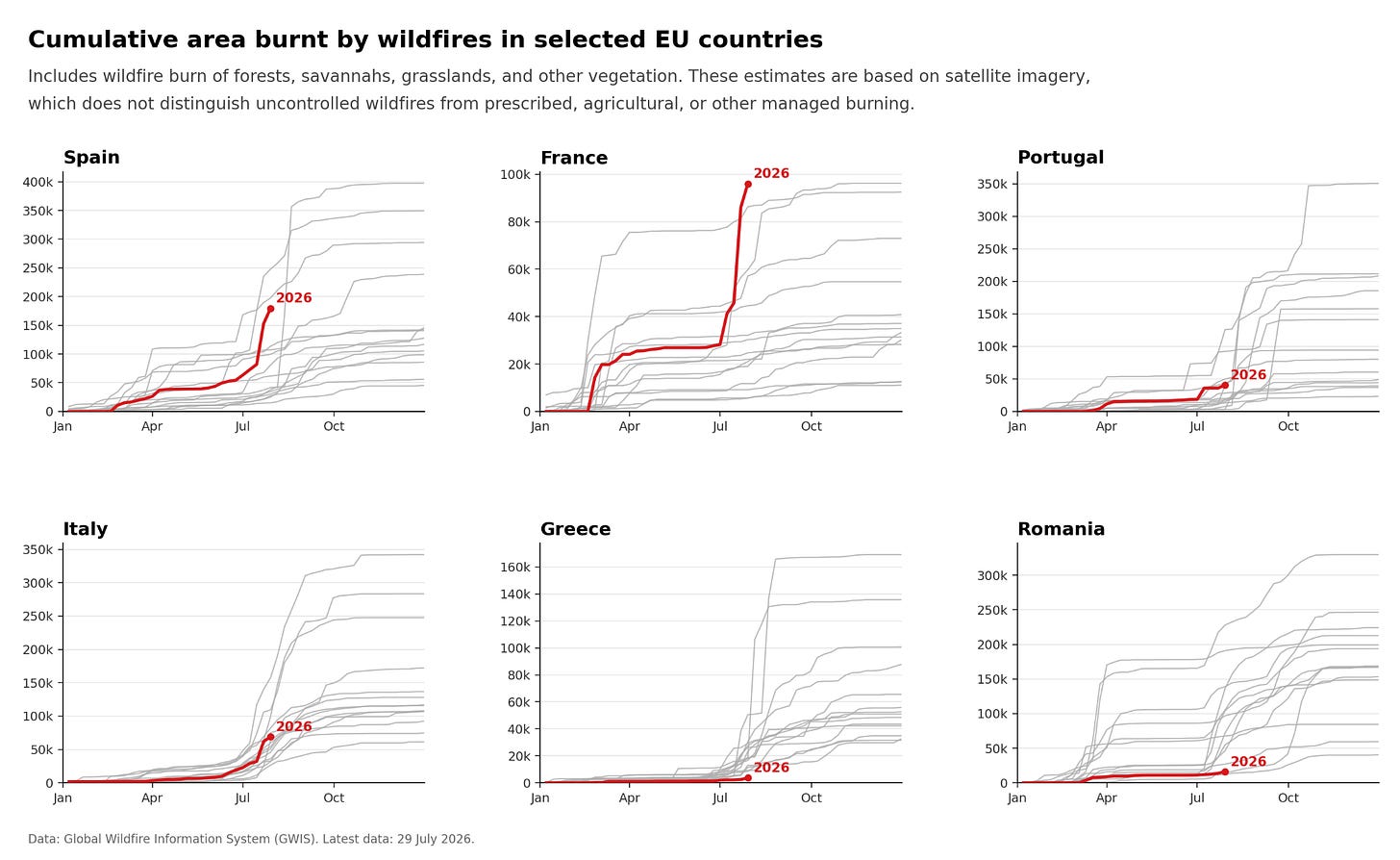
For France, it’s not just that wildfire burn is higher than usual. It’s seeing record-breaking fires for this time of the year. You can see this in the panel chart below.
Compare that to Greece, where wildfires are tracking for their lowest levels since 2012.
This matters for the aggregate European, or EU, figures.
Let’s take that same chart, but make the y-axis scale the same across all countries. Some countries simply contribute far more to the total than others. France is breaking records — which obviously matters a lot for its national figures — but it doesn’t have a huge impact on the region’s overall numbers. A really big year in Portugal, Italy, Romania or Spain does make a big difference. But the relatively high year in Spain is “offset” by a low year for Romania.
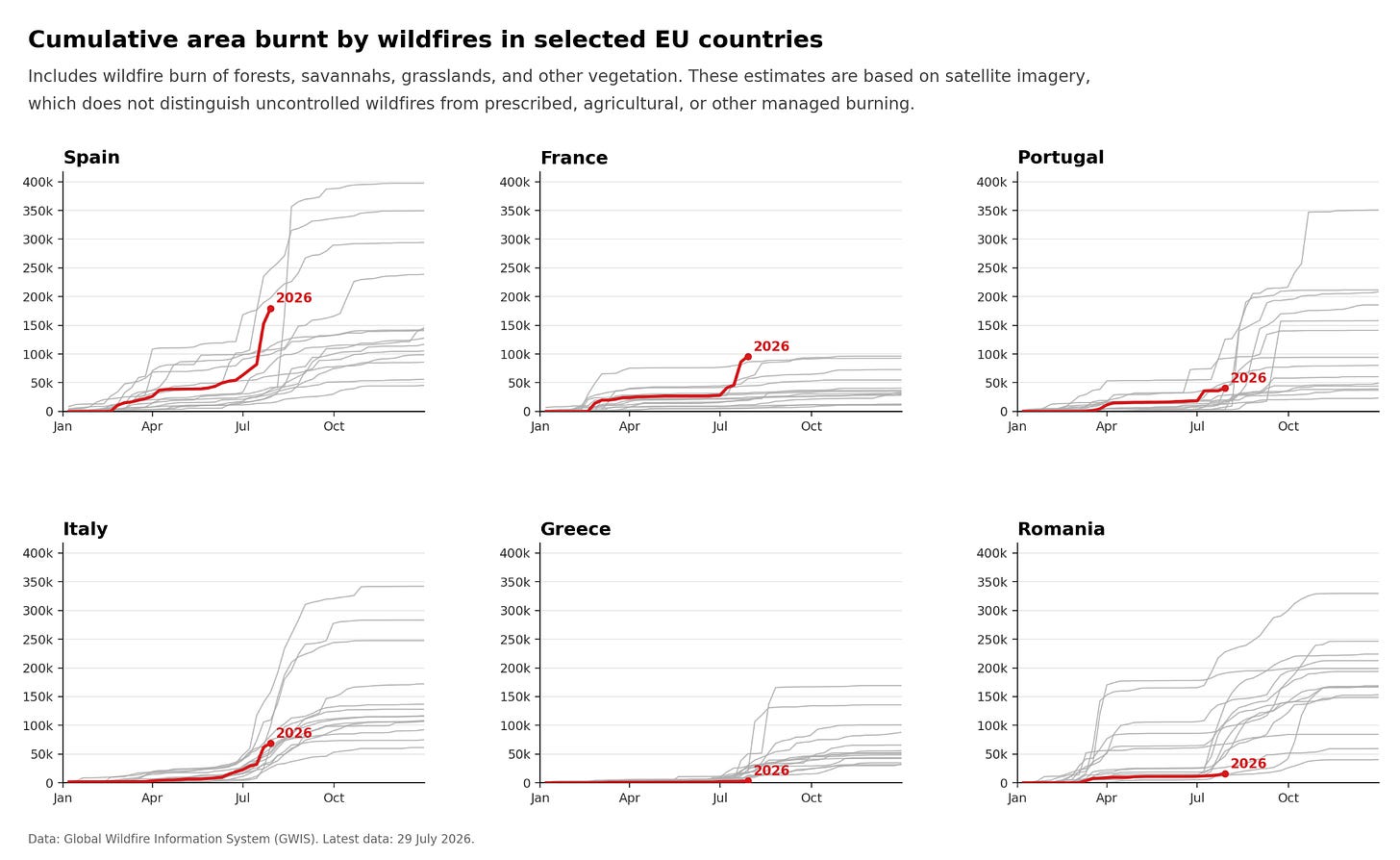
That’s really the point: some countries are having really severe wildfire outbreaks, affecting huge population centres and landscapes. That France is struggling this summer is not a lie or just media hype. It can also be true that others offset this with quiet years in the regional totals.
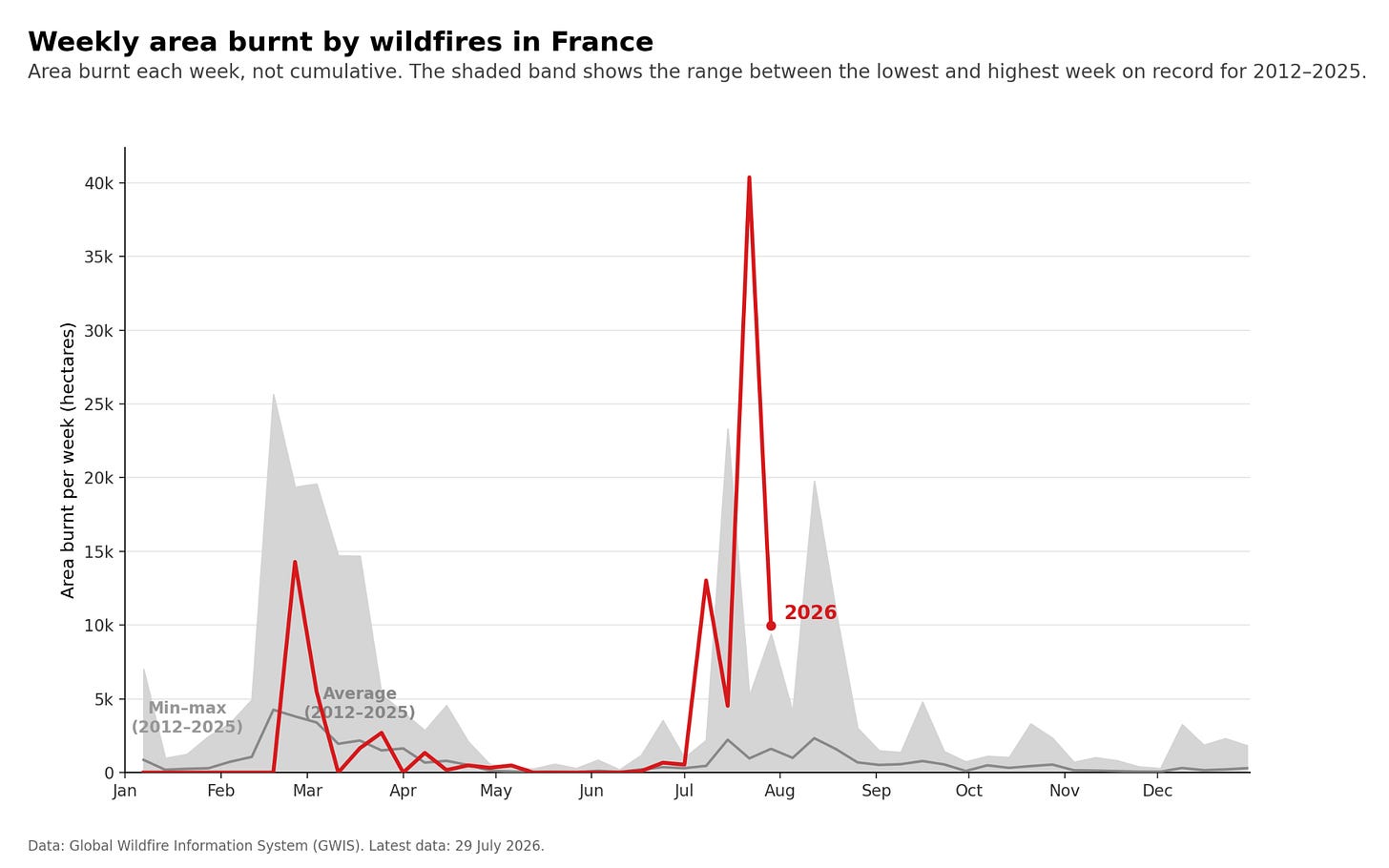
The anomaly in France this year is even clearer when we look at the weekly wildfire burn. The spike you see in the chart below was far higher than any other week in France’s record since 2012. The speed and intensity of wildfire outbreaks is arguably more important for the impact on communities than just the total area burned.
What if we zoom out to look at data across all regions?
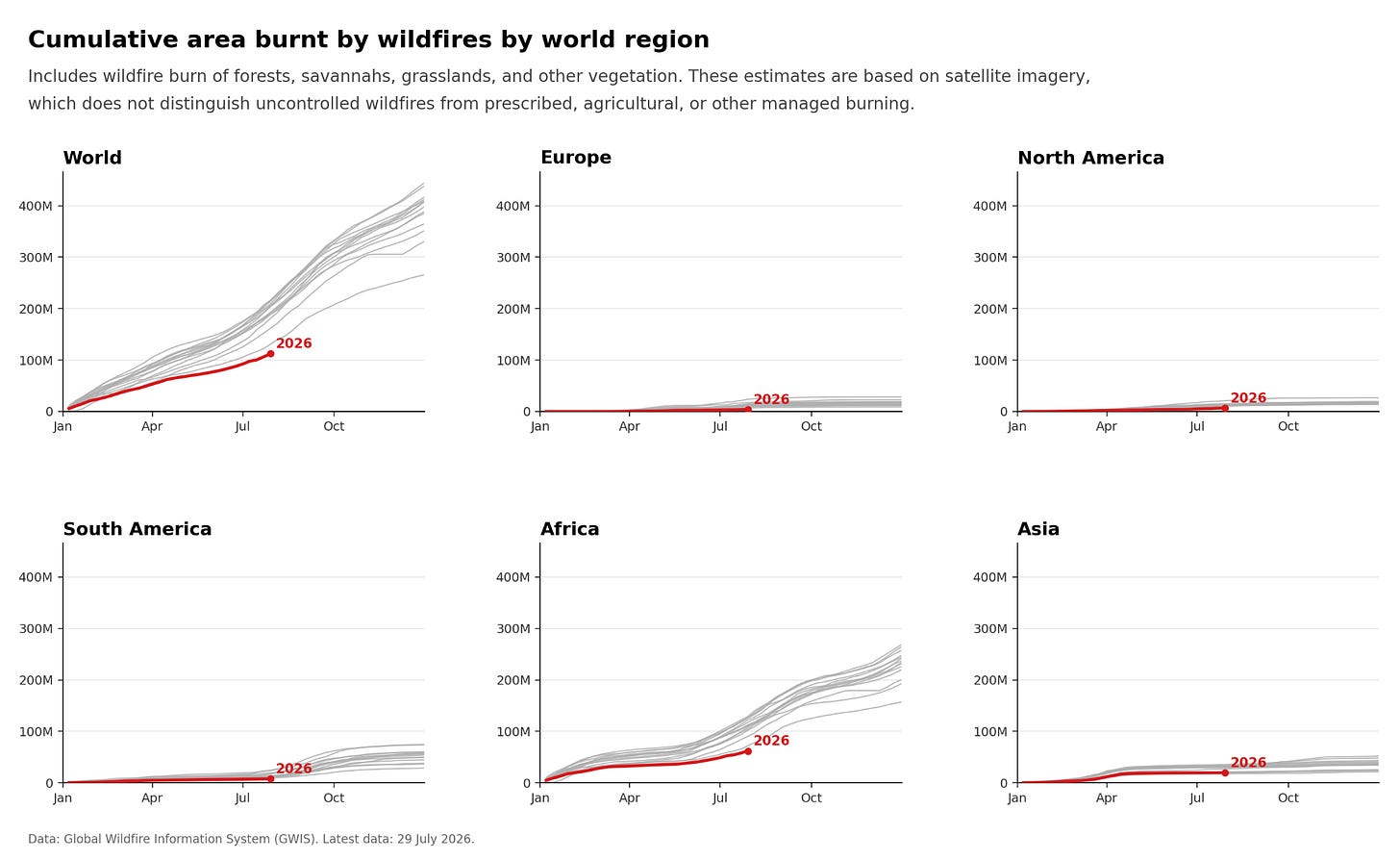
Here they are, with the y-axis scales the same. It really is a low year for wildfires globally. Most of that is explained by low wildfire burn in Africa. A lot of Africa’s wildfires are about agricultural burning, and fires on grasslands and savannahs. South America is also having a quiet year, so far.
Europe and North America, in particular, have little bearing on the global total, simply because they’re so small. Europe without Russia has even less so.
1 Much of the burning in the Balkans is related to agricultural land practices, which differ from how people think about forest fires.
Posted by Guest Author on Tuesday, 4 August, 2026

 |
The Skeptical Science website by Skeptical Science is licensed under a Creative Commons Attribution 3.0 Unported License. |