This is a re-post from By the Numbers by Hannah Ritchie
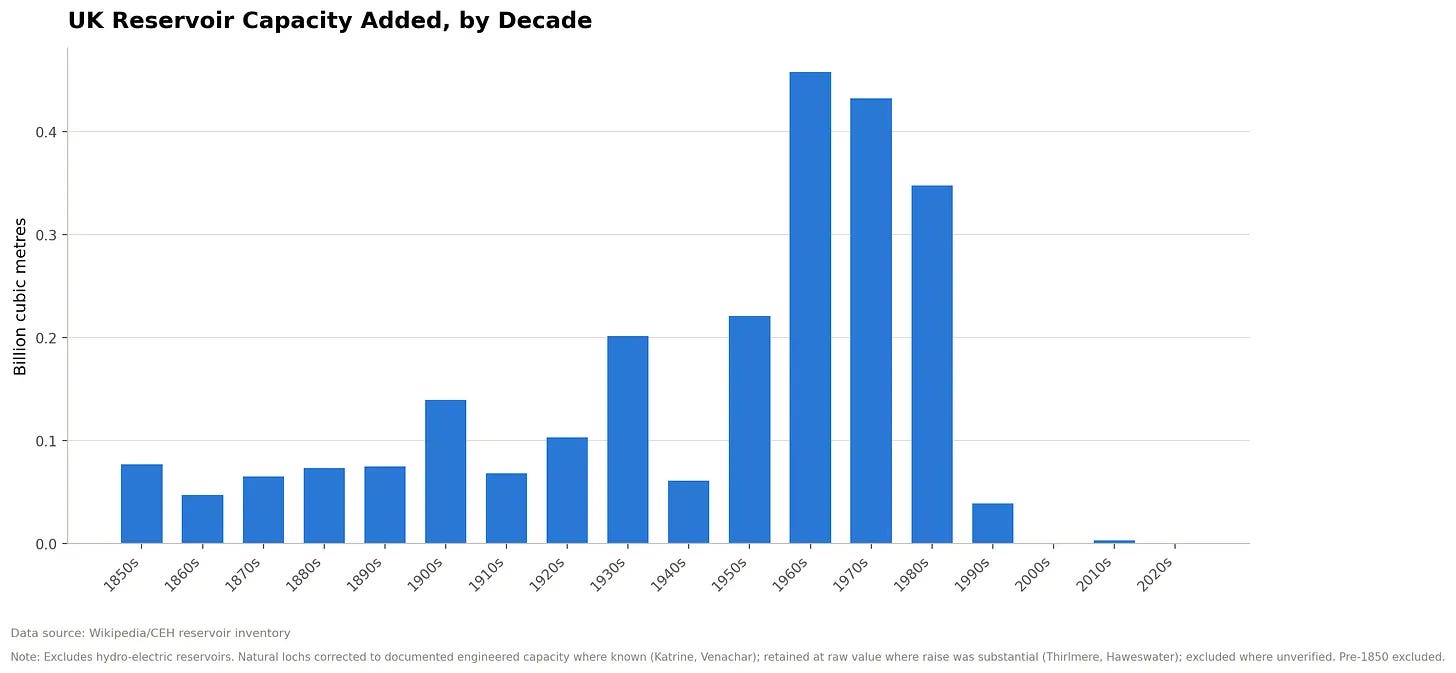
A few weeks ago, I wrote an article about why the UK needs to get its act together and build some new reservoirs. It hasn’t built one in my lifetime — despite adding 10 million people — and the mismatch between winter and summer rain is probably going to get worse.
Someone asked a very reasonable question: why don’t we just build some desalination plants instead? Reservoirs are pretty big infrastructure projects. They constantly get blocked by local communities. They clearly disrupt the ecosystems and environments where they’re built.
Now, a lot of you will immediately think this is an insane idea. Do you realise how much energy desalination uses?!
I admit, it does seem a bit mad. Rather than just collecting freshwater in a big hole before it goes into the ocean, we’ll let it run in there, get all salty, then use a bunch of energy to pull the salt back out again.
For a long time, I had also held the “desalination consumes so much energy” tightly. It was a mantra I’d been taught a long time ago, and never updated. That is, until a few years ago, when I dug into the latest numbers. Supplying drinking and household water through desalination is really quite cheap, and uses far less energy than I’d have guessed.
How would these numbers work out for the UK? By that, we’re really talking about England, because that is where most of the water demand will be.
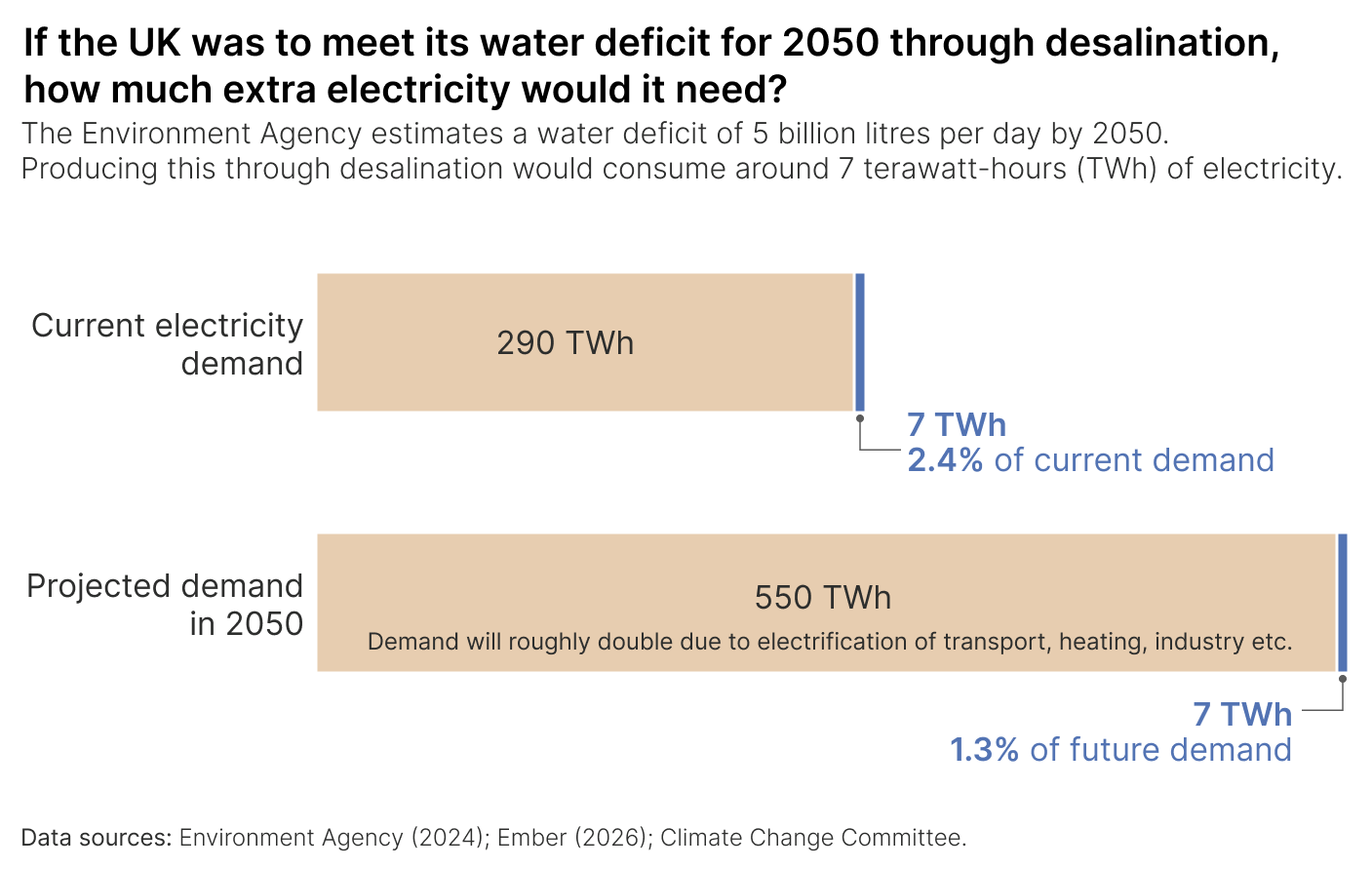
The Environment Agency estimates that by 2050, England will need to fill a deficit of 5 billion litres per day.1 Reverse osmosis from seawater consumes around 4 kWh per cubic metre (m3).2 Or 4 Wh per litre. That means we’d need 7 terawatt-hours (TWh) of electricity to meet all of England’s additional demand from desalination.3
The UK consumes around 290 TWh of electricity a year, so this would add a little over 2% to our annual demand.4 That’s not that much.
The UK’s electricity demand is already set to roughly double by 2050 to meet growing demand from the shift to electrified transport, heating, and industry. An extra 1% or 2% to have adequate water supplies doesn’t seem like a huge deal.
Producing that extra electricity has some (but small) environmental impact, whether it’s the materials or the land use. They also have the problem of managing brine — the plant’s output that they need to discharge somewhere. But reservoirs have environmental costs, too. How do they compare on other measures?
England already has a desalination plant — Beckton in London — which gives us some insights into how this goes.
I first thought this would be a win for desalination. Historical experience is actually quite positive. The Beckton plant took six years to build; the first planning application was submitted in 2004, and it was completed in 2010. Compare that to the Abingdon reservoir, which has been a saga going on for more than 15 years.
The prospects for desalination plants looked good until I found out that two plants — Bacton and Mablethorpe — in the early feasibility stages are not expected until at least 2040. That’s no better than a reservoir. It seems that Beckton was built under a far simpler regulatory regime that no longer exists. Desalination projects will be stuck in the long planning and approval queues that almost every infrastructure project now faces.
If they were the same size as the Beckton one, we’d need around 50.5 The desalination plant the UK has built is small. We could dramatically reduce that by building much larger plants. The Sorek plant in Israel, for example, has a capacity five or six times larger. With these designs, we’d need around 8.
Building desalination plants would be more expensive than many alternatives. The government plans to fill a lot of the water deficit, not through supply solutions like desalination or reservoirs, but by fixing leakages in the water system (which are pretty large) and improving efficiency. Those solutions obviously make sense and are far cheaper than building large infrastructure projects (although there are diminishing returns: the first leaks are very cheap to fix, but there is a tail where things get increasingly expensive).
But for the remaining gap that needs to be filled with new supplies, is it cheaper to desalinate or to build a reservoir?
There are two ways to compare these: the upfront cost to build, and how expensive water is over the lifetime of the project.
Reservoirs are not automatically cheaper than desalination plants. Costed over their lifetime (which can be more than 80 years), they often are. But in the near- to medium-term, I don’t think they clearly win on economics. Reservoirs do come with high upfront costs, even if they’re then cheaper to run. Recent figures from Severn Trent put the average capital cost at £8.12 million per Ml per day for reservoirs, compared with £9.77 million per Ml per day for desalination.6 Desalination is around 20% more expensive to build. But these projected costs have a habit of ballooning, so I could quite plausibly believe that the inverse becomes true.
Desalination plants in the UK are expensive by international standards. In the UK, it costs somewhere between $1.50 and $12 per m3. That range is so large because it depends on how often the desalination plant is running (we’ll come on to this later). That compares to around $0.50 in the Middle East, $1 in Australia, and $2 to $3 in the US.
There are a couple of reasons why it’s more expensive. The UK doesn’t have much experience building desalination plants, so it misses out on some of the learning that drives down costs. Its current plant and proposed ones are small, so we miss out on economies of scale. The UK has strict planning regulations that extend timelines and are costly, even before construction begins. Finally, its plants would be used intermittently — probably only in the summer, and not even every summer. That redundancy drives up costs compared to a plant that runs continuously, as in countries like Australia or the Middle East.
The places where desalination works well have one thing in common: they’re running almost all the time. They don’t just get turned on in a drought. They’re there to provide basic water services year-round.
That’s not how the UK’s current desalination plant works. It’s not how its future ones would work either.
This affects the economics: the unit price is lower for plants running 24/7. But it also affects their reliability.
The Beckton plant was completed more than 15 years ago, and it has only been switched on 5 times. When the UK was facing severe droughts in 2022, it was ordered to come online. Despite assurances that it was ready to go online, it was not. The plant did not run and provided no help whatsoever during the crisis period that it was specifically built for.
This year was a repeat of that. Most of England was in drought this summer. The Beckton plant was “unusable” because it needed “essential operational upgrades”.
The problem is that the infrastructure that is almost never used does not go through the same continual operational testing as stuff that runs continuously.
Here’s an excerpt of a government examination with the CEO of Thames Water:
Chris Weston: The first thing I would say is we have a team at the desalination plant that is working very hard to try to make it work.
Chair: Has it ever worked properly?
Chris Weston: It has worked in the past.
Chair: It is not going to work this year though?
Chris Weston: No, and I share your concerns. The desalination plant is a big problem for us. I wonder why it was built in the first place.
Chair: Two hundred and fifty million pounds.
Chris Weston: Yes, I accept that. It is not a good story, it was not a good investment, and there are no excuses about it. I would point out one thing with the desalination plant: at the moment, it relies on a very complicated and expensive process. Within it, it has certain treatment membranes. Those treatment membranes are at the end of their life.
This is nothing specific to the UK. We see it in Australia, too. Desalination plants have worked well in Perth because they are used as a key source of drinking water, and these plants run almost continuously.
Elsewhere, the story is similar to Beckton’s. Melbourne’s plant was completed in 2012, but mothballed until 2017, when it started delivering water for the first time. The government had agreed contracts to pay for this every year, despite receiving no water in return. In Adelaide, the plant sits idle for most of the wetter months. But Sydney has gone in the other direction: in 2023, the government stopped regarding it as an on-off backup, and it now runs close to a full-time operation. Maybe that’s something Britain can learn from.
For me, this is the crux of it.
I am not worried about the energy demands of desalination for the UK. I think adding 1% to 2% to our electricity demand is not unmanageable. I’d be happy with that trade-off if it reduced the environmental impact of reservoirs and unsustainable extraction from existing aquifers.
The problem is that reserving desalination for emergency situations does not seem to work well. It hurts the economics. It means they sit idle for years, and then are not ready to go when a crisis hits. Desalination plants work far better when you need continuous freshwater supplies. For Britain, that means they’d be far better suited to relieving pressure on existing aquifers (which is less stop-start) than to being kept on reserve for drought management.
If we build them, we should make sure we actually use them.
1 This is partly due to population growth, partly due to climate change, but actually the biggest driver is more water resources to reduce pressure on existing aquifers in environmentally-sensitive areas.
2 This is on the higher end of the estimates, but I'm trying to be conservative/harsh here.
3 5 billion * 365 * 4 = 7.3x10 12 Wh. That's 7 billion kWh (or 7 TWh). One point to note is that electricity generation also uses water (how much depends on the electricity source). But even if this extra demand was being supplied by gas (which uses the most water), it would be far less than 1% of the water deficit: millions rather than billions of m3.
4 7 / 290 * 100 = 2.4%
5 Thames Water previously scoped the plant to have a capacity for around 150 million litres per day. But has since said that its more realistic capacity is around 100 million litres.
6 This report cites a range of £1000 to £9000 per ML. I've converted that to cubic metres, and dollars. https://committees.parliament.uk/writtenevidence/157464/html/
Posted by Guest Author on Tuesday, 1 September, 2026

 |
The Skeptical Science website by Skeptical Science is licensed under a Creative Commons Attribution 3.0 Unported License. |