Dana Nuccitelli is Research Manager for the nonprofit Citizens' Climate Lobby, which has advocated for permitting reform in the U.S. since 2022, and for the Bipartisan American Affordability and Jobs Act in 2026. This post is a data-based assessment of the importance of the bill for the climate, and does not constitute an endorsement by Skeptical Science.
'Permitting' refers to the government review and approval that projects require before they can begin construction. Projects with a federal connection – like those built on public lands or receiving federal funds – have to go through federal permitting processes that includes environmental review under the National Environmental Policy Act (NEPA).
The permitting process in general is important to ensure that projects don't unduly harm people, environments, or workers during their construction or operation. But the timeliness of permitting processes is also an important consideration. For example, in the United States, it takes a decade on average to permit and build a new electrical transmission line. Some big multi-state transmission lines have taken over three decades to complete. And clean energy sources like solar and wind farms require transmission lines to connect to the grid and transport that electricity to population centers.
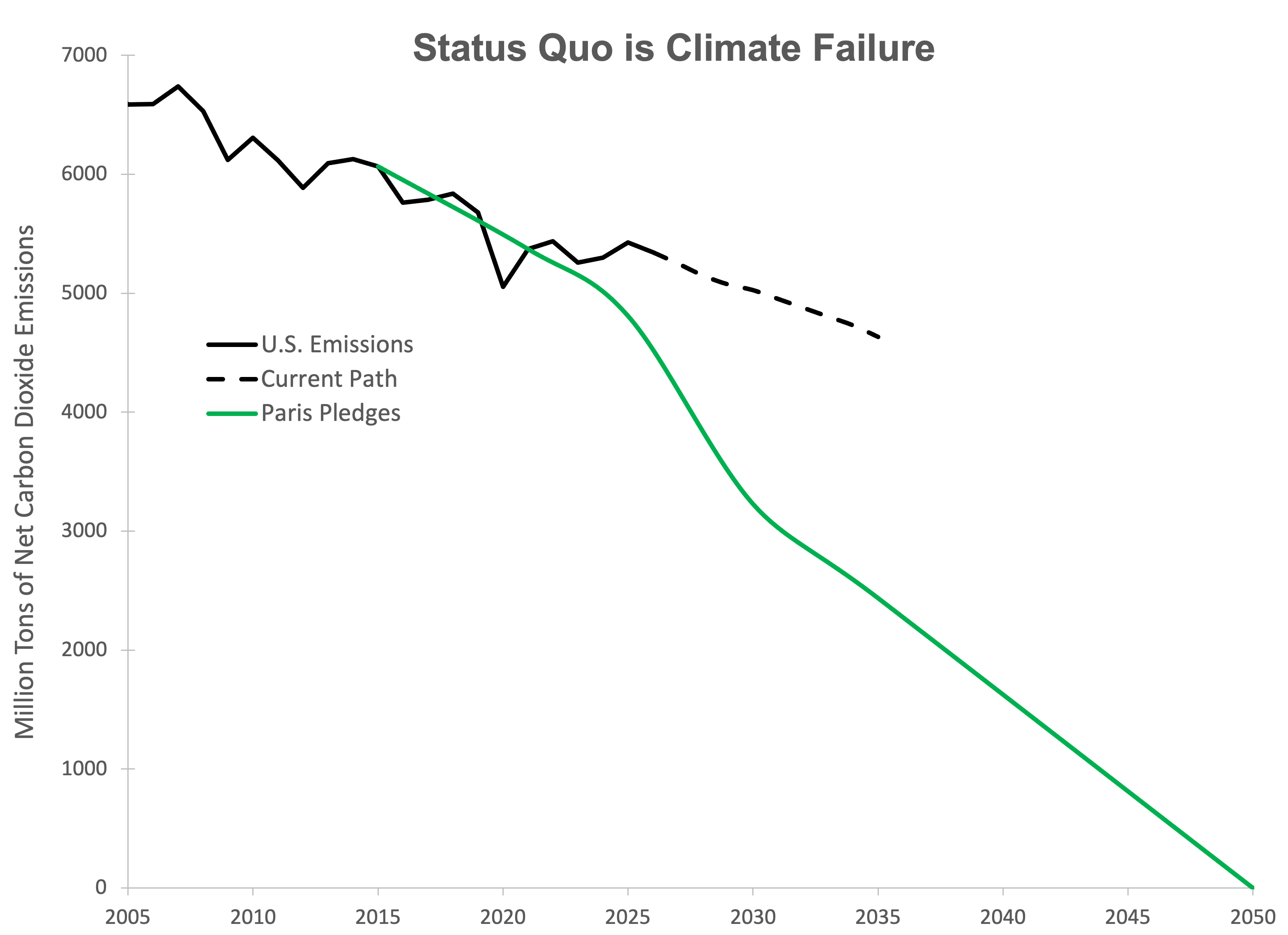
If our goal is to rapidly transition from a fossil fueled economy to one powered by clean energy, these timelines are far too slow. The U.S. is falling further and further behind the prior Obama and Biden administrations' international climate commitments.
U.S. greenhouse gas emissions from the EPA greenhouse gas inventory (black solid line), trajectory based on current policies per Bistline et al. 2026 (black dashed line), and U.S. Paris commitments under the Obama and Biden administrations (green line). Created by Dana Nuccitelli
The most widely-accepted strategy for achieving these ambitious climate targets involves rapidly decarbonizing the power sector and then electrifying as much of the rest of the economy as possible.
The good news is that the fundamental economics of power generation technologies now make this strategy a feasible one. The costs of solar panels, wind turbines, and battery storage have fallen so far that they're usually the cheapest sources of new power available today. The bad news is that slow permitting processes are severely restricting the speed at which the U.S. can deploy the technologies needed to decarbonize its power sector.
Texas provides one counter-example, where despite a very fossil fuel-friendly state government, virtually all of the state's rapidly rising power demand over the past 20 years has been met by wind, solar, and batteries. Texas has a very permissive permitting system, and these clean sources have dominated recent deployments purely because they're the most cost-effective options.
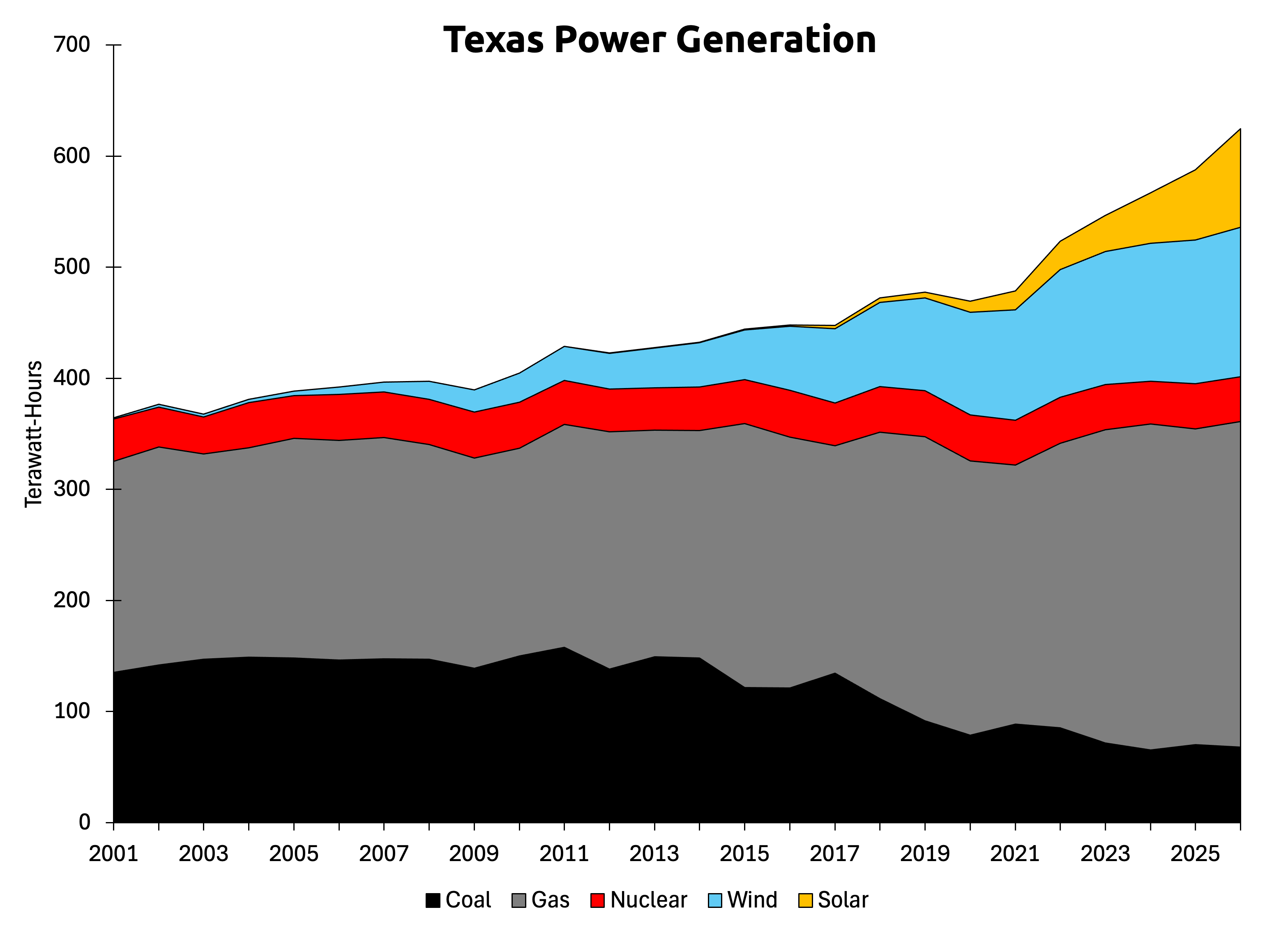
Power generation by source in Texas. Graphic by Dana Nuccitelli with data from Ember.
U.S. Congress has tried for many years to mimic Texas' faster permitting system. So-called 'permitting reform' bills were introduced in 2022, 2023, 2024, and 2026. A relatively small package of reforms was signed into law in 2023, but a more comprehensive package called the Energy Permitting Reform Act narrowly failed to navigate the Congressional gauntlet in 2024.
In the current session of Congress, Senators Sheldon Whitehouse (D-RI), Martin Heinrich (D-NM), Shelley Moore Capito (R-WV), and Mike Lee (R-UT) spent nearly two years negotiating a new comprehensive bipartisan permitting reform package that both political parties might find acceptable, called the Bipartisan American Affordability and Jobs Act (BAAJA). They released the text of the bill on September 30th, 2026. It was subsequently amended to address some concerns, and the Senate voted on November 19th to pass the bill by a 62–33 margin. The House of Representatives is slated to vote on it this week.
The bill is nearly 500 pages long and includes sections reforming NEPA, the Clean Water Act, the Endangered Species Act, and the National Historic Preservation Act (NHPA); on 'project certainty' aimed at preventing the kinds of federal agency permitting obstruction practices that the Trump administration is weaponizing against wind and solar projects; transmission reforms; and a general energy permitting reforms section that aims to ease the permitting of other kinds of energy projects like advanced geothermal, small hydro, nuclear, and marine power. The Bipartisan Policy Center offers a detailed explainer of all sections in the bill.
BAAJA has divided environmental and climate advocacy organizations in the United States. Many of the country's big environmental groups utilize strategies centered around bringing lawsuits against energy projects they believe will be harmful, using laws like NEPA and its slow permitting processes to delay and/or cancel these projects. As such, reforms to these laws are antithetical to their strategic approach. From their perspective, these laws are critical to protect people and environments from harmful projects.
That strategy was effective in prior decades. The U.S. experienced a natural gas fracking boom in the 2000s and 2010s, at a time when solar panels were still relatively expensive and national power demand was nearly flat. In those conditions, a strategy centered around stopping energy infrastructure projects made sense, because fossil fuel projects were proliferating and weren't needed to meet growing demand. Natural gas power generation primarily ended up displacing coal power plants during those years.
But today's energy ecosystem is completely different, and to be effective in helping to meet climate targets, climate advocates must adapt to these changes. Solar, wind, and batteries are now the cheapest sources of new power. Fossil fuels are often constrained by forces beyond permitting. For example, natural gas turbine manufacturing backlogs currently stretch for about five years, and their prices have tripled. And power demand is now rising incredibly fast due largely to the proliferation of artificial intelligence data centers.
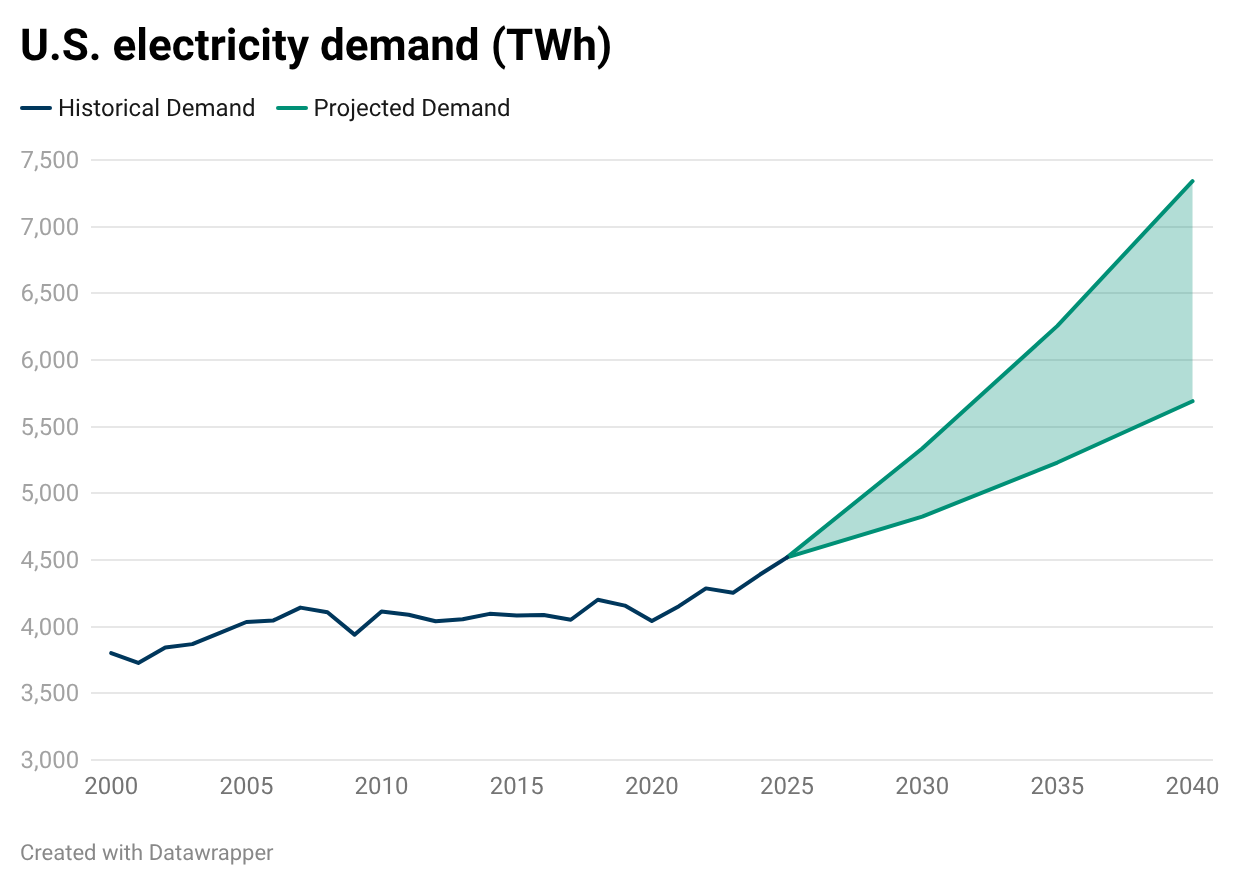
U.S. electricity demand from 2000 to 2025 (blue) in terawatt-hours (TWh) and the range of forecasts (green) by various groups. Created by Dana Nuccitelli with data from Ember, Princeton REPEAT, American Clean Power, Bank of America Institute, Enverus Intelligence Research, and McKinsey & Company
The electrification of other sectors will contribute to that rising power demand. Fortunately, there is ample clean energy available to meet it. According to Lawrence Berkeley National Lab, over 2 terawatts of power generation and storage capacity are sitting in interconnection queues, awaiting authorization to connect to the grid. Solar panels, battery storage, and wind turbines comprise nearly 90% of that capacity. For comparison, the entire U.S. power grid has about 1.4 terawatts of installed power generation capacity today.
Many of those proposed projects are merely speculative and most will never be built, but there's nevertheless a lot of clean power capacity just waiting to connect to the grid, if there were sufficient transmission lines to accommodate it. But adding that transmission capacity and processing the interconnection queue in a timely manner requires the kinds of reforms that are included in BAAJA.
It also requires reforming environmental laws like NEPA, which inhibit projects with a large geographic footprint like solar and wind farms and transmission lines more than fossil fuel projects. When transmission and solar project developers are asked which types of permits cause them the biggest delays, the vast majority answer: federal NEPA permits. This is evidenced by the fact that only 4% of renewable power generation in the U.S. comes from federal lands, despite the fact that 28% of the country, especially in the sunny, hot Southwest, is federally owned or managed.
BAAJA's impacts have been modeled by Rhodium Group, Resources for the Future (RFF), the Center for Climate and Energy Solutions (C2ES) in collaboration with Greenline Insights, and by Purdue assistant engineering professor Kevin Kircher. The former three all conservatively estimate [because it's difficult to translate legislative text into real-world changes, they only model some of BAAJA's provisions] that it will likely reduce climate pollution in the gigatons scale (billions of tons fewer cumulative tons of emissions than in the status quo) over the next two decades. They also find that the bill would improve energy affordability and security and employment.
Kircher is the outlier in projecting that passing BAAJA would result in increased climate pollution. That's because it would likely increase overall power demand and consumption, some of which he assumes would be supplied by fossil fuels. Because of this assumption, Kircher's model structurally precludes a reduction in fossil generation or emissions from a technology-neutral permitting reform package like BAAJA.
Kircher has criticized the other modeling groups for failing to account for BAAJA-induced power demand and consumption growth, by holding demand steady between their baseline and BAAJA scenarios. But Rhodium does account for higher BAAJA-induced demand and nevertheless finds that it would be met by clean sources, and that overall emissions would decline under BAAJA. How much they decline depends on how the prices of clean and fossil technologies and fuels evolve in the coming decades.
It also depends on what additional climate policies are implemented in the future. Perhaps more important than its direct emissions reductions is the fact that BAAJA would amplify the efficacy of future climate policies. For example, clean energy tax credits or carbon pollution pricing can create the financial incentive for accelerated clean energy deployments, but many energy systems modelers have noted that without permitting reforms like those in BAAJA, those clean technologies can't be deployed in a timely fashion. As Rhodium's Ben King told Heatmap News,
"If your goal is to do climate policy in the future, [BAAJA] is an important down payment to making progress there."
Over 100 social and Earth scientists signed a letter opposing BAAJA. Much of the letter centers around a disputed legal argument that's outside the signatories' expertise, and triggers memories of physicists and economists who decide to weigh in on climate science research, despite lacking expertise in the subject. But the letter is also relevant to emissions and climate policy strategy, noting:
"It is our opinion as climate and Earth scientists that, even if BAAJA reduced emissions to the degree modeled above, those reductions would not offset the bill’s codifying of coal, oil, and natural gas in the U.S. energy mix. Even reduced emissions continue to make global warming worse so long as they are ongoing."
However, all of the energy systems and economic modeling of BAAJA finds that it would either have no effect on or more likely would accelerate the ongoing decline of coal power in the United States. And all but Kircher's forecast that fossil fuels will play a bigger role in U.S. energy production under the status quo than if BAAJA becomes law. That's precisely why these modeling exercises concluded that BAAJA would reduce climate pollution compared to the status quo, which is dominated by fossil fuels. Cheap, clean energy can only displace fossil fuel production if it can be permitted and deployed quickly.
Moreover, many of the letter's signatories have said that every ton of climate pollution and every fraction of a degree matters. The modeling indicates that BAAJA would make progress toward that end, and most importantly as noted above, would amplify the efficacy of future climate policies.
This all leads to the ultimate conclusion that BAAJA is important, arguably even necessary, for the U.S. – the world's second-largest source of climate pollution and perhaps the #1 global superpower – to even come close to meeting its climate targets. Doing so requires a rapid decarbonization of the power sector, and that rapid decarbonization is not possible given the bottlenecks created by today's slow permitting processes.
Some parties have argued that Congress should wait until the next session to make a "better deal" on permitting reform, but the political conditions for such a deal in the next session appear to be considerably worse than they are today. Moreover, what's "better" is subjective, and would likely involve removing reforms to environmental laws like NEPA that are actually important for deploying clean energy projects faster. What some would consider a "better bill" would likely be worse for the climate.
It also takes several years for many of these permitting reforms to take effect, which involve slow processes like new rulemakings from the Federal Energy Regulatory Commission (FERC). Passing BAAJA today would allow these processes to unfold by the time the next president and Congress are elected and take office in 2029. Delaying would leave these constraints in place, preventing a rapid deployment of clean technologies during the next administration.
There are legitimate critiques and tradeoffs in the bill. In particular, its reforms to the NHPA erode tribal sovereignty, weaken sacred site and cultural protections, and limit Tribal consultation and judicial remedies. That being said, BAAJA does codify early and ongoing Tribal consultations that the Trump administration is in the process of gutting. Nevertheless, many (though not all) Tribal groups oppose BAAJA for valid reasons. And it will be more difficult to stop legitimately environmentally-harmful projects if the bill becomes law.
Opponents argue that BAAJA is an over-correction from a too-restrictive permitting system to a too-permissive one that will allow too many harmful projects to be built, especially with the Trump administration in office for the next two years. That may be a fair critique, but it's also important to bear in mind that climate change is a long-term problem and BAAJA will be a durable law that accelerates clean energy project deployment and emissions reductions for decades to come. Erring on the side of allowing more projects to be built may be justified given the scope of the climate crisis, which poses an immense threat to people and species and ecosystems worldwide. It would also benefit other kinds of projects that are hampered by restrictive permitting processes like public transit, affordable housing, and ecosystem restoration.
And without BAAJA, the status quo would continue to constrain clean energy deployment in the U.S. for the foreseeable future, prohibiting the world's #2 climate polluter from coming anywhere near close to meeting its climate targets.
Posted by dana1981 on Monday, 30 November, 2026

 |
The Skeptical Science website by Skeptical Science is licensed under a Creative Commons Attribution 3.0 Unported License. |