



 Arguments
Software
Resources
Comments
The Consensus Project
Translations
About
Support
Arguments
Software
Resources
Comments
The Consensus Project
Translations
About
Support







Latest Posts
- How many people does heat actually kill?
- Check out the brand-new hurricane ‘cone of uncertainty’ graphics arriving this season
- 2026 SkS Weekly Climate Change & Global Warming News Roundup #23
- SkS Housekeeping: Updating the Comments Policy
- Skeptical Science New Research for Week #23 2026
- Nobody knows the future of energy
- Fact brief - Do electric vehicles almost always have a lower carbon footprint than gasoline-powered cars?
- Solar, wind, and EVs have knocked out a doomsday climate scenario
- 2026 SkS Weekly Climate Change & Global Warming News Roundup #22
- Skeptical Science New Research for Week #22 2026
- The next era of Atlantic hurricanes could be far more destructive
- On the death of RCP8.5
- RCP8.5 Update
- 2026 SkS Weekly Climate Change & Global Warming News Roundup #21
- Skeptical Science New Research for Week #21 2026
- What’s a ‘super El Niño’? And other El Niño questions, answered
- Fact brief - Does electromagnetic radiation from wind turbines pose a threat to human health?
- Five things you need to know about El Niño’s likely comeback
- 2026 SkS Weekly Climate Change & Global Warming News Roundup #20
- Skeptical Science New Research for Week #20 2026
- Higher warming predictions for 2026 and 2027
- A look back at ‘An Inconvenient Truth,’ 20 years later
- Two videos about the Atlantic Meriodonal Overturning Circulation (AMOC)
- 2026 SkS Weekly Climate Change & Global Warming News Roundup #19
- EGU2026 - Five days of virtual learning
- Skeptical Science New Research for Week #19 2026
- Climate Adam - Climate Change is Destroying Lives... Now
- EGU2026 - Presentation about the Skeptical Science Experiment
- Fact brief - Were the 2022 whale deaths off the US East Coast caused by offshore wind development?
- 2026 SkS Weekly Climate Change & Global Warming News Roundup #18

Comment Search Results
Search for It's the sun
Comments matching the search It's the sun:
- Emergence vs Detection & Attribution
wilddouglascounty at 01:42 AM on 17 December, 2025Thank you, @8 Bob, for sharing your perspective on this issue and the climate as a causal factor. I guess I'm not sure whether its descriptive or physical when you are doing attribution of a hurricane's intensity as being caused by climate change as it seems that it has elements of both.
That aside, what I'm saying, once again to use the analogy of the juiced athlete, is that if there is a change in the constellation of factors that make them a professional athlete including years of strength and endurance training, strategic coaching, genetic predisposition, etc., along with the performance enhancing drugs, as contributing to the increased frequency of home runs, does it make sense to to talk about the athlete in general terms that includes the entire cluster of factors (physical), or the performance statistics (descriptive); OR rather does it make sense to focus on the relevant causal factor of the practice of using performance enhancing drugs as causing the changes in the athlete's performance? For clarification's sake, the changing performance of athletes in general could not really be addressed until the key causal factor, performance enhancing drugs, was identified, after which people "got it" and took actions that penalized their use.
In a similar way, yes, physical climatology has causality in a general, collective way that clusters the real causal factors "under the hood". Since there is an identifiable subset of those "under the hood" factors called "greenhouse gases," "human activity emissions," "carbon emissions from human activities, primarily fossil fuel use" or what have you, it's time to start focusing on those "performance enhancing chemicals" we're emitting as the cause of the observed changes, so that people "get it." Otherwise vested interests will just continue to spread misinformation about the other factors, such as the sunspot cycle, cosmic rays, the end of the ice age and other things they can point to also under that hood. They are not incorrect in pointing to other factors that contribute to the climate; it's just that the science is clearly pointing to the changes in the climate as being linked to the changes in the atmospheric and oceanic chemistry caused by carbon emissions.
- Climate Sensitivity
Bob Loblaw at 04:56 AM on 3 September, 2025John @ 3:
Ken may or may not respond himself here, but whenever SkS reposts his articles it is worth going to his web site to see the comments on the originals.
At the end of the original post over at Ken's, you can see that his articles are grouped into classes and tagged with various markers. Under this post ("Climate Sensitivity"), you can see that it is under the group "Climate Sensitivity", and that is also has tags for "ECS" and "Equilibrium Climate Sensitivity" (which are the same thing in terms of climate science, but different tags).
Links to those three groupings of Ken's posts are:
Equilibrium Climate Sensitivity
There are dozens hundreds of posts listed under these categories (which overlap)...
....but to answer your question ("how many?") directly, it's either:
- Too many (if you think in terms of how many times does this have to be explained before the message sinks in)
- Not enough (if you think in terms of the fact that it has not yet sunk in).
(I guess that's not really an either/or question, though. It's probably both too many and not enough.)
- Learning what's at stake with the Weather & Climate Livestream
One Planet Only Forever at 08:59 AM on 26 May, 2025Regarding: “It's not the place of Skeptical Science to tell anybody whether ignorance is strength or not, but we encourage you to learn that answer for yourself.”
Anyone wondering how ‘ignorance could be strength’ should check out the Wikipedia entry for Ignorance (linked here). It includes the following well-reasoned point:
“Ignorance can have negative effects on individuals and societies, but can also benefit them by creating within them the desire to know more. For example, ignorance within science opens the opportunity to seek knowledge and make discoveries by asking new questions. [2]”
A key requirement is for people to wonder what they are unaware of and be curious about changing their mind by becoming more aware of well-reasoned evidence-based understanding.
However, it can be challenging for people to change their mind, especially if they believe they will benefit from a misunderstanding.
Hopefully this event will cause some people who have been inclined to misunderstand things to learn that they need to stop allowing themselves to be manipulated and misled by Merchants of Misinformation (the larger group of harmful misleaders that includes the Merchants of Doubt (Wikipedia linked here) – Oreskes and Conway deserve credit for the name)
An internet search for Merchants of Misinformation will find many informative items.
Awakening from Ignorance and becoming interested in freedom from misunderstanding can be very powerful.
- Skeptical Science New Research for Week #18 2025
One Planet Only Forever at 07:24 AM on 5 May, 2025This week I read a few news items that were related to the problem presented in this week’s introduction regarding Silencing Science Tracker. Only one of them, White House dismisses authors of major climate report, from NPR, by Rebecca Hersher, Apr 29, 2025, was directly related to climate science (I submitted it to SkS and it is shared in 2025 SkS Weekly Climate Change & Global Warming News Roundup #18). The others are not about climate science, nor are they regarding ‘Research Reporting’. But I think they supplement the point about the escalation of efforts in the US by the Trump Republicans to silence science.
Scientists reel as turmoil roils National Science Foundation – NPR includes the following:
Eliminating so much of this agency's budget would be "a crisis, just a catastrophe for U.S. science," says Sudip Parikh, chief executive officer of the American Association for the Advancement of Science, one of the largest scientific societies in the world.
He's optimistic that Congress wouldn't go along with it, but the budgetary process would likely take months.
Meanwhile, the uncertainty would leave scientists fretting over how to support their labs and the students and early-career researchers who work there.
"That's created this paralysis that I think is hurting us already," says Parikh, who says that when he talks to scientists, he's starting to hear them express an interest in having an "exit plan from these jobs."
Medical journals hit with threatening letters from Justice Department – NPR includes the following quote:
"It's pretty unprecedented," says J.T. Morris, a lawyer at the Foundation for Individual Rights and Expression, a free speech advocacy group. He says the First Amendment protects medical journals.
"Who knows? We've seen this administration take all sorts of action that doesn't have a legal basis and it hasn't stopped them," Morris says. And so there's always a concern that the federal government and its officials like Ed Martin will step outside and abuse their authority and try to use the legal process and abuse the court system into compelling scientific journals and medical professionals and anybody else they disagree with into silence."
Trump says he's ending federal funding for NPR and PBS. They say he can't – NPR includes the following:
President Trump issued an executive order late Thursday directing the Corporation for Public Broadcasting's board of directors to "cease federal funding for NPR and PBS," the nation's primary public broadcasters, claiming ideological bias.
"Neither entity presents a fair, accurate or unbiased portrayal of current events to tax-paying citizens," the order says. "The CPB Board shall cancel existing direct funding to the maximum extent allowed by law and shall decline to provide future funding."
It is not clear that the president has the authority to make such orders to CPB under the law.
PBS President and CEO Paula Kerger called it a "blatantly unlawful Executive Order, issued in the middle of the night."
A common theme is the Trump Republican claims of bias (against them). It is becoming increasingly certain that ‘learning’ is biased against the interests of the Trump Republican misleading marketing machinery.
The Trump Republicans are attempting to restrict ‘research and reporting funding’, especially if it contradicts ‘their interests’. That will not produce lasting improvements. Increased awareness and improved understanding is not achieved by ‘restricting the pursuit of learning’. Lasting improvements are actually achieved by people being ‘more woke’.
Some people undeniably try to keep other people from learning. People who are less aware and misunderstand things are the basis for the popularity of unjustified beliefs supporting and excusing undeserved perceptions of superiority. Less awareness and more misunderstanding is ‘never a good thing for any group’, regardless of how beneficial it can be for people who are perceived to be the ‘winners – leaders’.
- Greenhouse effect has been falsified
Reed Coray at 11:07 AM on 2 April, 2025Bob, I haven't gone away. I apologize for the delay. I've just struggled with the process of bringing up a window into which I can enter a comment. It's only chance I have brought up some windows. I think I've figured out how to do that, so I'll get to the questions as soon as I can.
Let's see if this comment gets inposted.
In my opinion, most people who responded to my comments are missing the point I am trying to make. My point is NOT that the greenhouse effect isn’t real. [I believe the greenhouse effect is real in the sense that gases in the Earth’s atmosphere (called greenhouse gases) will absorb the energy in the infrared radiation (IR) emitted from the Earth’s surface and radiate a portion of that absorbed energy back to the Earth’s surface.] My point is that the claim: “The presence of greenhouse gases in the atmosphere increases the temperature of the Earth’s surface by trapping heat within the Earth/Earth-atmosphere system” is a denial of science.
[Note: Any misunderstanding regarding the point I’m trying to make is my fault. I did, after all, post my original comment under the thread “falsifying the greenhouse effect.” I accept responsibility and apologize for any misunderstanding my choice of thread has caused.]
Bob Loblaw wrote (01:05 AM on 31 March, 2025) “Reed Coray's argument is a pig in a poke. He's making a mountain out of a molehill. He's making a federal case out of a trivial issue. He's sweating the small stuff. He's blowing things out of proportion. It's a tempest in a teapot. It's much ado about nothing. He's giving us a song and dance. He's laying it on thick. [Aren't dictionaries fun?]”
[In the spirit of Bob’s question “Aren’t dictionaries fun?” I mention that Bob left out the phrase “his arguments are mouse nuts.” Because of this oversight, I recommend someone buy Bob a new dictionary.]
If atmospheric greenhouse gases can trap heat, then not only is it likely that all of Bob’s characterizations of my argument are appropriate, it’s worse than that--my arguments are flat wrong and can be dismissed out of hand.
If, however as I believe is the case, science says that heat can’t be trapped,
(1) Then the process of “trapping heat” doesn’t and can’t exist.
(2) If the process of “trapping heat” can’t exist, then claiming that something can or will occur as a result of “trapping heat” is a logical fallacy.
(3) Since the claim says that the Earth’s surface is warmed “by trapping heat in the Earrth/Earth-atmosphere system,” the claim contains a logical fallacy.
If the above three-step logic is valid, then any global warming argument that uses the words “trapping heat” to represent a real-world phenomenon is an argument that contains a logical fallacy. No matter how closely the real-world phenomenon agrees with the meaning of “trapping heat,” the use of the phrase “trapping heat” is a logical fallacy The magnitude of the logical fallacy may play a minor role in determining the amount of temperature change the real-world process that is called “trapping heat” can cause, but no matter how small a logical fallacy is, it is still a logical fallacy.
The SkS blog (a) implies that when discussing AGW, “denying science” is bad, and (b) claims that one technique used to “deny science” is to employ arguments that contain one or more logical fallacies. Thus, anyone who employs a logical fallacy is denying science.
If the AGW community encourages people to point out skeptic arguments that deny science, shouldn’t the skeptic community encourage people to point out AGW arguments that deny science--no matter how insignificant that denial is (e.g., pig in a poke, making a mountain out of a molehill, making a federal case out of a trivial issue, sweating the small stuff, blowing things out of proportion, tempest in a teapot, much ado about nothing, giving a song and dance, and worrying about mouse nut)?. The phrase I think that applies to the above is: “What’s sauce for the goose, is sauce for the gander.” Bob, would you check to see if see if that phrase is in your dictionary?
To end this comment, I pose six questions to all who are interested in this topic.
(1) Does science preclude the existence of “trapped heat?” Yes or No. If “No,” I’m interested in knowing the rationale behind your “No” answer.
(2) Does the fact that “trapped heat” can’t exist, prohibit “trapping heat?” Yes or No. If “No,” I’m interested in knowing the rationale behind your “No” answer.
(3) If “trapping heat” can’t exist, does the use of “trapping heat” in an argument mean the argument contains a logical fallacy? Yes or No. If “No,” I’m interested in knowing the rationale behind your “No” answer.
(4) Does the claim “The presence of greenhouse gases in the atmosphere increases the temperature of the Earth’s surface by ‘trapping heat’ within the Earth/Earth-atmosphere system” use the phrase “trapping heat?” Yes or No. If “No,” I’m interested in knowing the rationale behind your “No” answer.
(5) Does the claim “The presence of greenhouse gases in the atmosphere increases the temperature of the Earth’s surface by ‘trapping heat’ within the Earth/Earth-atmosphere system” contain a logical fallacy? Yes or No. If “No,” I’m interested in knowing the rationale behind your “No” answer.
(6) Does the fact that the claim “The presence of greenhouse gases in the atmosphere increases the temperature of the Earth’s surface by ‘trapping heat’ within the Earth/Earth-atmosphere system” contains a logical fallacy imply a denial of science? Yes or No. If “No,” I’m interested in knowing the rationale behind your “No” answer.
If you reach this point in this comment with all “Yes” answers, then we are in agreement—the claim “The presence of greenhouse gases in the atmosphere increases the temperature of the Earth’s surface by trapping heat within the Earth/Earth-atmosphere system” is a denial of science.
If you reach this point with one or more “No” answers, then we have identified the issue (or issues) that are worthy of further discussion.
Thank you for your time. - Greenhouse effect has been falsified
Bob Loblaw at 01:05 AM on 31 March, 2025Charlie_Brown @ 189:
That's a useful addition to the discussion. Humpty Dumpty may hold the point of view that "When I use a word, it means just what I choose it to mean - neither more nor less”, but in communications it is desirable that people agree on meanings. And when you start to run into technical jargon, there can be a barrier to understanding if the audience is not familiar with the jargon. You then need to explain that jargon in words that the audience does understand. That explanation can vary widely, depending on the background of the audience.
Even an object as familiar as a dictionary needs to follow this rule: you can't explain the meaning of words by using the same words. When trying to explain what a frobnitz gleabinator is, you can't just tell someone "that's a device that will gleabinate your frobnitz". If they don't know what a frobnitz is, or what gleabinating does, they are still lost.
(Homework: try grabbing your favourite dictionary and looking up the word "dictionary", to see how it manages to avoid a circular reference.)
(Homework 2: if you don't know what a "circular reference" is, try looking it up under "reference, circular".)
Reed Coray has utterly failed to explain the distinction between his undesirable "trap heat" and his preferred "warm the Earth's surface". To a lay person, these look pretty much the same. Well, to pretty much anyone, I expect they mean pretty much the same thing. Unless Reed Coray can provide a reasonable explanation of the difference, he is (as I said before) just playing word games.
The OP even goes into the inaccuracies of the term "greenhouse". (You need to read the Intermediate tab to see it.) It mentions the role of blocking convection rather than radiation in the glass greenhouse. It does not mention that plastic greenhouses can do this just as well - even though they are transparent to IR. It also doesn't point out that glass (or plastic) greenhouses also only work because they let sunlight in - just as the atmosphere does. A "greenhouse" that does not have a clear roof is just a house - and doesn't heat up the same way a greenhouse does (even though a house does block convection).
In spite of the differences between a glass greenhouse and the atmospheric "greenhouse" effect, both require the use of the physics of radiation transfer and the physics of convection in explaining how they cause warming. The analogy (look that up in your dictionary!) is useful, although the two situations are not identical.
Reed Coray's argument is a pig in a poke. He's making a mountain out of a molehill. He's making a federal case out of a trivial issue. He's sweating the small stuff. He's blowing things out of proportion. It's a tempest in a teapot. It's much ado about nothing. He's giving us a song and dance. He's laying it on thick. [Aren't dictionaries fun?]
- Climate skeptics have new favorite graph; it shows the opposite of what they claim
One Planet Only Forever at 14:28 PM on 30 March, 2025I am not surprised that the paper’s presentation of 485 million years of temperature history was irrationally misinterpreted. Some people desperately seek any excuse to maintain their harmfully incorrect beliefs about climate science, and many other matters. They can be especially desperate to prolong or increase the benefits they can get from delaying the ‘responsible, ethical and moral’ corrections of harmful developed human beliefs and behaviour that climate science has identified.
The fact that human civilization has only existed in the last 10,000 years (less than 0.002% of the length of the chart) has to be ignored by some people to maintain their desired misunderstandings.
It took me less than a minute to find the following Phys.org report from 2021: Global temperatures over last 24,000 years show today's warming 'unprecedented'. It presents details of the temperatures in that tiny right-hand end of the misunderstood chart from the 485-million-year paper. (Note that the title includes a term that some people attempt to claim does not apply to the results of modern-day human impacts on the planet).
Undeniably, many people are easily tempted to believe misunderstandings about research results like this report. And, unfortunately, some people are so passionately emotionally invested in their misunderstandings that they powerfully resist attempts to get them to care to learn that their beliefs are ‘harmfully incorrect’.
Harmfully misleading pursuers of popularity and profit like Joe Rogan (and like Musk, and Trump, and all the people who bought memberships in Trump’s Mar-a-Lago Cult) are unlikely to be influenced by efforts to get them to learn that their preferred beliefs are harmful incorrect. They will behave like the following quote from this re-posted Climate Brink story.
The furor over the graph reached its apogee in January when Joe Rogan showed it in a podcast interview with Mel Gibson, saying that “If you believe these silly people, way before human beings had ever existed, there's always this rise and fall. And this idea that the whole thing is based on carbon emissions from human beings is total bullshit. It's not true. Right. We might be having an effect, but we're having a small effect, a very small effect.”
It is tempting to say that ‘all people in a democracy’ are to blame for the results of their collective leadership elections. But that is disrespectful of everyone who tried to help others learn to be less harmful and more helpful to Others. And it excuses the harmful misleading actions of the likes of Joe Rogan (and the likes of Donald Trump and Elon Musk).
It is important to understand that ‘pure democracy’ would result in the interests of ‘the controlling majority’ being justified regardless of the undeniable harms caused by those interests. Regardless of the socioeconomic-political system, there is a significant risk of harmful abusive actions dominating (winning) unless everyone is effectively governed by learning to be less harmful and more helpful to Others.
Ideally everyone would responsibly self-govern to be less harmful and more helpful to Others. But there will always be some people who need to be ‘governed by Others’.
- Do Americans really want urban sprawl?
Eric (skeptic) at 00:47 AM on 22 March, 2025One Planet said "(internet searching will find many estimates that it costs more than $10,000 per year to be a car owner)"
Isn't that part of the same consumption problem that underlies a lot of the energy intensity of the economy? My Ford Focus has 347,000 miles and it costs about $3,600 in gas and $1,000 (give or take) in other expenses per year. 40,000 miles a year is the reason my costs are so high. Some of that mileage is to see family in New England, but some could be reduced. I know some people with lower car expenses and people with higher. The higher ones are mostly "overconsumers" IMO.
Roads for cars is indeed a problem, but you also need to consider roads for trucks including "walkable" cities. Careful design could alleviate the need for heavy trucks that wear out roads. The worst case is cement mixers with 10 tons per axle but there are alternatives if you want to be careful about road wear.
Thanks for posting the video about condo prices. It was nominally focused on "investment" when in fact all of the people involved were speculators, not investors. Also the reporter did not give a sustainability perspective. He didn't ask the question of how long hastily constructed condo buildings will last. Nor any other sustainability issues.
Your Lafluer article raises some questions when he says "There’s no reason why someone in a cul-de-sac should be forced by the zoning code to hop in his car to get a loaf of bread or grab a coffee." Why do they need a loaf of bread or coffee? Because fresh food is better tasting? People can make their own fresh bread and coffee.
The answers are pretty simple: people walk because it's healthy and it's fun to go somewhere. They might walk to get a loaf of bread in which case there are economic benefits of division of labor, energy savings (more bread from one oven), lower capital costs, etc. In my neighborhood people walk from one great view to another on a mostly wooded road.
I agree completely with Lafluer's conclusion of better planning. But planning is very complicated when you take into all life activities including the need for socializing and nature.
The first Calgary Herald article was very interesting and highlights a common problem in many older cities. Arlington Virginia is dealing with the same problem, the city leaders want more development and most residents want NIMBY. They tried ADU: www.arlnow.com/2021/06/03/accessory-dwelling-units-begin-popping-up-in-arlington-backyards/ and that didn't really work. They tried "upzoning", very similar to that CH article, with years of NIMBY pushback. The other rezoning article (Glenmore Landing) reinforces the problem: change is hard because negative impacts are easier to envision than positive ones. For example, when I walk around high rise areas in Rosslyn VA I see a lot of reflected sun. Even the simple "shade from high rise" argument against high rises is nuanced.
The "Ministry of Truth" article is of course a red herring. The issue is not true vs false, but nuance, context, and of course the big picture. Posters at meetings, two-minute speeches, and short articles in the newspaper (often just opinion pieces) mostly miss the big picture.
There are many players and interests. I consider the NIMBY arguments against rezoning to be a form of anti-growth. But they miss the big picture too because we have increasing population in most places, and real estate growth is inevitable. The most urgent need IMO is to focus on the meaning, purpose and needs of life and ignore the politicans who are in bed with the developers. I would recommend ADU (with proper inspection) and very localized redevelopment where the big developers don't participate.
- How to find climate data and science the Trump administration doesn’t want you to see
One Planet Only Forever at 08:49 AM on 25 February, 2025prove we are smart @10
I offer these ‘additional thoughts’ for consideration:
Re: “It's like the quality of our leaders has downgraded the quality of the people, aided by a media corrupted by elites/corporations.“
There is indeed a harmful feedback system created by the potential popularity of harmful misunderstandings.
The success of harmful misleaders is a serious problem. And the lack of professional responsible restrictions of behaviour in media, especially social media.
The term ‘elites/corporations’ is open to misleading uses because it is not specific about the problematic behaviours in the population.
Re: “...a system willing to sacrifice its own future, along with ours, rather than mitigate the problem. ... those holding the reins of power figure on adaptation instead, since with the increasing chaos it may bring more wealth/power opportunities and being already wealthy that bring its own privileges, so they can't lose.”
The harmful competitors ‘allowed and encouraged in a system’ also likely do not care about adaptation because that can be thought of as being a personal problem. And they likely don’t think that they will have to adapt because they won’t be living in that worse future.
Also, they likely believe that they will benefit from not having mitigation happen. Their perceived loss of benefit because of mitigation, like having to pay more to burn fossil fuels, is more than the adaptation they expect to personally have to deal with.
This is a tragedy for the common sense interest in a sustainably improved future. Many people can tragically develop a liking for thoughtlessly and destructively competing for perceived benefits and pursuing appearances of superiority relative to Others. They want over-sized, over-powered, overly-noisy personal vehicles that they can drive everywhere rather than being less harmful, especially rather than 'using public transit - yuck'.
- Sabin 33 #12 - Do solar panels work in cold or cloudy climates?
Bob Loblaw at 02:09 AM on 24 January, 2025Upstream, in comment 4, I talked about some of the aspects of solar panel installation and orientation. Words are nice, but pictures are often better, so I've graphed out some data to show some difference between clear/cloudy, winter/summer, and horizontal/tilted measurements of solar radiation.
The following graphs are a continental location, at about 50°N latitude.
All radiation graphs show five different measurements:
- The "Direct" measurement is "direct normal" - an instrument pointed directly at the sun, with a narrow field of view.
- "Diffuse" is the radiation on a horizontal surface of just the sky - direct sun blocked.
- "Global" is a full sky view (direct plus diffuse) on a horizontal surface.
- "Titled" is also direct plus diffuse, but at a 50° tilt to the south, so it sees some sky and some ground.
- "Reflected" is the same type of instrument as "Global", but upside-down so it sees all the solar radiation being reflected off the ground surface.
The first graph is a clear day at the beginning of January. Direct radiation peaks at over 900W/m2, and diffuse radiation is less than 100W/m2. Because the sun is low in the sky, the global reading is much less than the direct - peaking slightly over 300 W/m2. The tilted sensor, though, peaks at over 800 W/m2 - not only is it pointing much closer to the sun, but it also sees a lot of ground that is very bright. The reflected reading peaks at over 200W/m2 - the ground is snow covered, reflecting about 75% of the global signal, so much brighter than the deep blue sky of the diffuse signal.

Clearly, a tilted solar panel would produce much more power than a horizontal one. We can see why when we look at the solar elevation angle (how high about the plane of the panel the sun is located). This graph shows the elevation above a horizontal surface (global instrument) and tilted surface. The sun is barely 20° above the horizon of the horizontal sensor, but is over 60° above the tilted sensor's "horizon". Note that the daylight period is only about 8 hours - elevation>0° for the horizontal view. Even though the titled sensor has an elevation >0° for much longer, those "extra" hours mean nothing, as the view of the sun is blocked by the earth!

The next day, cloud moved in. Direct radiation is zero, except for a brief period in early afternoon when the clouds thinned enough to let a bit of direct sun through. The four other lines are, from highest to lowest, tilted, Global and Diffuse (virtually tied), and Reflected. With no direct sun, and a snow-covered surface that reflects most of the solar radiation, there isn't much difference between the horizontal and tilted readings.

Note that for the horizontal sensor (global) the cloudy day is not much lower than the clear day. It peaks around 250W/m2, compared to a little over 300W/m2 on the clear day.
What about summer? Here is a "mostly" clear day in early July. Direct beam peaks only slightly higher than in January, but global radiation is much higher because of the higher solar elevation. The titled sensor peaks a little higher than global - it's tilt is no longer much of an advantage over the global sensor, and the portion of ground it sees is now dark (reflecting only about 20% of the global). Diffuse is again <100W/m2.

Daylight is now more like 16 hours, though, so daily totals will be quite different from January. We also see something odd in the tilted sensor - it peaks higher than the global (horizontal) sensor, but in early morning and late afternoon, it sees less than the global sensor. In fact, at the extremes it looks like it is only seeing the diffuse radiation - no direct.
We can understand this by looking at the solar elevation again. Note that for the titled sensor, the sun "rises" much later and "sets" much earlier (elevation <0°) than for the global sensor. What is happening is that the sun rises in the NE and sets in the NW, so it is actually behind the tilted sensor, not in front of it.

And lastly, we'll look at a cloudy summer day, right on the summer solstice. We do see some direct sun getting through in the afternoon, but we can see the cloudy period that covers most of the day. We see a substantial reduction in global before noon local time (compared to the clear day). After 12pm, we see a higher value for global as the cloud thins and a bit of direct radiation makes it through the clouds. During the cloudy period, the tilted sensor is not much different than the global one - both are seeing the same diffuse radiation.

So, hopefully this helps illustrate some of the complexities related to solar panel installation and orientation. To refer back to the OP - no, cloudy skies does not mean "no solar energy". The OP is correct - the myth is busted.
This is only one location, and a few days of data. And this level of data is not readily available for most locations. But it does illustrate that installation may be dependent on local factors such as amount of cloud, type of cloud, timing during the day, etc.
- Sabin 33 #12 - Do solar panels work in cold or cloudy climates?
Bob Loblaw at 01:10 AM on 23 January, 2025Comment 1 is a classic case of David-acct engaging in whataboutism, to distract from the rebuttal that points out that cold is not a problem, and solar panels do continue to generate power even with cloudy conditions (albeit at reduced rates).
As scaddenp points out in comment 2, David-acct is essentially going off-topic. David-acct is attempting to rebut something that isn't in the OP. David-acct acknowledges this in his comment, where he says "...key data for understanding the full context is missing..." David-acct wants to expand the context, to try to make a different point. This is a case of deflection - something politicians are good at when asked a question they don't want to answer.
David-acct's first link includes this graphic:
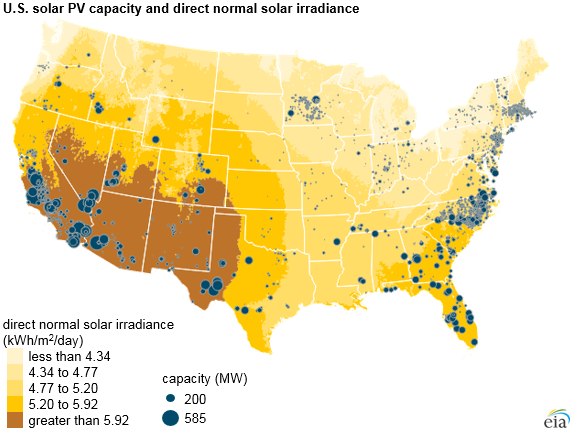
Wow. It turns out that you get more output from your solar panels where solar irradiance is higher. And solar irradiance is higher in clearer skies. Whodathunk.
Note that the graphic shows "direct normal solar irradiance". This is the strength of solar energy measured pointing an instrument with a narrow field of view (about the size of the sun) directly at the sun. The instrument used for this is the pyrheliometer. It does not include input from any of the rest of the sky (known as "diffuse radiation"). The sum of direct + diffuse gives total solar irradiance.
For any surface (the ground, a solar panel, the side of your house), you need to make a calculation to convert direct normal irradiance as measured pointing directly at the sun to an irradiance value at the orientation of the surface. The surface in question will only get the full "direct normal" value if that surface is pointing directly at the sun - e.g., the sun is directly overhead at that location for a horizontal surface (e.g. the ground), or the surface is tilted to point directly at the sun (a sun-tracking solar panel).
The graphic above does not indicate whether it's daily mean totals are corrected for a horizontal surface, or whether they represent the total available to a tracking system that always points at the sun. The use of the term "direct normal" implies the latter - "normal" is used in the geometric context of "at right angles to", and to stay at right angles to the sun's rays requires that you track the sun. If they mean the former, then they are sloppy in calling it "direct normal" - they should refer to it as "direct radiation on a horizontal surface".
And solar panels to use the non-direct radiation that comes in from the sky at angles other than the direct path to the sun. In a clear sky, this is the blue you see away from the sun, and is a small proportion of the total. In an overcast sky, diffuse radiation can be quite a bit higher than the diffuse radiation in a clear sky. And this is one of the points in the OP: just because it is cloudy does not mean that solar panels produce no power.
Another nuance in all this is that orientation of solar panels is important, to maximize the use of power available from the direct sun:
- In clear skies, a tracking system that points the panels directly at the sun (tracking both horizontally and vertically) gives maximum output.
- Under overcast conditions, you actually get the most output from a panel sitting horizontally. If it is tilted, part of what it sees is the ground, which is less bright than the overcast sky.
- For a fixed panel, you usually want to tilt it south (in the northern hemisphere) to get the best response from the high noon-time sun.
- but the best angle varies with the time of year. The sun is higher in the sky in summer.
- ...and in a specific location, you may also see seasonal differences in cloud cover, which alter the direct/diffuse rations and alter the "optimal" angle.
- ...and in some locations, there are time-of-day issues. In a location where cloud typically builds up through the day, so mornings are clear and afternoons are cloudy, you may be better off pointing your panels east rather than south.
So, there is lots to consider in siting solar panels. And all of the above is pretty well known to people studying the development of solar energy. (Granted - the details of direct versus diffuse radiation are often not measured at a lot of locations, but that does not mean that the principles are not known.)
...and lots more "context" than David-acct alludes to. I doubt he really understands how to interpret the sources he has linked to. But we're used to that now, based on his history here at SkS. At least this time he did not call it "raw data". But it is clear that - once again - he is simply trying to throw something at the wall in hope that it sticks, to discredit the statements in the OP. Once again, he's not doing a very good job.
- The forgotten story of Jimmy Carter’s White House solar panels
Eric (skeptic) at 04:23 AM on 6 January, 2025Michael Sweet, need energy numbers (GWh or TWh) for solar hot water. For example China has 7.5% capacity factor (2022 numbers) for photovoltaic solar so their GW of capacity are about half as effective as ours. Also the regions mentioned for solar hot water are more sunny than Washington DC.
Bob, yes, solar thermal collects a lot more energy from the sun than solar voltaic. Despite that it needs to be deployed cost effectively, and it is throughout the Mediterranean region, desert and west coast of the US, etc.
One Planet, thanks for the carbon price perspective. I suspect Carter, who is now being reconsidered in historical context, knew more about the costs but had to be politically pragmatic and put money into synfuel and other fossil interests. But also his Navy speciality of nuclear power, plus renewables.
Reagan cut all of it, nuclear, fossil, and renewables. That's the actual symbology of the removal of those particular panels in my opinion. They were an experiment, not very successful, but much more cost effective than photovoltaic at that time. It pointed the way to more R&D which was critical at that time. It's still critical today as always.
- CO2 effect is saturated
CallItAsItIs at 22:18 PM on 14 December, 2024- Response @855
CallitAsItIs seems quite happy to reject Kirchhoff's Law "because thermal equilibrium", but he does not reject Schwarzschild's equation for the same reason. Even though both of them require an assumption of "local thermodynamic equilibrium".
No! What I am rejecting is the climate science version of Kirchhoff's Law which says that for every photon absorbed, an identical one is emitted and vice versa, which is blatantly false! Also, a (false) implication of this "law" is absolutely rigid thermal equilibrium. Therefore, in using the climate science version of Kirchhoff's Law, we are assuming total equilibrium and not just local equilibrium. Additionally, it seems that this "law" is applied regardless of whether or not we have such equilibrium.
So, why is it that climate scientists are using this false version of Kirchhoff's Law? Well, you will have to ask them of course, but here is what I sense is happening. They need the extra photons predicted by this "law" in their model in order to predict CO2 greenhouse warming above what would otherwise be the extinction altitude. Also, it is the basis upon which they make arguments that it is energy exchanges in the higher altitudes rather than near the suface that are important for explaining climate change.
Now, I have explained these things already in previous posts, but you removed them! And it's not fair to delete my explanations and then accuse me of misunderstandings and inconsistencies when in fact I had already addressed them. So please — let's use some discretion about what's deleted so that I don't have to waste time re-posting stuff to answer peoples questions.
Response @855
So, if CallItAsItIs wants to convince anyone, he needs to put all his thoughts on this into one full, coherent, consistent explanation. Once he has written that to his own satisfaction, I hope he will re-read this entire comment thread and reflect on how each criticism he has already received applies to his explanation.
Actually, I've done this already. At this point, I have my arguments and equations pulled together but not yet quite ready for presentation. Over the last few days, I have searched for ways on how I might present this material, but haven't had any luck. BTW, what did you mean in 845 when you stated
Until such time as CallItAsItIS provides a numerical calculation of the purported effects he claims exist, and shows that it agrees with measurements, expect any and all comments from CallItAsItIs or reacting to him to be deleted.
Exactly how am I supposed to provide the material you requested? It would be impossible to post it directly onto this familiar Post-a-Comment page since my equations would have to be handled as images, and I would need at least 1200 pixels of resolution for my equations to render legibly. Post-a-Comment, however, only allows up to 450 pixels. Perhaps it would possible to submit a .pdf file to some hosting company from which SkS could access it, but I simply don't want the hassle of opening and maintaining such an account for a document that probably would not be up for long anyway. What I am willing to do, however, is to write up my results as a .pdf document and email or ftp this .pdf file to an address you provide. You can use the email address associated with my SkS account if you would like to contact me regarding this possibility.
Finally, I should add that I doubt that you or anyone else at SkS will like my results. Basically, I show rigorously from the Schwarzschild equation that I have been correct all along in my claims about CO2 absorption band saturation. Also, I resolved comments made by MA Rodger @849 about some "extra source of excited CO2". So, if you believe I am a crackpot, please send me the appropriate contact info and I will send you a .pdf file of my work so that your "scientific" staff can take some more "pot shots" at it. If, however, you don't want to risk the possibility of bad news about me being right, then don't send the contact info.
[snip]
- CO2 effect is saturated
Bob Loblaw at 01:27 AM on 2 December, 2024CallItAsItIs continues to provide assertions with no evidence. And he is also saying "it's too hard!" when asked to show his math, and shouting "Wrong!" at anyone that points out his misunderstandings.
MA Rodger is correct in comment 801, when he points out that this is grade-school level discussion. It's a continuation of CallItAsItIs's posts where he says things like "I cannot pack an entire radiometry textbook into this comment space". Long experience tells me that someone who pretends it is too complex or hard to explain things to me has reached a point where they are trying to hide their obvious lack of knowledge.
What is also glaringly obvious is that when CallItAsItIs reads pretty much anything, the only part that makes it into his mental model is any small snippet that he thinks confirms his misunderstandings. Anything else is rejected as "irrelevant".
More than once, I have referred to Schwarzschild’s equation, and linked to its discussion on Wikipedia. CallItAsItIs claims (in comment 791) "I have checked out every link and diagram that was posted, and only found two that were even remotely related to the problem I am addressing,"
So, what has CallItAsItIs's reaction to Schwarzschild’s equation? It's in comment 796 (quoted in its entirety, for context):
Wonderful! Now with your radiation expertise and Schwarzschild's equation, you surely see that the solution for spectral intensity has a term that accounts for thermal radiation (ie. blackbody) and an exponential term that vanishes at high altitudes, giving us the exact same result I have been claiming through all the ridicule. Yes, those photons are there but they are there to establish thermal equilibrium at the surrounding temperature and not for warming. I'm glad you finally see the light!.
Amazing! CallItAsItIs has noticed that Schwarzschild’s equation includes both absorption and emission of radiation. But all he sees is the bit that he thinks confirms his "theory". For reference, here is equation, as posted on Wikipedia:
If we read further, we'll note that Schwarzschild’s equation is not applied to the atmosphere as a whole, but over small volumes where local thermodynamic equilibrium applies. Reading even further, we get to a section on "Application to Climate Science" that starts with (emphasis added):
If no other fluxes change, the law of conservation of energy demands that the Earth warm (from one steady state to another) until balance is restored between inward and outward fluxes. Schwarzschild's equation alone says nothing about how much warming would be required to restore balance.
In other words, you need to combine the local aspects of Schwarzschild’s equation into a series of equations that links many layers of the atmosphere - and also includes other forms of energy transfer besides radiation. Once you have Schwarzschild’s equation, there is still work to be done. The very next sentence on Wikipedia starts this:
When meteorologists and climate scientists refer to "radiative transfer calculations" or "radiative transfer equations" (RTE), the phenomena of emission and absorption are handled by numerical integration of Schwarzschild's equation over a path through the atmosphere.
Further down, we even get a section titled "Saturation". What do we find in the first paragraph? (Again, emphasis added).
In the absence of thermal emission, wavelengths that are strongly absorbed by GHGs can be significantly attenuated within 10 m in the lower atmosphere. Those same wavelengths, however, are the ones where emission is also strongest. In an extreme case, roughly 90% of 667.5 cm−1 photons are absorbed within 1 meter by 400 ppm of CO2 at surface density,[23] but they are replaced by emission of an equal number of 667.5 cm−1 photons. The radiation field thereby maintains the blackbody intensity appropriate for the local temperature. At equilibrium, Iλ = Bλ(T) and therefore dIλ = 0 even when the density of the GHG (n) increases.
Near the bottom of the Wikipedia article we see:
The radiative forcing from doubling carbon dioxide occurs mostly on the flanks of the strongest absorption band.
There is more there that disagrees with CallItAsItIs's "reading", but his Morton's Demon is blocking that information. He does not see that Schwarzschild’s equation includes emission of radiation that he deems "irrelevant" or non-existent. He does not see the information that should tell him that the local flux of IR radiation - including emissions - will be far more than just the IR radiation that has reached that altitude from the surface. He does not see that calculations of the effect of CO2 must look at more than just the strongest absorption band (and more than just radiation).
...but we have been trying to point all this out to CallItAsItIs for a week now.
It's very, very simple. In order for CallItASItIs's "interpretation" to be correct, one must ignore huge swaths of basic physics and observations of the climate system. And CallItAsItIs has been very effective at maintaining that ignorance in his knowledge. There is a word for that.
- CO2 effect is saturated
Bob Loblaw at 00:32 AM on 28 November, 2024CallitItAsItIs @ 765 (where he responds to my request for his definition of "sources of energy"):
You are in no position to tell other people to "learn some physics". Let's start with one of your statements:
...we are trying to determine the warming of the atmosphere due to GHGs tapping energy from the terrestrial IR radiation rising from the surface. This means that the upwelling terrestrial IR radiation is the source.
Once again, you are wrong. Let's look at Trenberth's diagram again:
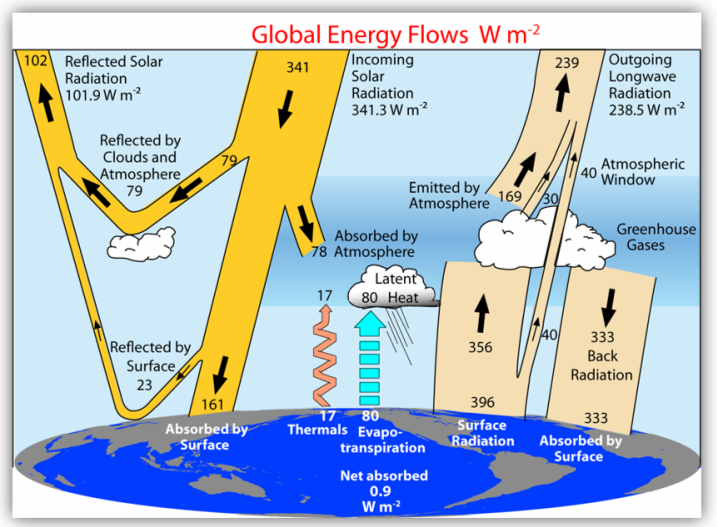
You clearly have no idea what this diagram shows. I will point specifically to two arrows in the middle of the diagram, originating at the surface. The ones labelled "Thermals" and "Evapotranspiration". Those are flows of energy from the surface ("source") to the atmosphere (sink, if you like). IR radiation (labelled "Surface radiation") is to the right, and it is not the only transfer of energy from the surface to the atmosphere.
You continue with:
The sun also is a source of energy since it puts out IR radiation which is absorbed by the GHGs and converted into thermal energy in the same manner as the terrestrial IR radiation.
Once again, you ignore anything other than IR radiation. A lot of the sun's direct warming of the atmosphere comes from absorbing non-IR radiation - visible light, and UV radiation. In fact, the main reason that the stratosphere is much warmer than the troposphere is because of UV absorption by ozone. The atmosphere is not completely transparent to visible or UV radiation.
Then you state (with respect to surface heating):
The down-welling terrestrail radiation from the atmosphere is another a source, but a much weaker one.
Look at the Trenberth diagram again. Solar radiation absorbed by the surface is 161 W/m2. (On the left side.) If you look on the right side, you see that "Back Radiation" (IR from the atmosphere to the surface) is 333 W/m2. I challenge you to find one reputable source that says 333 is "much weaker" than 161.
..and if you look closely at the IR radiation flows between the surface and the atmosphere (on the right of the diagram), you will see that the net exchange is only +23 W/m2 - the atmosphere only absorbs 356 W/m2 of the 396 W/m2 coming off the surface, but sends 333 W/m2 back to the surface. Contrast that with the 97 W/m2 (17+80) transferred from the surface to the atmosphere by thermals and evapotranspiration, and add in the 78 W/m2 of solar radiation absorbed directly by the atmosphere (in the middle of the diagram) and you get a total of 175 W/m2 of energy added to the atmosphere from sources that are not surface emission of IR radiation.
And then in your closing paragraph, you state (emphasis added):
Since the contributions to the total upwelling EMR at different frequencies involve different photons, conservation of energy must hold for each frequency independently of the others.
And this is probably the root cause of your confusion. No, conservation of energy is not something that must hold for each frequency independent of others.
Once CO2 (or any other material) absorbs a photon, the energy gets transformed into another form (thermal/kinetic, chemical, etc.) and the CO2 is free to do whatever it wants to (restricted by physics and chemistry, of course) with that energy. It can emit it as radiation in any frequency of the many it is capable of absorbing or emitting. It can keep it as kinetic (thermal) energy. It can dump it off as kinetic energy to other molecules it collides with as it bounces around in the sky.
The energy contained within the CO2 molecule has no memory of where it came from. Absorption of radiation, kinetic transfer from colliding with other molecules, etc. It's all just energy once it is stored in the molecular structure of the CO2.
Energy conservation only applies to the system as a whole. Your version of "physics" is bordering on crackpot territory.
- Skeptical Science News: The Rebuttal Update Project
Cedders at 19:08 PM on 6 October, 2024I'm glad to read that the articles are getting a systematic refresh. Anything to make the rebuttals more accessible can help effectiveness in countering myths, misunderstanding and misinformation.
There are two reasons I can think of for the new intros. People are looking for shorter tl:dr abstracts. Secondly, information can be too technical for some audiences. Unfortunately it's hard for scientifically literate writers to know what is likely to be misunderstood, deliberately or accidentally (we know frequent examples like Greenland surface mass balance). Is the new text being tested against actual occurrences of myths?
I hope there's no need to delete much text from the passage of time and it can be edited instead. Historical perspectives can help transparency. As a hypothetical example: 'Loss of Arctic sea ice seemed in the early 2010s to be happening far faster than projections, leading some people to conclude at the time that summer sea ice would be virtually gone by 2020/whenever and headlines. Ice loss has since slowed bringing it more into line with projections.'
- 2024 SkS Weekly Climate Change & Global Warming News Roundup #28
One Planet Only Forever at 08:46 AM on 15 July, 2024The Story of the Week’s focus is well summarized as:
We believe this is helpful background information for making fully joined-up decisions in an important election year. After all, in general it's best to choose leaders who reliably can see and employ crisp facts rather than spout useless ideology when administering our affairs.
Since ‘decision making’ is ‘making judgments’ the following are relevant quotes from Daniel Kahneman’s (an expert on the matter of human judgment) recent book “Noise – A Flaw in Human Judgment” (with Oliver Sibony and Cass R. Sunstein).
Quote from Chapter 18 with my additions in ( )
Judgments are less noisy and less biased when those who make them are well trained (in the subject matter of the judgment), are more intelligent (have fundamentally high levels of cognitive ability), and have the right cognitive style (are passionate about learning). In other words: good judgments depend on what you know, how well you think, and how you think (italics by the authors). Good judges tend to be experienced and smart, but they also tend to be actively open-minded and willing to learn from new information (new evidence and reasoning).
Quote from Chapter 4 about Matters of Judgment
...A matter of judgment is one with some uncertainty about the answer and where we allow for the possibility that reasonable and competent people might disagree.
But there is a limit to how much disagreement is admissible. Indeed, the word judgment is used mainly where people believe they should agree. Matters of judgment differ from matters of opinion or taste, in which unresolved differences are entirely acceptable.
Based on that ‘hard to argue against understanding’ it is important for everyone who cares to be a reasonable responsible member of society to be interested in learning from experts to be less harmful and more helpful to others, appreciate that on many matters there are strict limits on diversity of acceptable judgments (no misunderstanding), and vote according to that constantly improving understanding.
An example of diversity of options within the constraints of pursuing being less harmful and more helpful is structure design and construction (and related design codes). There are a diversity of materials, structural systems, and methods of construction that can meet a high level of safety and reliability requirements.
All political groups could also have unique approaches ad corresponding judgments while adhering to the governing objective of constantly learning to be less harmful and more helpful.
Important Note: Restricting a person’s ability to promote misunderstanding or limiting their ability to benefit more from more harmful actions is not ‘harming them’.
- The science isn't settled
Eclectic at 11:39 AM on 10 May, 2024TWFA @104 :
(Thanks ~ good timing ~ I was about to leave the house.)
Your question would be better expressed, not as "nature bringing temperature up stopped [in 1850]" . . . but rather as : nature reducing the greater downward pressure (by about 1850). Of course, from a Milankovitch-cycle aspect, we would expect the slow gradual line of temperature decline . . . to continue for about 15,000 years, until "the ice really hits the fan" . . . ;-) . . . and the world plunges deep into the next Glacial Age (a genuine Ice Age).
[ So there was no rush for humans to burn all their coal to keep the next glaciation at bay. ]
TWFA, the forcing from the sun ~ is only one factor in the big picture. And as best I currently understand it, the Little Ice Age was caused by two roughly equal factors. Those factors being (A) the Grand Solar Minima [Spoerer, Maunder, etc] . . . and [B] a period of greater frequency of major volcanic eruptions [stratospheric particulates causing cooling ]. A Grand Solar Minimum, by itself, is rather weak in its cooling effect.
The major factors causing climate change are : Albedo, Sun, Particulates, and CO2 (currently!)
Yeah, it's complicated. But the scientists have been doing good work in getting an understanding of it.
Fair to say : the science is settled enough for our current practical purposes. It is the politics of how to tackle our self-made problem . . . which is the difficult part to carry out efficiently.
- Shakun et al. Clarify the CO2-Temperature Lag
Ignorant Guy at 09:17 AM on 6 May, 2024DeeplyMoronic @158
I suspect that you misunderstands what "lag" is and how it is shown in the diagram you ask about.
First: It is not so simple that the horizontal displacement distance of the yellow curve and the blue curve is the time lag. The yellow 'curve' (collection of measurement points, rather than a curve) and the blue curve represents two quite different things (CO2 concentration vs temperature) and their respective scales are a bit arbitrary. They are selected to make the diagram easy to read with a glance. Imagine that the scale of the blue curve was selected so that it was much taller than the yellow curve. Then, if you assume that the horizontal distance was directly indicative of the lag, it would appear as the time delay was different, i e smaller. Just because of a change of scale.
Second: The concept 'lag' is a bit fuzzy. In this case we have one variable, representing a certain phenomenon, temperature, that depends on another variable , representing the phenomenon concentration of CO2. The temperature responds to changes in CO2 concentrations. This can be compared to signal theory where an out-signal responds to an in-signal. If the in-signal is a step then the out-signal is the step reponse. A typical step response starts immediately after the input but will take some time to reach its final value. In fact it will take some time before it's clearly visible - even if it really starts immediately.
See
https://en.wikipedia.org/wiki/Transient_response
and
https://en.wikipedia.org/wiki/Step_response
If the in-signal is not a perfect step (and in the real physical world it never is) then the response will look a bit more complicated and will take longer time to reach its final value.
Lots of physical system has this kind of behaviour. So in this case we have that when the CO2 concentration rather suddenly rises the temperature immediatly also start to rise, but the response takes quite a long time to finish. The climate is a very complicated physical system with all sorts of feedbacks and 'filter functions' involved so you should expect a diagram of past events to be a bit hard to read.
For our current situation we have a change in CO2 concentration that is not 'rather sudden' but very, very sudden. So we can expect that the temperature response will be visible a lot faster.
- Climate - the Movie: a hot mess of (c)old myths!
nigelj at 04:41 AM on 2 April, 2024Two Dog @55
"You make the same point I am searching for - namely that "blips" in the temperature record can be driven by natural factors. What puzzles me is others on this thread, whilst they recognize these natural impacts, appear confident that the natural factors that we are aware of are "temporal and not significant" (my words) when pitted against the powerful impact of human GHG emissions"
Nobody has claimed natural factors are all 'insignificant' forcings. Only that the natural cycles are in a cooling or flat phase in recent decades so cannot explain the recent warming trend. However the solar cycle is not a particularly powerful factor, and if it was in a warming phase it would struggle to explain more than a small amount of the recent warming. Refer to the climate myth "It's the sun" on the left hand side of this page.
"They rely on climate scientists for this - a group who are highly unlikely to admit the strength and frequency of natural factors is unpredicatble and hard to measure."
Incorrect. Climate scientists freely admit that the frequency of natural factors can be unpredictable to an extent. I provided you with data on the solar cycle, ENSO, and The PDO oscillation which depicts the degree of regularity of these cycles. You can see there is a repeating cycle bit its not perfectly regular.This data is prepared by climate scientists.
In addition whether they are not precisely predictable doesnt stop us detecting how they are affecting temperatures at any given time.
Climate scientists are quite open about accuracy of data. If you dig into the details the data has error bars. However the data has generally good accuracy. Solar irradiance in particular is meaured by satellite sensors with reasonable accuracy, and the Sorce network used since 2003 is highly accurate:
www.ngdc.noaa.gov/stp/solar/solarirrad.html
ENSO index is not that hard to measure with decent accuracy:
www.ncei.noaa.gov/access/monitoring/enso/technical-discussion
"I think this is where the climate scientists tend to differ from the physicists and geologists, whose very existance does not require them to claim knowledge of all factors that impact the climate."
Incorrect. Most climate scientists are in fact physicists, geologists, chemistry graduates etc. There is a degree in climatology, but its very recent and not many climate scientists have that degree. It typically has modules in physics and geology anyway. I suggest google it for your local university.
- Climate - the Movie: a hot mess of (c)old myths!
Bob Loblaw at 23:38 PM on 1 April, 2024diff01 @ 51,52:
If you want to apply a "modicum of reasoned thought", the answers to your questions are available if you look. Given your use of labels such as "true believers" and "sham", I doubt that your mind is open to any reasoned discussion, but here are a few pointers. Basically, your short post is kind of like the movie: a hot mess of (c)old myths.
Skeptical Science posts that are already linked in the OP:
Additional Skeptical Science posts:
I hope that if you come back with "a myriad of other questions", that you will have given them more than "a modicum of reasoned thought". So far, what you have said here suggests that your level of thought is at the "trifling" end of "modicum" (per Wictionary). Scientists, on the other had have given these issues a lot of thought.
Noun
modicum (plural modicums or (rare) modica)
A modest, small, or trifling amount.
- Climate - the Movie: a hot mess of (c)old myths!
John Mason at 20:35 PM on 1 April, 2024Re - #51 diff01:
I'll break this up into Q&A because there's a range of questions:
Q. Will changing one small ingredient (0.04%) of the earth's greenhouse gases (CO2) arrest gloabal warming (if that is what is happening)?
A. CO2 has increased 50% since pre-industrial times. Can you imagine if sunshine became 50% stronger?
Q. If the scientists(?) believe this to be the case, how will it be regulated to adjust the climate to maintain an average that is not too hot or cold?
A. We have yet to see!
Q. If all anti-carbon emitting policies were implemented, what says the climate will not be too cool?
A. Already locked into further warming for centuries.
Q. How will the climate be regulated (say changing one greenhouse gas does the trick) if the sun's intensity changes (sun spots), the reduction in carbon emission works, and it cools too much?
A. Changes in total solar irradience across a sunspot cycle are very low, but not neglibible.
Q. Another question I have is about other factor's, such as the recent eruption at Hunga Tonga. Apparently water vapor increased by 10% in the stratosphere. Won't that affect the climate?
A. It may be accoutable for a few tenths of a degree of recent warming, but research continues.
Q. What about the earth's orbit, and it's distance from the sun?
A. You are referring to Milankovitch cycles that affect three orbital parameters. However they do so over tens of thousands of years, not in a couple of centuries.
- Climate - the Movie: a hot mess of (c)old myths!
diff01 at 19:38 PM on 1 April, 2024Will changing one small ingredient (0.04%) of the earth's greenhouse gases (CO2) arrest gloabal warming (if that is what is happening)?
If the scientists(?) believe this to be the case, how will it be regulated to adjust the climate to maintain an average that is not too hot or cold?
If all anti-carbon emitting policies were implemented, what says the climate will not be too cool?
The other, obvious hole in the argument for drastic economic change in the name of cooling the planet, is that the sun is not factored into the equation (by the way, I am all for increasing efficiency and reducing waste). How will the climate be regulated (say changing one greenhouse gas does the trick) if the sun's intensity changes (sun spots), the reduction in carbon emission works, and it cools too much?
Another question I have is about other factor's, such as the recent eruption at Hunga Tonga. Apparently water vapor increased by 10% in the stratosphere.
Won't that affect the climate? How do the 'models' account for nature not doing what the computers predict?
There are a myriad of other questions. I haven't watched the movie yet, but will, with interest.
When I searched for the movie, this website popped up right under the movie heading.
It's always interesting to hear from the 'true believers'.
The whole thing is a sham of biblical proportions. You need just a modicum of reasoned thought to tell you so.
Just had a quick look at your response regarding 'the sun'.
You say the 'irradiation level' has been measured with accuracy for the last 40 years, and shown little variation.
The sun has been influencing weather on earth for 4 and a half billion years. What about the earth's orbit, and it's distance from the sun?
- Climate - the Movie: a hot mess of (c)old myths!
diff01 at 19:32 PM on 1 April, 2024Will changing one small ingredient (0.04%) of the earth's greenhouse gases (CO2) arrest gloabal warming (if that is what is happening)?
If the scientists(?) believe this to be the case, how will it be regulated to adjust the climate to maintain an average that is not too hot or cold?
If all anti-carbon emitting policies were implemented, what says the climate will not be too cool?
The other, obvious hole in the argument for drastic economic change in the name of cooling the planet, is that the sun is not factored into the equation (by the way, I am all for increasing efficiency and reducing waste). How will the climate be regulated (say changing one greenhouse gas does the trick) if the sun's intensity changes (sun spots), the reduction in carbon emission works, and it cools too much?
Another question I have is about other factor's, such as the recent eruption at Hunga Tonga. Apparently water vapor increased by 10% in the stratosphere.
Won't that affect the climate? How do the 'models' account for nature not doing what the computers predict?
There are a myriad of other questions. I haven't watched the movie yet, but will, with interest.
When I searched for the movie, this website popped up right under the movie heading.
It's always interesting to hear from the 'true believers'.
The whole thing is a sham of biblical proportions. You need just a modicum of reasoned thought to tell you so.
- 2nd law of thermodynamics contradicts greenhouse theory
Likeitwarm at 04:18 AM on 30 September, 20231600. Rob Honeycutt et al
I'll wear that name proudly!
I'm just looking for the most plausible reasons for climate change.
I have found a number of theories. You will call them all quackery because they are not your theory.
I like Peter Ward's. Scroll down the page you sent me and read Peter's responses to his challengers. He makes a lot of sense. His challengers did not prove him wrong, only disagreed with him.
What I find wrong with your version of the science is that you say the small amount(less than 8% of all IR from the surface) re-radiated IR from a colder part of the atmosphere causes warming of the surface per Trenberth chart. That cannot happen. Your radiated photons from all emitting gases carry wave length and amplitude dependent on temperature emitted from. Not enough energy to heat the surface there. Per Ward 2015 colder IR is reflected by warmer object, not destroyed.
Magically, your chart shows the down welling radiation is greater, almost double, than what the sun supplies. Satellites see 255k for the temperature that is radiated from about 5-6 km altitude, not from the surface. The surface is warmer, not from the GHE, but from gravity doing work on the atmosphere causing adiabatic heating. This is why near surface temperatures are ~33c warmer than Planck equations predict. That makes sense unlike the GHE raising the temperature that much.
There is no experiment showing co2 warms the atmosphere.
There is no measurement showing human emissions of co2 cause the recent warming.
All you have is a correlation that doesn't prove anything.
The extra UV-B radiation reaching the surface warms the ocean and the warmer ocean emits more co2 per Ward 2015 makes sense and he does have a correlation with ozone levels and temperatures. Read his paper I linked to.
I know you like labels, but get the label right.
It's "CO2 causes climate change science denier" not "climate science denier". - John F. Clauser: the latest climate science-denying physicist
Eclectic at 09:34 AM on 27 September, 2023Wbru49 @20 :
What were the points you wish to make about the Happer/Lindzen letter addressed to the U.S. Environmental Protection Agency (EPA) ~ were there any important legal or scientific aspects which are worth noting?
Based on my quick scan of it : the letter seems to be a general outpouring of all sorts of old "denialist" talking points. Not sure whether it's best described as a rant or as a "Drumpfized" Gish Gallop of nonsenses & half-truths.
Either way, it is sad to see two elderly scientists showing that peculiar degeneration of intellect which too-often accompanies "Emeritus" status. Or would be sad ~ if it weren't already Old News.
Or perhaps I have misunderstood what these two guys are up to. Are they laying the ground for an actual legal challenge to the EPA . . . or are they just venting?
- A Frank Discussion About the Propagation of Measurement Uncertainty
Bob Loblaw at 05:02 AM on 13 September, 2023MAR @ 65:
You are trying to ell me that Pat Frank misread and misunderstood something? I'm shocked, I tell you, shocked.
...but you made me go back and read some of Bevington and Robinson again, to try to see what Pat Frank was looking at and why he thinks what he thinks. [I'll forgive you for doing that, this time.]
The odd thing is that the section containing B&R's equation 4.22 is titled "Relative Uncertainties", and follows a section titled "Weighting the data - Nonuniform Uncertainties", and it is all dealing with looking at how to use statistics to determine "the most probably value" and its uncertainty. The everyday mean is "the most probably value" when all points have the same precision, but when they don't, B&R derive equations that account for that.
The B&R section on Relative Uncertainties begins with the statement "It may be that the relative values of σi are known, but the absolute magnitudes are not". And then equation 4.21 is how to estimate a weighted mean, accounting for the ratio between uncertainties. They say (about equation 4.21) that "the result depends only on the relative weights and not on the absolute magnitudes".
And, as you say, B&R then get to equation 4.22 for the "weighted average variance of the data" (not the mean), and equation 4.23 gives the expected 1/sqrt(N) relationship between the σ of the data and the σ of the mean. All this “weighted variance” stuff does not change that 1/sqrt(N) relationship.
But then, as is usual, you try to figure out where the student went wrong and do they deserve part marks, and you realize that all this stuff in this section of B&R is talking about distributions of data where errors are happening randomly. B&R talk about systematic errors as a complication, but the equations presented do not account for that. Pat Frank keeps saying "it's not random, it's systematic". At which point you say "oh, you're looking at equations that don't deal with systematic error".
And then you realize that Pat Frank's equations 4, 5, and 6 are not dealing with relative error - he has specific numbers he has claimed for the uncertainty of maximum and minimum temperature readings, and daily means. In equations 5 and 6 he is claiming that they carry on as constants ad infinitum regardless of averaging period. So you say "you're not looking at equations that should be used when you know the absolute variances".
And then he switches horses and claims that those equations have nothing to do with uncertainty or precision or whatever. He says the 0.382C is not a distribution, etc.
I only see two options:
- He really has not understood the material he has read, and is misusing what he sees, so his results are based on a misunderstanding.
- He knew what he wanted to see at the start, and has only read the references enough to find something that he thinks looks like what he wanted to begin with.
Some time, over a few beers, I'll have to tell you what I really think.
- Climate Confusion
Markp at 21:50 PM on 1 September, 2023Not sure how to respond to comments to my comment... There is no "reply" etc., featured in those comments, so I'll just say to Eclectic that I'm sorry you find my last paragraph unclear, and to Bob Loblaw and Rob Honeycutt: I'm clear on the difference between different types of "zero" CO2 scenarios, whether they imply constant concentrations or not. And Zeke's "explainer" is nice but is only a case in point: too many people simply assert that under a complete end to human emissions scenario, whereby natural uptake through oceans and trees continue drawing down CO2, heating will stop. Almost immediately. And they seem to base that belief purely on what has been modelled. And as everyone should know about models: garbage in, garbage out. The models don't reflect reality, though they try. Their inputs aren't complete, but merely partial. For example, ZECMIP is only CO2. The fact is, when we talk about hypothetically achieving no more human emissions, we're talking about a time in the future that is not tomorrow or next year or next decade, but at the very least, several decades, at least going by the extremely lazy response by humanity thus far. Correct? So by that time in the distant future, as emissions have continued, and tipping points have tipped, many things will have likely changed that our current thinking (or modeling) does not account for. So it is a bit silly to claim that temperatures will just stop IF/WHEN/? we ever manage to end human emissions, or "net" end them through the net zero concept. We place far too much reliance on models here, or rather I should say, those who are cheerleaders for net zero do.
So to Eclectic, I'm not proposing an alternative to reducing emissions. We need to reduce emissions. But that won't be enough. We also need to try the best form of SRM we can manage, which in my view is land-based mirrors, because the tech is here now, it's low tech, non-toxic, completely scalable, does not block sunlight from reaching our flora and fauna, and has an immediate effect on warming, unlike all the downstream GHG management methods.
- Skeptical Science New Research for Week #25 2023
One Planet Only Forever at 05:47 AM on 25 June, 2023Nigelj,
I am responding hoping to encourage you to read the UN document about Information Integrity on Digital Platforms.
I agree that Harari’s “21 Lessons for the 21st Century” (and “Sapiens”) are helpful presentations. I read both books a while ago. Your comment prompted me to revisit “21 Lessons ...”
“The Ecological Challenge” sub-section of the “Nationalism (Global Problems Need Global Answers)”, a chapter about the problems caused by nationalism, is aligned with the new UN initiative regarding the harm of successful disinformation production and promotion. Another tragically relevant chapter today is the “Post-Truth (Some Fake News Lasts Forever)” chapter.
The item from Harari’s book that seems most relevant to the new UN initiative is from the “Education (Change Is the Only Constant)” chapter. Though not explicitly stated, the implication is that people who resist increasing their awareness and resist improving their understanding of what is harmful and helpful to the development of sustainable improvements for the future of global humanity ‘will potentially need legal or other government actions to limit the harm done by their preference for preserving a misunderstanding or lack of awareness’.
In the chapter on Education, Harari makes the following important point:
So what should we be teaching? Many pedagogical experts argue that schools should switch to teaching “the four Cs” – critical thinking, communication, collaboration, and creativity. More broadly, they believe, schools should downplay technical skill and emphasize general-purpose life skills. Most important of all will be the ability to deal with change, learn new things, and preserve your mental balance in unfamiliar situations.
The new UN initiative regarding the harm of disinformation, misinformation and hate on digital platforms, including its further development and implementation, is a “four Cs” type of action.
I would encourage you to read the complete UN document. Though I can quickly scan a document, when reading I am usually slower than others because I tend to read every word. It took me 40 minutes to read the entire text (not reading footnotes). For comparison, the Harari sub-section on The Ecological Challenge was a 10 minute read. And it is only 1/4 of the important “Nationalism” chapter. And that entire chapter is only 6% of the book’s ‘well worth reading’ content.
Regarding your stated concern:
However I'm not too keen on governments or the news media or other organizations becoming censors of information. I read George Orwells book 1984 recently and it certainly does a good job of raising awareness of the dire consequences of governmnet and media censorship even if it's well meant.
Of course we do have some established and reasonable limits on free speech, like laws against inciting violence but they are minimal and related to law breaking. I'm talking about going beyond this.
Your concern is addressed in the UN document. Also, the interventions you are accepting are ‘interventions to limit harm done’. That is, or should be, the fundamental principle of laws and their restrictions of freedom. Tragically, I agree that sovereign national or regional governments and pursuers of profit cannot be trusted to constantly govern their law-making, regulation-creation, enforcement or other actions to limit harm done. Pursuits of popularity and profit can create interests for individuals and sub-groups of global humanity that are in conflict with correcting harmful developments and conflict with developing sustainable improvements for global humanity. Those damaging ‘developed and developing conflicts if interest’ include the potential for the sub-group of ‘all of current-day humanity’ having interests that conflict with the development of a sustainable improving future for global humanity.
So, Harari’s book is informative and exposes many important issues. However, the UN document is doing the harder work of applying the ‘four Cs’, to develop global change regarding the integrity of digital information to limit harm done. The section titled “What is the relevant international legal framework?” (page 9) addresses the matter of free speech (as do other parts of the document). It is less than a 3 minute read and opens and ends with:
The promotion of information integrity must be fully grounded in the pertinent international norms and standards, including human rights law and the principles of sovereignty and non-intervention in domestic affairs. In August 2022, I transmitted to the General Assembly a report entitled “Countering disinformation for the promotion and protection of human rights and fundamental freedoms”.15 In the report, I laid out the international human rights law that applies to dis-information, including the Universal Declaration of Human Rights and the International Covenant on Civil and Political Rights. Under these international legal instruments, everyone has the right to freedom of expression.16
...
In its resolution 76/227, adopted in 2021, the General Assembly emphasized that all forms of disinformation can negatively impact the enjoyment of human rights and fundamental freedoms, as well as the attainment of the Sustainable Development Goals. Similarly, in its resolution 49/21, adopted in 2022, the Human Rights Council affirmed that disinformation can negatively affect the enjoyment and realization of all human rights.
And the following is a quote from the beginning of the section titled “Towards a United Nations Code of Conduct UN” (page 21):
The United Nations Code of Conduct for Information Integrity on Digital Platforms, which I will put forward, would build upon the following principles:
• Commitment to information integrity
• Respect for human rights
• Support for independent media
• Increased transparency
• User empowerment
• Strengthened research and data access
• Scaled up responses
• Stronger disincentives
• Enhanced trust and safety
I encourage people who are concerned about the harm of disinformation to take the time to read the full UN document.
- Cranky Uncle: a game building resilience against climate misinformation
Rob Honeycutt at 04:49 AM on 19 June, 2023I actually take Peppers at his word thinking he actually believes these are pertinent questions to ask. I think he's likely operating at a very low level of understanding on climate science issues, thus everything seems pertinent. The problem is he's not understanding that he's asking very low level questions for which there are simple answers.
It's rather like when climate deniers say the warming is caused by the sun on the ridiculous assumption that climate scientists have never bothered to check.
All very "Cranky Uncle" stuff.
I guess it's far easier to believe there's a conspiracy rather than reading the published research to learn there's not.
- 2nd law of thermodynamics contradicts greenhouse theory
Eclectic at 13:01 PM on 13 June, 2023Likeitwarm @1550 commented: "These things are put out there by people I don't think are dummies. I wonder if they would put them out there if they knew they were wrong?" [answer: Yes, because of Cognitive Dissonance]
Thanks for the chuckle !
Yessir indeed. Even some very intelligent Denialists repeatedly put stuff out there when they know it's wrong. Over and over again, they put out there some favorite pieces of wrongness, despite repeatedly being shown wrong by scientific literature or repeatedly being shown wrong in science-based blogs such as SkS= SkepticalScience / ATTP= And Then There's Physics / etcetera.
Why do Denialists keep posting wrongness? ~ because they are angry and have huge cognitive dissonance and they indulge in Motivated Reasoning. And a small percentage are paid for such propaganda [looking at you, Heartland Institute and GWPF= Global Warming Policy Foundation ] of using half-truths & other misleading stuff.
Likeitwarm ~ there certainly is some value in reading denialist blogs such as WUWT= WattsUpWithThat , and ClimateEtc [blog by Dr Judith Curry]. You won't learn much genuine climate science there, but you will learn something of the flaws & follies of Human Nature. ~Which can be entertaining . . . as you see the persistent wrongheadedness of 90% of the commenters there.
The big question, the interesting question, is why do those people (both the intelligent ones and the moronic ones) keep on persistently misunderstanding and/or misrepresenting stuff**
** An amusing example from just a few days ago on ClimateEtc ~ a certain regular commenter stated: "many studies on sea level [show] rising for centuries at approximately the current rate" and he cited a scientific paper. When I myself accessed that paper: it showed the complete opposite picture in its very first diagram [which showed centuries of flatness followed by a spectacular "Hockey Stick" upwards trend in the past 200 years]. The original commenter's egregious error was pointed out by another commenter . . . whose post mysteriously disappeared a day later.
- 2nd law of thermodynamics contradicts greenhouse theory
John Mason at 17:38 PM on 8 June, 2023@ Likeitwarm #1533
Your dismissal of the blanket analogy - "a blanket works by preventing convection of air near and heated by conduction from my body", demonstrates a gross misunderstanding of how the human body loses heat.
If you lie outside with no clothes on on a cold day or night, your body will lose little heat due to conduction. Air is an utterly useless conductor of heat. Instread the human body loses almnost all heat by radiation - look up "radiative cooling". Then when you've done that, contemplate how frequently on winter mornings you've noticed cars covered in frost crystals but no grass frost. Some things are better at radiative cooling than others. Conduction within the metal body of the car makes sure it cools more evenly, but the cooling mechanism with respect to the surrounding air IS radiative.
Anything that blocks that radiation through the surrounding air - by any mechanism - will give you a chance of survival - hence space-blankets, carried by many outdoor folks. It's also why we wear clothes and why on a hot summer's day we wear less of them.
- At a glance - The greenhouse effect and the 2nd law of thermodynamics
Charlie_Brown at 02:56 AM on 6 May, 2023Excellent comment, Bob. Far too many words are spent on misunderstanding technical distinctions. Concepts need to be conveyed succinctly at understandable levels. That requires knowing just what is being misunderstood. Input from a non-technical person is helpful. To understand the point of view of denialists, I have been working my way through the comments on the main aarticle for this thread. I now understand Philippe's comment @8 above, (@1112 in the main thread. I just saw your reference to Manabe & Wetherald @1134 which you provided to me a little while ago. I am thinking of having another go at drafting something as input for at-a-glance. I am hopeful that I can distill and limit the 2nd law myth into something managable. It's a tall order, but maybe my 2-cents would help.
- At a glance - The greenhouse effect and the 2nd law of thermodynamics
Bob Loblaw at 23:59 PM on 5 May, 2023I think you guys are illustrating the difficulty of specialized terminology versus common usage. In day-to-day conversation, "heat" and 'energy" are almost interchangeable, but the difference is important at a technical level.
For conduction, you are still looking at bulk properties what talking about heat flow from warm to cold. Temperature only has meaning as the average kinetic energy level of a large number of molecules. Individual molecules will be transferring energy from one to another via collision, and individual collisions can transfer energy in any physical direction. It will always be from the higher energy molecule to the lower energy molecule, but that is not dictated by the bulk properties of "hot" versus "cold". It's only when you get to the average of a large number of collisions that you can say "heat/energy goes from warm to cold"
So, even "conduction" is a net transfer result. For radiation, if you have two plates facing each other with a vacuum between, the net radiative transfer will be from the hot plate to the cold plate - but there will be photons travelling in both directions. The photons emitted from the cold plate have no knowledge of the existence of the hot plate and its emitted energy. What individual photons do is not limited to matching the net result of many photons - just as individual molecular collisions are not limited to matching the net result of conduction.
The "heated by..." phrasing is also ambiguous in common usage. People can imaging being "heated by" an electric blanket that is warmer than they are. A regular blanket that is cooler than the person? "Heated by" make a little less sense, but "kept warm by" is perfectly reasonable. The use of "heated by" instead of "kept warm by" isn't enough to say that a regular blanket violates the laws of thermodynamics, though.
Likewise for IR radiation and the greenhouse effect. The surface is "heated by" back-radiation? Maybe a bit sloppy in terminology? How about "kept warmer by.."? But to make sense, you really have to get into the overall energy balance and some mathematical descriptions. The main article for this thread includes a link to an excellent post by Eli Rabbet on The Green Plate Effect. It has a loooong comments thread, but in it you can see some of the die-hard denialists at work. The extreme cases are people that claim that downward-directed IR from the atmosphere to the surface simply does not exist - usually with some "2nd Law" faulty logic involved.
As I mentioned earlier, countering a "2nd law" argument depends hugely on exactly what flavour of "2nd law" the person is claiming. The only common element is that the person making the claim has misunderstood something - what they call "2nd law" is not actually the real 2nd law..
- There is no consensus
Rob Honeycutt at 09:25 AM on 22 April, 2023Okay, let's go over this again, Albert.
The premise of the paper is as stated in the introduction.
We examined a large sample of the scientific literature on global CC, published over a 21 year period, in order to determine the level of scientific consensus that human activity is very likely causing most of the current GW (anthropogenic global warming, or AGW).
Do you honestly not see the words: human activity is very likely causing most of the current AGW?
That statement creates the fundamental basis of papers that either endorse or minimize that position.
If you're telling me that most "skeptics" agree that human activity is very likely causing most of the current GW... hey! We're good!
"It is a clear indication that only 1.6% of the papers thought that humans were causing most of warming."
Nope, precisely because categories 1, 2 and 3 all endorse the idea that human activity is very likely causing most of the current GW.
"...AMS in 2016 and it explicitly asked members if they vpbelieved humans were responsible for the majority of warming and 67% said yes."
And they also explain that most of their members were NOT experts in climate science and do not publish climate research. The greater their expertise, the greater their level of agreement, with the highest level of expertise also demonstrating ~97% agreement with the idea that human activity is very likely causing most of the current GW.
"...why Cook went to considerable lengths to hide the category numbers."
He didn't.
"I am passionate about truth in science..."
Clearly, quite the opposite.
"...I have an open mind on all matters..."
As Carl Sagan used to say, "It's good to keep an open mind, but not so much that your brain falls out." I think that perfectly describes your position in this matter.
"In the sixteenth century, 99.9% of scientists believed the Sun orbited the Earth."
No, it was 16th century scientists who were explaining to people the earth orbited the sun. Once presented within a scientific/mathematical structure, scientists of the day readily accepted this fact.
"i Won't be commenting on this thread again."
We are relieved.
- There is no consensus
Albert22804 at 09:03 AM on 22 April, 2023"a) If you had bothered to read the actual paper it's explained why the figures are organized as they are."
I have read the paper multiple times and the so called explanation groups 1,2 and 3 together and compares them to groups 5 6 and 7 and as I have said, most sceptics would be in group 3.
The "minimise" option Is a red herring as most sceptics believe in an ECS of 1.2C which is both group 3 and groups 56 and 7.
"b) Your 1.6% figure only relates to papers that explicitly quantify human contribution. With that you'd have to compare that to other papers that explicitly minimize human contribution."
Nonsense. It is a clear indication that only 1.6% of the papers thought that humans were causing most of warming.
You can't count, for example, a paper that explicitly quantifies against a paper that implicitly endorses human contribution.
Nomsense. Most sceptics who write papers would be in several categories and that is the lie in Cooks paper.
The only time that a scientific organisation has polled its members was by the AMS in 2016 and it explicitly asked members if they vpbelieved humans were responsible for the majority of warming and 67% said yes.
They didn't play the pretend game of setting up false categories and compare warmists against sceptics like Cook did.
The AMS were extremely embarrassed by this and tried to spin the result saying it was misinterpreted blah blab blah but since this no scientific body has ever dared poll their members again.
Roh you still havenot explained why Cook went to considerable lengths to hide the category numbers. It took me a couple of days to eventually figure out how to chuck the file into a spreadsheet and extract the totals.
I am passionate about truth in science, you're not, so let's just agree to disagree.
PS engaged with you on this subject because I have an open mind on all matters and wanted to read whether there were aspects of the "97%" I wasn't aware of, but your comments show me that there aren't.
Last comment
A few years ago the Australian sceptic society had a comment on their home page saying nothing was exempted from scepticism but also had a manifesto on global warming saying the science was settled and gave theit reasons.
I went through the manifesto line by line discrediting it by referring to data and submitted it. However next day it had disappeared and I contacted the editor and he said he had passed it on to "experts" to see if it was valid. He said he would get back to me but never did.
So a sceptic society now determines what you can be sceptical about. You can challenge the theories of Newton and Einstein but not the high church of climate change. That makes it a faith, not science.
Very last comment
In the sixteenth century, 99.9% of scientists believed the Sun orbited the Earth.
i Won't be commenting on this thread again.
- Solar cycles cause global warming
Bob Loblaw at 23:43 PM on 31 March, 2023As a further follow-up to the responses to retiredguy, note that the Beer et al paper mentioned in comment #60 is from 2000, when a lot of contrarians were still beating the "cosmic rays" drum pretty hard. You can read more about it here. In the past 20 years, that drum has been beaten to death.
Just over a year ago, I also did a more thorough review of another "it's the sun" paper that SkS was asked about in email. You can read that review to see where the paper went wrong. That paper argued (incorrectly) for "indirect solar effects" in an attempt to get around the weak direct effects (changes in total energy from the sun).
And finally, reading my comment #62 here in the original thread (instead of in "Recent Comments"), I see that the graph I provided is also in Comment #59.... Plus ca change...
- Solar cycles cause global warming
Bob Loblaw at 11:09 AM on 31 March, 2023retiredguy:
You have linked to the publisher's site, which only has a portion of the paper visible (along with "Access through your institution" and "Purchase PDF" buttons). Google Scholar led me to a full version here.
The first half of the paper simply reiterates a variety of reasons to expect variation in solar input to the earth system on a variety of time scales, without getting into specific solar irradiance values. They also talk about the importance of spectral variations - in addition to simple variations in total energy input.
In section 3.1, they cover "the reconstruction of the past solar irradiance". In that section, they state (emphasis added):
"Our own irradiance reconstruction is based on the frequency of the Schwabe cycle because we find a better fit with the temperature data if we assume a linear relationship between cycle frequency and irradiance (Fig. 7).
Their figure 7 is a graph of the reconstructed solar irradiance. It shows a solar irradiance value of about 1362 W/m2 in 1850, and a value of about 1366 W/m2 in 1990, for a difference of 4 W/m2. The wiggles in their reconstruction go as low as 1361 W/m2 in 1900, up to 1364 W/m2 from 1920-1950, and down to 1362 W/m2 around 1965.
Skeptical Science also has another page on "It's the sun". On that page, we see another solar irradiance reconstruction:
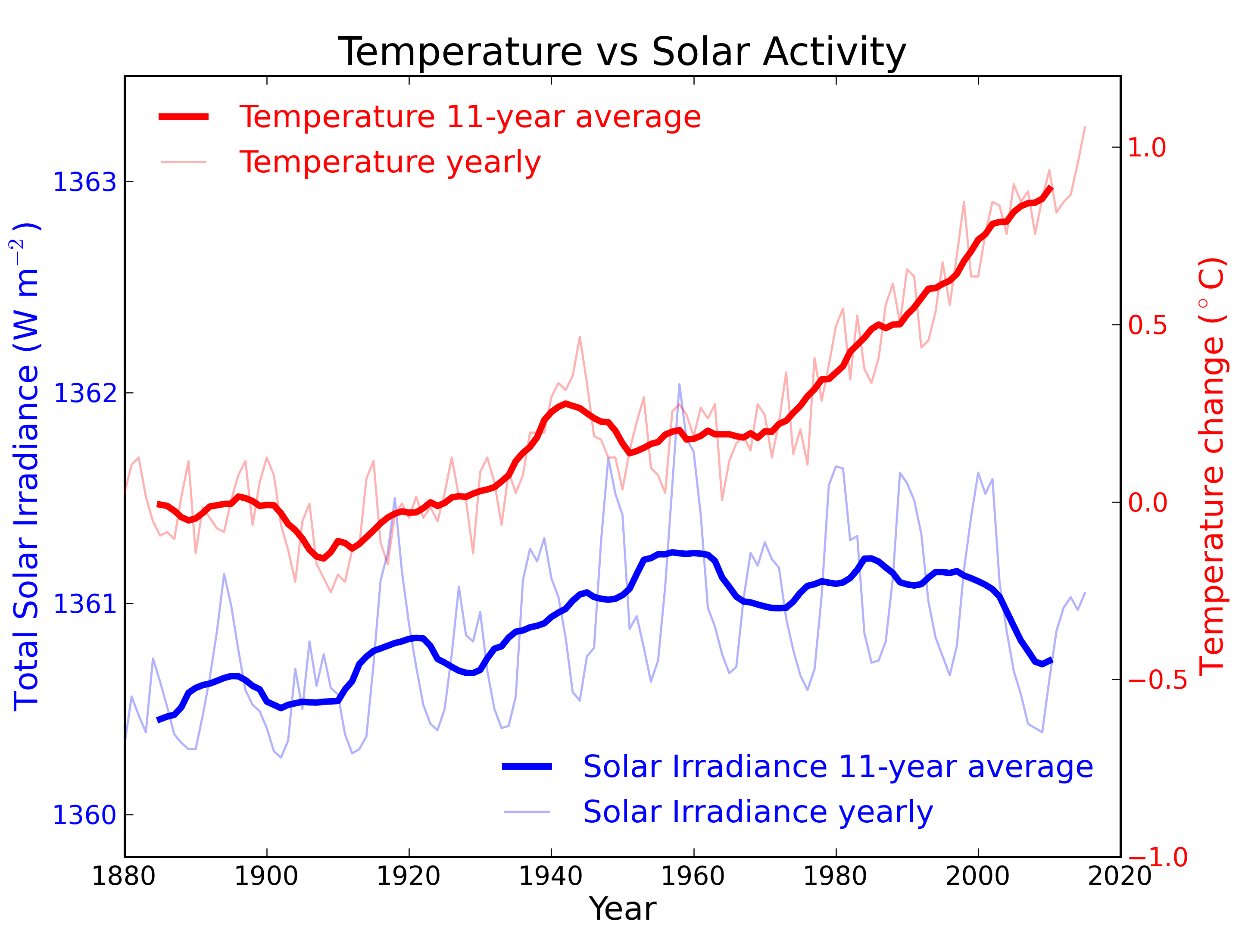
Note that the reconstruction from the paper you linked to shows much more variability and range. Their figure 7 mentions a "14-y low-pass filter", so it should probably be compared to the 11-year average in the above figure.
So, the first thing is that they have estimated a much larger change (about 4x) in solar irradiance over the 1850-1990 period than most other sources. This would explain their conclusions that solar forcing is a strong effect.
So, you have to ask, which solar reconstruction is better? Well, I think the clue is in the section I quoted and highlighted above, regarding their choice of method of reconstruction:
"...because we find a better fit with the temperature data..."
To put it bluntly, to claim that solar forcing is an important factor affecting temperature after choosing a solar reconstruction "because we find a better fit with the temperature data" is plain bad science. In all likelihood, they have erroneously fitted other causes of temperature change into their solar reconstruction, which leads to an overestimate of the magnitude and importance of solar forcing.
I notice their figure 10 is also for northern hemisphere temperature, not global. They do talk about the two hemispheres in the text, but I don't see an explanation as to why they did not use global temperature in their final evaluation.
In short, the main weakness is that they have a really bad solar irradiance reconstruction.
- The Big Picture
Bart Vreeken at 21:31 PM on 22 March, 2023N R N P @168
Shall I have a try in answering your questions? I live in The Netherlands and here we have the same kind of discussions. Excuse me in advance for my English, it seems to be horrible.
A. Changing for the worse?
I hope we do agree that the earth is warming. It's an on going process and we (science) expect that it will go on for a much longer time. So it gives a lot of changes in the climate almost everywhere.
A key point is that the continents and the oceans are warming in a different speed. The oceans are warming much slower. This has consequences. When the atmosphere warms up it can contain more water vapor. But the less warming ocean can't deliver enough water vapour to keep the more warming continents humid enough. As a result there is more risk for drought at many places.
An other thing is that the air whole circulation will change. It means that local climates can change more than the global average. Wet climates can turn to dry climates, but also the other way round. Our agriculture, infrastructure and houses are not (always) prepared for that.
As you know, a warmer climate makes the sea level rise. The warmer water in the ocean expands, the ice sheets and mountain glaciers are melting to a certain extent. This sea level rise will give a lot of problems in many coastal areas. Here in the Netherlands the protection against the sea is very well organized, we can manage the first one or one-and-a-halve meter in this century. When it gets more we have a problem, but we are already try to prepare for that. Other countries, including deltas in Asia and parts of the US are less protected and will have large problems before 2100. By the way, it's not only the sea level rise there. Many of these places have also subsidence of the land, but these two come together and the problems are coming much faster then without sea level rise.
And then there is the unpredictable part. We don't know exactly how the ice sheets will react. Maybe there are mechanisms for a quick decline of parts of the ice sheets. In that case we have less time to prepare for it.
Of course, there can also be places where the climate gets better, or at least in a part of the year. And at least, we will need less fuel for warming the houses. (but more electricity for cooling in the summer.)
An interesting point is the direct effect of the increasing CO2 level to the vegetation and the agriculture. Plants can grow faster with that. Remote sensing shows something like 'global greening'. But it's a mixture of natural response and increasing agriculture. The last thing is tricky when water recourses are limited. And as we have seen, the increasing risk for drought is a cause for concern by itself. Maybe you know the story of the Aral See?
Then your question B) changing because of human activities?
Yes, we can be sure about this. We could calculate the effect of increasing CO2 hundred years ago and it's just what happening. Other possible factors, like changing sun power don't have much effect, these changes are too small. The less known part is how the atmosphere reacts (water vapor, clouds), how the ocean circulation reacts, how ice sheets react in detail.
"C) why this time it is different than the changes that have taken place?"
The changes are going very fast now, and as I said, the houses, the infrastructure, the agriculture and the water supply are not prepared for these changes. And there is the risk for sudden, even faster changes (tipping points). - The Big Picture
One Planet Only Forever at 06:34 AM on 22 March, 2023Bart Vreeken @131,
There was no question. I was presenting an understanding based on observations of evidence in your comments. Your presented interpretation of my comments appears to support my observation in my comment @99 that:
"There is a wealth of evidence in Bart’s comment history that appears to indicate that their interests are not Big Picture. Their interests appear to be much smaller/narrower. They appear to be seeking ‘positive perceptions from the perspective of short-term regional interests’."
I have made other comments about the harm of pursuing positive perceptions because it delays learning the Truth about the Big Picture harm being done to the future of Humanity. Arguing for a 'positive, less panicked, perspective' has produced the current serious harm, and risk of more significant harm, to the future of humanity that is presented in the article I pointed to in my comment @130. Another report on that same topic is by NPR "Cut emissions quickly to save lives, scientists warn in a new U.N. report".
The harmful reality you appear try to avoid understanding, even if you present global interpretations, is not altered by speculation based on one year of heavy snow fall on Antarctica and an unsubstantiated perceived correlation between snowfall and sea ice extent, or because Greenland may only melt on its east coast (conclusions you appear to be interested in jumping to).
Also, as I presented in my comment @68, the very negative (panic level severity) of possible outcomes is what the people who benefit most from the harm need to 'mitigate'. It is important to understand that what is referred to as 'climate change impact adaptation' is mitigation required by others because of a failure of harmful people (success from their short-term limited regional interest perspective) to mitigate their harmfulness. And part of how the harmful try to justify being more harmful is by claiming that "It's not that Bad = positive perceptions that the harm is not very significant" or "Harm done is worth it because of the Perceived Positives".
The Big Picture understanding is that it is generally unacceptable to use benefits or potential benefits to excuse harm done or potential harm done. The only case where that 'may be' acceptable is a case where the individual pursuing or obtaining the benefit will be the only one suffering any harm. It does not even apply to a group because different members of a group may obtain different degrees of harm and benefit.
In spite of that undeniable Big Picture understanding regarding the importance of learning to minimize harm and help those who have been harmed, many people today try to excuse continuing to pursue more benefit from being more harmful. And part of their harmful effort is the pursuit of harmful misunderstandings or a focus on 'positive perceptions that minimize the need for helpful mitigation by reducing the perceptions of severity of harm being done' (like claiming that less fortunate people deserve to be less fortunate, or being dismissive of what is happening to places like Bangladesh).
- The Problem with Percentages
Doug Bostrom at 16:35 PM on 20 February, 2023Although they're not obvious, Evan's data sources are in the figure captions for figs. 1-3. Although OWIND is not specialized along the lines of IEA or the like, it's not pitching data ideally suitable for producing "industry propaganda." OWIND's renewables projections seem to be substantially (for the precision required here given Evan's thrust) in agreement with the IEA, which admittedly have been conservative (as has been so much else assessment in this rapidly evolving scene).
This brings us to figure 4, which shows quite a bit of daylight betwen overall demand increase and the contribution of renewables to that— back to the point Evan is making about percentages.
Michael, using the conservative IEA source (it's better to pick one, and IEA seems to be a benchmark for most discussion) and so that we can better understand: do you think the overall demand projection in fig 4 is incorrect, given that the renewables portion appears largely commensurate with IEA's projection?
I think Michael may have been typing in haste and dropped a clause when he wrote "Likewise your claim that renewables cannot generate more than 30% of all electricity was proven incorrect over 5 years ago when several countries exceeded that amount," because Evan did not make that claim.
Also and notably with regard to the latter remarks, Evan's analysis is speaking of global energy demand, supply. It's not an apples-apples critique to employ a handful of wind-heavy US states to form a comparison with what's under discussion, the global situation. Not saying Michael's wrong, but it would be better to employ broader geography— the same whole globe that is the subject of Evan's analysis. Otherwise we're talking about quite different things.
I'm pretty sure that whatever misunderstandings there are over this can easily be resolved with some collaboration. It's possible that Evan is wrong. That can more easily be established in an atmosphere of calm. I feel certain Evan would be fine with making his analysis better if such is shown necessary. Probably a good step would be to agree on data sources, make sure the subject being discussed is the same, and that what Evan is claiming is clearly understood.
- It's not bad
Eclectic at 09:29 AM on 20 February, 2023PollutionMonster @409 ,
Good luck with your battle against the science-deniers. As you have noticed, they use all sorts of poor logic and see-the-tree-but-ignore-the-forest stuff. They are emotionally driven ~ as you must be, if you wish to entertain yourself by crossing swords with them in public.
Your task of course is to persuade the onlookers, not the intransigent Denialists. My humble advice is to Keep It Simple.
A/ The observed Stratospheric Cooling is a great argument : being proof that it is not The Sun causing modern global warming. And the Stratospheric Cooling was successfully predicted by "models" of 80-ish years ago.
B/ The observed sea level rise is great proof of actual global warming (Denialists try to deflect on to the gray area of "but the rise is not accelerating" or the rubbishy "it's just rebound from the Little Ice Age".) Also you can mention the coastal measurements by Kulp & Strauss [2019] showing that a 1 meter sea level rise would displace 230 million people (Denialists hate the idea of refugees & migrants).
C/ When pressed to declare what the perfect climate is ~ I state the climate of 1950 A.D. (Easy to defend.)
These sorts of arguments suit my simple brain, and are difficult to counter by sophists, bloviators & other trollish propagandists.
- Climategate CRU emails suggest conspiracy
Bob Loblaw at 23:24 PM on 15 February, 2023JonJC, Eddie:
I suspect that the video in question is the one recently discussed on the "It's the sun" thread. MA Rodger's comment provides a link to the Curry/Peterson part of the video, with a pithy comment about the quality of Curry's blatherings.
I also suspect that there is nothing new in Curry/Peterson that isn't the result of a gross misrepresentation of the email contents. For the peer-review aspects, you should also read this SkS post on the subject:
- Global warming: a battle for evangelical Christian hearts and minds
EddieEvans at 22:17 PM on 13 February, 2023One Planet Only Forever at 05:42 AM on 13 February 2023
It's the sun
I should have read the Curry comments this morning before posting comments. Your post hits the mark.
"People who want to prolong harmful misunderstandings demand that presentations of harmful misunderstanding must be 'protected freedom of thought and expression'
Those same people declare that it is unacceptable to ridicule people who present understandably ridiculous beliefs. They have a ridiculous belief about community-building. They believe that community-building requires acceptance of harmful people who want to promote and prolong harmful misunderstanding. Ridiculing people who persist in resisting learning to change their mind about harmful misunderstandings is deemed to be 'harmfully divisive'." - It's the sun
Jim Hunt at 00:42 AM on 13 February, 2023As blind chance etc. would have it I currently find myself engaging with Judith Curry's denizens under her article about the recent joint venture with Jordan Peterson.
This is presumably the cause of some or all of the "it's the sun, stupid!" nonsense currently being promulgated in the Twittodenialosphere?
As a consequence my Arctic alter ego felt compelled to bring the following NASA article to the attention of one such Dunning-Kruger sufferer:
https://climate.nasa.gov/ask-nasa-climate/2949/why-milankovitch-orbital-cycles-cant-explain-earths-current-warming/
Elon's new thought police helpfully suggested that I might want to reconsider my attempted violation of Twitter's community guidelines:
The allegedly "offensive language" was merely echoing that of the DK sufferer in question.
What a "Brave New World" we currently inhabit!
- It's the sun
MA Rodger at 02:10 AM on 12 February, 2023The link given @1305 leads me to a bunch of YouTube adverts but if you specify a time with the link, the Curry/Peterson nonsense appears. Thus:
https://www.youtube.com/watch?v=9Q2YHGIlUDk&t=60s
Below the video there is a box that can be expanded with a 'show more' tab and that shows a list of a couple of dozen parts to the video (called Chapters) and one of these does mention things solar (which was what panhuag @1306 was asking about) 'The Challenger explosion, how the sun affects climate'. This provides the following from Curry:-
"Once you get into the sun, it's even crazier. The IPCC has pretty-much dismissed the role of the sun in the last 150 years but the interesting AR6.6 finally acknowledged the great uncertainty in the amount of solar forcing in the late 20th century and this arises from ... a gap in the satellites measuring the sun's output that occurred at the time of the Challenger shuttle disaster... So one solar sensor was running out and they were supposed to launch another one but all the launchers were put off for a number of years until they sorted out... (the launchers). So there's a so-called gap which depending on what was happening in that gap, you can tune the solar variability to high variability or low variability. So all the climate models are being run with low solar variability forcing.
For the first time in AR6.2 (2.2.1), the observational chapter acknowledges this issue, that there are huge amounts of variability.
And this doesn't even factor in the solar indirect effects.... It's not just the heat from the sun. There's a lot of issues related to UV and stratosphere and cosmic rays and magnetic fields and all these otehr things that really aren't being factored in. They're at the forefront of research but they're certainly not factored into the climate models so there are so many uncertainties out there that affect certainly the projections of what might happen in the 21st century but also our interpretation of what's been going on with the climate for the last 100 years and exactly what's been causing what.
A quick look at AR6.2.2.1 shows Curry is doing particularly well ast spouting nonsense here.
- Checklist: How to take advantage of brand-new clean energy tax credits
Bob Loblaw at 00:38 AM on 3 February, 2023nigel:
Yes, there is an important distinction between electricity production, and what the industry calls "transmission and delivery" (or "T&D").
T&D is clearly a system that is a natural monopoly. Having 20 different companies all stringing cables across the land in an attempt to sell you power would be highly inefficient. Production/generation is more flexible.
Generation, on the other hand, is very difficult to control in the context of "my customer needs power now, I will produce it and put it into the system now". It's not as though the electrons I am putting into the grid at the moment are labelled, and the same ones that are delivered to the customer that bought power from me.
So, the "free market" generation needs to follow rules and pricing variations in a controlled fashion. And the T&D system still needs to be regulated in a fashion that is fair to all.
As an electricity seller, I would obviously prefer to have my sunk capital costs spread over as much revenue-generating sales as possible, so if I can rig the rules to my advantage at the expense of my competitors, so much the better. The last thing I want is to spend money on generating capacity that sits idle most of the time.
In a "free market" that is dominated by a few large producers that have the ear of the regulators, it can be very difficult for small producers to effectively compete in the market. Hence the number of states in the U.S. that have been enacting legislation to make life difficult for small renewable power operations. The politicians are pushed by the established companies/lobbyists (usually fossil-fuel driven) who want to preserve their position.
Which goes to say that the system needs rules and regulations, and that means the government needs to be involved. And that means government involvement in trying to influence the demand side of the power/electricity equation, too.
In Canada, traditional electricity systems used to be regulated monopolies - at least within one province or major region. Some were (and still are) state-owned, while others have seen much more privatization (even the T&D side). Prices still follow a lot of regulation. We haven't gone as deeply into deregulation as some countries, but the pressures are there.
- Human CO2 is a tiny % of CO2 emissions
Doug Cannon at 09:57 AM on 28 December, 2022Rob #373, 374.
I apparently wasn't clear in my second paragraph. I'm referring to our current practice where there is always enough fossil or nuclear power available when solar or wind isn't available. This comes at no extra investment; it's sunk cost.
That scenario is the absolute best economic case for the use of renewables based on today's cost. We're eliminating the CO2 emmissions that would otherwise come from the replaced gas and it's costing us $7.61/Mwhr.
Try some other scenarios. I don't think you'll find any more favorable situation. Remember to account for the battery storage when needed.
- Human CO2 is a tiny % of CO2 emissions
Doug Cannon at 08:00 AM on 27 December, 2022RE: Rob Honeycutt 360
Here's my reference for known fossil fuel reserves
https://ourworldindata.org/grapher/years-of-fossil-fuel-reserves-left
Estimates on lithium range from 20 years to 200 years. Would be interestedto know if you have some more definitive information.
Re: Rob Honeycutt 359
If we accept the original premise above, the earth is a net absorber of 17 Gigatons annually. The land having 11 Gigatons of net absorption. So more land vegetation should provide more net absorption. The .5% is the proportion (200 million acres) of total land required to absorb the CO2 emitted by fossil fuels. I would be interested in a better analysis of this if you have one. That was the original question I presented.
Regarding your staement "it will cost less to transition to renewables than it would be to continue using FF's." That may be true for developing countries who have growing needs for power and no access to natural gas. But you shouldn't misunderstand staements that say renewables are cheaper than FF.
In the U.S. for example there is little need for added electrical power.
It would take little or no up front capital investment to continue with FF. Theoretically to totally replace The terrawatts of U.S. energy with solar and battery backup would require a $1.7trillion investment. That is no doubt not the way to proceed, but it's the cheapest renewable route.
Here's a link to eia 2020 cost of electric utilities.
https://www.eia.gov/analysis/studies/powerplants/capitalcost/pdf/capital_cost_AEO2020.pdf
For large wind turbines: base cost $1265/kw plus 35.14/kw each year
For solar PV : base cost $1313/kw plus $15.25/kw each year
For combined cycle gas: base cost $958 plus $12.20/kw each year Plus $1700/Mwhr (my estimate).
It gets complicated when you have to take into account if solar and wind have a capcity factor of 25% and 35%. So as long as we continue to use renewables with fossil backup you can just amortize the cost of renewables over 30 years and compare to FF it replaces when they're operating. If you want to completely eliminate the FF backup you have to multiply the costs of renewables by 3 or 4 and add cost of battery backup.
I don't think we should argue the economics to justify renewables. We need to argue for the benefits.
I
- We’ll keep tweeting (for now) but have also started tooting.
Rob Honeycutt at 15:09 PM on 24 December, 2022peppers @36... You seem to be suggesting I said, "Opposing views of anyone, anyone else are harmful misunderstandings, and the person needs to be inculcated and re-oriented to be less harmful/more helpful."
Again, this is gibberish, and it's most certainly nothing that I said.
- Skeptical Science New Research for Week #50 2022
peterklein at 07:12 AM on 16 December, 2022I mostly became mostly aware of the climate and global warming issue about the time that Al Gore began beating the drum (even while he continued to fly globally in his private jet). Since then, I've read about climate change and climate modeling from many sources, including ones taking the position that ‘it is not a question if it is a big-time issue, but what to do about it now, ASAP?’.
In the past few weeks, it appeared to me there has been a of articles, issued reports, and federal government activity, including recently approved legislation, related to this topic. While it obviously has been one of the major global topics for the past 3+ decades, the amount of public domain ‘heightened activity’ seems (to me) to come in waves every 4-6 months. That said, I decided to write on the topic based on what I learned and observed over time from articles, research reports, and TV/newspaper interviews.
There clearly are folks, associations, formal and informal groups, and even governments on both sides of the topic (issue). I also have seen over the decades how the need for and the flow of money sometimes (many times?) taints the results of what appear to be ‘expert-driven and expert-executed’ quantitative research. For example, in medical research some of the top 5% of researchers have been found altering their data and conclusions because of the source of their research funding, peer ‘industry’ pressure and/or pressure from senior academic administrators.
Many climate and weather-related articles state that 95+% of researchers agree on major climate changes; however (at least to me) many appear to disagree on the short-medium-longer term implications and timeframes.
What I conclude (as of now)
1. This as a very complex subject about which few experts have been correct.
2. We are learning more and more every day about this subject, and most of what we learn suggests that what we thought we knew isn't really correct or at least as perfectly accurate as many believe.
3. The U.S. alone cannot solve whatever problem exists. If we want to do something constructive, build lots of nuclear power plants ASAP (more on that to follow)!
4. Any rapid reduction in the use of fossil fuels will devastate many economies, especially those like China, India, Africa and most of Asia. Interestingly, the U.S. can probably survive a 3 or 4% reduction in carbon footprint annually over the next 15 years better than almost any country in the world, but this requires the aforementioned construction of multiple nuclear electrical generating facilities. In the rest of the world, especially the developing world, their economies will crash, and famine would ensue; not a pretty picture.
5. I am NOT a reflexive “climate denier” but rather a real-time skeptic that humans will be rendered into bacon crisps sometime in the next 50, 100 or 500+ years!
6. One reason I'm not nearly as concerned as others is my belief in the concept of ‘progress’. Look at what we accomplished as a society over the last century, over the last 50, 10, 5 and 3 years (e.g., Moore’s Law is the observation that the number of transistors on integrated circuits doubles about every two years!). It is easy to conclude that we will develop better storage batteries and better, more efficient electrical grids that will reduce our carbon footprint. I'm not so sure about China, India and the developing world!
7. So, don't put me down as a climate denier even though I do not believe that the climate is rapidly deteriorating or will rapidly deteriorate as a result of CO2 upload. Part of my calm on this subject is because I have read a lot about the ‘coefficient of correlation of CO2 and global warming, and I really don't think it's that high. I won't be around to know if I was right in being relaxed on this subject, but then I have more important things to worry about (including whether the NY Yankees can beat Houston in the ACLS playoffs, assuming they meet!).
My Net/Net (As of Now!)
I am not a researcher or a scientist, and I recognize I know far less than all there is to know on this very complex topic, and I am not a ‘climate change denier’… but, after
also reading a lot of material over the years from ‘the other side’ on this topic, I conclude it is monumentally blown out of proportion relative to those claiming: ‘the sky is falling and fast’!
• Read or skim the book by Steven Koonin: Unsettled: What Climate Science Tells Us, What It Doesn't, and Why It Matters /April 27, 2021; https://www.amazon.com/Unsettled-Climate-Science-Doesnt-Matters/dp/1950665798
• Google ‘satellite measures of temperature’; also, very revealing… see one attachment as an example.
• Look at what is happening in the Netherlands and Sri Lanka! Adherence to UN and ESG mandates are starving countries; and it appears Canada is about to go over the edge!
• None of the climate models are accurate for a whole range of reasons; the most accurate oddly enough is the Russian model but that one is even wrong by orders of magnitude!
• My absolute favorite fact is that based on data from our own governmental observation satellites: the oceans have been rising over the last 15 years at the astonishing rate of 1/8th of an inch annually; and my elementary mathematics suggests that if this rate continues, the sea will rise by an inch sometime around 2030 and by a foot in the year 2118… so, no need to buy a lifeboat if you live in Miami, Manhattan, Boston, Los Angeles, or San Francisco!
• Attached is a recent article and a Research Report summary.
Probably the most damning is the Research Report comparison of the climate model predictions from 2000, pointing to 2020 versus the actual increase in temperature that has taken place in that timeframe (Pages 9-13). It's tough going and I suggest you just read the yellow areas on Page 9 (the Abstract and Introduction, very short) and the 2 Conclusions on Page 12. But the point is someone is going to the trouble to actually analyze this data on global warming coefficients!
My Observations and Thinking
In the 1970s Time Magazine ran a cover story about our entering a new Ice Age. Sometime in the early 1990s, I recall a climate scientist sounding the first warning about global warming and the potentially disastrous consequences. He specifically predicted high temperatures and massive floods in the early 2000’s. Of course, that did not occur; however, others picked up on his concern and began to drive it forward, with Al Gore being one of the primary voices of climate concern. He often cited the work in the 1990’s of a climate scientist at Penn State University who predicted a rapid increase in temperature, supposedly occurring in 2010 and, of course, this also did not occur.
Nonetheless many scientists from various disciplines also began to warn about global warming starting in the early 2000’s. It was this growing body of ‘scientific’ concern that stimulated Al Gore's concern and his subsequent movie. It would be useful for you to go back to that and review the apocalyptic pronouncements from that time; most of which predicted dire consequences, high temperatures, massive flooding, etc. which were to occur in 10 or 12 years, certainly by 2020. None of this even closely occurred to the extent they predicted.
That said, I was still generally aware of the calamities predicted by a large and diverse body of global researchers and scientists, even though their specific predictions did not take place in the time frame or to the extent that they predicted. As a result, I become a ‘very casual student’ of climate modeling.
Over the past 15 years climate modeling has become a popular practice in universities, think-tanks and governmental organizations around the globe. Similar to medical and other research (e.g., think-tanks, etc.) I recognized that some of the work may have been driven by folks looking for grants and money to keep them and their staff busy.
A climate model is basically a multi-variate model in which the dependent variable is global temperature. All of these models try to identify the independent variables which drive change in global temperature. These independent variables range from parts per million of carbon dioxide in the atmosphere to sunspot activity, the distance of the earth from the sun, ocean temperatures, cloud cover, etc. The challenge of a multi-variant model is first to identify all of the various independent variables affecting the climate and then to estimate the percent contribution to global warming made by a change in any of these independent variables. For example, what would be the coefficient of correlation for an increase in carbon dioxide parts per million to global warming?
You might find that an interesting cocktail party question to ask your friends “what is the coefficient of correlation between the increase in carbon dioxide parts per million and the effect on global warming?” I would be shocked if any of them even understood what you were saying and flabbergasted if they could give you an intelligent answer! There are dozens of these climate models. You might be surprised that none of them has been particularly accurate if we go back 12 years to 2010, for example, and look at the prediction that the models made for global warming in ten years, by 2020, and how accurate any given model would be.
An enterprising scientist did go back and collected the predictions from a score of climate models and found that a model by scientists from Moscow University was actually closer to being accurate than any of the other models. But the point is none were accurate! They all were wrong on the high side, dramatically over predicting the actual temperature in 2020. Part of the problem was that in several of those years, there was no increase in the global temperature at all. This caused great consternation among global warming believers and the scientific community!
A particularly interesting metric relates to the rise in the level of the ocean. Several different departments in the U.S. government actually measures this important number. You might be surprised to know, as stated earlier, that over the past 15 or so years the oceans have risen at the dramatic rate of 1/8th of an inch annually. This means that if the oceans continued to rise at that level, we would see a rise of an inch in about 8 years, sometime around 2030, and a rise of a foot sometime around the year 2118. I suspect Barack Obama had seen this data and that's why he was comfortable in buying an oceanfront estate on Martha's Vineyard when his presidency ended!
The ‘Milankovitch Theory’ (a Serbian astrophysicist Milutin Milankovitch, after whom the Milankovitch Climate Theory is named, proposed about how the seasonal and latitudinal variations of solar radiation that hit the earth in different and at different times have the greatest impact on earth's changing climate patterns) states that as the earth proceeds on its orbit, and as the axis shifts, the earth warms and cools depending on where it is relative to the sun over a 100,000-year, and 40,000-year cycle. Milankovitch cycles are involved in long-term changes to Earth's climate as the cycles operate over timescales of tens of thousands or hundreds of thousands of years.
So, consider this: we did not suddenly get a lot more CO2 in the atmosphere this year than we had in 2019 (or other years!), but maybe the planet has shifted slightly as the Milankovitch Theory states, and is now a little closer to the sun, which is why we have the massive drought. Nothing man has done would suddenly make the drought so severe, but a shift in the axis or orbit bringing the planet a bit closer to the sun would. It just seems logical to me. NASA publicly says that the theory is accurate, so it seems that is the real cause; but the press and politicians will claim it is all man caused! You can shut down all oil production and junk all the vehicles, and it will not matter per the Theory! Before the mid-1800’s there were no factories or cars, but the earth cooled and warmed, glaciers formed and melted, and droughts and massive floods happened. The public is up against the education industrial complex of immense corruption!
In the various and universally wrong ‘climate models’, one of the ‘independent’ variables is similar to the Milankovitch Theory. Unfortunately, it is not to the advantage of the climate cabal to admit this or more importantly give it the importance it probably deserves.
People who are concerned about the climate often cite an ‘increase in forest fires, hurricanes, heat waves, etc. as proof of global warming’. And many climate deniers point out that most forest fires are proven to be caused by careless humans tossing cigarettes into a pile of leaves or leaving their campfire unattended, and that there has been a dramatic decrease globally on deaths caused by various climate factors. I often read from climate alarmists (journalists, politicians, friends, etc.), what I believe are ‘knee-jerk’ responses since they are not supported by meaningful and relevant data/facts, see typical comments below:
• “The skeptical climate change deniers remind me of the doctors hired by the tobacco industry to refute the charges by the lung cancer physicians that tobacco smoke causes lung cancer. The planet is experiencing unprecedented extreme climate events: droughts, fires, floods etc. and the once in 500-year catastrophic climate event seems to be happening every other year. Slow motion disasters are very difficult to deal with politically. When a 200-mph hurricane hits the east coast and causes a trillion dollars in losses then will deal with it and then climate deniers will throw in the towel!”
These above comments may be right, but to date the forecasts on timing implications across all the models are wrong! It just ‘may be’ in 3, 10 or 50 years… or in 500-5000+ before the ‘sky is falling’ devastating events directly linked to climate occur. If some of the forecasts, models were even close to accuracy to date I would feel differently.
I do not deny there are climate related changes I just don’t see any evidence their impact is anywhere near the professional researchers’ forecasts/models on their impact as well as being ‘off the charts’ different than has happened in the past 100-1000+ years.
But a larger question is “suppose various anthropogenetic actions (e.g., chiefly environmental pollution and pollutants originating in human activity like anthropogenic emissions of sulfur dioxide) are causing global warming?”. What are they, who is doing it, and what do we do about it? The first thing one must do is recognize that this is a global problem and that therefore the actions of any one country has an effect on the overall climate depending upon its population and actions. Many in the United States focus intensely upon reducing carbon emissions in the U.S. when of course the U.S. is only 5% of the world population. We are however responsible for a disproportionate part of the global carbon footprint; we contribute about 12%. The good news is that the U.S. has dramatically reduced its share of the global carbon footprint over the past 20 years and doing so while dramatically increasing our GDP (up until the 1st Half of 2022).
Many factors have contributed to the relative reduction of the U.S. carbon footprint. Chief among these are much more efficient automobiles and the switch from coal-driven electric generation plants to those driven by natural gas, a much cleaner fossil fuel.
While the U.S. is reducing its carbon footprint more than any other country in the world, China has dramatically increased its carbon footprint and now contributes about 30% of the carbon expelled into the atmosphere. China is also building 100 coal-fired plants!
Additional facts, verified by multiple sources including SNOPES, the U.,S. government, engineering firms, etc.:
• No big signatories to the Paris Accord are now complying; the U.S. is out-performing all of them.
• EU is building 28 new coal plants; Germany gets 40% of its power from 84 coal plants; Turkey is building 93 new coal plants, India 446, South Korea 26, Japan 45, China has 2363 coal plants and is building 1174 new ones; the U.S. has 15 and is building no new ones and will close about 15 coal plants.
• Real cost example: Windmills need power plants run on gas for backup; building one windmill needs 1100 tons of concrete & rebar, 370 tons of steel, 1000 lbs of mined minerals (e.g., rare earths, iron and copper) + very long transmission lines (lots of copper & rubber covering for those) + many transmission towers… rare earths come from the Uighur areas of China (who use slave labor), cobalt comes from places using child labor and use lots of oil to run required rock crushers... all to build one windmill! One windmill also has a back-up, inefficient, partially running, gas-powered generating plant to keep the grid functioning! To make enough power to really matter, we need millions of acres of land & water, filled with windmills which consume habitats & generate light distortions and some noise, which can create health issues for humans and animals living near a windmill (this leaves out thousands of dead eagles and other birds).
• So, if we want to decrease the carbon footprint on the assumption that this is what is driving the rise in the sea levels (see POV that sea levels are not rising at: www.tiktok.com/t/ZTRChoNTg) and any increase in global temperature, we need to figure out how to convince China, India and the rest of the world from fouling the air with fossil fuels. In fact, if the U.S. wanted to dramatically reduce its own carbon footprint, we would immediately begin building 30 new nuclear electrical generating plants around the country! France produces about 85% of its electrical power from its nuclear-driven generators. Separately, but related, do your own homework on fossil fuels (e.g., oil) versus electric; especially on the big-time move to electric and hybrid vehicles. Engineering analyses show you need to drive an electric car about 22 years (a hybrid car about 15-18 years) to breakeven on the savings versus the cost involved in using fossil fuels needed to manufacture, distribute and maintain an electric car! Also, see page 14 on the availability inside the U.S. of oil to offset what the U.S. purchases from the middle east and elsewhere, without building the Keystone pipeline from Canada.
Two 4-5-minute videos* on the climate change/C02/new green deal issue, in my opinion, should be required viewing in every high school and college; minimally because it provides perspective and data on the ‘other’ side of the issue while the public gets bombarded almost daily by the ‘sky is falling now or soon’ side on climate change!
* https://www.prageru.com/video/is-there-really-a-climate-emergency and
https://www.prageru.com/video/climate-change-whats-so-alarming - Skeptical Science New Research for Week #43 2022
Art Vandelay at 16:55 PM on 9 November, 2022MA Rodger @ 23.. "The carbon cycle is estimated to include an annual 120Gt(C) flux from the biosphere to the atmosphere suggesting human beings provide directly 0.6% of that flux. This is far smaller than the proportion being bandied about by commenter Art Vandelay."
That's a misundersting on your part. I expressed CO2 from human respiration as a percentage of human emissions, not total flux.
Above and beyond the use of fossil fuels, the impact of humanity indirectly on the size of that 120Gt(C) flux (by replacing natural ecosystems with agriculture & pasture) and any resulting impact that change in size would have on the CO2 levels in the atmosphere is seperate consideration which is yet to be properly set out by commenter Art Vandelay."
There's no shortage of published studies, and some have shown that as much as a third of atmospheric CO2 the result of human activity other than fossil fuel combustion. I would hope that the significance of this would be embraced as we move away from fossil fuel consumption, and with certainty of population growth and a further 6 billion added to a 'developed world'.
"Feel free to continue to flaunt your ignorance."
And lets all feel free to discuss with civility and respect.
One planet Only @ 25..
"But the rate of fossil fuel use, along with other human activity impacts (not the exhaling of CO2 which is simply a small part of the already established carbon cycle) is undeniably causing a significant increase of CO2 levels in the atmosphere and related global warming and related climate changes."
Of course it is, and that's why there's a global focus and commitment to remedy that situation.
The better way to make the point may be that what Art claims to have learned from a Professor of Geology is potentially Art fooling themself about the matter.
For what it's worth, the same geologist is also of the view that cows are a contributing factor to climate change, even though they too, like us, are part of the natural carbon cycle. Assuming the number of cattle is static their contribution to rising greenhouse gas is zero.
So are cows a problem or not?
- 2022 SkS Weekly Climate Change & Global Warming News Roundup #37
Eagle the Greek at 05:23 AM on 6 October, 2022As a Greenhouse gas, CO2 makes life possible on Earth but also threatens it's inhabitants with extinction. Both side of the argument have big misunderstandings on this issue and that's what makes things really frightening. To see a US Senator babble about what the"ideal temperature" is without realizing that it is ∆T, is, the rate of change is of crucial importance. We are still in a glacial period and we need to learn more about being able to control the Earth's climate.
- There's no tropospheric hot spot
Cedders at 21:46 PM on 19 August, 2022Hello again. I hope this is a reasonable place to post a potential new myth or misunderstanding related to the upper atmosphere, which I read in a pamphlet by a noted contrarian (brother of a UK politician; a PDF is online and an earlier version found on a Reading University student debating blog). The confusing tract is almost entirely myths already covered on SkS, confusions of carbon stocks and flows, graphs of Antarctic CO₂ lag, faulty logic of causation, a proposal that increases in atmospheric CO₂ are a reaction to the MWP and coming from the oceans, and an incomprehensible suggestion that back radiation doesn't conserve energy. Then it mentions lapse rate and emission layer displacement but that 'this model also says that with more CO₂ the upper atmosphere at a certain level will get warmer ... the hotspot turned out to be a coldspot!'
Now it's not clear how the auithor made that connection; maybe it was the both emission layer displacement and 'hotspot' involve temperature lapse rate. I understand, as explained on the intermediate page here, that the negative lapse rate feedback is due to increased evaporation and latent heat transport from warming oceans, not directly related to CO₂. The pamphlet then ventures three reasons for the alleged inconsistency of model with experiment, never mind that it's actually consistent: these include changes in lapse rate curve (actually the basis of the hotspot), that 'transpiration cooling by plants... increases with CO₂' (the reverse is true, surely?), and then something that I can't verify one way or the other:
In the real atmosphere there are day/night temperature fluctuations (eg in upper atmosphere). They are larger with more CO₂ because CO₂ (infra red absorber / emitter) gains & looses [sic] heat easier than N₂ & O₂ and so enables all the air to adjust quicker.
So translating into my terminology, the idea is that diurnal temperature range at the top of atmosphere increases with CO₂ and contributes to temperature heterogeneity, total outgoing flux and negative Planck feedback. As GHG concentration increases, the effective top of atmosphere rises to less dense air, correct? (Which means daytime air might lose a similar amount of energy initially, but cool faster but then need mixing from lower layers to continue the same radiative flux to space. Or something.) So could it be a valid interpretation? My reponse would be that any such effect is covered in GCM models, but it would be quite difficult to pull it out and quantify it as a separate effect. It seems it might be a small negative feedback on the first-order effect, but is the logic of the speculation sound? Diurnal temperature variation at the surface will decrease with CO₂: will it decrease or increase or stay the same at height? Thanks for any references or insight.
- Skeptical Science New Research for Week #32 2022
JasonChen at 12:01 PM on 18 August, 2022I'm still not clear whom you're debunking. The initial reference was "a globalist elite promoting CC as part of a Great Reset." It seems pretty easy to identify factions meeting all four criteria. They need not be secret, nor coordinated, and like all of us they will have a gamut of motivations from the practical to the ideological. There need not be any org chart, no overarching organization, no mastermind coordinating the planet to make the Reset Great again.
Specifically, what articles are you expecting to see that you're not? The media distorts and misuses climate research constantly and everywhere. "Sunny day could be linked to climate change." "Experts shocked by latest findings." "It's even worse than we thought!" I wouldn't expect academic journals to publish letters from aggrieved researchers done wrong by the Washington Post. Nor exposés of the narrative advanced in the IPCC reports.
- CO2 effect is saturated
Eclectic at 12:55 PM on 6 August, 2022My apologies, OldHickory @646 and prior ~ but I am having difficulty understanding exactly where you think the climate scientists are wrong about the physics of climate. And it's likely that other readers are sharing my difficulty.
Please explain yourself more clearly. You seem to be ignoring the effect of the atmospheric Lapse Rate, which is so crucial to the mechanism of "greenhouse".
And infra-red photons from the planetary surface can only go a short distance before being absorbed by a CO2 or H2O molecule. Most of those photons would not even reach the rooftop of your house. So in that sense you can say that the lower atmosphere is "saturated" for CO2 , H2O etcetera ~ and it would be "saturated" whether the CO2 level were 200ppm or 400ppm or 800ppm or 1600ppm.
But the concentration level of greenhouse gasses at the bottom of our atmosphere will directly affect the concentration level near the TOA, and the TOA (for each specific gas) is the level where the infra-red is radiated out into space. The lower levels of air have a colossal re-cycling of IR photon energy . . . but what ultimately matters is the temperature of the TOA level. Because that is the level from which our planet loses (to space) the heat energy being gained from the sun. (Here I am disregarding the directly reflected sunlight from Earth's surface; and also the small portion being the IR "window" where IR of that wavelength that can pass directly through the air & clouds).
And the TOA temperature is dependent on the Lapse Rate. Conversely, the Lapse Rate determines the surface temperature, if you care to think about it in that way.
- 2nd law of thermodynamics contradicts greenhouse theory
grindupBaker at 03:06 AM on 15 July, 2022The underlying heat-adjustment effect works like this:
---------
"GREENHOUSE EFFECT", TRYING TO WARM IF THE QUANTITY INCREASES
- The "greenhouse effect" in Earth's troposphere operates like this: Some of the "LWR" aka "infrared" radiation heading up gets absorbed into cloud above instead of going to space so that's the "heat trapping" effect of a cloud. The top portion of the cloud radiates up some of the LWR radiation that's manufactured inside the cloud but it's less amount than the LWR that was absorbed into the bottom of the cloud because the cloud top is colder than below the cloud and colder things radiate less than warmer things. That is PRECISELY the "greenhouse effect" in Earth's troposphere. It's the "greenhouse effect" of liquid "water" and solid "ice" in that example. You can see that "greenhouse effect" of liquid "water" and solid "ice" for all the various places on Earth from CERES satellite instrument at https://www.youtube.com/watch?v=kE1VBCt8GLc at 7:50. It's the pink one labelled "Longwave....26.2 w / m**2" so cloud globally has a "greenhouse effect" of 26.2 w / m**2.
- Solids in the troposphere have the exact same effect as the "cloud greenhouse effect" above for the exact same reason.
- Infrared-active gases in the troposphere (H2O gas, CO2, CH4, N2O, O3, CFCs) have the exact same effect as the "cloud greenhouse effect" above for the exact same reason. Non infrared-active gases in the troposphere (N2, O2, Ar) have no "greenhouse effect" because their molecule is too simple to get the vibrational kinetic energy by absorbing a photon of LWR radiation or by collision. The "greenhouse effect" really is that simple, and it's utterly 100% certain.
---------
SUNSHINE REFLECTION EFFECT, TRYING TO COOL IF THE QUANTITY INCREASES
- Clouds (liquid "water" and solid "ice") absorb & reflect some sunlight and the "reflect" part has an attempt-to-cool effect, which has nothing whatsoever to do with the "greenhouse effect". You can see that "sunlight reflection attempt-to-cool effect" of liquid "water" and solid "ice" for all the various places on Earth from CERES satellite instrument at https://www.youtube.com/watch?v=kE1VBCt8GLc at 7:50. It's the blue one labelled "Shortwave....-47.3 w / m**2" so cloud globally has a sunshine reflection effect of 47.3 w / m**2.
- Solids in the troposphere absorb & reflect some sunlight and the "reflect" part has an attempt-to-cool effect, which has nothing whatsoever to do with the "greenhouse effect".
- Infrared-active gases in the troposphere (H2O gas, CO2, CH4, N2O, O3, CFCs) do not absorb or reflect any sunlight (minor note: except a tiny portion in the high-frequency ultraviolet where O2 & O3 has absorbed most of it already in the stratosphere above the troposphere).
---------
NET EFFECT OF THE 2 ENTIRELY-DIFFERENT EFFECTS DESCRIBED ABOVE
- The net result of the 2 entirely-different "cloud" effects is that clouds have a net cooling effect of 21.1 w / m**2 as seen in the blue-hues pictorial at left on screen at either of my 2 GooglesTubes links above.
- The net result for solids in the troposphere is a net cooling effect because the change in this effect by humans is the "global dimming" atmospheric aerosols air pollution effect and that's a cooling effect (separate from its cloud change effect).
- The net result for infrared-active gases in the troposphere (H2O gas, CO2, CH4, N2O, O3, CFCs) is a warming effect because their 2nd effect above is negligible, essentially zero.
---------
Cartoons or text that describe a "greenhouse effect" in which photons from the surface are absorbed by infrared-active gas molecules and then are re-emitted with 50% of it going down and warming the surface are incorrect because they do not include a tropospheric temperature lapse rate which is an absolute requirement. Explanations of the "greenhouse effect" which include phrases like "the radiation from the surface does not directly heat the atmosphere" are incorrect because there are simple laboratory experiments which prove that infrared radiation does indeed heat the CO2 infrared-active gas and its surroundings (which means, of course, that molecular vibrational kinetic energy is converted on collision to molecular translational kinetic energy before it happened to "thermally relax" and emit a photon and thus no photon was "re-emitted" in that case).
++++++++++
Cloudy winter nights don't cool as much as clear-sky winter nights. It is PRECISELY the "greenhouse effect" in Earth's troposphere which causes that. - Skeptical Science New Research for Week #21 2022
Doug Bostrom at 04:29 AM on 30 May, 2022"So much of the harmful misunderstanding in 2012 is alive and kicking harder today."
An observation supported by hard data.
We log accesses to our rebuttals coming in via Facebook. We can't tell who is referring to our stuff but we see the usage. It is truly amazing to see what's in play in the public mind; the oldest and most shopworn rubbish is still "debated," judging from resources people on FB are drawing upon.
For the "lifer" doing this crazy work it's all too easy to think of an issue as done-and-dusted, if only from sheer boredom over "rinse, repeat" ad nauseam.
- The Climate Shell Game
Eric (skeptic) at 11:28 AM on 26 March, 2022michael sweet @50
The poor are building out renewable energy in many locations. Why build a coal generator when renewable energy is much cheaper? Why build out central facilities wheen distributed generation (like PV) is much cheaper? You guys need to read the literature and give up on the fossil fuel propaganda.
I assume you mean undeveloped countries? Or people who are actually poor? Coal is being built out because, apparently, it's been easier to get the financing for them from China:
Perceptions of coal for baseload reliability and low cost seem to be the driving factors, but biased by the availability of financing for coal.
I looked through the Connelly link you provided, but that solution was for wealthy Europe. Then clicked from that page to Jacobsen: Matching demand with supply at low cost in 139 countries among 20 world regions with 100% intermittent wind, water, and sunlight (WWS) for all purposes
Seems like that would speak to your claim which I quoted above. Haiti is poor and would have less than 10 cents average electric cost with 65% solar PV (nameplate, table 2). Table 3 shows Haiti with a mainly flexible load (my point earlier). Seems practical and fairly reasonably priced. But "much cheaper"? I don't see that.
Please note I am not promoting coal, just stating the facts of where coal is headed (e.g. as shown by endcoal.org).
- The Climate Shell Game
jan21405 at 01:24 AM on 25 March, 2022@Evan #31
Many power utilities will certify that they use "green energy credits" to ensure the power used for cars comes from renewables.
People are often subject to tempting keywords. 100% certainty that your electrical outlet is currently supplying electricity from "green sources" is only if your house is off-grid + connected to your PVe/Wind/Hydro power production system. Otherwise, your distribution company supplies a mix of energy from sources that are currently providing this energy. Just to be sure.
Also, getting a lot of EV's on the road sends the right signal to the company's making them and to the company's powering them. Hard to know where to start, but I think we need to just jump in and get things going whereever we can.
Shouldn't this discussion be scientific? This is just a chaotic shooting into a dark approach. No hypothesis verification.
I think they call this the chicken or the egg problem. :-)
For common people - yes.
If you want to run a stable distribution grid you need:
- the stable source of energy production for 24/7/365 operation (any time, any weather conditions). Today they are - Nuclear, Coal, Natural gas, Hydro (dams). You can't control the sun (irradiation, clouds) or wind (atmospheric pressure).
- for unstable energy sources you need storage with sufficient capacity. More unstable weather, more capacity for the storage.
- all the sources must be able to deliver power quality conditions (Variation in voltage magnitude, frequency, transient voltages and currents, harmonic content for AC)
- solve challenging demands for the transmission losses. More warm conditions = more losses = need more energy production. Note: I have done a study in Slovakia power grid how weather conditions have a heavy impact on the transmission losses (in period 1964-2019). And I can responsibly say that this is a very modern power grid vs UK or US.
So, we have heavy challenges:
- transform existing energy production from the fossil fuels, including YoY increment of energy production
- upgrade the obsolete power grids to keep existing power demand
- in parallel create new energy production capacities for new electric charging points (EVs, trucks, busses, ...). You can't build up these points anywhere.
- create new power grids for the new energy sources, including new transition stations, ...
- and keep it all orchestrated to achieve a sustained power supply. This is really tricky now (see below)
- and in Europe, we have an additional heavy variable - to cut off from Russia natural gas - one of the important resources for Europe power production and power grid sustainability.
Finally yes - it is about chicken or the egg:
- you can't decrease emissions with EVs charged from Coal, Oil or Natural gas power plant energy sources.
- stabilize the obsolete power grid or new demand in the existing obsolete grid.
It's similar to enjoying a healthy diet that you're preparing on a coal fire stove.
Power production needs an order. No chaotic solutions.
Some useful information:
- Jan/2021 - Europe was near heavy Blackout due to power supply failure that is suspected to have originated in Romania disrupted the Continental Europe Synchronous Area. Its frequency dropped to 48.75 Hz (target frequency 50Hz), which caused the South-East area to be separated from the rest of the grid. This disruption and a lack of operating reserves in France nearly caused a Europe-wide blackout. Luckily, the automatic activation of power stations throughout Europe and the automatic initiation of contracted load shedding in Italy (1000 MW) and France (1300 MW) kept the grid stable and prevented a blackout. This incident shows the fragility of the grid and the real possibility of a Europe-wide blackout, which we need to prevent.link
- IPCC AR6 - The latest IPCC report suggests that average wind speeds over Europe will reduce by 8%-10% as a result of climate change.
- UK’s renewables share drops to 35.9% in Q3 2021 on slow winds
- Spain's solar energy crisis: Thousands os Spaniards bankrupt after investing in solar panels
- It's albedo
Bob Loblaw at 09:04 AM on 3 March, 2022I have been watching this discussion for a while, and I too have a really difficult time understanding what blaisct's real purpose or argument is. With respect to albedo, it seems as if he is implying that albedo causes the change in climate, while ignoring the possibility that other factors are changing the climate and albedo is responding to that - the classical albedo feedback that is a standard part of climate science.
I have access to some high temporal resolution surface radiation data from a continental location. Let's look at four graphs of daily values:
January radiation and albedo:
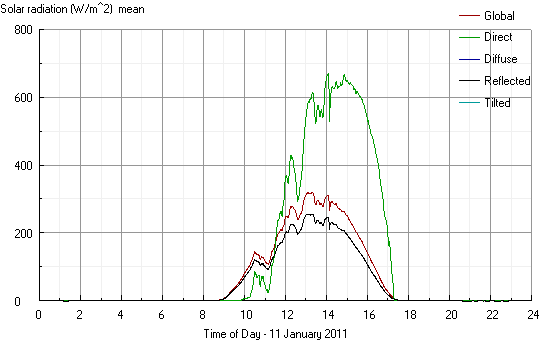
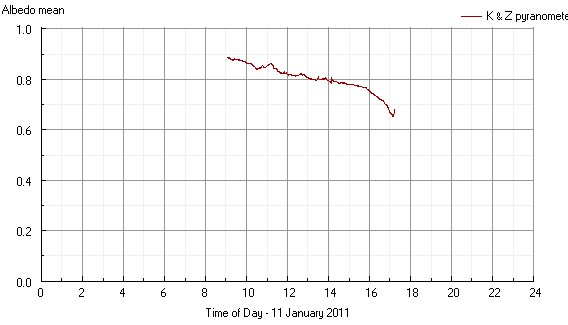
...and the same location in July
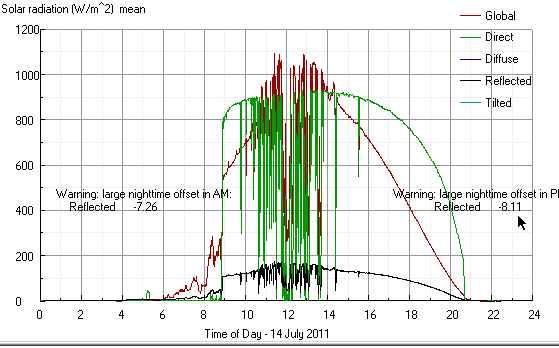
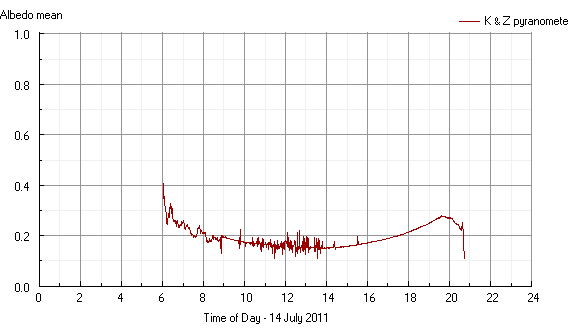
Let's talk about the last two first. It's a mostly sunny day. with some morning cloud and mid-day scattered cloud. Global radiation peaks at over 1000 W/m2. There is a strong diurnal pattern to albedo - lowest in mid-day (less than 0.2), and highest around sunrise and sunset (around 0.3).
Then let's compare these to the first two, from January. A similar day in the sense of morning cloud and afternoon clear skies, but global radiation is much lower - (peaks at about 300 W/m2). Albedo is quite different - it drops from about 0.9 in the morning to
I also know a bit about the temperatures on each day. In July, it was much cooler in the morning and evening, and hottest in the early afternoon. January was much, much colder.
Should I assume that the differences in albedo have caused those temperature differences? After all, there is a strong correlation: albedo drops, and temperature rises. Very high albedo? Very cold temperatures!
...but all I have done is shown that winter is colder than summer, so you can get snow on the ground instead of agricultural crops. After all, the energy input from solar radiation in January peaks at 30% of what it was on that July day, even if we don't account for the higher January albedo and shorter daylight period.
And the diurnal cycle in July? It is well-known and well-documented that surface albedo shows variability with solar zenith angle in clear skies. The sun is high in the sky at solar noon (which is about 1pm clock time on these graphs), and low in the sky at sunrise and sunset. It's not the albedo that is driving temperature differences: it is the change in solar input.
Nothing surprising here. Albedo differences are the result of other factors that affect weather and climate.
I think the same applies to blaisct's humidity and cloud arguments. There is nothing that I can see in his comments that gives any evidence that albedo or humidity are the driving force behind changing climate - they can (and are more likely to be) the result of a changing climate. A feedback, not a forcing.
- SkS Analogy 1 - Speed Kills: How fast can we slow down?
Evan at 12:02 PM on 18 February, 2022Santalives@25
Yes, some science is settled. When Apple decides how to make the iPhone14, I don't think they will entertain debates about the science of how semiconductors works. Your iPhone works because it is based on settled science. Maybe the iPhone 20 will be based on some new methods, but companies like Apple rely on using settled science to make neat gadgets.
Hold a ball in your hand. Open your hand. What will happen?
As you noted about Einstein, you cannot "prove" it will fall, but you know it will fall. Would you bet against the ball falling? Only if you're foolish. You can go into a lab day after day after day and show that CO2 is a greenhouse gas. Day after day you get the same result. You can't "prove" that the next day CO2 will cause heating when illuminated by infrared radiation, but after the millionth experiment you declare this settled science.
So this is my last comment to you, because you are being led astray by slick-sounding arguments. There is settled science. It is contained in reference books that engineers use to design all the things that make our society run. Yes, there are advancements. Yes, sometimes the reference books contain errors. But by in large a scientist is one who develops new science. Engineers are the ones who apply settled science to make things.
If you believe that no science is ever settled, does that mean you will spend time reading papers that say the Earth is flat and that the Sun orbits the Earth? What self-respecting astronomy journal would publish an article questioning whether we really know if the Earth orbits the sun and if it's spherical?
- From the eMail Bag: the Beer-Lambert Law and CO2 Concentrations
Bob Loblaw at 12:08 PM on 12 January, 2022The original emailer has sent in a follow-up to the Skeptical Science contact page, asking about black-body radiation and differences between emissions at 255K and 288K. A temperature of 255K is the commonly-cited radiative temperature at which the earth-atmosphere system emits IR radiation to space, while 288K is the commonly-cited global mean temperature for the earth's surface. The difference is a measure of the role of the atmosphere - the greenhouse effect - and this difference is predicted to continue to rise as atmospheric greenhouse gases continue to increase.
The blog post focuses on atmospheric absorption, not emission, but atmospheric absorption by CO2 is a key factor in the greenhouse effect. So, how might that temperature difference - 288K at the surface, 255K at high altitude - affect this process?
A few of the comments to the post touch on aspects of IR emission, and in figure 2 and comment #10 I mentioned Planck's Law, which governs radiation emission. Figure 2 was intended to show the difference between solar (5800K) and terrestrial (255K) sources of radiation, but does not touch on differences for the range of temperatures within the earth-atmosphere system. The recent follow-up email asked to see Planck curves for 255K and 288K (and to see them on a linear scale), so here is that graph:
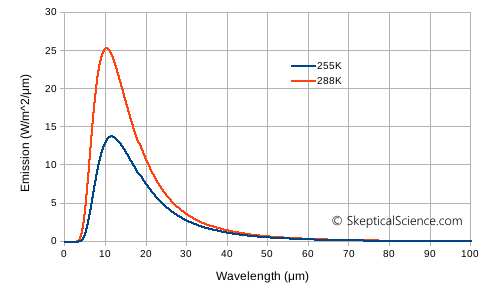
The horizontal axis is wavelength in μm, and the vertical axis is energy in W/m2/μm.
There are three obvious features:
- At the hotter temperature, the area under the curve is much larger. This area represents the total energy emitted. Hotter sources emit more energy overall.
- At the hotter temperature, the peak happens at a slightly shorter wavelength. Hotter sources shift a larger proportion of their emissions to shorter wavelengths.
- The 288K curve always lies above the 255K curve, so even at a specific wavelength, the hotter source emits more radiation than the cooler source.
The "hotter source" explains why I used a logarithm scale in figure 2. The sun emits a lot more energy than the earth. There is also one more "feature" to figure 2: I scaled the solar output so that instead of giving the intensity at the surface of the sun, where it is emitted, I scaled it down to the value appropriate at the earth's orbit around the sun. That was the only way to get the two lines to graph anywhere close to each other.
So, if we look back at our discussion of the Beer-Lambert Law, what difference does the source temperature have on the absorption of IR radiation? (The original email had mentioned 15 μm, which we see is a little to the right of the peak in the above graph.)
Well, it turns out that the temperature of the source has absolutely no effect whatsoever on the absorption according to the Beer-Lambert Law.
- In the blog post, note that the equations for the Beer-Lambert Law do not have temperature in them.
- You can add a subscript to the Beer-Lambert Law to indicate wavelength, as the absorption coefficent is highly-dependent on wavelength, but it does not matter what temperature the source was at that emitted the radiation.
- It also does not matter what the temperature is at the location the absorbing is happening.
Why is this? Well, there are several factors:
- The Beer-Lambert Law just tells us the probability that a single photon will be absorbed.
- Each individual photon is either absorbed, or not. Do, or do not. There is no try.
- If the photon is absorbed, all the energy goes into the molecule that does the absorbing (and is then transferred to heat all gases through molecular collision).
- If the photon is not absorbed, then the photon will continue along its way, and be transmitted through the atmosphere.
- An absorption coefficient of 0.01 means that there is a 1% chance that a single photon will be absorbed. It does not mean that each photon loses 1% of its energy - it means that 1% of all the photons lose 100% of their energy and the oher 99% lose none.
And all 15 μm photons are the same.
- They travel at the same speed, and they contain the same amount of energy.
- They do not contain more energy if they were emitted from a source at 288K than if they were emitted from a source at 255K.
- The source at 288K that is emitting more total energy at 15 μm is not emitting higher-energy 15 μm photons, it is just emitting more of them.
- The difference between the two curves in the graph above is just that a 288K source emits more photons at all wavelengths, compared to the 255K source. The 288K source can do this because it has more energy (it's hotter!) that can be transformed into radiation.
When CO2 absorbs a 15 μm photon in the atmosphere, it has no way of knowing if that photon was emtited from the surface at 288K, a kilometre away at 270K, or a metre away at 255K. It is just another 15 μm photon carrying the same amount of energy that every other 15 μm photon carries. And that amount of energy just happens to fit nicely into the different energy states that CO2 likes, so it is easy for CO2 to absorb it.
So, the CO2 will absorb the photon, and that heat is added to the local atmosphere, and it does not matter if the location where it is absorbed is warmer or colder than where the photon was emitted.
- How machine learning holds a key to combating misinformation
Nick Palmer at 00:33 AM on 15 December, 2021John - you wrote "It turns out these were the least common forms of climate misinformation. Instead, the largest category of climate misinformation was attacks on scientists and on climate science itself."
I agree that smearing the science and scientists has indeed been the predominant form of denial/pathological scepticism for a long time - it's what I've found from my own experience tackling the toughest exponents, however I think the mechanisms they use to achieve the 'smear' are still the old tried and true 'Skepsci' favourites - Soon's 'it's the Sun', Climategate, Briffa's Yamal tree rings, Curry's 'uncertainty monster', Mann's hockey stick PCA's, Svensmark's cosmic rays, Morner on sea level etc. etc., although the originators are not nowadays mentioned by name so often these days - they don't need to be - their 'sceptical' objections have become established as canon in the denialosphere. - Can we afford (not) to stop Climate Change?
sfkeppler at 01:42 AM on 16 September, 2021Dear Adam,
The most important thing is to understand what is going on! - I don't want any more question the reason of global warming. Everyone feels that there is something wrong with the earth's temperature. Minimizing carbon emission is perhaps the direct way scientists of IPCC want to go, but there is another physical fact - water!
We have to follow natural mechanisms of cooling the troposphere by water evaporation. This is not expensive, because does not need any energy other than that from the sun. We should evaporate water from the tropical oceans directly on the beach, additionally producing best salt. Does that cost anything to understand the global water-cycle, which comenses by the humidity of the evapotranspiration of the tropical mangroves, being transportet along tropical rainforests and lifted up to the cold region of the athmosphere by the tropical convection. From there it's transported to the southern and northern hemispheres, bringing rain and refrigeration. - Is it so difficult to understand??? - only evaporating seawater at the tropical east-coasts?
Stefan
- It's albedo
coolmaster at 10:47 AM on 13 September, 2021MA Rodger93:
MAR: "Your proposed grand scheme seems to be assuming atmospheric water can increase by 0.001335M km^3 annualy, or a 10% annual increase."
No - I never ever assumed, wrote or thought about that I plan or can increase atmospheric water by 1335km³ annualy.
You are making a very similar mistake as Prof. Stefan Rahmstorf from PIK in Potsdam in response to my comment in another climate forum.
Your mistake is probably that you have not read my posts with due attention, even though they are kept very simple and straightforward.
An increase in atmospheric water by 10% / year would mean that, according to the CCF, earth temperatures rise by approx. 1.4 ° C per year. A state of the climate which means certain death for all life on earth.
So you also completely misunderstood me.
My climate protection strategy would like to take the volume of 3.7mm SLR(1335km³) from the global rivers discharge when their water levels are sufficient(&clean) or even specially in flood events after rain- !!! to store it in soil moisture and groundwater over the land mass.
In principle a simple, seasonal storage of retained river water also to adapt to droughts and floods.
In dry seasons, this water will be mainly evaporated from agriculture, but also the before mentioned “amunas” of the old inca culture and their water management are a perfect way to rewet forests & moors.
hidraulicainca.com/lima/sistema-hidraulico-amunas/
This in turn ensures an increasing relative (and specific) humidity and additional cloud formation over land in a regional drought season.
After an average of ~8.5 days in the atmosphere it will return – even with a relatively high probability – as precipitation over another land area. There will be a multiplier effect that increase together with soil moisture and evaporation rate (wet regions become wetter).
As a result, the water cycle over the land areas is intensified by ~ 1-1,5% and thus the increasing size of the annual mean cloud cover over land areas leads to a higher albedo & CRE, which I estimate to be at least a cooling RF of ~ -0.2W/m² / year.
A really cooling, additional radiative forcing, which, in my opinion, can more than compensate for the current annual radiative forcing caused by CO² .
A holistic, functioning climate protection strategy,(stopping SLR AND global temperature rise & adaptation to droughts and floods) which works alternatively and independently of the reduction in CO² emissions, which only promises to stop the temperatures rise perhaps after ~ 2070 (if we as humanity can reduce emissions immediately – which I personally do not believe)
In the latest IPCC report / WG1 Chapter 7.4.2.4.3, the positive feedback of the cloud cover on an atmosphere warmer by 1 ° C is given with +0.42W m-2 ° C-1.
We are slowly but steadily losing not only areas of ice and snow albedo, but also the clouds albedo due to decreasing global mean cloud cover and higher lapse rate.
The cooling CRE with ~-19W m-2 (chapter 7.2.1. in the same report) should decrease accordingly.
The slower warming of the oceans means that there has not been enough moisture evaporated into – and then held in – the air above the oceans to keep pace with the rising temperatures over land. This means that the air is not as saturated as it was and – as the chart below shows – relative humidity has decreased, desertification is spreading rapidly mainly caused by human activities.
Dryness is a temperature driver and cloud killer.
That is why I (as an artist - not a climate scientist) think it's a good idea to create additional “artificial” clouds by additional artificial irrigation retained by river discharge from the superfluous water of the oceans.
---
MAR: but the reported 10% increase in evaporation rate 2003-19 over land equates to some 7,000km^3/y while the reported 3% increase in rainfall equates to 3,300km^3/y and the decrease in direct discharge from land to ocean a further 3,000km^3/y.
This suggests your grand scheme wouldn't make a ha'p'orth of difference. Evaporation over land is shown to have increased five-time the amount you propose yet AGW and SLR continued apace.
coolmaster: ???
360.57M km² ocean area * 3.7mm SLR = 1334.1km³ water = 8.93mm above the land area.
149.43M km² land area * 2.3L / m² increasing evaporation per year = 343.689km³ water.
* 1L / m² increasing precipitation per year = 149.43km³
* -1.01L decreasing runoff through the rivers per year = -150.92km³
* -0.75L decreasing groundwater level per year = -112.07km³
Your calculator probably has a built-in joker.
And if you are holding a PhD, you should hand it over (to me ?) as soon as possible. - It's the sun
Chuck21005 at 07:07 AM on 31 August, 2021I appreciate the argument on recent decrease in solar output. But that is the "Gravity doesn't exist" argument. A person tracks a falling ball. Initially, gravity theory and fall rates match. Then they no longer match. So lesser scientists conclude that it's not gravity making the ball fall. "See, if it was gravity, then the ball fall rate would continue to rise." There are good arguments, but that's not a worthy one.
Scientists have long ago learned to account for fluids. With gravity, it's friction provided by the fluid called air. In climate, it's the fluid called oceans.
If I turn the stove down, stove element temperature will decrease. But, if the pan still has a temperature lower than the stove element, pan temperature will continue to rise. Oceans are about 7C warmer than the atmosphere. As sun and ocean temperatures fall, they will continue to increase the temperature of the atmosphere. Oceans will always have a temperature higher than the atmosphere. But, the gap does narrow as oceans cool and the atmospheric temperature continues to rise.
Think of atmosphere as aluminum foil and think of the oceans as the cast iron pan that is absorbing (and storing) solar heat. This will get you closer to the truth about climate change.
- The number of lives that clean energy could save, by U.S. state
Jds at 04:50 AM on 21 July, 2021Data graphs... Interesting... Fact sheets, do tell. Article by who? Really. Source links to a group that links it's source information back to itself.
C02 is not a poison until it reaches highly concentrated levels. Rarely happens.
.04% of our atmosphere is c02. .0016% of that .04% is manmade. Multiply the two figures together to get the % of the atmosphere which is manmade c02. That's .000064. If you added .000064% pink panther fiberglass to your outhouse your butt would still be cold in the winter.
Studies reveal!!! What studies? Oh, Yale. University. Must be smart kids there these days. Reading books. Looking at thermometers.
Been researching C02 detectors myself lately. Basic description for the most detailed I shall provide now.
Too housing contains filter mechanism. Bounces Electrons (little buggers) back and forth between electrode plates. Electrolytes (salt water? Potassium? Gatorade?) change c02 to o2 through oxidation (rust) and reduces (evaporates)... get ready far this... oxygen into water. O into H2O. Yup... water into wine as well I suppose. The electrodes are biochemically sensitive to these changes.
I'll have to look this convuluted one up again for further details. It didn't mention any silicone chips nor as usually typical the almighty laser.
Fancy thermometer at best. Get yours free shipping from Walmart for like $30.
You can't even find anyone who wants to admit being the inventor of these snake oil charms nor will you find any original patents. Yet hundreds of mostly fly by night companies sell them for prices up into the thousands.
Shows parts per million.
NASA has these million dollar detectors that shoot lasers from far above to hit the earth surface and I suppose eventually be picked up by some big Gatorade coated hunk of metal which detects out of each of the million parts that exist in the atmosphere... 400 are C02. Further calculations determine that we cased half of this.
Here is an interesting argument. It has been millions of years since the global temperature and C02 levels have been this high and man wasn't even around back then which proves man is the current cause!!! Most unintelligent argument to date. Who caused the high rates back then if we were not around? Wooly mammoth? Hairy hippos? It's like saying your daughter's boyfriend must not have worn a condom the last time they had sex because your great grandmother was pregnant at one time.
Please think before you make pointless arguments.
We humans if all in one spot on a globe shoulder to shoulder would not even be much of a pin point. Combine all of our biggest cities into one megalopolis... a small freckle on the on the face of ma Gaia.
Mother earth has made home for countless creatures... if we were to just add the ones we have yet to discover to the internet... google would overheat and break down from an overload. And yet we still search for even one or to life forms elsewhere.
Mother earth has survived subzero trips to the shore and hot lava baths. She is covered in worm poo and skunk diddle.
And you worry she will die from second hand smoke which has been circulating since the dawn of her birth.
Your numbers are baseless. Your charts disconnected. Your facts biased. Your proofs conjectured. Your projections assumed. Your own researched will lead you down rabbit holes that will have you as well ask questions to determine validity. Give it time and you find... fancy thermometers. People pointing lasers at silicone chips. Digital readings.
There are no valid reputable respectable people in the realm of all of our highest minds who can validate and properly explain the how function of your fancy thermometers. They just assume like you did that the producers knew what they were doing by way of high intelligence and education and not one in the line of them would ever attempt to decide or hoodwink. Nobody dares to question fancy thermometer for fear they will look unintelligent themselves.
And you can take my statements directly to any of our scientists. Then bring those kids to me. I would like to see their heads sink in sullen shame as we review all of the information available in the world about fancy thermometer... and here them admit to it's nonsense.
Nice charts. Splendid graphs.
Pretty fancy thermometers.
Now prove to me that our c02 without one shred of any doubt 100% caused the average number of tsunamis per year to go from 2 to 3.
Show me just one autopsy report stating cause of death was... air pollution.
Show me the beaches where brilliant scientists are dutifully lined up measuring constant instant by instant changing ocean depths and receding shorelines.
Show me that the number of facilities which extract atmospheric data from the air are evenly distributed across the world and not primarily clumped into rural areas. The ratio difference of such facilities between rural and non grows every year in favor of the rural. That in itself makes for apparant temperature anomalies.
Show me where climate summits, committees, activist gatherings and fancy thermometer operators ever saved or even improved the life of even one person. Common sense of a child would tell you if they spent one tenth of the time exploring ways to prepare ourselves for natural disasters that are unavoidable regardless of our activities (you do know such things exist?) they would save many lives. Just one tenth of your focus shifted toward a more fruitful activiy... it is not much to ask.
Show me empirical evidence and precision studies prove that a two degree raise in global temp makes an unstable earth when global temperates rise and fall many multiples of degrees higher and lower within seasons (Siberia holds 100° record differential), months, weeks, days, hours... any increment of time. Regionally two degree shifts happen within seconds... why can you not make a connection to calamity in these instances? Why do you refuse to admit 2° shifts over a century might be a small % normal. bet if I told the right activist that scientists predict an unpredicted ten degree shift in average global temperature within the hour... those activist would fall in panic, run out the back door with their fancy thermometers pass out from the frantic exhaustion of getting their ownselves heated over a common occurrence.
Show me the credentials of each and every root source of every last statistic you have blind faith in. I would like to know if fancy thermometer makers might not be pushing a few numbers. Bet your bank account some are.
Show me how C02 is killing anything currently. Start looking for actual single file individual case examples in the anals of all our history of even one person who passed out from too much carbon dioxide... I'll give you the rest of your life to produce such papers... good luck. Before you can do that I will prove c02 allows for more life to flourish.
Show me a year that has not had both record high and low temperatures. Of course we must remember readings are not evenly dispersed yet and the lasers attached to satellites are yet to be a cover all.
Show me again the ice age many of the scientists from the 70's were warning us about... where is it? Guess that concept was beginning to sell less copies so they had to change the format or big guv who has an interest in people who have a concern the main public is following will stop funding them... seriously I want you to reread that last statement a few times... let it sink in. Think about the implications and how very real they might we'll be.
Show me causation, not correlation. The person did not get a sun tan on a hot day because a coconut dropped on their head that day.
And really a bunch of the information I may come up with is questionable as well. Who knows what's right? They give us estimates, rounded figures, apple orange comparisons. Coming up with pictures of prehistoric creatures bases on fragments of a single jawbone... then tell us approximately how millions of years since jawbone beast roamed earth... somewhere within this multimillion year range... and the temperature at that time was... and their favorite food was... and they squatted when they pooed fluffy spinich like clumps. Really. They know these facts due to the data represented by their Walmart C02 detectors.
Suckers are not born every minute. They develop through passages of time by way of emotional stimulations. They are targeted. Their opinions are advocated, supported and fed so to break down their defenses. Once trust is gained... (after all, fancy thermometer man has my same concerns therefore his concerns are for me personally as well)... they strike.
And you buy... in full... pun intended (aren't most all?).
And I buy as well... in part.
I wish not to find you reGret the weather... the Thunder... the iceBerg. Us grown ups are patiently waiting for your heroes... your people of the year... fan favorites... to grow up yourselves and drop the hatred and blame. Please stop pointing to the minute spinach stains on the teeth of others when immense festering cavities are being ignored.
8% of human c02 production counted is through breathing. So you can't get us to net zero anyway unless you well... kill us. A % of our CO2 production which makes up part of the statistical reports you adhere to... are from farm animals... eating, pooing, breathing... existing. Us meat eaters are trying to be rid of them as well for your satisfaction but only so much can fit on the plate.
Getting to NetZero is impossible. Waste of time anyway.
Proving that the .00005% is the only factor in 2° rise in the last century is harder than proving the chickens furting in a tornado caused more property damage.
Please be useful.
Activism is well intentioned griping. Would you like reward for it? I don't ever think I found any activist of any cause who enriched our environment beyond a sprinkling... especially the griping or as as I like to call the negative activist. Even the great MLK who was a positive activist is predominantly known by his most endearing followers by just four words... "I had a dream" sad how the majority of the world only knows this much of the man. The four words can be attributed to anything. Further research will educate a follower his dream was basically that some day all races will get along... not to insult but many have said same message with less recognition. It was a world wide sprinkling recognized best because of his ability to sell the product of his speech with the decor of his character. Charisma was the salesman. Same for the young swedish girl with face twisting sputtering gripe furiously. If said in a calm sensible tone she would have been ignored. So I see the point of bringing out the personality to sell the product. A 90 yo business owner/salesman friend told me to be successful you must sell the sizzle not the steak...
I will not abide to that when it comes to you and this subject you invested in. Instead I simply ask you...
where's the beef?
- Human CO2 is a tiny % of CO2 emissions
Jds at 06:07 AM on 20 July, 20211. More testing for temp & c02 happens in or close to rural areas. Common sense logic. I need no link to prove. Why would you?
2. Saying the ocean increase of 8 inches since 1800's? When was the last time you saw vast amounts of brilliant scientists up & down the coastlines with yardsticks or God help me dipsticks measuring the lines as the ocean ebbs and wanes a great amount of times more than eight inches many times within decades yrs mnths wks days hrs mins? Maybe the guys back in the 1800's were comparing satellite images to determine the beginning rises? I do not need a link to prove this is b.s. Nor should you.
3. C02 gauges determining 400 parts out of 1,000,000 are c02? Fancy thermometer you have there & that is all it is. Electrochemical sensors? Did they count the atoms? Did they feel them? Smell them? Sorry el ch sensors only are in c0 detectors. C0 is even lower ppm than c02. C02 detects by measurements of laser intensity. Fancy thermometer. & Considering C02 can only possibly take up .05 to 5% of a given area that would mean variant temp detect would need be within those ranges as well. & Typal it would take the area of 3 average adults to have required amount of oxygen atoms needed to bond with carbon for such a reading of 400 ppm? Fancy thermometer. And this junk measures the laser intensity (pressure on the silicone chip... yes that's all.) in order to assume raises in c02 due temp rises? Fancy. Like if you had a concealed area void of all carbon oxygen etc and you lit a match to it the inner temp would not raise because only c02 can raise a temp! I do not need a link to prove this as quakery nor should you.
4. Global warming causes tsunamis? Do they mean the consistent average of 2 a yr which has never shown an increase as far as I know to 3 is & has been caused by humans? I do not need a link. Suddenly I am hungry for sausage though. How about you?
5. If .04 % of atmosphere is c02 & of that .04 we contribute .0016 of it that means we are changing approximate .00005 of atmo. An alien bug shifted a cosmic wind storm with a furt... seriously it did! But .00005% of your outhouse wallscovered in pink panther fiberglass... your still gonna shiver during snowy winter outdoor poo runs. Suddenly I no longer feel like sausage. Do you?
6. 2 degrees!!!! Omgomgomg! Over 200 yrs! Imagine if that happened in a minute? It does. & Within an hour day week month season decade century Millennium four score seven years etc. I even heard it goes up & down by higher than 2° in those time increments! Could you imagine waking up one morning and it was like 10°!!! This is why Eskimos don't visit Africa... they would melt. Animals, especially humans cannot adapt to extreme 2°+ changes... impossible... especially if they happen over decades... trust me that's what common sense scientists say. I'm trying to make a segue with Abe right now but politics are not allowed here. Shoulda txt 5 score & 8 yrs. Nor should you... sorry just trying to stick to a format here.
7. It's been millions of yrs since the earth has been this hot or had this much c02 & man was not even in existence back then which proves man did it! So who did it? Wooly mammoths? Hairy hippos? It's like saying your great grandmother to the ten millionth power got pregnant which prove the guy dating your daughter will not where a condom. Yeah I know... poor link. Norse soot dew.
8. 8% of our c02 production is what we breathe out. Gw alarmists should put a bag over there heads to help us get to the 0% c02 in the air which is what they want so that all plant life can die followed by all other life but at least surfers will not wipe out when a hundred ft high wave crashes upon them. Annette Fettuccine. Ignore her doo.
9. Animals breathe too... little effers. Get over here fido. It's time I introduced you to Mr. Gallon size ziplock. I'll leave the pasta in there so you can have a last meal. Dogs don't know it's not seven degrees hotter for Kevin bacon... nor does he.
10. You would think that after all this blaming mankind for every catastrophic thing that happens in nature from the monsoons to the tidal waves to rats overrunning Portugal the one's hitting the near end panic buttons with all their summits & committees & conferences & picnic BBQs & gov funding & YouTube funny cat video empirical research would come up with a way to significantly bring the average gt down by at least half a degree of our controllable portion so we could have only one & one half the amount of disasters. Like one and one half of a Suzuki.
The moral of the story.
Spending time preparing for the unavoidable will save more lives than attempting to eliminate mankind's effects toward the consequences of a chaotic nature. Therefore gw are murderers by way of their ignorance. It is like they are watching a man beat child while attempting to prove a too many carbohydrates will make man beat child... now if we can just keep Frankie Avalon from the spaghetti we might save a child from abuse!
- The making of a one-of-a-kind climate change PR professional
nigelj at 18:11 PM on 12 July, 2021What truly excellent commentary!
A couple of comments on a few aspects. I have found De Smog blog most useful for finding information on people. So thanks for this often very detailed and revealing work.
It's so sad when people abuse public relations skills to do bad things and promote disinformation.
This really resonates: "The goal of argument and public debate should not be to crush someone who disagrees with you, but to bring forward the truth. Argument is necessary and people should be encouraged to hold different opinions, to challenge issues, to question motivations and points of view, and to take part in passionate discussion. Paralysis is what’s bad......Empathy and evidence need to replace disinformation and division"
The commetary says "I became preoccupied with a question. Why, despite all the alarming scientific evidence, are we doing so little to address the big environmental challenges?"
While the disinformation campaign is obviously part of this it doesn't entitely explain it for me because many people who accept climate science and the need to do something don't appear to do much to change their own behaviour or change laws etcetera. This commentary is probably part of the answer:
"Harvard psychology professor Daniel Gilbert argues that humans are exquisitely adapted to respond to immediate problems, such as terrorism, but not so good at more probable, but distant dangers, like global warming. He talks about his op-ed piece which appeared in Sunday's Los Angeles Times......"
- The New Climate War by Michael E. Mann - our reviews
nigelj at 13:50 PM on 13 June, 2021Nick Palmer @31, I do understand where you are coming from but I have a couple of disagreements.
"I thought I'd already addressed that. The short answer is that Big Oil continued to support the "B.S. factories" because they were effective at trying to protect those corporations against unwarranted attack."
That doesn't mean the corporations don't also use lobby groups to help spread denial. You seem a little bit stuck in an either / or mindset.
"Anyone who regularly takes on the really incorrigible denialists, as I do - I don't mean the brainwashed rank and file Hicksville idiots, but the much smarter ones - soon discovers that beneath all the high sounding 'alternative science' of the 1000frollyphds, the B.S. factories, Heartland's James Taylor, Quora's James Matkin etc are people who are almost always actually motivated by just a couple of things, of which by far the most common is extreme ideological antipathy to the 'big government' solutions promoted by extremist activists - the deep green environmentalists, the 'Smash Capitalism' closet reds and the 'System Change, not Climate Change' demonstrators."
This extreme ideological antipathy to big government is indeed common thing with the denialists, a libertarian and conservative leaning thing, but you need to understand many of these people define big government as anything beyond military and policing! They are opposed to anything that isn't very small government. So to say climate denlialism is the fault of a few extreme political activists proposing very big government is flawed logic.
"The 'Greenpeace knew' report and the recent Oreskes/Supran paper really are not evidence showing which way the truth lies being, as I've suggested before, chock full of cherry picking and insinuation and, in my view, the leading-the-reader attribution of malignant motives to innocent(ish) behaviour because of the underlying ideology of the authors. Oreskes is known to be significantly left wing and long ago Greenpeace's leaders adopted similar, or stronger, politics and I find their campaigning and assertions have got increasingly slanted and deceptive too."
I thought Orekses book was actually quite good if a bit too general, but there is plenty of hard evidence tying oil companies to spreading denialism of you look around. Read the book Dark Money for a start.
"What is noticeable is that no matter how convincingly one may have demolished their case, give them several weeks, or a couple of months, and one will often find them using exactly the same flawed logic, cherry picked facts and deceptive framing as before. This could mean either they have some sort of mental condition where their mind edits out their defeat so, like psychics who forget all their wrong predictions and only remember any correct ones, they maintain a spurious sense of their own abilities or they don't care much if you demolish their case in public because their only goal is to sway the public mind to their desired end and they know that the public has a very short memory and that the short denialist memes 'it's the Sun, it's cooling, it's cold now in Hicksville, it's cosmic rays etc have a very powerful ability to fool, or at least induce doubt and uncertainty in, the public's minds."
Yes its some sort of mental condition of a sort. Some people have difficulty admitting to themselves they are wrong or have been sucked in, so they hang onto beliefs. They become stubborn and entrenched. We probably all do a bit at times. With others the stubborness and arrogance is more extreme. Google narcissistic personality disorder. Combine this with small government leanings and a smart mind and a reasonable knowledge of science and you have a nuclear powered denialist, and the internet gives them the whole world to preach to. It's really frustrating to say the least.
- The New Climate War by Michael E. Mann - our reviews
Nick Palmer at 01:20 AM on 13 June, 2021Well, there's too much to address there! Just a couple of points.
Phillipe@28 wrote: " However, that would leave one wondering why they continued to support the bullshit factories churning out propaganda favorable to their short-term financial interests in the following 30 years, as uncertainty dwindled away."
I thought I'd already addressed that. The short answer is that Big Oil continued to support the "B.S. factories" because they were effective at trying to protect those corporations against unwarranted attack. Pharmacological/vaccine corporations are currently coming under similar COVID19 propaganda type attacks to their detriment - they have less of a need to use 'B.S. factories' because most of the population have been familiar with vaccination most of their lives, so they know that the attacks are mostly baseless. The general voting public have no such familiarity with climate change, and the effectivess or otherwise of the many and various solutions put forward out there, so they are vulnerable to political manipulation by ideologically motivated types who think 'the answer' to the whole (not just climate change but biodiversity loss, inequality, 'white supremacy', LBTQ+ gender inequality etc etc) situation is to change 'the system' to end up with a world where we all live in some sort of vaguely defined harmony with nature and everybody is equal and all the wealth is redistributed to achieve their faith-based dreams of a socialist paradise. Part of that playbook is undermining established big industry and 'decentralisng'.
Anyone who regularly takes on the really incorrigible denialists, as I do - I don't mean the brainwashed rank and file Hicksville idiots, but the much smarter ones - soon discovers that beneath all the high sounding 'alternative science' of the 1000frollyphds, the B.S. factories, Heartland's James Taylor, Quora's James Matkin etc are people who are almost always actually motivated by just a couple of things, of which by far the most common is extreme ideological antipathy to the 'big government' solutions promoted by extremist activists - the deep green environmentalists, the 'Smash Capitalism' closet reds and the 'System Change, not Climate Change' demonstrators.
I really don't know if these 'denialist/lobbyist' people truly believe all the propaganda they put out, in which case they would have been driven to delusion to protect their favoured clients and industries to sabotage the 'stop all fossil fuel use today and indict the corporations types' or if they cynically know that they are deliberately spreading deceit and misdirection to achieve the same end.
The 'Greenpeace knew' report and the recent Oreskes/Supran paper really are not evidence showing which way the truth lies being, as I've suggested before, chock full of cherry picking and insinuation and, in my view, the leading-the-reader attribution of malignant motives to innocent(ish) behaviour because of the underlying ideology of the authors. Oreskes is known to be significantly left wing and long ago Greenpeace's leaders adopted similar, or stronger, politics and I find their campaigning and assertions have got increasingly slanted and deceptive too.
BTW, when I refer to left wing I am not referring to centre'ish politics like that of the US Democrats but more towards the sort of Utopian student revolutionary type beliefs.
Blowing my own trumpet, I am one of the very few climate science denier fighters who can actually beat them to the point where they shut up (the smarter ones) or else (the dumber/madder ones) they resort to increasingly irrational conspiracy theory ideology to respond (not 'the scientists are all faking it for grant money' conspiracy but full-on Rothschilds, Bilderbergers, Illuminati, New World Order - even the shape shifting lizards!) which lets the reading/listening audiences see 'what lies beneath'. What is noticeable is that no matter how convincingly one may have demolished their case, give them several weeks, or a couple of months, and one will often find them using exactly the same flawed logic, cherry picked facts and deceptive framing as before. This could mean either they have some sort of mental condition where their mind edits out their defeat so, like psychics who forget all their wrong predictions and only remember any correct ones, they maintain a spurious sense of their own abilities or they don't care much if you demolish their case in public because their only goal is to sway the public mind to their desired end and they know that the public has a very short memory and that the short denialist memes 'it's the Sun, it's cooling, it's cold now in Hicksville, it's cosmic rays etc have a very powerful ability to fool, or at least induce doubt and uncertainty in, the public's minds.
A clear example of the second type is Marc 'Climate Depot' Morano who is so confident of the validity of his position that he even proudly described it on camera to greenman3610 (Pete Sinclair).
https://www.youtube.com/watch?v=JFnhTo6Wd80
He still appears to believe in his 'in denial of mainstream climate science' position but he does admit here to using misleading rhetoric etc to achieve his ends, which are to sway the views of the public. He more or less admits to using 'the game' to propagandise. Even this is not necessarily smoking gun evidence of 'evil' if he truly believes his own rhetoric is accurate, it's just yet another example of what I call 'non-clinically diagnosable insanity' of which the online world is now suffering a tsunami!
My main point is still this. I'm just about certain that the underlying motivations and beliefs of all major figures in the climate change wars are far more nuanced, and often hidden, than the simplistic 'they knew', 'they're evil', 'they're stupid' etc epithets flung at them by their opponents, whose motivations are similarly complex. - The New Climate War by Michael E. Mann - our reviews
Bob Loblaw at 07:36 AM on 11 June, 2021Nick Palmer:
I agree with what Phillip and NigelJ have said to a much larger extent than I agree with what you have said. I will focus on a few points in your latest comment.
"I was referring to the definite and real uncertainty in the science BEFORE Hansen's 1988 speech"
Give me a break. I was studying climatology for 10 years before Hansen's speech, and a dozen years before the 1990 IPCC report. I did not need Greenpeace or any other media reports to know what was going on - I was reading the primary literature. I found about papers like Manabe and Wetherald (1967) by reading them when they were still <20 years old.
"It is less than honest of people to assert that our modern established science in any way is comparable to the nascent science back then,"
It is less than honest for people to assert that there was not a lot that we knew back then, either. We knew in the mid 1980s that Sherwood Idso's arguments for negligible warming were wrong. That did not stop special interests from funding him for decades afterwards. That funding was not intended to pursue a legitimate sicentific goal - it was to sow doubt.
Climatology was not "nascent" in the 1980s. It was "nascent" in the 1880s.
"I submit that these tactics of Big Oil were just ordinary political manoeuvring to resist irrationally draconian 'green/red' calls until the science got strong enough. "
I submit that if this were the case, then Big Oil would have tried to argue the real science and legitimate uncertainty, instead of funding positions that were already known to be bunk.
"...government pandering to the views of misinformed activists ..."
You mean like the denial industry that was created specifically to maximize the extent to which politicians and the public were provided with misinformation? As you point out, right-wing politicians like Margaret Thatcher had a reasonably realistic view of the science several decades ago. Something - someone - managed to convince them otherwise.
"It is a matter of record that the fossil fuel industry increasingly deserted the early 'denialist' fossil fuel organisation - which was formed in 1989 - the 'Global Climate Coalition' - until by the early 2000s it was disbanded, and this was because the science had got strong enough."
Alternate explanation: as early denial organizations lost credibility, it was easier to let them die and fund new organizations that could spout the same misinformation under a new name. Until that organization loses it credibility. Or don't even wait - just create a whole bunch of them and make it look as if there is widespread doubt.
Much of the rest of your comment dives into "the mean lefties made them do it". I heard the same kind of arguments being made about general environmental issues when I worked in the oil patch in the early 1980s. It was not a reaction to climate isuses - it was a standard rhetorical tactic long before then.
"BTW, are there are any links to Big Oil documents which actually deny the science in the way that deniers do - it's the Sun - it's cooling - it's cosmic rays - the temperature record was tampered with - it's all fraud etc? I've never seen any actual full-on denialism in them. "
Because they learned from the problems the tobacco industry ran into over their internal documents? And funneled the money through shell corporations or institutes to hide the source, letting the denial groups do this for them? People that don't want to get cuaght doing what they are doing usually figure out eventually to not keep records.
It doesn't matter if Big Oil believed the denialism or not - they sure funded it. Out of the goodness of their hearts, or because they thought it made good business sense?
- The New Climate War by Michael E. Mann - our reviews
Nick Palmer at 02:05 AM on 11 June, 2021Phillipe and NigelJ. I think you two have somewhat missed that I was referring to the definite and real uncertainty in the science BEFORE Hansen's 1988 speech and the formation of the IPCC. That is when the documents in 'Exxon Knew', which are now held up as evidnec of 'certain' knowledge and associated deceit, were created. It is less than honest of people to assert that our modern established science in any way is comparable to the nascent science back then, upon which it would have been simply wrong to base far-reaching, global economy affecting/dismantling policies. It is verging on deceit to cast aspersions at targets who are not guilty or, at least, very much less guilty than they are being accused of being, using sophisticated rhetoric, cherry picking, misattribution of motivation etc and all the liguistic techniques that such as John Cook has clarified the denialist 'side' as using.
The uncertainty I was referring to (ordinary man-in-the-street definition, not the scientific one), at the relevant time, and what was not well understood then, was of such a magnitude (look again at the Dessler quote I gave) that it was entirely justified that Big Oil did not turn on a sixpence and shut down when the environmental organisations seized on this new way to attack Big Industry by using activist's frequent tendency to make unwarranted speculations on fragmentary evidence, then deciding that whatever unlikely speculative doomy result they came up with is almost certain to happen and then using that to justify calling for bans and authoritarian restrictions to avoid that end.
There can be no doubt that Big Oil sponsored think tanks, Institutes and lobbying organisations that used actual denialist rhetoric as part of their portfolio of techniques to try to influence politicians and policy formulations but, and I think this is where a lot of people go wrong, this should not have caused people to jump to the conclusion that Big Oil was deliberately spreading denialism because they were actually in denial of climate science - pause for a lot of screaming and gnashing of teeth by the extremists! I submit that these tactics of Big Oil were just ordinary political manoeuvring to resist irrationally draconian 'green/red' calls until the science got strong enough. The primary function of such lobbying organisations is to help their clients fight back against what they see as heavy handed legislation or inappropriate policy making by government pandering to the views of misinformed activists and those members of the voting public whose views have been changed by them to the point where they would vote in such draconian and misconceived action.
It is a matter of record that the fossil fuel industry increasingly deserted the early 'denialist' fossil fuel organisation - which was formed in 1989 - the 'Global Climate Coalition' - until by the early 2000s it was disbanded, and this was because the science had got strong enough.
"The GCC dissolved in 2001 after membership declined in the face of improved understanding of the role of greenhouse gases in climate change and of public criticism" https://en.wikipedia.org/wiki/Global_Climate_Coalition
Anyone who engages with denialists, the right wing or who defends the basic priciples behind environmentalism (which are, of course, still very valid) will pretty soon be accused of being a 'watermelon' - green on the outside, red on the inside, by which they mean that environmentalists have a superficial layer of concern for the environment masking a far left 'smash capitalism' ideology underneath. This is not a conspiracy theory! It is clear that many recent significant spokespersons indeed do have a very deep seated antipathy towards the capitalism system, upon which they lay the blame for all sorts of mankind's woes and they have an ideological zeal that only their pet version of international socialism will save us all - which goal, to them, justifies the deceit and propaganda they use as they try to 'socially engineer' the masses.
It is these 'fifth columnists' who created the Patrick Moore's, the Patrick Michael's, the Bjorn Lomborg's and who gave such as the Heartland Institute such large amounts of ammunition to doubt the integrity of the genuine, reasonable scientifically based policies. Bear in mind that one of the very earliest politicians to warn about the dangers of potential climate change in public and political circles was the rather far right Margaret Thatcher
https://www.youtube.com/watch?v=VnAzoDtwCBg&t=30s
and it was the far left who more or less started denialism off by insinuating that it was all fake science to justify shutting coal mines down, to handicap the development of the Third World and to accelerate the expansion of nuclear power. It was only afterwards that the left realised that if they became anti-global warming they could have a powerful stick to hit Big Industry, the international monetary system etc and slip their desired political outcomes in by the back door. That change in outlook in turn created the right wing/libertarian opposition - first to the 'solutions' the left claimed were mandatory and then their political 'chess moves' generated out and out deceitful-but-plausible-sounding denialism to undermine the legitimate science by appealing to the U.S.'s conservative blue collar population that it was actually a reds-under-the-bed attempt to undermine their freedoms.
Here is the very rational Zion Lights explaining why she disavowed her earlier extreme, ideology based, environmental beliefs and how she sees those beliefs as counter-productive these days.
https://quillette.com/2021/05/31/the-sad-truth-about-traditional-environmentalism/
Whether activists like it or not, I believe it was the environmental organisations excessive and unwarranted views, and the political engineering of (some) of their leaders, which led them to make simplistic and ill thought out (or craftily planned) demands for policy changes which would have been disastrous. A far more likely explanation of Big Fossil Fuel's stance and acts is not that their execs were real denialists possessed of a psychopathic disregard for humanity but that their adverts and public facing statements were their attempt to resist politicians moving against them and implementing the type of draconian policies called for by those with fallacious, or at least well over-the-top, views in some cases motivated by an underlying 'closet' political ideology - Smash Capitalism! - that the public would never actually vote for if it was expressed out loud.
BTW, are there are any links to Big Oil documents which actually deny the science in the way that deniers do - it's the Sun - it's cooling - it's cosmic rays - the temperature record was tampered with - it's all fraud etc? I've never seen any actual full-on denialism in them. That's why I made my point that the words in the documents have likely been mischaracterised by Oreskes and Supran et al to insinuate and attribute motives which really weren't there.
I think you really shouldn't characterise Stephen Schneider's views as "the opinion of one person". He was a very well regarded early climate scientist, who was also acknowledged as a brilliant communicator of that science to the public. His (unedited by denialists) quote which I gave is still a very accurate statement on the science and its communication and comprehension by the public. Unfortunately, in this area, he is almost peerless these days. Richard Alley, Katharine Hayhoe, Gavin Schmidt and Michael Mann are really good but, in my opinion, they are not quite at the same level. Schneider could take on a hostile audience of denialists and either defeat them or make their apparently plausible views look as irrational as they really are.
BTW, Phillipe, I actually referred to the CMIP6 models (not the CMP5 ones, as you incorrectly stated I did) running (considerably) too hot. This is not contentious. Ask Gavin Schmidt or any other similarly credentialled scientist...
- 2021 SkS Weekly Climate Change & Global Warming News Roundup #17
Eclectic at 21:29 PM on 27 April, 2021Dale H @6 ,
a somewhat brief overview from me as a non-expert :-
The atmospheric CO2 level was very high "from the start", in the sense of Pre-Cambrian times. Fortuitously, the early Sun was significantly lower in output (insolation has been increasing by 1% per 120 million years approx.)
In the long run up to now, exposed rock has very slowly absorbed CO2 by "weathering" to form carbonate which ends up on the ocean floor (and/or subducted by tectonic movement). And part of these carbonates is recycled into the atmosphere by volcanic venting.
The rate of weathering has varied at times. Also, there was a large "plunge" in CO2 level during the fossil-carbon formation in the Carboniferous age (much plant life, and no large herbivores?). A separate plunge during the Ordovician age (somewhat unclear, owing to uncertainty from poor time-resolution). And some major spikes in CO2 (and temperature) owing to Large Igneous Province eruptions such as the Siberian Traps and the Deccan Traps events.
Overall, it's been quite a ride !
The present latitudinal positions of the continents (plus Antarctica at polar position) has predisposed to glacial times for our planet. And likewise, the current "low" CO2. And if I have gathered correctly ~ in about an estimated 15 million years' time, the CO2 level would have become low enough to embarrass the present species of plants (unless they suitably evolve their photosynthetic mechanisms). Obviously the 15 million year time-scale gives the human race considerable leeway in tackling that particular problem.
Dale H , my apologies if you were already aware of much of this broad background. The SkS website has a vast amount of detail available for your self-directed searching.
As you have said you have already spent a goodly amount of time researching climate matters, then it might be advantageously efficient if you gave specific indication of where you feel puzzled or where you feel the mainstream climate scientists might be wrong.
If you need to raise particular questions, then it is standard SkS policy that you place one or two questions in the most appropriate thread . . . and deal with those questions . . . and then progress to the next question you have in mind.
- It hasn't warmed since 1998
Vonyisz at 01:51 AM on 21 April, 2021I would have a methodological questions. As this text suggests:
„To claim global warming stopped in 1998 also overlooks a simple physical reality - the land and atmosphere are just a small fraction of the Earth's climate (albeit the part we inhabit). The entire planet is accumulating heat due to an energy imbalance. The atmosphere is warming. Oceans are accumulating energy. Land absorbs energy and ice absorbs heat to melt. To get the full picture on global warming, you need to view the Earth's entire heat content. More than 90% of global warming heat goes into warming the oceans, while less than 3% goes into increasing the atmospheric and surface air temperatures. Nuccitelli et al. (2012) showed that the Earth has continued to heat up since 1998.”
– global warming is not really about temperature, but about the amount of energy.
But this is often misunderstood. Throughout the media, global warming is portrayed as if it could be characterized by changes in temperature.
Q = c * m * ΔT, but here c is not an exact value, consider large pressure and temperature differences
E (pot) = m * g * h, E (kin) = (m * v ^ 2) / 2
And I would have more questions here.
1. What do we refer to the amount of energy? Atmosphere? The kinetic and potential energy of air? With or without hidden heat? (The equivalent potential temperature (theta-e) is the temperature a sample of air would have if all its moisture were condensed out by a pseudo-adiabatic process (i.e., with the latent heat of condensation being used to heat the air sample), and the sample then brought dry-adiabatically back to 1000 hPa.) Surface? How deep? One meter? More? Caves? Groundwater that has a connection to the surface? Top 200 meters of oceans? Or the whole ocean? Energy stored in salinity and depth? Ice? Melting or freezing energy? Potential energy?
1.conc. Average global temperature? Why? When misleading in light of the above: the amount of energy (no matter how we determine what we include in it) is not equal to temperature. Thus, a change in temperature cannot be equal to a change in the amount of energy! Not me saying that. The quoted text does this.
2. We determine what we want to measure. Can it succeed? Can we assign a global average to the temperature of the entire earth? When I buy myself a pair of pants, at least three metrics help me with that. And do we characterize the average temperature of the earth (or rather the total amount of energy) with a single data? Even if we do, what are we going to do with it? What usable speech data does this tell us? This is because exactly what spheres are included in the total energy calculation are closely related to this data. If we calculate this as accurately as we wanted, what can we say about how long this accuracy has been available to us in the past? 10 years ago? 100 years?
2.atm. Do we really measure the temperature and humidity and density of the entire atmosphere? Do we really know the temperature of the earth's surface all over the earth at a depth of one meter?
2.surf. Do we know how much energy is stored in that part of the earth’s surface that is involved in the processes detailed here, absorbs sunlight, and largely heats the atmosphere? Do we know its density? Do we know your specific heat? Do we know its water content? Maybe it's not just the top one that counts? Could it be several meters in some cases? Who can say that? How to calculate? If someone says something, what to expect from him? How do you justify his theory?
2.oce. Do we know the temperature and the amount of dissolved salt everywhere in the oceans? Of course, we don't have an instrument everywhere, we fill in the missing data with approximation calculations. What is the ratio of the total error rate caused by the approximate calculations to the percentage of change to be examined? I read in several places that only the top 200 meters of the oceans matter in terms of global warming. Others write 100 meters. Many people write that the deep ocean has only long-term effects, it doesn’t count in the heat balance in the short term. Why a hundred? Why two hundred? Why doesn't it matter? The limit drawn here seems very arbitrary to me, and in terms of the change in total energy ... it is important to decide and justify: whether or not to include the deep ocean in the energy balance when examining global warming!
2.conc. I see a lot of temperature charts pros and cons. This is how the temperature goes up or how the earth cools. But none of the camps really show how the total amount of energy on earth measured according to the principles detailed above has changed, at least in the last 10-20 years, where perhaps we already have evaluable data in this regard. How can we start a scientific debate without clarifying the framework? The concepts? Principles of repeatable measurements? How is the data processed? Both camps bombard the media with marketing texts that pick it up as raw material and distort it so that it will no longer be completely untraceable to the average person.
3. A degree of warming of the whole ocean is approx. on the order of 10 ^ 24 Joules. Melting the ice of Antarctica would absorb 10 ^ 24 Joules of energy. A degree of warming of the dry air is on the order of 10 ^ 21 Joules. The Sun kisses the Earth with 10 ^ 24 Joules of energy in one year.
Based on these, the scare that the entire Antarctic ice sheet will melt soon seems rather doubtful. This event would eliminate the amount of energy in a whole year of solar radiation (of the same order of magnitude). This needs to be justified! While land ice heats the air when it forms and cools the air when it melts, the formation of coastal ice hanging in the ocean heats both the surface of the ocean and the air, but its melting typically cools the deeper layers of the ocean. Interestingly, land ice can be coastal ice. I hope I use good concepts. The direction of energy as a whole: heat is transferred to the atmosphere from the deeper parts of the ocean. People with CO2 can't warm up the ocean as a whole, just the top few hundred meters. And that is my next question. Are we counting the incoming solar rays and the outgoing infrared rays in the total amount of energy on earth? For example, the city is 35 degrees Celsius in vain if objects are 50-70 degrees Celsius and radiate heat unbearably to humans, while the same 35 degrees in the forest is unpleasant but tolerable because here the temperature of the objects is not higher than the air temperature. Here, the air temperature alone is very misleading. And sorry for the analogy, do we count the energy on the ocean heat transfer road to the total amount of energy on earth? I would like to draw attention to a trap. When the ocean conveyor delivers less energy, the average temperature in the upper part of the ocean is lower, but in this case heat is trapped around the Equator and the poles cool. On the other hand, with higher energy transport, the surface temperature of the oceans increases, most of the excess heat arrives at the poles from around the Equator, so significant warming begins here, more significant than at the Equator. However, the excess heat at the poles also means that the earth's surface can radiate over a larger surface at a higher temperature (T ^ 4). Overall, more heat is dissipated compared to when the capacity of the oceanic strip was smaller, disregarding other factors. I am thinking in particular here that, as soon as the Arctic ice melts in the summer, this process must be taken into account, because the thermal insulating effect of the ice will disappear.
3.conc. Is it conceivable that a change in the latter will affect a change in the distribution of the total amount of energy on earth? Perhaps these and other relevant metrics can bring the understanding and explanation of global warming closer to both experts and the average person? - CO2 is not the only driver of climate
Likeitwarm at 07:22 AM on 6 April, 2021Hi. Neophyte here again and I do consider myself that, but I keep trying to learn.
I think this'll be on topic, but possible it should be under "it's the sun". Sorry if I made a mistake.
I ran into this article: https://coldclimatechange.com/carbon-dioxide-is-a-cooling-gas-according-to-nasa/
Let me know what you think of it. I'll keep reading.
- It's planetary movements
Daniel Bailey at 02:45 AM on 30 March, 2021
"there is no effect on our climate"
Likeitwarm, while the Sun can influence the Earth’s climate it isn’t responsible for the warming trend we’ve seen over the past few decades. The Sun is a giver of life; it helps keep the planet warm enough for us to survive. We know subtle changes in the Earth’s orbit around the Sun are responsible for the comings and goings of the ice ages. But the warming we’ve seen over the last few decades is too rapid to be linked to changes in Earth’s orbit, and too large to be caused by solar activity.
One of the “smoking guns” that tells us the Sun is not causing the recent warming of Earth’s surface and ocean comes from looking at the amount of the Sun’s energy that hits the top of the atmosphere. Since 1978, scientists have been tracking this using sensors on satellites and what they tell us is that there has been no upward or downward overall trend in the amount of the Sun’s energy reaching Earth.
A second smoking gun is that if the Sun were responsible for global warming, we would expect to see warming throughout all layers of the atmosphere, from the surface all the way up to the upper atmosphere (stratosphere). But what we actually see is warming at the surface and cooling in the stratosphere. This is consistent with the warming being caused by a build-up of heat-trapping gases near the surface of the Earth, and not by the Sun getting “hotter.”
Scientists have quantified the warming caused by human activities since preindustrial times and compared that to natural temperature forcings.
Changes in the sun's output falling on the Earth from 1750-2011 are about 0.05 Watts/meter squared.
By comparison, human activities from 1750-2011 warm the Earth by about 2.83 Watts/meter squared (AR5, WG1, Chapter 8, section 8.3.2, p. 676).
What this means is that the warming driven by the GHGs coming from the human burning of fossil fuels since 1750 is over 50 times greater than the slight extra warming coming from the Sun itself over that same time interval.
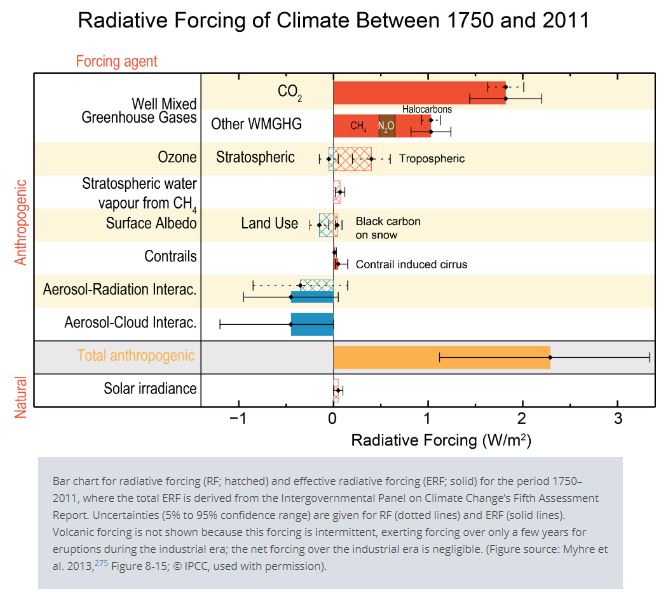
https://science2017.globalchange.gov/chapter/2/#fig-2-3
The reality is, over the past 6 decades of significant global warming, the net energy forcing the Earth receives from the Sun had been very slightly negative. As in, the Earth should be cooling, not warming, if it was the Sun driving the observed warming of the past 6 decades. Does this mean the Sun is dimming? No. Over the centuries, the Sun’s output waxes and wanes between more active periods of time, like during the 1950s and 1960s, and periods when it is very quiet for decades like in the1600s (called a Grand Solar Minimum). However, the difference between the more active periods and the quieter periods isn’t very great and is not by itself long enough or great enough to propel Earth’s climate into either a runaway heating (like happened on Venus) or into an “snowball Earth”. Overall, the Sun has increased its output by roughly 10% per billion years of its life.
https://climate.nasa.gov/faq/14/is-the-sun-causing-global-warming/
https://www.climate.gov/news-features/understanding-climate/climate-change-incoming-sunlight
"brightening of the Sun is unlikely to have had a significant influence on global warming since the seventeenth century"
https://www.nature.com/articles/nature05072
What this means, in plain English: the warming caused by the greenhouse gas emissions from the human burning of fossil fuels is 6 times greater than the possible decades-long cooling from a prolonged Grand Solar Minimum.
Even if a Grand Solar Minimum were to last for a century, global temperatures would still continue to warm. Because the Sun is not the only factor affecting global temperatures on Earth.
https://agupubs.onlinelibrary.wiley.com/doi/full/10.1029/2010GL042710
https://agupubs.onlinelibrary.wiley.com/cms/asset/6dbf95a2-e322-4c92-838a-faf4dd77fa93/grl26938-fig-0002.png
https://agupubs.onlinelibrary.wiley.com/doi/10.1029/2011JD017013
https://agupubs.onlinelibrary.wiley.com/cms/asset/50198c16-0139-4e49-a7f2-e3e66e3af759/jgrd17754-fig-0006.png
https://agupubs.onlinelibrary.wiley.com/doi/full/10.1002/grl.50361
https://agupubs.onlinelibrary.wiley.com/cms/asset/a4f99608-109a-410d-99e6-d1c80799bccc/grl50361-fig-0002-m.jpg
https://agupubs.onlinelibrary.wiley.com/doi/full/10.1002/grl.50806
https://agupubs.onlinelibrary.wiley.com/doi/full/10.1002/2014JD022022
https://www.nature.com/articles/ncomms8535
https://www.nature.com/articles/nature21364
https://www.swsc-journal.org/articles/swsc/abs/2017/01/swsc170014/swsc170014.html
https://academic.oup.com/astrogeo/article-abstract/58/2/2.17/3074082
https://iopscience.iop.org/article/10.3847/2041-8213/aaa124/meta
https://www.atmos-chem-phys.net/18/3469/2018/
https://www.sciencedirect.com/science/article/pii/S0277379118307261
https://www.nature.com/articles/s41561-019-0402-y
https://journals.ametsoc.org/doi/abs/10.1175/JCLI-D-19-0059.1
https://climate.nasa.gov/blog/2953/there-is-no-impending-mini-ice-age/
https://www.nasa.gov/press-release/solar-cycle-25-is-here-nasa-noaa-scientists-explain-what-that-means
The human forcing is now the dominant forcing of climate, dwarfing all natural forcings combined. Even that from the Sun.
- Skeptical Science New Research for Week #9, 2021
Rob Honeycutt at 01:46 AM on 16 March, 2021What's fascinating to watch is how SunBurst has presented erroneous statements, been corrected with evidence and citations, and ignored it. It's clear he just flat out doesn't care when he gets something wrong.
@4, 6, 12 he said (without citation) warming isn't global, and shown he's wrong multiple times and in multiple ways.
@14 he claims (without citation) we're taking energy away from people who need it, and shown how this is wrong.
@18 he claims (without citation) that Al Gore said NYC would be under water in 10 years, and he was repeatedly shown this is wrong.
@20 he questions how we could know that human CO2 emissions are causing warming, and is shown the research and evidence, and ignores it.
@27 he asserts that "AGW folks" claim (without citation) that CO2 levels are "unprecedented," is shown the research and ignores the error of his assertion.
@35 he makes the false assertion (without citation) that Lacis 2010 claims the earth must be in perfect equilibrium, and will surely be back to defend his false statement.
If this isn't Gish Gallop then I don't know what is.
- Skeptical Science New Research for Week #9, 2021
Rob Honeycutt at 06:33 AM on 15 March, 2021SunBurst... It's clearly stated in the movie what's being demonstrated is what would happen if all the ice on the Greenland and Antarctic ice sheets melted. An ice-free planet, which we had the last time CO2 levels were as high as today, would have sea levels that are 70 meters higher than today. These are facts.
- Skeptical Science New Research for Week #9, 2021
nigelj at 07:26 AM on 14 March, 2021Sunburst @12
"You must, however, consider the Big Picture in that "global warming" really isn't global unless the upward temperature trends are happening everywhere, and I have pointed out several regions where exactly the opposite is happening."
No. The world doesn't have to be warming at every place for the world to be warming as a whole. All that has to happen is the planets average temperature goes up. This is self evidently possible even if some small areas are cooling. By analogy a simple traditional wood fire could be getting hotter and hotter measured with temperatures in the chimney even if you spilt your iced drink on a small part of the fire causing one corner of the fire to cool for a little bit. I've already explained all this @7 and you havent disproven it with any data. You have pointed out a couple of regions where you allege without hard evidence theres cooling but you neglect the many more regions that show warming. You provide no proof that areas of your alleged cooling are greater than areas of warming. And as people point out you confuse a warming trend with weather so you havent demonstrated any actual cooling trend anywhere at all on the planet.
---------------------------------
Sunburst @13
"Well, you are free to believe whatever you want. But I'm sure that most Americans who have seen skyrocketing heating bills and frozen water mains for the past 5-10 winters would tend to say it's a cooling trend and not just cold weather. "
Or is it because electric companies are simply charging more money for other reasons? Maybe they are building new infrastructure. Maybe they are getting greedy. Maybe there is maineinance work. Again you provide no reliable evidence of why prices are skyrocketing or even "if" they are sky rocketing.
And 10 years does not constitute a climate change trend. Its generally accepted we need 30 years of data to be certain the climate has changed in a fundamental way and its not just short term natural cyclical variability. This is why it was only decided in about the 2000s that burning fossil fuels was definitely causing climate change. So even if the global climate WAS cooling for 5 -10 years (it isn't) this doesnt prove very much.
" At any rate, it would simply be wrong to deprive those people (including myself) of the fuels they need in order to get them through the winter seasons despite all of the "global warming" we are experiencing."
Strawman. Nobody is depriving anyone of fuel.
- Veganism is the best way to reduce carbon emissions
Klemet at 05:49 AM on 14 February, 2021@Rob Honeycutt : I apologize if I misunderstood your question, Rob. I'd say that I haven't see the IPCC clearly stating "animal agriculture is responsible for X% of emissions" anywhere; but as they use the FAO's numbers in their repport on the issue (which leads to their conclusions on the question, specifically about the sustainability of a vegan diet), I thought that this was enough of an endorsment.
Regarding the rest of your comment, I'd say that you perfectly point out why we see so many different numbers when we talk about the impacts of animal agriculture on GHGs emissions, or on over environmental issues (e.g. water, land-use, etc.).
Personnaly, I'm more of a "full supply chain" kind of person. For example, many questions and debates arise about the quantity of ressources (e.g. water) needed to produce a pound of meat/milk/etc. Advocates of animal agriculture will say that it's not that much, especially when it comes to water; but when you take into account that crops and forage has to be given in huge quantities to the animals in question (and that a lot of these ressources/energy are "wasted" as base metabolism, rather than becoming part of their bodies/secretions that we then eat), this changes everything. However, from my point of view, it is hard to argue that these crops and forage would be produced if not to be eaten by those animals. Hence, I deem it a part of the impact that animal agriculture have, just as transportation/building aspects. Might be naive of me, though.
Concerning the nutritional value of whatever is used to replace, I fully agree. That's why I'm always fond of expressing GHGs emissions or environmental impacts per calorie or gram of protein rather than in kg of food produced.
Still, and I might be wrong on that, but I think that we're starting to have a concensus on those aspects. Conclusion of articles such as the one from Poore and Nemecek are echoed in other meta-analysis (like the one from Clark and Tilman), and it kind of makes sense from my point of view : if you want to eat things coming from a step above in the "food chain" (i.e. animal bodies or secretions), then you have to contend with the fact that a huge amount of energy/ressources given to the species you feed are not going to become "food" for you, but are going to be lost in the transition from one step of the chain to another (e.g. metabolism, etc.). If I remember my ecology lessons, while the notion of "food chain" is now obsolete, there was still talk of about 80% of energy lost from one step to another (e.g. plants to herbivores, herbivores to primary carnivores, etc.). I don't know if this number still holds up today; but in any case, that makes for a low-yield ressources wise, which is what is reflected in those conclusions, I believe.
40 years of being vegetarian is a pretty long time, though ! I don't want to ask to much personal questions in comments, but I'd be very curious to know what got you to change such a long time ago, where vegetarian diets were not the trend that they are today. But I do agree with you that science on the topic is very often misguided, and use as a weapon rather than as a learning tool. I guess that it's such an emotional topic though that it is to be expected. In my experience, listening to the fears that can arise from both sides (e.g. the fear of having animal products labelled as illegal in the future, or the fear of knowing that animals are killed without good reasons) can lead to some defusing of the issue.
@BaebelW : If help if needed to maybe re-write some things or propose a more precise alternative, please let me know. Skeptical Science is a site I greatly admire, and as a PhD student, I should be able to write a proposition in a relatively proper manner. I imagine that authors must already have a ton of work on their hands, and I don't want to add to much to it. Still, thank you very much for the consideration, and thank you for all of your good work !
- Models are unreliable
Eclectic at 16:08 PM on 24 January, 2021Gzzm @1282 ,
thank you for replying to Tom Dayton, who, I gather, was inclined to bet that you yourself were simply one of those "timid-but-angry" commenters who make a drive-by comment . . . and are never seen again here, owing to their strange psychological make-up.
Gzzm, clearly you are made of sterner stuff and wish to add some rational intelligent points to the online discourse. And it's never too late to begin in earnest !
In reply to your point /4. [in brief because off-topic] :-
4. Where is the proof ... CO2 ... variable like solar energy ...
Alas, Gzzm, this is "off-topic" here at this thread. You will find the evidence you ask for, at the Top Left of this page, via MOST USED Climate Myths number 2 "it's the sun" . . . or the other thread recommended by the Moderator. Indeed, your education would be greatly enhanced by you reading through at least the first half-dozen Myths in their Original Post form [basic thru advanced ] . And as has already been suggested, please read the OP of this thread here (which you appear to have omitted from your things-to-do-first list.)
Back on topic, Gzzm, with the models are unreliable ~ I can recommend some later reading for you, for the counter-arguments which can be found on the WattsUpWithThat blogsite. At WUWT the view is that all the scientists' models have subsequently proven to be completely wrong . . . and therefore all climate science is wrong.
Gzzm, you may not have heard of WUWT , or perhaps you have been warned to avoid it because of its strong tendency to promote half-baked science (or disproven science) and even more to repeatedly promote rubbish which is "Not Even Wrong". But fear not, Gzzm ~ among the pig-swill there, you may occasionally find a pearl or two from genuine scientists like Nick Stokes. Alas, Stokes does not appear there often . . . likewise there are a few other scientific minds to be found in the WUWT comments columns, but few and rare, because they generally get driven out of WUWT by the editors/censors. (Or perhaps these scientific minds get tired of the incessant torrents of mindless vitriol they receive at WUWT .)
Nevertheless, Gzzm, the WUWT blogsite is a fascinating exhibition of logical fallacies and intellectual insanity. An excellent guide to What Not To Do with one's brain. Most interesting of all, is the huge amount of anger there, underlying the flakey thinking and political extremism and lack of human compassion.
Gzzm, I have the strong impression that you yourself may be able to enlighten me about the deepest psychiatric basis of the sheer anger in these disparate "contrarian" minds. Some of it may be a genetic personality-type anger in all or most of the denialists, but there may well be one or more other factors. Your own insight would be welcome ! (But please reply on a more appropriate thread.)
- Climate Change's Cause Confusion
Doug Bostrom at 05:22 AM on 13 December, 2020Per Nigel's remark, a sampling of our imperfect tracking of research output on this, from this year alone:
- Vegetation response to wildfire and climate forcing in a Rocky Mountain lodgepole pine forest over the past 2500 years
- Climate change significantly alters future wildfire mitigation opportunities in southeastern Australia
- Past variance and future projections of the environmental conditions driving western U.S. summertime wildfire burn area
- Wildfire risk science facilitates adaptation of fire-prone social-ecological systems to the new fire reality
- Large wildfires in the western US exacerbated by tropospheric drying linked to a multi‐decadal trend in the expansion of the Hadley circulation
- Climate change is increasing the likelihood of extreme autumn wildfire conditions across California
- Increasing concurrence of wildfire drivers tripled megafire critical danger days in Southern California between1982 and 2018
- Applying intersectionality to climate hazards
- Projected Changes in Reference Evapotranspiration in California and Nevada
- Assessing Climate Change Impacts on Live Fuel Moisture and Wildfire Risk Using a Hydrodynamic Vegetation Model
- The Australian wildfires from a systems dependency perspective
So yeah, climate affects wildfires. And it does seem true: if all the signals from science are "wildfire is affected by climate" yet it's a common misunderstanding that climate isn't related, there must be a reason for that.
- New rebuttal to the myth 'Holistic Management can reverse Climate Change'
Philippe Chantreau at 04:28 AM on 9 November, 2020Your silliness accusation (a little condescending, I have some clue about these issues) is not warranted, because the boundaries of the discussion were not adequately defined. The subject of this post is clearly agricultural resources management and more specifically livestock. Holistic management therefore has here been understood here as holistic mangement of such resources. The climate stabilization wedges concept put forth initially by Pacala and Socolow include that and much more. I understand what a holistic approach is (I have to do it in my work all the time), but here we are treating more specifically of livestock (or we were, from the posts preceding mine).
I agree that there is some misunderstanding, and even possibly some level of strawman in the OP; they seem to have understood the initial claim as the ability of holistic grazing management to single handedly stop and reverse warming. I don't think they are wrong in their argument that it is not enough. Savory and yourself felt this was wrong amd missed the point, because you understand holistic management in a much more inclusive way, extending far beyond grazing alone; I get it. It's a very different claim. I note, however, that Allan Savory's post higher in this thread is focused on agricultural resources, whereas you expand to even larger horizons.
My question, the most important part of the post you taxed with silliness remains unanswered: is it possible to integrate in any sustainable fashion the roughly 1 billion heads of cattle (estimates vary) we have right now in a holistic agricultural management model? How much land and water does that take? Other agricultural production need water and land too. Do the numbers add up? Perhaps Mr Savory has done the maths, and I missed it in his earlier contribution, in which case a reminder will be welcome. If not, then that needs attention.
I agree that a holistic socio-economic model is the best approach, that is very much convergent with the sustainable development goals that OPOF has discussed at length; different name, similar idea. However, you shouldn't accuse me of being silly just because I stuck to the subject at hand, as did Mr Savory himself.
- What does the global shift in diets mean for climate change?
wayne19608 at 10:57 AM on 21 October, 2020Hi Rob @23 that's why I said it was a start :) and was just adressing the impact of rice cultivation. Do we not think that 22% and 11% methane contributions compare unfavourably with those of cattle?
Organisms vary in their efficiency of feed conversion. Ruminants or foregut fermentation is one of the greatest developments in evolution since it's arrival some 50 million years ago. The benefit and efficiency of this system can be seen in their almost complete dominance of the herbivorous meso/megafauna. Virtually all non-ruminants or complete hindgut fermenters have since that time faced extinction. Out of some 450 ungulates today only about 25 non ruminants survive.
See (Demment MW, Van Soest PJ (1985) A nutritional explanation for body-size patterns of ruminant and nonruminant herbivores. Am Nat 125: 641–672) for an explanation on the distribution and relative efficiencies of these different fermentation systems. Notice that non-ruminants are fermenters as well, just that one of the fermentation products ie., methane comes out the back instead of the front.
This does not just apply to different digestive/fermentation systems but the inputs and outputs themselves.
Feeding high nutrient/digestable feed to ruminants may result in lower enteric methane outputs (Boadi, D. A., Wittenberg, K. M., Scott, S. L., Burton, D., Buckley, K., Small, J. A. and Ominski, K. H. 2004. Effect of low and high forage diet on enteric and manure pack greenhouse gas emissions from a feedlot. Can. J. Anim. Sci. 84: 445–453.), but see their qualification and comparison to IPCC estimates
A concern when evaluating animal feeding and management strategies to determine greenhouse gas mitigation potential is that significant emission reduction in one part of the production system may be negated if emissions are increased in another part of the production system. Table 6 demonstrates that inclusion of whole sunflower seed in general resulted in significantly lower (P < 0.05) total daily emissions of CH4 and NO2 expressed as CO2 equivalents. The observed reduction in total emissions is attributed to a significant reduction in enteric CH4, which contributed 95 to 96% of the total non-CO2 emissions from the feedlot. Enteric emissions by feedlot cattle fed a typical barley-based finishing ration were 72% of that estimated by IPCC (Tier 1). Use of whole sunflower seeds in the high forage:grain diet resulted in even lower emissions relative to estimates. Similarly, manure pack emissions in the current study were approximately 50% of that estimated using IPCC (Tier 1) coefficients.
Indeed over 7.5 times more CH4 kg–1 dung (DM basis) was emitted from grain-fed compared to their hay-fed counterparts.
Jarvis, S. C., Lovell, R. D. and Panayides, R. 1995. Patterns of methane emissions from excreta of grazing animals. Soil Biol. Biochem. 27: 1581–1588
Thus the "thermodynamically impossible" comment, but it goes much further than that.
People do realise that sheep and goats are just small ruminants and cattle are just large ruminants. You can even have cattle and sheep that approach each other very closely on a size basis. On the basis of size alone one of the biggest thermodynamic constraints will be the surface area to volume ratio, smaller organism will be energetically less efficient than larger ones, "having to run all day just to stay in one place". This is literally highschool physics and biology.
Monogut organisms like ourselves and for simplicity sake chickens and pigs cannot handle the feed inputs that hindgut and forgut fermenters can, generally requiring higher quality feed from both a nutrient and digestive quality standpoint. But those feed inputs didn't arrive out of the blue, they required huge (relative) inputs and resulting outputs. By focussing on enteric emissions we are missing the forest for the trees.
I can deal with monogut efficiency and energy inputs/outputs of cash crops later as I am running out of time, but these conversations always remind me of how little people understand about their food whether it be wheat, corn, chicken or cows
- What does the global shift in diets mean for climate change?
RedBaron at 21:20 PM on 15 October, 2020@6 7 Nigel,
That's not the only nonsensical thing you said Nigel.
"Firstly this is a tacit admission that cattles methane emissions are a problem, and less cattle equals less of a problem."
That statement is pretty wrong too. If cattle numbers are dropping and methane levels are rising, it is a probable falsification of the hypothesis that cattle emissions were the problem. There are plenty of other sources of methane that actually are the problem, natural gas leaks are the most likely culprit. However, grain production is way up there on the list because in the overwhelming majority of cases it destroys the ecosystem function of grasslands, which are a net sink for methane. Haber process nitrogen made from natural gas, commonly used to raise grains, is also rising. Cattle raised properly on grasslands can restore ecosystem services, and do not need haber process nitrogen to do it.
You also said,
"Since food, water and land are scarce in many parts of the world, this represents an inefficient use of resources."
Also wrong. Cattle properly raised on grasslands restore degraded land, they do not "use" those limited resources, they are part of a system that generates those limited resources. We all know they generate food. But commonly misunderstood is they generate water too.
Effect of grazing on soil-water content in semiarid rangelands of southeast Idaho
Notice that the best result for soil moisture is properly grazed land? Even better than no grazing at all? What do you suppose would happen if we plowed that land to grow grain? In case you didn't know, Google "dust bowl images" for a graphic explanation.
The proper use of animals, especially ruminants, generates new fertile land, food for human use, and water cycles. It does not use them up, it generates more of each.
Feedlots are a different matter. This is why I have asked multiple times on this forum that people use their words carefully. It's not the animals that is the problem, it's the way we raise or food that matter. Actually animals are a great help in this regard.
“As the small trickle of results grows into an avalanche — as is now happening overseas — it will soon be realized that the animal is our farming partner and no practice and no knowledge which ignores this fact will contribute anything to human welfare or indeed will have any chance either of usefulness or of survival.” Sir Albert Howard
- Berkeley study: 90% carbon-free electricity achievable by 2035
Doug Cannon at 02:40 AM on 9 October, 2020michael sweet.
I guess I didn't make myself clear. Of course we have to take into account the costs of global warming. But we can't lie to ourselves about the fact that decarbonizing will require a huge investment up front.
Don't just look at the video and its carefully couched claims. Read the report and the NREL references. They show the cost of wind at $25/Mwhr now, dropping to $15/Mwhr by 2035. The cost of solar at $20/Mwhr now, dropping to $13Mwhr by 2035.
The cost of a new gas utility is $6.26/Mwhr now (U.S. Energy Information Administration {EIA} Annual Energy Outlook 2019 AEO2019.....by the way, this reference agrees with Berkel;ey's current cost of wind and solar.) These comparison are all based on a 30 year life span. The story would be a lot different comparing to coal, but we're not building coal plants anymore. Renewables just can't compete with natural gas.
But we have to look beyond that analysis because we're not really talking about expanding our electrical output, we're talking about replacing existing fossil generation with renewables.
What we're doing today is using wind and solar to partially cut back on using the installed fossil generation when wind and solar are available (about 25% of the time for solar and 35% for wind). The $20-$25/ Mwhr cost for the renewables is offset by the reduction in variable cost for fossil which is about $2/Mwhr for gas and $4/Mwhr for coal. The capital cost for fossil is already sunk cost so we can't save that cost. It's costing us the difference of $20-25 minus $2-4 to reduce CO2 emmisions.
The Berkeley Report is going a step further and actually replacing 90% of the fossil plants by shutting them down. They recognize that shutting down most of the fossil results in a need for battery storage, which we avoid with the current "cherry picking" strategy. This is even more expensive than our current strategy. How much is a little vague; they don't breakout the cost of storage.
I won't even go into the lost opportunity cost resulting from the diversion of resources into such a program. I'll assume we could find the resources and we could live with the reduction in our standard of living. But we have to get over this idea that requiring more manpower to get the same output is a good thing. The logic that this program is good because of more jobs is like saying we should go back to building highways with picks and shovels even though it would cost an order of magnitude more.
So to get rid of fossil will take a major up front investment. The cost savings from reducing CO2 are well down the road. I doubt you could find a climate scientist to agree we would see any effect this century. But what we do now will help in the centuries to come. CO2/temperature is such a slow, long term issue I wonder if cutting back fossil to 90% in 15 years is any significant advantage over doing it in 30 years as the old fossil plants are retired.
- Critical Thinking about Climate - a video series by John Cook
Bob Loblaw at 00:59 AM on 7 October, 2020JoeZ:
With my 40 years of studyig climatology and watching the public discussion, I disagree that it is an exaggeration. I have watched years of mis-informed "skeptic" behaviour that clearly follows the sequence:
- I'ts not happening. (instrumental error, site locations, urban heat island, data fudging accusations, etc.)
- It's not us (natural cycles, the sun, El Nino, cosmic rays, recovery from Little Ice Ag/Big Ice Age, CO2 change is not from fossil fuels, etc.)
- Experts disagree (there is no consensus, science isn't done by consensus, here is a list of "experts" that disagree, the IPCC is political, the greenhouse effect doesn't exist, there is no such thing as "back radiation", etc.)
- It's good for us (saves us from the next glacial cycle, CO2 is plant food, agriculture is better in a warmer climate, cold kills more than heat, etc.)
- There is no hope - well, that's the next step in the successive retreat from unsupportable "skeptic" positions.
That you finish your comment with the phrase "your cause" tells me a lot about how you are approaching this issue. My cause is good science, which "skeptics" are frequently lacking in.
- Category 6 Sets Its Sights Over the Rainbow
Haiburton42 at 20:40 PM on 18 July, 2020"I like to think of the rainbow pictured above as symbolizing the multitudinous human colors and textures that have made this meeting place what it is." Wow. What a refreshing perspective. A "rising rainbow" would be very neat to witness. I'm jealous! And I had no idea that in order to see a rainbow near the horizon, the sun needs to be almost 42° above the opposite horizon.
I guess you learn something new everyday if you're lucky, huh!
Really, though, comparing the climate crisis to a final-exam themed nightmare is perfect. I mean, if you're a student taking 12 credit hours, it's a bit like each course is one of the four horsemen.
Apocolyptic examinations, indeed!
- Planet of the humans: A reheated mess of lazy, old myths
Wol at 20:38 PM on 29 April, 2020Sir Charles @ 5:
>>The UN estimate a peak by the end of this century with a global population of about 11 billion people.<<
It's only a few years since the UN estimate was a peak of 9Bn. Then in the last year or two, 10Bn. So now 11Bn?
There may be many problems with this film, but its comments on population are correct. Just because there's the same taboo on even mentioning overpopulation as there is on criticising religion doesn't mean it's not THE centre of the problem.
Every living part of the ecosystem competes in a Darwinian fight to increase its share, until it overblows itself and suffers a partial or complete die-off. Humanity is different, because we have been clever enough (Ha!) to mostly eliminate the usual causes of such die-offs.
We probably need at least two earths for sustainable existence: it's well pat time to accept that unless and until the human load on the planet comes down to something that can be sustained the future isn't sunny. Eating fewer livestock, wearing vegan sandals and switching off the odd light is pointless when there are another three of us every second to feed, grow up, house etc.
- There is no consensus
PatrickSS at 06:51 AM on 20 December, 2019Estoma I will check out the Iris Effect
Rodger, did you read the summary of the raw data that I pointed you to? Here's the link again:
https://www.pbl.nl/en/publications/climate-science-survey-questions-and-responses
What do you think of the responses to Q12?
Isn't it very odd that Bart V and colleagues didn't mention Q12 in their paper?
And do you realize that the "91%" quoted on this page includes Lindzen, Happer, Dyson, Curry and Ridley?
Thx for all your responses. I'm going to the "It's the sun" page.
- There is no consensus
PatrickSS at 07:49 AM on 19 December, 2019DB, can't I say that it's incredibly unfortunate that climate science has become political?
One Planet, when I listen to “consensus” climate scientists, they say that sunlight comes in, heats the Earth, and the heat escapes from the Earth via IR. Increased CO2 absorbs and blocks more IR, so the Earth gets warmer.
When I listen to Richard Lindzen he says that CO2 and H2O already absorb all the IR emitted at the Earth's surface, and that the IR that escapes is actually emitted high in the atmosphere. Increasing CO2 causes the IR to be emitted at slightly greater altitude. This warms the surface because the temperature at which the emission takes place is the same, so when the lower atmosphere is chaotically mixed the air reaching the surface is hotter (because it gets compressed as it comes down).
That seems to me to be "expanding awareness and improving understanding". He seems to be a good communicator and a good scientist. It seems unlikely that he invented the whole thing.
Then I watched Richard Alley on youtube. He is a very good communicator, and at first I found his argument very convincing. He said that the ice ages were driven by cycles of the sun at 100,000, 41,000, 23,000 and (I think it was) 19,000 years. Then he said that the sun cycles (periodically) released CO2, and the CO2 drove temperature. So we have sun -> CO2 -> temp. But the sun can only act through temperature. So we have sun -> temp -> CO2 -> temp. Suddenly it seems much less plausible. What's wrong with sun drives temperature?
One Planet, I don't get your point about Curry's reviewer. Surely we can agree that his or her comment was extraordinary, and showed dishonest thinking? Curry's other reviewers may have been good and rational, but one at least was not. Of course she could have made that comment up – but I have no reason to believe that. It seems more likely that she is sincere because she has put her career on the line.
None of this means that the “consensus view” is wrong. But it makes it very difficult to know who we should listen to. - Skeptical Science New Research for Week #48, 2019
Doug Bostrom at 03:05 AM on 7 December, 2019Ed, your point about a site that collects and compares methods and mechansims for mitigation, adaptation etc. is a good one. There's a lot of redundant babble in the popular climate communications world and there could certainly be benefit from more specialization. Perhaps there is such a site— I don't know of it myself.
But as to whether or not SkS is useful, site access statistics show a clear result: some half a million persons per month arrive here and land on specific articles debunking various climate change myths. It's a very purposeful and objective use of the site. These people are on personal fact-checking missions and we're here when they need us. There's no other such resource available.
Skeptical Science is specialized on providing factual corrections to climate misunderstandings. That's our stock-in-trade, our raison d'etre. We're a climate myth debunking encyclopedia.
Perusing the "Humans dealing with our global warming" section above suggests several other available specialty communications slots. A site focusing on popular conveyance of human cognition of hazards and risks would certainly be good. Much of our problem in dealing with climate lies in our poor mental faculties for that.
- It's cosmic rays
Daniel Bailey at 06:22 AM on 4 December, 2019jmh530, the best available evidence we have is that there is no direct linkage between the sun’s output and cosmic rays impacting the Earth’s climate. Now that’s a broad statement, but let’s examine some more in-depth evidence on those individual components.
Scientists use a metric called Total Solar Irradiance (TSI) to measure the changes in output of the energy the Earth receives from the Sun. And TSI, as one would expect given the meaning behind its acronym, incorporates the 11-year solar cycle AND solar flares/storms.
The reality is, over the past 4 decades of significant global warming, the net energy forcing the Earth receives from the Sun had been negative. As in, the Earth should be cooling, not warming, if it was the Sun.
The scientists at CERN designed an experiment called CLOUD to evaluate the potential impacts of cosmic rays on clouds and cloud nucleation (Cloud Condensing Nuclei = CCN).
Per CLOUD director Kirkby:
"At the present time we can not say whether cosmic rays affect the climate."
Looking at the results of CLOUD, if cosmic rays were a significant factor in affecting our climate, the Earth should have been cooling, not warming. Instead 8 of the warmest 10 years have all occurred in the most recent 10 years.
Erlykin et al 2013 - A review of the relevance of the ‘CLOUD’ results and other recent observations to the possible effect of cosmic rays on the terrestrial climate
“The problem of the contribution of cosmic rays to climate change is a continuing one and one of importance. In principle, at least, the recent results from the CLOUD project at CERN provide information about the role of ionizing particles in ’sensitizing’ atmospheric aerosols which might, later, give rise to cloud droplets. Our analysis shows that, although important in cloud physics the results do not lead to the conclusion that cosmic rays affect atmospheric clouds significantly, at least if H2SO4 is the dominant source of aerosols in the atmosphere. An analysis of the very recent studies of stratospheric aerosol changes following a giant solar energetic particles event shows a similar negligible effect. Recent measurements of the cosmic ray intensity show that a former decrease with time has been reversed. Thus, even if cosmic rays enhanced cloud production, there would be a small global cooling, not warming.”
Modern CCN are pretty much insensitive to cosmic rays and changes in TSI from the Sun, compared to the very much larger anthropgenic and natural contributions (volcanoes, oceanic oscillations and wildfires):
"New particle formation in the atmosphere is the process by which gas molecules collide and stick together to form atmospheric aerosol particles. Aerosols act as seeds for cloud droplets, so the concentration of aerosols in the atmosphere affects the properties of clouds. It is important to understand how aerosols affect clouds because they reflect a lot of incoming solar radiation away from Earth's surface, so changes in cloud properties can affect the climate.
Before the Industrial Revolution, aerosol concentrations were significantly lower than they are today. In this article, we show using global model simulations that new particle formation was a more important mechanism for aerosol production than it is now. We also study the importance of gases emitted by vegetation, and of atmospheric ions made by radon gas or cosmic rays, in preindustrial aerosol formation.
We find that the contribution of ions and vegetation to new particle formation was also greater in the preindustrial period than it is today.
However, the effect on particle formation of variations in ion concentration due to changes in the intensity of cosmic rays reaching Earth was small."
And
"...solar cycle variations of ion concentration lead to a maximum 1% variation of CCN0.2% concentrations. This is insignificant on an 11 year timescale compared with fluctuations due to, for example, the El Nino-Southern Oscillation, variations in wildfires, or volcanoes."
Gordon et al 2017 - Causes and importance of new particle formation in the present-day and preindustrial atmospheres
And the coup de grace for cosmic rays, being proven to unable to significantly affect clouds and climate, is that CCN respond too weakly to changes in Galactic Cosmic Rays to yield a significant influence on clouds and climate.
Pierce 2017 - Cosmic rays, aerosols, clouds, and climate: Recent findings from the CLOUD experiment
Scientist Richard Alley pretty much killed the cosmic ray hypothesis here (the relevant part of the lecture starts at 42:00)
"We had a big cosmic ray signal, and the climate ignores it. And it is just about that simple! These cosmic rays didn’t do enough that you can see it, so it’s a fine-tuning knob at best."
To recap, the Laschamp excursion (the strongest cosmic ray event in the past 40,000 years) hammered climate for 2,550 years about 40,000 years ago. The flux of beryllium-10 produced by cosmic rays greatly increased as the Earth’s magnetic field weakened by 90%.
Here is the chart he’s referring to, showing how the flux of beryllium-10 produced by cosmic rays greatly increased as the Earth’s magnetic field weakened by 90% about 40,000 years ago.

From the AR5, WG1, Chapter 7, p. 573:
"Cosmic rays enhance new particle formation in the free troposphere, but the effect on the concentration of cloud condensation nuclei is too weak to have any detectable climatic influence during a solar cycle or over the last century (medium evidence, high agreement). No robust association between changes in cosmic rays and cloudiness has been identified. In the event that such an association existed, a mechanism other than cosmic ray-induced nucleation of new aerosol particles would be needed to explain it. {7.4.6}"
- Top 10 most viewed rebuttals in September and October 2019
Eclectic at 10:29 AM on 14 November, 2019Thanks, Nigelj.
I will make a few points about website WUWT, and then shut up ~ since it's getting somewhat off-topic. The comparison of the two websites has some interest here in "numbers" comparison only. There's no real other comparison . . . I think of SkS as an eagle flying in the sunshine, while WUWT is more like an octopus slithering in the murky depths.
For those readers wise enough to be unfamiliar with WUWT:- Anthony Watts & team run the WattsUpWithThat website. Allegedly they don't receive Big Oil funding these days. Be that as it may, they want to receive a lot of hits/views, partly in order to have enough high rank to pull in advertising of the incidental sort ( e.g. I myself am plagued with telescope advertisements when I click on the WUWT site).
Accordingly, WUWT has a high turnover of lead articles. Most articles are brief, and many are slanted propaganda against the reality of AGW and often are rather childish whinges about the teething problems of the gradual transfer to renewables (versus fossil fuel power stations) . . . or whinges about Greta Thunberg, James Hansen, and so on. There's the occasional leavening with articles about technical developments, or astronomical news, or things of general interest [but not many!]. Then we get the re-posts of Heartland propaganda articles, of GWPF, and of assorted Media op-ed propaganda pieces. And a succession of crackpot ideas from Lord Monckton, Dr Pat Frank, and similar fringe dwellers of Dunning-Krugerism and Delusion Land.
WUWT maintains a high hit rate, by having an open-door policy on its comments columns ~ provided that the comments do not support mainstream climate science nor support "climate action". (A tiny dribble of such comments is permitted by moderators . . . but mainly I suspect to act as red meat and keep the regular clientele in a savage mood. A prominent exception, is comments by scientist Nick Stokes, who often has something pertinent to say, which punctures the usual rubbishy comments. He is loathed by the standard clientele, and I suspect he is not moderated out . . . because his is a token presence to illustrate the respectabiity & toleration of the WUWT website!)
In short, WUWT is an echo-chamber for the Angries, the extremists, and the deluded. Comments tend to be repetitious ventings. But the sheer number of these, is part of what keeps the site ranking high enough to attract advertising dollars. Does the WUWT ranking intimidate politicians into thinking there's a lot of Denialists around? I don't know.
My own interest in the WUWT website, is to observe the ways that some intelligent minds engage in rampant Motivated Reasoning. And to a smaller extent, to keep in touch with the Dreck found in the murky depths. Know thine enemy!
Sorry, Nigelj, for my own lengthy vent of a post ~ but I hope it provided some "edutainment".
- SkS Analogy 20 - The Tides of Earth
Alan Lowey at 17:34 PM on 11 November, 2019Philippe Chantreau, MA Rodger
We all need to keep thinking logically for ourselves and not just quote research paper conclusions as if they are fact set-in-stone. All theories are work-in-progress until a Theory of Everything has been established.
The two UniverseToday articles can't be directly compared as 'evidence'. Let me explain why.
The Precession cause is given as "by the tidal forces from the Sun and Moon". This agrees with the information from LINZ.
The Tilt cause is not mentioned.
The Eccentricity, 100,000yr cycle, cause is given as the planetary influence of Jupiter and Saturn. This doesn't agree with LINZ.
The second article refers to a 405,000yr cycle, via the gravitational effects of Venus and Jupiter. This doesn't agree with LINZ but at least they have some evidence in rocks that the cycle does exist.
...
The logical conclusion is that LINZ is both correct/incorrect and that the causes of the 100,000yr and 405,000yr cycles are both correct/incorrect.
This does take some mental agility. The basic law of Newtons gravitational attraction doesn't reconcile with the amount of perturbation required to create such significant orbital changes.
The only logical conclusion is a new physics with regard to gravity. The issue is solved by the notion of a strong gravitational interaction between the cores of the planetary bodies when on the same plane. We tend to think of planetary motions in two dimensions but it's the third dimension, the inclination, which has been omitted from deep thought.
I know this sounds as if I must be insane to doubt the entire scientific community but my position is one of logic.
I don't expect anyone to leap to my side and accept that I'm making a valid logical point. It takes a lot of time to be able to comprehend the issues I'm raising.
- SkS Analogy 20 - The Tides of Earth
Alan Lowey at 20:10 PM on 10 November, 2019The author states:
"Jupiter and Saturn affect Earth's orbital dynamics"
This is in complete contrast to the professional article "The Cause and Nature of the Tides" by the Land Information of New Zealand (LINZ). This states quite clearly:
"What about the planets? Venus exerts the greatest gravitational pull on the Earth of all the planets but, at just 0.0054% of the effect of the Moon, makes no real impression. Despite being the largest planet, Jupiter's greater distance means that it's influence is ten times smaller than Venus. So the Moon and Sun are the only celestial bodies that have any significant gravitational impact on the Earth."
I'm guessing that your reply will be something like:
"Jupiter's gravity, despite being just 0.00054% of the effect of the Moon, has feedback loops which amplifies this near invisible influence, to create sea level changes of 120m."
The numbers just don't stack up. Even if they were anyway near close, there's still another logical error. Jupiter's gravitational influence would be acting all the time, not just on a 100,000yr cycle.
- SkS Analogy 20 - The Tides of Earth
Alan Lowey at 04:04 AM on 9 November, 2019I can't stand sloppy unscientific sentences such as "The sun and moon pull on the oceans" as described in the beginning of this topic. They do NOT! It's their gravitational interaction across the entire body of Mother Earth which changes the shape of the planet. It's this bulge which flexes the lithosphere. The bulge of the ocean floor pushes the ocean from beneath to create our daily tides. The person who wrote the intro doesn't understand the very basic nature of how our tides work.
- Skeptical Science New Research for Week #41, 2019
Daniel Bailey at 11:26 AM on 8 November, 2019That the climate changed naturally before the impacts of humans became the dominant forcing of climate is uncontentious.
That the impacts of human activities are now the dominant forcing of climate is equally uncontentious, from a scientific basis.
Scientists have evaluated all natural forcings and factors capable of driving the Earth's climate to change, including the slow, long-term changes in the Earth’s movement around the Sun (Milankovitch cycles or orbital forcings), and it is only when the anthropogenic forcing is included that the observed and ongoing warming since 1750 can be explained.
Natural vs Anthropogenic Climate Forcings, per the NCA4, Volume 2, in 2018:
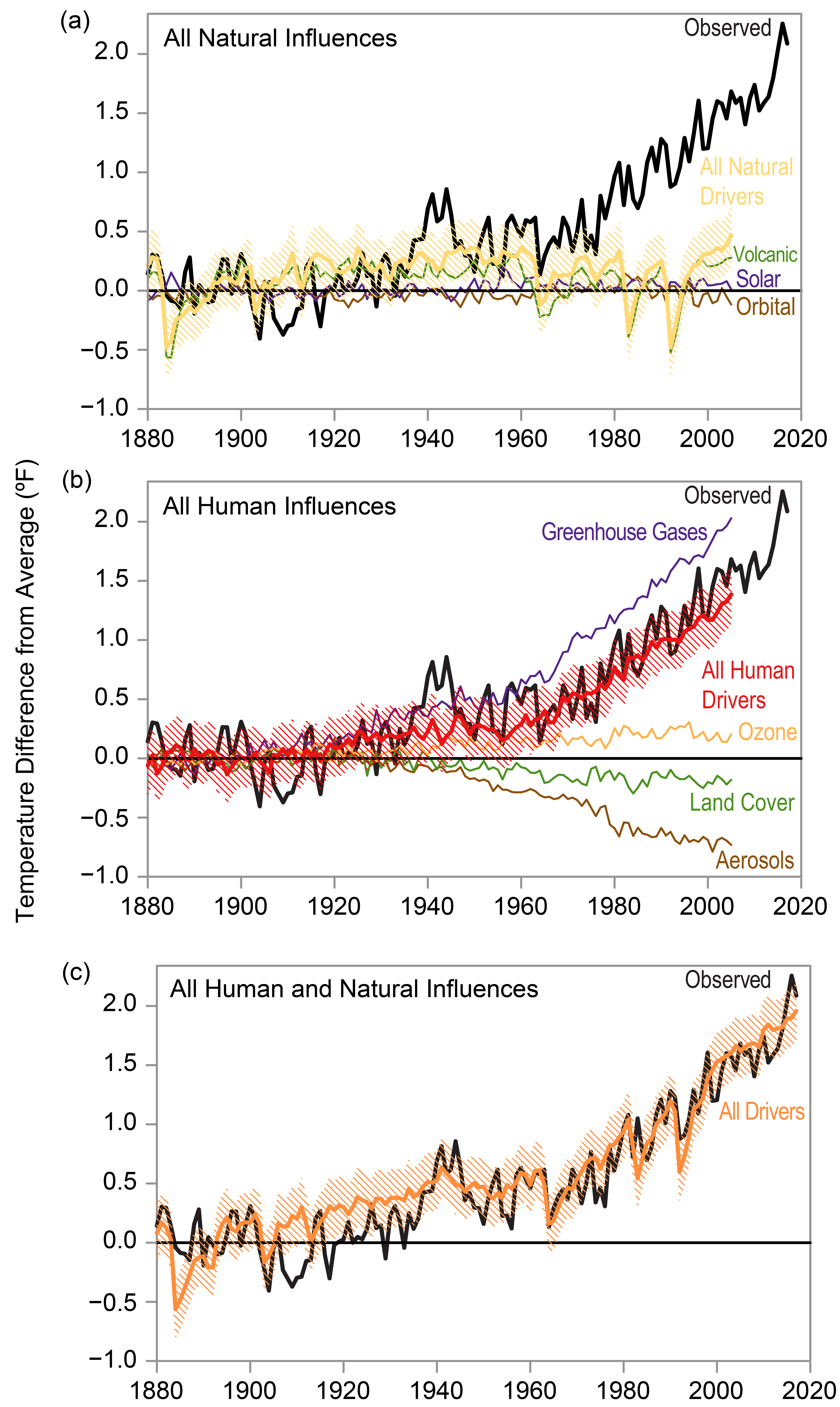
Scientists have also quantified the warming caused by human activities since preindustrial times and compared that to natural temperature forcings.
Changes in the sun's output falling on the Earth from 1750-2011 are about 0.05 Watts/meter squared.
By comparison, human activities from 1750-2011 warm the Earth by about 2.83 Watts/meter squared (AR5, WG1, Chapter 8, section 8.3.2, p. 676).
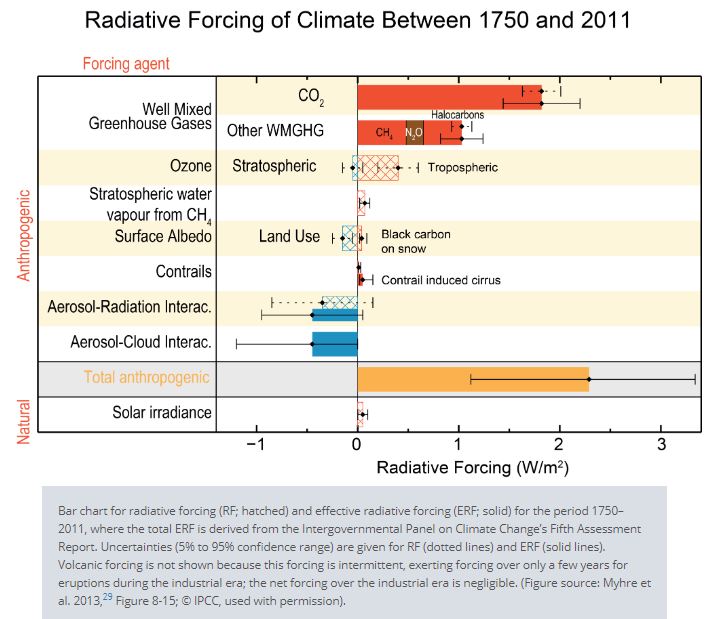
In the early 20th century human activities caused about one-third of the observed warming and most of the rest was due to low volcanic activity. Since about 1950 it's all humans and their activities.
https://journals.ametsoc.org/doi/10.1175/JCLI-D-18-0555.1
https://onlinelibrary.wiley.com/doi/full/10.1002/wcc.522Further, the detection of the human fingerprint in the observed tropospheric warming caused by the increase in atmospheric concentration of greenhouse gases like CO2 has reached 6-sigma levels of accuracy.
https://www.nature.com/articles/s41558-019-0424-x
There have been many, many scientific studies over the past 175 years examining the properties of greenhouse gases, the radiative physics of carbon dioxide and the role it plays in the Earth’s atmosphere. One of the most comprehensive, recent and openly-accessible is the US 4th National Climate Assessment (Volume 1, released in 2017 and Volume 2, released in 2018). You can download the whole thing or by chapter:
https://science2017.globalchange.gov/
https://science2017.globalchange.gov/downloads/https://nca2018.globalchange.gov/
https://nca2018.globalchange.gov/downloads/FAQ’s:
https://nca2018.globalchange.gov/chapter/appendix-5/#section-1In short, human activities (primarily via the human burning of fossil fuels) have warmed the globe, which in turn are impacting the Earth’s climate.
More than 100 comments found. Only the most recent 100 have been displayed.

More than 100 comments found. Only the most recent 100 have been displayed.






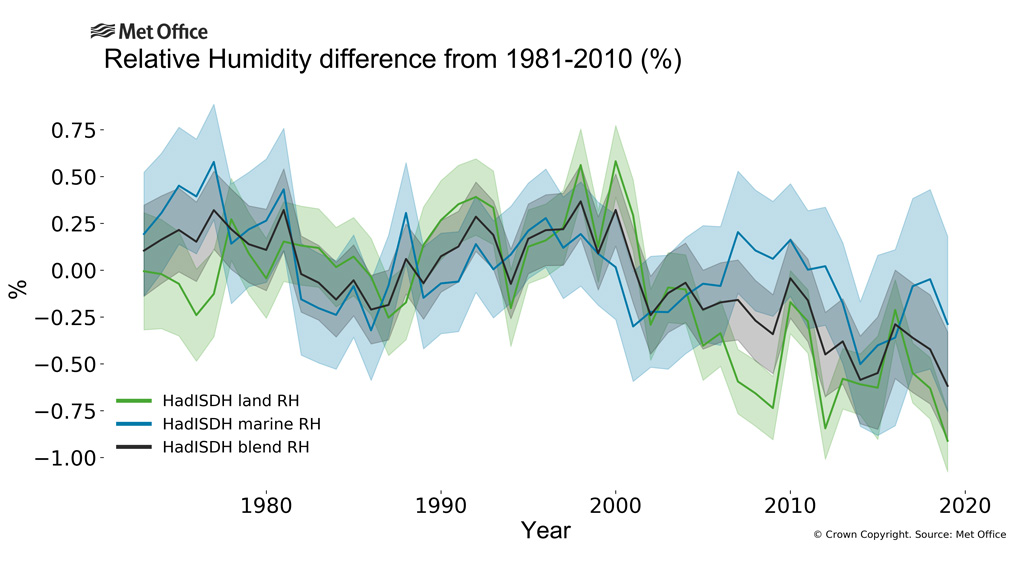


THE ESCALATOR

(free to republish)