



 Arguments
Software
Resources
Comments
The Consensus Project
Translations
About
Support
Arguments
Software
Resources
Comments
The Consensus Project
Translations
About
Support







Latest Posts
- How many people does heat actually kill?
- Check out the brand-new hurricane ‘cone of uncertainty’ graphics arriving this season
- 2026 SkS Weekly Climate Change & Global Warming News Roundup #23
- SkS Housekeeping: Updating the Comments Policy
- Skeptical Science New Research for Week #23 2026
- Nobody knows the future of energy
- Fact brief - Do electric vehicles almost always have a lower carbon footprint than gasoline-powered cars?
- Solar, wind, and EVs have knocked out a doomsday climate scenario
- 2026 SkS Weekly Climate Change & Global Warming News Roundup #22
- Skeptical Science New Research for Week #22 2026
- The next era of Atlantic hurricanes could be far more destructive
- On the death of RCP8.5
- RCP8.5 Update
- 2026 SkS Weekly Climate Change & Global Warming News Roundup #21
- Skeptical Science New Research for Week #21 2026
- What’s a ‘super El Niño’? And other El Niño questions, answered
- Fact brief - Does electromagnetic radiation from wind turbines pose a threat to human health?
- Five things you need to know about El Niño’s likely comeback
- 2026 SkS Weekly Climate Change & Global Warming News Roundup #20
- Skeptical Science New Research for Week #20 2026
- Higher warming predictions for 2026 and 2027
- A look back at ‘An Inconvenient Truth,’ 20 years later
- Two videos about the Atlantic Meriodonal Overturning Circulation (AMOC)
- 2026 SkS Weekly Climate Change & Global Warming News Roundup #19
- EGU2026 - Five days of virtual learning
- Skeptical Science New Research for Week #19 2026
- Climate Adam - Climate Change is Destroying Lives... Now
- EGU2026 - Presentation about the Skeptical Science Experiment
- Fact brief - Were the 2022 whale deaths off the US East Coast caused by offshore wind development?
- 2026 SkS Weekly Climate Change & Global Warming News Roundup #18

Comment Search Results
Search for Little Ice Age
Comments matching the search Little Ice Age:
- Human-caused climate change is unmistakably distinct from Earth’s natural climate variability
MA Rodger at 22:44 PM on 23 April, 2026Eric (skeptic) @7,
I was a little taken aback in your comment by you saying in the context of 'slow feedbacks' that "feedback increases CO2." That is not the normal understanding of 'slow feedbacks' which are the main difference between ECS & ESS.
Folk are usually rather vague about the nature of the things dividing ESS from ECS but carbon feedbacks isn't what I find mentioned (as per here). It's usually the changing vegetation & ice cover that gets the mention, along with deep ocean warming. Melting ice/permafrost and oceans will have an associated thermal-lag element but I can't see that aspect being very great. This suggests the big part of Δforcing remaining out-of-equilibrium after ECS arrives is albedo changes.
I see two points of note - (1) The value of ESS & (2) Its relevance to the AGW situation.
(1) The main evidence supporting a significant ESS is of course the temperature and the CO2 records. And those don't come with labels showing the Δforcing involved in ESS. However, they do show ESS significantly above the usual range of ECS values (ECS =+2.0ºC to +4.5ºC) although there remains the "fat tail" in ECS analyses which sits yet higher.
The accounts of ESS have in the past put ESS = 1.5 x ECS or ESS = 2 x ECS, whatever that means number-wise. The analysis is usually applied to pre-ice age data although the OP above has also used mainly ice-age data-points and spliced them onto Judd et al (2024). (The OP figures show the Cenozoic data points of Judd et al below 700ppm CO2. So not shown is the seven Cenozoic points at higher CO2 levels. If these high points were missing also from the OP's analysis, it may explain the discrepancy between the Judd ESS [+7.7ºC] and the OP ESS [+8.2ºC].)
Judd et al (2024) Fig 4b
Of course, the ESS analyses are dependent on these temperature and CO2 reconstructions. And there is significant variation here as Judd et al Fig 4a below and Rae et al (2021) fig 7 below-again demonstrate. (At 50My bp, Judd et al have CO2 at 1,200ppm & Temp at 33ºC while Rae et al have CO2 at 1,500ppm & Temp at 27ºC which would make a significant difference in caculating ESS.)
Judd et al (2024) Fig 4a
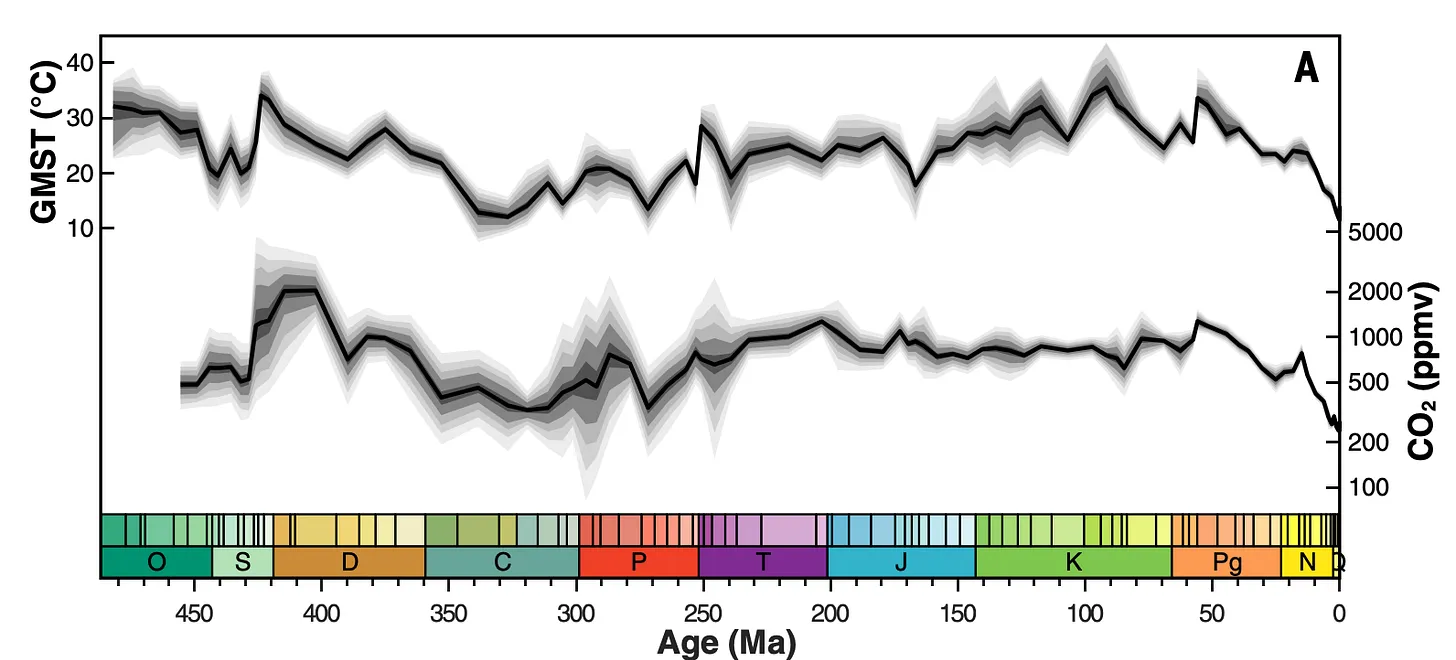
Rae et al (2021) Fig 6

So what value ESS? Presumably somewhere +5ºC to +9ºC.
But does it matter?
(2) Both ECS and ESS warming assumes the CO2 levels (or equivalent) are maintained until the respective equilibrium is reached. Give the draw-down of CO2 over the millennium will amount to roughly half the CO2 level increase of today, that maintenance of CO2 levels over the millennium would require a lot of CO2 coming from somewhere. The carbon feedbacks aren't that big. (See this CarbonBrief article which suggests natural feedbacks could amount to perhaps 15% or so.) If CO2 levels will not be maintained over centuries post-net-zero, that suggests that even ECS lacks relevance, although beyond the millennium and into ESS-territory there is no significant CO2 draw-down.
Of course, with AGW rapidly approaching +1.5ºC and the emissions still up where they shouldn't be, I don't think any reassurance given about AGW not reaching ESS levels or ECS levels (ECS levels which still may be higher than the 'usual range' due to the "fat tail"): any such perceived reassurance should not be allowed to lessen the efforts to rapidly cut emissions and reduce the bad effects of AGW we are creating for the future. (And note that the less-dreadful IPCC scenarios also include net-negative anthropogenic emissions post-net-zero to add to the natural draw-down.) - Is Nuclear Energy the Answer?
One Planet Only Forever at 04:30 AM on 21 March, 2026PollutionMonster @471,
The end quote from the abstract of the peer reviewed article in your “nuclear energy decarboninzation.” link (the quote above the link), correctly indicates the need to maintain and improve safety, equity and environmental protection.
As indicated by the series of NPR articles I pointed to in my comments @ 460, 468 and 470 the US leadership-of-the-moment has likely reduced the safety, equity, and environmental protection related to nuclear power systems.
Your brief statement comparing safety of different energy systems ending with “...Nuclear killed zero people in contrast in 2025.” is an absurdly simplistic comparison of harms and risk of harm.
The IFP article (Institute for Progress) you linked to with the rather bizarre wording ‘Red tape nuclear power construction cost and time’ does not say what you seem to believe it says. Did you read the entire article? The opening statements of IFP article are misleading. You have to read quite far into the article to see important details that are not mentioned in the opening statements.
The opening statements are:
Nuclear plant construction is often characterized as exhibiting “negative learning.” That is, instead of getting better at building plants over time, we’re getting worse. Plants have gotten radically more expensive, even as technology has improved and we understand the underlying science better. [This statement is made in spite of the detailed content of the article explaining that many reasonable factors, including important updating of safety requirements, are the reason for the cost increase.]
Nuclear power currently makes up slightly less than 20% of the total electricity produced in the U.S., largely from plants built in the 1970s and 80s. People are often enthusiastic about nuclear power because of its potential to decarbonize electricity production, produce electricity extremely cheaply [that is a blatant misleading statement] and reduce the risk of grid disruption from weather events [this ignores the reality that designing and constructing nuclear power systems for the potential risks of weather events is part of the ‘high cost of nuclear power’, unless regulations do not require those concerns to be investigated and addressed]
But U.S. nuclear power has been hampered by steady and dramatic increases in plant construction costs, frequently over the life of a single project [later explained to be due to new understandings of safety problems that had not been identified and adequately addressed before construction of the system had begun].
…
Constructing cooling systems that can continue to operate in a damaged plant contributes heavily to nuclear construction costs.
Also buried later is the following: “Rising labor costs are the bulk of increased construction costs”.
Much further into the article is the following:
“One key indicator of regulatory standards, the number of Atomic Energy Commission (AEC) and Nuclear Regulatory Commission (NRC) “regulatory guides” stipulating acceptable design and construction practices for reactor systems and equipment, grew almost seven-fold, from 21 in 1971 to 143 in 1978. Professional engineering societies developed new nuclear standards at an even faster rate (often in anticipation of AEC and NRC). These led to more stringent (and costly) manufacturing, testing, and performance criteria for structural materials such as concrete and steel, and for basic components such as valves, pumps, and cables. [sounds like the original plans were inadequate and unsafe]
Requirements such as these had a profound effect on nuclear plants during the 1970s. Major structures were strengthened and pipe restraints added to absorb seismic shocks and other postulated “loads” identified in accident analyses. Barriers were installed and distances increased to prevent fires, flooding, and other “common-mode” accidents from incapacitating both primary and back-up groups of vital equipment. Similar measures were taken to shield equipment from high-speed missile fragments that might be loosed from rotating machinery or from the pressure and fluid effects of possible pipe ruptures. Instrumentation, control, and power systems were expanded to monitor more plant factors under a broadened range of operating situations and to improve the reliability of safety systems. Components deemed important to safety were “qualified” to perform under more demanding conditions, requiring more rigorous fabrication, testing, and documentation of their manufacturing history. [all this is justified ‘increased costs’ that raise valid questions about pushes to get cheaper ‘new nuclear now’]
Over the course of the 1970s, these changes approximately doubled the amounts of materials, equipment, and labor and tripled the design engineering effort required per unit of nuclear capacity, according to the Atomic Industrial Forum.”
… [still much later in the article]
Some regulatory increase wasn’t necessarily unreasonable. Early safety requirements for nuclear plants often overlooked critical risks. For instance, prior to the proposed power plant at Bodega Bay near the San Andreas fault, seismic activity had not been considered in the design of nuclear plants. Subsequent analysis revealed that the potential for severe seismic events was much more widespread than had previously been thought. Similarly, tornado design requirements weren’t created until an application to construct a plant in a high tornado area revealed that tornado risk was much more widespread than had been assumed. When accident risk was considered, it was often analyzed incorrectly. A reactor meltdown was thought to be an astonishingly unlikely accident, yet Three Mile Island experienced one after relatively few reactor-years of operation.
Regulations constantly change
In response to learning more about how nuclear reactors could fail, the NRC’s regulatory stance became a deterministic, defense-in-depth approach – the NRC imagined specific failure modes, and specific ways of preventing them, and then tried to layer several redundant systems atop each other to compensate for uncertainty. Whenever something new was learned about potential failure modes, the regulations were changed.
These changes applied not only to future plants, but often to plants under construction. In some cases existing work had to be removed, requiring intervention and oversight from design engineers, managers, field inspectors, and other expensive personnel. This became another major source of increased costs.
... [a little further along]
To minimize the likelihood of cost overrun, plants should be built using mature designs that don’t need to be changed during the construction process. In construction of the French reactor fleet, for instance, the CEO of the French utility company EDF noted that during plant construction “Whenever an engineer had an interesting or even genius [improvement] idea either in-house or at Framatome, we said: OK, put it on file, this will be for the next series, but right now, we change nothing.” [however, if an engineer raises a new safety related concern it should be rigorously evaluated and adequately addressed]
By building multiple reactors using an unchanging design, the benefits of learning-by-doing can be unlocked. In the French reactor fleet, though costs increased whenever a new reactor type was introduced, later plants using a given reactor design tended to be cheaper than earlier plants. Similarly, the 4th unit built at the UAE’s Barakah plant was 50% cheaper than the 1st unit.
…
However, it’s not impossible to deliver nuclear plants in reasonable amounts of time for a reasonable budget. We have a playbook for improving this process. By using mature plant designs that can be built repeatedly, learning-by-doing gains can be achieved, making each plant built cheaper than the last. By developing and maintaining a robust nuclear supply chain with the necessary expertise and experience, we can ensure we don’t lose the ability to deliver plants in the future. By stabilizing regulations, making them clear, and making changes to them predictable, we can prevent cost overruns associated with expensive and time-consuming on-site rework.
But we should be realistic about what this playbook might achieve. Public concern about nuclear accidents likely makes any significant reduction in plant safety requirements untenable. Experience with the Navy’s nuclear program suggests that even by following the above playbook, building a nuclear plant to the level of safety required is a fundamentally expensive undertaking. Truly moving the needle on nuclear power might require a ground-up rethinking of how we build plants, towards things like small modular reactors or nuclear plants built in shipyards in large numbers and floated into position along the coast.
Note that the key understanding to avoid cost increases regarding nuclear power plants is having a ‘mature design’. That means having thorough updating to be confident of safety systems and environmental protection. That means ‘lots of time required before embarking on the building of a new nuclear system and the understanding that any newly identified safety concerns need to be properly evaluated and addressed even if that delays or increases the cost of construction or requires a shut-down of operations if the safety concern is discovered after the item is in operation.
Also note that a modular nuclear system design would need to be adequately safe in all possible worst conditions of all possible installation locations.
The prerequisites for success of small modular reactors is acceptance of the reality that they will be higher cost, potentially higher cost per unit of generated and delivered electricity than renewables with battery back-up. That revises the question for discussion to be “Why is effort being wasted on the promotion and development of more expensive electricity generating alternatives?”
And the lack of transparency by the Trump administration suggests that reduced safety, increased harmfulness and increased risk of harm, is being secretly pursued because it will reward the people who made bad bets on ‘developing small modular reactors’.
Things will indeed be quicker and cheaper if the harmfulness or the risk of harm is allowed to be increased. But that only proves the unacceptability of allowing potential benefits for a few people to justify increased harm or risk of harm to Others. This would only be OK if the only people negatively affected by the reduced safety would be the people who profit from the less safe item.
- Trump just torched the basis for federal climate regulations. Here’s what it means.
nigelj at 10:48 AM on 2 March, 2026OPOF was talking about people who ignore the best interests of future generations. The expert interview below is relevant and important and does it related to climate change. Its a long read but worth it. Its from NPR. Ive made a few of my own comments at the end. The article:
Harvard psychology professor Daniel Gilbert argues that humans are exquisitely adapted to respond to immediate problems, such as terrorism, but not so good at more probable, but distant dangers, like global warming. He talks about his op-ed piece which appeared in Sunday’s Los Angeles Times.
The interview:
NEAL CONAN, host:
In an op-ed in Sunday’s Los Angeles Times, Harvard psychologist Daniel Gilbert argues that human brains are adapted to respond to some threats more than to others. For example, he says, we take alarm at terrorism, but much less to global warming, even though the odds of a disgruntled shoe bomber attacking our plane are, he claims, far longer than the chances of the ocean swallowing parts of Manhattan.
And the reason is biology, the human brain evolved to respond to immediate threats but may completely miss more gradual warning signs. If you have questions about how and why our brains got wired this way or about its implications, 800-989-8255, or e-mail us, talk@npr.org.
Daniel Gilbert is a professor of psychology at Harvard University, author of the book Stumbling On Happiness. You can link to his op-ed and to all previous Opinion Pages at the TALK OF THE NATION page at npr.org.
Daniel Gilbert joins us now from his home in Cambridge, Massachusetts. Nice to have you on the program today.
Professor DANIEL GILBERT (Psychology, Harvard University): Thanks so much for having me.
CONAN: Now, you say that we need to put a threat, a face on a threat, in order to truly perceive it.
Prof. GILBERT: Well, that’s true. I mean, you know, look, if alien scientists were trying to design something to exterminate our race, they would know that the best offense is one that does not trigger any defense. And so they would never send little green men in spaceships. Instead, they would invent climate change, because climate change has four properties that allow it to get in under the brain’s radar, if you will.
There are four things about it that fail to trigger the defensive system that so many other threats in our environment do trigger.
CONAN: As you point out in your piece, our brains are exquisitely tuned to, if we see a baseball coming at our head, get out of the way.
Prof. GILBERT: Exactly so. So that’s one of the features of climate change that makes it such an insidious threat, is that it’s long-term. It’s not something that threatens us this afternoon, but rather something that threatens us in the ensuing decades. Human beings are very good at getting out of the way of a speeding baseball. Godzilla comes running down the street, we know to run the other way. We’re very good at clear and present danger, like every mammal is. That’s why we’ve survived as long as we have.
But we’ve learned a new trick in the last couple of million years – at least we’ve kind of learned it. Our brains, unlike the brains of almost every other species, are prepared to treat the future as if it were the present. We can look ahead to our retirements or to a dental appointment, and we can take action today to save for retirement or to floss so that we don’t get bad news six months down the line. But we’re just learning this trick. It’s really a very new adaptation in the animal kingdom and we don’t do it all that well. We don’t respond to long-term threats with nearly as much vigor and venom as we do to clear and present dangers.
CONAN: So a lot of us thought evolution would reduce us to four toes or maybe four fingers. You say what it in fact has meant is that we’ve developed delayed gratification.
Prof. GILBERT: Well, yes indeed. I mean, evolution has optimized our brain for the Pleistocene. I mean, you’d be, you know, if we put you back three million years, you’re going to be the most adapted animal walking the earth. The problem is that our environment has changed so rapidly because we’ve got this great big brain so we could navigate our ancestral environment, and lo and behold, what did we do? We created an entirely new environment to which our brain is not perfectly adapted.
CONAN: We’re talking with Daniel Gilbert, a psychologist at Harvard University, on the TALK OF THE NATION Opinion Page. If you’d like to join us, 800-989-8255, e-mail, talk@npr.org. And this is TALK OF THE NATION from NPR News.
Another requirement for that human response, that triggered response, is some sort of moral outrage, you say.
Prof. GILBERT: You’re right. And so I started by saying there were four, and then I talked about one, so what are the other three? The other three are, A) the source of the threat should be human rather than inanimate; B) there should be a moral component; C) as we just talked about, it should be short-term rather than long-term; and D) if you want the human brain to respond, you really want to make sure that the threat is sudden rather than gradual.
So you asked about the moral component. There’s a lot of energy these days in our Congress, and indeed in our nation, devoted to what really our strictly moral issues. There’s very little doubt that many people will be injured by burning flags or gay sex, and yet we are up in arms about flag burning and gay marriage. And the reason is that these offend many people at the moral level. We’re very good at taking umbrage. We’re just not very good at taking action against things that don’t create – that don’t arouse moral emotions. And you know, climate change just doesn’t.
As I say in my essay, if, you know, if eating, if the practice of eating kittens were the thing responsible for climate change, we’d have people massing in the street in protest right now, because eating kittens is such a morally reprehensible action.
CONAN: Yet we see things like, obviously a terrorist attack, a human action, really centers everybody’s attention. Tens of thousands of people die on American highways every year and nobody notices.
Prof. GILBERT: Well, you’re exactly right. I mean, one of the things that the human brain is specialized for is other human beings. They are the greatest source of reward and punishment in most of our environments. We’re a highly social mammal, and our brains are awfully good at looking for, thinking about, and remembering any sign of other people and their plans and their intentions. That’s why we see faces in the clouds but we never see clouds in peoples’ faces. If you play people white noise for long enough, they begin to hear voices in it. But they never hear white noise in voices.
So we’re looking. It’s as if the brain is tuned in to the signal of other human action. And that’s why when other people do things to us, we’re very, very quick to respond. We respond to terrorism with unrestrained venom and with great force, just as our ancestors would have responded to, you know, a man with a big stick. The problem is climate change doesn’t have a human face. It’s not an Iraqi with a big mustache. It’s not somebody we can villainize. It’s not a man with a box cutter. And so if there’s no one to vilify, there’s no face to put it to, it’s hard for human beings to get very excited about it.
CONAN: Let’s get a call in from Guillermo, Guillermo calling from Raleigh, North Carolina.
GUILLERMO (Caller): Hi.
CONAN: Hi.
GUILLERMO: I guess my point is similar along the lines – somewhere along the way in school I heard a story basically along the lines of more complex issues humans don’t process that well yet. So, for example, if a person had to hear all of the news events that occurred on the planet earth in a single day, your brain wouldn’t be able to take it. And I just wanted him to see if there’s any truth in this, or…
CONAN: Does quality relate to our quality of alarm?
Prof. GILBERT: Well, you bet it does. I mean, climate change in some ways is a very simple issue. But those who profit from not taking action against global warming have turned it into a complicated issue. Why have the opponents – and believe it or not, there are opponents of action against global warming – why are the opponents turning it into a complicated issue? Well, as our caller well knows, if we can make this complicated, enough people will throw up their hands and say, you know, scientists, they all disagree. Who knows what we can really do about this?
You know what? Scientists don’t disagree about this, and what we can do is very, very clear.
CONAN: Scientists don’t necessarily agree on the cause of it. They do agree that it’s happening. Anyway, Guillermo, thanks very much for the call.
GUILLERMO: Thank you very much.
Prof. GILBERT: Well, scientists agree to an enormous extent on the cause of it. You know, it’s interesting, when you look at scientific articles on global warming, there’s enormous consensus. When you look at news articles on global warming, about half of them mention that there isn’t much consensus. It really just isn’t so. Scientists are in vast agreement about the causes of global warming, as much as they’re in agreement about the dangers of cigarette smoking. You could say scientists don’t all agree, and I’m sure there’s somebody out there who’s still saying it doesn’t cause cancer, but by and large…
CONAN: So there you have an evil human face you can put on this. Those who are dastardly working towards profit 50 years hence.
Prof. GILBERT: You see, that’s how I’m getting myself to respond.
CONAN: Thanks very much for being with us, Daniel Gilbert. We appreciate your time today.
Prof. GILBERT: My pleasure. Thanks.
CONAN: Daniel Gilbert’s op-ed was this week in the Los Angeles Times. It’s Why Americans are Afraid of the Wrong Threats.
Again, if you’d like to read the piece, there’s a link to it at our webpage. Just go to npr.org and go to the TALK OF THE NATION page. Also there, all of the other previous Opinion Pages on TALK OF THE NATION.
I’m Neal Conan. This is TALK OF THE NATION from NPR News, in Washington.
Copyright © 2006 NPR. All rights reserved. Visit our website terms of use and permissions pages at http://www.npr.org for further information.
https://www.npr.org/2006/07/03/5530483/humans-wired-to-respond-to-short-term-problems
My comment: I’m not a doomer. I dont think such findings mean we are locked into inaction, or that we are doomed. Perhaps we can overcome these impediments, and renewable energy is gaining traction on its merits and low costs anyway. But its just something we need to understand. And I think some of us are more reactive to distant future events that others, for some reason that seems deeply seated. Like personality differences.
- After a major blow to U.S. climate regulations, what comes next?
Bob Loblaw at 02:47 AM on 27 February, 2026Eric @ 15:
Thanks for the clarification. Yes, I think the last sentence in the OP is a little vague. It could mean "Oh, Gawd. The states and Congress will muck this up and never do anything." Or it could mean "We have an opening for the states and Congress to take action."
The downside of action at the individual state level is patchwork of regulations that makes interstate commerce difficult and/or expensive. And it makes for "that's not my problem" decisions if Ohio decides they love coal and hate New York. Canada was also a recipient of acidic winds from places in the US. Canada and the US did agree to bilateral action on the issue (both reduction and monitoring).
And interstate patchworks are even more difficult at the international level. Too many times I've heard the argument "Canada only produces 2% of the world's CO2. It won't make any difference if we cut it all." My response is "Yes, and the rest of the world consists of 49 other regions that also only contribute 2% of the total. They can make the same excuse, and then nothing happens." It's the poster child for tragedy of the commons.
Controlling emissions also can't be done pragmatically on a patchwork basis. Everyone has an excuse why their industry should not be limited, or should get extra credits. Carbon taxes (or "fee and dividend"), carbon credits and cap-and-trade systems. All will fail when only applied locally. Taxes are avoided by relocating production to low- or no-tax jurisdictions. Cap-and-trade requires a market large enough to provide sufficient flexibility.
Going slowly is better than not going at all, but going too slowly won't get us where we need to go. (When I was a grad student, we were at the pub one Friday evening. My office-mate was supposed to meet his girlfriend at 7pm, but as 7pm approached he decided to stay for another beer or two. He said "I'm late already; it won't matter if I'm even later." On Monday morning, when I arrived at the office, his first words were "Remember when I said Friday night it didn't matter if I was even later? I was wrong.")
- Is Nuclear Energy the Answer?
One Planet Only Forever at 06:52 AM on 22 February, 2026A followup to my comment @460,
The US leadership-of-the-moment’s push to deploy massive amounts of small nuclear reactors without rigorous proof that it will be safe continues as described in the following report:
US military airlifts small reactor as Trump pushes to quickly deploy nuclear power, reported in NPR, by Associated Press, Feb 21, 2028.
This is an example of misleading marketing abused by gamblers (inventor/investors) who will try to harmfully maximize their benefit from potentially bad bets (or bad ideas). The harm will be discovered in the future (because the innovator is not required to rigorously investigate potential for harm). And it is likely that the promoters of the ‘innovation’ will obtain benefits that cannot be taken away from them in the future when the harm they benefited from causing becomes undeniable – like the fossil fuel climate impact issue.
Selected quotes from the article:
Energy Secretary Chris Wright and Undersecretary of Defense Michael Duffey, who traveled with the privately built reactor, hailed the Feb. 15 trip on a C-17 military aircraft as a breakthrough for U.S. efforts to fast-track commercial licensing for the microreactors, part of a broader effort by the Trump administration to reshape the country's energy landscape.
...
Skeptics warn that nuclear energy poses risks and say microreactors may not be safe or feasible and have not proved they can meet demand for a reasonable price.
Wright brushed those concerns aside as he touted progress on Trump's push for a quick escalation of nuclear power. Trump signed a series of executive orders last year that allow Wright to approve some advanced reactor designs and projects, taking authority away from the independent safety agency that has regulated the U.S. nuclear industry for five decades.
...
The minivan-sized reactor transported by the military is one of at least three that will reach "criticality" — when a nuclear reaction can sustain an ongoing series of reactions — by July 4, as Trump has promised, Wright said.
"That's speed, that's innovation, that's the start of a nuclear renaissance," he said.
...
Edwin Lyman, director of nuclear power safety at the Union of Concerned Scientists, said the transport flight — which included a throng of reporters, photographers and TV news crews — was little more than "a dog-and-pony show" that merely demonstrated the Pentagon's ability to ship a piece of heavy equipment.
The flight "doesn't answer any questions about whether the project is feasible, economic, workable or safe — for the military and the public," Lyman said in an interview.
Rapid scale-up to power AI data centres could see 1000s of these ‘potential disasters’ in operation by 2030. The expected global power demand for AI data centres by 2030 is over 1000 TWh. Assuming a 5 MW generator, like the one reported to have been shipped by the military on Feb 15, 2026, operates at full power 24 hrs a day every day it would produce 5 x 24 x 365 = 43,800 MWh = 0.0438 TWh. (Also note that a typical AI data centre requiring 100 MW would need twenty 5 MW generators).
Poorly regulated, unrestricted, innovation in pursuit of personal benefit has a history of producing harmful results that Others have to deal with. New Nuclear appears to be rapidly becoming a New Future Disaster promoted by Master Misleading Marketers.
- Zeke's 2026 and 2027 global temperature forecasts
prove we are smart at 18:19 PM on 26 December, 2025@2 MA Rodger "His argument is really simply that the current trajectory of mankind is pointing to some really bad outcomes. You could use such projections to point to, say, pre-industrial mankind drowning in horse shit."
I never read that story before-a funny shitless outcome for technology and fossil fuels saving the cities, the twist to that is the savior is now the villain and an existential threat to, well,everything. ???????????? Human health
Extreme heat increases risks for vulnerable groups, including pregnant women and infants.
Heatwaves, air pollution, and the spread of diseases all worsen as temperatures rise.
???? Economies
Countries face major economic losses from reduced productivity, damaged infrastructure, and disrupted supply chains.
For example, Cyprus could lose up to €29 billion from its GDP by 2050 without action.
????️ Ecosystems & wildlife
Species that depend on stable climates — like mountain meadow animals or cool-stream amphibians — are already struggling as their habitats change or disappear.
????⚡ Water and energy systems
Asia’s water and power systems are being hit hard by floods, droughts, and extreme weather, putting millions at risk and requiring trillions in adaptation spending.
???? Communities & infrastructure
Rising sea levels, stronger storms, and more frequent wildfires threaten homes, roads, and essential services.
NASA notes that effects like sea ice loss, glacier melt, and more intense heat waves are already happening and will worsen.
???? Food security
Droughts, heat, and unpredictable weather reduce crop yields and disrupt food supply chains.
????️ Earth’s natural systems
Global assessments highlight extreme weather, biodiversity loss, and destabilization of Earth’s systems as top long-term risks for humanity.
There is no argument the earth temperature is still rising,in fact,arguably accelerating. All the nation states are playing in an international poker game,where everyone is cheating. The unfriendly USA is openly and aggressively war mongering for Venezuela's heavy crude and more than eyeing off the sovereign nation of Greenland for its particular usefulness.
All the responders opinions agree that last link I mentioned is complete "pretentious twaddle". I see something else. I see tipping points of no return happening on our watch. I see a tragedy from a thousand cuts to our biosphere. I see political leaders too "involved" with corporations/big business and election cycles to plan sincerely.
Worst of all,the consumer has only a little appetite for a meaningful change to their bubble. The commodification of everything and the insidious media manipulation means a continuation of an economical system driving us all towards that cliff.
At least 6@ nigelj adds a little realism to it all. I don't have an answer to turn societies to less comforts, we need to be less capitalistic and more community minded and that goes against most western countries lifestyles.
- Ice age predicted in the 70s
Philippe Chantreau at 00:10 AM on 9 November, 2025The motivation is simple and as crude as it gets in the denialist bag of tricks: Scientists predicted an ice age in the 70s and it didn't happen, so there is no reason to believe what they are predicting now. The funniest thing is that it no longer is a prediction, it is happening right in front of us.
Now, Angusmac is only increasing word count, throwing smoke and mirrors to try to hide the abysmal shortcomings of that little list. A first step would be to make sure that every link actually leads somewhere. I'm not holding my breath. The whole thing is a pitiful attempt at twisting reality.
- Ice age predicted in the 70s
angusmac at 13:19 PM on 7 November, 2025@152 & @153
BL, you state that, “To claim that PCF-08 is wrong, angusmac needs to evaluate using the same criteria: a time scale of decades to centuries. If he is to gain any credibility, he needs to outline where in Sellers (1969) he finds support to argue that Sellers thought that the solar constant would decrease by this amount (or any amount) over the next century.”
In response, I now enclose an image of a paragraph from p.399 of Sellers (1969).

Note that Sellers (1969) states that "...in as little as 100 years…it is not inconceivable that the solar constant will change”. Consequently, it is obvious that my classification of Sellers (1969) is based on "time scales from decades to a century".
Notwithstanding the above, he does state that such a change in the solar constant for an extended period is, “on the fringe of being highly unlikely”. Furthermore, I would suggest that “on the fringe” means that the possibility cannot be discounted. Additionally, nowhere in Sellers (1969) is a change to the solar constant ruled out. Indeed, he includes such a possibility of solar change as one of his "major conclusions" (as highlighted below).

I contend that all of the Sellers (1969) conclusions are valid because all of them “were specified to be physically realistic” (although some outcomes may be more likely than others).
Consequently, I still maintain that my change to the PCF-08 classification of Sellers (1969) from warming to neutral is valid because he did state that there was a possibility of another ice age and that it was specified to be "physically realistic” .
- Is this the most embarrassing error in the DOE Climate Working Group Report?
prove we are smart at 09:45 AM on 10 October, 2025I have to use simple breathing techniques to read/listen to anything from this Trump regime! Enabled by a political party of grifters and cowards with little conscience and no mirrors in their many houses.
Generations of this countrys populous fed on years of media stereotyping dumbing most down and culminating in electing a malignant man not once but twice. A mob boss,whose arsehole has swapped places with his mouth.
Indeed, Wikipedia on their "false and misleading statements by Donald Trump" page, have trouble deciding whether to split the narrative into 2 pages! en.wikipedia.org/wiki/False_or_misleading_statements_by_Donald_Trump
I guess it is about people voting against their own best interests. Seeing the big picture without the baggage you have grown up with or picked up along lifes journey. It seems not becoming a fatalist is much harder now and giving in to such is a guarantee of a dismal future for those generations to come.
- Koonin providing clarity on climate?
Charlie_Brown at 05:09 AM on 28 September, 2025Ken Rice is lenient with the authors of the DOE Climate Impacts report and with Secretary Chris Wright. Chris Wright states in the Foreword: “I chose them for their rigor, honesty, and willingness to elevate the debate. I believe it faithfully represents the state of climate science today.” I care more about substance than credentials. My public comments included: “The Foreword highlights that the purpose of the Critical Review is to challenge and counter mainstream science. It certainly does not represent the state of climate science today. Rather, it provides a rationalization for weakening current policies for combatting climate change. The authors are neither representative of the scientific community nor diverse.”
The science is not that complex. The report is full of misrepresentation, distraction, and obfuscation. It is not worthy of an undergraduate term paper let alone a critical review of science by PhDs. Many points have been thoroughly discussed and debunked here on the SkS website. My comments included:
1) “Section 2.1 is oversimplistic. CO2 is rarely the limiting nutrient. It discusses photosynthesis as a benefit but ignores adverse effects resulting from CO2 as the primary cause of climate change including drought, extreme temperatures, excess rain, and cropland relocation.”
2) “CO2 below 180 ppm is an irrelevant distraction to the discussion of modern global warming.”
3) “Changing ‘ocean acidification’ to ‘ocean neutralization’ is semantic posturing that does not change the effects. To say that pH reduction is not acidification until the pH drops below 7.0 it is not meaningful.”
4) “Implying that the IPCC uses data manipulation to satisfy preferences is baseless accusatory language. The change in radiative forcing due to the Earth’s orbit around the sun is negligible within the period of modern global warming. The change due to sunspot activity is measured and found to be negligible.”
5) “Comparing 3 W/m2 to 240 W/m2 is misleading and diminishes the significance of 3 W/m2. It is an example of science denialism by distraction, obfuscation, and omission. Straightforward, fundamental physics including conservation of energy and radiant energy calculations combined with atmospheric properties allow the effects of anthropogenic forcing to be isolated by calculation. The calculated spectra of energy loss to space is verified by satellite measurements (Hanel, et al.,1972) (Brindley & Bantges, 2015). 3 W/m2 is sufficient to cause and continue observed global warming. The anthropogenic forcing is not determined by difference of two large, measured numbers and does not rely on just satellite estimates of radiative energy flows. There is very little uncertainty about the effects of increasing gas concentrations.
The effect of clouds is the largest uncertainty in climate models. However, average cloud cover does not change without a driving force. Therefore, the effect of increasing GHG can be isolated by holding clouds constant. Specific humidity will rise with increasing surface temperature, resulting in positive water vapor feedback. This can affect clouds."
Others have submitted many more excellent comments, but I have made my point. The science can be explained and understood by most scientific-minded people who are interested in learning. One does not need a PhD in climate science to understand the flaws in the DOE report.
Disbanding the CWG may not be a sign of progress. It may be a way to avoid the lawsuit by the Environmental Defense Fund and the Union of Concerned Scientists that would restrict the use of the report.
- 2025 SkS Weekly Climate Change & Global Warming News Roundup #14
One Planet Only Forever at 08:04 AM on 9 April, 2025This week’s news includes several items in the Climate Change Impacts category about the damaging impact of human-caused global warming and climate change on developed and developing global socioeconomic systems.
- Big Banks Quietly Prepare for Catastrophic Warming
- Global warming of more than 3°C this century may wipe 40% off the world’s economy, new analysis reveals
- Climate crisis on track to destroy capitalism, warns top insurer,
Those articles provide a basis for continuing a discussion here that started on the recent SkS reposting of “Climate skeptics have new favorite graph; it shows the opposite of what they claim”. The comment discussion had evolved away from the topic of the OP. The discussion had shifted to matters related to the development of sustainable improvements for the total global population, now and into the very far future.
The three articles listed above prompted me to expand on my semi-conspiracy theory about the development of opposition to the efforts to increase awareness and improve understanding of how people can be less harmful and more helpful to Others. (see my comment @22 and nigelj’s reply @23 on that SkS reposting linked above)
Additional considerations related to this week’s News items are:
Big Banks Quietly Prepare for Catastrophic Warming:
Quote:
“The recent reports — from Morgan Stanley, JPMorgan Chase and the Institute of International Finance — show that Wall Street has determined the temperature goal is effectively dead and describe how top financial institutions plan to continue operating profitably as temperatures and damages soar.”
Related thoughts:
This suggests that some people who know better are not powerfully raising awareness and improving the understanding of the general population. They are trying to maximize their collective benefit in spite of knowing how harmful their lack of action to limit the global harm done will be. It is like the way that the 2008/9 global financial disaster turned out to be beneficial for many of them (very few of them faced a negative change of status relative to Others – many of them increased their status relative to Others). The least fortunate who got little benefit from the sub-prime mortgage scams suffered the most.
Global warming of more than 3°C this century may wipe 40% off the world’s economy, new analysis reveals
Quote:
“Any impacts from weather events elsewhere, such as how flooding in one country affects the food supply to another, are not incorporated into the models.
Our new research sought to fix this. After including the global repercussions of extreme weather into our models, the predicted harm to global GDP became far worse than previously thought – affecting the lives of people in every country on Earth.”
Related thoughts:
A group of people today have proudly watched a 10% hit happen to global economic activity in a matter of a few days. They think they will be the winners. Everyone will lose because of the unjustified tariff attacks. But the likes of Trump probably think they will suffer less harm that Others will. Some of them may even believe they will benefit from the inequitable unjustifiable actions (paying members of Trump’s Mar-a-Lago Cult could have an unfair advantage if they heard about what the Trump Administration would actual do before it became public knowledge). These type of people would have even less concern about actions they benefit from causing 40% harm to the future economy Others have to live with.
Climate crisis on track to destroy capitalism, warns top insurer
Quote:
“The insurance sector is a canary in the coalmine when it comes to climate impacts,” said Janos Pasztor, former UN assistant secretary-general for climate change.
The argument set out by Thallinger in a LinkedIn post begins with the increasingly severe damage being caused by the climate crisis: “Heat and water destroy capital. Flooded homes lose value. Overheated cities become uninhabitable. Entire asset classes are degrading in real time.”
“We are fast approaching temperature levels – 1.5C, 2C, 3C – where insurers will no longer be able to offer coverage for many of these risks,” he said. ...
“This applies not only to housing, but to infrastructure, transportation, agriculture, and industry,” he said. “The economic value of entire regions – coastal, arid, wildfire-prone – will begin to vanish from financial ledgers. Markets will reprice, rapidly and brutally. This is what a climate-driven market failure looks like.”
Related thoughts:
All of the resistance to the achievement of Sustainable Development Goals, not just resistance to efforts to limit the harm done by climate change impacts, is raising doubts about, and reducing the sustainability of, capitalism (and democracy – given the recent authoritarian ‘winning of unjustified popular beliefs and related abusive power’ in many democracies).
The following time-line of events is part of the basis for my semi-conspiracy theory about the reasons there is such a powerful resistance to learning to be less harmful and more helpful to Others. (note that there are many similar things along the timeline ... since the beginning of recorded human history and more recently)
- 1913 – US 16th Amendment ratified allowing Congress to impose an Income Tax. (Still resisted by many wealthy and influential people who almost certainly know that their resistance is harmfully incorrect. Also resisted by people who are less aware or misunderstand things and have unjustified doubts about the benefits of an Income Tax because they are easily tempted to be misled that way)
- 1933 – 1938 – US New Deal series of reforms (Resisted - See above)
- 1948 – UN Universal Declaration of Human Rights (Resisted - See above)
- 1962 - Silent Spring first published (Resisted - See above)
- 1964 - US Surgeon General report regarding smoking (Resisted - See above)
- 1965 – UN Development Programme - evolved from UN programs that started in 1949 (Resisted - See above)
- 1972 - Stockholm Conference – identified many harmful developed human impacts (Resisted - See above)
- 1990 – IPCC first report (Resisted - See above)
- 2020 – COVID19 – (Influential people opposed to learning to be less harmful and more helpful to Others found new ways to maximize their ability to benefit from being misleading)
Constantly improving global civilization is not a guarantee. It is very hard work to limit the harm done by people who resist learning to be less harmful and more helpful to Others. They know better, but do not care about how harmful their actions and lack of actions are.
- Climate's changed before
Bob Loblaw at 23:39 PM on 18 March, 2025Brainscientist @ 902:
As pointed out by Eclectic in 903, and in the moderator's comment on your comment, there are many resources where you can find out more about the topics you opine on. Here at Skeptical Science, you are expected to provide some sort of reference to claims. Sadly, your comment is short on supporting information.
You can find much information here, using the Search function on the upper left of each page, or by looking at the many topics that are presented in the Most Used Climate Myths (also linked to in the upper left of each page).
You start with an empty assertion that people "...never discuss the fact the [sic] the climate changed dramatically in the last 880ka.". "Never" is an awfully strong assertion. You say that, in spite of the fact that the Intermiediate tab of the post you are responding to has a graphic (Original source Wikimedia) showing earth temperatures over the past 500 million years. Here is the graphic again:
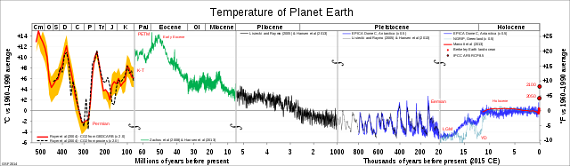
Your claim of "never" is so easily refuted that it makes one wonder just what sources of information you have been using.
You also use the "never" word in your third paragraph, where you say "...when in the past there has NEVER been an ocean level above 20m from present and most are less than 8m." Again, let's make use of some graphics from Wikipedia, where there is a page on Past sea level. That page has the following graphic:

Your claim of "never" includes the 542 million year period covered in that graph - unless, of course, you have some sort of special meaning for "never". For most of us, the definition of "never" is probably similar to that found in Wiktionary: "At no time; on no occasion; in no circumstance."
FYI, the peak in that graphic (400m) is a wee bit higher than your claim of 20m. Unless you also have your own definition of the mathematical meaning of "above 20m".
Skeptical Science has a nice page on the Younger Dryas.
If you really, honestly "..would like to know why..." then (as Eclectic and the moderator have pointed out) you should start with some reading (or videos such as the Potholer ones Eclectic has mentioned). Whatever sources you have been looking at appear to have seriously led you astray.
...and when you make assertions about observations or analysis, then please provide some sort of references to the sources of the material you have used to inform your opinions. Without references, all you have is empty opinions.
- Fact brief - Can CO2 be ignored because it’s just a trace gas?
One Planet Only Forever at 04:21 AM on 28 January, 2025Evan @8,
I understand that I am ‘not the norm’. I am a retired professional engineer with an MBA who, decades ago, ‘took to heart’ the ethical obligation to learn to ‘protect the public interests from the potential harms of interests that are opposed to learning to be less harmful and more helpful to others’.
There is a reason I concluded my comment @7 the way I did.
I agree that the future is likely to continue to get worse while ‘potentially appearing to be getting better’. Global interests can indeed be harmfully influenced by ‘Us (me) vs Others’-ism (not just nationalism). There needs to be a systemic change of the ‘developed dominance of misleading marketing in the competitions for perceptions of superiority’.
The ‘popularity of beliefs’ needs to be governed by learning to be less harmful and more helpful to others. Developed socioeconomic systems have been significantly influenced by misunderstandings that keep people from learning how to be less harmful and more helpful to others.
The problem has always been the many ways that popularity of instinctive, first-impression, emotion-triggered, gut-reaction misunderstandings can ‘be more popular’ than rational unemotional thoughtful considerate (critical thinking) pursuits of learning to be less harmful and more helpful to others. Note that changing this fundamental dynamic is an uphill battle. The science (knowledge) of how to win by being misleading is very advanced and continues to quickly advance.
It is important for people to learn where the blame lies (intentionally chosen term):
- People who struggle to obtain the basic needs of a decent life can be excused for not trying to learn to be less harmful and more helpful to others (however, many such people still try to be less harmful and help others).
- Many more fortunate people have little excuse – other than how easy it is to be impressed by misinformation marketing that triggers passionate belief of harmful misunderstandings.
- Leaders and other big winners have no excuse for failing to learn to be less harmful and more helpful to others and failing to help others free themselves from the vicious grip of harmful misunderstandings.
I also hope that the future of humanity will be sustainably improved. However, I share your concern that climate change impact mitigation is not happening as rapidly as is need to responsibly limit the harm done. Responsible considerate leadership could have accomplished significantly more mitigation by now.
My more global concern is that we could be witnessing the early days of a powerful resurgence leading to many decades, possibly centuries, of global humanity being dominated by extremely harmful misunderstandings.
The success of misleaders can be sensitive to small changes of awareness and understanding. Every vote and consumer choice matters.
The more 'common sense, or normal, understanding' needs to be that anyone aware of misleading messages regarding climate science has no excuse for supporting the misleaders (as customers or voters) regardless of other interests. ‘Pursuers of popularity’ who are misleading about climate science are likely harmfully misleading about many other things.
- Sabin 33 #12 - Do solar panels work in cold or cloudy climates?
One Planet Only Forever at 09:28 AM on 24 January, 2025Evan,
To try to stay ‘close to topic’, but respond to your interest in the most beneficial ways to install home solar panels, I will start by saying that incorrect claims like the Myth that this Rebuttal addresses are attempts to unjustifiably discourage people from:
- supporting solar panel systems as part of the required correction of developed Grid generation systems
- considering the helpful installation of home solar systems.
A very important consideration is that the governing objective is to minimize CO2, or other lasting or significant global warming impacts, produced by electricity generation.
Grid electricity generation needs to be transitioned to be truly net-zero ghg. And grid, as well as home, solar panels can be part of that transition. Even a rapid correction of a grid system to responsibly limit the harm done can take many years. And ‘natural gas peaker plants’ are likely to be the last parts removed from regular operations (natural gas peaker plants may exist long-term as an ‘emergency-emergency back-up’ that is very rarely needed).
Based on that understanding, people can help more rapidly reduce the harm of electricity generation by installing home solar systems. And they should design home solar installation to maximize the total annual generated electricity, appreciating what affects the amount of electricity generated. They should not be discouraged by the reality that many factors affect the amount and timing of electricity generated. And they certainly should ignore misleading claims like “Solar panels don’t work in cold or cloudy climate.”, or when covered by snow.
Bob Loblaw, and others, have provided plenty of very helpful information, including information about how cold and cloud affect solar panel performance.
Moving a little further from the topic to add some more considerations for home solar installations...
Variation of pricing should guide the use of electricity. However, a focus on the ‘variation of grid pricing’ may result in choices that do not minimize the overall amount of CO2 emissions.
If CO2 per Grid-generated MW-hr does not vary with time of day then minimizing the ‘net demand for grid energy’ should minimize CO2 from grid energy production. That means maximizing the total annual home solar generation with unused home generated electricity stored for later use or delivered to the grid to reduce grid generation. Building home solar for maximum generation during ‘peak price times’ would likely reduce the total annual home generated electricity and result in more CO2 generation than building to maximize total annual generation.
However, if CO2 per MW-hr is significantly higher during peak price times, because of things like the use of natural gas peaker plants to meet peak demands, then designing the home system to reduce the ‘home grid demand’ during the peak ‘CO2 per MW-hr’ times may be more helpful. However, as the grid system is improved to reduce CO2 generation the home system built to maximize generation during those current peak CO2 times becomes less helpful than a home system designed to maximize total annual generation.
The story changes if home generated electricity cannot be delivered to the grid or will not be stored for later use. Minimizing the grid energy needed would still be the objective. But maximizing the home solar generation during times of peak home electricity use becomes a significant, but complex, consideration. This could lead to potential benefits from maximizing generation during peak use times. However, that would also lead to understanding the benefits of charging the EV during peak home solar generation times.
All of the above considered may result in the conclusion that the best thing to do is build the home solar system to maximize the annual total generation and then adjust the home electricity use to minimize CO2 emissions impact of grid energy needed.
Final points regarding panel orientation:
- Being able to manually adjust the angle from horizontal could allow seasonal adjustment that increases the total annual electricity generation.
- The extra cost of an automated tracking system that seeks the orientation that maximizes generation may be more beneficial than a system that tracks the sun. But automation does not always work as well in reality as it does in conceptual planning.
- Sabin 33 #12 - Do solar panels work in cold or cloudy climates?
Bob Loblaw at 02:09 AM on 24 January, 2025Upstream, in comment 4, I talked about some of the aspects of solar panel installation and orientation. Words are nice, but pictures are often better, so I've graphed out some data to show some difference between clear/cloudy, winter/summer, and horizontal/tilted measurements of solar radiation.
The following graphs are a continental location, at about 50°N latitude.
All radiation graphs show five different measurements:
- The "Direct" measurement is "direct normal" - an instrument pointed directly at the sun, with a narrow field of view.
- "Diffuse" is the radiation on a horizontal surface of just the sky - direct sun blocked.
- "Global" is a full sky view (direct plus diffuse) on a horizontal surface.
- "Titled" is also direct plus diffuse, but at a 50° tilt to the south, so it sees some sky and some ground.
- "Reflected" is the same type of instrument as "Global", but upside-down so it sees all the solar radiation being reflected off the ground surface.
The first graph is a clear day at the beginning of January. Direct radiation peaks at over 900W/m2, and diffuse radiation is less than 100W/m2. Because the sun is low in the sky, the global reading is much less than the direct - peaking slightly over 300 W/m2. The tilted sensor, though, peaks at over 800 W/m2 - not only is it pointing much closer to the sun, but it also sees a lot of ground that is very bright. The reflected reading peaks at over 200W/m2 - the ground is snow covered, reflecting about 75% of the global signal, so much brighter than the deep blue sky of the diffuse signal.

Clearly, a tilted solar panel would produce much more power than a horizontal one. We can see why when we look at the solar elevation angle (how high about the plane of the panel the sun is located). This graph shows the elevation above a horizontal surface (global instrument) and tilted surface. The sun is barely 20° above the horizon of the horizontal sensor, but is over 60° above the tilted sensor's "horizon". Note that the daylight period is only about 8 hours - elevation>0° for the horizontal view. Even though the titled sensor has an elevation >0° for much longer, those "extra" hours mean nothing, as the view of the sun is blocked by the earth!

The next day, cloud moved in. Direct radiation is zero, except for a brief period in early afternoon when the clouds thinned enough to let a bit of direct sun through. The four other lines are, from highest to lowest, tilted, Global and Diffuse (virtually tied), and Reflected. With no direct sun, and a snow-covered surface that reflects most of the solar radiation, there isn't much difference between the horizontal and tilted readings.

Note that for the horizontal sensor (global) the cloudy day is not much lower than the clear day. It peaks around 250W/m2, compared to a little over 300W/m2 on the clear day.
What about summer? Here is a "mostly" clear day in early July. Direct beam peaks only slightly higher than in January, but global radiation is much higher because of the higher solar elevation. The titled sensor peaks a little higher than global - it's tilt is no longer much of an advantage over the global sensor, and the portion of ground it sees is now dark (reflecting only about 20% of the global). Diffuse is again <100W/m2.

Daylight is now more like 16 hours, though, so daily totals will be quite different from January. We also see something odd in the tilted sensor - it peaks higher than the global (horizontal) sensor, but in early morning and late afternoon, it sees less than the global sensor. In fact, at the extremes it looks like it is only seeing the diffuse radiation - no direct.
We can understand this by looking at the solar elevation again. Note that for the titled sensor, the sun "rises" much later and "sets" much earlier (elevation <0°) than for the global sensor. What is happening is that the sun rises in the NE and sets in the NW, so it is actually behind the tilted sensor, not in front of it.

And lastly, we'll look at a cloudy summer day, right on the summer solstice. We do see some direct sun getting through in the afternoon, but we can see the cloudy period that covers most of the day. We see a substantial reduction in global before noon local time (compared to the clear day). After 12pm, we see a higher value for global as the cloud thins and a bit of direct radiation makes it through the clouds. During the cloudy period, the tilted sensor is not much different than the global one - both are seeing the same diffuse radiation.

So, hopefully this helps illustrate some of the complexities related to solar panel installation and orientation. To refer back to the OP - no, cloudy skies does not mean "no solar energy". The OP is correct - the myth is busted.
This is only one location, and a few days of data. And this level of data is not readily available for most locations. But it does illustrate that installation may be dependent on local factors such as amount of cloud, type of cloud, timing during the day, etc.
- Is Nuclear Energy the Answer?
Philippe Chantreau at 06:28 AM on 19 January, 2025Michael,
I know I won't change your mind about nuclear as a large scale solution, but please give me the courtesy of keeping up the quality of argument expected from all participants here. I don't doubt that you have some notion of what kind of analysis is required before one can claim that some days are "representative" and I am sure that, if anyone on this forum was to make such claim on any subject, they would be asked to produce substantation.
There is an abundant literature about load following and and it disagrees with your contention that it is by nature uneconomical. Here is an example, that I have no doubt you could find just as easily as I could. It also contains information as to how the load following is achieved and it is not through shutting down the reaction. Virtually all reactors currently in use in France were designed for load following. Wikipedia has a page on load following, which is also very easy to find.
The reason EDf was partially privatized in 2004 was to satisfy a EU mandate. The following years saw underinvestment in infrastructure and maintenance. There was a number of problems with several reactors in 2021-22 but these have now been resolved and the parc is again exporting electricity all over Europe, so, once again, using the adverb "lately" is a little imprecise whren talking about the capacity decrease of 2021/22.
I won't dispute that nuclear electricity is more expensive than coal gas or oil, that is a fact. The carbon footprint, however, is much better. Perhaps there is a price to that, although that was not the reason why it was initially chosen as a solution.
I know very little about the US nculear reactor fleet and how it ise used, so I won't comment on that.
My contention is that France's programme has been largely successful and has produced yearly terawatts of carbon free electricity for decades. If not produced from that source, what would they have been using instead over the past 60 years? Oil, coal and gas, like England and Germany or even Denmark? Would that truly have been better?
- Skeptical Science New Research for Week #1 2025
Bob Loblaw at 02:09 AM on 10 January, 2025Part of this exchange with David-acct has been under the implication of "due diligence". I think it is worth discussing how I have gone about checking things, as it illustrates how science should be done.
(The topic of this thread is "New Research...". How research is done becomes relevant, even if this comment seems like a bit of a tangent.)
To start, in comment 2, David-acct draws attention to Wallace et al (2022) [although he actually meant Wallace et al (2023)]. He referred to data in eTable 1.
- I wanted to look at that data, as David-acct just made a claim that it "devastates the study's conclusion". A very strong claim, that needs supporting evidence. David-acct did not provide any description of what was in eTable 1, or how we should interpret it.
- Wallace et al (2022/23) is not a paper listed in the OP. Where does that reference come from? It is contained in a portion of the paper by Ecker et al (which is listed in the OP), quoted by OPOF in comment 1.
- I noticed that David-acct had erroneously claimed that OPOF made the statement. David-acct did not realize (or care?) that OPOF was quoting someone else.
Tangent: when citing scientific references, you are expected to cite the source where you obtained the information.
- If you are citing Columbus (1492) as a source of information about the discovery of America, you have to have actually read Columbus (1492).
- If you are reading Higgentoot (1776), which looked at the early history of the area that became the United States of America, and Higgentoot says "according to Columbus (1492)...", you are not allowed to repeat what Higgentoot said Columbus said, and cite it in your paper as "Columbus (1492)". You need to cite it as "Columbus (1492), as described in Higgentoot (1776)".
- OPOF correctly identify the quote he placed in comment 1 as coming from Ecker et al.
- David-acct failed to properly reference the quote when he referred to it in comment 2.
So, back to my pursuit of eTable 1.
- From OPOF's original comment, I knew that Wallace et al (2022) had been cited by Ecker et al.
- From Ecker et al, I could get a title.
- I used Google Scholar to look for the paper. I found a copy on-line.
- It did not contain anything called "eTable 1".
- I went back to Ecker et al. Their reference list provided a link to the paper they had used.
- It was the same link I had found using Google Scholar.
- Still no eTable 1.
- I challenged David-acct on this in comment 3.
- In comment 4, David-acct provided a link to the later version of the paper, Wallace (2023).
- From that main page, I was able to eventually find eTable 1.
- I was also able to see that much more information was available, and that David-acct was misrepresenting what was in that table - and being very selective in what information he was using from that paper.
Now, blog posts and comments are not scientific papers, but attention to detail is still important. David-acct was making strong claims about the reliability (or lack thereof) of scientific work.
- He failed to notice key differences between the Wallace et al paper versions.
- He did not provide a link to the paper he was talking about, until challenged.
- This led me on a goose chase.
- The goose chase was constructive, in a fashion, as it helped me realize how sloppy David-acct is with his work.
- He has been highly selective in the portions of the Wallace et al work that he references.
- Exposing this has required that I challenge him to provide links to his sources.
- [I still strongly suspect that David-acct is relying on a secondary source that tells him Wallace et al is unreliable, and David-acct has not actually read or understood the paper. But, as I stated in my previous comment, we'd need more evidence to isolate that explanation from several other possible explanations for him ignoring the bulk of the paper.]
So, this little commentaryhelps illustrate why people commenting here are often asked for references to support their claims.
Tangent 2:
I'm old-school. When I read a scientific paper (or write one), my expectation is that the paper will provide an explanation of methodology, the data used (Observations), the result of any calculations or modelling done with the data (Results), interpretation of the data (Interpretations), and conclusions (Conclusions).
- The ability to make a separation between Observations, Results, Interpretations, and Conclusions is essential at several levels:
- When reading previous papers that provide you with background.
- When doing the work.
- When preparing to write up the work.
- When presenting work to an audience.
Conclusions without clear indications of supporting observations, results, and intepretations are nothing more than opinions.
- Climate news to watch in 2025
Evan at 07:35 AM on 7 January, 2025nigelj, there is another way to look at this. Not based on temperature, but looking at what atmospheric CO2 concentrations are doing. It is no secret that CO2 concentrations have been accelerating upwards since David Keeling started measurements in the late 1950's. Accelerating is the term his son, Ralph Keeling, uses to describe the trend.
But CO2 may be more than accelerating upwards. If you take 10 year moving averages of CO2 from 1970 to 2005, it forms a smooth, upward curve depicting the upward acceleration. If you then use that curve to extrapolate forward to see where we should end up if the upward acceleration continued, what actually happens is that the concentrations for 2010, 2015, and 2020 lay above that already upward-accelerating curve!
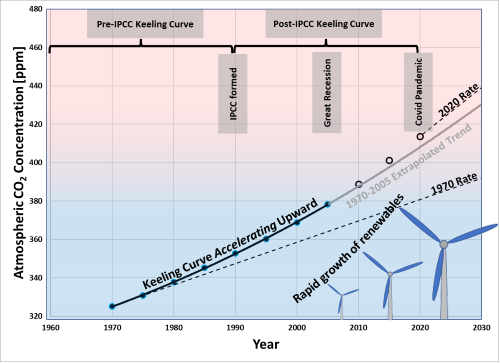
This despite the Great Recession, the Covid Pandemic, and the recent, rapid growth of renewables and EVs. People focus on the rapid growth of renewable energy and the increasing deployment of EVs, but neglect to notice that fossil-fuel use continues to increase. Plus other second-order effects likely driven by environmental feedbacks.
Bob's reference is likely far more authoritative than my comments, but the graph I provide hints (there is too little data in the CO2 record to prove that CO2 is accelerating upwards) that the third derivative of CO2 concentration could be positive. CO2 would then not just be accelerating upwards, but the acceleration rate would be increasing.
- Sabin 33 #8 - Will solar development destroy jobs?
Evan at 02:22 AM on 3 January, 2025I know that my comment is a little off topic, but one reason utilities like renewable energy is that costs are more predictable than for fossil-fuel plants. For renewable energy, the energy is free, even if more labor is required than fossil fuel plants. Fossil-fuel plants always have to be fed a product whose price goes through wild gyrations over the life of the plant. Whatever long-term average costs are, there is the uncertainty associated with what it will cost to feed your power plants.
- Jobs in wind, solar, and energy storage are booming. Is your state keeping up?
michael sweet at 01:34 AM on 30 October, 2024Nigelj,
This wind map shows more detail than the statewide averages you linked. There is a lot of wind in West Texas. California has windy areas in the southeast part of the state. Florida has little wind and the state recently passed a law forbiding offshore wind.
There are other sources of renewable jobs. A lot of solar panel manufacturing plants and wind turbine suppliers have been or are in the process of being built, primarily in republician areas, using money ftom Biden's Inflation Reduction Act. Other political issues cause uneven distribution of renewable energy. The OP points out that Montana, West Virginia, Wyoming and Alaska do not have much renewable energy, undoubtedly for political reasons. California has encouraged renewable energy so they have a lot of it.
Texas is an interesting case. They have their own grid to avoid federal regulations. In the past they have always gone with the cheapest producer to lower costs. Now that wind, solar and batteries are cheaper than gas they are changing their rules to protect the gas industry. It will be interesting to see how long Texas pays more for gas power instead of installing cheaper renewable energy. Since gas power plants take longer to build than renewable plants and they need power soon they will have to make some hard choices.
Renewables are now cheaper virtually everywhere so political reasons are the main reason they are not built out faster. It costs less to build a new renewable plant (including the mortgage) than to run a coal plant with no mortgage. If utility executives want to charge less for power they build renewables. Almost all new build power in the USA (and the world) is renewable because it is cheapest.
I remember in Australia several years ago the government supported building more coal plants. More recently solar was supported. Now Australia has a lot of renewable solar from those installations and coal is struggling to compete.
- On Hens, Eggs, Temperature and CO2
MA Rodger at 19:27 PM on 4 September, 2024rkcannon @16.
Assuming Mark Johnson @18 is correct and you do refer to the graphic posted @6 (which seems entirely sensible), your question has still not been properly addressed.
And that presumably is to ask why the CO2 fluctuations through recent ice ages (180ppm to 280ppm) are associated with large temperature fluctuations (10ºC peak-to-peak) but the larger recent anthropogenic CO2 (280ppm to 420ppm) doesn't result in any commensurate temperature increase in the graph.
There are a number of factors to consider.
(1) The forcing from changes in CO2 is logarithmic, so the recent CO2 forcing would be slightly smaller than the ice age forcing (2.2Wm^-2 as opposed to 2.4Wm^-2).
(2) It takes time for the temperature to react to an imposed forcing so only about two-thirds of any CO2-forced increase would have occurred in the decades of man-made warming so far.
(3) The ice age CO2 forcing was not the major forcing through ice ages. The change in albedo due to the shrinking ice sheets and the rising oceans would be double the CO2 forcing. Other factors like methane and dust were also in play. (The orbital forcing that triggers ice ages is very minor.) Increasing CO2 contributed perhaps a third of the ice age forcings.
(4) The temperatures being plotted are from the EPIC ice core data and thus Antarctic temperatures which wobbled tiwce as much as global temperatures through the ice ages. (Note the modern CO2 value has been added, marked with an asterisk. Grafting on the modern EPIC temperature record would be difficult, and would not show much as the instrument record is more wobble than rise.)
So taking (1) to (4) into account, the 10ºC ice age cycle in the graphic @6 would be a little smaller, say 90% (1) then a third off (2) then two-thirds off (3) and finally halved (4). So the global temperature should be very roughly something like [10ºC x 0.9 x 0.67 x 0.33 x 0.5 =] +1ºC which is pretty-much what we see globally today. - CO2 emissions do not correlate with CO2 concentration
rkcannon at 01:34 AM on 3 September, 2024Regarding C14, the gradual decline may be due to the nuclear tests that created C14 that is decaying or disappearing naturally. Ref this paper. Also this paper also looks at 13C/12C ratio, saying the following. Is there discussion on this somewhere?
Net Isotopic Signature of Atmospheric CO2 Sources and Sinks: No Change since the Little Ice Age
by Demetris Koutsoyiannis
[ORCID]
Department of Water Resources and Environmental Engineering, School of Civil Engineering, National Technical University of Athens, Heroon Polytechneiou 5, 157 72 Zographou, Greece
Sci 2024, 6(1), 17; https://doi.org/10.3390/sci6010017
Submission received: 19 December 2023 / Revised: 23 February 2024 / Accepted: 29 February 2024 / Published: 14 March 2024
Abstract
Recent studies have provided evidence, based on analyses of instrumental measurements of the last seven decades, for a unidirectional, potentially causal link between temperature as the cause and carbon dioxide concentration ([CO2]) as the effect. In the most recent study, this finding was supported by analysing the carbon cycle and showing that the natural [CO2] changes due to temperature rise are far larger (by a factor > 3) than human emissions, while the latter are no larger than 4% of the total. Here, we provide additional support for these findings by examining the signatures of the stable carbon isotopes, 12 and 13. Examining isotopic data in four important observation sites, we show that the standard metric δ13C is consistent with an input isotopic signature that is stable over the entire period of observations (>40 years), i.e., not affected by increases in human CO2 emissions. In addition, proxy data covering the period after 1500 AD also show stable behaviour. These findings confirm the major role of the biosphere in the carbon cycle and a non-discernible signature of humans. - What’s next after Supreme Court curbs regulatory power: More focus on laws’ wording, less on their goals
Bob Loblaw at 06:00 AM on 24 July, 2024In comment 7, Eclectic mention a Youtube video from the LegalEagle channel that discusses this topic. This is the direct link to that video. I finally got around to viewing it a few days ago.
Although the ads are annoying, the video does provide some interesting details on a number of the historical precedents that are related to the most recent Supreme Court decision. The producers of that video obviously have a viewpoint about the SCOTUS decision that TWFA and David-acct probably will not agree with, but it is definitely worth watching if you don't know what the fuss is all about.
Two of the predictions they make are interesting:
- This decision will lead to huge numbers more lawsuits against regulatory agencies, which will choke the legal system.
- This decision will stifle regulatory actions and result in regulations (if the agencies don't simply give up) that will be increasingly complex as they try to avoid future legal challenges. Not efficient - but that is a feature, not a bug, if the goal is to choke the $#!^ out the regulatory agencies so that industry can do whatever they darn well please and can externalize the damage they cause (i.e., get someone else to pay for it).
At the end of the video, one of the points they make is that it is worthwhile in such (legal) cases to look at the end of the brief, to determine who it is that decided to spend money on challenging a law in court. For the two cases that led to this SCOTUS decision, the plaintiffs are well-funded think tanks that include the Koch brothers as sources of funding.
This case is not "the little guy looking for justice". This is rich industrialists with a primary goal of getting richer. Why worry about trying to achieve "regulatory capture" when you can accomplish "legal system capture"?
- What’s next after Supreme Court curbs regulatory power: More focus on laws’ wording, less on their goals
One Planet Only Forever at 08:00 AM on 18 July, 2024My comments about the harmful learning/change resistant hard-liners (religious, racist, sexist, greedy rich, and more types) taking over the US right-wing, including the SC control evident in the Chevron deference judgement, is well summarized in this new NPR article:
RNC represents culmination of a decades-old movement in the Republican Party
The article also aligns with the understanding that ruining democracy and ending the related freedoms, particularly the freedom from unjust persecution, for caring thoughtful responsible people is often a slow process (I mentioned this was presented in the book “How Democracies Die” in my comment @62 and earlier comments). It also supports the understanding that the institution of the Republican Party failed to protect US democracy by allowing the hard-line social conservatives to taking over the party. And it presents the case that the take-over of the Republican Party was a significant source of the divisiveness in current day USA.
The following are a few quotes from the article:
They feared changing values around sex, civil rights, women’s rights and gay rights.
They believed the establishment was too moderate, too accommodating.
They dismissed the machinery of government and the media as controlled by a liberal elite.
They were known as “the New Right,” and 50 years ago they won a victory in the Republican Party.
It is the heirs of that political movement who have gathered at this year’s Republican National Convention in Milwaukee. As the party pushes to dramatically reshape government and roll back changing cultural mores, nominating a candidate who has disregarded fundamental elements of American democracy, it may feel like a sudden and extreme pivot in American politics. But this surge to the far-right stems from seeds planted a half-century ago.
...
1974: Kanawha County, West Virginia
... They were appalled by mentions of sex, inclusions of profanity, exploration of non-Christian creation myths, and readings from Malcolm X.
The protests grew violent. Bombs exploded at elementary schools (Horan later went to prison for his involvement). Snipers fired at school buses. The Ku Klux Klan joined a rally at the state capitol in Charleston.
Meanwhile, outside activists arrived to aid the protesters, as well. They came from a variety of mostly new organizations: the Conservative Caucus, Citizens for Decency Through Law, the Populist Forum, and one called the Heritage Foundation.
The Heritage Foundation is undeniably the harmful buddying up of the fossil fuel interests with the social conservative interests (almost all in conflict with learning to b e less harmful and more helpful to others)
It is important to understand that the powerful fossil fuel interests had been significantly influencing US leadership judgment before the social conservatives pursued the capture (hostile take-over stuff) of the Republican Party in the 1970s. The harmful wealthy fossil fuellers willingly buddy up with harmful social conservatives because:
- It costs callous wealthy fossil fuellers very little to support the unreasonable misunderstanding-based leadership judgments and actions desired by the social conservatives.
- And the social conservatives are obviously happy to support any interest group that will support their interests no matter how unreasonable they are and how much misunderstanding is required to support them.
The union of unreasonable misunderstanding fuelled people have captured control of the SC for the foreseeable future (no mechanism to change the SC other than a SC justice ‘retiring’ when Democrats control the Senate and Presidency, or a SC justice being successfully impeached and convicted by the House and Senate).
Some final quotes from the NPR article:
1974: Boston, Massachusetts
A bottle shattered. Eggs splattered and rocks hammered against the window of a school bus filled with children. Parents had violently risen up against a plan to desegregate schools, which involved sending children sometimes across town by bus.
As riots engulfed the city, once again outside activists from a variety of new groups arrived to help the protesters.
The next year, 1975, featured a remarkable convergence. Hundreds of anti-busing protesters from Boston and anti-textbook protesters from West Virginia joined together in a march on Washington, D.C.
Two separate, regional uprisings against social change became one.
...
The outside groups who aided the protests, along with a host of others like them, would earn the moniker “the New Right.”
...
1976: North Carolina
It was embarrassing how badly Ronald Reagan was losing.
... Reagan pledged to transform the GOP, shift it rightward, into a “party of bold colors, no pale pastels.”
In other words, Reagan was the candidate of the New Right.
... He lost the first five primaries to Ford, in increasingly emphatic fashion. His top aides prepared to withdraw.
... Sen. Jesse Helms and his political strategist Tom Ellis, took charge of Reagan’s campaign in their state. They reshaped his message, emphasizing a nationalist appeal featuring the Panama Canal.
Reagan adopted a new slogan: “Make America Number One Again.”
...
This week, amid bipartisan calls to ratchet down political rhetoric after the assassination attempt against Trump, Republican delegates in Milwaukee approved the party’s latest platform. While it removes explicit opposition to abortion, the social backlash and apocalyptic rhetoric that decades ago typified the New Right infuses the document, from its call to “deport millions of illegal Migrants who Joe Biden has deliberately encouraged to invade our Country” to its focus on banning textbooks “pushing critical race theory.”
The New Right did not fully succeed 50 years ago when it sought to “organize discontent,” with “its eye on the presidency,” and the goal of taking “control of the culture.” But its values and heirs to its movement drive today’s Republican Party.
And the New Right Republican Party also supports environmental and fossil fuel interests that conflict with learning to be less harmful and more helpful.
I recommend reading the full NPR article and the many other presentations of the long slow deliberate attack on democracy and its 'freedoms for all reasonable responsible people' by the collective of unreasonable hard-liners who win by promoting harmful misunderstanding to excuse unjust beliefs and related unjust judgments. They harmfully mislead because they can get away with it.
- What’s next after Supreme Court curbs regulatory power: More focus on laws’ wording, less on their goals
Bob Loblaw at 10:03 AM on 14 July, 2024Sorry, Phillippe. Yes, I should have made it clearer in my comments 38/39 that you were summarizing TWFA's position, not expressing your own, when you wrote "Actor 2 should be punished". I think TWFA's irony meter is broken, though.
"Blaming the regulator" when a regulated bad actor acts bad is not surprising. The "cut red tape" crowd frequently seem to argue "still too much red tape" when cutting red tape for private industry leads to Bad Things™. In my government experience, the politicians that are keen on cutting red tape for private industry also show little interest in cutting red tape within government itself. Instead, they put up more roadblocks and audits and processes that make things even less efficient. No price is too high when it comes to making sure that $100 was spent wisely!
Your inside information on FAA processes is interesting, My PIC time is limited to Cessna 150/152 and Cessna 172 aircraft - although I also managed to get a very small amount of (uncredited) stick time on a Bell 47 one summer. It sounds like the low-end airplanes are not much different from the last time I was in one over 40 years ago.
- What’s next after Supreme Court curbs regulatory power: More focus on laws’ wording, less on their goals
Eclectic at 10:43 AM on 11 July, 2024Nigelj @4 and TWFA @5 & prior :
Nigel, since you speak as a Non-American, it is likely that you have not considered all of the peculiarly American aspects of the situation. On that assumption, please allow me to recommend the viewing of a "fresh" Youtube video posted within the last 12 hours. It is issued by the LegalEagle channel, and has the appallingly Clickbaity title: "The Supreme Court Destroyed The Government While You Weren't Looking". (the length is about 22 minutes, after subtracting ads)
You (and TWFA) will find the video entertaining as well as instructive. They've packed a lot into the 22 minutes, about the SCOTUS reversal of of the so-called "Chevron Deference".
TWFA, I have traveled 1000's of miles by bus on country roads ~ and it sounds like you have not. I can assure you that everyone inside (and outside) the bus has a far better likelihood of safe travel where there is a single (though imperfect) driver holding the steering wheel . . . . compared with a group of judges & lawyers & their clients all fighting for control of the wheel (which would be bad enough on a straight road, let alone on a twisty mountainous road).
TWFA, you have not really thought things through, regarding government and the functioning of society. As shown by history (and common sense) ~ the system you propose would result in more damage & oppression to the Little Man (that's me & you) as we endure a rather chaotic courts system where deep-pocketed individuals & corporations throw their weight around (even worse than they do at present).
TWFA, your ideological objections might possibly be satisfied if Congress provided far more detailed legislation to cover the great complexities and ongoing changes of modern life. But that would require extensive & numerous committees of reviews & inquiries & oversight. And in view of the Kindergarten scientific education level of (the majority of) Congressmen . . . then they would (if not corrupt) require the advice of the very experts that you abhor.
Sadly, TWFA, that would require the large expansion of the Senate to 600 maybe 2,000 senators . . . and a far larger Lower House ~ maybe to 4,400 or even 12,000 representatives.
Be careful what you wish for, TWFA.
- The science isn't settled
Eclectic at 11:39 AM on 10 May, 2024TWFA @104 :
(Thanks ~ good timing ~ I was about to leave the house.)
Your question would be better expressed, not as "nature bringing temperature up stopped [in 1850]" . . . but rather as : nature reducing the greater downward pressure (by about 1850). Of course, from a Milankovitch-cycle aspect, we would expect the slow gradual line of temperature decline . . . to continue for about 15,000 years, until "the ice really hits the fan" . . . ;-) . . . and the world plunges deep into the next Glacial Age (a genuine Ice Age).
[ So there was no rush for humans to burn all their coal to keep the next glaciation at bay. ]
TWFA, the forcing from the sun ~ is only one factor in the big picture. And as best I currently understand it, the Little Ice Age was caused by two roughly equal factors. Those factors being (A) the Grand Solar Minima [Spoerer, Maunder, etc] . . . and [B] a period of greater frequency of major volcanic eruptions [stratospheric particulates causing cooling ]. A Grand Solar Minimum, by itself, is rather weak in its cooling effect.
The major factors causing climate change are : Albedo, Sun, Particulates, and CO2 (currently!)
Yeah, it's complicated. But the scientists have been doing good work in getting an understanding of it.
Fair to say : the science is settled enough for our current practical purposes. It is the politics of how to tackle our self-made problem . . . which is the difficult part to carry out efficiently.
- The science isn't settled
Eclectic at 10:18 AM on 10 May, 2024TWFA @102 :
Best if you look at the bigger picture ~ not just the past 500 years.
As you know, back before about 150-200 years, the various temperatures must be assessed by means of proxies. And the more proxies over a wider area, then the smaller the amount of uncertainty.
The proxy evidence points to the past temperature normals [note: plural] following a cycle [Milankovitch] during the past million years. For instance, during the Holocene period, world temperatures were at a high plateau for roughly 5,000 years . . . followed by a slow decline of [all rough figures of course] about 0.7 degreesC for the past 4.000 years. ~All this, due to natural factors.
During that slow decline, there were small deviations from the line of decline [owing to certain transient natural causes]. E.g. the Medieval Warm Period of several centuries showed a world warming of about 0.3 degreesC ; and the Little Ice Age (including the 1600-1800 period you express interest in) showed a downward "blip" of about 0.3 C . . . and thus was about 0.6 C below the peak of the MWP.
The LIA finished roughly 1850 ~ by which time world temperatures had reached the "normal" i.e. were near the average line of decline from the Holocene peak. And by 1850, thermometer readings were starting to be used (outside the Central England Temperature region). And so we know, quite accurately, that the world temperatures have then "shot up like a rocket" ~ way above the (Milankovitch-related) line of natural decline . . . and world temperatures today are roughly 0.5 C above the peak of the Holocene.
# A very impressive sudden warming change (and with more to come) ~ and all this is clearly "not natural" in its causation.
TWFA ~ so where is your "not unreasonable" objection?
- The science isn't settled
Bob Loblaw at 05:35 AM on 10 May, 2024TWFA @ 100:
I see where your problem is. You have no idea what you are talking about.
Determining trends is "processing". The data that goes into that trend determination will affect the trends that are calculated. Noise does matter, and uncertainty in trend calculation takes that into account.
Of course, you are probably determining "trend" using the eyecrometer, so it is easy for you to just see what you want to see, and filter out anything you don't like.
...and this may be news to you, but "global sea level" is not something that is measured using a single data value. It requires a bunch of values at different locations, and you need to combine those data values together properly to get an estimate of a global value. You know: that "processing" step?
...and because sea level measurements are not evenly distributed, you can't just average the individual locations with equal weighting. The weighting method (more "processing") does matter, and that is what Jevrejeva does poorly.
As for your focus on the 1700s - there are many factors that affect sea level, both locally and globally. If one factor affects sea level in 1700, that does not mean that other factors can't affect sea level at another time. I think you need to read the "Climate's change before" rebuttal. There is a reason it is #1 in the "Most Used Climate Myths" list.
- Climate's changed before
Eclectic at 11:22 AM on 21 April, 2024Spooky @899 , you should not really be surprised ~ since the OP article is referring to Global temperature changes.
Not to the local rapid changes in the boreal icesheet region (e.g. Denmark, Greenland, Alaska : during the last glacial age) as shown in the Bolling-Allerod warming and in the briefer Dansgaard-Oeschger events. Those local northern regions are affected by "sudden" changes in local oceanic currents ~ both smaller & larger (e.g. the AMOC). But that has little effect on the global scale, except when it involves a massive event like the melting of the Laurentide Ice Sheet (i.e. the Younger Dryas).
In India, the Indian Monsoons (to which you allude) show much fluctuation resulting from very small alterations in local temperatures & winds (winds which may bring more oxygen18-rich water) . . . even in the absence of a 30-year climate change.
For global temperature changes, there need to be global-scale changes in albedo / insolation / particulates / or greenhouse gasses.
- How extreme was the Earth's temperature in 2023
Jan at 17:45 PM on 19 April, 2024Made it a little bit nicer, as it is important:
On the causes of the exceptional temperature jump in 2023
First things first:
What was special about the warming in 2023 was, that it happened all in the last 6 months, so it was a much larger jump over these months than the mean values of 2023.
Further, only a moderate El Nino existed, so not too much warming came from here.
Reasons where:
SOx reductions over the shipping routes amplified the marine heatwave signal across the mid-latitudes.
The El Nino in combination with a positive Indian Dipole - both lead to a larger heat release of the tropical oceans as a clear and strong circulation cell is supported over the tropical oceans due to the zonal SSTs gradient.
Sea ice reductions around the Antarctic caused circulation changes that led to moist and warm air advection over Antarctica (strong effect on the warming as exceptional heat waves rocked Antarctica), as well as radiative effects of the sea ice reductions and heat release over sea ice-free areas.
Then that climate warming warms the oceans now more than natural variability is often able to produce colder than normal SSTs - at one time only some ocean regions existed with colder than normal temperatures.
Then we had the vast expansion of marine heatwaves across the global oceans, especially across the mid-latitudes reaching a coverage of more than 40% in July.
The warmer-than-normal Oceans created a cloud feedback thereby increasing shortwave absorption (reinforces marine heatwaves).
From 2012 to 2016 we had a non-linear increase of moisture in the marine boundary layer caused by exceptional SSTs. The next jump will have happened in 2023 causing a water vapor feedback over large parts of the oceans to increase. And tropical moist air advection is causing marine heatwaves in the subtropics to mid-latitudes. So also here is another feedback as more water vapor radiates longwave radiation back to the surface.
Further, we had during summer to autumn large areas where the soil-moisture-temperature cascade came into play producing these exceptional continental heat waves. It comes along with a cloud feedback and supports stalled/fixed high-pressure systems as these heat domes redirect the jet around them (higher troposphere).
Then we had the pattern effect of increasing zonal (east/west direction) temperature gradients at the ocean surface and continents which disturb the overlying circulation, often causing blocking patterns (also a reason for the marine heatwaves to build up)
Then we had towards autumn a heat release of the marine heatwaves across the mid-latitudes, as the atmosphere gets colder. Also, cold core and warm cors eddies cause extreme temperature gradients in the western boundary extension regions leading to a larger latent heat releases over these ocean regions (small-scale pattern effect of SSTs increases wind speeds).
Last it has been possible that the oceans released heat from the subsurface that had built up. Across the mid-latitudes warm freshening water masses are accumulating under the surface as shallow as 150m depth. And these heat depots could have been tapped, as the jets speed up during winter, as the density gradient between the tropics and poles increases in the upper atmosphere while it decreases near the surface, especially during winter. More and stronger low-pressure systems due to increased shear are the outcome. And all these extreme low-pressure systems in autumn and winter across the mid-latitudes in 2023/24 could have tapped these subsurface heat depots. But no study here as this is a new development seen in the intensity of the low-pressure systems the last years (e.g. number of atmospheric rivers hitting the US west coast)
Main problem thou is the expansion of marine heatwaves, as they are feedback driven by global warming heating the oceans from the surface too fast (thermal stratification increases non-linear in the upper 300m of the oceans in various regions), in combination with the pattern effect which disturbs global zonal circulation with the result of more stalled high-pressure systems (low wind speeds are in most instances the main precondition for marine heatwaves to form besides thermal stratification and shallow upper mixed layer depth).
Last the warming of the northern latitudes can also be included in the factors driving global warming in 2023.
In short, the warming of 2023 was feedback-driven by various systems forcing each other into a heating mode with the systems of the oceans, atmosphere, and landmasses acting in unison!
The exact series of which contributed to what extent to the heating science has to find out. But it would have to be done on a monthly basis!
The next jump will have devastating consequences as they become larger...
In my opinion, the model spread is now a joke as it is way too large proving the uselessness of models as they will increasingly become unable to predict what is coming as too many parametrizations prevent them from simulating the non-linear character of the mutually reinforcing systems with many processes operating on small scales...
p.s. we warm the oceans too fast from the surface that is our main problem!
- Welcome to Skeptical Science
Bob Loblaw at 01:07 AM on 5 April, 2024cookclimate @ 118:
I have looked at the paper in the volume I linked to in comment 121. There are definite changes compared to an earlier version I found that said "submitted to Earth and Space Science", so I presume that you've had some sort of review and modified the paper since the earlier drafts.
It looks like you have identified the 1470-year cycle using your eyecrometer. I see nothing in the paper that actually does any sort of signal processing to identify cycles using any objective statistical technique. You are seeing a cycle because you want to see a cycle.
Your speculation includes arguments that include all sorts of stuff that has been debunked many times before. Pages are available on Skeptical Science that cover thee topics:
- Geothermal heat flux is included in this post.
- The "CO2 lags temperature" argument is discussed here.
- Most of your examples use regional, not global, temperature proxies. Regional temperatures are far more variable than global ones, and it is invalid to compare the two directly. This is discussed in this SkS post.
- You're convinced that an increase in volcanoes are adding to warming. That is the opposite of the argument commonly made by "skeptics" that increasing volcanic activity caused the Little Ice Age, so a subsequent decrease is causing warming (discussed here). In any event, just counting the number of volcanoes (your figure 3) is extremely simplistic. Arguing that more volcanoes implies more geothermal heat is a non-starter, as discussed in the post linked above.
- Your "computer models are unreliable" is an old, tired argument, scoring position 6 on the SkS Most Used Climate Myths. The rebuttal is here.
So, your paper is really nothing more than an "I see it" 1470-year cycle mixed with a rehash and Gish Gallop through a variety of common "skeptic" myths. I could probably find more, but it isn't worth the time.
I hope you didn't pay too much money to get it published.
- Climate - the Movie: a hot mess of (c)old myths!
Two Dog at 22:33 PM on 2 April, 2024Scadd - #64
Thanks for the explanation and appreciate the civility, I don't consider it a dog-pile(on?) to reply - and its nice not to be accused of "abysmal ignorance" and told to "put up or shut up".
I get the fact the planet is warming and your sea temperature chart is more compelling for the reasons you cite, although I would like to understand where this temperature is measured and the average obtained - but I do not doubt the trend. I also agree the heat has to come from somewhere and, to be clear, I have no preference for theories of man-made sources or natural sources. My point remains that we are not dealing with a world in perfect temeprature equilibrium, so I feel uneasy discounting natural sources as significant when their impact is all too obvious when looking at the historical temperature record. I have no idea "which natural sources" I am referring to but I am fairly confident we are unable to accurately measure and predict them. However, so long as the temperature continues to rise in line with C02 emmissions I think the man-made argument becomes more and more compelling but a few years blip and, for me, it becomes open to considerable doubt. That is why the 30 year period of little warming looks suspicious to me (and I now know the explanation some have for this)
I did also read that the warming effect of CO2 decreases as its concentration increases so the warming is expected to reduce over time. Is there any truth in that?
- At a glance - Was Greenland really green in the past?
nigelj at 05:27 AM on 21 February, 2024This recent book is relevant to the MWP: "The Earth Transformed, by Peter Frankopan, first published 2023". The book is a complete 700 page environmental history of earth from its formation to this decade. It covers both natural environmental changes and human caused environmental changes.
The book has chapters on the MWP, Little Ice Age and modern anthropogenic warming period. And chapters on the impacts on the environment of indigenous culture, farming, early civilisations, the industrial revolution, and the colonial period, communist societies, capitalist countries and modern period and many other periods and issues.
Haven't had time to read the whole thing, but what I've read is fascinating, a real eye opener, even if you think you know much of the material already, and it flows nicely so is easy to read. You can also pick and choose chapters at random and still make sense of them. It comes across as facts based, well researched, and objective and unbiased.
Extensive bibliography running to 300 pages, not included in the book because its so long, but available online.
- Climate Adam: The tough reality of Carbon Capture & Storage
One Planet Only Forever at 05:00 AM on 29 December, 2023michael sweet @17,
Agreed that the use of CO2 to scrub oil off of rock formations, a possible benefit of CO2 injection to increase the production of oil as presented in the article, would almost certainly mean that CO2 comes out with the oil. But, to be fair, CO2 injection can potentially lock-away CO2 while producing more oil from an oil deposit.
Here are potential stages of oil production:
- Natural pressure of the trapped oil deposit forces oil to the surface when it is drilled into – the ‘gusher’.
- Pressure drops as the oil flows out.
- A pump-jack increases the rate of extraction by ‘lifting’ oil out of the well – like a water well pump.
- As more oil is removed the rate of flow to a well point pump-jack declines.
- Injecting gasses like captured CO2 can increase the pressure in the oil deposit and force more oil out of the well locations. Current operations inject CO2 captured from the exhaust of burned fossil fuels. This process potentially traps the injected CO2 in the rock formation that the oil was trapped in.
So oil can be produced by injecting and trapping CO2. But scrubbing oil off of the formation that the oil is in would mean CO2 comes out with the oil.
However, CO2 thought to be trapped in an oil deposit may not be truly trapped. Accurate pressure monitoring over a long time frame would be required to prove that the CO2 is staying where it was put. And until the completion of that pressure testing it is uncertain that the ‘claimed to be trapped’ CO2 is properly trapped. If a pressure test fails, the pressure drops, then the ‘carbon removal’ action plan is failing. And there would be little that could be done to keep the rest of the ‘believed to have been locked away’ CO2 from leaking out.
Who will pay for removing it and locking it away? Everybody essentially pays for the profit obtained, or pays for the government subsidy (worse when the government subsidizes the obtaining of profit - nobody should profit from publicly funded harm reduction like CO2 removal).
It would be nice if the ones who benefited most from the developed total current problem paid the most to limit the harm done ... but the current systems have a histry of making the least fortunate, who do not deserve to be penalized, suffer the most harm. Refer to the lead article in the Skeptical Science New Research for Week #50 2023 for a detailed presentation of concerns regarding free-market development of Carbon Capture.
- At a glance - Climate scientists would make more money in other careers
Philippe Chantreau at 10:07 AM on 31 October, 2023More questions:
What sources report a gross over-supply of engineers and scientists, a term used twice in post #2 above?
I have a little familiarity with the aerospace industry, where many scientists with physics and applied mathematics backgrounds can use their competence, even if they are not specifically trained as aerospace engineers. There is a serious shortage of talent in that field.
I am also familiar with medicine and biomedical applications, where shortage of scientists and engineers are also a problem, easily confirmed by any basic search.
Other sources report a serious shortage of hydrologists, a profession of very high interest for the future.
I'll add this article from the Bureau of labor Statistics. Of special interest is this quote: "A comprehensive literature review, in conjunction with employment statistics, newspaper articles, and our own interviews with company recruiters, reveals a significant heterogeneity in the STEM labor market: the academic sector is generally oversupplied, while the government sector and private industry have shortages in specific areas."
So, once again, how does this constitute a "gross over-supply"?
If anything, with the supply and demand law being what it is and the immense financial means available to private industries, it seems that this imbalance abundantly confirms that there is more money to be made for science majors in the private sector than in research, does it not?
- From the eMail Bag: Carbon Isotopes, Part 2: The Delta Notation
Bob Loblaw at 07:40 AM on 17 October, 2023Rabelt @ 9, 11, 13, and 14:
You are really missing the big picture on carbon isotope ratios. The C13 levels alone are not "proof" that the fossil fuels are causing the atmospheric rise in CO2 - they are one line of evidence that rules out other sources. You are over-interpreting what you are reading here (or elsewhere).
This post is titled "Part 2". I suggest that you also read Part 1. It gives essential background about how isotope ratios differ across C12, C13, and C14, depending on the source.
You should also read Climate Change Cluedo. Steps 4 and 5 note the significance of changing C14 and C13 levels. To quote,
- Declining C14 ratio indicates the source is very old, hence fossil fuel or volcanic (ie, not oceanic outgassing or a recent biological source);
- Declining C13 ratio indicates a biological source, hence not volcanic;
Isotope ratios are also discussed on How we know human CO2 emissions have disrupted the carbon cycle, and on What is causing the increase in atmospheric CO2.
The caption on figure 3, which states that declining C13 ratios tell us it is fossil fuel combustion should really be interpreted as "the declining C13 ratio tells us that it is not volcanic. Since volcanoes are the only other possible source of C14-depleted carbon, the only remaining explanation is fossil fuels".
And none of those explanations require that C13 ratios be solely dependent on fossil fuel combustion. Figure 3 shows that for 800 years, C13 ratios were only slightly variable, and have now changed significantly once fossil fuel combustion began.
Your argument that "it changed before, so it can't be fossil fuels now" is just a peculiar flavour of the general "climate's changed before" myth that is number one on the hit parade listed on the upper left of every SkS page.
Just because you don't know of or understand an explanation does not mean that there isn't one.
- We're coming out of the Little Ice Age
John Hartz at 05:01 AM on 17 September, 2023Recommended supplemental article:
What climate change deniers get totally wrong about the Little Ice Age
What does a regional period of mid-millennial cooling have to do with today's climate disasters? Absolutely nothing
by Matthew Rozsa, Science & Health, Salon, Aug 7, 2023
- Akasofu Proved Global Warming is Just a Recovery from the Little Ice Age
John Hartz at 03:44 AM on 17 September, 2023Recommended supplemental article:
What climate change deniers get totally wrong about the Little Ice Age
What does a regional period of mid-millennial cooling have to do with today's climate disasters? Absolutely nothing
by Matthew Rozsa, Science & Health, Salon, Aug 7, 2023
- There is no consensus
RicardoB at 23:13 PM on 10 September, 2023Eclectic @951:
Thank you for you comments.
You stated: "Dr Jordan Peterson shows how little he knows about climate matters ~ fair enough ~ but why is he choosing to boost Dr Curry?"
He chooses to boost Curry as he chooses to boost many other prominent "climate narrative contrarians" that he "interviews" in that same channel, like Robert Bryce, Steven Koonin, Richard Lindzen and Alex Epstein.
Dr. Peterson main point of view on the "climate debate" seems to come from his strong belief (?!) that the political measures that are being enforced by governments (to tackle global warming) will lead to mass impoverishment and starvation via the rise of the energy bill. In his words: "People can't care about environmental concerns when they are so desperate they are worried about tonight's shelter and the next meal." He frequently rages about "the consensus" and the "hysteria" that are leading to these political choices.
Hence, he deliberately chooses to debate the topic only with "specialists" from the "contrarian side" - champions for the carbon industry agenda. It suffices to say that these interviews function not as debates or means to get to the truth (by now, Dr. Peterson seems mostly uninterested in the cientific truth), but as opportunities both to let these "specialists" voice their cherry-picked concerns and attack established comprehensive scientific bases, and to not get himself confronted/debunked on his opinions. There's no debating; there's only agreeing.
- It's cooling
Bob Loblaw at 22:39 PM on 6 September, 2023CORK @ 330:
I see. You're in the group of people that say "how could we possibly know what happened in the distant past?
The simple answer to why the current warming is due to human emissions of CO2 is "physics". We do have information on past climates through geology - combined with understanding the physics involved. We know what physics can and has affected climate in the past, and we know that those processes do not explain the current warming - unless you also include the effect of CO2.
But as the moderator told you in comment 327 - this is getting off topic for this discussion. The moderator pointed you to the thread on past climates. Another post you may benefit from reading is the one on the Empirical evidence that humans are causing global warming.
- It's cooling
CORK at 04:27 AM on 5 September, 2023Climate's changed beforeWhat bothers me in the "Escalator" is the time scale. From 1970 to 2022 the temperatures rise, yes.
But this is not incompatible with a cooling at geological time scales. We may be in a rising part of the curve which will go down and over several 1000s of years the average will show a cooling trend.
The scale of time can be used and the curves can defend both arguments. Therefore the "escalator" is of no use.
The only pure fact in all the climate change saga is that humans are producing greenhouse gasses.
From that fact a whole theory of climate has been built. It is very difficult to say things like that without being insulted today.
- Climate Confusion
Markp at 22:43 PM on 3 September, 2023For Rob: I know I have not provided much data to back what I've been saying, but that's mainly because I was going on the assumption that you may already be aware of the data that could support me. In other words, I don't think what I've said is uncontroversial from a data point of view, but I do accept that it might be controversial from the point of view of making those holding a mainstream view (and I know that's vague) uncomfortable.
I disagree with little of what you say about climate in this last post. From your list of 8 items, only 1,4 and 5 are problematic in my view. Unfortunately, those few items are weighty:
"A lot is happening towards decarbonization" is vague enough to require examples to qualify the statement. There has definitely been a lot of talk about decarbonization, but as 2022 saw global emissions hit a new high of 36.8 Gt, according to the IEA's report "CO2 Emissions in 2022" one has to ask what decarbonization achievements, what action, in place of mere talk, can we point to. Renewable energy production plus use of EVs, heat pumps and who knows what else saved about 550 Mt. Fine. But this growth rate (growth of renewable contribution) won't hold up. So when you say "a lot" is happening, what's that really mean? And could you give just a few bullets on how you think we'll achieve net zero by 2050?
I'm also curious to know how much your vision of "net" zero relies on offsetting schemes, because I don't trust them and fear that they are being relied on too much for comfort.
As for what happens to the rising temperatures in a net zero 2050, we'll have to wait and see.
I'm certainly with you on breaching 2C by 2050, but since I've got little hope we'll be anything close to net zero by then (for whatever net zero is actually worth as long as we've got all the offestting nonsense thrown in there) it looks worse to me than to you.
Finally, and to change the subject a bit, I think the talk about models went too far. I'm not saying models are bad, just that they're being relied on too heavily in certain important cases. And as my primary experience (nearly 30 years now) has been in the financial arena for many "quant" strategies where, in that industry it is painfully common to see wonderful quant investment funds with great backtested results finally have some real money thrown at them and start a live track record, only to see the live returns look nothing like the lovely return characteristics of those backtests, I confess a lot of my skepticism comes from just that type of environment. Still, when we continually see news reports with headlines running "Researchers present shocking new data that climate change is happening much faster than expected" and the previous expectation was based on models, I don't feel at all surprised. I've just had a look at the "myths" section of Skeptical Science specifically at the models myth and I also see there that most of the argument seems to be toward trying to convince climate deniers who say models are all wrong that GW is real. That's clearly not me.
For Eclectic: I don't think I've written too much, do you? I know people these days don't like to read anything longer than a twitter post, but I don't think your assessment here is fair. I've tried to keep it short, in fact. Like I said, I assumed, and maybe wrongly(?), that you folks had a decent understanding of the data already, and could follow commentary like mine that took a broader look at things rather than fussing over citations and decimal points because I'm not claiming anything that boils down to a disagreement over small measurements but has been more about one's basic orientation: some of you seem to be wearing rose-colored glasses in my view, like too many people are.
As for the mirror concept, if the goal were to limit global temperature rise to 2C by 2100 we would need about twice the surface area of the contiguous USA. Although these reflectors would be useful in many instances, like on rooftops, parks, outdoor markets, reservoirs, etc., the main idea is for them to be used in agricultural settings because there's a lot of agricultural land, and because the reflectors would bring both local benefits to the crops by cooling, saving water and increasing yield, and contribute to global cooling. How to do that on a large scale is a problem that needs to be worked out. Any cropland managed by tractors and other large machines would either need to involve reflectors that would be removed from time to time for those machines to do their work, which wouldn't be easy, or they'd need to be placed so as not to interfere with those machines, perhaps by having them suspended vertically alongside crops rather than horizontally over them. And of cource, horizontal coverage would not involve blocking all available sunlight as to choke off photosynthesis, but as most crops can thrive with up to 30% shading, it would be placed intermittently. Anyway, this is the rough idea. Reflectors made from PET and aluminum cans from landfill provide more than enough for this level of scale, but other reflector constructions/materials could pop up as well. If you feel this isn't the type of detail you'd like to see, I'm not allowed to offer more. Not to protect technology or profits, because this comes from a nonprofit, but simply because I'm not authorized. As some of you know, the science takes time. We're working on it.
If that surface area seems "too big" as in "nobody will go for that" I can certainly feel that, but what choice have we got? The Earth is big. We can do it. We've got 4 million miles of roads in the USA. When cars first got started, nobody would have thought that possible. All of our climate "solutions" are by nature on a grand scale. Nothing to do about that as far as I know. And why people might balk at lots of mirrors/reflectors when they seem to think DAC (or your solution of choice) can clean (enough of) the entire atmosphere, I'm stumped.
- Eastern Canada wildfires: Climate change doubled likelihood of ‘extreme fire weather’
Eclectic at 22:49 PM on 29 August, 2023Davz @4 : you are wrong. That paper does not support your claim of showing "far fewer not more fires over a long period of time". Please read through the paper, and with particular attention to the last paragraph.
The paper is from 2016 and includes mention of "recent" study decades of up to 2012 and up to 2015 ( eight years ago ). The paper was very vague about "areas burned versus fire intensity" [unquote].
The authors also said: "We do not question that the fire season length and area burned has increased in some regions over past decades" [unquote]. Again, no quantification. And you, Davz, have the advantage of knowing something of the past eight years of global fire activity ~ unlike the authors.
They also mentioned (in an unquantified manner) the other factors of "increased fire prevention, detection and fire-fighting efficiency, abandonment of slash-and-burn cultivation in some areas and permanent agricultural practice in others" .
And the authors commenced with: "Charcoal records in sediments and isotope-ratio in ice cores suggest that global biomass burning during the past century has been lower than at any time in the past 2000 years." Davz , this is very vague unquantified stuff ~ indeed, the paper is little more than a discussion essay.
The title is grand, though. "Global trends in wildfire and its impacts: perceptions versus realities in a changing world". But the paper itself is so vague as to be almost useless.
It is certainly not qualifying as "Counter-Propaganda" ~ if that was what you were intending?
- ClimateAdam: The Vlog Brothers on geoengineering
Markp at 22:49 PM on 24 August, 2023This is a reasonably well-done video by Adam, but there are some points that need to be made.
As many people have learned, the IPCC has done a pretty lousy job of informing the public, and the scientific views it presents have been warped both by the scientists themselves (the dreaded "scientific reticence" effect) as well as the politicians from 195 member countries that have veto power on much of the content released to the public which can be generally characterized as very, very conservative. In other words, it's way worse than they tell us, and their "solutions" not nearly as effective as they tell us. Adam and his friend Miriam are both, from what I can tell, very much cheerleaders for the IPCC. Not surprising: they are fresh out of university and so in that sense have not spent much (any?) time in the real world of working scientists, so their current YouTube careers aside, they may not want to annoy the IPCC-dominated narrative on all things climate.
Two big issues: 1) we need geoengineering more than they tell us, and 2) there is more to geoengineering than SAI.
1) Like so many climate scientists under the spell of the IPCC, (for many reasons which take too long to unpack here) Adam and Miriam accept the logic that the only necessary thing to do in order to reverse GW is to reverse GHGs, in other words, get rid of them. That's a little bit like having your doctor tell you that in order to cure your tobacco-caused cancer, you just need to stop smoking. Fighting the cause isn't always guaranteed to bring about a result in a timely manner. Reducing GHGs, yes, but who is doing that? Miriam said something like international agreements like Paris have "already reduced warming by 1C" and I say huh? All the talk of international agreements sounds good but isn't our reality, as anyone looking at our world's biggest problems today knows in an instant. Our "efforts" to reduce emissions are nowhere. It's not happening. Targets and discussions aren't enough. The point that people behind geoengineering make is: emissions reduction is not and WILL NOT happen fast enough to stop our ecosystem from collapsing. Additionally, carbon removal methods, whether nature-based or mechanical, have huge scaling problems. Yes, nature has dealt with CO2 in the past, but not like what we have now. They are very slow, are not always even feasible (tree-planting a perfect example, look at the studies) and have other issues such as water constraints making them impossible at scale. And mechanical CO2 removal is even worse. When it works, it's fast, but unscalable, with DAC being the most obvious case. So after the IPCC cheerleading stops, we have to face the music. We don't have time to rely only on the method of "turn off the tap and clean up the mess."
2) Geoengineering (you heard Adam slip in "SRM" as well, Solar Radiation Management, a type of geoengineering) is almost always equated with just ONE currently discussed method, which is Stratospheric Aerosol Injection, or SAI. That's because it's got a lot of billionaire-potential!
SAI is NOT more than a theory at this point, however. But you won't find that mentioned by many of its proponents. It is not the only way to go, is not loved by many (unbiased) climate scientists, has oodles of scientific problems to overcome if it would even work, and so is NOT the end of the geoengineering or SRM story. So Nigelj's characterization above, which makes it seem that SAI is ready-for-take-off, is wrong.
I will admit that, like the VAST majority of actual movement on climate we have seen, geoengineering efforts have a lot in common with disaster capitalism, and so should be checked out very thoroughly. Making money off of GW is the most effective thing we humans have done to date, which is a crime against humanity. Period. Governments now throwing large sums of money out for grants only on very narrowly-defined work chokes real progress. What we forget is that scientists have to get paid. Who pays them? Why? Most scientific research is arguably being funded by those who are expecting a product to patent and sell if things go well. Scientists are NOT always out there trying to find the fastest most practical fix here. The more tech that goes into it, the better. The more career-building we can get out of it, the better. That's why we see people talking about, of all things, space mirrors, as if simply putting them on the ground here to do what clouds and snow do is out of the question. There are people promoting that very idea and it has vastly more promise than any other geoengineering solution but is largely ignored (but that's changing) because it doesn't create billionaires and cannot be weaponized.
Like many things, this discussion has so much more to it than meets the eye. We need to think, REALLY think, and be realistic, and stop listening so much to government institutions (or their cheerleaders) that have almost never served anyone other than the powerful very well.
- A Frank Discussion About the Propagation of Measurement Uncertainty
MA Rodger at 18:52 PM on 11 August, 2023Nigelj @13,
The paper Frank (2019) did take six months from submission to gain acceptance and Frontiers does say "Frontiers only applies the most rigorous and unbiased reviews, established in the high standards of the Frontiers Review System."
Yet the total nonsense of Frank (2019) is still published, not just a crazy approach but quite simple mathematical error as well.
But do note that a peer-reviewed publication does not have to be correct. A novel approach to a subject can be accepted even when that approach is easily show to be wrong and even when the implications of the conclusions (which are wrong) are set out as being real.
I suppose it is worth making plain that peer-review can allow certain 'wrong' research to be published as this will prevent later researchers making the same mistakes. Yet what is so often lost today is the idea that any researcher wanting publishing must be familiar with the entirety of the literature and takes account of it within their work.
And for a denialist, any publication means it is entirely true, if they want it to be.
In regard to the crazy Frank (2019), it is quite simple to expose the nonsense.
This wondrous theory (first appearing in 2016) suggests that, at a 1sd limit, a year's global average SAT could be anything between +0.35ºC to -0.30ºC the previous year's temperature, this variation due alone to the additional AGW forcing enacted since that previous year. The actual SAT records do show an inter-year variation but something a little smaller (+/-0.12ºC at 1sd in the recent BEST SAT record) but this is from all causes not just from a single cause that is ever accumulating. And these 'all causes' of the +/-0.12ºC are not cumulative through the years but just wobbly noise. Thus the variation seen do not increase with variation measured over a longer period. After 8 years in the BEST SAT record is pretty-much the same as the 1-year variation and not much greater at 60 years (+/-0.22ºC). But in the crazy wonderland of Pat Frank, these variations are apparently potentially cumulative (that would be the logic) so Frank's 8-year variation is twice the 1-year variation. And after 60 years of these AGW forcings (which is the present period with roughly constant AGW forcing) according to Frank we should be seeing SAT changes anything from +17.0ºC to -12.0ºC solely due to AGW forcing. And because Frank's normal distributions provides the probability of these variations, we can say there was an 80% chance of us seeing global SAT increases accumulating over that 60 years in excess of +4.25ºC and/or decreases acumulating in excess of -3.0ºC. According to Frank's madness, we should have been seeing such 60-year variation. But we haven't. So as a predictive analysis, the nonsense of Frank doesn't begin to pass muster.
And another test for garbage is the level of interest shown by the rest of science. In the case of Frank (2019), that interest amounts to 19 citations according to Google Scholar, these comprising 6 citations by Frank himself, 2 mistaken citation (only one by a climatological paper which examines marine heat extremes and uses the Frank paper to support the contention "Substantial uncertainties and biases can arise due to the stochastic nature of global climate systems." which Frank 2019 only says are absent), a climatology working-paper that lists Frank with a whole bunch of denialists, three citations by one Norbert Schwarzer who appears more philosopher than scientist, and six by a fairly standard AGW denier called Pascal Richet. That leaves a PhD thesis citing Frank (2019)'s to say "... general circulation models generally do not have an error associated with predictions"
So science really has no interest in Frank's nonsense (other than demonstrating that it is nonsense). - Just how fast will clean energy grow in the U.S.?
Eclectic at 04:43 AM on 11 August, 2023Davz @3 , you are quite right that it is only the actual production of electricity that should be stated. Like you, I am irritated by public announcements of XYZ generation capacity newly installed . . . when it would be more honest to quote the actual effective generation (which is in the 15-30% range, for various wind & solar).
Since you have used UK figures (rather than the OP's North American bias) ~ there we see wind turbines supplying around 20-25% of electricity needs. Planned turbine growth will exceed expected growth of UK electricity needs.
The UK usage of lubricating oil is an interesting topic. Davz, on your figures the oil usage by wind turbines is close to 10% of the lubricating oil used by the UK's 40 million vehicles. More turbines = more oil, and yet more more electric vehicles = less lubricating oil. A nett advantage for EV's (and that also ignores the fuel oil used by ICE vehicles).
Davz, please check the figures for lubricating oil used by nuclear plants ~ on the little that I have seen, it is reported that "nuclear" uses a much higher oil amount per MegaWatthour than does coal / gas / wind turbine. And then there is the problem of nuclear's huge costs & very slow build times (but I presume you know that).
Costs of batteries is red-herring. When wind turbines are over-producing electricity, the turbines are feathered or stopped down. Future battery costs . . . who knows? . . . but the technology is leading to much lower prices. Eventually, a small household battery may get to the price of a household refrigerator.
# By the way Davz, please return to your comment on another thread, where you suggested that climate warming had no way of contributing to increased wilfires. It would be ethical of you to discuss your point further ~ or acknowledge that you were wrong.
- 2023 SkS Weekly Climate Change & Global Warming News Roundup #29
Bob Loblaw at 05:10 AM on 26 July, 2023Wild and One:
I'm going to have to express some disagreement. Although in public discourse and discussion there may be reasons to keep emphasizing the links between human activities, fossil fuels, and changing climates, in the scientific discussion (which Skeptical Science tries to focus on), the terms such as "climate change" have specific scientific meaning.
Not all climate change is induced by burning fossil fuels or other recent human activities. Using vocabulary that fails to recognize that will lead to a risk of losing credibility. Number 1 on the SkS "Most used climate myths" is "Climate's changed before". Number 89 is "They changed the name from 'global warming' to 'climate change'." Number 209 is "IPCC edited out natural causes of climate change".
It's unfortunate, but you need to be careful on how contrarians will twist your words.
- How big is the “carbon fertilization effect”?
daveburton at 01:45 AM on 14 July, 2023Eclectic wrote, "Daveburton @22 ~ Please explain more of your first chart [ IPCC's decadal Carbon Flux Comparison 1980-2019 ]. The natural sink flux figures… show a rather steady proportionality to the total carbon emissions."
Glad to. Any two things which steadily increase are thereby correlated. There's only a possibility that the relationship might be causal if there's a possible mechanism for such causality.
There's no possible mechanism by which the rate at which CO2 emerges from chimneys could govern the rate at which CO2 is taken up by trees & absorbed by the oceans, or vice-versa, so the relationship cannot be causal — just as this famous relationship is not causal:
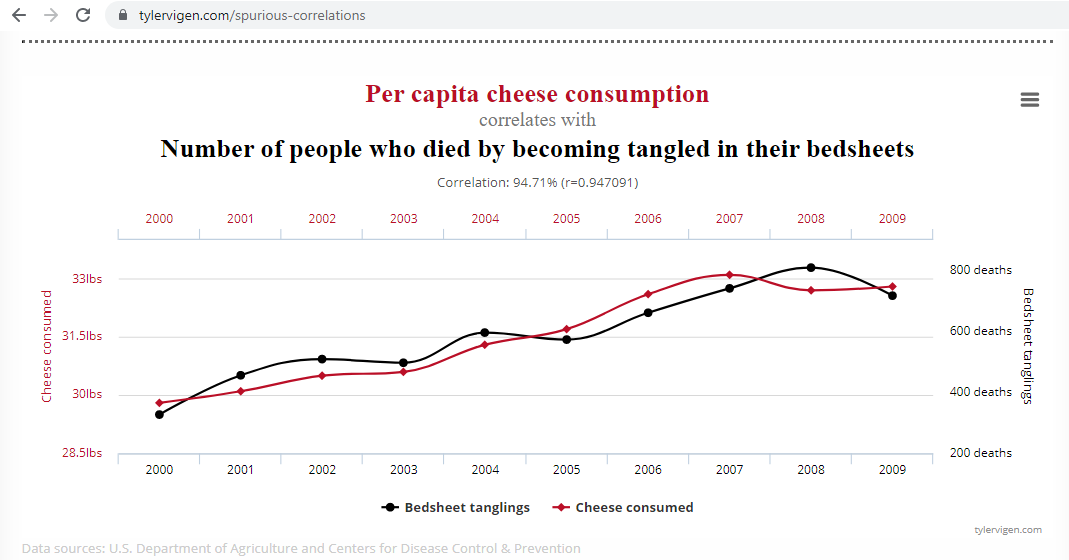
Eclectic wrote, "The land sink shows about 30-35% of total emissions, while the sum of land & ocean remains around 55-60%."
Yes, I usually say "about half," as in, "If our CO2 emissions were cut by more than about half then the atmospheric CO2 level would be falling, rather than rising."
It is important to recognize that the relationship is merely coincidental, not causal.
Eclectic wrote, "as the decades progress, the natural carbon sink flux in absolute terms rises with the rising emissions ~ but does not show a proportional increase."
The rate at which natural processes, such as ocean uptake, uptake by trees and soil ("greening"), and rock weathering, remove CO2 from the air, is affected in minor ways by many factors, but in a major way by only one: the current amount of CO2 in the air.
Our CO2 emission rate does not and cannot affect the natural removal rate, except indirectly, in the long term, by being one of the most important factors which affect the amount of CO2 in the air.
Eclectic wrote, "looking back in time ~ as the atmospheric CO2 level decreases, the size of the natural sink flux decreases also."
That is correct. It will also be correct looking forward in time, when CO2 levels are falling, someday.
Eclectic wrote, "this directly contradicts your hypothesis of 'if emissions were halved ... atmospheric CO2 level would plateau.'"
If you'll allow me to use "halved" as a shorthand for "reduced to the point at which emissions merely equal current natural removals, rather than exceed them," then those two statements are both correct, and perfectly consistent. It's pCO2 (level), not the rate of CO2 emissions, which (mostly) governs the rates of all the natural CO2 removal from the atmosphere.
Of course there are also minor factors which affect the removal rates. For instance, as we've already discussed, a 1°C rise in water temperature slows ocean uptake of CO2 by roughly 3%. Conversely, a rise in air temperature accelerates CO2 removal by rock weathering. (Sorry, I don't have a quantification of that.) But the main factor which controls the rate of CO2 removals is pCO2.
Eclectic wrote, "While the nutritive components of some food crops may reduce slightly as CO2 rises…"
Oh boy, another rabbit hole! That's the Loladze/Myers "nutrition scare."
It is of little consequence. That should be obvious if you consider that crops grown in commercial greenhouses with CO2 levels as high as 1500 ppmv are as nutritious as crops grown outdoors with only 30% as much CO2.
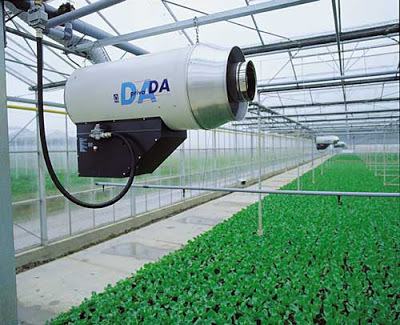
≥1500 ppmv CO2 is optimal for most crops. That's why commercial greenhouses typically use CO2 generators to raise daytime CO2 concentration to well above 1000 ppmv. It is expensive, but they go to that expense because elevated CO2 (eCO2) makes crops much healthier and more productive. (They don't typically supplement CO2 at night unless using grow-lamps, because plants can't use the extra CO2 without light.)
If elevating CO2 by >1000 ppmv doesn't cause crops to be less nutritious, then elevating CO2 by only 140 ppmv obviously doesn't, either.
Better crops yields, due to eCO2 or any other reason, can cause lower levels (but not lower total amounts) of nutrients which are in short supply in the soil. But that doesn't happen to a significant extent when agricultural best practices are employed.
I had an impromptu online debate about the nutrition scare with its most prominent promoter, mathematician Irakli Loladze, in the comments on a Quora answer. If you're not a Quora member you can't read it there, so I saved a copy here. He acknowledged to me that food grown in greenhouses at elevated CO2 levels is as nutritious as food grown outdoors.
Faster-growing, more productive crops require more nutrients per acre, but not more nutrients per unit of production.
Inadequate nitrogen fertilization reduces protein production relative to carbohydrate production, because proteins contain nitrogen, but carbohydrates don't. Likewise, low levels of iron or zinc in soils cause lower levels of those minerals in some crops. So, it is possible, by flouting well-established best agricultural practices, to contrive circumstances under which eCO2, or anything else which improves crop yields, causes reduced levels of protein or micronutrients in crops.
But farmers know that the more productive crops are, the more nutrients they need, per acre. Competent farmers fertilize accordingly.
Or, for nitrogen, they may plant nitrogen-fixing legumes — which benefit greatly from extra CO2.
If you don’t fertilize according to the needs of your crops, negative consequences may include reductions in protein and/or micronutrient levels in the resulting crops. The cause of such reductions isn't eCO2s, it's poor agricultural practices.
The nutrient scare is an attempt to put a negative "spin" on the most important benefit of eCO2: that it improves crop yields.
Eclectic wrote, "it is (as you state) beyond argument that higher CO2 benefits overall crop yield & plant mass."
That's correct. Moreover, agronomy studies show that for most crops the effect is highly linear as CO2 levels rise, until above about 1000 ppmv (which is far higher than we could ever hope to drive outdoor CO2 levels by burning fossil fuels). That linearity is obvious in the green (C3) trace, here:
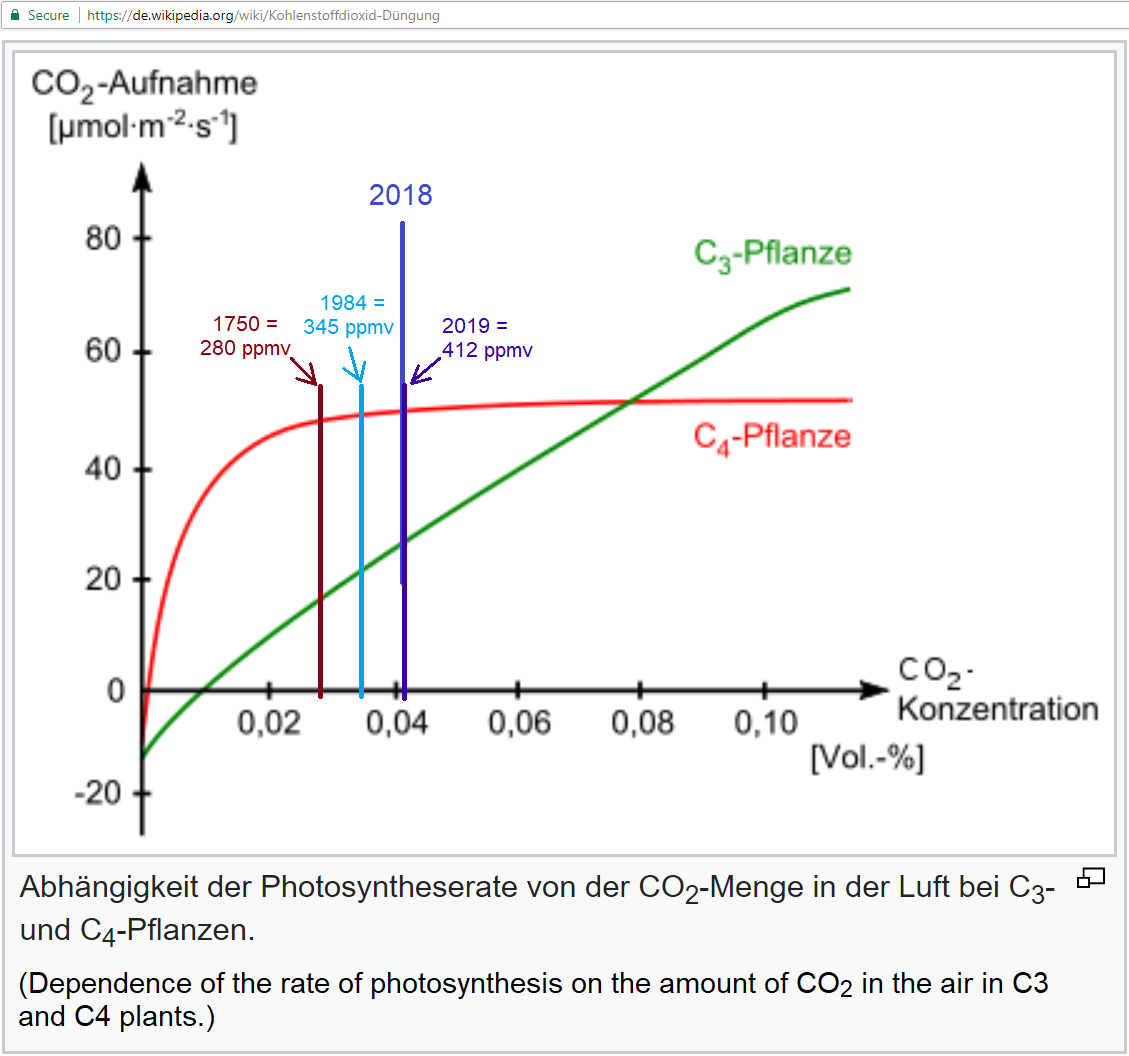
That improvement is one of several major reasons that catastropic famines are fading from living memory.
If you're too young to remember huge, catastrophic famines, count yourself blessed. Through all of human history, until very recently, famine was one of the great scourges of mankind, the "Third Horseman of the Apocalypse." But no more. This is a miracle!
https://ourworldindata.org/famines
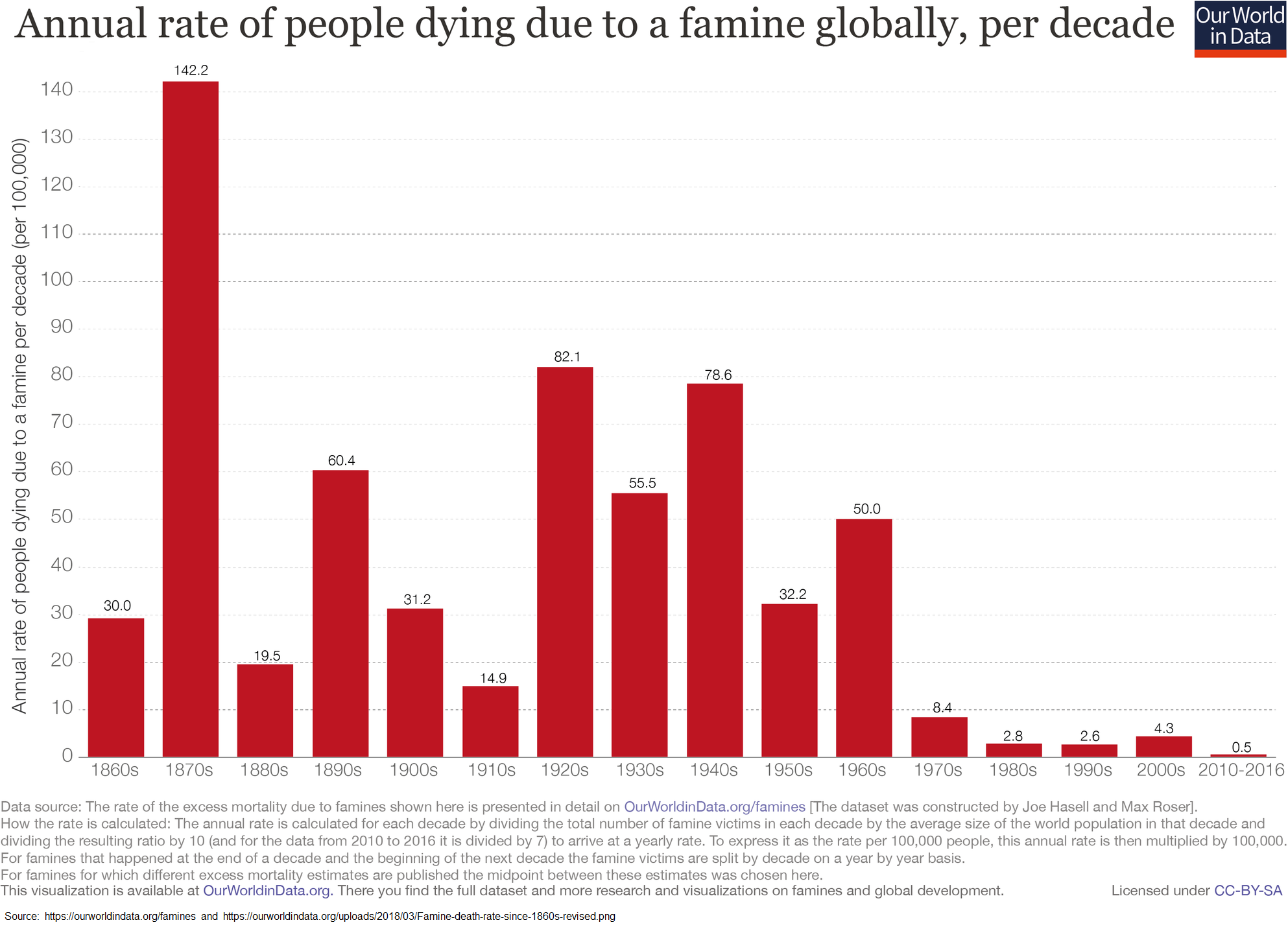
Ending famine is a VERY Big Deal, comparable to ending war and disease. Compare:
● Covid-19 killed 0.1% of world population.
● 1918 flu pandemic killed about 2%.
● WWII killed 2.7%.
● The near-global drought and famine of 1876-78 killed about 3.7% of the world population.
Eclectic wrote, "other CO2/AGW concomitant effects of increased droughts /floods /heat-waves can be harmful to crop yields in open-field agriculture. [And especially so for the staple crop of maize.]"
Well, let's examine those one at a time.
Heat-waves. Overall, temperature extremes are not worsened by the warming trend. Heat waves are slightly worsened, but by less than cold snaps are mitigated. That's because, thanks to "Arctic amplification," warming is disproportionately at chilly high latitudes, and it is greatest at night and in winter. The tropics warm less, which is nice, because they're warm enough already.
1°C is about the temperature change you get from a 500 foot elevation change. (That's calculated from an average lapse rate of 6.5 °C/km.)
On average, 1°C is similar in effect to a latitude change of about sixty miles, as you can see by looking at an agricultural growing zone map. Here's one, from the Arbor Day Foundation:
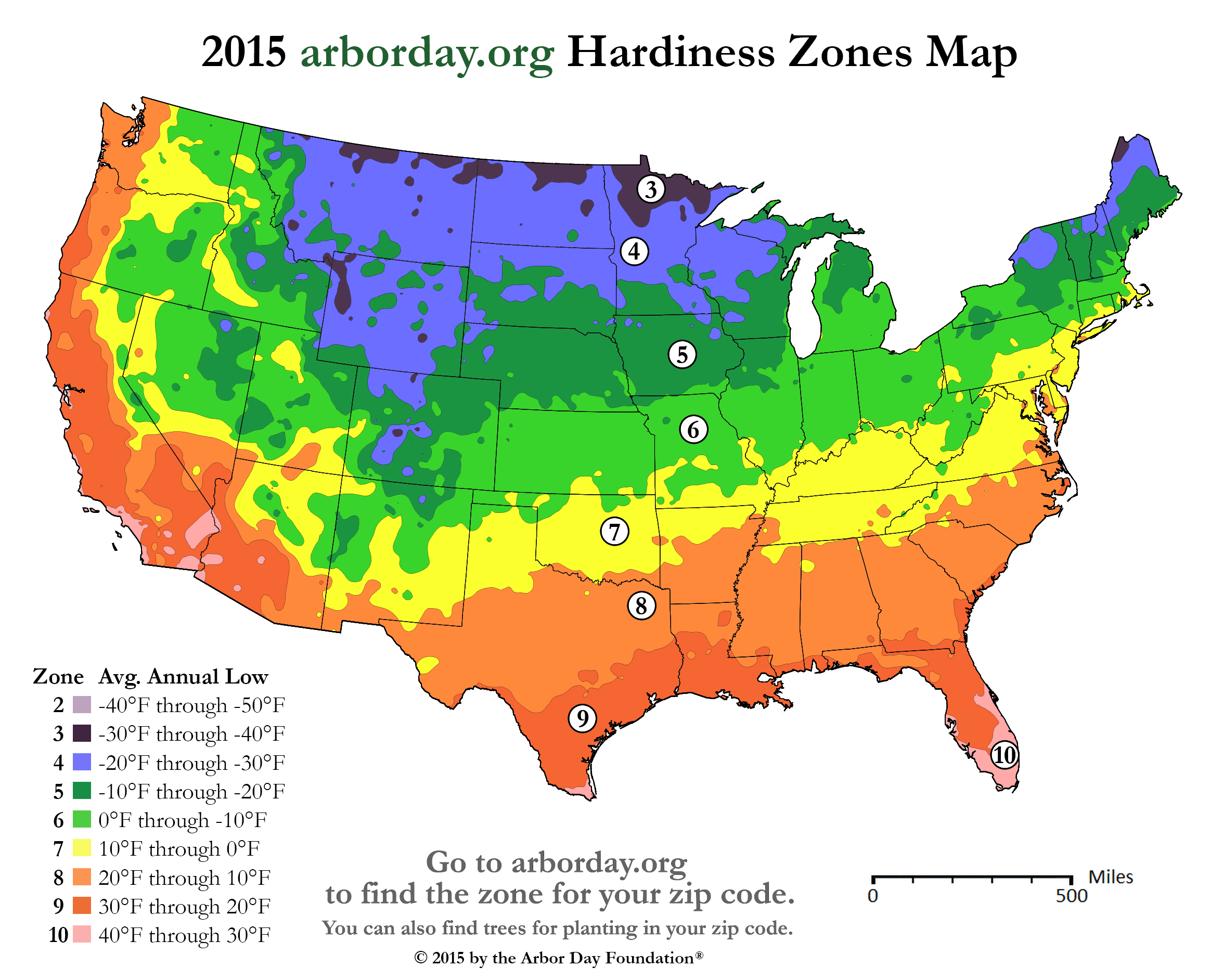
From eyeballing the map, you can see that 1°C (1.8°F) = about 50-70 miles latitude change.
James Hansen and his colleagues reported a similar figure: "A warming of 0.5°C... implies typically a poleward shift of isotherms by 50 to 75 km..."
1°C is less than the hysteresis ("dead zone") in your home thermostat, which is the amount that your indoor temperatures go up and down, all day long, without you even noticing.
In the American Midwest, farmers can fully compensate for 1°C of climate change by adjusting planting dates by about six days.
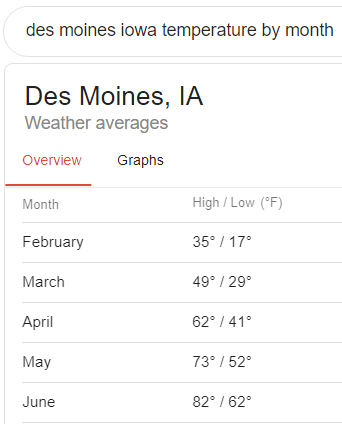
Floods. Theoretically, by accelerating the water cycle, climate change could increase the frequency or severity of floods. But the effect is too slight to be noticeable. AR6 says no change in global flood frequency is detectable:
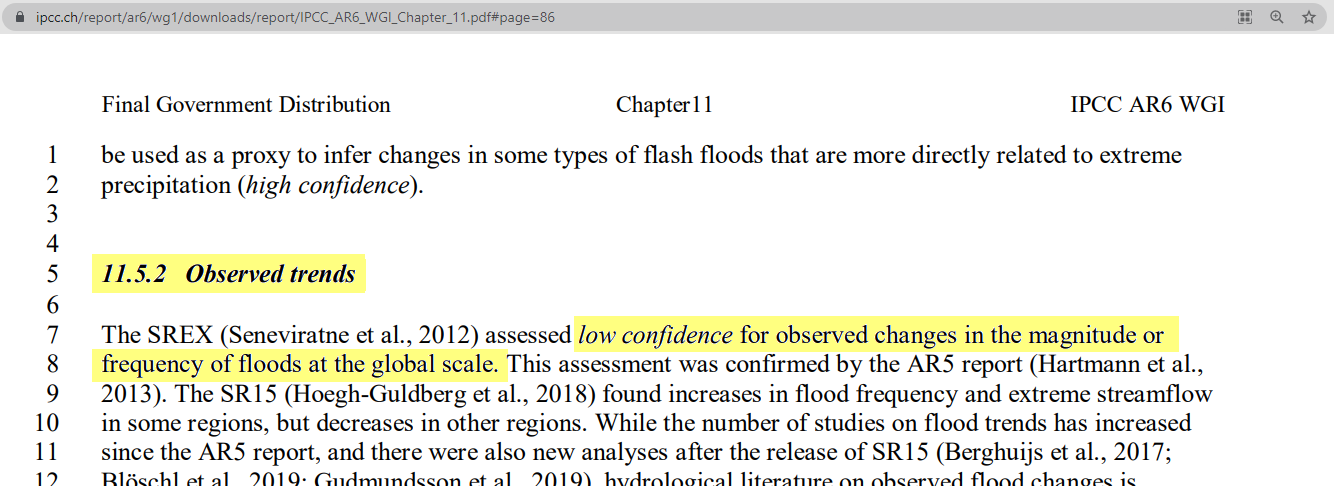
Droughts. Droughts have not worsened. In fact, the global drought trend is slightly down. Here's a study:
Hao et al. (2014). Global integrated drought monitoring and prediction system. Sci Data 1(140001). doi:10.1038/sdata.2014.1
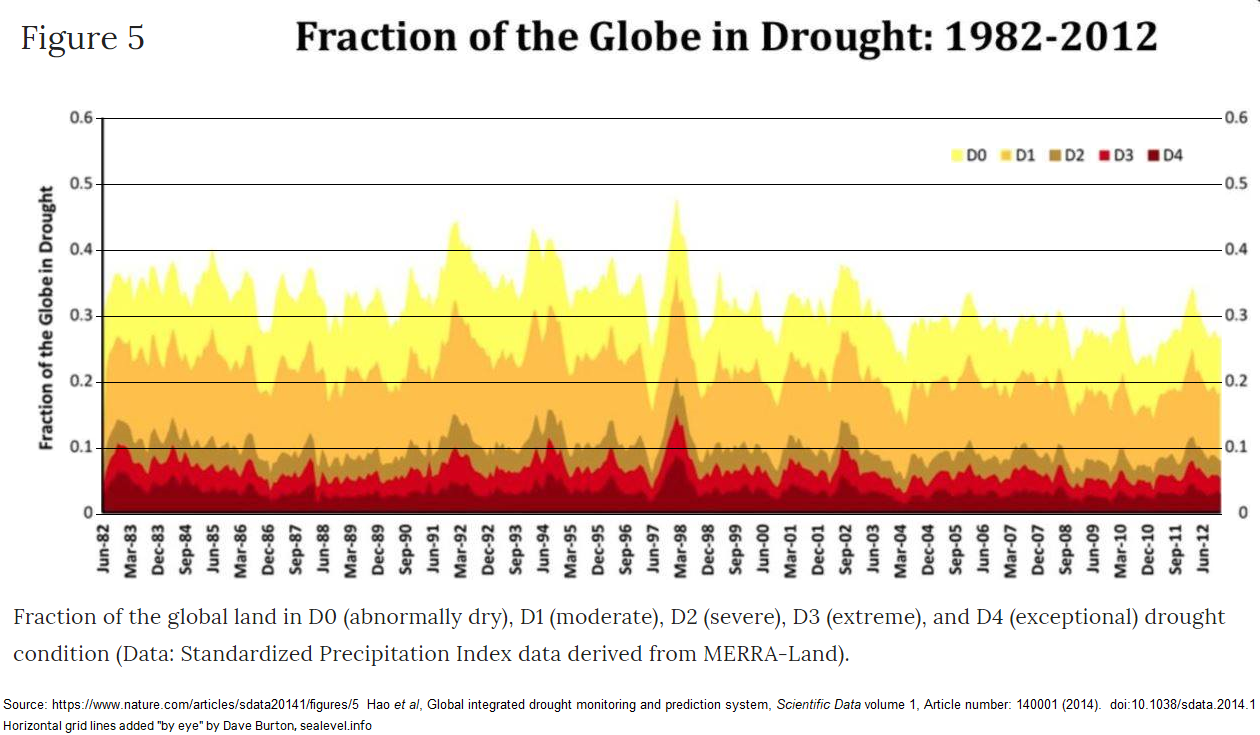
Here's the U.S. drought trend (the bottom/orange side of the graph):
https://www.ncei.noaa.gov/access/monitoring/uspa/wet-dry/0
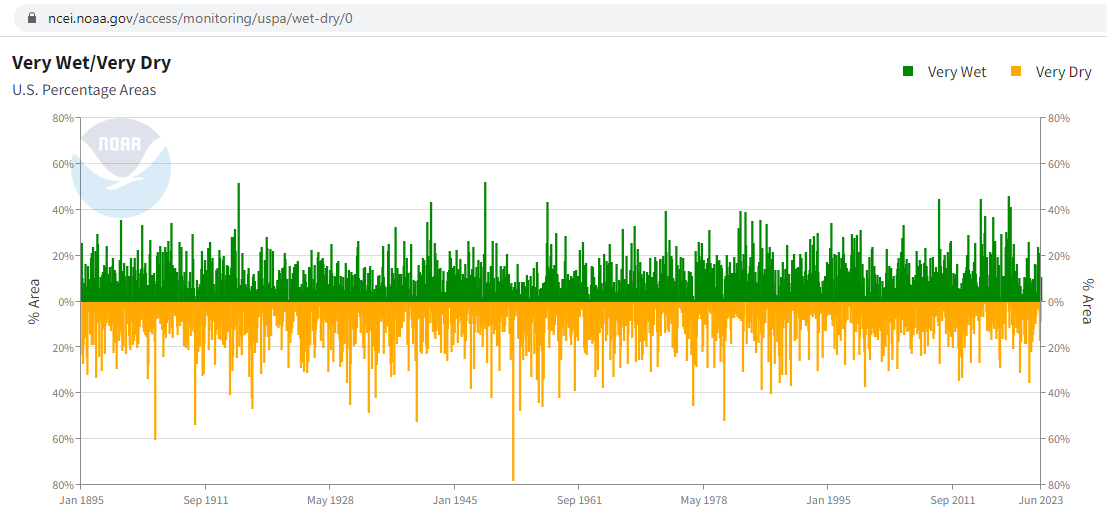
Not only does climate change not worsen droughts, it has long been settled science that eCO2 improves plants' water use efficiency (WUE) and drought resilience, by improving CO2 stomatal conductance relative to transpiration. So eCO2 is especially beneficial in arid regions, and for crops which are under drought stress.
Maize (corn) has been very heavily studied. Even though it is a C4 grass, it benefits greatly from elevated CO2, especially under drought stress. Here's a study (one of many):
Chun et al. (2011). Effect of elevated carbon dioxide and water stress on gas exchange and water use efficiency in corn. Agric For Meteorol 151(3), pp 378-384, ISSN 0168-1923. doi:10.1016/j.agrformet.2010.11.015.
EXCERPT:
"There have been many studies on the interaction of CO2 and water on plant growth. Under elevated CO2, less water is used to produce each unit of dry matter by reducing stomatal conductance."
Here's a similar study about wheat:
Fitzgerald GJ, et al. (2016) Elevated atmospheric [CO2] can dramatically increase wheat yields in semi-arid environments and buffer against heat waves. Glob Chang Biol. 22(6):2269-84. doi:10.1111/gcb.13263.
However, I agree with you that putting a monetary value on the benefits of CO2 for crops is difficult. In part that's because the price of food soars when it's in short supply, and plummets when it's plentiful. So, for example, if we were to attribute, say, 15% of current crop yields to CO2 fertilization & CO2 drought mitigation, and value that 15% using current crop prices, we would be underestimating the true value, because absent that 15% boost the prices would have been much higher.
- How big is the “carbon fertilization effect”?
daveburton at 15:36 PM on 13 July, 2023Rob wrote elsewhere, "greening is now turning into 'browning.' ... fertilization [has now been] overwhelmed by other effects... In other words, the greening has now stopped," and here, "You were making the claim that natural sinks were removing more of our emissions, and that is not the case by any stretch of the imagination.""
Here's AR6 WG1 Table 5.1, which shows how natural CO2 removals are accelerating:
https://www.ipcc.ch/report/ar6/wg1/downloads/report/IPCC_AR6_WGI_Chapter_05.pdf#page=48
Here it is with the relevant bits highlighted:
https://sealevel.info/AR6_WG1_Table_5.1.png
Or, more concisely:
https://sealevel.info/AR6_WG1_Table_5.1_annot1_partial_carbon_flux_comparison_760x398.png
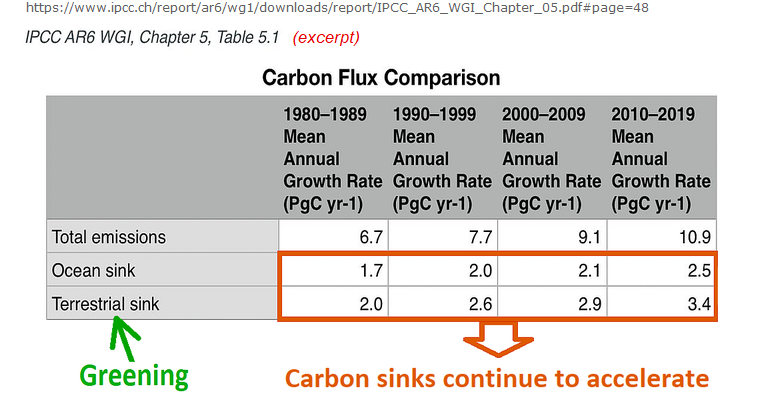
(Note: 1 PgC = 0.46962 ppmv = 3.66419 Gt CO2.)
As you can see, as atmospheric CO2 levels have risen, the natural CO2 removal rate has sharply accelerated. (That's a strong negative/stabilizing climate feedback.)
AR6 FAQ 5.1 also shows how both terrestrial and marine carbon sinks have accelerated, here:
https://www.ipcc.ch/report/ar6/wg1/downloads/report/IPCC_AR6_WGI_Chapter05.pdf#page=99
Here's the key graph; I added the orange box, to highlight the (small) portion of the graph which supports your contention that, "greening is now turning into 'browning.' ... fertilization [has now been] overwhelmed by other effects... In other words, the greening has now stopped."
https://sealevel.info/AR6_FAQ_5p1_Fig_1b_final2.png
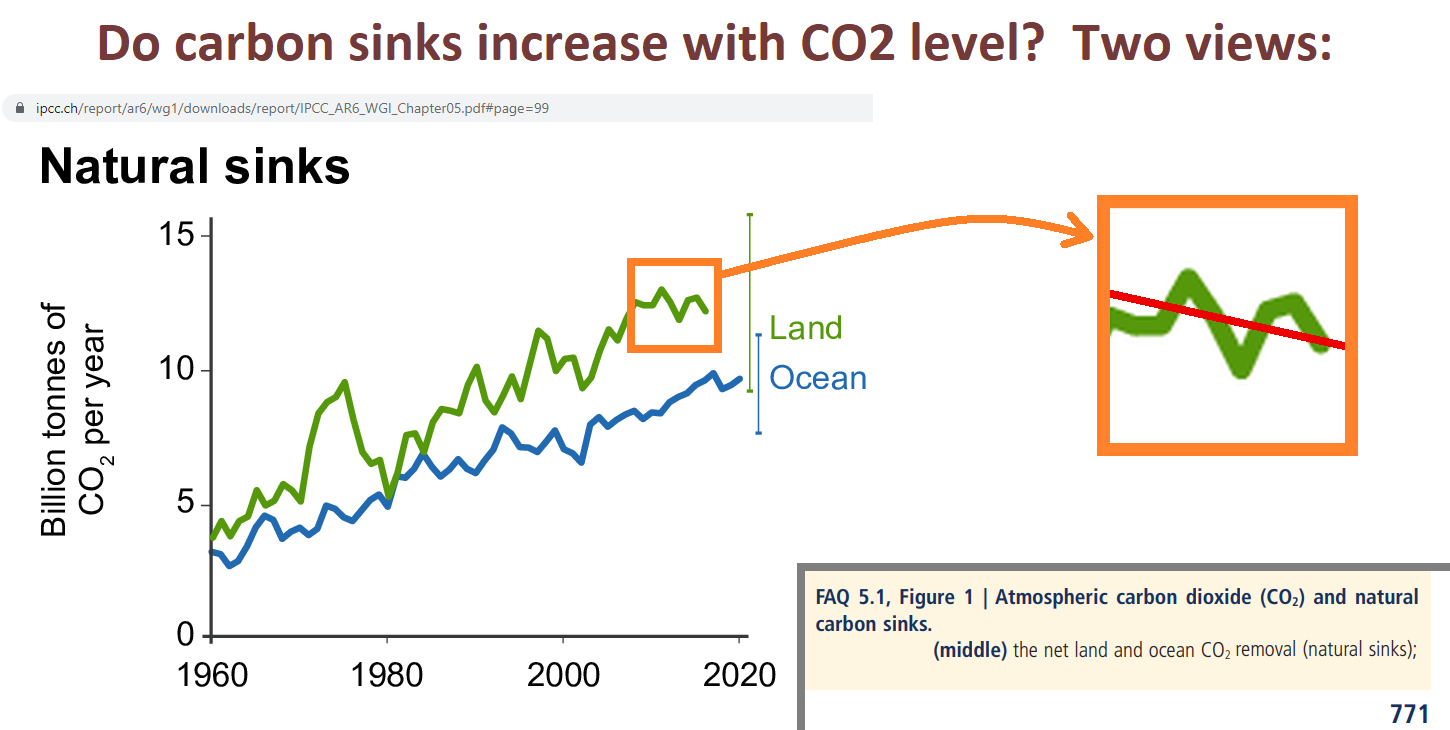
Here's the caption, explicitly saying that natural removal of carbon from the atmosphere is NOT weakening:
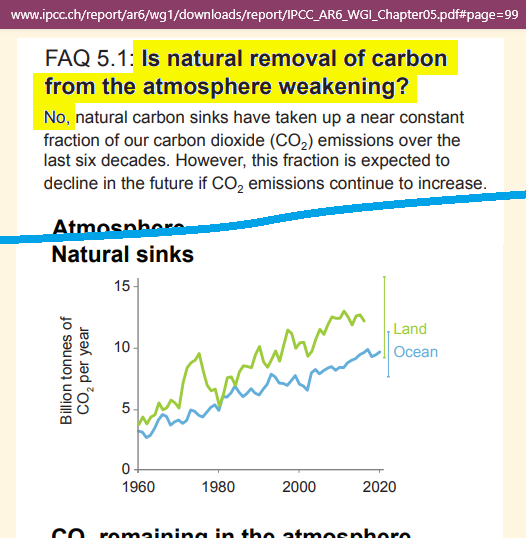
The authors did PREDICT a "decline" in the FUTURE, "if" emissions "continue to increase." But it hasn't happened yet.
What's more, the "decline" which they predicted was NOT for the rate of natural CO2 removals by greening and marine sinks, anyhow. Rather, if you read it carefully, you'll see that that hypothetical decline was predicted for the ratio of natural removals to emissions.
What's more, their prediction is conditional, depending on what happens with future emissions ("if CO2 emissions continue to increase").
Well, predictions are cheap. My prediction is that natural removals of CO2 from the atmosphere will continue to accelerate, for as long as CO2 levels rise.
The "fraction" which they predict might decline, someday, doesn't represent anything physical, anyhow. (It is one minus the equally unphysical "airborne fraction.") Our emission rate is currently about twice the natural removal rate, so if emissions were halved, the removal "fraction" would be 100%, and the atmospheric CO2 level would plateau. If emissions were cut by more than half then the removal "fraction" would be more than 100%, and the CO2 level would be falling.
I wrote elsewhere, "This recent study quantifies the effect for several major crops. Their results are toward the high end, but their qualitative conclusion is consistent with many, many other studies. They reported, "We consistently find a large CO2 fertilization effect: a 1 ppm increase in CO2 equates to a 0.4%, 0.6%, 1% yield increase for corn, soybeans, and wheat, respectively.""
If you recall that mankind has raised the average atmospheric CO2 level by 140 ppmv, you'll recognize that those crop yield improvements are enormous!
Rob replied, "If you actually read more than just the abstract of that study you find this on page 3: 'Complicating matters further, a decline in the global carbon fertilization effect over time has been documented, likely attributable to changes in nutrient and water availability (Wang et al. 2020).'"
Rob, I already addressed Wang et al (2020), but you might not have seen it, because the mods deemed it off-topic and deleted it. Here's what I wrote:
Rob, it's possible that your confusion on the greening/browning point was due to a widely publicized paper, with an unfortunately misleading title:
Wang et al (2020), "Recent global decline of CO2 fertilization effects on vegetation photosynthesis." Science, 11 Dec 2020, Vol 370, Issue 6522, pp. 1295-1300, doi:10.1126/science.abb7772
Many people were misled by it. You can be forgiven for thinking, based on that title, that greening due to CO2 fertilization had peaked, and is now declining.
But that's not what it meant. What it actually meant was that the rate at which plants remove CO2 from the atmosphere has continued to accelerate, but that its recent acceleration was less than expected. (You can't glean that fact from the abstract; would you like me to email you a copy of the paper?)
What's more, if you read the "Comment on" papers responding to Wang, you'll learn that even that conclusion was dubious:
Sang et al (2021), "Comment on 'Recent global decline of CO2 fertilization effects on vegetation photosynthesis'." Science 373, eabg4420. doi:10.1126/science.abg4420
Frankenberg et al (2021), "Comment on 'Recent global decline of CO2 fertilization effects on vegetation photosynthesis'." Science 373, eabg2947. doi:10.1126/science.abg2947
Agronomists have studied every important crop, and they all benefit from elevated CO2, and experiments show that the benefits continue to increase as CO2 levels rise to far above what we could ever hope to reach outdoors. Perhaps surprisingly, even the most important C4 crops, corn (maize) and sugarcane, benefit dramatically from additional CO2. C3 plants (including most crops, and all carbon-sequestering trees) benefit even more.
Rob also quoted the study saying, "While CO2 enrichment experiments have generated important insights into the physiological channels of the fertilization effect and its environmental interactions, they are limited in the extent to which they reflect real-world growing conditions in commercial farms across a large geographic scale."
That's a reference to the well-known fact that Free Air Carbon Enrichment (FACE) studies are less accurate than greenhouse and OTC (open top container) studies, because in FACE studies wind fluctuations unavoidably cause unnaturally rapid variations in CO2 levels. So FACE studies consistently underestimate the benefits of elevated CO2. Here's a paper about that:
Bunce, J.A. (2012). Responses of cotton and wheat photosynthesis and growth to cyclic variation in carbon dioxide concentration. Photosynthetica 50, 395–400. doi:10.1007/s11099-012-0041-7
The issue is also explained by Prof. George Hendrey, here:
"Plant responses to CO2 enrichment: Much of what is known about global ecosystem responses to future increases in atmospheric CO2 has been gained through Free-Air CO2 Enrichment (FACE) experiments of my design. All FACE experiments exhibit rapid variations in CO2 concentrations on the order of seconds to minutes. I have shown that long-term photosynthesis can be reduced as a consequence of this variability. Because of this, all FACE experiments tend to underestimate ecosystem net primary production (NPP) associated with a presumed increased concentration of CO2."
Rob wrote, "It does seem that you're claiming CO2 uptake falls with increasing temperature.""
That is correct for uptake by water. Or, rather, it would be correct, were it not for the fact that the small reduction in CO2 uptake due to the temperature dependence of Henry's Law is dwarfed by the large increase in CO2 uptake due to the increase in pCO2.
Rob wrote, "But it's unclear to me how you think this plays into the conclusion that CO2 levels would 'quickly normalize' over the course of 35 years" and also, "You also claimed CO2 concentrations would quickly come down (normalize) once we stop emitting it. This is also not correct unless you're using 'normalize' to mean 'stabilize at a new higher level'."
Perhaps you've confused me with someone else. I said nothing about CO2 levels "normalizing."
I did point out that the effective half-life for additional CO2 which we add to the atmosphere is only about 35 years. I wrote:
The commonly heard claim that "the change in CO2 concentration will persist for centuries and millennia to come" is based on the "long tail" of a hypothetical CO2 concentration decay curve, for a scenario in which anthropogenic CO2 emissions go to zero, CO2 level drops toward 300 ppmv, and carbon begins slowly migrating back out of the deep oceans and terrestrial biosphere into the atmosphere. It's true in the sense that if CO2 emissions were to cease, it would be millennia before the CO2 level would drop below 300 ppmv. But the first half-life for the modeled CO2 level decay curve is only about 35 years, corresponding to an e-folding "adjustment time" of about fifty years. That's the "effective atmospheric lifetime" of our current CO2 emissions.
Rob wrote, "Dave... The fundamental fact that you disputed is that oceans take up about half of our emissions."
That reflects two points of confusion, Rob.
In the first place, our emissions are currently around 11 PgC/year (per the GCP). The oceans remove CO2 from the atmosphere at a current rate of a little over 2.5 PgC/year. That's only about 1/4 of the rate of our emissions, not half.
More fundamentally, the oceans are not removing some fixed fraction of our emissions. None of the natural CO2 removal processes do. All of them remove CO2 from the bulk atmosphere, at rates which largely depend on the atmospheric CO2 concentration, not on our emission rate. If we halved our CO2 emission rate, natural CO2 removals would continue at their current rate.
Because human CO2 emissions are currently faster than natural CO2 removals, we've increased the atmospheric CO2 level by about 50% (140 ppmv), but we've increased the amount of carbon in the oceans by less than 0.5%, as you can see in AR5 WG1 Fig. 6-1.
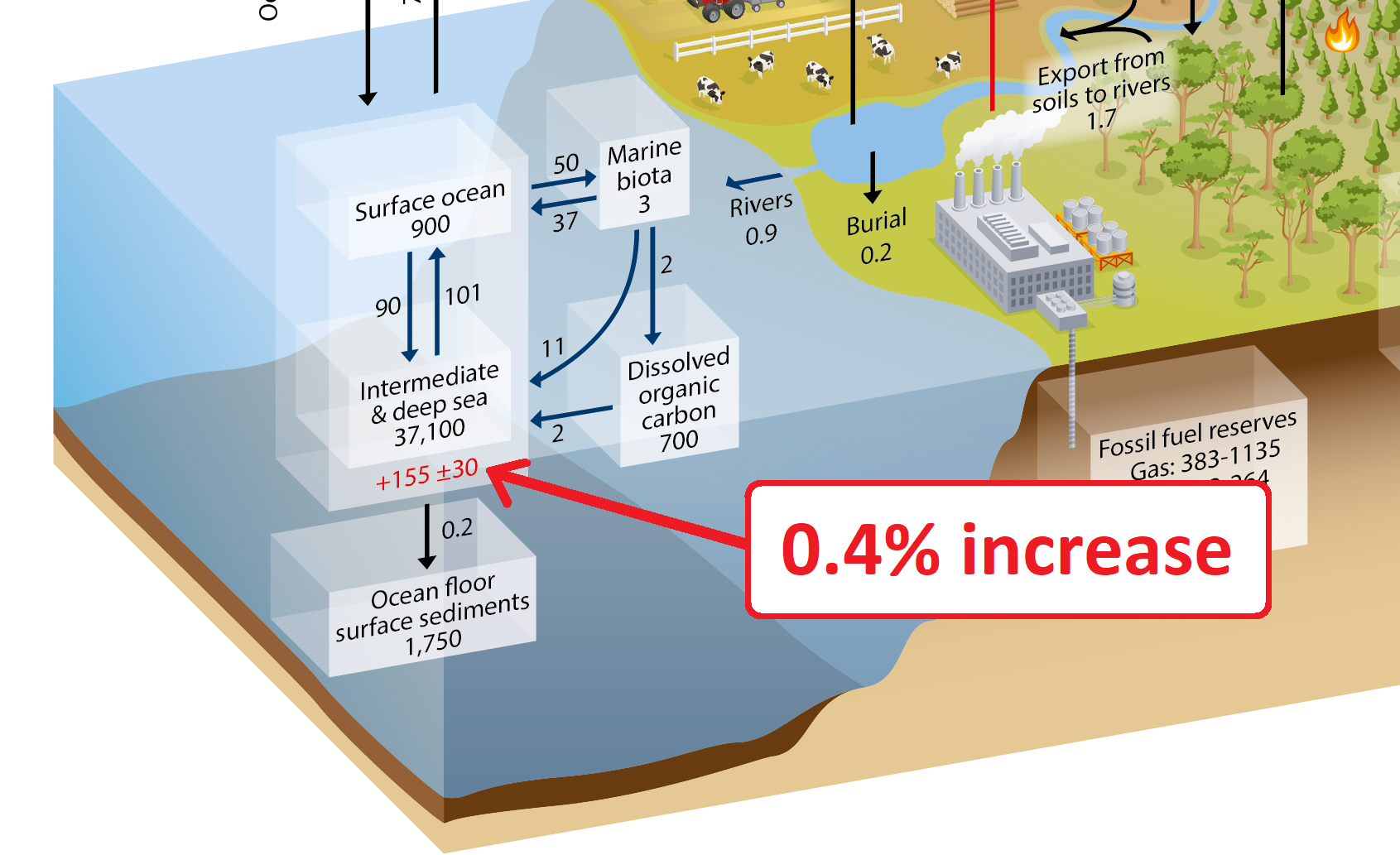
Sorry, this got kind of long. I hope I addressed all your concerns.
- Hansen predicted the West Side Highway would be underwater
daveburton at 07:39 AM on 6 July, 2023Rob wrote, "that greening is now turning into 'browning.'"
Well, here's what AR6 shows:
Some people point to that little orange box and say that greening has ceased. That reminds me of the folks who say that the it's not as warm as the 2015-16 El Nino, so warming has ceased.
Philippe wrote, "There is probably a better thread for this argument,"
I agree. I was just trying to address OnePlanet's remark about a "locked in" CO2 level.
Philippe wrote, "There is only one factor that truly controls how green any region can be: water availability."
That's a common misconception. Elevated CO2 levels greatly improve plants' water use efficiency (WUE) and drought resilience. That's why elevated CO2 is especially beneficial for crops when under drought stress. It has been heavily studied by agronomists. Here's a paper about wheat:
Fitzgerald GJ, et al. (2016) Elevated atmospheric [CO2] can dramatically increase wheat yields in semi-arid environments and buffer against heat waves. Glob Chang Biol. 22(6):2269-84. doi:10.1111/gcb.13263.
Philippe wrote, "The experiences that have shown a CO2 fertilization effect were done in very controlled conditions and involved extremely high concentrations (800 ppm and up)."
That's incorrect. All major crops have been studied, and all benefit from elevated CO2. It is true that the greatest benefits accrue at 1000 ppmv or higher, but even modest CO2 increases significantly improve crop yields.
This recent study quantifies the effect for several major crops. Their results are toward the high end, but their qualitative conclusion is consistent with many, many other studies. They reported, "We consistently find a large CO2 fertilization effect: a 1 ppm increase in CO2 equates to a 0.4%, 0.6%, 1% yield increase for corn, soybeans, and wheat, respectively."
This study evaluated pine trees:
Idso, S., & Kimball, B. (1994). Effects of atmospheric CO2 enrichment on biomass accumulation and distribution in Eldarica pine trees. Journal of Experimental Botany, 45, 1669-1672.
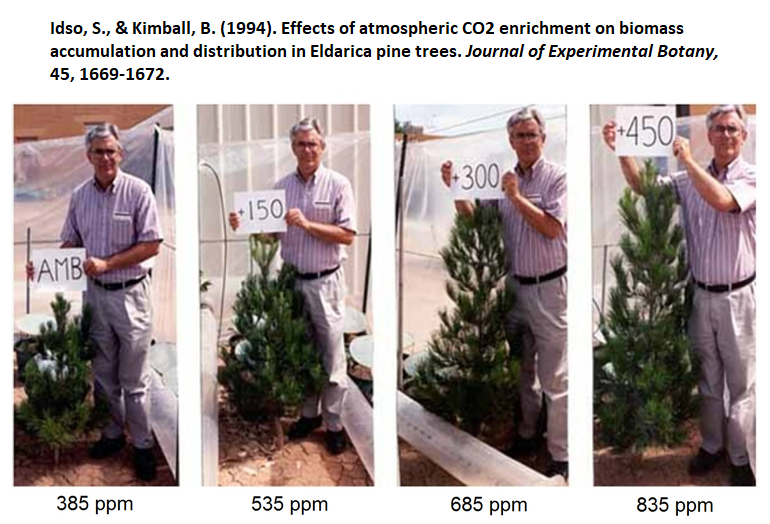
As you noted, the effect is greatest with CO2 >800 ppmv, but, as you can see, even a much smaller CO2 increase has a substantial effect.
Rob wrote, "This entire paragraph is patently absurd and completely fabricated."
It is 100% factual, Rob. I'm surprised that you didn't already know it.
These figures are from that same AR6 Table 5.1 excerpt which I already showed you:
average CO2 removal rate in the 2010s = 2.7707 ppmv/yr
average CO2 removal rate in teh 2000s = 2.3481 ppmv/yr
These figures are from Mauna Loa:
average CO2 level in the 2010s = 399.91 ppmv
average CO2 level in the 2000s = 378.84 ppmv
(399.91-378.84) / (2.7707-2.3481) = 49.86
So a 50 ppmv increase in CO2 level accelerates the natural removal rate by about 1 ppmv/year.
49.86 / 2.1294 = 23.42 ppmv increase yields a +1 PgC removal rate increase.
I encourage you to do the calculations yourself for any other time period of your choice.
If you have the natural removal rate as a function of CO2 level (which we do), it is trivial to simulate the CO2 level decline if emissions were to suddenly cease. I wrote a little Perl program to do it; email me if you want a copy.
Rob wrote, "if true, the oceans would just continue to suck up all the atmospheric CO2 and we'd live on a frozen planet."
That's incorrect. The system progresses toward equilibrium, which is below 300 ppmv, but not zero.
Rob wrote, "rather that starting from a prior where all the published science is getting it wrong, and making stuff up... you don't have the requisite training to fully grasp the topic"
Rob, it's not necessary to resort to ad hominem attacks. I'm happy to document things that are surprising to you. You need but ask. Everything I've written is well-supported.
Rob wrote, "take some time to fully familiarize yourself with Henry's Law."
Due to the temperature dependence of Henry's Law, a 1°C increase in temperature slows CO2 uptake by the oceans by about 3%. But a 50% (140 ppmv) rise in atmospheric CO2 concentration accelerates CO2 uptake by the oceans by 50%. That's the main reason that ocean uptake of CO2 continues to accelerate.
- Hansen predicted the West Side Highway would be underwater
daveburton at 03:51 AM on 6 July, 2023Thanks for fixing those links, Rob. We were obviously typing simultaneously; you beat me to it by 7 minutes.
However, nothing I wrote was misleading. If you "follow the link to the actual IPCC page to read the full" table, you'll see that it shows exactly what I said it shows: as atmospheric CO2 levels have risen, the natural CO2 removal rate has sharply accelerated. (That's a strong negative/stabilizing climate feedback.)
The commonly heard claim that "the change in CO2 concentration will persist for centuries and millennia to come" is based on the "long tail" of a hypothetical CO2 concentration decay curve, for a scenario in which anthropogenic CO2 emissions go to zero, CO2 level drops toward 300 ppmv, and carbon begins slowly migrating back out of the deep oceans and terrestrial biosphere into the atmosphere. It's true in the sense that if CO2 emissions were to cease, it would be millenia before the CO2 level would drop below 300 ppmv. But the first half-life for the modeled CO2 level decay curve is only about 35 years, corresponding to an e-folding "adjustment time" of about fifty years. That's the "effective atmospheric lifetime" of our current CO2 emissions.
Moreover, it is not correct to say that "the ocean takes up about half of our emissions." Our emissions are currently around 11 PgC/year (per the GCP). The oceans remove CO2 from the atmosphere at a current rate of a little over 2.5 PgC/year, but they are not removing some fixed fraction of our emissions. If we halved our emission rate, natural CO2 removals would continue at their current rate.
Because human CO2 emissions are currently faster than natural CO2 removals, we've increased the atmospheric CO2 level by about 50% (140 ppmv), but we've increased the amount of carbon in the oceans by less than 0.5%, as you can see in AR5 WG1 Fig. 6-1. (It's not a problem for "sea dwelling creatures.")
In the oceans, biology generally trumps chemistry, and that is certainly true for CO2 uptake. Some people think that the capacity of the oceans to take up CO2 is limited to surface water by ocean stratification. But that's incorrect, beause the "biological carbon pump" rapidly moves CO2 from surface waters into the ocean depths, in the form of "marine snow."
The higher CO2 levels go, the faster that "pump" works. Here's a paper about it:
https://www.science.org/doi/reader/10.1126/science.aaa8026
Once carbon has migrated from the ocean surface to the depths, most of it remains sequestered for a very long time. Some of it settles on the ocean floor, but even dissolved carbon is sequestered for a long time. For instance, it is estimated that the AMOC takes about 1000 years to move carbon-rich water from high latitudes to the tropics, where it can reemerge. That is obviously far longer than the anthropogenic CO2 emission spike will last.
- EPA’s car pollution rules would save Americans trillions of dollars
michael sweet at 06:16 AM on 13 May, 2023Reading Eric's link about Brake and tire dust I noticed that they always said "brake and tire". That suggests to me that brake dust is more important. The article suggests that this research is just beginning because ICE pollution used to be so much bigger that people did not bother looking at brakes and tires.
I Goggled a little and found that a lot of EV's use one pedal driving. I have found that with one pedal driving I rarely use the brakes. I have not measured but I would estimate much less than 5% of the time. It appears that all electric cars use regenerative brakes. The brake wear from electric cars will be much lower than current ICE cars. I saw a youtube video (what could be more accurate ;) where after 90,000 miles (about 145,000 Km) the brake pads were about 15% worn. Google says brake pads should be replaced every 20,000 miles, although some pads last longer.
The mechanic estimated that the tires had been driven 65,000 miles and had 5,000 miles left on them. The car was a Tesla model. 70,000 miles is not much different than an ICE car tire wear. I note that when you buy tires some have much longer warranty milage claims than other tires. Presumably tires with a longer lifetime release less dust per mile. The size of the dust particles is probably also different but I have no idea what the differences are.
My conclusion is that elecric cars release much less brake dust and probably a little more tire dust than ICE cars. Since these are currently not even measured because ICE cars release so much particle pollution, switching to electric cars will dramatically reduce small particle pollution.
- EPA’s car pollution rules would save Americans trillions of dollars
michael sweet at 10:21 AM on 12 May, 2023Eric,
My Tesla Model 3 uses the motor for almost all of the braking. I will be very surprised if the vehcle ever requires new brake pads. I have read that many other (most? All?) electric cars primarily use the motor for braking since they generate electricity to increase driving range. Can you provide a reference that says electric cars will wear out brake pads faster than ICE cars? Even hybrids use regenerated braking to increase range.
What do other model electric car users who read SkS find about brake use? All Teslas primarily use regenerative braking with the engine and not brake pads.
I have heard a little about tire wear. My niece, who is a environmental scientist working on land management, had never heard of this type of pollution, which suggests to me that it is not very important. Can you provide a link that describes the importance of electric cars versus ICE and tire wear? I expect that tire manufactures will reformulate tires to reduce wear if it is a problem, how much that would help is another question.
I notice that fossil fuel proponents raise a lot of red herrings about electric cars, like brake pad and tire wear. Are these really issues or are they fossil propaganda?
- CO2 is not the only driver of climate
Bob Loblaw at 07:54 AM on 9 May, 2023piotr @ 73:
I am not sure what your "not directly" statement refers to. I presume that the Martin Mlynczak quote is the one in comment 69. To put it simply, the thermosphere and the earth's surface respond to solar radiation in very different ways. You can read about the thermosphere on Wikipedia. Note that the thermosphere is at very high altitudes (>80km), and its temperature structure is the result of the absorption of UV radiation. It also has very low density, so even though average kinetic energy is high ("temperature") it does not hold a lot of heat. It is not strongly linked to the surface, which is heated by the absorption of solar radiation over the full spectrum.
This paper by Lean, Beer, and Bradley (1995) shows in figure 2 that variations in total solar irradiance are much less than for the UV range (in %).
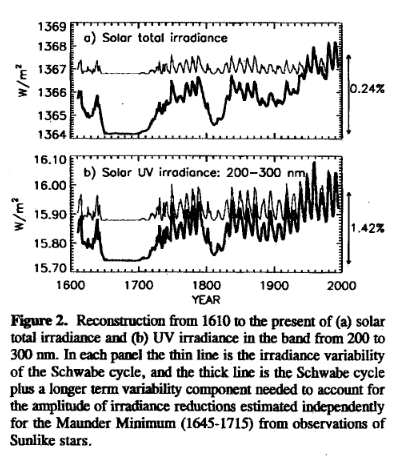
To use the 4W/m2 drop in that figure, you need to first reduce it by a factor of 4 (area of a sphere vs. area of a circle), and then adjust for global albedo (0.3), giving an overall forcing of only about 0.7 W/m2. Sustained over only a period of about 50 years, this is not going to have a major cooling effect on its own.
You say that "it noticeabl[y]e cooled large parts of the no[r]thern hemisphere", which I presume is a claim with respect to surface temperature responding to these solar variations. You then throw in volcanic effects. You seem to grossly overestimate those solar effects, though - with no references to any supporting information. If you look at this SkS post, the first figure shows that reconstructed global temperatures for that period are much smaller than your claimed "decrease up to 1.5°C".
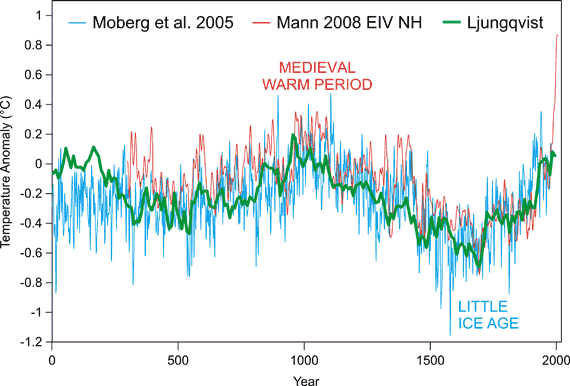
In your second paragraph, you start talking about "The past 10.000 years where up and downs in global mean temperature like +/- 2°C for dozen decades, even for nearly 2000 years - as we can reconstruct with little data-points." This starts to wander into the last glacial period, where Milankovitch cycles start to play a role. You are mixing together a lot of different forcing mechanisms, as if they are all equivalent in some fashion.
You then start into urban heat island effects, and finish off with a couple of paragraphs that represent an argument from incredulity. If you actually want to learn something about temperature reconstructions from proxies, Wikipedia has a decent article on this, too. The Wikipedia page also has a graph that shows even less variation in temperature than the one above:
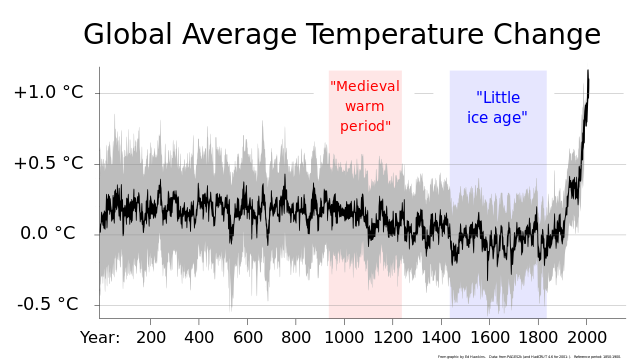
The numbers you are throwing around in your "just imagine" scenarios seem to be ones that you have a lot of confidence in. The problem is that they also appear to disagree with broad swaths of the scientific literature. You appear to be claiming that science is unsure of what happened in the past - but you are. It seems highly unlikely that you are correct.
If you want to have any credibility here, you are going to have to provide references to the numbers you post. This is not a site where you will be permitted to post a lot of unsubstantiated opinion. As you are a new user here, I strongly suggest that you read the Comments Policy.
- CO2 is not the only driver of climate
Eclectic at 05:51 AM on 9 May, 2023Piotr @73 ,
Wind & ocean currents move heat energy around the planet - and so there is a considerable "averaging" effect on global temperatures. Even today, you do not need thousands of observation stations in order to assess changes in global temperature. Analysis shows that less than 100 stations are needed (if well-distributed, of course) to give a closely accurate picture of conditions.
A so-called Grand Solar Minimum is not actually very grand ~ studies such as Feulner & Rahmstorf, 2010 and Anet et al., 2013 indicate that a GSM produces a global cooling of around 0.3 degreesC. (Other studies indicate slightly smaller changes.) And this is because our Sun is a very stable star, with a very stable output of radiation. Very little variation.
Even the Little Ice Age was not spectacularly cold ~ a global cooling around 0.5 degreesC . . . which had been helped along by a number of cold winters from volcanic eruptions.
There have been periods of decades of marked cooling in the neighborhood of Greenland earlier in the Holocene, as a result in temporary changes in ocean currents. But these had little effect on average global temperature (the planet is big, and there is a vast amount of tropical ocean). The one exception is the millennium of strong cooling (the "Younger Dryas" ) about 12,000 years ago ~ and this was a one-off event produced by the single event of melt/discharge of the Laurentide Ice Sheet situated in Canada.
Piotr, you seem to have a wrong idea about earlier warm periods (of the Holocene) such as the so-called Minoan / Roman / Medieval Warm Period ~ these were only very slight changes, around 0.3 degreesC or smaller. These were only tiny "blips" on the general slow cooling from the Holocene Maximum temperature (slow cooling owing to the Milankovitch Cycle).
Possibly you have been misled by reports based on Arctic region temperature estimates (the Arctic shows bigger swings than the average global temperature).
- CO2 is not the only driver of climate
piotr at 03:11 AM on 9 May, 2023@Bob Loblaw
Not directly. I was just wondering on Nasa's Martin Mlynczak statement to Grand solar minimum "and will not cause noticeable cooling at the surface". Yeah, not globally, except the overall temperatures may decrease a bit in statistics too. But it noticeable cooled large parts of the nothern hemisphere, like big vulcanic eruptions can cause for few years and did in even the last 150 years too -> global mean temperatures decrease up to 1.5°C, besides some areals warmed then too.
So what is Martin Mlynczak talking about? The past 10.000 years where up and downs in global mean temperature like +/- 2°C for dozen decades, even for nearly 2000 years - as we can reconstruct with little data-points.
Overall my main questions is the concerning how plausible is the reconstruction of earthly temperatures over thousands of years just with indirect data besides modern technology with thousend parameters, stations around the globe and on every time (even in grown urban places, which totally heat up just being sealed ground and overcrowded for decades). modern observation for like 30 years am totally cool with, but the rest is a large extrapolation of indirect measurement and got "worse" at we strife further away in time.
Just imagen if we would have high technology measurements like today in for example 6000 BC to 5500 BC, then we would see global warming for at least 0,5 - 0,8 °C over aproxx 1-200years similar like today and we knew that for some areas or changing habitats like sahara desert, but not excessive like modern data amount. btw. its also stated there were same co2 ppm levels as pre-industrial times.
i think its "fascinating" to have data from million years ago, when no modern human lived and we think to "know" how life was back then, globally, just by knowing some single fragments and feeding supercomputers with, which try hart to simulate complex features like climate or even local weather to be back then. Im a big fan of astronomy since my child days and read about the fist extrasolar-findings back in the days. but thats much more extreme, as we can never proof for real, even if its pretty possible to conclude a habital place somewhere on a planet just by reconstruction of the atmosphere, despite being back in time maybe million years ago. its hilarious to say "we found a possible earthlike planet!".
- CO2 is not the only driver of climate
Bob Loblaw at 11:20 AM on 8 May, 2023piotr @ 70:
You ask what might have caused the Maunder Minimum. First, you should think about exactly what the Maunder Minimum was: a period of low sunspot numbers. Wikipedia has a good article, and they include this figure:
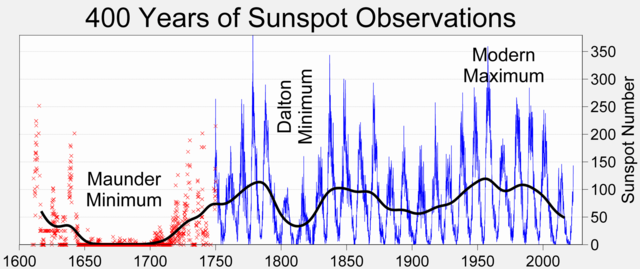
Technically, "what caused the Maunder Minimum?" is a question of astrophysics, not climatology. But what you are probably wanting to ask is "what caused the xxxxx?, where xxxxx is something that you feel is correlated with the Maunder Minimum. Reduced solar irradiance? Lower temperatures? The Little Ice Age?
So, this means that you are looking at something where the Maunder Minimum is an indirect/proxy indicator of some potential climate factor. You do realize that we do not have direct evidence that the Maunder Minimum caused a specific decrease in solar irradiance? You do realize that many of the observations indicating cooler temperatures - such as ice on the Thames -are local, and not global? The Little Ice Age appears to be related to a number of factors. You can read about it a bit more in this post.
Understanding of past climates is based on things like vegetation, sediments, etc. A lot of those have automatic time-averaging (trees don't grow in a year) and spatial averaging (sediments and pollen get carried in to lakes from large watersheds). The analysis of past climates includes a wide variety of proxy indicators. You can read more about it on this post.
In short, you need to be more specific in explaining what you do understand, and what questions you have.
- CO2 is not the only driver of climate
Eclectic at 10:20 AM on 8 May, 2023Piotr @70 ,
Think about it this way ~ causes and effects.
In this universe, if you see an effect, there must be a cause (and with enough study, you can find that cause - which may be a single cause, or a combination of causes).
Past studies (by experts) have shown broad changes in climate - not measured in tenths of a degree as per modern thermometers, but in broad assessments of indirect indications of climate average temperatures / sea level changes / vegetation changes / and so on. From this, it is evident that the climate changes when there is a causative change (a change in solar output, or in atmospheric CO2 levels, or in reflective "albedo" from global ice coverage, or in stratospheric aerosol particles from major volcanic eruptions).
All these jig-saw pieces fit together nicely, to give the scientists (and us) a good understanding of how climate "works".
Beware of non-scientists who say that "stuff just happens" [excuse the American expression]. They seem to wish to believe that the past century or two of very rapid global warming is somehow not caused by the obvious causes. And that it came for no identifiable reason. They seem to wish to believe that the modern warming "just happened for no cause" (sometimes expressed in the meaningless phrase "it is just a rebound from the Little Ice Age").
(The Little Ice Age had its own causes - frequent major volcanism plus episodes of reduction in solar output.)
Or they say that the modern rapid warming must instead be caused by "long-term changes/oscillations in ocean currents" ~ which actually does not make scientific sense (if they bothered to think it through).
Piotr, there are definitely some people who do not wish to think.
- Arctic sea ice has recovered
Albert22804 at 17:00 PM on 20 April, 2023The Kinnard has Arctic ice extent increasing from about 750 to 1500 which is an absurdity. Vikings colonised Greenland about 980 and farmed some areas that today are permafrost.
But the graph shows 980 ice extent to be about the same as 1700 and by that time the areas farmed were permafrost.
The graph shows ice extent dropping dramatically from about 1400 but the little ice age was ramping up in 1400, not down.
The graph shows ice extent increasing dramatically from about 1600 but the LIA peaked around 1650-1700 and temperatures have risen sporadically ever since. The Central England Temperature database correlates well with this.
Here is a different reconstruction that shows 1940 Arctic ice to be about the same as
[LINK]
See figure 1b
But the guy was italian and what would they know? See, I can be sarcastic as well.
- There is no consensus
Rob Honeycutt at 10:24 AM on 20 April, 2023"But Michael Mann showed us in his model that the medieval warm period and little ice age never existed so all those thousands of scientists that proved they did exist must be wrong."
a) Please look up the definition of the word "heterogeneous."
b) Assuming you're talking about MBH98/99, that was nearly 25 years ago and their research only went back too the MWP. Perhaps you should catch up on more recent research.
(Yes, this is quickly veering off-topic... as one would expect.)
- There is no consensus
Albert22804 at 09:46 AM on 20 April, 2023"Such low ECS figures would mean the earth's climate should be almost perfectly stable over geologic time (no glacial-interglacial cycles) and we know that's not true."
Rob, believe it or not there are other factors that effect global temperature like, the sun, solar winds, magnetic fields, cosmic rays, transportation and retention and expulsion of ocean heat, volcanic activity above and below water, aerosols, clouds, gravitational pull of other planets, milankovitcg cycles, earth rotation wobble, shifting of poles, etc.
Our current warming cycle started around 1700 as The little ice age peaked negatively and we have been warming sporadically ever since.
its all perfectly normal with many historical precedents in the Holocene and previous interglacials.
1000 years ago Vikings colonised and farmed parts of Greenland that are still permafrost today. How can this be unless Greenland was far hotter than today. etc Etc etc.
But Michael Mann showed us in his model that the medieval warm period and little ice age never existed so all those thousands of scientists that proved they did exist must be wrong.
- Arctic sea ice has recovered
MA Rodger at 23:43 PM on 19 April, 2023Albert @133/134,
Simply accepting anecdotal evidence from newspapers is not the way to determine historical Arctic ice conditions.
There are serious attempts to create records running back before the instrument era, like Walsh et al (2017) 'A database for depicting Arctic sea ice variations back to 1850' which is the subject of the CarbonBrief article linked @131 with the graphic @132. A little more recently there is Schweiger et al (2019) 'Arctic Sea Ice Volume Variability over 1901–2010: A Model-Based Reconstruction' which reaches similar conclusions, the graphic below from that paper showing rolling annual averages of Arctic SIV and annual red dots.

I would suggest you read the comment @123 if you feel that "no one has challenged the fact that Arctic ice thickness or extent has not dropped since 2012." And I do look at JAXA data and it evidently has "decreased since 2006" in that the JAXA annual average SIE 2006-22 has a linear trend of -0.032M sq km/y, a smaller decline than for the earlier part of the record (-0.51Msq km/y) but still a decline. So it has "dropped."
- The Big Picture
Bart Vreeken at 05:57 AM on 22 March, 2023Hi Rob @153
"the gravitational effects from the Greenland ice sheet are not going to reduce the Netherlands' risk from sea level rise."
Looks like you still don't understand the topic completely. I stated that only 12.5% of the meltwater of Greenland comes to the Netherlands. So yes, the gravitational effect does reduce the risk from sea level rise in NL a little.
"You were not the first to create temperature bars on a graph"
When I started with that I hadn't seen it anywhere else. But of course I can't oversee everything. I didn't research the complete Internet then. My remark about the inspriration for the Climate Stripes was just my opinion, just a site remark and not my main message of @131. You make it more important then it was.
- Antarctica is gaining ice
Bob Loblaw at 12:09 PM on 13 March, 2023Bart @ 552:
The point in my comment at 534, responding to your first comment, was that it is a huge mistake to try to make extrapolations into the future from a short time period. We see it all the time: temperature (The Escalator), sea ice coverage, etc. People that want to believe a particular thing, and ignore the long-term trend by saying "look at this!" from a short period of data at the end of a noisy data set.
If you had followed the link to The Escalator, you would have seen that the very first sentence says:
One of the most common misunderstandings amongst climate contrarians is the difference between short-term noise and long-term signal.
That you choose to call it "a stupid graph" indicates that you still don't understand the error in drawing grandiose claims from short periods of data.
Now, you are saying "The result is interesting: there don't seem to be much correlation between SMB and discharge. Strange enough, in the last year with little sea ice the discharge was even less then normal."
No, this is not at all interesting. As has been said to you previously, relationships between precipitation, accumulation, glacier flow, discharge, and sea ice are not simple. Rob Honeycutt has posed a number of questions to you in comment 554 that are germane to the point. Unless you understand why those questions are important, and can begin to think of answers to them, you are not looking at the topic seriously.
The very first response I gave to you - the first paragraph - was:
What exactly is your point? The links between sea ice area and land ice mass are not simple, and have been discussed in the detailed sections of the blog post and earlier comments.
I suggest that you actually try doing some reading, starting with the blog post (both the basic and intermediate sections) and then through the numerous comments, and maybe then you'll have enough understanding to be able to engage in a "serious discussion".
The simple answer is that you seem to be expecting a simply answer and a simple relationship for a complex system, and you are simply wrong.
- Antarctica is gaining ice
Bart Vreeken at 07:09 AM on 13 March, 2023As I said, I was hoping for a more serious discussion on this site.
What went wrong: in my first post I wanted to show the graph with the SMB as well. I must have done something wrong, for it didn't came up. Sorry for that. But this information is not so hard to find. MA Rodger succeeded in doing this, Bob Loblaw preferred to show a stupid graph about cherry-picking. Well, that's not the point here.
Anyhow. The correlation between SMB and mass change was not clear, so I put them together in one table. The SMB is calculated over November - November. The original graph gives the anomaly of the SMB. The average mass of the anomaly seems to be some 2700 Gigaton, so I added that to the anomaly. Then the discharge of the ice sheet can be calculated as the difference between the GRACE data and the SMB.
The result is interesting: there don't seem to be much correlation between SMB and discharge. Strange enough, in the last year with little sea ice the discharge was even less then normal.
An important thing could be that GRACE isn't measuring the total amount of ice, but only the amount above the sea level. So, increased calving from floating iceshelfs isn't noticed.

- It's not bad
PollutionMonster at 18:07 PM on 21 February, 2023Rob Honeycutt @412
That's an awesome example. "I don't deny the Earth has a climate." I love it! Thank you. :)
Eclectic @413
Thanks this helps me a lot.
""Denier" is a handy short label for those who are opposed to taking action for fixing the global warming problem. They themselves dislike it, and whinge greatly about the label" Eclectic
I won't visit or even mention the name of the website you mentioned. I figure it is just giving them more ad revenue. As for the part about Africa, I call what the climate change denier is doing as concern trolling. This argument also relies heavily upon climate myth #3 it is not bad.
Sometimes the denier takes the moral grandstanding route, angry, and insulted when I implied they are a climate change denier. I usually, just apologize to be nice, but sometimes I think I apologize too much. Anti-vaxxers do this too.
Caricature of a climate argument.
me: "climate change can be prevented without pitting the enviorment versus poor people. I recommend the websites skepticalscience.com and crankyuncle."
Sample denier argument: "You are calling me a climate change denier by linking to the two links above. How dare you insult me! Calling me a climate change denier is an ad hominem and dehumanizing language. You should be ashamed of yourself. I will not stand for such harassment, abusive hate speech, I am highly offended!!!"
This moral outrage type of argument can be quite difficult to stomach. More so if they catch you off guard. Let's check my message, wait what? Let alone if I show any emotion especially anger.
me: "Wow, this is tin foil hat level of conspiracy thinking gish gallop."
Climate change denier: "Enough with the attitude! I wrote twenty pages and you dismiss my claims with a single sentence. You ignore all of my claims and make no effort. What do I get in response, snark? I find this disrespectful. Nobody listens to me. How dare you! "
Pay attention to the self-pity in the above paragraph. I can practically hear them playing a violin.
With your example of Africa the climate change denier tries to peg the skeptic as a member of the cabal, the denier as a member of the army of light, and everyone else as sheeple. That's why I think #3 its not bad is such an important myth to dispel.
The idea that proponents of climate change action are cast as the villains and deniers the heroes bothers me. Taken a step further the climate change denier sometimes resorts to abusive ad hominems and even threats. Justifying their nasty remarks and threats because in their warped sense of reality they are heroes defeating a horrific villain and saving the sheeple.
I call the tactic attack the skeptic. Sometimes I get a little scared when a denier uses violent rhetoric and graphic threats. At first I thought it was funny because it was so over the top. I though he was just poeing to be funny.
Poe's Law
https://rationalwiki.org/wiki/Poe%27s_Law
Pretty scary because this has been going on since about May 2022, I though if I ignored him he would just go away.
But I guess that's pretty normal if you debunk climate myths long enough you are going to attract a tin foil hat Young Earth Creationist Christian zealot who really thinks God is on their side believes in Qanon and views the opposition as a satanic threat. How common is this?
In conclusion, I think #3 myth it is not bad is a pretty good place to focus because climate change deniers love to declare themselves the heroes and vilify anyone who pushes climate change action.
Simplest form:
Climate change action advocate: "We should do something about climate change."
Denier: "You monster! Groups x,y, and z will be harmed by your immoral and reckless actions. We should be completely passive and do nothing because climate change is good."
- It's not bad
Eclectic at 09:29 AM on 20 February, 2023PollutionMonster @409 ,
Good luck with your battle against the science-deniers. As you have noticed, they use all sorts of poor logic and see-the-tree-but-ignore-the-forest stuff. They are emotionally driven ~ as you must be, if you wish to entertain yourself by crossing swords with them in public.
Your task of course is to persuade the onlookers, not the intransigent Denialists. My humble advice is to Keep It Simple.
A/ The observed Stratospheric Cooling is a great argument : being proof that it is not The Sun causing modern global warming. And the Stratospheric Cooling was successfully predicted by "models" of 80-ish years ago.
B/ The observed sea level rise is great proof of actual global warming (Denialists try to deflect on to the gray area of "but the rise is not accelerating" or the rubbishy "it's just rebound from the Little Ice Age".) Also you can mention the coastal measurements by Kulp & Strauss [2019] showing that a 1 meter sea level rise would displace 230 million people (Denialists hate the idea of refugees & migrants).
C/ When pressed to declare what the perfect climate is ~ I state the climate of 1950 A.D. (Easy to defend.)
These sorts of arguments suit my simple brain, and are difficult to counter by sophists, bloviators & other trollish propagandists.
- Skeptical Science News: The Rebuttal Update Project
One Planet Only Forever at 04:46 AM on 20 February, 2023John Mason @8,
To be clear, I am not suggesting an end to human efforts to combat misinformation. And I am sure that constant human monitoring would be required to ensure that an AI ChatBot was as effective as possible. And human monitoring and input would also be required to identify and counteract 'novel developed attempts to impede the effectiveness of the helpful AI ChatBot'.
Thinking a little more about it, it is likely that harmful pursuers of advantage in obtaining personal benefits to the detriment of Others are already working on developing AI ChatBots for their interests.
As is often noted, there is an endless possibility for developing 'harmfully appealing misleading claims'. And the efforts to limit the harm are always too little too late.
Trying to correct harmful misunderstandigs is fighting an uphill battle. There is a profusion of harmful misleading unjustified positive impressions and unjustified anxieties and fears (negatives) that impede learning to be less harmful and more helpful to Others. The Story of the week in 2023 SkS Weekly Climate Change & Global Warming News Roundup #7 and the first 2 comments are evidence of a globally coordinated effort to oppose the interests of the future of humanity. And the Story of the Week in 2023 SkS Weekly Climate Change & Global Warming News Roundup #5 provides a detailed evaluation of the success of such efforts impeding the achievement of the Paris Agreement objective, making that achievement 'not plausible' (Limiting impacts to 1.5 C not plausible even with significant systemic transformation starting today. And limiting impacts to 2.0 C requiring significant systemic transformations starting today).
A significant systemic transformation could be one powerful ChatBot developed collaboratively by the UN (UNICEF, UNDP, UNEP, ...). That could help the 'effort to educated people' on the many matters of concern regarding the future of humanity, not just the climate impact challenge. But I would suspect very few current day powerful governments would support the effective development of something like that. They almost all have their power because of a lack of eductation of the population that gives them the power they have.
- The Problem with Percentages
PrzemStep at 08:31 AM on 18 February, 2023Hi there,
Unfortunately I'm posting because I noticed what can only be called bad trend analysis.
1. The renewable energy growth trend is simply badly done.
a) Renewable energy has four distinct components with different growth trends. Wind, solar, hydro and the rest (primarily bioenergy). Hydro and other renewables is following a linear growth trend, while wind and hydro are growing exponentially. However this exponentiality is hidden if you throw them in together: the dominant hydro represses the actual growth rates of solar/wind. This means your analysis is inherently flawed.
b) Solar is growing from 2011 to 2021 by 38,8% annually, while wind by 16,5%. Assuming hydro and other renewables continue linear growth they reach respectively 5000 TWh and 1100 TWh by 2032. By comparison if solar and wind retain 38,8% and 16,5% annual growth rates they will reach 37600 TWh and 9900 TWh respectively, so jointly renewables would have 53600 TWh by 2032. That would be the result of a proper trend analysis. Surprisingly you seem to have had a problem with percentages...
c) Now both solar and wind seem to be following more of an S-curve, so 38,8% and 16,5% growth rates seem unlikely to hold. Basic analysis of trends suggests average growth rate for 2022-2032 at 25,5% and 14% respectively, worst case scenario 20% and 11%. This average scenario would mean 26300 TWh renewable energy by 2032, while the worst case scenario 19000 TWh. As you can see all result put it much higher than your wrongly done trend analysis suggests.
2. The fossil fuel usage graph has an even simpler flaw. It suggests continued linear growth, but absolutely ignore the fact that fossil fuel usage seems to have stalled in 2018 and shown little growth. We seem to have hit peak oil consumption. IEA notes all these facts. No does this mean that fossil fuel usage will stop growing or even start falling? No. But you should have at least noted the recent stagnation of fossil fuel growth as the sudden jump from 2022 is odd to say the east.
- Skeptical Science New Research for Week #7 2023
John Hartz at 09:55 AM on 17 February, 2023By coincidence, Greta Thunberg adresses CCS head-on in a recently (yesterday) published Op-ed that I today posted a link to on the SkS Facebook Page. A key pragraph from Thunberg's Op-ed:
"Also, the carbon-removal facility in Iceland has some serious scaling up to do. Yet that is clearly not happening, which makes no sense at all. Why foster the idea that this underdeveloped technology could be a substitute for the immediate, drastic mitigation needed? Why bet our entire civilization on it without making the slightest effort to make it work? Why make the world picture a potential solution so vividly that we include it in every possible future scenario and then fail to invest in it? Could it be that it was never even meant to work at scale? That it was just being used — once again — as a way of deflecting attention and delaying any meaningful climate action so that the fossil fuel companies can continue business as usual and keep on making fantasy amounts of money for just a little while longer?"
Source: Greta Thunberg: Global leaders are dropping the ball on climate change, Op-ed by Greta Thunberg, Winston-Salem Journal, Feb 15, 2023
- 2023 SkS Weekly Climate Change & Global Warming News Roundup #5
One Planet Only Forever at 08:06 AM on 11 February, 2023EddieEvans,
Thanks for the words of encouragement in your comment @11.
I plan to continue to be 'anonymous' on the internet. As an anonymous participant I have no copyright on the thoughts I share. I am still learning from others and I am happy to have others adopt aspects of what I share as part of their learning.
I agree with your current understanding that significant social change is required to limit the harm done by misleading pursuers of personal benefit. Without that social change harm will continue to be done by pursuers of status and personal benefit. A 'technological transition' that appears to address the climate change problem could end up being like putting new wall-paper on the walls of a dwelling that is continuing to rot, be burned-out and be pest-infested, but the walls will look nicer - for a little while.
- Don’t get fooled: Electric vehicles really are better for the climate
Philippe Chantreau at 03:56 AM on 6 January, 2023I believe that this has been looked at already in details by multiple teams:
arstechnica.com/cars/2021/07/electric-cars-have-much-lower-life-cycle-emissions-new-study-confirms/
Overall impact is highly dependent on battery manufacturing processes, and the ones made in Asia have an overall higher adverse impact:
www.sciencedirect.com/science/article/abs/pii/S0048969721079493
By far the most comprehensive analysis I have seen on the subjects is that of the EEA:
https://www.eea.europa.eu/publications/electric-vehicles-from-life-cycle
From section 6.1, summary of key findings, climate change impacts: ". In general, GHG emissions associated with the raw materials and production stage of BEVs are 1.3-2 times higher than for ICEVs (Ellingsen et al., 2016; Kim et al., 2016), but this can be more than offset by lower per kilometre use stage emissions, depending on the electricity generation source (Figure 6.1). Hawkins et al. (2013) reported life cycle GHG emissions from BEVs charged using the average European electricity mix 17-21 % and 26-30 % lower than similar diesel and petrol vehicles, respectively (Figure 6.1). This is broadly in line with more recent assessments based on the average European electricity mix (e.g. Ellingsen et al., 2016, Ellingsen and Hung, 2018."
The referenced papers are available, Hawkins et al (2013) is probably a little dated but not as European specific as others cited. Neugebauer, Zebrowski and Esmer (2022) has a variety of models that show benefits in most situations. Ellingsen and Hung (2018) is more specifically focused on the European generation mix. In general, CO2 emissions favor EVs, unless the EV would replace a still operational ICE car that is driven less than 5000miles/year. This holds even for generation mixes that are heavily reliant on coal.
- Skeptical Science New Research for Week #52 2022
MA Rodger at 20:45 PM on 5 January, 2023michael sweet @4,
This document 'Global warming in the pipeline' by Hansen et al does appear to need some rewriting in my view.
It explains it is the first of a pair (the second being 'Sea Level Rise in the Pipeline') and together they are perhaps akin to Hansen et al (2016) 'Ice melt, sea level rise and superstorms: evidence from paleoclimate data, climate modeling, and modern observations that 2 °C global warming could be dangerous' which was more a discussion document than a piece of science. But given 'Global warming in the pipeline' starts off with our understanding of the greenhouse effect back in the 1800s, its audience is probably not climatologists, so not a discussion document, although it does get a bit 'detailed' in places where a good understanding of climatology is required.
At 48 pages, it covers a lot of ground and as-yet I haven't read very far through it, down to page 12 which covers the assessment of ECS. But it does read a little odd.
The Abstract tells us that "improved knowledge of glacial-to-interglacial global temperature change implies that fastfeedback equilibrium climate sensitivity is at least ~4°C for doubled CO2"
The first thing that I felt odd was reference to Hansen et al (1984) 'Climate sensitivity: analysis of feedback mechanisms' but without a sign that this was such an old paper. The tempersture rise from the LGM used to calculate the ECS in Hansen et al (1984) is said to be +3.6°C, a value said to yield ECS=2.5 to 5°C. For me, that +3.6°C temperature increase is way below that usually quoted elsewhere for the post-LGM temperature rise.
And 'Global warming in the pipeline' indeed then presents higher estimates of the temperature rise from the LGM: +6.8°C (± 0.8) in Osman et al (2021), +5.9°C (± 0.3) in Tierney et al (2020) and +5.8°C (± 0.6) for land SAT from Seltzer et al (2021).
These are in keeping with values I've seen in literature for recent decades which usually sit +5°C to 6°C, perhaps the +6.8°C (± 0.8) in Osman et al (2021) a little higher than normal while some of those lower values have also persisted.
And using such LMGR temperature increases, 'Global warming in the pipeline' then calculates ECS concluding "Thus, while the LGM-Holocene climate change implies ECS =3.3-5.1°C for 2×CO2, the PGM-Eemian implies ECS ~ 4-6°C. We conclude ECS is at least approximately 4°C and is almost surely in the range 3.5-5.5°C."
What goes unsaid is that the literature used to source LGMR the temperature rise from the LGM also developes ECS values with ECS = 2.2°C to 4.3°C in Tierney et al (2020) (Fig 4 from this paper below, the RAE accounting for 'mineral dust forcing') with Seltzer et al (2021) concurring with the central value of this, 3.4°C. For 'Global warming in the pipeline' to ignore these ECS values is entirely unscientific as we now have two values for ECS derived from LGMR which are at odds with each other.
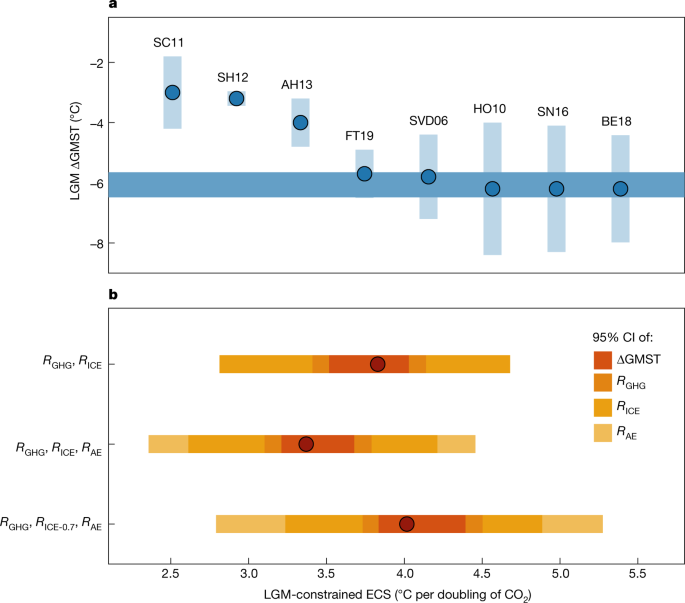
And the use of the PMG-Eemian temperature rise to calculate an ECS value is a novel and perhaps rather too adventurous as I don't know of such a use previously. 'Global warming in the pipeline' references Rohling et al (2017), a long paper which does not itself address ECS.
So that is not a good start for a work which presents such startling findings.
- Skeptical Science New Research for Week #50 2022
peterklein at 07:12 AM on 16 December, 2022I mostly became mostly aware of the climate and global warming issue about the time that Al Gore began beating the drum (even while he continued to fly globally in his private jet). Since then, I've read about climate change and climate modeling from many sources, including ones taking the position that ‘it is not a question if it is a big-time issue, but what to do about it now, ASAP?’.
In the past few weeks, it appeared to me there has been a of articles, issued reports, and federal government activity, including recently approved legislation, related to this topic. While it obviously has been one of the major global topics for the past 3+ decades, the amount of public domain ‘heightened activity’ seems (to me) to come in waves every 4-6 months. That said, I decided to write on the topic based on what I learned and observed over time from articles, research reports, and TV/newspaper interviews.
There clearly are folks, associations, formal and informal groups, and even governments on both sides of the topic (issue). I also have seen over the decades how the need for and the flow of money sometimes (many times?) taints the results of what appear to be ‘expert-driven and expert-executed’ quantitative research. For example, in medical research some of the top 5% of researchers have been found altering their data and conclusions because of the source of their research funding, peer ‘industry’ pressure and/or pressure from senior academic administrators.
Many climate and weather-related articles state that 95+% of researchers agree on major climate changes; however (at least to me) many appear to disagree on the short-medium-longer term implications and timeframes.
What I conclude (as of now)
1. This as a very complex subject about which few experts have been correct.
2. We are learning more and more every day about this subject, and most of what we learn suggests that what we thought we knew isn't really correct or at least as perfectly accurate as many believe.
3. The U.S. alone cannot solve whatever problem exists. If we want to do something constructive, build lots of nuclear power plants ASAP (more on that to follow)!
4. Any rapid reduction in the use of fossil fuels will devastate many economies, especially those like China, India, Africa and most of Asia. Interestingly, the U.S. can probably survive a 3 or 4% reduction in carbon footprint annually over the next 15 years better than almost any country in the world, but this requires the aforementioned construction of multiple nuclear electrical generating facilities. In the rest of the world, especially the developing world, their economies will crash, and famine would ensue; not a pretty picture.
5. I am NOT a reflexive “climate denier” but rather a real-time skeptic that humans will be rendered into bacon crisps sometime in the next 50, 100 or 500+ years!
6. One reason I'm not nearly as concerned as others is my belief in the concept of ‘progress’. Look at what we accomplished as a society over the last century, over the last 50, 10, 5 and 3 years (e.g., Moore’s Law is the observation that the number of transistors on integrated circuits doubles about every two years!). It is easy to conclude that we will develop better storage batteries and better, more efficient electrical grids that will reduce our carbon footprint. I'm not so sure about China, India and the developing world!
7. So, don't put me down as a climate denier even though I do not believe that the climate is rapidly deteriorating or will rapidly deteriorate as a result of CO2 upload. Part of my calm on this subject is because I have read a lot about the ‘coefficient of correlation of CO2 and global warming, and I really don't think it's that high. I won't be around to know if I was right in being relaxed on this subject, but then I have more important things to worry about (including whether the NY Yankees can beat Houston in the ACLS playoffs, assuming they meet!).
My Net/Net (As of Now!)
I am not a researcher or a scientist, and I recognize I know far less than all there is to know on this very complex topic, and I am not a ‘climate change denier’… but, after
also reading a lot of material over the years from ‘the other side’ on this topic, I conclude it is monumentally blown out of proportion relative to those claiming: ‘the sky is falling and fast’!
• Read or skim the book by Steven Koonin: Unsettled: What Climate Science Tells Us, What It Doesn't, and Why It Matters /April 27, 2021; https://www.amazon.com/Unsettled-Climate-Science-Doesnt-Matters/dp/1950665798
• Google ‘satellite measures of temperature’; also, very revealing… see one attachment as an example.
• Look at what is happening in the Netherlands and Sri Lanka! Adherence to UN and ESG mandates are starving countries; and it appears Canada is about to go over the edge!
• None of the climate models are accurate for a whole range of reasons; the most accurate oddly enough is the Russian model but that one is even wrong by orders of magnitude!
• My absolute favorite fact is that based on data from our own governmental observation satellites: the oceans have been rising over the last 15 years at the astonishing rate of 1/8th of an inch annually; and my elementary mathematics suggests that if this rate continues, the sea will rise by an inch sometime around 2030 and by a foot in the year 2118… so, no need to buy a lifeboat if you live in Miami, Manhattan, Boston, Los Angeles, or San Francisco!
• Attached is a recent article and a Research Report summary.
Probably the most damning is the Research Report comparison of the climate model predictions from 2000, pointing to 2020 versus the actual increase in temperature that has taken place in that timeframe (Pages 9-13). It's tough going and I suggest you just read the yellow areas on Page 9 (the Abstract and Introduction, very short) and the 2 Conclusions on Page 12. But the point is someone is going to the trouble to actually analyze this data on global warming coefficients!
My Observations and Thinking
In the 1970s Time Magazine ran a cover story about our entering a new Ice Age. Sometime in the early 1990s, I recall a climate scientist sounding the first warning about global warming and the potentially disastrous consequences. He specifically predicted high temperatures and massive floods in the early 2000’s. Of course, that did not occur; however, others picked up on his concern and began to drive it forward, with Al Gore being one of the primary voices of climate concern. He often cited the work in the 1990’s of a climate scientist at Penn State University who predicted a rapid increase in temperature, supposedly occurring in 2010 and, of course, this also did not occur.
Nonetheless many scientists from various disciplines also began to warn about global warming starting in the early 2000’s. It was this growing body of ‘scientific’ concern that stimulated Al Gore's concern and his subsequent movie. It would be useful for you to go back to that and review the apocalyptic pronouncements from that time; most of which predicted dire consequences, high temperatures, massive flooding, etc. which were to occur in 10 or 12 years, certainly by 2020. None of this even closely occurred to the extent they predicted.
That said, I was still generally aware of the calamities predicted by a large and diverse body of global researchers and scientists, even though their specific predictions did not take place in the time frame or to the extent that they predicted. As a result, I become a ‘very casual student’ of climate modeling.
Over the past 15 years climate modeling has become a popular practice in universities, think-tanks and governmental organizations around the globe. Similar to medical and other research (e.g., think-tanks, etc.) I recognized that some of the work may have been driven by folks looking for grants and money to keep them and their staff busy.
A climate model is basically a multi-variate model in which the dependent variable is global temperature. All of these models try to identify the independent variables which drive change in global temperature. These independent variables range from parts per million of carbon dioxide in the atmosphere to sunspot activity, the distance of the earth from the sun, ocean temperatures, cloud cover, etc. The challenge of a multi-variant model is first to identify all of the various independent variables affecting the climate and then to estimate the percent contribution to global warming made by a change in any of these independent variables. For example, what would be the coefficient of correlation for an increase in carbon dioxide parts per million to global warming?
You might find that an interesting cocktail party question to ask your friends “what is the coefficient of correlation between the increase in carbon dioxide parts per million and the effect on global warming?” I would be shocked if any of them even understood what you were saying and flabbergasted if they could give you an intelligent answer! There are dozens of these climate models. You might be surprised that none of them has been particularly accurate if we go back 12 years to 2010, for example, and look at the prediction that the models made for global warming in ten years, by 2020, and how accurate any given model would be.
An enterprising scientist did go back and collected the predictions from a score of climate models and found that a model by scientists from Moscow University was actually closer to being accurate than any of the other models. But the point is none were accurate! They all were wrong on the high side, dramatically over predicting the actual temperature in 2020. Part of the problem was that in several of those years, there was no increase in the global temperature at all. This caused great consternation among global warming believers and the scientific community!
A particularly interesting metric relates to the rise in the level of the ocean. Several different departments in the U.S. government actually measures this important number. You might be surprised to know, as stated earlier, that over the past 15 or so years the oceans have risen at the dramatic rate of 1/8th of an inch annually. This means that if the oceans continued to rise at that level, we would see a rise of an inch in about 8 years, sometime around 2030, and a rise of a foot sometime around the year 2118. I suspect Barack Obama had seen this data and that's why he was comfortable in buying an oceanfront estate on Martha's Vineyard when his presidency ended!
The ‘Milankovitch Theory’ (a Serbian astrophysicist Milutin Milankovitch, after whom the Milankovitch Climate Theory is named, proposed about how the seasonal and latitudinal variations of solar radiation that hit the earth in different and at different times have the greatest impact on earth's changing climate patterns) states that as the earth proceeds on its orbit, and as the axis shifts, the earth warms and cools depending on where it is relative to the sun over a 100,000-year, and 40,000-year cycle. Milankovitch cycles are involved in long-term changes to Earth's climate as the cycles operate over timescales of tens of thousands or hundreds of thousands of years.
So, consider this: we did not suddenly get a lot more CO2 in the atmosphere this year than we had in 2019 (or other years!), but maybe the planet has shifted slightly as the Milankovitch Theory states, and is now a little closer to the sun, which is why we have the massive drought. Nothing man has done would suddenly make the drought so severe, but a shift in the axis or orbit bringing the planet a bit closer to the sun would. It just seems logical to me. NASA publicly says that the theory is accurate, so it seems that is the real cause; but the press and politicians will claim it is all man caused! You can shut down all oil production and junk all the vehicles, and it will not matter per the Theory! Before the mid-1800’s there were no factories or cars, but the earth cooled and warmed, glaciers formed and melted, and droughts and massive floods happened. The public is up against the education industrial complex of immense corruption!
In the various and universally wrong ‘climate models’, one of the ‘independent’ variables is similar to the Milankovitch Theory. Unfortunately, it is not to the advantage of the climate cabal to admit this or more importantly give it the importance it probably deserves.
People who are concerned about the climate often cite an ‘increase in forest fires, hurricanes, heat waves, etc. as proof of global warming’. And many climate deniers point out that most forest fires are proven to be caused by careless humans tossing cigarettes into a pile of leaves or leaving their campfire unattended, and that there has been a dramatic decrease globally on deaths caused by various climate factors. I often read from climate alarmists (journalists, politicians, friends, etc.), what I believe are ‘knee-jerk’ responses since they are not supported by meaningful and relevant data/facts, see typical comments below:
• “The skeptical climate change deniers remind me of the doctors hired by the tobacco industry to refute the charges by the lung cancer physicians that tobacco smoke causes lung cancer. The planet is experiencing unprecedented extreme climate events: droughts, fires, floods etc. and the once in 500-year catastrophic climate event seems to be happening every other year. Slow motion disasters are very difficult to deal with politically. When a 200-mph hurricane hits the east coast and causes a trillion dollars in losses then will deal with it and then climate deniers will throw in the towel!”
These above comments may be right, but to date the forecasts on timing implications across all the models are wrong! It just ‘may be’ in 3, 10 or 50 years… or in 500-5000+ before the ‘sky is falling’ devastating events directly linked to climate occur. If some of the forecasts, models were even close to accuracy to date I would feel differently.
I do not deny there are climate related changes I just don’t see any evidence their impact is anywhere near the professional researchers’ forecasts/models on their impact as well as being ‘off the charts’ different than has happened in the past 100-1000+ years.
But a larger question is “suppose various anthropogenetic actions (e.g., chiefly environmental pollution and pollutants originating in human activity like anthropogenic emissions of sulfur dioxide) are causing global warming?”. What are they, who is doing it, and what do we do about it? The first thing one must do is recognize that this is a global problem and that therefore the actions of any one country has an effect on the overall climate depending upon its population and actions. Many in the United States focus intensely upon reducing carbon emissions in the U.S. when of course the U.S. is only 5% of the world population. We are however responsible for a disproportionate part of the global carbon footprint; we contribute about 12%. The good news is that the U.S. has dramatically reduced its share of the global carbon footprint over the past 20 years and doing so while dramatically increasing our GDP (up until the 1st Half of 2022).
Many factors have contributed to the relative reduction of the U.S. carbon footprint. Chief among these are much more efficient automobiles and the switch from coal-driven electric generation plants to those driven by natural gas, a much cleaner fossil fuel.
While the U.S. is reducing its carbon footprint more than any other country in the world, China has dramatically increased its carbon footprint and now contributes about 30% of the carbon expelled into the atmosphere. China is also building 100 coal-fired plants!
Additional facts, verified by multiple sources including SNOPES, the U.,S. government, engineering firms, etc.:
• No big signatories to the Paris Accord are now complying; the U.S. is out-performing all of them.
• EU is building 28 new coal plants; Germany gets 40% of its power from 84 coal plants; Turkey is building 93 new coal plants, India 446, South Korea 26, Japan 45, China has 2363 coal plants and is building 1174 new ones; the U.S. has 15 and is building no new ones and will close about 15 coal plants.
• Real cost example: Windmills need power plants run on gas for backup; building one windmill needs 1100 tons of concrete & rebar, 370 tons of steel, 1000 lbs of mined minerals (e.g., rare earths, iron and copper) + very long transmission lines (lots of copper & rubber covering for those) + many transmission towers… rare earths come from the Uighur areas of China (who use slave labor), cobalt comes from places using child labor and use lots of oil to run required rock crushers... all to build one windmill! One windmill also has a back-up, inefficient, partially running, gas-powered generating plant to keep the grid functioning! To make enough power to really matter, we need millions of acres of land & water, filled with windmills which consume habitats & generate light distortions and some noise, which can create health issues for humans and animals living near a windmill (this leaves out thousands of dead eagles and other birds).
• So, if we want to decrease the carbon footprint on the assumption that this is what is driving the rise in the sea levels (see POV that sea levels are not rising at: www.tiktok.com/t/ZTRChoNTg) and any increase in global temperature, we need to figure out how to convince China, India and the rest of the world from fouling the air with fossil fuels. In fact, if the U.S. wanted to dramatically reduce its own carbon footprint, we would immediately begin building 30 new nuclear electrical generating plants around the country! France produces about 85% of its electrical power from its nuclear-driven generators. Separately, but related, do your own homework on fossil fuels (e.g., oil) versus electric; especially on the big-time move to electric and hybrid vehicles. Engineering analyses show you need to drive an electric car about 22 years (a hybrid car about 15-18 years) to breakeven on the savings versus the cost involved in using fossil fuels needed to manufacture, distribute and maintain an electric car! Also, see page 14 on the availability inside the U.S. of oil to offset what the U.S. purchases from the middle east and elsewhere, without building the Keystone pipeline from Canada.
Two 4-5-minute videos* on the climate change/C02/new green deal issue, in my opinion, should be required viewing in every high school and college; minimally because it provides perspective and data on the ‘other’ side of the issue while the public gets bombarded almost daily by the ‘sky is falling now or soon’ side on climate change!
* https://www.prageru.com/video/is-there-really-a-climate-emergency and
https://www.prageru.com/video/climate-change-whats-so-alarming - SkS Analogy 9 - The greenhouse effect is a stack of blankets
Charlie_Brown at 07:27 AM on 20 November, 2022The blanket analogy is fine for those who are not familiar with radiant energy transfer. For those who do know a little about it (think night vision goggles), there are other analogies that could be used that are not based on thermal conduction heat transfer. 1) Smudge pots used in fruit orchards on cold, clear nights. Increasing CO2 would be akin to thickening the smoke layer. 2) The effect of cloud cover on cold, but otherwise clear, nights. Similarly, increasing CO2 would be akin to thin clouds vs. thicker clouds. 3) Mylar space blankets instead of fabric blankets. Increasing CO2 would be akin to filling in holes changing the material to reduce the emissivity. There are weaknesses in the analogies, but they can help to convey the message about global warming. Resolving the weaknesses can be educational. A technical description necessarily involves emissivity as a function of wavelength. The Advanced description in “Is The CO2 Effect Saturated” is excellent. The Basic description also is very good because it includes the critical effect of cold temperature at high altitude with a very nice graphic image. The 27 pages of 668 comments are tedious to work through because they contain a lot of misinformation mixed in with some very good information, and it takes quite a bit of critical thinking to sort through what is accurate and important. I will post my additional comment there, at risk of making repetitive points and being lost in the mix.
- Don’t get fooled: Electric vehicles really are better for the climate
Doug Bostrom at 10:21 AM on 18 November, 2022Per Eddie's remarks, we have an EV that does the vast bulk of our mileage. It can handle dimensional items up to 118" (~3m) with the hatch closed and can comfortably do a 190 mile (305km) roundtrip I routinely need to cover, in winter, mostly at 70mph (112kph) and without the driver freezing, w/~40 miles (64km) reserve range on returning to driveway. And it's a delight to drive, makes me feel a little bit too much like I'm 16 years of age again. So lots of bullet points covered there.
For other needs we have a 1997 Ford Ranger. It goes through about 40 gallons of gas per year, at about 25MPG (10km/l) for above trip case. I've not done the math, but I suspect the current embodied carbon in replacing it with the most plausible EPU candidate (Ford F150 Lightning) may be problematic; the choice would not necessarily be a win over the geriatric Ranger.
There are two other problems.
For us, $40k is not a dealbreaker. But as a practical matter and in the context where a lot of PUs are used (think solo operators running a yard care concern, etc.) that's a huge lift, essentially impossible.
But here's another dealbreaker: none of the current EPUs will hold a 6' (1.8m) dimensional item in the bed with the gate closed, the lowest bar of legitimate PU cargo specs*. All of them are centered as designer accessories first, tool second. This is like having to use a tack hammer where one needs a framing hammer, or (given the toy-like nature of such an implementation) a kid's plastic hammer instead of the real deal. And that's a shame, because for the legitimate use case of many PUs, EPUs otherwise offer distinct advantages, and have range more than ample for a typical day's work.
Eventually this will get sorted and we'll probably even see -proper- EPU models with what used to be the correct treatment: an 8' (2.4m) bed. But right now, conflicted objectives, still catering to urban cowboys having PUs with no scratches or dirt in the bed. A lot of cost and a lot of dead weight are concentrated on useless appurtenances, things that are completely irrelevant to the original use case of PUs, hardware as psychological reassurance, ending up with the worst possible analogy to designer handbag.
All that said, the more EVs, the better for the planet, with the stipulation that fewer vehicle miles of all kinds are also going to be necessary. We're habituated to automobiles, but in truth if we can't feed or house ourselves with jumping into a car, our "convenience" item is substantially a prosthetic device, a very large and inefficient wheel chair.
*"just leave the gate open" isn't responsive to how that actually unpacks in practice. As usual, "just" is way too economical.
- 2022 SkS Weekly Climate Change & Global Warming News Roundup #42
nigelj at 11:04 AM on 29 October, 2022scvblwxq1.
Your solar theory of the recent warming period since the 1970's is wrong. There is only a very poor correlation between surface warming and solar irradiance over the last 50 years. Solar irradiance increased early last century until about 1960, then levelled off or fell slightly for about 30 years, then fell sharply from about 30 years ago to presently, but warming steadily increasing over that same total 50 year time frame. So you have a poor level of correlation.
skepticalscience.com/solar-activity-sunspots-global-warming.htm
If global warming over the last 50 years was being caused by fluctuations in solar activity, you would expect a near perfect correlation between solar activity and warming over that 50 years, because the effects of solar irradiance on surface temperatures are reasonably instantaneous. Instead we see a very low level of correlation if any.
Fluctuations in solar irradiance over the last 50 years have also been quite small in terms of WM2, and not enough to account for the quantity of warming measured. So nothing in the way of causation.
With the climate issue the devil is in the detail like this. The fact that solar irradiance is generally a bit higher than 100 years ago doesn't explain the recent warming trend when you look into the details. Thats why we have climate scientists to look at the details.
The grand solar minimum during the little ice age is suspected of contributing to that cool period, but the little ice age only affected part of the northern hemisphere, temperatures dropped only about a degree c and over hundreds of years. So a similar thing now would clearly do very little if anything to offset the predicted 3 - 5 degrees of warming this century and 8 degrees of warming over 2 - 3 centuries. A grand solar minimum, If it actually happens, is clearly not going to save use.
- No, a cherry-picked analysis doesn’t demonstrate that we’re not in a climate crisis
Bob Loblaw at 23:38 PM on 9 October, 2022Eric. Thank you for the updated links.
In your second link, which allows searching for stations, the top title is a link to this web page that give an indication of the instrumentation that is used to collect this data. On that page we see (emphasis added):
The Cooperative Observer Program (COOP) Hourly Precipitation Data (HPD) consists of quality controlled precipitation amounts, which are measurements of hourly accumulation of precipitation, including rain and snow for approximately 2,000 observing stations around the country, and several U.S. territories in the Caribbean and Pacific from the National Weather Service (NWS) Fischer-Porter Network.
The Fischer-Porter is a weighing-type automated precipitation gauge. You can read a little bit about it here. Old data will have been on the paper coded tapes described in that link, but a lot of more recent data (last 30 years) will have been "modified for remote transmission" (interpretation: modified for electronic readouts).
Weighing gauges in general are poor at determining small amounts of precipitation over short intervals. The noise characteristics are not good. The gauge just tells you "this is how much weight I have now", and you need to process that into a change in weight over time to determine precipitation amounts. That can be done externally using the raw weights, but modern gauges may have internal electronics that will do the processing - for better or for worse. You have a classic "signal to noise" ratio problem with small changes.
Weighing gauges should be more reliable for heavier rainfall amounts, but they are still a limiting technology. There are many other brands of weighing gauges, too - Geonor, Pluvio and Pluvio2 are ones that I have worked with. They are generally better at cumulative rainfall estimates over longer periods of time. (One of their advantages is that they collect snow as well as rain.)
Short term rainfall intensity data are more commonly collected using tipping bucket technology, which can provide one-minute rainfall intensity data. Tipping buckets have problems at high rainfall rates, and are not so good for long-term cumulative amounts, so many automated stations (virtually all at Canadian automated stations) will have both types.
Intensity-Duration-Frequency curves are a standard part of precipitation analysis. They are needed for engineering design (drainage design) and are useful for many hydrological and ecological purposes. You can read more about the Canadian methodology and results by following the links on this page.
Any precipitation gauge will have issues with "capture efficiency" at high winds. Winds cause turbulence around the gauge, which general causes the gauge to under-collect. Much more important for snow, but still a factor with rain. Most automated weighing gauges will be installed with some sort of wind shield to help with this. Tipping buckets are usualy mounted close to the surface, where wind is less of a factor. Getting data that have been adjusted for wind capture efficiency is often very difficult.
Changes in instrumentation (which automated gauge, what wind shielding, how the data are processed) will be inportant in looking at trends.
And none of that helps much with the problems of localized storms passing between recording stations.
- A critical review of Steven Koonin’s ‘Unsettled’
michael sweet at 01:24 AM on 11 September, 2022dvaytw:
You list two items where you think Koonan was correct and climate scientists are incorrect:
1) "The economic impacts of climate change will be minimal to the end of this century". Tell that to Pakistan which has suffered $30 billion of damage from the worst flooding recorded. Record flooding is occuring around the world. There are billions of dollars damage in the USA alone from forrest fires, and those fires are happening around the entire globe. The damage suffered yearly now are severe, we don't need to wait untill the end of the centuary.
2) "Use of fossil fuels is the only real means by which developing countries can achieve parity". Perhaps you have not noticed but a shortage of fossil fuels are currenly causing economic pain across the world. Countries that have invested in renewable energy are doing great! Renewable energy is the cheapest energy all around the world now and is cheaper every year. Meanwhile fossil fuels get more expensive every year since all the cheap fossil fuel was mined years ago. Do you want to condem developing nations to expensive, polluting energy that they will have to replace as soon as it is built with cheaper renewable energy? I note that in developed countries little new fossil fuel generators are being built, virtually all new installations for new energy are renewable. In addition, distributed solar can be installed immediately virtually everywhere while central fossil generation requires expensive transmission systems that do not exist in developing countries.
Your arguments were false ten years ago and are absurd now. Read more and get up to date.
- A critical review of Steven Koonin’s ‘Unsettled’
Eclectic at 18:15 PM on 10 September, 2022Dvaytw @21 : my 2 cents on that August 2022 debate :-
Two questions.
A/ What is "minimal" impact? To use those cliches Global North and Global South . . . the North has considerable fat on its waistline. For instance, in the USA the wealth of the socioeconomic top 1% is approx 40 trillion USD ~ so the nation could comfortably manage to deal with a plus/minus 10% economic impact over the course of the next eighty-ish years.
# But for the South, things like the [presentday] disastrous Pakistan flooding/ other droughts floods heatwaves and increasing sea-level rise (over the coming 100 years & beyond) . . . are heading in the direction of cumulating catastrophe, which will fall most heavily on the South. Quite possibly the total global GNP's will continue to increase [to the applause of economists] ~ but that would provide little comfort against a vast scale of human misery. So shame on Koonin, if that is his line of "economic impact" argument.
B/ What do the people of the so-called developing countries actually need over the next 100 years? First answer is : food/ shelter/ education/ freedom from oppression, and so on. Parity, in the sense of a widescreen television etcetera would be nice, but it is a long way down the immediate wish list, I'm sure. Neither the food nor the TV will be produced by a large ramping-up of fossil fuel usage. Much reform (and careful international aid) is needed ~ but Koonin is absurd if he opines that Nigeria will necessarily benefit from more oil production or Congo Republic benefit from more cobalt production.
If Koonin thinks that more fossil fuel usage will not cause an overall digging-deeper of the present "hole" for global conditions, then he is being disingenuous (for the sake of quickie debate points).
# Third question . . . is the Koonin/Dessler debate worth viewing? Dvaytw, if the two points you mention are the best/strongest that Koonin can do, then their debate sure ain't worth viewing.
- What’s going on with the Greenland ice sheet?
MA Rodger at 23:09 PM on 3 September, 2022Wayne @4,
I was in two minds on continuing our interchange, but I decided I would continue when I came across coverage of the paper underlying this SkS OP which surprisingly appeared today on the pages of my local rag with the title "Zombie ice to raise global sea level". On-line I see the same story getting into newspapers elsewhere (eg The Washigton Post).
In terms of an SLR-CO2 correlations, I don't recall seeing Hansen provide it. I believe the closest he got was in Hansen et al (2013) 'Climate sensitivity, sea level and atmospheric carbon dioxide' (with its well-used Fig 1) which looked at temperature & SLR but only inferred CO2 levels with very cursory checks to actual CO2 reconstructions.

And for me, Hansen's 5m SLR by 2100 was always a bit of theorising that I struggled with. Even after it appeared properly written up in Hansen et al (2016), which at least answered the energy equations that were my initial objection to such a large SLR projections, for me it still remains more 'discussion document' than a full-blooded argued case. In my view, worrying as it is, the future SLR from Greenland & Antarctica depends on the Precipitation minus Ice-Loss balances and that puts us in the hands of climatologists for the precipitaion and glaciologists for the ice-loss. The application of paleoclimatology and whether Greenland melted out in the Eemian isn't so relevant for our future SLR.
Just to throw in my other SLR bug bear which also becomes relevant here, I've always reckoned SLR ain't gonna stop at 2100. So why do we go on so long about the 2100 SLR when by 2150, 2200, 2300 etc it's going to be seriously bigger? (A total of 2.3m SLR/ºC AGW according to IPCC AR5 fig13.14.)
The SLR-ΔCO2 relationship is of course a paleoclimate thing, so may not be immediately relevant outside the Eemian or now we have a Panama Isthmus connecting N&S America. That said, the SLR-ΔCO2 relationship is usually a step beyond what most graphics provide, but fig 6 of Rea et al (2021) 'Atmospheric CO2 over the Past 66 Million Years from Marine Archives' does provide us a ΔT-SLR-ΔCO2 graphic. Note that they do not attempt to be definitive with this CO2 reconstruction, saying "While each method has uncertainties, these are largely independent, so their broad convergence on similar CO2 histories is encouraging."
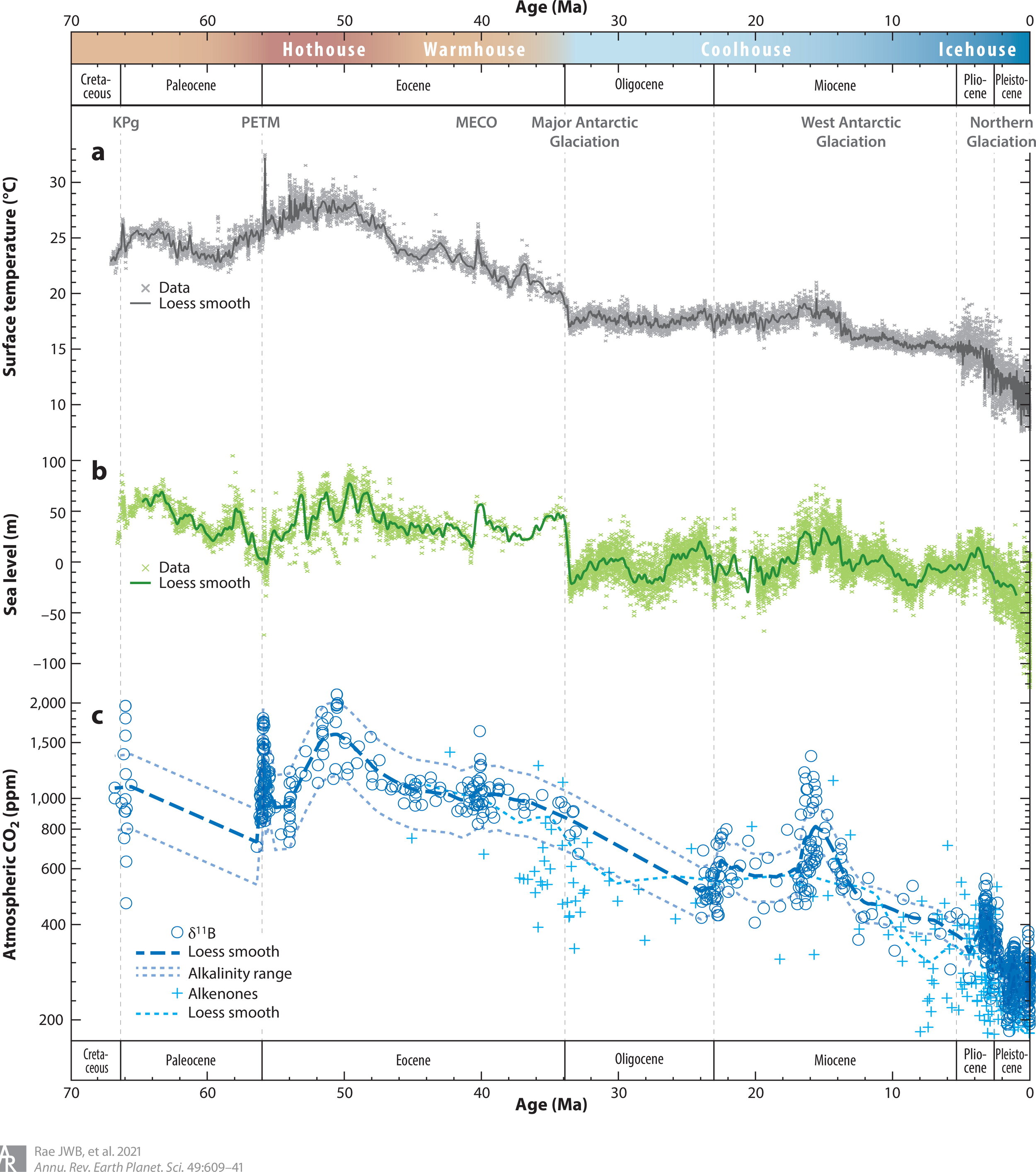
But I stress the idea that paleoclimate stuff should concede precedence to glaciology when it comes to the melting ice caps today and glaciology is where the paper underlying the SkS OP above comes from, Box et al (2022) 'Greenland ice sheet climate disequilibrium and committed sea-level rise'. I read that paper as saying that, as of now (2000-19), Greenland is not tipped over into melt-out mode (which I think was always seen as requiring a little more AGW to do that tipping, but nonetheless is good news to hear said) and that the Greenland melt which we are committed-to will happen in the next several decades, not several centuries, and will be mainly over by 2100.
So at least for Greenland under the AGW so-far, my bug bear (that we are in denial ignoring massive SLR awaiting us post-2100) is assuaged.
Mind, the SLR thus awaiting from Greenland isn't trivial. And there is still Antarctica. And not forgetting we still have the tiny task of halting future AGW.
- Science: What it is, how it works, and why it matters
Bob Loblaw at 10:22 AM on 2 September, 2022Thanks, Baerbel, for that information on arXiv. It indeed seems to be simply a place for people to upload papers with little regard to quality. They may or may not be papers that are submitted elsewhere. Calling something a "publication" because one puts a copy on arXiv is hubris at the extreme.
On their "About" page, arXiv states the following (emphasis mine):
Material is not peer-reviewed by arXiv - the contents of arXiv submissions are wholly the responsibility of the submitter and are presented “as is” without any warranty or guarantee. By hosting works and other materials on this site, arXiv, Cornell University, and their agents do not in any way convey implied approval of the assumptions, methods, results, or conclusions of the work.
The main arXiv page actually has a warning related to Covid-19 submissions (again, emphasis mine):
Important: e-prints posted on arXiv are not peer-reviewed by arXiv; they should not be relied upon without context to guide clinical practice or health-related behavior and should not be reported in news media as established information without consulting multiple experts in the field.
I agree with MA Rodger's initial evaluation of the merit of these "publications" - not worth the time to look at.
- How not to solve the climate change problem
Bob Loblaw at 04:50 AM on 25 August, 2022scvblwxq1:
Yes we know that solar output has been decreasing. But this purported "cooling" just isn't happening, Things are warming up, instead. Maybe there is some other factor involved?
If you think we're heading towards another glacial period (within the current ice age), you're worrying about something that would not happen until the distant future.
If you think that warming is going to be good for us, you need to think again.
Please take discussions of these arguments to the appropriate thread, as indicated by the links I have provided.
- There's no tropospheric hot spot
MA Rodger at 19:23 PM on 23 August, 2022Cedders @33,
And having had a read of that PDF...
Cedders @33,
Having examined the PDF (16 pages not 24), it is quite evident that it is a pile of utter nonsense, a "welcome to the lunatic asylum" message and not anything in any way scientifically-based.
The author is Piers Corbyn, a well-kown denialist and an elder brother of Jeremy Corbyn (a long-serving left-wing Labour MP who bizarrely gained the heady position of Leader of the Labour Party for 4½ years).
Piers Corbyn is described in Wikithing as "an English weather forecaster, businessman, anti-vaxxer and conspiracy theorist" and does feature here at SkS being (1) Cited within a spot of denialism of 2015 in the Daily Express tabloid/comic, (2) The main source of a pile of climate nonsense of 2013 from the then Mayor of London Alexander Boris von Pfiffle Johnson, a man now renowned throughout the known world for not being particularly truthful, (3) Listed here at SkS as a denialsit with zero peer-reviewed writings.
The 16 page thesis linked up-thread @33 is a 2019 thesis presented to the Reading University Debating Journal and sitting at the top of a list of 24 such theses posted 2018-19, top of the list because it is the most recent (the journal lasted less than a year), a list which addresses such important topics as 'Why Self-Service Checkouts are the Invention of the Devil' and 'The Great University of Reading Catering Con: Man Shall Not Live off Sandwiches Alone' and an anonymous piece 'Why I Support the Conservatives: The Most Successful Party in British History'.
The Piers Corbyn thesis begins by citing David Legates' dismissal of the 97% AGW consensus before dismissing that because "it is about facts; and no Global-Warming Inquisition is going to prevent me exposing their nonsensical theories."
Corbyn then kicks off by asserting anthropogenic CO2 comprises 4% of atmospheric CO2 (thus confusing FF carbon with naturally-cycled carbon) and that CO2 is not the main controller of global temperature (here presenting a graphic which confuses the US temperature with global temperature - shown below in this comment).
A further assertion is then presented, that CO2 is the result of warming oceans with six references/notes provided in support which seem to all point back to crazy denialist Murry Salby.
So, a la Salby, the present rise in CO2 is claimed to result from the good old Medieval Warm Period. A graphic is presented comparing a denialist 1,000y temperature record (based on the schematic FAR Fig 7c) with the much-confirmed scientifically-based Hockey Stick graph.
This brings us to the halfway page of Corbyn's denialist rant.
The thesis continues with pageful of misunderstanding of how the GH-effect works, ending with accusations that this misunderstood 'theory' breaks the 2nd Law of Thermodynamics (or it does if you misinterpret the 2nd Law of Thermodynamics).
Happily, this misunderstanding is considered to be not supported by "better scientists" who consider the lapse rate. And this indeed is a 'better' consideration. But here Corbyn perhaps confuses the tropical 'hot spot' (which is caused by increased tropical rainfall transporting more latent up into the troposphere) with some CO2 effect. (The 'hot spot' results from a warmer tropics and not per se any enhanced GH-effect.) And he fails to address the reasons why there is difficulty detecting this tropical 'hot spot'. Indeed he brands it as a 'coldspot' that he seems to say is caused by "more CO2 & other GHGs" which cause a diurnal fluctuation in the IR "heat-exit height" to become greater and, due to the 4th-power in the SB equation, this causes cooling. Whether such a phenomenon extends beyond the tropics (thus globally more-than negating the 'hot spot') is not properly explained but, due to the lapse rate this phenomenon can apparently also negate "the original expected surface warming."
A first graphic box is presented with three unsubstantiated bullet points explaining "Why CO2 theory does not work" alongside two similar "apart from"s.
A second graphic box also titled "Why CO2 theory does not work" states:-
In the real atmosphere there are day/night temperature fluctuations (eg in upper atmosphere). They are larger with more CO₂ because CO₂ (infra red absorber / emitter) gains & loses heat easier than N₂ & O₂ and so enables all the air to adjust quicker.
This is a fundamentally different explanation from the previous fluctuation in IR "heat-exit height" explanation described earlier, and it is still wrong.
(A packet of air with X concentrations of CO2 will both emit and absorb an IR photons of quantity P. With absorb=emit, it is thus in equilibrium. Add CO2 so the concentration is doubled to 2X, and the emitting photons will double to 2P and the absorbed photons will also double to 2P so absorb=emit and the same equilibrium is maintained. The main result is that twice the level if IR emission has half the pathlength before absorption so at any point the IR flux remains unchanged. And CO2 does not "gain & lose heat easier than N₂ & O₂" when it remains thermally coupled to the N₂ & O₂. )
The remainder of this second graphic box on PDF page 9 is a little too confused to rebut with any confidence. A diurnal range of "about 5 or 6 deg" is given which is apparently a temperature range yet whatever “deg” means (presumably Kelvin), the bulk of the troposphere has a far smaller diurnal range than even 5ºF. The mechanism for the enhanced cooling from the "heat-exit height" is presented as due to a fluctuating temperature losing more heat (by radiating IR) than a constant temperature (which is true). A rather dodgy-looking equation is followed by the note "Detail subject under research" but no reference is given and three-years-on there is no sign of such "research."
And a third graphic box is shown on the next page also titled "Why CO2 theory does not work," this third such graphic mainly presenting a pair of images from Australian denialist David M. W. Evans who has his own SkS page of climate misinformation.
The thesis then turns to the proposition that it is not CO2 but solar forces that "rules climate temperature" with the dotted line on the graphic below described as such a ruling influence. It apparently shows how the "9.3yr lunar-nodal crossing & the full 22yr solar magnetic cycle" allegedly shift the jet stream and "many circulation patterns." The graphic's 60-yr periodicity is less than convincing,being fitted to US rather than global temperature which, when extended beyond the 1895-2008 period shows itself to be simple curve-fitting (eg the Berkeley Earth US temperature record 1820-2020 does not show it, even to a blind man). The graphic was presented by Corbyn at the Heartland Institute's 2009 conflab in NY in which Corbyn [audio] insists other findings demonstrate “something is going on” but why it is this graphic being reused in this 2019 thesis is not clear – perhaps the forecast of world temperature dropping to 1970s levels by 2030 is too evident on other slides he used in that Heartland presentation.
To support his thesis Corbyn mentions an alleged cover-up by the likes of the BBC in reporting only global warming when the 'true' data shows cooling, the reported support for all this Piers Corbyn craziness from oil companies who shy away only because they want to use AGW to "make higher profits" and how these AGW-inspired mitigation agendas are already directly responsible for needlessly killing "millions" annually.
The thesis ends with a challenge:-
It is for this reason that I, Piers Corbyn, challenge whoever is willing in Reading University or other appropriate institutions to a debate on the failed Global warming scam vs evidence-based science.
So I interpret the thesis as a "welcome to the lunatic asylum" message from Piers Corbyn.
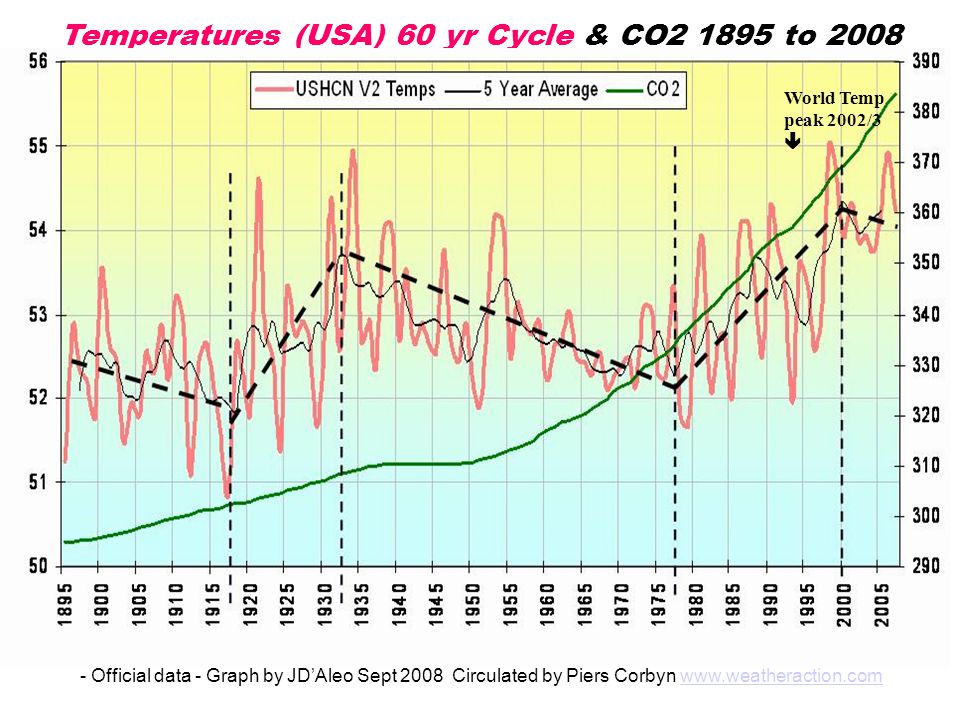
- Skeptical Science New Research for Week #32 2022
One Planet Only Forever at 02:36 AM on 13 August, 2022The study “Estimating the environmental impacts of 57,000 food products” adds to awareness and understanding helping consumers make less harmful food choices. But it contains a couple of questionable points:
- It is questionable to consider any water needed for food growing to be a problem. Water use is only a concern if it is artificial potentially unsustainable human caused water extraction or diversion such as irrigation, especially water extraction from aquifers. Food production that does not require artificial water use is not a problem. Almond growing without irrigation an be lower impact than growing food that requires very little water but is done by diverting natural water for the growing.
- It is questionable to claim that the impacts of processing the processed foods are insignificant compared to the impacts of ‘growing, harvesting, and delivering basic food commodities to retail stores for sale’ (the following quote makes that questionable claim).
"The estimated environmental impacts account for the processing and transportation of commodities to retail stores, but do not incorporate postproduction processing, packaging, and transportation of, for example, converting sugar into a sugar-sweetened beverage or flour and butter into a croissant. This is unlikely to have a large influence on the estimated environmental impact scores as the large majority of food-related environmental impacts result from agricultural production (14), but it is important to note that this may affect the estimated scores for, for example, air-freighted produce or highly processed foods composed of agricultural commodities with low environmental impacts (19, 20).”
The authors should have stated that the full lifecycle impacts of postprocessing need to be included in the evaluation of the total impact of a consumer’s purchase choice. A personal bag of crisps (UK term for what N. Americans call potato chips), with ~1.5 oz (40 g) of potato in it, contains about 1/4 of a medium-sized potato. It seems very unlikely that the impacts of construction and operation of the processing, packaging, transportation of end products, and all related wastes of every part of the process are insignificant compared to the impacts of growing, harvesting, and delivering 1/4 of a potato to a retail display. Frying the bits of potato is not an insignificant impact, though it has to be off-set by the impacts of the home cooking method. And the transportation of the massive volume of completed ‘bags full of very little material’ would appear to produce a significant impacts per 100 g of product. Also, related important impact of a bag of crisps is the end disposal of the packaging of that little bit of edible product.
- Skeptical Science New Research for Week #31 2022
One Planet Only Forever at 02:41 AM on 6 August, 2022Presentations like “Climate Endgame: Exploring catastrophic climate change scenarios” are what matter most in science.
And the matter is more than "Given our circumstances and the wellspring of advice at hand, we'd be stupid not to pay attention." Not pursuing increased awareness and improved understanding and applying it to limit harm done and help those needing assistance is unethical - immoral.
Ethical Scientists need to maintain a focus on identifying the harm done by developed human activity. The marketplace competition for perceptions of superiority based on popularity and profit has proven to be uninterested in identifying and limiting harm done.
In the 2022 book “What Climate Justice Means and Why We Should Care” Elizabeth Cripps provides a well-reasoned moral/ethical understanding built on the thoughtful work of many others.
The bottom line understanding undeniably includes:
- the impacts of everyone’s thoughts and resulting actions add up to become the future reality.
- it is catastrophic for anyone to choose to act in ways that are unnecessarily harmful
- it is sad and harmful when a person chooses to be less helpful than they could be
The question of ‘unnecessary harm’ leads to understanding that only people living less than a basic decent life can be excused for acting harmfully in pursuit of a basic decent life. But the actions taken to achieve a basic decent life need to be as harmless as possible. Others who are living ‘better than basic decent lives’ at least owe assistance that they can easily provide to help those living less than basic decent lives sustainably improve their lives. In many cases the least that is owed is ‘to seek out and vote for leaders who would lead effective collective efforts to limit harm done and sustainably improve conditions for those who live less than basic decent lives’.
That ethical understanding makes it plain that people living more than basic decent lives are only pursuing ‘wants’, not ‘needs’. Pursuit of improved circumstances above a basic decent life ‘need’ to be essentially harmless because everyone doing a little bit of unnecessary harm can easily add up to a massive amount of harm. And any claim that ‘it is harmful to limit the excess harmful actions of people who are enjoying more than basic decent lives’ is an absurd, but potentially very popular and profitable, argument.
That understanding leads many people to try to deny that there is any harm being done by the harmful actions they developed a liking for. They try to deny there is any harm done by the undeniable increased CO2 due primarily to fossil fuel use. Some try to promote beliefs that there is no relationship between increased CO2 and harmful results of increased global average surface temperature (many of the items on the SkS list of “arguments” are versions of that).
The ability of misleading marketing efforts to tempt people to deny or excuse the unnecessary harmfulness of their chosen ways of enjoying ‘better than basic decent lives’ is potentially the most catastrophic thing that humans have developed. The resulting unsustainable harmful over-developed consumption by supposedly 'more advanced' people is a catastrophe. That portion of humanity 'is the asteroid ruining the future of humanity'.
- Taking the Temperature: a dispatch from the UK
MA Rodger at 09:44 AM on 23 July, 2022Bob Loblaw @17,
The CET is described as "representative of a roughly triangular area of the United Kingdom enclosed by Lancashire, London and Bristol." That would give it a centre somewhere near Stratford-on-Avon and only the western edge of your red area sitting within that triangle which extends mostly to the south. One problem with using early daily data (or even monthly data) from CET is that it is not using standardised thermometer hosuings. The Met Office do give ranked regional, national and UK-wide monthly averaged data for max min & mean temperatures but only go back to the start of use of the Stevenson Screen in the 1860s. These at least would be "sticking with national averages" which as described by Fixitsan @2 indeed would be "a better guide to what is happening in terms of trends over a larger sample area," although advice apparently then ignored.
These UK-wide top-rankers come in:-
Max Temp - Jan 1916, Feb 2019, Mar 2012, Apr 2011, May 2018, Jun 1940, Jul 2006, Aug 1995, Sep 1895, Oct 1921, Nov 2011, Dec 2015, Winter 1989, Spring 1893, Summer 1976, Autumn 2006, Annual 2014.
Mean Temp - Jan 1916, Feb 1998, Mar 1938, Apr 2011, May 2008, Jun 1940, Jul 2006, Aug 1995, Sep 2006, Oct 2001, Nov 1994, Dec 2015, Winter 1989, Spring 2017, Summer 2018, Autumn 2006, Annual 2014.
But single months and even single years ar subject to a lot of noise so listing out these top-ranked months etc and reflecting on the length of time thay have maintained that top-rank is doing little more than examining randomness. Even for annual means, this UK-wide data provides a randomness spread of +/- 0.9ºC (2 sd) and the rankings will be latching on to even rarer events than 1-in-20.
So the argument set out up-thread by Fixitsan is baseless.
Added to that, the statement @2 that "most of the CO2 was produced before 1989" is wrong. In terms of FF emissions, more has now been emitted since 1989 and in terms of the rise in atmospheric CO2 levels, 1989 sit at about halfway from pre-industrial, but not forgetting the poor old climate system does need a decade or more to get its reaction to climate forcing working significantly.
- Clouds provide negative feedback
Bob Loblaw at 06:00 AM on 13 July, 2022Likeitwarm:
The paper by Mulmenstadt et al that you mention was covered in this blog post at Skeptical Science, around the time it first appeared. (SkS reposted the Carbon Brief article.)
In that post, a key summary is:
However, the lead author of the study tells Carbon Brief that fixing the “problem” in rainfall simulations “reduces the amount of warming predicted by the model, by about the same amount as the warming increase between CMIP5 and CMIP6”.
So, the results are not as earth-shattering as you seem to want to imply. Uncertainties in cloud feedback are a well-known part of climate modelling and understanding, and this paper represents one more small step in helping understand the consequences.
As for your description of the water cycle:
- A wet surface evaporates more than a dry one. This transfers energy as latent heat into the atmosphere, and reduces the energy transfer as sensible heat (thermal energy). Thus, it priimarily changes the balance in how the energy reaches the atmosphere, not the total.
- What evaporates evenutally condenses and falls out as precipitation, but it rarely condenses or precipitates over the location it evaporates. Most extra water vapour is transported to other regions, where it falls as precipitation.
- Oceans receive far less water via precipitation than they lose as evaporation.
- Land areas (mostly) are the opposite - much more precipitation than evaporation.
- Increased evapoation does not necessarily lead to increased cloud cover at the evaporation location. Any changes in cloud type, amount, etc., are strongly depndent on when and where and how that cloud eventually forms.
- This complexiity is why cloud feedbacks are still an area of active study.
- The current understanding remains that clouds provide neither strong negative or positive feedback.
As for your discussion of "runaway warming" - nobody is predicting such a result due to CO2, so you are arguing a strawman.
And as to "self regulation of the temperature of the atmosphere" - the simple fact that climate has changed in many ways, for many reasons, over centuries and millenia is strong evidence that this is not true. Perhaps try reading the "Climate's changed before" post that reponds to our number 1 myth listed in our "Most Used Climate Myths" in the top left sidebar of all our pages.
I have worked through some darn cold sunny days in winter - much colder than overcast days in summer - to illustrate how incomplete your cloudy/sunny day closing statement is.
- How to inoculate yourself against misinformation
MA Rodger at 19:56 PM on 7 July, 2022Petra Liverani @68,
I do not see any connection which would require you to begin the comment "Just to add,..." You appear to be suggesting that certain argument proves nothing yet will still be savaged by those responding.
Simply stating "The climate's always changed," or "CO2 is plant food" does not of itself contradict the accepted fundings of climatology. I think you would need to set out the use of such statements (& the responses) to be able to judge whether "the kind of responses" were inappropriate.
To provide such context for your "The climate's always changed" statement, the first listed SkS myth cites Dickie Lindzen who is an actual clomatologist but who has never accepted the science of AGW and has done a lot of work attempting to overturn that science. Yet despite his best efforts, he has established nothing and in his attempts to establish something has adopted many egregious arguments like "The climate's always changed."
Indeed, the climate has always changed but that does not prevent us understanding why it changes and thus seeing that it has not changed before like today's AGW. Even the PETM which was also driven by rising CO2 levels took tens of thousands of years when we are driving the climate in mere centuries.
The "CO2 is plant food" argument is listed as the SkS's 43rd myth which describes why elevated CO2 is not entirely a good thing for plants. And do note that the plants are not very hungry for CO2 as they are only eating up a quarter of the CO2 we serve up.
- What role for small modular nuclear reactors in combating climate change?
michael sweet at 09:48 AM on 20 June, 2022Macquigg,
You have acted as an advocate of nuclear here so I have responded in kind. The Renewables vs Nuclear Debate forum on Facebook seems to me like a lot of nuclear advocates slamming the "greenies". You frequently state there that you support nuclear power. I see little informed discussion. The nuclear proponents who come here to post usually have little knowledge about reactors. One poster, Ritchieb1234, was very informed and we had a good discussion.
As I have previously told you, Abbott 2012 describes the issue with uranium. He shows that with low uranium concentrations in the ore it takes more energy to mine the uranium than you get from using it in a reactor. Your WNA article assumes that future engineers will develop mining processes that are orders of magnitude more efficient than any currently known processes. I doubt that is possible. Nuclear supporters would not work on breeder reactors or thorium if they thought there was enough uranium. We could get unlimited supplies of hydrogen simply by syphoning off the surface of the sun, but that is impossible. I note that you said "the cost of uranium is unlimited", not the supply.
Thor Cons statement that they do not process the salt is obviously false since they remove the noble gasses from it. That is a chemical process by definition. You do not understand the difference between a chemical "process" and "reprocessing" nuclear fuel. Thor Con is misleading. That is not my problem. Chemical processing the fuel is not a proliferation risk. Reprocessing the fuel is a proliferation risk. It appears to me that you are decieved by misleading information from Thor Con.
137Cs. As stated clearly in Lyman 2021, which I linked for you at least twice about this issue, giving you the page number (91) to read here, Thor Con would remove 137Xe, a noble gas, from the salt as part of their scheme to remove the noble gasses. The Xenon then decays into 137Cs in whatever storage system they have for the noble gasses. It would coat the inside of all the piping and the pumps. Thor Con has to answer the question of how they plan to deal with radioactive cesium-137 formed in the noble gas stream. Read the reference I have given for you to get the question that you are seeking. Lyman stated (in advance) that Thor Cons answer is misleading.
Your statement about Cesium being in column one is uninformed. If you had read the citation I gave you, you would know that the cesium is formed in the gas stream from radioactive decay, it does not evaporate from the salt. Since I am a professional chemist and I have read much, much more about reactors than you, I understand the chemistry of reactors better than you. If you framed your statments as questions I would be more helpful and less irritated.
Keep in mind that I have been having this debate with nuclear supporters for 15 years. From your posts I understand that you are a newbie. I researched most of your points years ago. Nuclear supporters online repeat the same old tired arguments that were already false 15 years ago. Back then renewables were more expensive than nuclear and there was a debate. Now renewables are much cheaper than nuclear. Informed debate ended several years ago, you have just not learned enough about nuclear and renewable energy yet to realize you are barking up the wrong tree. Read Abbott 2012 about 15 reasons why nuclear cannot work. His arguments have not been answered by nuclear supporters.
This discussion has become very repetitive. Since you do not read the references that I give, you do not understand the questions and answers. I note that I have read your citations, read your Facebook site and read your Citizendium posts. I have read Abbott, Krall and Lyman entirely and the response to Lyman on Facebook (the response is completely worthless). Why don't you come back when you have done your homework and can address the issues that I raise.
I have authored three posts on Skeptical Science about producing all the world's energy supply using renewable energy. Read them here here and here. All three say nuclear power is not necessary or economic. That is what scientists think about future energy supplies. You could use them as a basis of your renewable post. Dana Nucitelli also authored a post about renewable energy powering the world.
Nuclear power is not economic and the matrerials do not exist.
- Skeptical Science tackles 'discourses of climate delay' and 'solutions denial'
One Planet Only Forever at 11:22 AM on 19 June, 2022Another priority for “discourse of climate delay” would be the diversity of unsustainable harmful actions that were quick fixes claimed to be helpful but really weren’t helpful. What is needed is the development of sustainable improvements. Anything other than that is harmful or a harmful distraction.
The BBC Ideas video “The 12-year-old who tried to save the world” is related. It expressed concern (in 1992) that adult leaders may not responsibly act to limit harm done and would try to claim that they were acting helpfully.
Examples of this problem since then are:
- Claims that changing the date of start and stop of Daylight-saving (a silly term to begin with) time change would significantly reduce energy demand. US President Bush did that. And he also declared that Americans did not have to change how they lived.
- Claims that compact fluorescent bulbs were a part of the solution. They were a harmful wasteful product. It would have been better to get people to replace use lower wattage incandescent bulbs and turn off bulbs when not needing the light while the development of LED light fixtures was prioritizes and expedited. A policy step for that would have been imposing a significant tax on higher wattage bulbs.
- Claims that wind turbines with blades that could not be recycled or that solar panels made in ways that are hard to recycle were part of the solution. It would have been better to get people who used more electricity than they needed to while the development of recyclable renewable systems was prioritized. A policy step for that would have been imposing a graduated pricing model for home electrical use, with the price rising for steps of higher use ($0.10/kWh for the first amount, $0.15/kWh for the next increment .....)
- Claims that nuclear fission is part of the solution. Nuclear fission consumes resources without recycling ... it is unsustainable. And nuclear fission produces accumulating harmful waste ... it is doubly unsustainable just like fossil fuel use. But, unlike solar and wind which can be part of a distributed integrated sharing power generation system, nuclear will be centralized power generation that investors and executives are more likely to be able to benefit from, as long as they are ‘privatized’ rather than being ‘Public owned utilities’.
The status quo of developing a series of harmful unsustainable things and claiming they are improvements that are ‘part of the solution’ is a delay tactic. The actions often do little to encourage the required reduction of energy consumption.
Reducing energy demand would be far more beneficial to future generations than higher demand for less harmful energy. Totally recyclable renewable energy generation and use may never be developed. It hasn't yet been developed. The most advanced systems still are not fully recyclable and accumulate harmful waste. It is possible that fully recyclable renewable energy systems will never be developed. Seriously restricting energy use is required until fully recyclable renewable energy generation is developed. Those restrictions would seriously motivate the development of the required recyclable renewable energy systems.
There is ‘only this one planet that is habitable for humans almost forever as long as humans don't ruin it with their technological creativity and related harmful misunderstandings about how great the new things are’. Humans have to learn to adapt to live with that reality.
- Planetary Dieticians
One Planet Only Forever at 12:42 PM on 15 June, 2022This is a good analogy. However, building on my Planetary Diets comment, the context for the dietician’s work should be expanded to be working with multiple people. And one of the objectives would be to help reduce the collective harm of avoidable future demand for health care services or other needed future adaptations or attempts to repair the avoidable harm.
In that context, the resistance of learning (lack of change of behaviour) of some patients would cause the dietician to pursue understanding of the likely developed motivations of the patients which would be influenced by the environment they developed in. Consumption-based competition driven by popularity and profit should be expected to develop powerful resistance to governing that would limit the pursuit of enjoyment and status. And it is worse if there is misleading marketing that scientifically tempts people to harmfully over-develop primal instinct-based harmful misunderstandings. That scientifically driven system of misleading marketing can promote desires for sweet, fat and salt in the pursuit of profitable popular harmful over-consumption. Examples include:
- a culture development like the ‘Reward of Birthday Cake’ (the donut being like that reward)
- enjoyment of salty snacks at a bar (causing you to desire more beverages)
- a cultural development like being impressed by a large piece of unhealthy fatty meat (fatty fish in moderation can be a helpful part of a healthy diet)
The dietician would become aware of the harmful desires for more consumption of whatever is perceived to be enjoyable or perceived to indicate higher status. Those desires could motivate people to resist changes that reduce their perceptions of enjoyment or status. And some people can become so harmfully tempted that they irrationally declare that they will only behave better if new things are developed that they perceive to be equally or more enjoyable, and cheaper and easier, than their harmful developed preference.
If the individual is determined not to learn to limit harm done to themselves then there is little that the dietician can do to help them. Updated monitoring and explanations of the results will continue to be denied and dismissed until the patient personally suffers horrible consequences that shake them out of their developed pattern of desired harmful misunderstanding.
That leads to understanding the dilemma of the reality of higher costs for renewable energy compared to the misleadingly low costs of fossil fuel energy. Fossil fuel costs are misleading because the costs do not fully neutralize the harmful impacts. The specific case of electricity is highlighted in “Cost increase in the electricity supply to achieve carbon neutrality in China” presented as the lead item on the Skeptical Science New Research for Week #23 2022. I will make a more extensive comment about that there.
- Planetary Diets
One Planet Only Forever at 04:15 AM on 14 June, 2022This is a good analogy for part of the fuller more complex issue of climate science. But it is missing some important aspects of the increased awareness and understanding of what is happening and the required changes and adaptations.
It has taken some time to reduce this to the following comment on this post. I intend to provide related ‘complementary or convergent’ comments on the Planetary Dieticians post and the “Cost increase in the electricity supply to achieve carbon neutrality in China.” item that is the lead in to the Skeptical Science New Research for Week #23 2022
A important awareness/understanding to be included is that the harmful climate impact problem is the result of the collective of personal actions. Everybody’s actions add up to be the future, and invariably impact Others. Climate science understanding is that the consequences of the climate change impact actions, the benefits and harms, are unfairly experienced. The ones who benefit most from the harm done generally will not suffer a commensurate amount (most) of the harm. What is happening is a reality that is a nasty version of the Corsican Brothers fictional tale. The Brother enjoying something feels little harm. Significant harm and little of the enjoyment is experienced by the Other Brother. It is also important to understand that those suffering climate impact harm include all the people of the future who have no influence today (which is a major part of the reason that the problem has not been seriously addressed in societies governed by current perceptions of popularity and status). That is a very important difference from presenting the case that an individual, or group, is only harming themselves by their actions.
A less significant point to include is that the type of donut consumed can also be understood to make a difference. But changing to lower calorie types only reduces the rate of the problem. Ending the donut eating is what is required along with actions by the donut eater to undo the damage done by the donut consumption.
That understanding connects to the unhelpful and harmful, but valid, claims that people will only change what they do after what they have developed a liking for is able to be replaced by something they see as being as enjoyable, cheaper and easier. Many people have learned things like ‘not to drive dangerously’ or ‘not to hit Other people’ or ‘not to litter’ without the development of an equally enjoyable alternative that was cheaper or easier (and some people did not even require the threat of penalties to learn to be less harmful and more helpful).
A serious problem is the people who resist learning from the advice of experts -> related comment in Planetary Dieticians.
- Why and How to Electrify Everything
John S at 10:21 AM on 7 May, 2022Don't electify where equivalent or better service can be provided in a way that uses less valuable electricity system capacity; e.g. building heating and cooling can can be accomplished directly via district energy systems from natural resources like the sun or deep water or waste heat or surplus power with just a little help from heat pumps and seasonal thermal enegy storage. BTW air source heat pumps are not efficient at the very low temperature which is exactly where a lot of the heating is needed in the northern US and Canada and the heating peak demand could be about three times the current electricity system winter available capacity (my estimate for Ontario).
- The Climate Shell Game
jan21405 at 01:53 AM on 29 March, 2022@michael sweet #61
I will continue to use the facts only:
1. in my post #40 you can read:
Vehicles operation is not global but regional. It follows that we cannot use global emissions from cars as a tool to calculate emission reductions with the introduction of EVs, but strictly regional, per country. It will be mathematically correct (the global data approach), but you will not be able to put it into practice.
What was the purpose of my discussion regarding the largest producer of GHG emissions with the largest EVs market in this world (+50%) with +70% of Power production from fossil fuels (and it grows). I don't like Global Math Averages. In principle, the arithmetic mean is the least accurate indicator of reality. I presented you with the NREL study, which may not fit into your concept, but it cannot suit everyone. However, if the comprehensive study by The National Renewable Energy Laboratory is not enough for you, it is difficult to look for anything more accurate.
So we can check your mentioned study about the EVs better emissions for Global strategy:
2. Your study (Vliet et all, 2011) mentioned in #61 contains a different statement (page 7):
"We find that EVs charged using electricity from coal do not have significantly different GHG emissions from driving in regular cars."
and as you wrote here:
"We find that EVs charged using [100%] electricity from coal do not have significantly different GHG emissions from driving in regular cars."
the value [100%] was defined on the basis of your own interpretation?
link to the study to confirmation of the mentioned wording (page 7)
following the study you need to take into account:
- study is from 2010 (published)
- it is about the Netherland's specific conditions only, you can't take it as the holy grail for each country
- also specific conditions for Power production must be taken into account - the NGCC technology is more predominant in this country = lower emission factor than coal-fired plants (you can see the differences in Table 4.: Electricity generation capacity in the Netherlands)
- you will find there also an increase in the pulverised coal-fired plants for the 2015-2030 period (Table 4)
- and finally - Summary and conclusions (Page 11) ... read carefully:
WTW GHG emissions from electric driving depend most on the fuel type (coal or natural gas) used in the generation of electricity
for charging, and range between 0 g km−1 (using renewables) and 155gkm−1 (using electricity from an old coal-based plant). Based
on the generation capacity projected for the Netherlands in 2015, additional electricity for EV charging would largely be generated
using natural gas, emitting 35–77 g CO2eq km−1. In the Dutch context, emissions vary little with charging patterns, and are unlikely
to change much before 2030.
And here is a summary from the IEA report 2020:
In 2018, TPES came from natural gas (42%), oil (37%), coal (11%), biofuels and waste (5%), and small shares from nuclear, wind, solar, hydropower and geothermal. The Netherlands is still one of the largest gas producers in Europe; however, domestic gas supply and gas exports are rapidly declining as production from Groningen is being phased out. Domestic oil supply is small, especially in comparison to the large oil demand. All coal is imported and is used primarily for electricity generation and steel production. The electricity supply is also heavily reliant on fossil fuels. In 2018, electricity generation came primarily from gas (52%) and coal (27%).
it means that there was no such significant coal damping as the study mentioned for 2015 = 55%; it's actually less. And even worse for 2021:
The current energy mix in the Netherlands is natural gas (38%), oil (35%), coal (11%), biofuels and waste (5%), and 11% from nuclear, wind, solar, hydropower and geothermal.
Following reality, the mentioned study is out of a doable plan. I like data and I would like to listen more than personal attacks, rather more deep-dive information from my base education in Energy engineering. I'm the proud owner of a small PVe and Solar water heating, so you really don't have to swear at my fossil fuels lobby. I understand energy - from its production, distribution to consumption.
That's why I'm researching anything related to emissions. Not everyone will like this option - but I'm not a friend of extreme solutions or chaos.
Finally, I'm sending a link to one peer-reviewed study from The Nature - A plant-by-plant strategy for high-ambition coal power phaseout in China. link
If you will find at least 3 fatal mistakes that should not appear in The Nature or any peer-reviewed studies, you have passed the Energy engineering exam. Otherwise, we can no longer talk about Energy engineering from the position where you want to be a professor.
I judge people by what they write about and how they write. I don't care what their education is. And I don't care if the document was peer-reviewed because:
- Energy engineering is my native domain
- We have scientists like Ivar Giaever and similar creators here
- you can choose peer-review as a service from your defined contacts, even in reputable journals.
Each of my documents contains data only from scientific sources and/or national sources from which I drew (defined). I don't like bending data. I do not have time for this.
- The Climate Shell Game
Philippe Chantreau at 02:50 AM on 28 March, 2022I don't understand what Jan is talking about at 54. The problem of how the electricity is generated is such a basic consideration that it has been studied enough to draw conclusions. Multiple studies have shown that the life cycle carbon footprint of EVs is lower than that of ICEs even if they are charged with electricity produced with coal. The battery production process is carbon intensive but that is compensated by the superior efficiency over the lifetime of the car. In pure mpg equivalent over only road use, it more than compensates, even with FF produced electricity.
It takes only 2 years on average for the balance to tilt in favor of EVs. Location and driving habits make it vary. However, when comparing EVs to ICE, it is always possible to reach a mileage where the whole vehicle life carbon emissions become lower for the EV and it is always a realistic number of miles. It just takes more miles when using electricity that has a lot of fossil fuel in the production mix and batteries made in Asia.
CarbonBrief has looked at this in details:
https://www.carbonbrief.org/factcheck-how-electric-vehicles-help-to-tackle-climate-change
Unfortunately, a vehicle is a big purchase. I already have a hybrid that I bought only a few years ago so no EV for me in the near future. Would help also if they became a little less expensive...
- The Climate Shell Game
michael sweet at 06:30 AM on 25 March, 2022Jan,
I think you have the incorrect assumptions behind many of your calculations. This results in your conclusions being in error. In general, whenever I see someone relying on their own calculations instead of published calculations I figure their conclusions are incorrect. I see very little peer reviewed data in your posts.
For example, many published studies describe how to get 100% renewable energy. See this description of Connelly et al 2021 for a starter. I note that you have no problem with "baseload" power sources that require emergency back up power every day to provide peak power but you are concerned that renewable energy might have problems providing peak power. Why is it OK for "baseload" sources to require back up but not renewables? Most of the pumped hydro storage in the USA was built to store power from nuclear power plants at night to use for peak power during the day. Plans like Connelly et al describe how to provide 100% renewable energy. You are wrong to suggest it cannnot be done. Providing 80% renewable energy using existing fossil gas peaker plants as storage is easy and cheaper than fossil power.
Your anaylsis of EV cars seems to me to be completely off. Even if the grid is 100% coal there are benefits from EV. You do not consider that baseload coal power plants are about 40-45% efficient at generating electricity form the heat of the coal. Gas combined cycle plants are over 60% efficient. EV cars are about 90% efficient in using electricity. By contrast, internal combustion cars are only about 20% efficient at using the energy in the oil they burn. When you consider the comparable emissions of carbon dioxide, an EV with electricity from a 100% coal electrical system releases comparable carbon to internal combustion engines. Since the electricity for Evan is over 50% from wind, his EV releases much less CO2 than a comparable ICE car.
According to Our World in Data China gets about 30% of its electricity from renewable sources. It seems to me that when you consider the efficiency of EV cars compared to internal combustion cars the EV's release less CO2 than ICE. Since almost all coal systems use gas for peak power the release of CO2 is even less from EV cars than ICE cars. My brother has solar panels on his roof that recharge his EV car. How much CO2 does his car release?
This peer reviewed paper says that the best thing to do for the next ten years is to build out renewable energy sources as fast as possible and switch to EV's at the same time. If we wait on EV's until we have more renewable energy we will not be able to switch fast enough from ICE's. Your argument that we should wait for more renewable energy to be built is completely incorrect. Please cite a peer reviewed paper that suppports your wild claims. I think your calculations are incorrect as described above.
I note that the people engaging in this conversation are citing their own calculations and not peer reviewed documents. I see many claims that I think have been demonstrated as false in the peer reviewed papers I have read. It seems to me that many of the claims made here are simly fossil propaganda against renewable energy. I want to remind posters that this is supposed to be a science based site. You must support your claims with peer reviewed data.
The poor are building out renewable energy in many locations. Why build a coal generator when renewable energy is much cheaper? Why build out central facilities wheen distributed generation (like PV) is much cheaper? You guys need to read the literature and give up on the fossil fuel propaganda.
- The Climate Shell Game
prove we are smart at 08:58 AM on 24 March, 2022Australia plays the climate shell game very well.. "This is little more than a wealth transfer. People can think of this as welfare payments for the undeserving". www.msn.com/en-au/news/australia/insider-blows-whistle-on-australias-greenhouse-gas-reduction-schemes/ar-AAVpXoK?ocid=ACERDHP17&li=AAgfYrC
I stopped feeling guilty about buying my only 4k oled smart tv 3 wks ago after reading this...www.miragenews.com/ranked-how-many-properties-do-australian-545566/
Thanks Evan for simplifying to some of the bottom lines. Many years ago I stumbled onto Skeptical Science which began my AGW learning, now of course commonly called climate change. Yes, the overshoot problem with 80 million people extra every year on a finite earth isn't helping.
I try to use many different media sources to reduce bias but with a lot of my friends many are not so caring. Thanks Jan@18 for hitting the nail for me. When I pulled my head out of the ground to educate myself, it was a fruitful exercise but lately it seems the doomer in me is growing stronger. Is that why so many wilfully delude themselves-I think in this media world people need to see the high status/leaders showing integrity and sacrifice( because it's needed now)- just don't hold your breath..
- The Climate Shell Game
Eric (skeptic) at 05:18 AM on 23 March, 2022Evan, the cause of the acceleration is important. It's not the usual suspects using more energy, it's billions of people who use very little energy using more energy. Two million children die each year from indoor air pollution. http://www.sciencedirect.com/science/article/pii/S003592030800271X. That's because 2.5 billion people use indoor fires for cooking and heating. Governments of all types will do what China did, first giving people stoves and then coal-fired electricity.
What do we do about that since that is the cause of the acceleration? We look at China's R&D as I pointed out in my opening comment, with the largest investment in solar hydrocarbon fuel research in the world. The benefits will be carbon neutral heat and cooking on demand. Fossil electricity is available today so they are doing that today. They will ramp up renewables as your fig 4 shows. The past lag is due to high price and the current lag is due to lack of emergy storage.
I hope I have explained why the curves in fig 4 have those shapes. Perhaps you can counter that argument and/or explain why lower prices and energy storage won't change the outcome by particular dates.
More than 100 comments found. Only the most recent 100 have been displayed.
More than 100 comments found. Only the most recent 100 have been displayed.






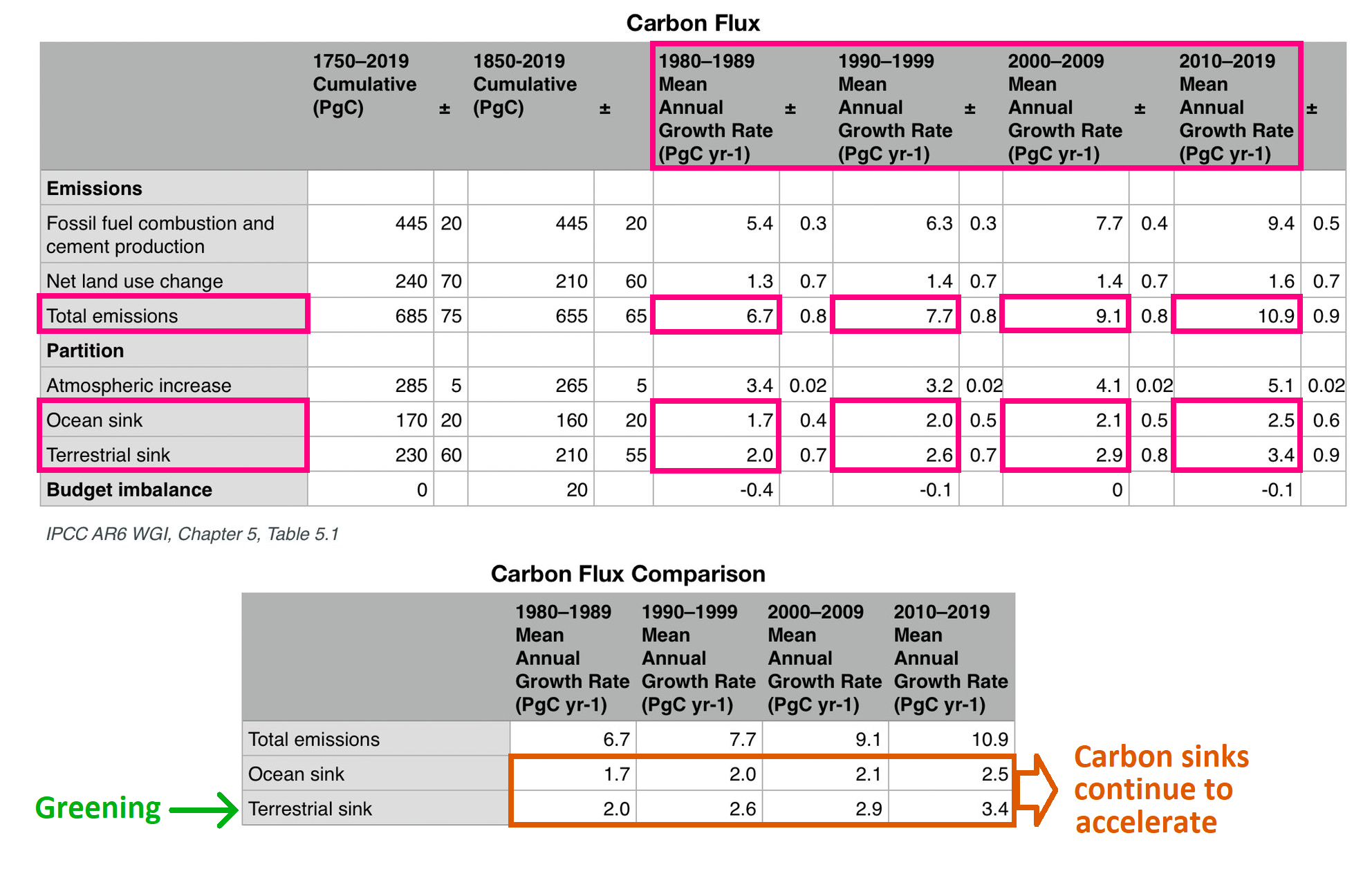
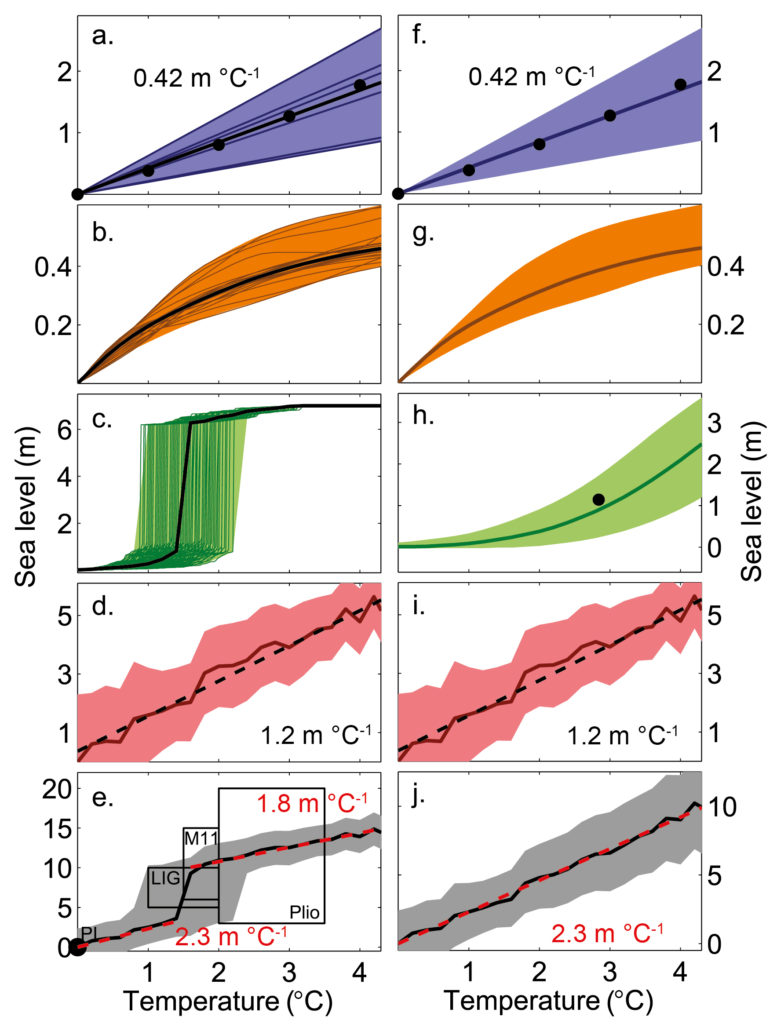
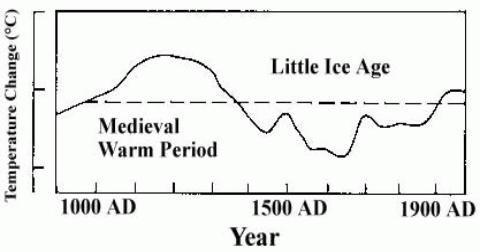
THE ESCALATOR

(free to republish)