



 Arguments
Software
Resources
Comments
The Consensus Project
Translations
About
Support
Arguments
Software
Resources
Comments
The Consensus Project
Translations
About
Support







Latest Posts
- How many people does heat actually kill?
- Check out the brand-new hurricane ‘cone of uncertainty’ graphics arriving this season
- 2026 SkS Weekly Climate Change & Global Warming News Roundup #23
- SkS Housekeeping: Updating the Comments Policy
- Skeptical Science New Research for Week #23 2026
- Nobody knows the future of energy
- Fact brief - Do electric vehicles almost always have a lower carbon footprint than gasoline-powered cars?
- Solar, wind, and EVs have knocked out a doomsday climate scenario
- 2026 SkS Weekly Climate Change & Global Warming News Roundup #22
- Skeptical Science New Research for Week #22 2026
- The next era of Atlantic hurricanes could be far more destructive
- On the death of RCP8.5
- RCP8.5 Update
- 2026 SkS Weekly Climate Change & Global Warming News Roundup #21
- Skeptical Science New Research for Week #21 2026
- What’s a ‘super El Niño’? And other El Niño questions, answered
- Fact brief - Does electromagnetic radiation from wind turbines pose a threat to human health?
- Five things you need to know about El Niño’s likely comeback
- 2026 SkS Weekly Climate Change & Global Warming News Roundup #20
- Skeptical Science New Research for Week #20 2026
- Higher warming predictions for 2026 and 2027
- A look back at ‘An Inconvenient Truth,’ 20 years later
- Two videos about the Atlantic Meriodonal Overturning Circulation (AMOC)
- 2026 SkS Weekly Climate Change & Global Warming News Roundup #19
- EGU2026 - Five days of virtual learning
- Skeptical Science New Research for Week #19 2026
- Climate Adam - Climate Change is Destroying Lives... Now
- EGU2026 - Presentation about the Skeptical Science Experiment
- Fact brief - Were the 2022 whale deaths off the US East Coast caused by offshore wind development?
- 2026 SkS Weekly Climate Change & Global Warming News Roundup #18

Comment Search Results
Search for cherry picking
Comments matching the search cherry picking:
- Human-caused climate change is unmistakably distinct from Earth’s natural climate variability
Eclectic at 18:28 PM on 19 April, 2026Eric @7 : you intrigue me. How will A.I. itself "solve that problem for better or worse"? Sure, the human psychology being what it is . . . we do need some sort of "savior" to effect a rapid & politically-acceptable technology that will quickly achieve Nett-Zero emissions in a few decades. But what could that almost-miraculous technology be? As yet, fusion-power seems to be starting the race a long way behind the starting line.
Nigel @5/6 :
Thank you. And much of what you (and the A.I.) mention boils down to Motivated Reasoning ~ which does not arise from a low I.Q. but very much from emotionally-driven thinking i.e. the confirmation bias & cherry-picking of aspects of climate science.
More interesting, I reckon, is the underlying causation of such thinking ~ is it from tribal hatred of the rest of humanity, or is there a degree of individual narcissism [ USA political comment omitted at this point! ] or other causation of intellectual failure?
Therefore I am keen to learn whether climate science denialists have some insight into their own style of thinking. And whether they can be bold enough to publicize their inner thoughts & self-understandings.
- Why Science Communication Fails: How to Break Down Misleading Arguments and Inoculate Against Misinformation
Just Dean at 23:11 PM on 12 March, 2026Eclectic@4:
Thank you for the thoughtful comment. You're right that the whack-a-mole dynamic is real and exhausting. My approach tries a different kind of end run — rather than arguing the science point by point, the diagram places three completely independent datasets on common axes and lets the convergence speak for itself. The goal is to make cherry-picking structurally difficult rather than rhetorically difficult. Whether it works is for readers to judge. I'd welcome your reaction if you have a chance to look at the full post.
- Why Science Communication Fails: How to Break Down Misleading Arguments and Inoculate Against Misinformation
Just Dean at 19:47 PM on 10 March, 2026John's discussion of cherrypicking — one of the five FLICC techniques — resonated with me in a specific way. One of the most effective forms of cherrypicking in climate communication isn't the deliberate kind; it's the inadvertent kind. When we present the modern instrumental record of CO₂ and temperature in isolation — as most data visualizations do — we're unintentionally handing skeptics an opening. The data is hanging out in parameter space with no reference point, vulnerable to the response: "the climate has always been changing."
As an engineer and former experimental physicist, my instinct when evaluating any measurement is to overlay independent diagnostics. If they converge, you have something real. Applied to climate, that means placing three completely independent datasets on the same CO₂–temperature axes: the deep-time equilibrium relationship from Cenozoic reconstructions spanning 66 million years (Judd et al., Science 2024), glacial–interglacial variability from Antarctic ice cores covering the past 800,000 years, and the modern instrumental record since 1850. These datasets were developed by different scientific communities, using different methods, to answer different questions. When plotted together, they don't just approximately agree. They land on top of each other.
What this ensemble makes structurally harder is cherrypicking. To dismiss the composite, a skeptic must simultaneously discredit three independent lines of evidence — geological proxies, ice cores, and direct measurement — each developed without reference to the others. More importantly, the composite provides a direct visual answer to the "climate has always been changing" myth. Yes — and here are 66 million years of it on one plot. What it shows is that nowhere in that entire record does Earth evidence the specific combination of CO₂ concentration and global temperature that exists today. It is not the individual values that are unprecedented. It is the combination.
At the end of the episode, Nate asked John what individuals can do. His answer — that we each bring something different to the table — struck me as both honest and important. I'm not a climate scientist. But the instinct to overlay independent diagnostics, standard practice in experimental physics, turned out to be useful here.
For anyone interested, the most recent post developing these arguments is here: [link]
- Five ways Joe Rogan misleads listeners about climate change
nigelj at 05:06 AM on 11 November, 2025Very informative and accurate commentary, except I have one nit pick:
Commentary says: "Rogan’s fake experts. Rogan’s podcast tends to invite fringe, unqualified climate contrarians who dispute the expert consensus. Happer is a retired physicist with a scant publication record in the field of climate science. Lindzen has an extensive list of climate publications, but his contrarian claims have been consistently proven wrong. In other words, they have not withstood scientific scrutiny or the test of time."
This is wrong about Lindzen and conflates a whole lot of things. Lindzen cannot be classified as a fake expert. Lindzen is certainly a well qualified in climate science. His CV and publishing record shows this. The fact he has been proven wrong on various issues doesn't make him non qualified. Experts are sometimes proven wrong. The fact hes a contrarian doesn't make him a non expert or non qualified. Hes not a fringe scientist. IMHO Lindzen is a very bad choice to use as an example of a fake expert. However several of his reasonings fit the examples of cherry picking and logical fallacies etc,etc.
Happer is arguably a fake expert but not an ideal expample because at least he has a physics degree. Someone like Christopher Moncton would be much better example of a fake expert, because he is interviewed as if he's an expert, but he has no climate science related qualifications at all. He has a BArts degree in classical studies and a journalism diploma.
- Ice age predicted in the 70s
Philippe Chantreau at 03:34 AM on 3 November, 2025To elaborate on the previous post, I'll add that I was somewhat lucky in being able to access that "paper" at my first try. Multiple other attempts on different pieces led to broken links or paywalls. One paywalled let me read a first page that did not suggest it was taking a strong position on forecasting future trends.
Another one was accessible but hardly relevant: "Summary of Soviet publications on weather modification." It nonetheless contained this bit: "Budyko, Drozdov and Yudin (1966) stated that in
less than 200 years the heat released by man's activities will have a greater influence on climate change than solar radiation changes." I recommend reading through it so that nobody accuses me of cherry picking. The bulk of it is about cloud seeding for agricultural purposes. Some parts reflect the insane arrogance of the Soviet approach to inhabiting this planet, especially the getting rid of Arctic ice ideas near the end. A fun read, but it's still hard to see how it could be construed as a research paper forecasting cooling of the Earth climate.
I am not sure I will have the patience to continue wading through this. So far, I am profoundly unimpressed with this "57 cooling papers" claim.
- New Book - Climate Obstruction: A global Assessment
One Planet Only Forever at 13:55 PM on 24 October, 2025The following article supplements the Alberta Government item I linked at the end of my comment @6: CBC News -Alberta throne speech pledges new pipelines and a boost for artificial intelligence
In addition to arguing against an emissions cap that would limit the harm done by Alberta’s pursuit of benefit from extracting and exporting fossil fuels, particularly the oil sands, the Alberta government has presented other objectives. They deny that they have any obligation to limit the global harm done by their pursuit of benefit from exporting fossil fuel resources. The following are quotes from the article:
…the speech outlining the provincial government’s agenda says it has been successful at convincing the rest of Canada of the importance of selling Alberta’s natural resources and recommits the province to doubling oil and gas production by an unspecified timeline.
...
“Alberta is winning and will continue to win this battle for our freedom and provincial rights – because your government believes we are on the right side of history and Albertans will not be denied their prosperous future,” the speech says.
…
Although (Premier) Smith did not point to a specific international agreement Canada had signed that Alberta wished to opt-out of, she said timelines to meet climate goals the federal government "arbitrarily arrived at" have harmed Alberta's economy.
They also want a new pipelines to increase the rate of oil sands export. A pipeline to the northern BC coast would negatively impact BC and many First Nations groups. The Alberta Government would need to obtain agreement from all affected parties. Instead of doing that they have tried to claim that the opportunities for BC to benefit from its coastal resources are not BC opportunities. Supposedly the BC coast is Canada’s coast, not BC’s. And Alberta’s leaders try to claim that the Federal government needs to force the pipeline onto the affected parties (CBC News: Alberta will need B.C. government’s support to build proposed pipeline: energy minister). Of course that way of arguing also means the oil sands in Alberta are not Alberta’s resource, they are Canada’s eh?
Being reasonable and developing sustainable Common Sense understanding are not strengths of Alberta’s leadership-of-the-moment, no matter how many times they claim they are being reasonable or claim their beliefs are Common Sense.
And, picking a rotten cherry to put on top of that harmful misleading nonsense, following the lead of other harmful misleaders pursuing personal economic benefit who ‘unjustifiably attack others, especially immigrants’, there is the following:
“Using Alberta’s constitutionally protected provincial rights, the government of Alberta will return to a more stable number of primarily economic migrants, so that newcomers come here to work and contribute as they have historically done, while Canadian citizens living in Alberta are given first priority to the social programs, jobs and opportunities our economy creates,” the speech says.
Historically, many refugees and poorer immigrants have started their lives in Canada in Alberta.
- New Book - Climate Obstruction: A global Assessment
nigelj at 05:14 AM on 23 October, 2025The commentary says:
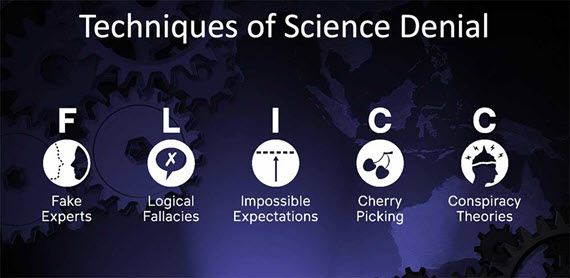
The key method for cultivating these disbeliefs is by FLICCing off scientific integrity—using the five techniques of science denial:
Fake experts
Logical fallacies
Impossible expectations
Cherry picking
Conspiracy theories
All good, but does it need a category of "pseudoscience", where flawed but superficially convincing scientific reasoning is used to attempt to debunk the greenhouse effect, or climate models, etc,etc.
- Getting climate risk wrong
nigelj at 06:43 AM on 22 August, 2025Ted Nordhaus talks about climate issues. Its important to understand his background and involvement in certain organisations. He has a BA degree in history, and was a founding member of the Breakthrough Institute. Wikipedia has a good page on the Breakthrough Institute. Some key excerpts:
The Breakthrough Institute is an environmental research center located in Berkeley, California. Founded in 2007 by Michael Shellenberger and Ted Nordhaus,[5] The institute is aligned with ecomodernist philosophy.[6][7] The Institute advocates for an embrace of modernization and technological development (including nuclear power and carbon capture) in order to address environmental challenges. Proposing urbanization, agricultural intensification, nuclear power, aquaculture, and desalination as processes with a potential to reduce human demands on the environment, allowing more room for non-human species.[8][9][10][11]
Since its inception, environmental scientists and academics have criticized Breakthrough's environmental positions.[12][13][14][15][16] Popular press reception of Breakthrough's environmental ideas and policy has been mixed.[17][18][19][20][21][22][15][23][24][25]
Programs and philosophy:
Breakthrough Institute maintains programs in energy, conservation, and food.[33] Their website states that the energy research is “focused on making clean energy cheap through technology innovation to deal with both global warming and energy poverty.” The conservation work “seeks to offer pragmatic new frameworks and tools for navigating" the challenges of the Anthropocene, offering up nuclear energy, synthetic fertilizers, and genetically modified foods as solutions.
Criticism:
Scholars such as Professor of American and Environmental Studies Julie Sze and environmental humanist Michael Ziser criticize Breakthrough's philosophy as one that believes "community-based environmental justice poses a threat to the smooth operation of a highly capitalized, global-scale Environmentalism."[12] Further, Environmental and Art Historian TJ Demos has argued that Breakthrough's ideas present "nothing more than a bad utopian fantasy" that function to support the oil and gas industry and work as "an apology for nuclear energy."[13]
Journalist Paul D. Thacker alleged that the Breakthrough Institute is an example of a think tank which lacks intellectual rigour, promoting contrarianist reasoning and cherry picking evidence.[15]
The institute has also been criticized for promoting industrial agriculture and processed foodstuffs while also accepting donations from the Nathan Cummings Foundation, whose board members have financial ties to processed food companies that rely heavily on industrial agriculture. After an IRS complaint about potential improper use of 501(c)(3) status, the Institute no longer lists the Nathan Cummings Foundation as a donor. However, as Thacker has noted, the institute's funding remains largely opaque.[15]
Climate scientist Michael E. Mann also questions the motives of the Breakthrough Institute. According to Mann, the self-declared mission of the BTI is to look for a breakthrough to solve the climate problem. However Mann states that basically the BTI "appears to be opposed to anything - be it a price on carbon or incentives for renewable energy - that would have a meaningful impact." He notes that the BTI "remains curiously preoccupied with opposing advocates for meaningful climate action and is coincidentally linked to natural gas interests" and criticises the BTI for advocating "continued exploitation of fossil fuels." Mann also questions that the BTI on the one hand seems to be "very pessimistic" about renewable energy, while on the other hand "they are extreme techno-optimists" regarding geoengineering.[16]
- Greenhouse effect has been falsified
Bob Loblaw at 00:18 AM on 4 April, 2025Reed Coray @ 202:
Well, at least you admit that you can't change your mind.
"I think we've come to an impass. Regarding the meaning of "trapping heat," nothing I say will change your mind, and nothing you say will change mine. Stalemate. "
You have confirmed my statement, repeated in comment 199: " as I pointed out in #188, "...you create such a strict literal meaning to the words 'trap heat' that is unjustified."
FYI, we haven't changed our minds because you have not provided a convincing argument, and you keep avoiding questions that are asked.
You have presented one, and only one, definition of "trap", without citing a source. Most dictionaries provide several variations/definitions of "trap" suitable for different circumstances. Once again, you are cherry picking to suit your position.
Let's try another source for a definition of "trap": the Cambridge dictionary. It provides several definitions for "trap", one of which is:
to keep something such as heat or water in one place, especially because it is useful:
- A greenhouse stays warm because the glass traps the heat of the sun.
Let's try the Collins Dictionary. One part of their definition says:
When something traps gas, water, or energy, it prevents it from escaping.
Wool traps your body heat, keeping the chill at bay.
The volume of gas trapped on these surfaces can be considerable.
Of course, you will not find that convincing, because you probably believe that the Cambridge and Collins dictionaries are part of the Grand Plot to "manipulate truth and facts" in regard to human influences on climate.
...or maybe they just understand the colloquial use of "trap" better than you do.
- Greenhouse effect has been falsified
Bob Loblaw at 04:41 AM on 29 March, 2025Reed Coray @ 187:
Your assertion that you "can't trap heat" and that using the phrase "trap heat" is "not true" only makes sense if you create such a strict literal meaning to the words "trap heat" that is unjustified. In that context, nothing at all anyone ever says anywhere is "true".
...and I repeat what I said in #185: you are arguing a point that is barely mentioned in the OP. It seems as though you want to ignore the rest of the OP. You're just playing word games.
You also have ignored the part where I say that such simple explanations represent a starting point for further discussion/explanation. Such as the discussion and explanation that is contained in the rest of the OP.
Your accusations of an "intent to manipulate truth and facts" are unfounded, unsupported, and against the Comments Policy of this site. You are now cherry picking one phrase you want to use to attack the science, and using that to claim some grand conspiracy to deceive. You have now hit two more techniques of climate denial:

- Climate Adam: Can Coral Reefs survive Climate Change?
Eclectic at 21:13 PM on 30 August, 2024Er .... the GBR [Great Barrier Reef] has never been better than now?
Rose-tinted glasses & cherry-picking are probably not the responsible and sensible approach to assessing and managing the GBR.
Heat (and pollution?) will certainly increase over coming decades, for reasons which you already know. So the GBR corals are facing a long uphill battle.
Perhaps the evolution of greater heat-resistance in many coral types (and their symbiotic algae) will occur ~ but will it be fast enough to preserve the majority of the GBR in a diverse form, or will the GBR deteriorate into something approaching a sad "monoculture"?
Maybe that sort of "recovery" of the GBR will occur in the matter of a decade ~ or perhaps there may be a large "valley of death" until evolution catches up. A lot is uncertain . . . but the corals are definitely facing a long uphill battle against the increasing heat.
MadMackz, your views may have been influenced by your innate cheerful & optimistic nature ~ reinforced by the outlier views of Dr Peter Ridd-Micawber and the false smiles of the GBR tourist boat operators.
- CO2 lags temperature
Blusox69 at 22:00 PM on 6 August, 2024Thanks for the replies so far. I read the paper over a few times and it didn't sit right with me. Under section 4.1 he neglects to show data or even graphs for the CO2 to T as he states they "did not provide useful results". Straight away that rang alarm bells. I've never omitted data from my studies, even if the results were not useful as it lays the foundation for being accused of cherry picking data/results. I'm not a statistician, but I'm sure the same logic would be applied to their work too.
- Climate - the Movie: a hot mess of (c)old myths!
nigelj at 04:48 AM on 1 April, 2024Two Dog @41
"Finally, on the "cherry picking" of the 50s, 60s and 70s. I think its a fair point to pick 30 years out of 150 in this case. Indeed, the argument above is, as I understand it, that the main and dominant factor in the current warming is human GHG emissions. For that theory to hold, in any period where GHG emissions are increasing year on year, then only a few years "blip" in warming must presumably call the theory into question? (unless we can find another new and temporary factor like air pollution)"
The reason the temperature record has "blips" and is not a smooth line is because the trend is shaped by a combination of natural and human factors that have different effects. However the overall trend since the 1970s is warming. The known natural cycles and infuences can explain the short term blips of a couple of years or so, (eg el ninos) but not the 50 year overall warming trend since the 1970s. Sure there may be some undiscovered natural cycle that expalins the warming, but its very unlikely with chances of something like one in a million. And it would require falsifying the greenhouse effect which nobody has been able to do. Want to gamble the planets future on all that?
The flat period of temperatures around 1940- 1977, (or as OPOF points out it was really a period of reduced warming) coincides with the cooling effect of industrial aerosols during the period as CB points out. This is the period when acid rain emerged as a problem until these aerosols were filtered out in the 1980s.
However the flat period mid last century also coincided with a cool phase of the PDO cycle (an ocean cycle), a preponderance of weak el ninos, and flat solar activity after 1950 and a higher than normal level of volcanic activity. Literally all the natural factors were in a flat or cooling phase. In addition atmospheric concentrations of CO2 were not as high as presently, so it was easier for the other factors to suppress anthropogenic warming.
So for me this is all an adequate explanation of why temperatures were subdued in the middle of last century. Just my two cents worth. Not a scientist but I've followed the issues for years.
- Climate - the Movie: a hot mess of (c)old myths!
Two Dog at 22:40 PM on 31 March, 2024Charlie_Brown @40. Thank you, that seems a sensible point and makes sense.
I appreciate the other responses (e.g. Bob Loblaw @32) but I am less convinced about the arguments that "all other causes for the current warming have been looked at and ruled out". I do not believe that we are that intelligent! The Earth is a clearly complex "living organism" with multiple factors that interact with each other impacting its climate. Do we really know what all of those factors are, how the affect each other and, then accurately measure their hypothetical potential impact over the last 150 years? Given we have no idea whether the economy (another complex organism) will grow or contract next year, how do we "know" what would have happened to our climate absent human GHG increases?
Finally, on the "cherry picking" of the 50s, 60s and 70s. I think its a fair point to pick 30 years out of 150 in this case. Indeed, the argument above is, as I understand it, that the main and dominant factor in the current warming is human GHG emissions. For that theory to hold, in any period where GHG emissions are increasing year on year, then only a few years "blip" in warming must presumably call the theory into question? (unless we can find another new and temporary factor like air pollution)
- CO2 lags temperature
RBurr at 08:51 AM on 15 March, 2024The analogy was cute, that the observation that CO2 rises lag temperature rises, means that the Temp rise causes the CO2 rise, is a bit like saying that chickens do not lay eggs because they have been observed to hatch from them. I would submit that, by the same token, opining that CO2 increases cause global warming is a bit like saying that chickens to not hatch from eggs, because they they’ve been observed to lay them.
This all suggests (as inferred) a co-dependent process.
However, this overlooks the same thing that MOST public blogs overlook, and that is the quantum mechanical mechanism on IR radiation (per greenhouse warming theory) has never been proven, and is actually false. New research indicates the fundamental error in the theory, presumes that Heat is ADDITIVE (eg. The Earth’s energy ‘budget’). The quantum process for Thermal transference is not additive. It is a function of frequency resonance. This is why microwave ovens work. Solar heating occurs because the spectrum of frequencies included in sunlight (which reaches the Earth’s surface) sets the maximum temperature which the recipient object may reach. An object in an oven set to 400 degrees will never reach 500 degrees no longer how long it is in the oven, because heat transference is not additive over time. The low energy IR waves received by CO2 molecules will naturally dissipate into the atmosphere with negligible net effect upon the atmosphere, but will never cause planetary ‘heating’ because, per thermodynamic law, no object can heat something beyond the temperature it possesses. Irradiated CO2 molecules can never heat the earth beyond the temperature frequency that already exists within the earth, which generated the IR light waves to begin with. IR Radiation does not raise the temperature of the Earth. The greenhouse warming theory is flawed. THAT is why the universally accepted historical record shows zero correlation between atmospheric CO2 levels and average temperature over the entirety of the past 4 Billion years. Zeroing in on the last 400k or 800k years, and pointing to an anomaly amounts to cherry picking, which disregards the other dynamics in play, such as Milankovitch Cycles. Note: Ozone depletion CAN increase surface temperatures because the range of UV frequencies that reach the surface is expanded. - Can we be inoculated against climate misinformation? Yes – if we prebunk rather than debunk
BaerbelW at 19:06 PM on 17 February, 2024OPOF @1
I think that even more important than providing specific facts ahead of potential misinformation is to clue people in on the FLICC-techniques they are most likely going to see employed. The examples in the article do just that by pointing out "false equivalence", "conspiracy theories" and "cherry picking". The more people are aware of these techniques, the less will - hopefully - fall for and share the misinformation.
- Skeptical Science New Research for Week #26 2023
Just Dean at 01:24 AM on 2 January, 2024I am also leery of single author papers.
If you are interested in the some of the latest thinking in correlations between ancient CO2 and T, I recommend this presentation by Dr. Jessica Tierney, REF .
If you are interested in just the bottom line, you can skip to the time marker around an hour into the presentation. If you look at her plot of GMST vs CO2 (ppmv) introduced at 1:04:08, you might imagine how if you wanted to play fast and loose with the data and do some cherrypicking you could make the correlation look fairly poor.
- Disinformation campaigns are undermining democracy. Here’s how we can fight back
Nick Palmer at 12:23 PM on 26 November, 2023What NigelJ said is very valid. My own perspective on such matters as percption of climate science is that probably most 'sides' - from doomist through alarmist to 'IPCC' accepting to 'sceptic' to denier - now currently distort the science and the varied consequences of assorted policies to suit their favoured take - often very strongly influenced by their personal politics. All sides use the very same techniques of cherry picking, quote mining, over-promoted 'experts', out-dated articles etc to make their cases. The actual peer reviewed science tends to get lost in the noise
- 2nd law of thermodynamics contradicts greenhouse theory
Rob Honeycutt at 05:24 AM on 30 September, 2023Likeitwarm... "I'm just looking for the most plausible reasons for climate change."
This is quite obviously untrue because clearly the most plausible reasons for climate change come from the overwhelming body of research demonstrating that CO2 is the primary cause.
I think you just don't like that conclusion and are cherry picking your way into "alternative facts," as they say.
- It's not urgent
Eclectic at 22:33 PM on 10 September, 2023PollutionMonster @47 :
Sorry if I have wasted some of your time. My reference to Mr G. Santos was intended as a humorous flourish, for the amusement of readers who follow U.S. politics. (Santos is a current federal House Representative, from New York, and is of the same political party as the 45th President.) Hard as it may be to believe, but Santos achieves a mendacity that exceeds that of No. 45 . . . and helps demonstrate the extremes to which we have come*** . And AFAIK, Mr Santos was not involved (directly) with the Budget Committee Report you linked to.
The Budget Committee Report you mentioned is largely pure partisan propaganda ~ and with it, I think your opponents are trying to trick you, by using omissions & cherrypicking of history and data. Please regard that Report with your highest level of skepticism, for it cannot be taken as a useful & valid source of information.
My phrase "budget deficit sabotage" was a shorthand to refer to how the "right-wing" party claims to be the party of responsible conservative fiscal management ~ and yet (under No. 45 ) blew an even yuger [huger] hole in the federal budget, by making large tax cuts for the very wealthy and for the big corporations. Leaving even less money for tackling climate issues.
But enough of this rather offtopic partisan politics ~ discussions in SkS threads are intended to be limited to politics in a general sense (not partisan) . . . and limited specifically to how humans' "general politics" is helping or hindering progress towards a healthy Nett Zero Carbon economy.
*** When you have some spare time, look up Cicero's
"O tempora O mores"
. . . which applies to anti-vaxxers, as well !
- It's not urgent
Eclectic at 13:08 PM on 5 September, 2023PollutionMonster @45 : you have linked to something titled: "Fact Check: Setting the record straight on Bidenomics".
Sadly , this is not an official government publication issued by (non-partisan) public servants who have carefully analysed the situation. Instead, it is a heavily-slanted piece of propaganda, issued by a partisan House Committee for political purposes . . . apparently with some editorial assistance from Mr G. Santos [readers in subsequent years may wish to google the Santos scandal ].
It needs a Fact Check itself !
PollutionMonster, if you look more closely at the Report, you will see not only cherrypicking ~ but a complete absence of mention of the Budget Deficit sabotage caused by the Trumpian years. Sabotage & societal harm caused also (by both major political parties) in following the reaganomics Trickle-Down fiasco.
PollutionMonster, tell your antagonists to find some reputable info.
- It's not urgent
Eclectic at 20:22 PM on 15 August, 2023PM @42 , please report on anything genuinely valid which these deniers can produce from Mr Stossel or Dr Curry. I'm betting that's Zilch.
You won't change the deniers, but you may influence "onlookers'. Myself in this situation, I'd figure it is reasonably justified to "poison the well". Point out that Stossel once, years ago, was a reputable journalist . . . but now he's an angry propagandist and has received money from the billionaire Charles Koch, whose propaganda "institutes" encourage propaganda half-truths & cherry-picking slanted information.
I would probably also go ad hom [ ad fem ? ] on Curry ~ whose arguments are vague & tenuous & rhetorical . . . and are therefore difficult to get to grips with. Point out that the real climate scientists find her a joke, and laugh at her and her vague position.
Challenge the deniers to come up with anything definite from these two anti-science propagandists.
- Hansen predicted the West Side Highway would be underwater
Rob Honeycutt at 11:11 AM on 7 July, 2023Dave @29... Here you're playing the classic science denier game of cherry picking facts that support the conclusion you prefer. Your graphs are technically correct but intentionally misleading because you're using them outside of the full context of the issue at hand.
If, on the absurd chance, you actually believe what you're presenting is compelling evidence then it is encumbent upon you to publish your findings in a legitimate science journal and convince a panel of experts that your findings are significant.
Given you've been doing this for something over a decade now I would have expected your position to become more substantive and nuanced. But it's not. You're regurgitating the same junk you've been posting all over the internet this entire time.
This leads me to believe you're not genuinely interested in facts or science. You're merely promoting an ideological position and you think this is an interesting way to do that.
Once again, this is not ad hom. Lots of people do exactly what you're doing and they (and you) have every right to do so. All any of us are doing is pointing out how weak your position is.
- Antarctica is gaining ice
Bart Vreeken at 00:23 AM on 23 May, 2023'Accusing NASA of cherry-picking, when they used what was probably all the available data at the time the analysis was done - and then claim that your analysis also ending in February is not cherry-picking because it is "all the available data", is hubris.'
Please have a better look.
- The data of the analysis by NASA run up to August 2020, but the last part is not used
- The data of my analysis starts and ends in February, so there is no seasonal effect.
- Antarctica is gaining ice
Bart Vreeken at 18:39 PM on 22 May, 2023"Where the 149 Gt/yr number comes from was discussed in March"
OK, let's have a look at the discussion in March. The 149 Gt/yr number comes from a video by NASA, published April 1, 2021.
https://climate.nasa.gov/climate_resources/265/video-antarctic-ice-mass-loss-2002-2020/
The selected data runs from October 2002 (+65 Gt) to February 2020 (-2808 Gt). That's already cherry-picking, for the ice mass tends to be low in February. Why do so? Maybe the publication date gives a hint ;-).
But ignoring the last two years, like Bob Loblaw does, is even more cherry-picking. This is how it looks like:

Is it also cherry-picking to end in February 2023? Not really, for it includes all the available data. Maybe we have a relatively high amount of ice now, according to the trend. But we won't know until afterwards. And remember that these are cumulative data. The amount of ice above the previous trend will first have to melt away again. That makes this figure different from a figure in which the temperature is displayed.
- Arctic sea ice has recovered
Rob Honeycutt at 00:46 AM on 21 April, 2023Albert @150... I'm curious why you can't see what you're doing is selecting (cherry picking) short time frames out of a clear overall trend in order to fit a predetermined conclusion.
This is truly what I find so fascinating to witness. The sheer volume of well-established research and scientific evidence that has to be dismissed or ignored in order to come to such conclusions is staggering.
Anthony Watts I can understand simply because his income is predicated on keeping climate deniers coming to his website. People who don't have a specific monetary necessity, these I don't understand.
- There is no consensus
Rob Honeycutt at 10:18 AM on 20 April, 2023@934... "believe it or not there are other factors that effect global temperature like, the sun, solar winds, magnetic fields, cosmic rays...(etc., etc.)."
This is starting to gish into a big gallop.
If you're going to accept low CS figures then you also need to accept high CS as well, otherwise you're just cherry picking your preferred conclusions without considering the full body of research.
There are good reasons to believe the high CS figures have low probability, as there are even stronger reasons to believe low CS figures are improbable.
- The Big Picture
Bart Vreeken at 20:35 PM on 18 March, 2023Bob Loblow @75 you said:
"Another clue for you: losing ice at lower altitudes around the perimeter of the ice sheet, and gaining ice at the higher altitude is Business As Usual for continental ice sheets. There is this thing called "glacial flow" that moves ice from the accumulation zone to the ablation zone"
Well, that's great. Do you really think I would write about Greenland when I didn't know how it works?
My turn then. The mass change of Greenland by year. Cherry-picking? Maybe, but I use all the available data of GRACE. Over a longer period (altimetry data) there is an increase of mass loss. Don't pay too much attention to the trendline, for the data have a lot of noice. But there is a similarity with Antarctica: more snowfall in the last years, caused by less sea ice.

- Antarctica is gaining ice
Bart Vreeken at 07:09 AM on 13 March, 2023As I said, I was hoping for a more serious discussion on this site.
What went wrong: in my first post I wanted to show the graph with the SMB as well. I must have done something wrong, for it didn't came up. Sorry for that. But this information is not so hard to find. MA Rodger succeeded in doing this, Bob Loblaw preferred to show a stupid graph about cherry-picking. Well, that's not the point here.
Anyhow. The correlation between SMB and mass change was not clear, so I put them together in one table. The SMB is calculated over November - November. The original graph gives the anomaly of the SMB. The average mass of the anomaly seems to be some 2700 Gigaton, so I added that to the anomaly. Then the discharge of the ice sheet can be calculated as the difference between the GRACE data and the SMB.
The result is interesting: there don't seem to be much correlation between SMB and discharge. Strange enough, in the last year with little sea ice the discharge was even less then normal.
An important thing could be that GRACE isn't measuring the total amount of ice, but only the amount above the sea level. So, increased calving from floating iceshelfs isn't noticed.

- Renewable energy is too expensive
stranger1548 at 00:06 AM on 6 March, 2023This was a post that I just read last night. I told the poster I had read up on the gas turbines and there effiency. I asked if he couId produce a paper because I thought there were facts he had probably not included. I refered him the the Anderson Economic study where some cherry picking had been done. He said I was math deficient and that anyone with even moderate math skills should be able to come to the conclusion.
The most BTU efficient method of fossil fuel energy generation is, of course, the natural gas turbine. The very newest (built within the last few years) hybrid NG plants can reach up to 60% thermal efficiency, but most combined cycle plants fall around the 38-42% mark.
Taking that, we know that a gallon of gasoline contains 112,000 BTUs, and in a perfect world without losses, 112,000BTUs = 32.82kWh. We also know a Honda Accord can travel 38-highway miles on 112,000BTUs per the EPA's testing.
But if we burn 112,000BTUs at an NG plant at 40% efficiency, we only get 13.12kWh. Then there's line losses to consider, which per Schneider Electric, are at around 12% on average (How big are Power line losses? | Jacques Schonek). But then that brings us down to only 11.54kWh.
Oh but Tesla also stated that charging losses are around 16%, which puts us down to 9.69kWh.
However, a 82kWh Tesla Model 3 can travel 310 miles per the EPA (using the same testing method as the ICE vehicle), for roughly 3.7 miles per kWh (with no A/C, heat, or other auxiliaries). Meaning the Tesla can travel for 35.85 miles from the same amount (112,000BTUs) contained in a gallon of gasoline that was burned at a natural gas plant.
When measuring from the time the fuel is combusted, EVs are the same, or even less efficient.
- CO2 limits will hurt the poor
PollutionMonster at 14:06 PM on 23 February, 2023I apologize that the inflammatory labels were too much, sorry you had to edit. Thanks for letting me know to keep the inflammatory labels down a bit. Still new here, I want to respect the rules, but gonna stumble some at first.
Rob Honeycutt @61
Thanks for the quick response. I want to focus on solar panels. That seems to be what the proverbial crankyuncles that I run into seem to be mentioning the most. I will put in fact, myth, fallacy, fact format a debunking. Though right now i don't have the scholarly peer reviewed articles to back up my conclusions.
Fact: Solar panels are a cheaper energy source than fossil fuels.
Myth: CO2 limits in the form of Solar panels will hurt the poor of the first world.
Fallacy: Cherry picking by using old data and omitting fossil fuel subsidies that can be used on clean energy. Hidden costs like healthcare and future generations having to clean up costs of pollution select evidence is used to come to the faulty conclusion.
Fact: Solar energy is cheaper than coal.
Analogy: Pretending that solar panels are still expensive is the same as imagining that all cell phones are still huge bricks.
Sources: NPR, Nature, and popularscience.
Solar cheaper than Coal NPR 2020
Popular science solar panels got cheap, 2021.
Nature 5.9 trillon fossil fuel subsidies.
Let me know if there is anyway to improve this debunking, and of course I would appreciate a fact check. The skeptic looks bad when the person who is denying climate science can prove them incorrect. Hopefully this is the correct thread to post this comment, seems the best to me, but I could be wrong. Thanks in advance. :)
- The escalator rises again
Bob Loblaw at 01:44 AM on 10 February, 2023I don't have the stomach to go over to WUWT, but the author of this blog post has also reposted it on his own blog, and here have been some interesting comments over there.
Willis Eschenbach, of WUWT fame, has commented, and posted a graphic of what he calls "an actual structural breakpoint analysis" for the period 1969 to now. He draws attention to the steps, claiming "this is not done by 'cherry picking' but by mathematical analysis, this brings up the interesting question … what is causing the jumps?".
Spolier alert: the "jumps" are an artifact of an inappropriate statistical analysis, and Willis has no explanation of any physical process to explain them, other than a brief hand-waving about El Nino events. But let's entertain the possibility for a bit.
I pointed out in the comments over at ATTP's that the month-to-month change in the anomalies (i.e., this month's anomaly minus last month's) shows absolutely nothing to suggest that the anomaly goes through any sort of slow change (as suggested by the linear segments) interspersed with sudden jumps. If you take the entire BEST record, this is what you see for the month-to-month change in the anomalies:
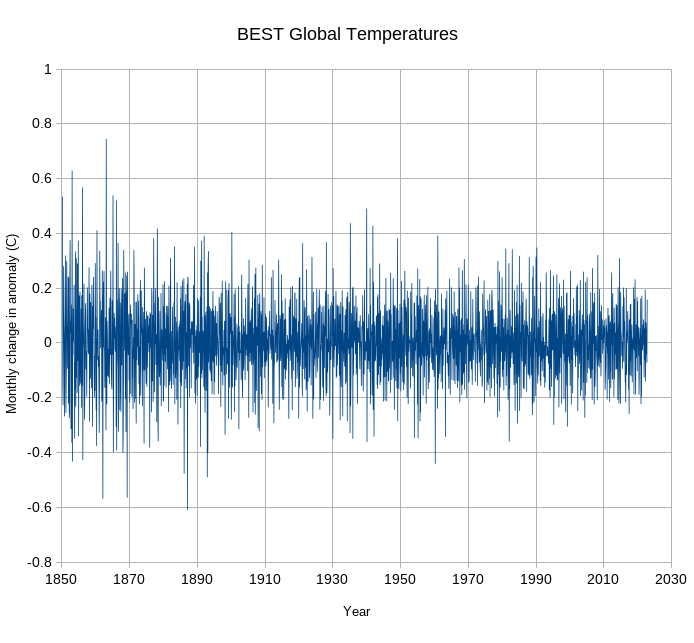
The month-to-month change in anomaly looks pretty much like random noise to me. If Willis' hypothesis of meaningful "jumps" existed, I'd expect to see periods of fairly steady (i.e., unchanging) anomalies, with periodic short episodes of large changes representing "jumps" No such structures appear in the data.
I also took the information from the graphic Willis posted of his "structural breakpoint analysis" and added the six line segments he created to a graph of the 1969-present BEST anomalies. This is a reproduction of that information from Willis' graph:
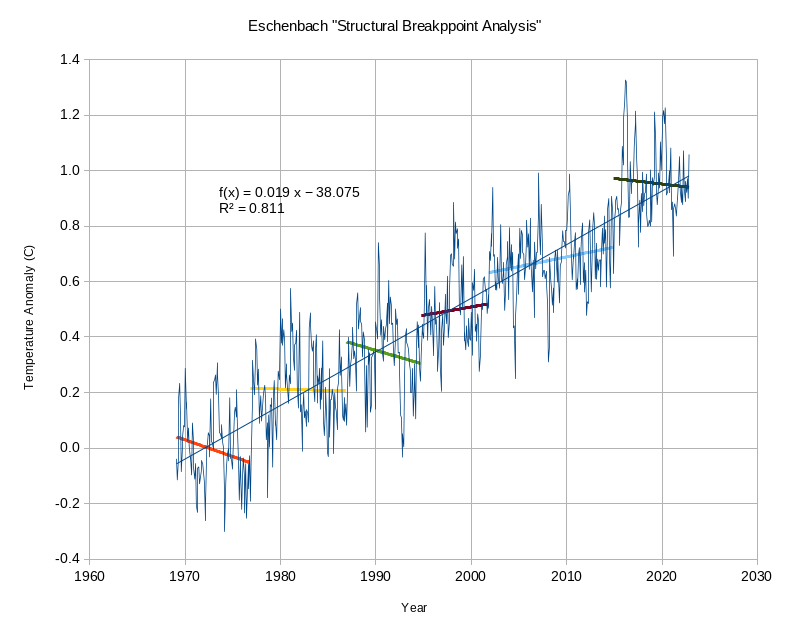
The point I made over at ATTP's is that Willis six-segment linear fit to the data provides virtually no additional statistical explanation of the overall data. The equation on the above graphic is the basic linear fit for the entire data set. Note that the r2 value is 0.81. The regression standard error is 0.145 C - indicating the remaining "unexplained" variation in the residuals from the regression.
How much better does Willis do with six line segments (and five breakpoints)? Not much. The accumulated standard error from the six regression lines is 0.133C - just over 0.01C better than the simple fit.
If we look at some statistics for the six segments, we get:
End Year Standard error P-value R^2
1976.8
0.131
0.07
0.0353
1986.9
0.141
0.764
0.0008
1994.7
0.141
0.25
0.0143
2001.8
0.137
0.376
0.0095
2014.9
0.119
0.005
0.0504
2022.9
0.137
0.126
0.0001
The P-values do not account for auto-correlation (there is lots), so take them with a grain of salt. But only one of Willis' line segments looks remotely significant, and the r2 values are very low.
The fact is that nearly all of the statistical explanation in Willis' analysis is in the jumps, but there is no reason (looking at the month-to-month changes) to expect this analysis to come up with anything that is not just a misrepresentation of the noise.
A basic linear regression does almost as well, with only two parameters (slope and intercept). In Willis' analysis, he needs 17 parameters: six lines (slope and intercept = 12 parameters) and five break-point years. This is not particularly parsimonious.
Splitting a gradual increase in the data into a bunch of "jumps" that are a function of noise may be entertaining, but it's not particularly scientific.
- Models are unreliable
Bob Loblaw at 07:31 AM on 29 November, 2022Eddie et al (comments 1314-1417) on Spencer's video and blog post.
Thanks, MAR, for the link to Spencer's blog post. I followed his link to the NOAA data source, and looked at the numbers. If I grab the June, July, and August monthly values (the standard climatological "summer"), I get the same results: about 0.26C/decade. That checks out. A few things that Spencer does not mention:
- The overall trend is not particularly linear.
- The r2 value is rather low.
- The standard error on the slope esitmate is 0.04 C/decade.
Here is a graph of the data:
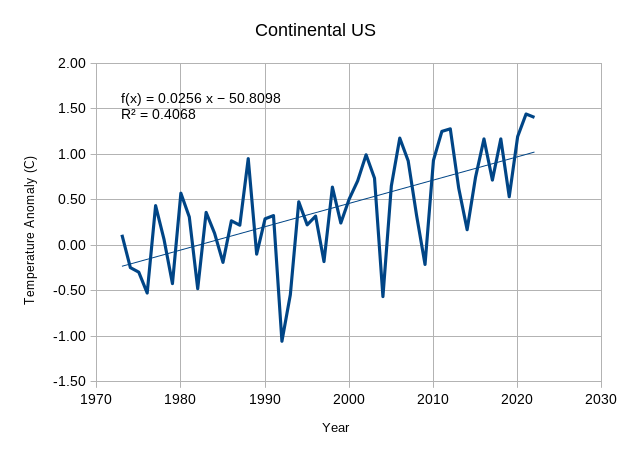
The uncertainty on the trend covers some of the model range he provides in the blog post. Two sigma range places the observed trend between 0.17 and 0.35 C/decade.
The model trends also include a level of internal variability. The observations follow a specific pattern of "unforced variations" related to cycles such as El Nino, etc., while individual model runs and models will have different patterns within a specific model run. Over shorter periods, and smaller areas, you need to consider this in making any comparisons. For models, they often get an "ensemble mean" of many runs with different variability - but the observations are still a "single roll of the dice" that can fall anywhere in the range of the collection of model runs and still be consistent with the models.
I see that you have already found the Great Global Warming Blunder post at RealClimate. They also have a couple of other relevant posts:
This one talks about how unforced variability affects model runs.
This one talks about things to consider in comparing models and observations.
Tamino's blog is also a useful place to look whenever statistical stuff comes up. In this post, he points out several aspects of the use of the continental US for data. He covers the non-linearity of trends, the variations in trends in different parts of the US, and points out that the continental US represents 1.6% of the global area (ripe for cherry picking).
In general, Spencer tends to get more wrong than he gets right.
P.S. The preferred abbreviation for SkepticalScience is SkS (for obvious reasons).
- A critical review of Steven Koonin’s ‘Unsettled’
MA Rodger at 22:30 PM on 13 September, 2022dvaytw @21,
This interchange has all gone a bit quiet. I've been reluctant to pitch in as I hold Koonin in very low regard given he has shown himself time and again to be a simple nepotistic nonsense-monger. But I did have a watch (not very attentively) of his 17 minute 'case against' in the video you mention and I don't see him presenting any worthy argument. It's all very 'chatty man' rather than well-founded analysis. It is but yet-more Koonin nonsense. (Note that Dessler & Koonin have recently debated before.)
Specifically on your first "strongest point", that is the 'chatty-man' GDP argument, do ignore the IPCC aspect of it which is solely based on cherrypicking some wording from WG2's SPM that can easily be set out to sound logical but which is actually allowing any global disaster you wish to be ajudged as okay.
Even less narrowly, the use of global GDP projections will always provide a simple way of burying mountains of bad stuff. You can thus point out that global GDP has risen at 3% annually for decades and even if you accept the most worrying projections of the costs of ignoring AGW (and all these projections are all very poorly defined), it is too easy to say global GDP will be 10x bigger by 2100 so we can cope with losing a few percentage points of that. Even the worst projections I've read that talk of 50% loss of GDP would see us 5x better off.
Hurrah!! AGW solved!!!
However, it is just as easy to point to the ongoing increase in FF use wich is still tracking the old doom-laden RCP8.5 scenario and that is certainly nowhere humanity wants to find itself.
Note that both these uses of projections out to 2100 are overly simplistic and thus both verging on being utterly nonsensical if taken at face value.
There are two serious criticisms of Koonin's chatty-man GDP argument.
Firstly, the argument is being made that it will all be fine-&-dandy because, given past decades, we can project these massive increases in the size of the economy. So, in the extreme, even if the damage and adaptation costs tot up to a hit equal to half the economy, we would still be far wealthier, 5x wealthier, and so have no reason for complaint. But that argument is mad, with its head too quickly stuck up the model and ignoring the outcomes in the real world in such circumstances. Koonin needs to make plain what climate he is advocating as an acceptable outcome before he starts sticking his head into his simplistic models to demonstrate the effects of such a future climate.
Secondly, and this has been touched on up-thread, the chatty-man GDP argument uses global averages which always allow unacceptably bad stuff to be buried.
Just for a kick-off, imagine say Madagascar with a GDP of $14billion or 0.014% of global GDP. If that entire nation simply melted and disappeared beneath the waves making 28 million souls homeless, it wouldn't even register as a blip on Koonin's global averages. And if such destruction isn't so bad, if one or two hapless countries have to take a hit to keep the world economy in Koonin's happy-place, how about the entire continent of Africa. Hey, it's only 3% of the world economy. I'm sure Africa's 1.3 billion inhabitants will understand the situation when Koonin explains it to them. Perhaps we should give them his address so they can go round and get it all properly explained to them. Mind, it's not all a bed of roses for Koonin because he wants so much to sell them billions of tons of expensive fossil fuels which can't happen if their economies disintegrate under future western-world-created AGW.
Koonin is a lunatic. His 17 minutes could be disassembled and the nonsense it comprises exposed. But why bother? Koonin is a lunatic!!
- Is Nuclear Energy the Answer?
Bob Loblaw at 04:23 AM on 3 September, 2022Seriously, sekwisniewski? "Conservation of mass" arguments?
Taking life-cycle emissions, using only what happens during construction and operation of the plant violates the "conservation of a consistent argument" requirement when looking at item 4. Either we are taking the entire system and results into account, or we are selecting only the part that supports a particular argument (AKA cherry picking).
- Is Nuclear Energy the Answer?
Bob Loblaw at 00:05 AM on 3 September, 2022A few problems with that list, sekwisniewski.
- It doesn't matter whether you label them as "nuclear' or "fossil". The emissions end up in the atmosphere.
- If nuclear is being built to replace existing nuclear, then it doesn't replace fossil-fuel-based capacity and does nothing to reduce fossil fuel emissions.
- Other sources coming on line now can also cover future demand.
- Yes. The calculations need to cover all sources of electricity, and all the CO2 emissions that are produced if a particular path is chosen. Cherry picking a compartmentalized view - where you only count emissions when a plant is operating (e.g., wind vs. nuclear) and you ignore how this fits into the overall picture - is a bad approach.
- Is Nuclear Energy the Answer?
MA Rodger at 18:46 PM on 29 August, 2022John ONeill @295,
You defence of the analysis of Edgardo Sepulvda is poor to the point of hopelessness. My hypothetical wielding of Luxembourg to demonstrate the absurdity of the use of small and tiny countries in that Edgardo Sepulvda graphic you presented @292 is not well addressed by your bold assertion that "The countries Sepulveda examines are mostly reasonably large," which is eidently untrue. There are (according to Wikkithing) 32 countries where nuclear reactors are currently operational.
The Edgardo Sepulvda graphic shows just twenty nuclear countries (here I list them with the No of current operational reactors in the order of their significance in the graphic) and most are certainly not "reasonably large," and most have less than half-a-dozen operational reactors which would suggest a 'lumpy' generation introduction, the phenomenon I demonstrated with the Luxembourg hypothesis.
In order of significance given in the Edgardo Sepulvda:- Sweden 6, France 56, Finland 5, Belgium 7, Lithuania 0, Switzerland 4, Slovakia 4, Canada 19, Taiwan 3, S Korea 25, Germany 3, Bulgaria 2, Hungary 4, Czechia 6, USA 92, Japan 33, Spain 7, Slovenia 1, Ukraine, 15 UK 9.
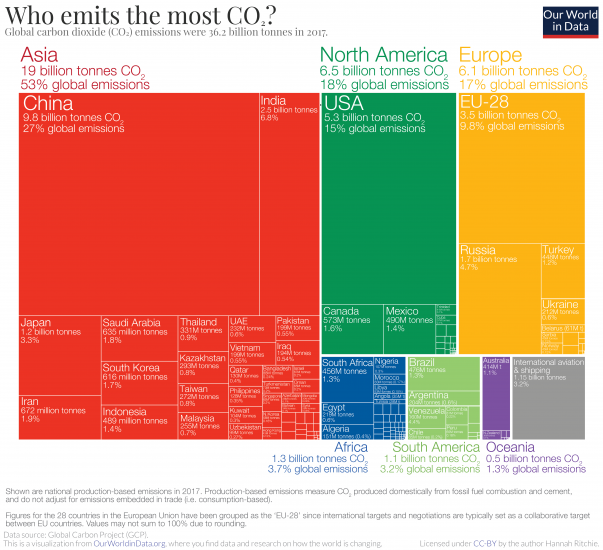
Perhaps to add further to the 'lumpy' problem that appears when an analysis addresses a global problem (AGW) by cutting-up the world into individual countries, Germany may be a powerhouse of the world economy but it is only 1.8% of global carbon emissions. In terms of countries, there are only two or three or four that are not small or tiny.
The selective nature of the data in the Edgardo Sepulvda graphic opens the door to possible cherry-picking, and that could extend to the choice of decadal capacity increases rather than some other period. Thus a choice of six years (the usual construction time for a nuclear reactor and so also the length of the 'look-ahead' analysis I presented @294 which you so-far ignore). And note that a six-year period analysis would reverse the placing of Germany Nuclear and Germany WInd.
And as a final indicator of the Edgardo Sepulvda analysis being more problem than illustrative, the data given by OurWorldInData (the web engines for this linked @294) give markedly different values for those presented for Germany Nuclear and Germany WInd which gives a ratio of 122-to-100 while the graphic shows 132-to-100, a variation rather too big to ignore. (This was the one check I made, and it suggests other big errors.)
So should we be surprised if others make similar forms of analysis and reach the opposite conclusion from you armed with that Edgardo Sepulvda graphic? Indeed this is the situation we see with the analysis michael sweet presents @296 (and do consider the 'look-ahead analysis I present @294).
- How not to solve the climate change problem
Eclectic at 11:55 AM on 29 August, 2022Scvblwxq1 , your assertions [not-quite-arguments] are going off all over the place ~ and are missing the target. And missing the more appropriate threads, too.
The 20% figure you mention is cherrypicked from the Environmental Defense Fund ~ other reports/studies point to figures like 8% and 10% . . . and even those are based on short-term periods, and do not look at the bigger picture. Does it not occur to you that the Environmental Defense Fund has an advocacy role and might be doing its own cherrypicking? You yourself should be taking a more skeptical view, and be examining evidence/data in a more thorough and nuanced manner.
Your CO2 growth figures of 2ppm and 80ppm demonstrate your wildly inaccurate arithmetic, and your lack of understanding the basics.
Your "migration" argument is unscientific. What can we really conclude about rich elderly Noo Yorkers retiring to Florida? Or some Wisconsinites & Michiganders moving south to the warmer Texas . . . while Mexicans & others are moving north to the cooler Texas ;-)
Sun energy and cloud feedbacks are issues again pointing to your needing to educate yourself about these basics.
I suggest it would be logical for you to study the practicalities of reducing the 75% bulk of fossil-derived CO2.
- It's the sun
MA Rodger at 22:04 PM on 3 August, 2022cgfree59 @1301,
The best initial assessment of any work by the Connolly brothers or Willie Soon is to assume it is yet another pile of their usual nonsense (I was much surprised recently seeing an NSIDC blog actually citing one of their papers for real!!) and given the lengths they go in obfuscating and misdirecting folk, this is not entirely a falacious use of an ad hominem argument.
There are responses to this particular serving of nonsense Connolly et al (2021) 'How much has the Sun influenced Northern Hemisphere temperature trends? An ongoing debate' (thus a layman's efforts or a reply from the numpties themselves to a criticism of press coverage of their paper) but I do not see anything here at SkS.
The conculsions of Connolly et al (2021) are to assert that the IPCC is premature with its conclusions as it ignores certain estimates of TSI and thus solar forcing which provide radically different results to the global warming attribution reached by the IPCC.
"Different TSI estimates suggest everything from no role for the Sun in recent decades (implying that recent global warming is mostly human-caused) to most of the recent global warming being due to changes in solar activity (that is, that recent global warming is mostly natural)."
You could expend time and effort trawling though Connolly et al (2021), picking out the obfuscation and misdirection they employ but the crux of it is the crazy method they use. That is they the employ blind curve-fitting of their preferred solar-caused climate forcing onto some crazy NH temperature estimates and only after this first-step into the lunatic asylum do they then get to attributing the left-overs of any temperature trends to anthropogenic forcings.
So the results are pure nonsense.
Further a rather telling observation is that of these TSI estimates which they claim are being ignored (TSI High Variability Estimates all plotted out in their Fig 3), only two would allow any naive correlation between rising global temperature with TSI through the all-important "recent decades."
One of these two exceptional TSI estimates was scaled from a postage-stamp-size graphic in Ammann et al (2007), a paper which contradicts the muppets in that it concludes:-
"Although solar and volcanic effects appear to dominate most of the slow climate variations within the past thousand years, the impacts of greenhouse gases have dominated since the second half of the last century.
The second is cherry-picked TSI estimate is from yet another tiny graphic (Fig 5b of Egorova et al 2018) in turn the trace being based on Muscheler et at (2016) which employs proxy data to create estimates of TSI, so not a precise method you would want to put much faith in.
The numpties offer no comment on such an obvious problem with their grand thesis, that it has such a narrow and less-than-reliable basis for the singularly important calculation within their account. Such an omission is a sign that you have strayed from reasonable analysis and entered the lunatic asylum. - SkS Analogy 1 - Speed Kills: How fast can we slow down?
nigelj at 16:47 PM on 21 February, 2022Santalives @80
I already said what I think drives people over at WUWT @74. I've amended it slightly here. Imho denialists seem to mostly engage in a lot of deliberate stupidity, mixed together with political and ideological motives (often libertarianism) , motivated reasoning, cherrypicking, and a tendency to see conspiracies everywhere. However some just appear naturally quite stupid (eg: JDS over at realclimate.org). There are also the scientific cranks with science degrees who just seem to like to be different and become very stubborn and narcissistic. This is my observation. I suspect you wont like this but its how they all frequently come across to me.
Regarding "Rethinking Climate, Climate Change, and Their Relationship with Water by Demetris Koutsoyiannis"
Some of his discussion is interesting and colourful. However a discussion of how to better define climate doesn't much interest me. I said before its pedantry. In no way does such a thing directly relate to or undermine findings that humans are causing a warming effect. And what we are interested in is relativities and rates of change from one period to another. You do not need a precise and perfect definition of climate to measure that. I'm sure you would get what I mean. I haven't the time to study his maths in detail and I'm rusty on some of that but I'm sure its probably correct, but it isn't relevant to the points I've just made. He himself said people will probably regard his paper as useless!
He then goes into a long discussion about water: "This idea is further expanded to establish a linear causality chain of the type: human CO2 emissions → increasing concentration of atmospheric CO2; → increasing temperature → changes in hydrological processes and water balance. This is evident in the popular practice of studying the so-called climate change impacts on hydrological processes. However, this is a naïve idea that does not correspond to physical reality.........Arguably, the fact that the CO2; has been so heavily and repeatedly studied, particularly in paleoclimatology studies (e.g., [49,51,52,53,54,55,56,57]), does not suggest that it is more important a greenhouse gas than water. Here we argue that water is the most crucial element determining climate (e.g., [58,59]), or as put by Poyet [60], “Water is the main player”. We list epigrammatically some of the reasons justifying it: (Abundance, heat storage etc.)"
The fact that water is abundant and a heat store and can be influenced by changes in solar energy and that water vapour is the more abundant a greenhouse gas is not contested or new information, and obviously does not in any way undermine the conventional idea that changes in Co2 is causally linked to increased evaporation which can cause further warming. He has conflated things, and enaged in a logical fallacy by deliberate intent or lack of awareness.
He has to be able to explain how his own theory of water would explain climate warming over the last 100 years. He provides no evidence based causal link to expalin a change in water vapour levels in the atmosphere over the period. But Co2 causing warming and evaporation and further warming explains things perfectly well and is consistent with the evidence.
Don't ask me why, how or when on all the details. I don't have the time for more. I'm giving you the essentials as I see them. To me its all fairly obvious. Think about it. I'm just an interested observer and while I enjoy discussions I dont have all day.
- SkS Analogy 1 - Speed Kills: How fast can we slow down?
nigelj at 11:41 AM on 21 February, 2022Eclectic @72
I do agree with all your views on the denialist trolls and how to respond to them. They are indeed quite interesting and entertaining.
Some people say don't respond or engage with the denialists, because it gives them visibility, but I feel that is a grave mistake. We dont know who is reading comments sections and if the denialists nonsense goes unanswered it may gain traction with middle of the road people reading.I tend to respond to denialists largely with those people in mind.
I tend to often keep my responses short and facts based rather than getting into a long debate, to avoid giving them too many opportunities to spam the website. Especially on general news media websites. However sometimes I will get into a longer discussion if it seems useful or interesting, and its unlikely vast numbers of people are reading the posts and they are not the spamming type of troll. I've noticed that rebuttals can actually create some interesting discussion. The people that say never respond to denialists take themselves a bit too seriously.
Imho denialists seem to mostly embrace a lot of deliberate stupidity, mixed together with political and ideological motives, motivated reasoning, cherrypicking, and a tendency to see conspiracies everywhere. However some just appear naturally quite stupid (eg: JDS over at realclimate.org).
- It's albedo
nobodysknowledge at 21:28 PM on 12 February, 2022Thank you for your presentation of the Dübal and Vahrenholt 2021-paper blaisct. I think there is a good overall agreement to the CERES data presented by Loeb et al 2021. I have commented this at Science of Doom.
The Dübal and Vahrenholt paper, Radiative Energy Flux Variation from 2001–2020, have got some attention. And for good reason. It is an important discussion. But there are some problems with some of the claims that are made.
«Radiative energy flux data, downloaded from CERES, are evaluated with respect to their variations from 2001 to 2020. We found the declining outgoing shortwave radiation to be the most important contributor for a positive TOA (top of the atmosphere) net flux of 0.8 W/m2 in this time frame.»
According to the CERES data they present (TOA all sky), the trend is LW out 0,28 W/m2/decade (cooling), SW out -0,70 (warming), and solar reduction 0,03 (cooling), wich gives a TOA warming trend of 0,39 W/m2/dec. So far so good. And in good agreement with Loeb et al 2021. EBAF Trends (03/2000-02/2021) 0.37 + 0.15 Wm-2 per decade.
«The declining TOA SW (out) is the major heating cause (+1.42 W/m2 from 2001 to 2020).»
Trend SW out all sky -0,70 W/m2/dec withsolar reduction included (0,70 W/m2/dec TOA warming). Gives 1,40 W/m2 over 20 years. This major heating is composed of SW clear sky heating trend of -0,37 W/m2/dec and a SW cloudy sky heating trend of -0,78 W/m2/dec. In the TOA radiation energy bridge-chart (figure 14) this is shown as SW clear sky increase of 0,15 W/m2 and SW cloudy areas increase of 1,27 W/m2. And the solar change impact is -0,17 W/m2 for 20 years. A great difference between trend and energy bridge-chart.
Loeb et al has a SW TOA heating of 0,63W/m2/dec through albedo change, with clouds increasing absorbed SW Flux 0,44W/m2/dec and surface increased absorption 0,19W/m2/dec. In good agreement with Dübal and Vahrenholt. EBAF Trends (03/2000-02/2021) 0.68 + 0.12 Wm-2 per decade.
«It is almost compensated by the growing chilling TOA LW (out) (−1.1 W/m2).»
But as we have seen, the trend is only 0,28 W/m2/dec. This is composed of LW TOA flux clear sky 0,04W/m2/dec and LW cloudy sky 0,35 W/m2/dec. How can they claim so big «chilling» longwave cooling? It looks like they use the startpoint and endpoint of a graph, and that the «chilling» cooling at TOA was for the year 2020 relative to 2001. In the TOA radiation energy bridge-chart (figure 14) this is shown as LW clear sky increase of 0,46 W/m2 and LW cloudy areas increase of 0,64 W/m2. I think what is presented in the bridge-charts is close to cherrypicking.
Loeb et al EBAF Trends (03/2000-02/2021) -0.31 + 0.12 Wm-2 per decade
The Dübal and Vahrenholt calculations for cloudy areas are clearly showing how thinning of clouds is the greatest component of global warming for the last 20 years, and probably for 40 years when we read the papers of M Wild and other cloud scientists. So when some say that the AGW is the cause of all global brightening or of all increase in water vapor, they are not taking the attribution problem serious. Increasing surface and atmospheric temperatures is contributing a lot, but there is a great complexity behind all this.
- From the eMail Bag: the Beer-Lambert Law and CO2 Concentrations
Eclectic at 08:55 AM on 2 January, 2022Thank you, Bob Loblaw @11
CD = Climate Detective . . . well now, who da thunk ;-)
But it is now more than 24 hours since the presumed bloggy author has posted here at SkS. Likely he has sailed away . . . or quite possibly sunk (considering how you delivered some heavy hits below his waterline).
To save SkS readers from wasting their time on the Climate Detective's blogsite, I will give a quick thumbnail sketch of the blog's contents. The author's blog contents range from: some technically correct stuff . . . to some definitely incorrect stuff . . . through to some quite bizarre stuff.
Much of the author's content has a mildly Wattsupian flavor . . . such as the cherrypicking of temperature charts for times and regions which are intended to demonstrate the wrongness of mainstream climate science & of all the national scientific bodies. That sort of thing ~ rather Wattsupian, but with a soft-pedal on the International Conspiracy Theories.
Then there was a slightly political take on the recent International Climate Conference in the UK ~ and the disastrous immorality of cutting out the consumption of petroleum oil. # "we [the rich West] will devastate the economies of many [Third World] oil producers." (Such callous disregard . . . cataclysmic impact . . . etcetera.) But # "alternative strategy . . . getting the producers to cut supply by 5% per year . . . result . . . global economic collapse."
~ An interesting demonstration of Motivated Reasoning. Binary thinking - only two future possibilities in that direction: Catastrophe A or Catastrophe B . Third or fourth possibilities are not conceivable. (Such is the effect of emotional bias on the intelligent mind - and there is no doubt that the author has an above-average I.Q. )
Elsewhere, the author raises the flag of Chaos, and becomes almost mystical: "[the AGW] that climate scientists think they are measuring is probably all just low frequency noise resulting from the random fluctuations of a chaotic non-linear system." And more: "this is because the fluctuations are actually the result of dynamic effects that played out long ago but which are only now becoming visible." (Not even the good Dr J. Curry rises to such elevation of the Butterfly Effect.)
And more (after plotting certain noisy graphs) ~ With a grand sweep of a mathematical wand, the author abolishes the multi-millennial swing from glaciation to deglaciation; abolishes Milanovitch cycles; abolishes solar variability . . . CO2 variations . . . volcanic aerosols . . . etcetera.
Apparently it is all a result of chaos mathematics and fractal geometry and self-similarity in nature. By this time, the author has disappeared down a fractal rabbit hole, into his own microcosmic concepts. He has failed to recognize that his ideas are unphysical.
- CO2 effect is saturated
MA Rodger at 00:49 AM on 28 October, 2021andrewhoward @628,
Concerning the 'nit-picking', back in September there was no sign of the Coe et al paper [full paper here] but instead another paper occupying those pages. It thus appeared at that time to be somewhat more than 'nit-picking'. There since has been some page re-numbering by the journal which isn't very professional and the side-bar buttons for 'Submit a Manuscript' and 'Become a Reviewer' and even 'Launch a New Journal' suggest a title that is more vanity publishing than serious science.
This would not be the first time denialists have accessed HITRAN to produce a pack of nonsense. Their description shows them calculating how much surface radiation is absorbed by the various GHGs and ignoring the emissions from the atmosphere. It is the density/temperature of the GHGs where they emit into space that determines the GH-effect so the paper's calculations are simple nonsense.
In terms of their basic findings, they find H2O alone would provide 91.8% of the GH-effect, CO2 alone would provide 24.7% but when added to H2O, CO2 would provide an additional 7.7%. The CH4 & N2O alone value isn't expressly given while their additional contribution is 0.5%.
This is all very silly. This RealClimate post provides a more conventional set of findings but includes further contributions to the GH-effect. Thus the CO2 percentages do not look greatly different. But H2O alone is given as just 66% and while the 'Other GHG' (which would be more than just CH4 & N2O but they would be the lion's share) provide an additonal 2%.
When Coe et al address ECS, they are entirely off with the fairies. It is well known that the forcing from 2xCO2 increases global temperatures by +1ºC. These jokers manage to find just +0.4ºC, a certain maker of 'idiots-at-work'. Coe et al say ECS estimates range from +1.5ºC to +4.5ºC. The usual best estimate is seen as +3ºC, thus a trebling of the CO2 warming through feedbacks. The statement by Coe et al that "More recent work, however, suggests ECS values of less than 1degC" is plain wrong - a cherrypick of fellow denialist work. Coe et al prattle through a pack of nonsense to turn the climate feedback from a best estimate +200% into just +12.4%. Of course, if such a crazy finding were in the slightest bit serious, it would need nailing down and strongly justifying. But Coe et al jump straight to what is the purpose of their task and so predictably conclude "There is no impending climate emergency and CO2 is not the control parameter of global temperatures."
- Thinking is Power: The problem with “doing your own research”
ulifwischnath at 21:30 PM on 4 August, 2021Dear Melanie,
I fully understand where you are coming from and have had a number of lengthy dsicussions with people whose 'research' mainly consisted of cherry picking.
Nevertheless I cannot accept that all who aren't scientists shall just trust the experts and done. Trust is something that needs to be earned. In this case the science has in my eyes the obligation to explain the findings in a way that as well the non-experts can get an idea of their own what is right and wrong.
Additionally we have got the problem that taking decisions is often interfering with a number of scientific fields and often the experts representing different fields come to different conclusions on such complex matters as how best to fight a Corona pandemic or climate change. Which scientist should a decision maker (and be it a voter) listen to? In my eyes there is definitely a necessity for the ability to form an opinion on your own based on information that you look at.
Best regards Uli
- Thinking is Power: The problem with “doing your own research”
nigelj at 08:12 AM on 4 August, 2021By my observation most people appear hopeless when it comes to investigating the credibility of various claims. They get fooled by obvious junk science, cherrypicking of information, misleading claims, the simplest of logical fallacies, self appointed experts without relevant qualifications, emotional manipulation, and anyone in a suit that tells them what they want to hear.
People have little understanding of their own inherent biases and even less ability to control them. They will hold onto ideas that conform with their instincts or preferences despite multiple lines of carefully gathered evidence they are wrong, partly because they are too proud to accept they were mistaken or fooled.
Why do people do all this? Partly because schools and universities do almost nothing (in my experience) to teach them about these things!
- The New Climate War by Michael E. Mann - our reviews
MA Rodger at 21:26 PM on 23 June, 2021Nick Palmer @88,
Delingpole? I don't see Delingpole as somebody who has any grip on anything that is worth my consideration. He is an absurd right-wing commentator, a wind-up merchant.
You are wrong to say the 2019 Katharine Hayhoe coverage"touches on the 'watermelon' aspect." It does not. It is saying some explain their denilaism by saying they see reds-under-the-AGW-bed, not that there are any there. All Hayhoe is saying is that the solutions to AGW have not been made as toxic as the science within the minds of those captured by denialism. That perhaps brings us back on-topic as the Mann book is saying that denialists are now laying claim to solutions such as CCS & nuclear to undermine the development of renewables. (I noted just yesterday on the BBC's Politics Live programme Steve Baker MP, one of the Gentlemen Who Prefer Fantasy, happily arguing for CCS & nuclear and bad-mouthing solar.)
Your other two links both discuss the same paper - Campbell & Kay (2014) 'Solution aversion: On the relation between ideology and motivated disbelief'.
I would suggest these citations simply makes the case against your assertion that Mann is pushing some deep-green agenda insinuated into the world by the evil GreenPeace. Rather, it suggests Mann has spotted this denialist shift in tactic.
...
You then turn to addressing us pidgeons which doesn't last long before we get another dead cat lobbed at us. "I haven't finished trying to clarify things for you all but...."
You expend 1,700 words trying to convince us that Exxon are being unfairly stitched up by Greenpeace/Oreskes. (I would suggest this is now appearing as something you care rather too much about for you not to have a dog in the race.)
You insist GreenPeace cherrypick from ancient Exxon documents to create their case against Exxon. I would suggest that an accusation of fundamental cherrypicking by GreenPeace could be (indeed should be) backed up by some evidence (maybe show us some false allegstions of Rochefeller funding work to undermine Arrhenius). You tell us these cherrypicks are "relatively few in number" but it seem presenting them is too complicated for you even though you later tell us it "is actually very quick and easy to do"!!.
What we do see is within you ability is to present some of the cherrypicks from Climategate (something that tick Delingpole tries to lay claim to exposing). Perhaps you feel this has more need of exposure than the case you are trying to make against GreenPeace.
...
All in all, Nick Palmer, you do not present your argument or yourself well here. Rather than the cocktail of argument you attempt to present, we pidgeons get a pile of dead cats. Perhaps your arguments need presenting for you.
- The New Climate War by Michael E. Mann - our reviews
Bob Loblaw at 11:47 AM on 22 June, 2021"...getting it, whatever it is" does not seem like a particularly ringing endorsement of whatever Nick is promoting.
I'm more in agreement with MAR: NIck's writing "does not make for pretty reading".
Nick has again started off with a diatribe about how "none of us are fully getting what I am saying", but he's not going to tell us why our responses are "flawed" and accuses MAR of writing something that "is a mirror inage [sic]of the sort of toxic denialist misrepresentation of someone's position".
Maybe your arguments are not well expressed, and not that convincing, Nick?
I get that you dislike Greenpeace. I get that you don't like Oreske's work. I get that you have personal anecdotes that convince you that the oil industry really hasn't been behaving all that badly.
I have personal anecdotes, too. I studied the physics of freezing soils and construction of arctic pipelines from some of the expert witnesses involved in the Berger Inquiry, and then worked in the oil patch and research comunity for three years before going back to grad school. I saw personally how the industry struggled to figure out how to deal with thaw settlement of warm pipelines in permafrost, and frost heave of refrigerated pipelines in unfrozen soils. Building pipelines in the arctic was not like building them in Texas.
...and I saw the public position the companies took, blaming delays on "environmentalists", all while working internally to understand engineering problems they had no solutions to. I saw this 40 years ago.
So, Nick, your argument that you are presenting some new idea that goes against common viewpoints seems odd to me - I've seen the "the environmentalists made us do it" charade a long time ago, and it is a dog that will not hunt - unless you can come up with something more than personal anecdotes. So, when you say "...I realise I've got an uphill struggle with you lot because you are unlikely to have heard anyone arguing this position before...", you are definitely wrong.
As for your arguments presented here, and your accusations of "denialist misrepresentation", etc., have you really looked at how you have characterized the people you are arguing with here, and the positions (either comments here, or from the larger debate) you are arguing against?
- "..the appearance of some of the more extreme campaigning activists by, in my view, misattributing dark motivations to and unfairly demonising the actions..."
- "Greenpeace's highly misleading report"
- "This is a seriously warped thing to assert."
- "When activists try to bad mouth Exxon et al they speak from a 'post facto' appreciation of the science,"
- "it was the far left who more or less started denialism off "
- "I believe it was the environmental organisations excessive and unwarranted views..."
- "... Big Oil continued to support the "B.S. factories" because they were effective at trying to protect those corporations against unwarranted attack. "
- "...chock full of cherry picking and insinuation ..."
- "...most seem to have been happy to accept Greenpeace et al's interpretation of events as gospel ..."
- "...an alternative explanation to the insinuative narrative that just about everyone seems to have accepted. I think that narrative is fundamentally flawed and was constructed by people with a strong ideological bias as a way to socially engineer the public ..."
- "Perhaps it might help if you and the other two knew three things which might help you..."
- "Just watch the 'usual suspects' jump on the word 'unabated' ..."
- "You sound like a denialist! "
- "You lot are STILL not understanding my main point and are jumping to fundamentally fallacious conclusions about my position."
- "I think you lot are trying to hard to prop up a very long standing meme, originated by Greenpeace and subsequently promoted by, IMHO, political forces not related to pure climate science"
- "it's been interesting to see the, in my view somewhat biased, kick-back from long term Skepsci followers. I think what I might do in due course is approach John Cook to see if we can arrange a Zoom meeting. He and Stephan Lewandowsky are right at the forefront of the 'psychological' approach to deconstructing denialist attitudes and methods. Maybe they'll be more welcoming of a new hypothesis than others..."
- "However, I assure you that..."
- BTW, as some of you are using exactly the same insinuative style as hardline denialists do,
Do you realize how your choice of words makes you appear?
I know nothing about you other than what you post here (and possibly a bit more posted elsewhere - I don't recognize the name)). I also know for sure that you don't know anything about me, other than what I post here or on other climate-related blogs you might have seen me comment on. (You can read about me on the SkS Team page to know how I know this.)
What's the point? Your self-agrandizement is pretty tiresome, and you really are not doing yourself any favours with your claims of knowing everything better than everyone else. You are not adderssing other people's criticisms - you are just dismissing them based on your fixed ideas about their motivation and (usually incorrect) assumptions about their sources of information.
By the way, in this thread my count says you've mentioned Greenpeace about 25 times. Did I mention that we already know you don't like Greenpeace?
You have said "I'll try and restate things later, if I get time,"
Please don't unless you actually have something new to say.
- The New Climate War by Michael E. Mann - our reviews
Nick Palmer at 06:31 AM on 16 June, 2021I think you lot are trying to hard to prop up a very long standing meme, originated by Greenpeace and subsequently promoted by, IMHO, political forces not related to pure climate science. I've never said that Big Oil should have done what they did, just that their motivation to do it may not have been that which was attributed to them by that meme. FWIW, I think the true culpability of Big Fossil Fuel is not for resembling the activist meme of them being shadowy psychopaths intent on destroying the world for profit but rather for being like the punk in Dirty Harry who, when neither of them knew for certain whether there were any bullets left in the Magnum, recklessly took a chance and paid the price.
If you've ever seen that analogy used in the climate wars, I originated it. My argument to denialists back then was that, by analogy, 'denier punks' had a right to risk their own lives by believing that there were no climate change bullets left, or that possible low climate sensitivity meant that any bullet would be nearly a blank, but that they had a much greater responsibility to not take any view which would put everyobdy else in the world at risk if they were wrong. I had long discussions about this general concept with Greg 'What's the worst that could happen' Craven whose approach of risk analysis I still think is far superior at getting through to the majority of the public rather than the 'This is what the science says', 'Oh no it isn't', 'Yes it is', shouting match that the public arena is.
I came to my ideas from a lot of experience over several decades debunking 'ordinary' denialism, but I also found it quite often necessary to debunk alarmists too, who went much further than the peer reviewed science actually said. Alarmism gives deniers a lot of amunition to smear the actual science, in the minds of the public, by proxy. A lot of current denialism consists of holding up the silliest statements of extremists to ridicule, rather than attacking the science directly, but unfortunately that rebounds badly on the actual science in the public's view who have little way of knowing which of the very confident sounding sides are accurate or legit.
Long before John Cook started off the whole Denial 101 F.L.I.C.C initiative, I had been made well aware of the multiple deceptive rhetorical 'tricks' used by ordinary denialists to deny the peer reviewed science. I also became aware that the vast majority actually completely believed their position, whether it was the 'almost mainstream' luke-warmer position or the weirder 'against the second law of thermodynamics' pseudoscience types. What I did notice was that, say, in the comments of WUWT, virtually none of the former ever criticised the latter. It was only a very, very few, such as Mosher, who took on the real loonies. I also came to see that the reverse was also the case in environmentalist literature. Apart from a few such as myself, who has always tried to root out any mistakes, delusion or deceptions wherever they may be found, activist alarmism in publicly available media seemed to get a 'free pass' from those who normally argued the science, such as skepsci types. For what it's worth, I find it much harder to deal with activists, rather than with the more moderate 'denialists' as activist ideology isn't really based on a rational bullet-proof knowledge of the science, but rather on persuasive memes and Hans Eysenck's 'hobgoblins' to scare the public. I couldn't help noticing that BOTH sides used the same techniques of misdirection, cherry picking etc although, back then, it tended to be the more extreme - the incorrigibles of the denialist side - who did the lion's share of it. In the last few years, as the political aspects of the climate arena have suddenly popped out of the closet far more than ever before, and the sides have become ever more partisan, I'd say 'what lies beneath' the surface of people on all sides debating climate policy is surfacing.
I used to sit on my former Government's Energy panel, which was set up to deal with energy policy relating to climate science and the energy transitions required and I became pretty well connected with some significant movers and shakers in the climate science arena, both scientists, civil servants and media folk. For what it's worth, the panel also had representatives on it from gas and oil 'fossil fuel' corporations, plus the area electricity supplier. That's another reason why I'm virtually certain that the Greenpeace/Oreskes meme, that even some smart people seem to have swallowed hook, line and sinker, is a fair distance from the truth. The meme has a lot of the smell of simplified 'hobgoblins to sway the public' about it, rather than it being a completely accurate piece of historical reportage...
Anyway, it's been interesting to see the, in my view somewhat biased, kick-back from long term Skepsci followers. I think what I might do in due course is approach John Cook to see if we can arrange a Zoom meeting. He and Stephan Lewandowsky are right at the forefront of the 'psychological' approach to deconstructing denialist attitudes and methods. Maybe they'll be more welcoming of a new hypothesis than others... - The New Climate War by Michael E. Mann - our reviews
nigelj at 13:50 PM on 13 June, 2021Nick Palmer @31, I do understand where you are coming from but I have a couple of disagreements.
"I thought I'd already addressed that. The short answer is that Big Oil continued to support the "B.S. factories" because they were effective at trying to protect those corporations against unwarranted attack."
That doesn't mean the corporations don't also use lobby groups to help spread denial. You seem a little bit stuck in an either / or mindset.
"Anyone who regularly takes on the really incorrigible denialists, as I do - I don't mean the brainwashed rank and file Hicksville idiots, but the much smarter ones - soon discovers that beneath all the high sounding 'alternative science' of the 1000frollyphds, the B.S. factories, Heartland's James Taylor, Quora's James Matkin etc are people who are almost always actually motivated by just a couple of things, of which by far the most common is extreme ideological antipathy to the 'big government' solutions promoted by extremist activists - the deep green environmentalists, the 'Smash Capitalism' closet reds and the 'System Change, not Climate Change' demonstrators."
This extreme ideological antipathy to big government is indeed common thing with the denialists, a libertarian and conservative leaning thing, but you need to understand many of these people define big government as anything beyond military and policing! They are opposed to anything that isn't very small government. So to say climate denlialism is the fault of a few extreme political activists proposing very big government is flawed logic.
"The 'Greenpeace knew' report and the recent Oreskes/Supran paper really are not evidence showing which way the truth lies being, as I've suggested before, chock full of cherry picking and insinuation and, in my view, the leading-the-reader attribution of malignant motives to innocent(ish) behaviour because of the underlying ideology of the authors. Oreskes is known to be significantly left wing and long ago Greenpeace's leaders adopted similar, or stronger, politics and I find their campaigning and assertions have got increasingly slanted and deceptive too."
I thought Orekses book was actually quite good if a bit too general, but there is plenty of hard evidence tying oil companies to spreading denialism of you look around. Read the book Dark Money for a start.
"What is noticeable is that no matter how convincingly one may have demolished their case, give them several weeks, or a couple of months, and one will often find them using exactly the same flawed logic, cherry picked facts and deceptive framing as before. This could mean either they have some sort of mental condition where their mind edits out their defeat so, like psychics who forget all their wrong predictions and only remember any correct ones, they maintain a spurious sense of their own abilities or they don't care much if you demolish their case in public because their only goal is to sway the public mind to their desired end and they know that the public has a very short memory and that the short denialist memes 'it's the Sun, it's cooling, it's cold now in Hicksville, it's cosmic rays etc have a very powerful ability to fool, or at least induce doubt and uncertainty in, the public's minds."
Yes its some sort of mental condition of a sort. Some people have difficulty admitting to themselves they are wrong or have been sucked in, so they hang onto beliefs. They become stubborn and entrenched. We probably all do a bit at times. With others the stubborness and arrogance is more extreme. Google narcissistic personality disorder. Combine this with small government leanings and a smart mind and a reasonable knowledge of science and you have a nuclear powered denialist, and the internet gives them the whole world to preach to. It's really frustrating to say the least.
- The New Climate War by Michael E. Mann - our reviews
Nick Palmer at 01:20 AM on 13 June, 2021Well, there's too much to address there! Just a couple of points.
Phillipe@28 wrote: " However, that would leave one wondering why they continued to support the bullshit factories churning out propaganda favorable to their short-term financial interests in the following 30 years, as uncertainty dwindled away."
I thought I'd already addressed that. The short answer is that Big Oil continued to support the "B.S. factories" because they were effective at trying to protect those corporations against unwarranted attack. Pharmacological/vaccine corporations are currently coming under similar COVID19 propaganda type attacks to their detriment - they have less of a need to use 'B.S. factories' because most of the population have been familiar with vaccination most of their lives, so they know that the attacks are mostly baseless. The general voting public have no such familiarity with climate change, and the effectivess or otherwise of the many and various solutions put forward out there, so they are vulnerable to political manipulation by ideologically motivated types who think 'the answer' to the whole (not just climate change but biodiversity loss, inequality, 'white supremacy', LBTQ+ gender inequality etc etc) situation is to change 'the system' to end up with a world where we all live in some sort of vaguely defined harmony with nature and everybody is equal and all the wealth is redistributed to achieve their faith-based dreams of a socialist paradise. Part of that playbook is undermining established big industry and 'decentralisng'.
Anyone who regularly takes on the really incorrigible denialists, as I do - I don't mean the brainwashed rank and file Hicksville idiots, but the much smarter ones - soon discovers that beneath all the high sounding 'alternative science' of the 1000frollyphds, the B.S. factories, Heartland's James Taylor, Quora's James Matkin etc are people who are almost always actually motivated by just a couple of things, of which by far the most common is extreme ideological antipathy to the 'big government' solutions promoted by extremist activists - the deep green environmentalists, the 'Smash Capitalism' closet reds and the 'System Change, not Climate Change' demonstrators.
I really don't know if these 'denialist/lobbyist' people truly believe all the propaganda they put out, in which case they would have been driven to delusion to protect their favoured clients and industries to sabotage the 'stop all fossil fuel use today and indict the corporations types' or if they cynically know that they are deliberately spreading deceit and misdirection to achieve the same end.
The 'Greenpeace knew' report and the recent Oreskes/Supran paper really are not evidence showing which way the truth lies being, as I've suggested before, chock full of cherry picking and insinuation and, in my view, the leading-the-reader attribution of malignant motives to innocent(ish) behaviour because of the underlying ideology of the authors. Oreskes is known to be significantly left wing and long ago Greenpeace's leaders adopted similar, or stronger, politics and I find their campaigning and assertions have got increasingly slanted and deceptive too.
BTW, when I refer to left wing I am not referring to centre'ish politics like that of the US Democrats but more towards the sort of Utopian student revolutionary type beliefs.
Blowing my own trumpet, I am one of the very few climate science denier fighters who can actually beat them to the point where they shut up (the smarter ones) or else (the dumber/madder ones) they resort to increasingly irrational conspiracy theory ideology to respond (not 'the scientists are all faking it for grant money' conspiracy but full-on Rothschilds, Bilderbergers, Illuminati, New World Order - even the shape shifting lizards!) which lets the reading/listening audiences see 'what lies beneath'. What is noticeable is that no matter how convincingly one may have demolished their case, give them several weeks, or a couple of months, and one will often find them using exactly the same flawed logic, cherry picked facts and deceptive framing as before. This could mean either they have some sort of mental condition where their mind edits out their defeat so, like psychics who forget all their wrong predictions and only remember any correct ones, they maintain a spurious sense of their own abilities or they don't care much if you demolish their case in public because their only goal is to sway the public mind to their desired end and they know that the public has a very short memory and that the short denialist memes 'it's the Sun, it's cooling, it's cold now in Hicksville, it's cosmic rays etc have a very powerful ability to fool, or at least induce doubt and uncertainty in, the public's minds.
A clear example of the second type is Marc 'Climate Depot' Morano who is so confident of the validity of his position that he even proudly described it on camera to greenman3610 (Pete Sinclair).
https://www.youtube.com/watch?v=JFnhTo6Wd80
He still appears to believe in his 'in denial of mainstream climate science' position but he does admit here to using misleading rhetoric etc to achieve his ends, which are to sway the views of the public. He more or less admits to using 'the game' to propagandise. Even this is not necessarily smoking gun evidence of 'evil' if he truly believes his own rhetoric is accurate, it's just yet another example of what I call 'non-clinically diagnosable insanity' of which the online world is now suffering a tsunami!
My main point is still this. I'm just about certain that the underlying motivations and beliefs of all major figures in the climate change wars are far more nuanced, and often hidden, than the simplistic 'they knew', 'they're evil', 'they're stupid' etc epithets flung at them by their opponents, whose motivations are similarly complex. - The New Climate War by Michael E. Mann - our reviews
Nick Palmer at 02:05 AM on 11 June, 2021Phillipe and NigelJ. I think you two have somewhat missed that I was referring to the definite and real uncertainty in the science BEFORE Hansen's 1988 speech and the formation of the IPCC. That is when the documents in 'Exxon Knew', which are now held up as evidnec of 'certain' knowledge and associated deceit, were created. It is less than honest of people to assert that our modern established science in any way is comparable to the nascent science back then, upon which it would have been simply wrong to base far-reaching, global economy affecting/dismantling policies. It is verging on deceit to cast aspersions at targets who are not guilty or, at least, very much less guilty than they are being accused of being, using sophisticated rhetoric, cherry picking, misattribution of motivation etc and all the liguistic techniques that such as John Cook has clarified the denialist 'side' as using.
The uncertainty I was referring to (ordinary man-in-the-street definition, not the scientific one), at the relevant time, and what was not well understood then, was of such a magnitude (look again at the Dessler quote I gave) that it was entirely justified that Big Oil did not turn on a sixpence and shut down when the environmental organisations seized on this new way to attack Big Industry by using activist's frequent tendency to make unwarranted speculations on fragmentary evidence, then deciding that whatever unlikely speculative doomy result they came up with is almost certain to happen and then using that to justify calling for bans and authoritarian restrictions to avoid that end.
There can be no doubt that Big Oil sponsored think tanks, Institutes and lobbying organisations that used actual denialist rhetoric as part of their portfolio of techniques to try to influence politicians and policy formulations but, and I think this is where a lot of people go wrong, this should not have caused people to jump to the conclusion that Big Oil was deliberately spreading denialism because they were actually in denial of climate science - pause for a lot of screaming and gnashing of teeth by the extremists! I submit that these tactics of Big Oil were just ordinary political manoeuvring to resist irrationally draconian 'green/red' calls until the science got strong enough. The primary function of such lobbying organisations is to help their clients fight back against what they see as heavy handed legislation or inappropriate policy making by government pandering to the views of misinformed activists and those members of the voting public whose views have been changed by them to the point where they would vote in such draconian and misconceived action.
It is a matter of record that the fossil fuel industry increasingly deserted the early 'denialist' fossil fuel organisation - which was formed in 1989 - the 'Global Climate Coalition' - until by the early 2000s it was disbanded, and this was because the science had got strong enough.
"The GCC dissolved in 2001 after membership declined in the face of improved understanding of the role of greenhouse gases in climate change and of public criticism" https://en.wikipedia.org/wiki/Global_Climate_Coalition
Anyone who engages with denialists, the right wing or who defends the basic priciples behind environmentalism (which are, of course, still very valid) will pretty soon be accused of being a 'watermelon' - green on the outside, red on the inside, by which they mean that environmentalists have a superficial layer of concern for the environment masking a far left 'smash capitalism' ideology underneath. This is not a conspiracy theory! It is clear that many recent significant spokespersons indeed do have a very deep seated antipathy towards the capitalism system, upon which they lay the blame for all sorts of mankind's woes and they have an ideological zeal that only their pet version of international socialism will save us all - which goal, to them, justifies the deceit and propaganda they use as they try to 'socially engineer' the masses.
It is these 'fifth columnists' who created the Patrick Moore's, the Patrick Michael's, the Bjorn Lomborg's and who gave such as the Heartland Institute such large amounts of ammunition to doubt the integrity of the genuine, reasonable scientifically based policies. Bear in mind that one of the very earliest politicians to warn about the dangers of potential climate change in public and political circles was the rather far right Margaret Thatcher
https://www.youtube.com/watch?v=VnAzoDtwCBg&t=30s
and it was the far left who more or less started denialism off by insinuating that it was all fake science to justify shutting coal mines down, to handicap the development of the Third World and to accelerate the expansion of nuclear power. It was only afterwards that the left realised that if they became anti-global warming they could have a powerful stick to hit Big Industry, the international monetary system etc and slip their desired political outcomes in by the back door. That change in outlook in turn created the right wing/libertarian opposition - first to the 'solutions' the left claimed were mandatory and then their political 'chess moves' generated out and out deceitful-but-plausible-sounding denialism to undermine the legitimate science by appealing to the U.S.'s conservative blue collar population that it was actually a reds-under-the-bed attempt to undermine their freedoms.
Here is the very rational Zion Lights explaining why she disavowed her earlier extreme, ideology based, environmental beliefs and how she sees those beliefs as counter-productive these days.
https://quillette.com/2021/05/31/the-sad-truth-about-traditional-environmentalism/
Whether activists like it or not, I believe it was the environmental organisations excessive and unwarranted views, and the political engineering of (some) of their leaders, which led them to make simplistic and ill thought out (or craftily planned) demands for policy changes which would have been disastrous. A far more likely explanation of Big Fossil Fuel's stance and acts is not that their execs were real denialists possessed of a psychopathic disregard for humanity but that their adverts and public facing statements were their attempt to resist politicians moving against them and implementing the type of draconian policies called for by those with fallacious, or at least well over-the-top, views in some cases motivated by an underlying 'closet' political ideology - Smash Capitalism! - that the public would never actually vote for if it was expressed out loud.
BTW, are there are any links to Big Oil documents which actually deny the science in the way that deniers do - it's the Sun - it's cooling - it's cosmic rays - the temperature record was tampered with - it's all fraud etc? I've never seen any actual full-on denialism in them. That's why I made my point that the words in the documents have likely been mischaracterised by Oreskes and Supran et al to insinuate and attribute motives which really weren't there.
I think you really shouldn't characterise Stephen Schneider's views as "the opinion of one person". He was a very well regarded early climate scientist, who was also acknowledged as a brilliant communicator of that science to the public. His (unedited by denialists) quote which I gave is still a very accurate statement on the science and its communication and comprehension by the public. Unfortunately, in this area, he is almost peerless these days. Richard Alley, Katharine Hayhoe, Gavin Schmidt and Michael Mann are really good but, in my opinion, they are not quite at the same level. Schneider could take on a hostile audience of denialists and either defeat them or make their apparently plausible views look as irrational as they really are.
BTW, Phillipe, I actually referred to the CMIP6 models (not the CMP5 ones, as you incorrectly stated I did) running (considerably) too hot. This is not contentious. Ask Gavin Schmidt or any other similarly credentialled scientist...
- A critical review of Steven Koonin’s ‘Unsettled’
nigelj at 08:16 AM on 6 June, 2021Eclectic @15
"I myself do spend time "there" because (A) I am entertained & intrigued by the range of psychopathologies to be found in the comments columns, and (B) it allows me to construct & internally rehearse counter-arguments to the rubbish currently fashionable ....etc..."
I totally understand. Nothing wrong with that. To be clear I'm equally intrigued by such psychopathologies and their seemingly endless varieties , having done a couple of psychology papers at Univerity many moons ago, but I get enough of them popping up here and over at realclimate.org and in our local media.
Talking about the denialists hypocrsisy that JH mentions. Another feature of scientific cranks in their shameless hypocrisy. They seem completely unable to see it in themselves. I see some hypocrisy in myself sometimes, painful though it is to admit.
Is WUWT a good or bad thing? They cook up all this nonsense and feed off and strengthen each other, and you can bet they spread it elsewhere as well. Hard to see it as a good thing.
Of course I would be worried if there was no climate scepticism, but when the scepticim descends into cherrypicking and stubborness its no longer scepticism. As we both know.
The thing is we have free societies with freedom of speech thankfully (with a few justified commonsense restrictions) so you will get crazy comments and websites like WUWT. Theres probably no alternative but to rebut them while trying hard not to give these guys too much oxygen. The climate science community appears to have generally taken the view better to ignore the denialist crazies (with the exception of a few websites like this and people like MM) and that may have been a mistake in my view. I know facts wont convince the angry politically motivated hard core of denialists, but there are a lot of other people in this world watching.
- Dr. Ben Santer: Climate Denialism Has No Place at Lawrence Livermore National Laboratory
nigelj at 17:56 PM on 25 May, 2021Steven Koonin truth teller apparently. That had me in howls of laugher. From his wikipedia entry:
"Koonin's views on the status and conclusions of climate science have been authoritatively criticized. In an article in Slate, Raymond Pierrehumbert, the Halley Professor of Physics at the University of Oxford, criticized Koonin's 2014 commentary in the Wall Street Journal, "Climate Science Is Not Settled,"[18] as "a litany of discredited arguments":
The nuggets of truth in Koonin’s essay are buried beneath a rubble of false or misleading claims from the standard climate skeptics’ canon. To pick a few examples:
He claims that the rate of sea level rise now is no greater than it was early in the 20th century, but this is a conclusion one could draw only through the most shameless cherry-picking...
He claims that the human imprint on climate is only "comparable" to natural variability, whereas multiple lines of research confirm that the climate signature of human-caused greenhouse gas increases has already risen well above the background noise level...
A large part of the natural greenhouse effect is due to substances (mainly water vapor, and consequent cloudiness) that are in the atmosphere only because carbon dioxide keeps the Earth warm enough to prevent them from condensing out...
He states that the effects of carbon dioxide will last "several centuries," whereas "several millennia" would be closer to the truth...
[He] doesn’t seem to appreciate that oceans cannot be a cause of long-term warming because almost all of the mass of the oceans is colder than the lower atmosphere.[19]"
- Is Nuclear Energy the Answer?
John ONeill at 18:04 PM on 9 May, 2021michael sweet at 242
'Sovacool is a peer reviewed scientific study.'
The paper you linked is behind a pay wall, but examples I have given show emissions from electricity generation, at least, are considerably lower in some nuclear-reliant countries than in comparable countries without it. For example, from 2000 to 2019, Germany's electricity generation from fossil fuels went down by 29%, France's ( to 2020) by only 1% ( from 'Our World in Data'). Nevertheless, in absolute terms, Germany was still getting 248 TWh from fossil fuels to France's 50 TWh. The difference in emissions would be even greater, since so much of Germany's power is from lignite, and even their 'renewable' thermal generation has a fairly hefty carbon footprint. The UK, which, unlike Germany, chose to close its coal plants instead of its nuclear ones, saw power from fossils fall by 49% over the same period. In 2020 the UK generated 5 TWh from coal, France 4 TWh, and Germany 134 TWh. (Denmark also made 4 TWh from coal, but it only has a twelfth the population of France or the UK.)
https://ourworldindata.org/fossil-fuels
My scepticism of Ben Sovacool's work stems from a paper he wrote, also peer reviewed, which claimed that nuclear power was responsible for three times as many bird deaths per watt hour delivered as wind turbines. This was based on a single incident of geese hitting cooling towers at a coal plant, and another isolated case of waterfowl dying in a copper mine waste pond. ( His estimates of lifecycle CO2 emissions from nuclear, in another paper, are rather higher than the IPCC's, but not as outrageous as some of the other authors he considers. )
'Uruguay produced 40% of its electricity from wind in 2020 while Sweden produced only 30% of its electricity from nuclear power. If you claim Sweden as a nuclear success than Uruguay has to be a wind success.' I would say that Uruguay is a wind success, but the circumstances allowing that are limited. The world currently gets 86% of its energy from coal, oil and gas, and has done for the last forty years. Wind backed by hydro will not replace that - the gaps in wind power would simply be far greater than hydro could fill. I can't show you a grid running on SMRs yet, but likewise you can't show me one with significant battery storage.
'I provided proof of at least 14 fires at the BN600 plant. Your claim of no fires was false.' I didn't claim they had not had any fires, I said they weren't having any currently. The last leak at the BN600 was in May 1994. https://www.gen-4.org/gif/upload/docs/application/pdf/2019-01/gifiv_webinar_pakhomov_19_dec_2018_final.pdf
'The World Nuclear Organization does not show any of these reactors under construction. Please provide evidence to support your claim that two are under construction.'
'The CFR-600 is a sodium-cooled pool-type fast-neutron nuclear reactor under construction in Xiapu County, Fujian province, China, on Changbiao Island...Construction of the reactor started in late 2017...A larger commercial-scale reactor, the CFR-1000, is also planned...On the same site, the building of a second 600 MW fast reactor CFR-600 was started in December 2020 and four 1000 MW CAP1000 are proposed.'
https://en.wikipedia.org/wiki/CFR-600
The Indian Prototype Fast Breeder Reactor, also sodium-cooled, is scheduled to go critical in October 2022 - though it's been delayed multiple times before. It's intended to close the fuel cycle from India's heavy water reactors, and allow the use of thorium, which India has very large reserves of.
'Worldwide installation of renewable energy is increasing exponentially. Your cherry picking a handful of countries that are not increasing wind or solar this year is simply an attempt to distract which will not work. Any cursory look at data shows that installation of renewable energy is increasing rapidly while nuclear plants are not being started up.'
Exponential growth is easy enough from a small base, but in the real world, it will eventually hit natural limits. In nearly every case, growth in solar has started falling, i.e. it's no longer exponential, when solar provides between five and ten percent of total generation. Wind has double the capacity factor, doesn't regularly drop to zero, and is usually less seasonal. Where there's plenty of hydro as backup, it does, in a few areas, help lower emissions to levels approaching those of a nuclear + hydro grid. In places like Texas or California, where it's backed by gas, average emissions stay higher. Since replacing current power fossil generators is only a small first step - we also need to provide clean power for much of the third world, and we've hardly started on industry and transport - it would be ill judged to rule out the world's second largest combustion-free energy source ( after hydro.) Nuclear can be installed as a plug-in replacement for coal plants, a role unsuited to power sources which spend much of the time powerless.
- Is Nuclear Energy the Answer?
michael sweet at 22:09 PM on 8 May, 2021John Oneill at 238:
Sovacool is a peer reviewed scientific study. You are attempting to substitute your personal opinion unsupported by any data or analysis at all. This is a scientific site. You must provide peer reviewed data to support your wild claims. You are simply sloganeering.
Uruguay produced 40% of its electricity from wind in 2020 while Sweden produced only 30% of its electricity from nuclear power. If you claim Sweden as a nuclear success than Uruguay has to be a wind success. (Our world in data linked below). Both have high hydro.
Nuclear electricity generation is (2020 TWh, 2000 TWh) World 2,616, 2498, France 355, 414 Canada 95, 69 and Sweden 50, 57 TWh our world in data Generation of electricity from wind is (2020 TWh,2000 TWh) World 1590, 31, France 39,0.04, Canada 34, 0.16, Sweden 27, 0.46, US 336, 6, Uruguay 5.5, 0, Denmark 16, 4. IBID
This data shows that worldwide nuclear is reducing or flat and everywhere is building out wind. Solar is much the same. Sweden and France are slowly shutting nuclear plants as renewable energy comes online. That allows them to progressively reduce carbon emissions while switching to renewable energy.
Talk to me about small modular reactors when they have a working pilot plant. That will be in 2029 at the earliest. Utilities are backing out of the NuScale project because of cost. Safety questions remain.
At 236 you said:
"The BN600 and BN800 in Russia seem to be operating without any leaks or fires - unlike some of the new grid storage battery plants,"
I provided proof of at least 14 fires at the BN600 plant. Your claim of no fires was false. I have to Google everything you say. They have to build expensive, duplicate cooling systems so that they can repair the fire damage without shutting down the entire plant. It is uneconomic to build duplicate cooling systems. The World Nuclear Organization does not show any of these reactors under construction. Please provide evidence to support your claim that two are under construction.
Worldwide installation of renewable energy is increasing exponentially. Your cherry picking a handful of countries that are not increasing wind or solar this year is simply an attempt to distract which will not work. Any cursory look at data shows that installation of renewable energy is increasing rapidly while nuclear plants are not being started up.
- We're heading into cooling
ClimateBuddha at 01:47 AM on 2 May, 2021This site is like Jehovah's Witness.
cherry picking bits of information and claiming that it is sceptics who do.
There is alarming amounts of growing evidence which show a downward trend in overall global temperature, coupled with cast amounts of 'unexplained' Antarctic ice increasing.
yet the singled out comments of scientists who have stated this type of evidence is used as rebuttal.
Give your head a good shake ffs
- 2021 SkS Weekly Climate Change & Global Warming News Roundup #17
Dale H at 09:38 AM on 28 April, 2021Eclectic
Thank you for the information above as it was all new to me as my investigation into climate change has mainly been from 1880 to the present with a little bit around the little ice age plus the higher sea levels 1000 to 1250 AD.
I am sorry about breaking policy guidelines as it wasn't my intent and will adjust my questions. It was just one question lead to another and I didn't see threads with graphs about CO2 and temperature levels in the dinosaur age on the website as I had noticed were higher on google but wanted good data. I also started here because on the newbie page I mainly saw people complaining about deniers and was hoping for some colaboration to help point me to which projects have a greater acceptance.
As mentioned I have delivered over 1000 projects and workshops in the food business on 4 continents and we always let the facts and models find as close to truth for us and then model out multiple scenarios to help achieve results on their goals and what they can afford. The data has no room for denial but people don't like change so their starting point on most things is denial and we use facts and to help and outcomes to help change them. There is some advantage that the Food business isn't political but there is always different agendas in corporations etc.. on having the results that would benefit them. I found it surprising at the amount of politics on the website which will immediately get the opposing parties backs up and stop the exchange of ideas. I truely believe there is alot more hard work and wisdom in the area that isn't getting out to the public probably on the 5 to 10 fold scale. On deniers one of the reasons I honestly looked at the area at first is I was hearing outrageous claims of what was going to happen. I said maybe but would have to look at as much of the raw data and model outputs myself. Once I looked into it I could see some classic cherry picking the time period, changing the scale etc.. which would give misintented results that is easy for deniers to poke holes in the conclusion and once you lose credibility on the data set it is difficult to get back. I also saw that if you looked at the whole dataset the trend and results show the same result of an increase but maybe on a slightly longer timeframe and was a missed opportunity on changing deniers opinion in some cases. For myself it led to realize that we are affecting climate and I had to tease out the last few questions I had to see any natural increase. (sea level going up before the industrial revolution, why the slow down in the 30's & 40's and a few other things).
I do think you are selling yourselves a little short and have an opportunity to point out that we have over powered the latest decrease in solar irradiance and sunspot decrease and the temperature is still rising as further proof.
My hope was to learn more and possibily collaborate on the full picture to help in anyway I could. As you all know in modelling you can predict outside the current data but the model error will go up as leave the data set. My thinking was as we leave the most recent area were CO2 has been the last few million years why not try to learn as much as we can in the dinosaur period when temperatures and CO2 were hotter to help our knowledge and what we are up against. In addition, as you know match your presentations to your audience varying details/complexity to some groups and the big picture with simple reasonable outcomes with executives.
I will continue to go through the site to look for knowlege on the areas mentioned for question to stay within policy. If you have any good datasets and hypothesis it would be appreciated. Since this may not to policy and not to bore everyone on the site please contact me dale.hansson@verizon.net and I would love to learn and help in anyway.
Dale
- Hurricanes, wildfires, and heat dominated U.S. weather in 2020
scaddenp at 06:10 AM on 24 February, 2021Jamesh, it is very unclear to me why you are posting here.
Let's get one thing very clear. If you wish to convince readers that the science is wrong, then you cannot do so by displays of ignorance. You certainly cannot disprove science by insisting it make predictions that it manifestly does not.
A "build up of heat in the environment" manifests itself as a temperature increase. A temperature increase of the observed size will definitely have effects such as we are seeing, but not more.
Here is how the game is played. If you want to dispute the science, then you point to what the science consensus says. The IPCC reports are the best way to do this, or quote from peer-reviewed research. (If you have learnt your climate science from denier sites, then chances are everything you think you know is wrong or distorted. ) Then you point to observations or papers which you think clearly show that the stated science is wrong. Beware of cherry-picked observations from denier sites. Deniers largely rely on strawmen statements about science and cherry-picking as the main rhetorical devices.
- 2020 SkS Weekly Climate Change & Global Warming News Roundup #44
One Planet Only Forever at 01:07 AM on 3 November, 2020Prometheus 1962 appears to be a victim of, or perpetrator of, attempts to 'raise doubt about and smear the Other Leaders' by claiming they are just like the 'type of Leader they like' - a version of the False Equivalency scam.
The full set of evidence differentiating the Leadership candidates makes it hard for them to defend what they like. That can be especially true if the general population is becoming more aware that Leaders should be pursuing increased awareness and understanding applied to help develop sustainable improvements for the part of humanity they lead that does not negatively impact any other parts of global humanity (and understanding that the global future generations are the biggest part of humanity to avoid harming).
Those harmfuly selfish people, liking harmful actions they hope to benefit from, have to claim the Others are the same, are equally bad. They even try to create the appearance that the Others are worse by making-up scandalous gossip where there is little evidence or where they fabricate the evidence and the story by Cherry-Picking or taking bits out of context.
- Berkeley study: 90% carbon-free electricity achievable by 2035
Doug Cannon at 02:40 AM on 9 October, 2020michael sweet.
I guess I didn't make myself clear. Of course we have to take into account the costs of global warming. But we can't lie to ourselves about the fact that decarbonizing will require a huge investment up front.
Don't just look at the video and its carefully couched claims. Read the report and the NREL references. They show the cost of wind at $25/Mwhr now, dropping to $15/Mwhr by 2035. The cost of solar at $20/Mwhr now, dropping to $13Mwhr by 2035.
The cost of a new gas utility is $6.26/Mwhr now (U.S. Energy Information Administration {EIA} Annual Energy Outlook 2019 AEO2019.....by the way, this reference agrees with Berkel;ey's current cost of wind and solar.) These comparison are all based on a 30 year life span. The story would be a lot different comparing to coal, but we're not building coal plants anymore. Renewables just can't compete with natural gas.
But we have to look beyond that analysis because we're not really talking about expanding our electrical output, we're talking about replacing existing fossil generation with renewables.
What we're doing today is using wind and solar to partially cut back on using the installed fossil generation when wind and solar are available (about 25% of the time for solar and 35% for wind). The $20-$25/ Mwhr cost for the renewables is offset by the reduction in variable cost for fossil which is about $2/Mwhr for gas and $4/Mwhr for coal. The capital cost for fossil is already sunk cost so we can't save that cost. It's costing us the difference of $20-25 minus $2-4 to reduce CO2 emmisions.
The Berkeley Report is going a step further and actually replacing 90% of the fossil plants by shutting them down. They recognize that shutting down most of the fossil results in a need for battery storage, which we avoid with the current "cherry picking" strategy. This is even more expensive than our current strategy. How much is a little vague; they don't breakout the cost of storage.
I won't even go into the lost opportunity cost resulting from the diversion of resources into such a program. I'll assume we could find the resources and we could live with the reduction in our standard of living. But we have to get over this idea that requiring more manpower to get the same output is a good thing. The logic that this program is good because of more jobs is like saying we should go back to building highways with picks and shovels even though it would cost an order of magnitude more.
So to get rid of fossil will take a major up front investment. The cost savings from reducing CO2 are well down the road. I doubt you could find a climate scientist to agree we would see any effect this century. But what we do now will help in the centuries to come. CO2/temperature is such a slow, long term issue I wonder if cutting back fossil to 90% in 15 years is any significant advantage over doing it in 30 years as the old fossil plants are retired.
- Participating in Al Gore's Climate Reality Leadership Corps Training
scaddenp at 08:40 AM on 17 September, 2020From years of looking at the debate, I would say denialist arguments are mostly either strawman or cherry picks. (With a dose of "its a hoax" and conspiracy theories when public facts dont match expection).
Strawman arguments work because you have to know what the science actually says to spot them.
Cherry picking works because people are poor at looking at the data and thinking "Gee I would have expected that record to be longer", and finding the full dataset is work.
Either way, getting educated on the science is best defense.
- Is Nuclear Energy the Answer?
michael sweet at 04:34 AM on 5 September, 2020Preston Urka at 216:
This is another post where you state your unsupportted ideas. Since you have no training, experience or education in nuclear power or power systems this post is entirely sloganeering. You are simply cherry picking data to fit your arguments. If your arguments had any weight you would find some references to support them. This is a completely unscientific post.
At 217: Every point you make is started "I believe". You have only one reference from 2012. Experience in wind power worldwide since 2012 shows that your reference is incorrect. Once again you are simply sloganeering. This is a completely unscientific post.
218: Here you actually have citations!!! Unfortunately, all are to news articles (including one at WUWT!!!) and not peer reviewed articles. You primarily discuss grid expansion costs. Fortuantely, this is covered in the peer reviewed literature cited upthread. If you had carefully read the background you would know that grid expansion typically costs 10-15% of total costs. This turns out to be a reasonable cost. Here is another link to a peer reviewed paper that discusses grid costs. Nuclear supporters used to make this argument several years ago until it was proven incorrect. Please try to catch up to current knowledge. Citing outdated papers and debunked arguments makes you look bad.
At 219: The point is that your claim that low carbon intensity in Sweden is due to nuclear was deliberately false.
At 220: Everyone wants to reduce the carbon intensity of economies. The peer reviewed literature indicates that the best way to achieve this goal is by building out renewable energy as fast as possible. This link contains the abstracts of 47 papers that describe how to provide 100% of energy to the entire economy world wide using renewable energy. They come from 13 different research groups with 91 different authors. This list demonstrates a consensus among energy system researchers that renewable energy is the way to go. (Hat tip to Postkey. You need to describe why your link is useful to be compliant with the posting rules.)
Your claims that renewable energy cannot supply 100% of world power are supported only by your opinion as someone who has no education, training or work experience in power systems and is completely informed by reading on the internet (and who cites WUWT as a reliable source). Coonstantly repeating your unsupported opinion is sloganeering.
Please cite one paper that suggests it might be possible to supply even half of world energy using nuclear power. Such a paper does not exist. According to Abbott 2012, it is impossible to supply a significant amount of world energy (more than 5%) using nuclear power.
- Is Nuclear Energy the Answer?
Preston Urka at 12:55 PM on 4 September, 2020michael sweet @212
hydro vs non-hydro renewables
I stated Sweden has 21% non-hydro renewables; 49% nuclear. (I was not "[making] make something look good by leaving out critical information]). Note that michael sweet @212's source states Sweden has 18% non-hydro renewables (between 18% and 21% I think we can forgive each other for not rounding properly) - we appear to agree!
I left out hydro because Eclectic @174 chastised me for talking about hydro:
"Future rivals to Nuclear do not include "hydro" (because relatively little room for large expansion in dams). Similarly not including wave energy or tidal flow or geo-thermal energy ~ which have their own "Pudding" problems."
I believe (but forgive me if I am wrong) that my argument in @198 specifically includes "dispatchable hydro and geothermal" as being empirical use cases lowering emissions.
I acknowledge that Sweden, on the face of it, is not as strong a case as France, but think on this: once having taken advantage of their geographic luckiness by implementing hydro, Sweden makes the most of the balance with nuclear.
cherry-picking
I chose several countries to represent the low-carbon, high-penetration dispatchable renewables, several (well, the few) countries/+Ontario to represent low-carbon high-penetration dispatchable nuclear.
I have invited you to inform this forum and myself of a low-carbon, high-penetration intermittent (or non-hydro if you prefer) renewables country. Cherry-pick to your heart's content! Show us low-carbon!
lack of citations
I provide raw data. Better than a citation. Anyone can download and analyze it. Are you claiming that the IEA's data is not valid? https://www.iea.org/countries/
Are you claiming my analysis is wrong? I have simply looked up the relevant data, copied the chart to a spreadsheet and calculated either fractions or % - excepting E&H per capita emissions. There I took the E&H emissions, divided by the IEA provided population and converted to a fraction. No mystery.
the argument
I provide empirical data of real countries with low-carbon emissions. If they were not geographically lucky, it appears due to the penetration (or to include Sweden, the balance of penetration) of nuclear.
You provide a theoretical construct of Jacobson 2009. Fine. But empirical results beat theoretical suppositions. Again, show us your cherry-picked low-carbon, high-penetration intermittent renewable empirical example. Shut me up with a HAH! in your face Preston!. Or, keep on with 'it could be done', 'it might be done', 'it has possibilities' .....
the wrong argument
Again your argument is (very, very brief description) 'nuclear bad and RE upcoming'. What you don't mention in all of @212 is about the low-carbon abilities of intermittent RE.
(I paraphrase michael sweet @212 here for brevity). Let me (for the sake of this post only) agree with your points:
- "Nuclear is uneconomic" - ok, but it reduces emissions.
- "Nuclear needs subsidies" - ok, but it reduces emissions.
- "Only France has 50%" - ok, but it reduces emissions.
- "France is moving to renewables" - ok, current nuclear reduces emissions; will France reduce emissions further by moving to renewables?
- "Renewables are cheap" - ok, but intermittent renewables don't appear to reduce emissions much.
- "Renewables are growing" - ok, but intermittent renewables don't appear to reduce emissions much.
Originally I wrote low-carbon potential of intermittent RE - yeah, it has lots of potential. Where is the empirical evidence?
- Spreading rock dust on fields could remove vast amounts of CO2 from air
daveburton at 16:20 PM on 14 August, 2020Eclectic, I agree that it's drifting from the core topic, into a discussion of the key assumption behind the core topic, but the Mod asked me for it, so I obliged.
What do you imagine resembles "cherry-picking" in my response to him? I tried to avoid anything which could be considered cherry-picking.
I showed him the highest and lowest temperature indexes. I showed him the effects of eCO2 on the most important C3 and C4 crops. I showed him the best sea-level measurement record in the biggest ocean, which has a very typical trend. I showed him both hurricanes and tornadoes. Etc, etc. What do you think I omitted?
He asked a very broad question. He asked me to provide "creditable evidence, preferably peer-reviewed publication" in support of my contention that rising CO2 levels aren't a problem.
To thoroughly answer that would require a full cost-benefit analysis!
That's obviously not doable here. But even to quantitatively address the question of whether or not rising CO2 levels are a problem requires an examination of both costs and benefits. So I touched on all the major supposed costs, and also on the major benefits. I tried to answer his question, as best I could, without writing a whole book, and while providing credible references for every claim, as he requested.
I relied on measured evidence, rather than speculative studies based on models, because, in science, measurements are much, much stronger evidence than modeling. Computer model outputs are just calculations: at their best representing the consequences of robust hypothesis, at their worst representing bugs — and usually, actually, somewhere in-between. - Spreading rock dust on fields could remove vast amounts of CO2 from air
Eclectic at 15:39 PM on 14 August, 2020Very entertaining, Daveburton @14. It's exactly why I enjoy viewing the Motivated Reasoning gymnastics by the regulars at WUWT.
Especially your bit where: "we've raised atmospheric CO2 levels for 61 consecutive years". Reminds me of the old joke about the optimist who fell off the top of the Empire State Building . . . "61 floors and okay so far". (I am sure you've heard something like it.)
Such cherry-picking. (I note cherries are always in season at WUWT.) Though you haven't yet played your ultimate argument ~ the Conspiracy of all the world's scientists, and their faked data. And all that faked paleo data, too.
But you will probably get around to your penultimate argument :- "Forest . . . what forest?"
Still, Dave, this is all a tad off-topic for this particular thread. Find one of the old threads for this old stuff. (And why are you coming out with such old stuff . . . right now? Is it a sign that a seed of genuine skeptical doubt is starting to germinate in your brain? Beware !! )
- Is Nuclear Energy the Answer?
michael sweet at 11:39 AM on 25 July, 2020Preston Urka,
It is taking me a little time to come up with data since you insist on using data from 2012 in the UK. It appears to me that the Lazard data cited by the moderator upthread is better data to use, but it is USA based.
After reading a little I learned why you insist on using very old data.
Carbon Brief published an article last September titled "Analysis: Record-low price for UK offshore wind cheaper than existing gas plants by 2023". It included a table showing the cost of off-shore wind has fallen from 160 pounds/MWh in 2017 to bids of 43 lb/MWh in 2023. The nuclear price is 105lb/MWh, morethan double the wind price. The HPC price is triple the wind price. The only mention of nuclear in the article is in the graph axis because nuclear is not economic.
It appears that the tempory government subsidies to get wind started have worked and subsidies for wind are no longer needed. After 65 years nuclear plants still require extreme government subsidies.
As I pointed out to you upthread, it is not necessary to be "a professional researcher and I do not have access to the resources required (like a full-time job as a researcher) to develop a cross-technology, cross-country, cross-currency longitudinal study which can definitively show nuclear/wind/solar etc is the cheapest technology." If you actually read my post at 177, Jacobson 2009 found that after counting hundreds of projects worldwide that nuclear plants take 10-19 years to plan and build. Wind and solar plants took 2-5 years to build in 2009 but now are completed faster.
The moderator here provides world wide data showing that it is cheaper to build and run renewable plants that just to run existing nuclear and coal plants with no mortgage.
As for the "massive political and economic power of the nuclear industry" (deleted by the moderator), where I live in Florida the local utility charged $1.5 billion to customers for a nuclear plant when they never even applied for a permit to build it! In Georgia customers are charged the interest for the long overdue Vogtle plants even thoug hthey have not generated a single watt of energy!1 in2017 customers in Georgia had already paid over $2.2 billion for nuclear power they have not started to receive.
Nuclear is not economic and takes way too long to build. Nuclear industry promises of lower costs and building plants on schedule are simply false. If you use current data nuclear is dead on arrival. Stop cherry picking old data.
- Is Nuclear Energy the Answer?
michael sweet at 21:18 PM on 24 July, 2020Preston Urka:
Hinkley Point is described in The Guardian as a "dreadfull deal, the world's most expensive power plant". If that is the best you have to defend nuclear power I do not need to respond. Using the projected construction time for a nuclear plant compared to actual construction times for wind is not realistic.
Hinkley Point is being constructed by the French. The capacity factor of nuclear plants in France is only 77% which lowers all your calculations. Cherry picking high capacity factors does not help your argument.
Perhaps it would be better to use costs of onshore wind, which is more commonly built, instead of cherry picking more expensive off shore wind projects. The United States has ony one, 30 MW, off shore wind farm. Over 100,000 MW of onshore wind is installed.
Nuclear is not economic. There are exactly zero nuclear plants being built world wide without massive government subsidies. In the past there are exactly zero nuclear power plants built without government subsidies.
I note that you have still not provided any peer reviewed studies that support nuclear power. Contually repeating your cherry picked claims does not advance your argument.
- Is Nuclear Energy the Answer?
Preston Urka at 11:30 AM on 24 July, 2020michael sweet @ 177
Yes, I am a bit familiar (I have read the background) with Barry's posts, but I hope I am putting his arguments more effectively. If you had answered his arguments in a way believable to me or others, I wouldn't be posting here.
"The basic calculation of area needed for a nuclear plant is described in Jacobson 2009." (michael sweet) - quite true, and he described the calculation of, and values from, Spitzley and Keoleian 2005, a paper which has been retracted, not just for anything, but specifically for "[needing] a correction on a metric pertaining to the nuclear fuel cycle" (retraction). Although this does not invalidate all portions of the Jacobson paper, it does invalidate that section.
"The 16 km2 you calculate" (michael sweet) - I did not calculate it, I lifted it from a broad description of the plant on WIkipedia, nor is it accurate, as it is mostly unused parkland.
"Jacobson 2009 estimates build times for nuclear as 10-19 years." (michael sweet) - yes, by including planning time. See Table 3.5, "The planning-to-operation times of the technologies in this table ...10-19 years for nuclear;" (Jacobson 2009). He specifically states planning - so including the planning time is appropriate in my calculation - I was cherry-picking in the sense I didn't do a full study, but London Array was top of my google search.
Let us compare 2 projects from the same country, same government, same time period - Hinckley Point C (HPC) and Hornsea 1 (HS1). I offer both planning and construction times (HPC, of course is not finished, but using estimated time as most probable - it is left as an exercise to the student to see how long HPC needs to further delay be to do as badly as HS1).
Let's do a head-to-head comparison for projects started around the same time.
Hornsea Project 1 (HS1)
- cost: 4.2 billion pounds
- CfD strike-price: 140.00 pounds/MWh
- nameplate capacity: 1,200 MW
- project start: 2011
- project duration: 9 years
- construction start: 2016
- construction duration: 4 years
- construction finish: 2020 (began delivering some electricity in 2019)
- capacity factor assuming 40% (could not find cf citation for Hornsea I)
- annual energy: 4,208,000 MWh
Hinkley Point C (HPC, one of the worst managed projects on the globe; PS, please do not bring up the delays, they are irrelevant to the calculation, I stipulate they occurred, and it merely means they should have hired a competent planning manager)
- cost: 21.5 to 22.5 billion pounds
- CfD strike-price: 92.50 pounds/MWh
- nameplate capacity: 3,260 MW
- project start: 2010
- project duration: 15 years
- construction start: 2018
- construction duration: 7 years
- construction finish: 2025 (estimated)
- annual energy: 25,700,000 MWh (assuming 90% cf; average for nuclear)
HS1 Results
- 998 pounds/MWh cost
- 467 GWh/y project duration
- 1052 GWh/y construction duration
HPC Results
- 875 pounds/MWh cost
- 1,713 GWh/y project duration
- 3,671 GWh/y construction duration
OK, time for the showdown
- CfD strike-price - HPC wins (92.5 pounds is worse than today's wind, but it was much, much better than 140 pound wind at the time of contract)
- If you believe we should contrast HPC's 2010 strike price with a 2020 project's, then forget us and try your trading strategy in the markets - full hindsight like that -probably won't get you too far.
- value - HPC wins (875 pounds/MWh is 12% cheaper than HS1's 998 pounds/MWh)
- project duration - HPC wins (3.6x faster than HS1, assuming 2025 estimate holds)
- construction duration - HPC wins (3.5x faster than HS1, assuming 2025 estimate holds)
HPC wins in every category, despite it being one of the worst managed projects on the globe. Imagine what could have been achieved with better management!
Yes, nuclear is cheaper and faster.
- https://en.wikipedia.org/wiki/Hornsea_Wind_Farm
- https://www.telegraph.co.uk/news/earth/energy/windpower/12138194/Worlds-biggest-offshore-wind-farm-to-add-4.2-billion-to-energy-bills.html
- http://euanmearns.com/uk-offshore-wind-capacity-factors-a-semi-statistical-analysis/
- https://en.wikipedia.org/wiki/Hinkley_Point_C_nuclear_power_station
- Is Nuclear Energy the Answer?
michael sweet at 03:24 AM on 24 July, 2020Preston Urka,
I believe all your arguments have already been made and answered upthread in the discussion with poster Barry. Your posting style is similar to Barry.
Cherry picking wind projects that had long planning stages before wind was the cheapest power do not support your argument. Your reference states that for the London Array: "Construction of phase 1 of the wind farm began in March 2011 and was completed by mid 2013." For Hornsea 1 your reference states: "Construction of the first phase started in January 2018, and the first turbines began supplying power to the UK national electricity grid in February 2019"
By contrast, at the Vogtle nuclear plant in Georgia (USA) according to Wikipedia, construction on unit 3 started on August 26, 2009 and will not be complete before the end of 2021 in the unlikely event that they stay on the current schedule. The original completion date was in 2016. The cost is currently estimated at $28 billion for 2 units with more expected additions (original estimates $14 billion) source .
Jacobson 2009 estimates build times for nuclear as 10-19 years. Vogtle is already at 14 years and is not finished yet. Build times for wind and solar plants are 2-5 years including planning. Since 2009 planning and approval times for wind and solar have decreased as regulators learn what is needed to approve wind and solar plants. Wind and solar projects are often delivered ahead of time and under budget.
Nuclear plants sell power at night for much less than the cost of generating the power.
You are arguing that your inability to find a reference cited by Jacobson 2009 means that Abbott 2011 is low quality. This is not a logical argument. The basic calculation of area needed for a nuclear plant is described in Jacobson 2009. Your example of Palo Verde does not include the land needed for mining, refinement and disposal of uranium and radioactive wastes. The 16 km2 you calculate is very similar to Jacobson's 20.5 km2. Since Jacobson 2009 says "as much as 20.5 km2", even if you corrected your error it would not contradict Jacobson. Palo Verde would never be allowed to be water cooled today. They would further purify the water and drink it.
- 2020 SkS Weekly Climate Change & Global Warming News Roundup #25
Eclectic at 20:33 PM on 23 June, 2020. . . . . continuation of post 18.
C** It is interesting that for someone whose blog complains that climatologists fail to appreciate the salient importance of noise in records of temperature, Slarty nevertheless seeks to disprove global warming by citing a very noisy & limited record (the historical tornado record for that section of the Earth known as the USA. )
D** Slarty makes handwavy cherry-picking of 4 glaciers in New Zealand.
[which have very dubious support for his assertions]
E** "CO2 is a greenhouse gas ... [but] this does not mean that increasing CO2 levels must lead to an increase in temperature."
[curiouser and curiouser! ]
F** Slarty gives some old chestnuttery ~ the by-proxy denying of mainstream climate science, by strawmanning with the apocalytic hyperbole coming from the ExtinctionRebellioners and suchlike non-scientists .
G** They [alarmists? scientists?] want to "get everyone to live in a cave".
[Actually a quote from upthread here : but a definite red-flagger emotionally.]
H** It is interesting that a self-described Environmentalist claims that he cannot decide on "the optimum surface temperature of Planet Earth".
I** The cognitive dissonance of holding mutually-contradictory positions (or at least, claiming to hold them). And some of the positions are quite unphysical.
[[ Note the word "unphysical", Slarty. That is the rock that sinks the ship of your statistical analyses of the climate situation. You have failed to grasp what is happening at the level of molecules / atoms / hadrons / photons. ]]
- Planet of the humans: A reheated mess of lazy, old myths
nigelj at 17:59 PM on 28 April, 2020The following is another fact check on the so called documentary. Fact check: New Michael Moore-backed documentary full of errors, fundamentally misunderstands electric system.
The criticisms of renewables are clearly dated and wrong and an awful lot of cherrypicking is going on, one of the logical fallacies usually used by climate denialists. For example picking the worst and oldest wind farm they could find.
That said, renewables do need plenty of storage and it would be foolish to claim they are perfect. But nothing is perfect. Don't make the perfect the enemy of the good (a quote from Voltaire)
But the article doesn't drill down adequately into the origins of this absurd attack on renewables. There are apparently some comments in the movie and by M Moore that strongly associate renewables with billionarie capitalists who are seen as a problem, so the attack on renewables looks politically motivated. Nothing wrong with scepticism about billionaire capitalists, but this is an example of scepticism going off the rails into the twilight zone because its not clear why some product or service is inherently bad or should be rejected, just because its a product of capitalism.
The alternative suggested is to keep burning fossil fuels and instead aim to reduce population growth and use hugely less energy. Now there is no doubt getting population growth down should be a part of climate mitigation because it reduces energy demand, and environmental pressure, but even if the fertility rate dropped to zero tomorrow (it won't) it would take decades for population size to fall in absolute terms so population reduction can only be a part answer to the climate problem. And expecting people to make massive 50% plus reductions in energy use doesn't look terribly realistic. So we need a new energy grid even if it is constructed by billionaire capitalists, (at least until someone comes up with a better way of financing such grids that actually works).
This is not an argument against sensible reforms to the capitalist system, or an excuse for billionaires who back climate denialism, or who rip off the system and set a bad example generally. There is a strong argument that capitalism needs to evolve, but conflating this with the value of renewables doesn't make a lot of sense.
This is related: I Am a Mad Scientist
- 2020 SkS Weekly Climate Change & Global Warming News Roundup #17
One Planet Only Forever at 01:18 AM on 27 April, 2020Sir Charles,
I have noticed The Usual Suspects cherry-picking the incorect or misleading bits from "Planet of the Humans" and using them as the basis for even more misleading or incorrect claims to attack and discredit the entire Realm of Environmental Protection.
I have also noticed that many people are able to correct the misleading comments in many ways, with the response to the corrections being the usual denial that the corrections are legitimate.
Reasoning motivated by Personal Interest can be incredibly harmfully incorrect and very resistant to expanded awareness and improved understanding.
This is often observed in the games of economics and politics, competitions for Impressions of Winning any way that can be gotten away with. It even influences thinking related to Sports, especially when Big Perceptions of Reward are at stake.
People who have developed a Devotion to an Activity, Sport, Team or Ideology can get Locked-In to narrow-minded short-term thinking and seek made-up excuses for all types of understandably unacceptable behaviours.
- A history of FLICC: the 5 techniques of science denial
Mal Adapted at 03:18 AM on 2 April, 2020nigelj:
Does it not all boil down to the denialists just being intellectually dishonest? (I wont say liars because its forbidden by moderation rules) . Almost all the logical fallacies, cherry picking, fake experts etc are essentially forms of intellectual dishonesty. If thats the case, why not just say so?
Well, because as you know, while the professional disinformers are dishonest, the volunteer AGW-deniers are fooling themselves first and foremost. In the US, standing before a crowd of Trump voters and calling them liars or fools is unlikely to sway any of them; it's more likely to reinforce their determination to fool themselves. Cultural identity is a powerful cognitive motivator for them!
Admittedly, I have little direct insight into the Trumpist mind-set. For that I turn to genuine experts, namely Republican politicians who recognize the need for collective action against AGW. Here I will praise John's employer, the Center for Climate Change Communication at George Mason University, located just outside the Capitol beltway in Northern Virginia. They're developing tools for climate realists to work the levers of power. I was linked from there to an item at Energy News Network last year, about former GOP Congressman Bob Inglis, who continues to work them despite losing his seat to a denier:
After his loss, Inglis formed RepublicEn to try to win over members of his party from outside the Beltway. He aims to persuade and activate 200 conservative voters in a set of target districts around the country. Mobilizing volunteers in those places should convert 25 Republicans in the House and 12 to 15 in the Senate, Inglis said. “And then we win.”
He approaches his goal like any seasoned retail politician, with a focus on how to find common ground with potential activists. Rather than start his conversation with voters in North and South Carolina about the local problem of rising sea levels and more intense storms, for instance, he first talks about free market tools to lower carbon emissions.
I'm assuming Inglis's membership in the GOP helps him with Trumpists. In any case, I suspect few of them would change parties even if they accept the need for collective mitigation. John's direct attack on denialist rhetoric may be better directed at Repubican politicians, who at least know what rhetoric is.
- A history of FLICC: the 5 techniques of science denial
nigelj at 06:39 AM on 1 April, 2020These categories are convincing and endlessly fascinating. As someone who did a bit of psychology at university (college to you Americans) I identify immediately. But as someone who likes to also rebut the denialists and explain the issues to other people, I find the categories complicated. They look like the neural map of a denialists brain.
Does it not all boil down to the denialists just being intellectually dishonest? (I wont say liars because its forbidden by moderation rules) . Almost all the logical fallacies, cherry picking, fake experts etc are essentially forms of intellectual dishonesty. If thats the case, why not just say so?
- There is no consensus
Eclectic at 22:53 PM on 16 March, 2020Thanks, MA Rodger @882 ,
the Heartland "Climate at a glance" summaries have also recently been touted on WUWT website: I gather Mr Anthony Watts has had some co-writing input for the Summaries. Unsurprisingly, they are a waste of time for anyone who wishes to learn anything truthful about climate matters.
I have read a number of the Summaries (they are quite short). Their pattern soon becomes evident :- cherry-picking & strawman arguments, and the general tenor is that of advocate-lawyers rather than scientists.
As you say, the "Consensus" summary did nothing but pick out and misrepresent one single study of members of the American Meteorological Organisation, and did not mention the World Meteorological Organisation . . . or any other organisations of greater relevance. No nuance; no general context; no honesty of presentation.
The "Summaries" are a complete waste of time for any inquiring mind ~ their only virtue is that they are brief. Yet brief as they are, they have a surprising number of typos and spelling errors ~ this is surprising for such brief presentations from a supposedly-slick propaganda "Institute" like Heartland, where one would at least expect some proof-reading of stuff going onto permanent display. Perhaps there is some truth in the rumors that Heartland has been forced to retrench staff.
- How I try to break climate silence
Jonas at 10:42 AM on 8 March, 2020I speak a lot about climate change. So hearing these statistics about people not talking about climate change is a little weird for me: climate change is one of the main topics of my live ..
I like best personal situations, where I can adapt to the situation and try to connect. I use whatever situation I can grasp, but I try not to overdo or overload a person: too much does not help. But online posting and mailing to friends (not too often) also is part of the picture. I operate a small garden forum for local gardeners and these people get a good dose of climate information (links to reports, articles, sks, ..), always with a little link to the garden, which is not hard to find: 2016 etc. were so exceptional that nobody doing garden work can ignore it: I try to help connect the dots.
What helps is if there is authentic action: I do not fly, have no car, eat no meat, little milk, mostly regional organic food, grow food myself, heat little (starting at 10C inside, but fortunately my current one room appartement does not get that cold: min 13 (I always live in the roof, so taking away little from other people in the house)), use no refrigerator (but I have computer, smartphone, books, an appartement for myself, an inline kitchen and a small bathroom for myself, a laundry washing machine, .. so far from being an eco angel). Authentic action already helped to impress even (and especially) very conservative people, because it partly fits their mindset, only the reason why I do it does not. Some started to think about it, I guess (I do not ask directly).
What also helps a lot is knowledge about climate change itself and about climate communication and climate fear. It helps to stay calm, even if you happen to encounter a denier argument you did not yet hear of and cannot answer by yourself: you know you can easily look it up (e.g. here at SkS), read about the flaw/fallacy and next time have the answer ready. I also use inoculation, in the form I learned in the SkS MOOC, but also differently: I prepare people that they will be fooled, present a denier argument (preferrably cherry picking, e.g. glaciers are growing or short periods of intermittent cooling after some local maximum), tell them it's true (leaving them stunned and searching for an explanation) and then reveal the whole picture (like in the escalator). I do this, because even ecologically minded people get trapped: they have some taken over opinion (like I do for some topics too) and the denier mechanics is to break trust/confidence. So I try to build resilience to seemingly well founded denier arguments by suggesting to postpone the evaluation until comprehensive valid data (e.g. SkS) is available.
I also regularly promote CO2 and footprint calculators if it fits the course of the conversation, because it helps to get the big picture and the extent of what is necessary. Especially ecologically minded people are often shocked to hear that they too have a long way to go (see https://www.umweltbundesamt.de/publikationen/repraesentative-erhebung-von-pro-kopf-verbraeuchen ). Others have even longer ways to go, but some do not even care (yet, until they meet me ;-) ..).
Recently, I also joined Fridays demonstrations (38 weeks ..): this is also a good opportunity for talking about climate change and networking.
- How deniers maintain the consensus gap
Eclectic at 23:38 PM on 26 February, 2020DantetnaD , you are correct that the science-denier movement is an example of what is in effect a type of intellectual insanity. It is based on emotion & consequent Motivated Reasoning (cherry-picking, and self-deception) . . . and/or on the emotions of tribal thinking (the sort of "them and us" division which has been so harmful to humanity through the ages).
Interesting that this politicization tendency seems greatest in the USA and to a lesser extent the other Anglophone nations. That may be because for the USA, the Right Wing contains many people who don't like to see any change in their current lifestyle ~ they are resentful of and fearful of the gradual sociological "erosion of privilege" (perceived, if not actual . . . and including a dollop of racism, too). Such a group is also fertile soil for the propaganda seeds implanted by the overt & covert manipulation from the Fossil Fuel lobby, which aims to turbo-charge all such concerns.
Not a pretty picture. Eventually things will get bad enough that more and more voters will press for stronger climate action ~ but this voter activity will not happen fast enough to stop a lot of preventable damage.
BTW, a few weeks ago, I did catch up with the "Anti-Greta" video by the German girl. It is not worth seeing. IIRC it was about 5 minutes long, and contained nothing substantive ~ no factual scientific arguments: just vague rhetoric and complaints that she didn't like being patronized or being called a denier. Only a fond mother (or a climate denialist) could see any virtue in it.
- How deniers maintain the consensus gap
scaddenp at 06:07 AM on 24 February, 2020Joez - and what makes them think that likelihood of change is at the low end? Because that opinion is informed by scientific observation or because doing something about it is unpalatable to their politics or not what their identity group believes. Isnt that just another kind of denial? Do you expect to be respected for uninformed hopes?
Instead of cherry picking the good news, wouldnt it be a better idea to evaluate globally the effects and see what the balance is? Surely you arent seriously suggesting that if global warming isnt hurting you, then you dont mind if the rest of world going to hell in an handbasket?
- 1934 - hottest year on record
Map at 00:17 AM on 3 February, 2020My original question had started closer to the topic but as I receive a response to that the questions naturally shifted, as most research does. The reason i chose this page to ask these questions is because the article above specifically attacks cherry picking of time and place, much like how my questioning had turned to other data that could be consider cherry picked by mainstream climate science. The problem I have had in my breif research is that all the papers I've read want to force the finished puzzle on you without examing the pieces, and when I research the pieces the information tends to lead to multiple outcomes that support and contradict the basis of global warming.
- 97% consensus on human-caused global warming has been disproven
Eclectic at 15:09 PM on 22 January, 2020Andrew Strang @70 :
The short answer is . . . No, it's not.
There's been endless talk downplaying "the 97% consensus" ~ just as there's still endless talk (mostly within the Flat Earth Society) that the Earth is not really Round.
Regarding climate aspects, much of the naysaying has been like the speech delivered by the Defendant's lawyer trying to minimize his client's guilt. Rhetorical sophistry, distortions, cherry-pickings, and outright misleading information. (The only difference here is that the lawyer won't utter a 100% mendacity . . . yet there are many prominent climate-change deniers who routinely do cross that line.)
But some lawyers will go up pretty close to the line. Sort of :-
"Yes the victim died later in hospital, but my client is not actually guilty of murder because it was a flesh-wound and my client's knife only made an entry wound and the blade did not come out the other side of the body. The whole thing is really a case of poor treatment by the surgeons."
Andrew, it's a sad fact that the "op-eds" in Forbes are aimed at the reader who knows the business/financial field and is not easily fooled there . . . but who knows so little about science, that he is easily fooled in the science & climate field. (And there are some Forbes readers who want to be fooled because, consciously or subconsciously, they have a guilty conscience about fossil fuels . . . and here we might justifiably point at the very author of the article and his role with fossil fuels or "energy" as prefers to call it. Motivated Reasoning at work, eh. )
Why does Forbes publish op-eds / articles which are little short of morally criminal? Perhaps it's their politics . . . or what they suspect is their reader majority politics . . . or perhaps they fear losing major advertisers.
Andrew , consider three important points :-
(A) What is happening in the real physical world.
(B) What are the causations acknowledged by the expert scientists when you speak with them or survey their personal opinions.
(C) What does "the science" show ~ and in essence, modern mainstream science is what is published in the respected peer-reviewed scientific journals (tens of thousands of scientific articles).
(B) and (C) together or separately, can be called the consensus. In practice, (B) is the result of (C) . . . but you will find science-denialists bending over backwards to say: "Ignore (C)" and: "Let's do some creative accounting with the figures & definitions in (B)". ~Hence the Forbes article, amongst others!
Andrew, the consensus "(C)" is well over 99.9% . . . and there are some rare contrarian scientific papers ~ but they've all been shown to be very faulty.
(B) is well over 90% (the small remnant usually due to personal political extremist views, rather than any actual scientific evidence).
(A) is simply a rapidly warming world ~ ice melting, seas rising & acidifying. The more you educate yourself on the subject, the more starkly obvious it all is.
And yet there are still denialists busily denying the facts. Go figure !
- Animal agriculture and eating meat are the biggest causes of global warming
Eclectic at 13:38 PM on 21 January, 2020BarbNoon1 @37 & following:
While I agree with much of what you say, nevertheless there are many disputable points.
All American children on standard diet have "striations of fat on their hearts" by around age 10 ? Did you mean so-called "fatty streaks" on the interior of their coronary arteries (which would apply to those with a genetic proclivity) . . . or mean merely fatty deposits on the exterior of the heart [as on the bowel ~ a matter largely caused by obesity] . . . obesity being known as a promoter of heart disease.
"Milk has hormones, and casein [... etcetera]" . . . but this is starting to sound like a Gish Gallop. And you are drawing a very long bow indeed. I did watch your "Dairy Causes Cancer" video. Sorry Barb, but it's very poor science, and also ignores the Big Picture. The cited papers on medical studies ~ show the typical weaknesses of studies of humans, as (a) being poorly-controlled, and (b) making little allowance for the vast number of confounding factors present in complex biological systems. All a ripe field for cherry-picking, too !
"Eggs high in cholesterol" . . . yes, that was thought important in the 1960's . . . but scientific understanding has improved since then. Which you ought to know. Please note that my main concern with rejection of ovo-lactarian diet, was in the area of child nutrition. A vegan diet can be fully nutritious, but you have to be very scientific in following it. Doubtless you've seen those occasional reports of developmentally-impaired children, whose ignorant parents simply gave the children what they themselves ate, without any allowance for vitB12 & sufficient essential amino acids etcetera. And then we should mention children in "Third World" nations.
"Sprayed ammonia" really should be unnecessary in modern scientific organically-based farming. Nor is it justified to eliminate all cattle livestock ~ since they can graze on semi-forest and marginal land too poor for most crops. And you will find on SkS here, some commenters ( IIRC: "RedBaron" ) who indicate that free-range grass-fed cattle can be beneficial by increasing carbon storage in the soil. Carbon negative! Sure, overall the cattle (and other livestock) should have their numbers greatly reduced, but not necessarily to zero !
Bozzza says all sorts of things, and often in a spray of one-liners. Sometimes he's right, sometimes he's "not so much" ~ it's as though he doesn't always care to make sense. But sure, overpopulation is a major problem, which is going to take centuries to correct anyway. AGW is too urgent a problem for "population reduction" to even be on the same page (and "population reduction" is even more a taboo subject, for most people). At the end of the day, it's the fossil fuels.
Barb, let's not get deep into subjects which are Off-topic for this thread.
The essential point I raised initially, is that the climate scientists should not be pushing veganism. Not this century, anyway !
- I had an intense conversation at work today.
Doug_C at 18:56 PM on 16 January, 2020barryn56 @35
As per this article
Global trends in wildfire and its impacts: perceptions versus realities in a changing world
Perceptions versus reality?
Last year we set a record for wildfire activity in this province BC, the year before that was the third worse on record and 2009 one of the worst.
2018 was also California's worst wildfire season on record.
We are seeing the same pattern in Siberia and also in Australia where as michael sweet comments they are seeing wildfires in places where they have never been encountered before.
The same trend in Europe and the Amazon was on fire last year, a rainforest where wildfires are typically not of that extent.
This all in the context of most of the highest global average temperatures being in this century just 20 years old.
Climate change science is based on observation and theory that dates back centuries, are you asking that we discount the role that carbon dioxide plays in moderating the Earth's heat budget. Something that was well established over a century ago, this is hardly new science that needs to be deciphered.
If as you claim you have a genuine desire to learn the full extent of this subject then take the time to learn it to the depth necessary. Spend a few days or if you have the time a few weeks going through this and other resources.
James Balog has been traveling the world documenting on film and video the rapid retreat of the cryosphere, if you want a visual representation if the ability of carbon dioxide to trap heat then view his work at;
Or the works of James Hansen at Columbia and GISS
Or the IPCC 2017 Report
Or many other resources that others here can fill you in on.
If you are presenting a viewpoint that runs counter to what almost all the evidence is telling us then in the end that comes down to you chosing those resources that are presenting a contrary position.
And while you can ask for assistence in determing the most likely explanation, you simply can't demand that anyone "prove" to your satisfaction this isn't happening or that it can't be carbon dioxide responsible.
In the end that is an impossible task with those who refuse to accept any case that this is so no matter how strong the theoretical and practical observational evidence that supports this.
The simple fact is, carbon dioxide is the most important persistent gas in the atmosphere for moderating the heat budget for the Earth's surface. This was recognized in the 1850s and quantified in the 1890s.
The case for this has only grown stronger in the century that followed as theory and experimental equipment has evolved to provide a very clear picture of this subject.
We know the concentration of carbon dioxide has increased by over 120ppm in the last century and we also know that the Earth's average temperature has increased as well as EM radiation in the spectrum absorbed and re-emitted by CO2 has increased at the Earth's surface consistent with far more of it being intercepted by all the extra CO2 we have emitted.
At about 100 times the rate of natural tectonic activity.
Are Volcanoes or Humans Harder on the Atmosphere?
You need to look at the entire picture to get an understanding of the scope and impacts of climate change and the still massive output of human generated CO2 every year.
Cherry picking extremely isolated subtopics and trying to conflate that into real doubt about what is one of the most solidly grounded topics in science today simply isn't genuine in any sense.
Look at the entire forest - to see that much of it is on fire - instead of picking an isolated tree that happens to be in a region that hasn't been impacted yet and claim that is indicative of the real picture.
- 2019 in climate science: A continued warming trend and 'bleak' research
nigelj at 05:40 AM on 14 January, 2020richieb1234 @15, if we used ocean heat content the denialists would probably say "and look that leads to just 1 degree, of warming" (or some other small number) and all the usual related blather. So we end up back where we started.
It might also create the impression we are trying to scare people by cherrypicking the most scary looking data, and if people start to think we are selectively doing this, scientists credibility gets shot to pieces.
The best thing is just to stick to the obvious thing people relate to which is temperatures like MS points out. Clearly 1.5 or 2 degrees doesn't sound very scary until you look into the consequences and how serious they are. I also like to point out that if we don't stop temperatures getting to 1.5 degrees, it could lock in tipping points that might take us over 5 degrees c eventually and 5 degrees should get peoples attention.
I totally understand your frustrations and I have experienced all the same things, but I think we just have to stick to the conventional approach and hope it convinces enough people. Once we try to be too clever in our approach to the thing it could backfire.
Denialists are frustrating. Even if we only convince a few of the hard core denialists its something, and it will probably only be a few.
Also people won't tell you if you are being persuasive, because people are too proud to publicly admit they have changed their mind. This doesn't meant they haven't changed their mind.
- The never-ending RCP8.5 debate
Nick Palmer at 01:31 AM on 14 January, 2020nigelj@54 wrote: "However in these posts I always mention that I think climate change is deadly serious and why, to try and get across that I'm not minimising the problem, but that we just need accuracy"
100% yes!! It's the lack of accuracy in the rhetoric that motivates me to take on 'difficult' people, both denialst or doomist or left or right and all of the various combinations. I try to explain to the hyper-alarmists that their overblown rhetoric is actually a significant problem to getting the public on board and get labelled by themn as denialsist or a 'concern roll'. It's frustrating because I know that any undecided more reasonable readers who may be following can be turned away from the sensible middle path by the prejudice and misinformation on display
Thank you for taking the time to 'judge' the Barlow/Palmer contretemps. I must say I have never been so insulted by someone who is nominally on 'our side' before and that is why I needed a little confirmation that it wasn't me who had gone too far down a path...
I accept what you say. It's interesting that you sense that Barlow is/was an ecologist type. In my own 'environmentalist career' I started out completely believing the imminent tales of ecological doom spread by such as Greenpeace and Friends of the Earth - indeed I was a local groups FoE 'coordinator' throughout the 90s. I very much thought that modern society had us on a one way irrecoverable trip to ecocidal hell with the job of our organisations being to slow down the damage as much as possible while fearing the worst would happen. In one sense I go a little easy on Steven Barlow and others like him because I (kind of) was like him several decades ago - I know his arguments well because they were also close to mine before I wised up (I think) a little...
I came to see that there were sufficient people who cared to make a difference and I've seen many initiatives succeed in increasing recycling, protecting areas of wildlife, specific threatened species, certain types of air and water pollution etc and all without 'crushing capitalism' - which is unfortunately, an ideology that some 'extreme ecologists' get driven towards.
Are there still large ecological problems? Sure, and climate change will have many large impacts if we don't get on top of it, but the years have made me more optimistic about how the human race can handle big problems, once it is aware they are genuine and not over-hyped, as many things have been in the past.
The extreme ecologist Barlow's of this world, who use 'fear porn' in their rhetoric in a bid to scare the public towards their favoured solutions - in Barlow's case I suspect he is deep down a Back to Eden type - are no doubt sincere in what they believe, but they then go on to believe that their back to nature/abandon industry methodology is the only solution. I mentioned earlier on that there were 'sufficient' people who cared enough to forego the trappings of civilisation to 'save the world' but I have come to believe, at least in the West, that that figure is only about 20-25% of the general population. Try and impose policies that threaten the lifestyles, ambitions and aspirations of the large amjority too much and one will probably come up against what the President of the Finance and Economics Committee of my then government explained would be (metaphorically) a lot of angry people with swords fighting back!
That is why I reject the increasingly extreme rhetoric that Greta Thunberg, and her back seat driver advisers, are drip feeding out to the public that we have to drop fossil fuel use almost overnight - see the link...
https://www.commondreams.org/news/2020/01/10/greta-thunberg-and-20-youth-climate-activists-call-davos-attendees-abandon-fossilI accept the view of many economists that such draconian action would immediately precipitate the world into a colossal mother of all global economic crashes. I think that's why IPCC targets allow for continued (but steeply reducing) use of fossil fuels as late as 2050. I think that is sensible. It's hard not to see, because of this relatively new development, that behind the Thunberg speeches that there is more than a hint of some politically minded influencers trying to engineer the destruction or hobbling of capitalism.
I worry that if such extreme action gets validated and taken on board by her many followers that the great mass of the population will be repulsed by it in short order.
In my view over-hyping dangers, calling for extreme and immediate one dimensional 'solutions' runs a grave risk of immunising the public against more measured action, and in this respect I think it a comparable to (or possibly greater, these days) problem than out and out denialism, which I think has recently moved into a new phase. In public fora and media they less and less actually deny the science directly any more but instead focus on cherry picking extreme media statements by alarmists and polticians, and innacurate 'shock horror' journalism, which they then knock down to smear the actual science in the minds of the public by proxy.
- 2019 in climate science: A continued warming trend and 'bleak' research
Cooper13 at 15:27 PM on 10 January, 2020@MA Rodger and @anticorncob6:
Rodger- you are correct; looking at 1975 to 2018, where the increases have become fairly linear (likely because of the continually increasing forcing with higher GhG concentrations), the trend is absolutely 2x.
We do need to be careful with cherry-picking a particular starting point, as that does alter the slopes somewhat. Choosing more like 50 years, 1968-2018 we get slopes of:
+0.17°C/decade (+0.31°F/decade) for Land AND Ocean (global)
+0.29°C/decade (+0.52°F/decade) for Land ONLY
So, 2x isn't all that bad a guess, really. Certainly the land-amplification (which is just an average - it's not the same everywhere) is somewhere between 1.5x and 2x of the global number. If you're a conservative farmer, concerned about your livelihood, I'd be going with the 2x assumption and acting accordingly (e.g. making your legislative representatives aware that you CARE about this and want action taken to minimize it)
Here are direct links to the page with those calculations, 1968-2019, as the pages will load with those selections saved:
So, my 'back of the napkin' guess in the first post may not be all that 'alarmist', the numbers indeed support it. Pass that along to people you encounter on this topic - perhaps SS will run a short post on this, as it's more about communicating the understanding than some magical revelation here. They will likely be able to cite sources which better clarify the background science, as well.
-Cheers
- The never-ending RCP8.5 debate
Nick Palmer at 10:25 AM on 5 January, 2020Michael Sweet. Whether you realise it or not, you argue in exactly the same way as denialists do, only in an alarmist mirror fashion. Clearly you are going to continue with your long ill-thought out posts chock full of incorrect assertions and characterisations and I wonder if the moderators need to slow you down a bit. I'll just point out an example of your style: M.S. wrote "I supported William Reese's article advocating allowing people to discuss high danger possibilities of AGW. Currently only low ball projections are publicly discussed"
It is absolutely untrue that only lowball projections are publicly discussed - you just made that up.
M.S also wrote: "You claim without suppport that Cauderia says 6 billion dead is scaremongering crap" Firstly, it is Caldeira actually...
This was extraordinarily easy to check - yet M.S didn't... - again, his aggressive denier/alarmist style shows because he appears to believe that if one don't know of something, that it doesn't exist. Try looking again at the 'Reece article' linked to in the comment#8. In it is this: "Similarly, Ken Caldeira, senior scientist, Carnegie Institution, points out, “There is no analysis of likely climate damage that has been published in the quality peer-reviewed literature that would indicate that there is any substantial likelihood that climate change could cause the starvation of six billion people by the end of this century.”"Which rather proves my point about Caldeira's views and demolishes his insinuation and it also strongly suggests that M.S. didnt read or properly understand the words in the article he referenced!. Only reading headlines or cherry picking articles is a classic denialist/alarmist trait
There is a point which M.S, is fundamentally not getting, which I have addressed several times already - incorrigibly ignoring or failing to understand repeated points is also classic denialist/alarmist think. That is starkly illustrated in his fallacious statement: "You ignore your previous complaints about underprediction and shift the goalposts to a single word Hallam said. You complain about people who discuss worst case scenieros and imply that I discuss worst case scenieros"
The point is that those who campaign and pontificate using 'fear porn' and say worst case low probability things WILL happen, like Hallam, are simply wrong. Get it? WRONG.... They are also highly irresponsible because they give massive amounts of ammunition to the denialist propagandists, who use it to confuse and mislead the public about what the sensible peer-reviewed science says. No scientist worth his salt would support that nonsense, indeed they get angered by it. BTW Michael Mann wouldn't approve of Sweet's postion either! It is the implied certainty in the words of Hallam and his ilk that is dangeously misleading.
I did not 'complain' about people who discuss worst case scenarios at all, all those scenarios are covered in the science and often in restrained magazine articles. It is legitimate to mention low probability outcomes as part of a full risk assesment process. It is not legitimate to tell the public that 'we're all going to die in X years'. Again, I say it is absolute nonsense to say that the very low probablity, worst case scenarios which depend not only on nothing at all being done to fix things but that fossil fuel use, particularly coal, will massively increase in future, which is the R.C.P 8.5 pathway which is next to being abandoned as a possible future, are not being mentioned publicly. However, it's true that climate scientists and policy makers are not 'hyping' them, like the dangerously stupid and irresponsible Hallam's of this world tend to do, for very good psychologcal reasons. Such risks may even be mentioned in the public arena more if only the reporters, fired up by the irresponsible doomers, extremists and alarmists, who create a journalistic hunger for headline worthy quotes about 'worst cases' happening and make them interview as if those were firm, almost inevitable, predictions, didn't need to be corrected so often by real scientists when interviewed.
Those types I do, and did, complain about are those who misrepresent the science and the possibilities to be as scary as they can possibly make them out to be in order to plug their cause or their ideology or whatever motivates them. NigelJ, who is probably one of the most regular commenters here, and who knows his stuff, has already confirmed that trying to scare the public with over the top hype to try and stampede them towards a policy, desired by the scarey pontificator, does not work and is actually counterproductive. People like Michael Sweet seem either unaware of this or ignore itAs Sweet clearly can't acknowledge that others can know stuff he is unaware of, shown by his denier like demands that everything anyone says that he doesn't like be ' proved' - MS: "You provide no data to support your claims", here's a few links that support what I and NigelJ wrote about hyping fear and its countreproductive nature.
Fear won't do it- Promoting Positive engagement With Climate Change Through Iconic and Visual Representations
'Loss-Framed Arguments Can Stifle Political Activism' Adam Seth Levine (a1) and Reuben Kline (a2)
'How Hope and Doubt Affect Climate Change Mobilization Jennifer R. Marlon1*, Brittany Bloodhart2, Matthew T. Ballew1, Justin Rolfe-Redding3, Connie Roser-Renouf3, Anthony Leiserowitz1 and Edward Maibach3https://onlinelibrary.wiley.com/doi/abs/10.1111/j.1751-9020.2008.00188.x
'Fear-Based Climate Appeals Can Be Counterproductive'
https://psmag.com/environment/fear-based-climate-appeals-can-be-counterproductive - The five corrupt pillars of climate change denial
BillyJoe at 10:01 AM on 25 December, 2019blub:
"The models are not robust at all between about 2000-2015"
Didn't you mean 1998-2012? In any case, you are cherry-picking. Why did you not comment on the entire record? Is it because the entire record shows that the models are indeed robust. At the very least, because of natural cycles, you have to look at a minimum 30 year intervals in order to see the signal from the noise. By picking 1998-2012, you are looking at the noise, not the signal, which is obvious if you look at the entire record.
"but have been recalibrated because of the heating hiatus"
No, there is no evidence for any recalibration at all between 1998 and 2012. If you disagree please show your evidence and your references.
"This is far from settled science"
When we say "settled science" we don't mean every detail is settled, only that certain details are settled. And "settled" means that "the vast majority of climate scientists agree that an assessemnt of all the evidence leads to this conclusion". As examples: CO2 is increasing, global tempertures are increasing, anthropogenic sources are almost entirely responsible for the increase in CO2, adverse overall climate consequences are already happening and will get worse especially if we go above 1.5 degrees C. This is all "settled science".
"only a handful of "real" climatologists..even understand climate modeling correctly".
There are not just a "handful" of "real" climatologists who understand climate modeling correctly, and those who do agree that the models are robust. As in every field there are contrarians, and those with fringe on climate science who disagree.
The rest of your comment consists, likewise, of cherry-picked links. This is not how science is done. All the papers and all the evidence must be taken into account. This is what the IPCC does and you should avail yourself of the conclusions contained in their reports or distilled by reputable science communicators.
- The five corrupt pillars of climate change denial
nigelj at 06:00 AM on 25 December, 2019blub @1
"The models are not robust at all between about 2000-2015, but have been recalibrated because of the heating hiatus during this time. This is far from settled science, but only a handful of "real" climatologists not self proclaimed climate scientists even understand climate modeling correctly."
Adding a few things. Climate models can never be 100% robust over short time frames of about 15 years, because these timeframes are modulated by ocean variability, and this does not follow a completely regular cycle. For blubs information, you cant ever accurately predict something that is partly random. Climate models are intended to model long terms trends of 30 years and more, and do this well. Scientists are aware of natural variability and the very first IPCC reports stated there would be flat periods within a longer term warming trend. The slowdown after 1998 was such a flat period.
Blub claims models have been recalibrated, but provides no evidence of this.
Blubs claims about a handful of so called real climate scientists are totally unsubstantiated arm waving.
Regarding the rest of his screed on natural variability. Cherrypicking a couple of scientific papers does not demonstrate anything. Nothing is provided to show there has been wide acceptance of these specific papers, and they do not falsify any of the models.
Models do reproduce ocean cycles, although not perfectly. However models have proven to have good accuracy at predicting multiple trends including temperatures here and here. Clearly although ocean cycles are not perfectly understood, their affects are overwhelmed by CO2.
- It's cooling
Eclectic at 20:24 PM on 12 December, 2019Rtc1956 @313,
thank you for the reference to website "temperature.global"
. . . where a very strange global temperature chart is shown !
Whatever data processing/ manipulating/ cherry-picking they've done, they have somehow produced a chart which is divorced from reality.
Have a look at 2016 figures ~ global temperature (presumably some sort of average) is shown as varying by over 3 degreesC in the course of that year !!! How on earth that could happen, requires a Harry Potter explanation.
They claim they are using "unadjusted" METARS (weather stations at airports) collated by NOAA/NCDC . . . which would be very heavily weighted to Northern Hemisphere landmasses of course. Which would not represent an honest global picture. Yet they also claim to use buoy data (presumably oceanic) which might add some sort of Southern Hemisphere weighting . . . but that sounds funny too, in view of the colossal 3 degree fluctuation in 2016. None of it seems to make sense.
Rtc1950, it is IMO just someone playing silly burgers with selected data.
There are two other commonsense filters that can be applied :-
(A) If world temperature has been cooling (and recent years being persistently cool, according to that website's temp chart) . . . then we would be seeing an increase in world ice, and a lowering of global sea level. Which ain't in evidence.
(B) There would be massive headlines & news reports around the world . . . cheering millions celebrating in the streets . . . and Miss Greta Thunberg would be promptly demoted from her (just announced) front cover of Times Magazine as "Person of the Year for 2019" ;-)
- There is no consensus
Bob Loblaw at 11:45 AM on 30 November, 2019klmartinson @ 846: "...seems to indicate that there is a correlation between a scientist's opinion and their ability to publish."
And a strong correlation it is.
The opinions that are little more than an opinion, use faulty methodology, are internally self-inconsistent, rely on cherry picking, ignore vast swaths of well-established physics, and are largely unsupported by evidence usually find it difficult to make their way into the published literature.
On the other hand, good science usually manages to overcome the hurdles involved in the publishing process. Not easily though - the review process can be pretty tough, and I"ve seen reviews that can get to be pretty nasty. The papers end up being better as a result.
- Using fallacy cartoons in a quiz
agno at 19:11 PM on 27 October, 2019I know this post is a bit old now, and I hate to split hairs, but, I think that you have misunderstood some of John's material.
As much as I love the idea of this toolkit, and am grateful to you for making it available, (I thought about using it at a Transition Town Meeting), I think it needs some small corrections.
Logical Fallacies are a subset of Science Denial Techniques. You have listed all of the Science Denial Techniques as a "Taxonomy of Logical Fallacies", not just the Logical Fallacies.
Fake Experts, Fake Debate, Impossible Expectations, Moving the Goalposts, Cherry Picking and Slothful Induction, are not Logical Fallacies.
Thank you again.
- There is no consensus
MA Rodger at 21:01 PM on 9 October, 2019Concerning the claims up-thread by CThopmspn of the basis for a 97% consensus being "all cherry-picking, symmatic gymnastics, inconsistent methodologies and all pretty dishonest," I note the main object of his criticism Doran & Zimmerman (2009) is only linked to its 'abstract' (or actually its first paragraph. The full (but brief) paper describing the survey is on-line here.
- There is no consensus
CThompson at 10:15 AM on 9 October, 2019Eclectic @834
Why get myself angry about the Doran study?
First, who says I'm "angry"? Second, if they have to overstate the reality with symmatic gymnastics with respect to the Doran study to try and make it appear more dramatic than what it really is, why should I not believe all the rest of them aren't doing the same? They come off with this "97%" figure, hoping people won't actually look at the study and realize that only 79 climate scientists were actually participating in the study and that is pretty much an infinitesimally small number compared to the total number of climate scientists that are in the world. I call that dishonesty and shady. And then, other people take that 97% and try and make it out as if that 97% is indicative of the opinions of the total number of climate scientists in the world when, in reality, it's only the opinion of 75 out of 77 climate scientists in the world. Third, I'm not buying your claim that it's 99%, that there is overwhelming consilient evidence nor, that there are hardly any "climate-skeptical" scientists remaining. Again, this is all likely derived from the same shenanigans pulled in the Doran study. We know they pulled something similar in going through supposed "peer-reviewed" abstracts in the Oreskes, 2004 study which was criticized for overstating the level of consensus acceptance within the examined abstracts so, this pretty much seems to be a pattern and I just don't find myself taking it seriously. It's all cherry-picking, symmatic gymnastics, inconsistent methodologies and all pretty dishonest. - How the Greenland ice sheet fared in 2019
One Planet Only Forever at 02:31 AM on 8 October, 2019Another detailed presentation that is likely to have cherry-picking applied by climate science deniers and delayers.
The reported Surface Mass Balance is all they need to, want to, see and hear about. It indicates that Greenland ice is increasing, as long as the fuller story is never sought out.
- 2009-2010 winter saw record cold spells
scaddenp at 11:10 AM on 23 September, 2019TVC15 - cherry-picking. Always suspect cherry picking or strawman fallacy when talking to deniers. Have a look at global distribution of temperature change and see why they may have picked NY. eg here.
- Millions of times later, 97 percent climate consensus still faces denial
nigelj at 16:55 PM on 20 August, 2019Eclectic @24, sorry to be a bit doomy and gloomy, but I doubt there is a brilliant chess move to neutralise climate denialists of the Christopher Moncton variety. Believe me I've tried to think of one many times, and I have scrutinised your and others comments looking for one!
Obviously facts do convince some people, or we would all still think the world is flat, but the Moncton's of the world are not interested in facts. They are Doubting Thomases who are strongly driven by politics, or religion, or economics as Doug C points out, and I think you could add plain crankiness in some cases, and I think they are sometimes immensely proud people who are unable to admit they are wrong, ever.
The only thing that might convince the hard core denialists is a rapid escalation in sea level rise or something like that, and even then maybe not in some cases. It's sobering to remember there's still a flat earth society, people think the moon landings were faked, and about 50% of people don't believe in Evolution in some countries.
Theres an old saying "you cannot argue with an idiot" and some intelligent people are determined to act like idiots. If fact they can be the most stubborn.
I've seen climate scientists debate with denialists to no avail.
This is not to say we shouldnt try, but mostly when I respond to hardened denialists, or if I crticise some sceptical research paper, I word things mainly to connect with open minded people who might be reading, and who are just a little sceptical of climate change, and I choose my tone, tactics and explanations accordingly.
Of course some denialism is just cherrypicking and other deliberate logical fallacies in a vertitable climate blizzard, and sometimes it's best to point these out and not get bogged down in the science too much.
I sincerely believe its a battle to convince the many people in the middle of the bell curve, who think at least vaguely rationally, and there is some real hope there. Acceptance of AGW theory has increased a bit in America over the last decade, but Moncton will probably be last in line to change his views.
- Models are unreliable
Eclectic at 00:34 AM on 30 July, 2019MA Rodger @1121 ,
thank you for the link to McKitrick & Christy 2018. The paper suffers from major logical non-sequitur in arguing from the status of the high altitude Upper Troposphere (which he elsewhere misrepresents as the lower troposphere "TLT" ) instead of examining the planetary surface temperature and (even more important) the ocean heat content. Severe cherry-picking . . . as well as poor logic.
Thank you also for the link to Dr Christy's talk at the GWPF (actually given in May 2019, not in June). Much of the earlier part, as well as the middle part, must have been as clear as mud to most of the audience !
The talk contained the same logical fault as the McK & C 2018 paper . . . and then expanded into a great deal of waffle. And then finalized with poor analysis of storms and Californian wildfires . . . and with much irrelevant but emotion-charged rhetoric (including how Christy's Californian land-holder neighbour had dishonestly moved Christy's property-boundary marker peg ~ ??possibly a metaphor for all those dishonest mainstream scientists at the IPCC?? )
Irrelevancies, poor science, and demagogic rhetoric ~ just another ordinary day at the GWPF.
Considering that Dr Christy makes similar misleading presentations at senate/congressional committee hearings . . . it comes as no surprise that he was "uninvited" to return to contributing to the IPCC.
- We're heading into an ice age
Estoma at 07:45 AM on 25 June, 2019I was sure cherry picking was involved. I searched Tamino's site before posting here but didn't come acoss the article you posted. My search skills need improvement.
- IPCC is alarmist
Estoma at 23:27 PM on 24 June, 2019Hope this thread is appropriate.
Over the years I've used the SKS escaltor in my blog posts from time to time. Recently I recieved a reply "it is a great example of cherry picking noisy high/low points along a period when first the PDO and then the AMO moved into their positive phases. If you remove the noise then the escalator magically disappears. What's left is two step rises. The first from 1976-1980 was the PDO going positive. The 2nd from 1993-1995 was due to the AMO going positive.
More than 100 comments found. Only the most recent 100 have been displayed.
More than 100 comments found. Only the most recent 100 have been displayed.






THE ESCALATOR

(free to republish)