In April 2026 we published a guest blog post by John Lang in which he introduced his "Climate Trunk" graphics project and website. Since then, he has been adding one graphic per week and plans to keep going for about 2 years rounding out the big picture of human-caused climate change graphic by graphic. In this blog post we'll show-case the graphics related to governance and will keep adding more as they get published.
The rules, institutions, diplomacy and accountability mechanisms that seek to coordinate action.
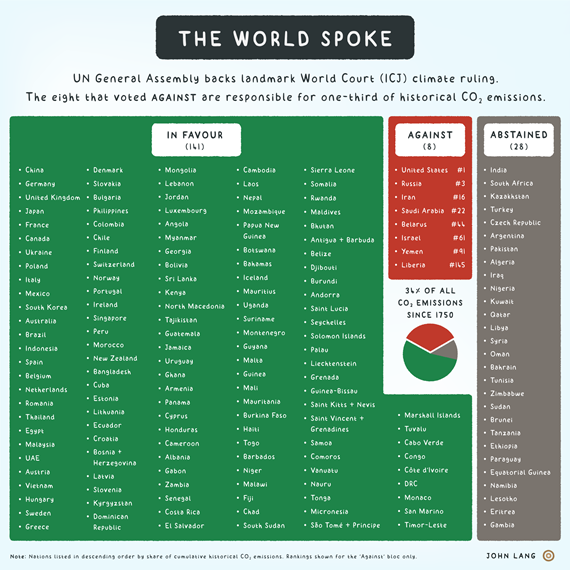
The UN General Assembly backed the ICJ’s landmark climate ruling by 141 votes to 8. The eight voting against, including the US and Russia, account for one-third of cumulative historical CO2 emissions since 1750.
The UN overwhelmingly backed the World Court’s climate ruling.
Climate change unfolds over decades. Political cycles don't. That's why countries are increasingly embedding climate action into law through targets, carbon budgets, independent oversight and long-term planning. This week's Climate Trunk graphic explores eight building blocks of effective climate governance.
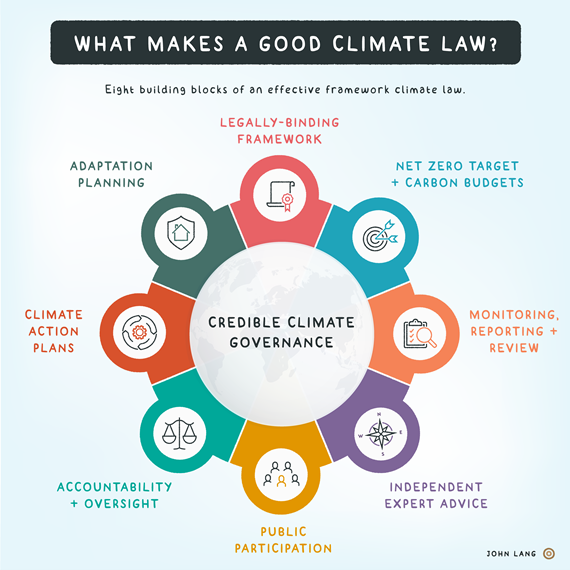
Eight building blocks of an effective framework climate law.
Setting a target brings scrutiny. Goog. But credible efforts to deliver it should bring recognition. Invert the pyramid: scrutinise silence first, and don’t let companies with no target escape accountability. Scrutiny should come with recognition when companies deliver, improve their plans or, importantly, honestly explain where they're falling short, why, and what’s needed to get back on track – be that stronger policy, say, or better grid infrastructure.
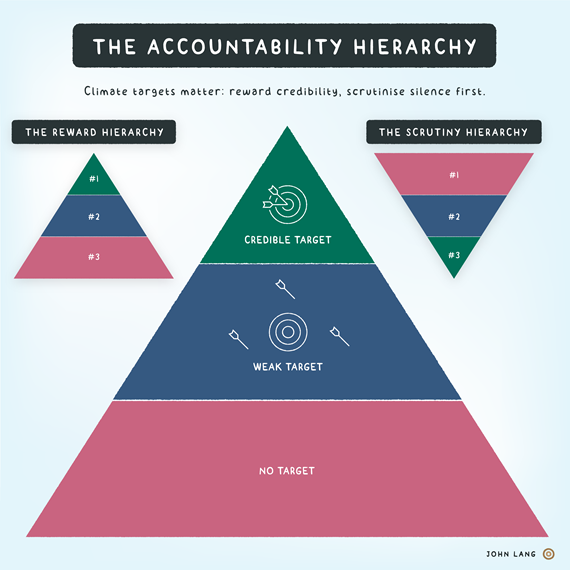
Targets should bring scrutiny. Credible action should bring recognition.
Net zero, carbon neutral and climate positive might sound similar, but the differences are vast. Net zero requires deep emission cuts and industrial-scale carbon removals, while carbon neutrality claims rely on credits that don't cancel out emissions already released into the atmosphere.
Reaching net zero CO2 will stabilise global temperatures, assuming other greenhouse gases (GHGs) are also controlled. Going further – towards net zero GHGs and net negative emissions – can eventually bring them back down. There’s a lot of work to do.
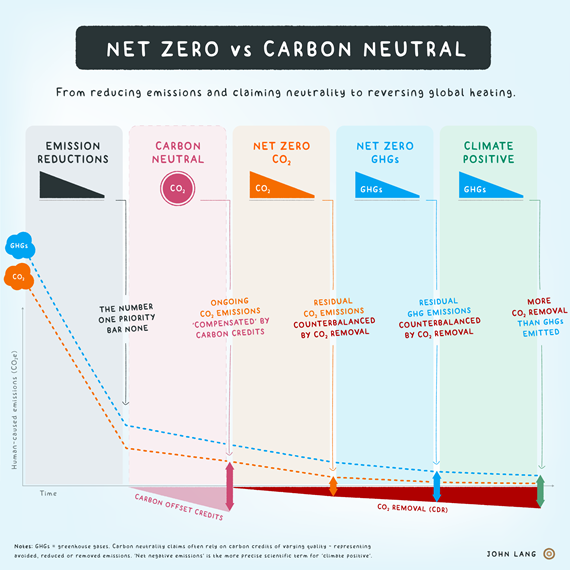
From reducing emissions and claiming neutrality to reversing global heating.
Berlin. Kyoto. Copenhagen. Paris. Glasgow. Dubai. Antalya. For more than three decades, governments have negotiated how to tackle climate change – with breakthroughs, disappointments and plenty of unfinished business. Progress there has been, but the atmosphere responds to cumulative emissions, not international consensus, which can be painstakingly slow.
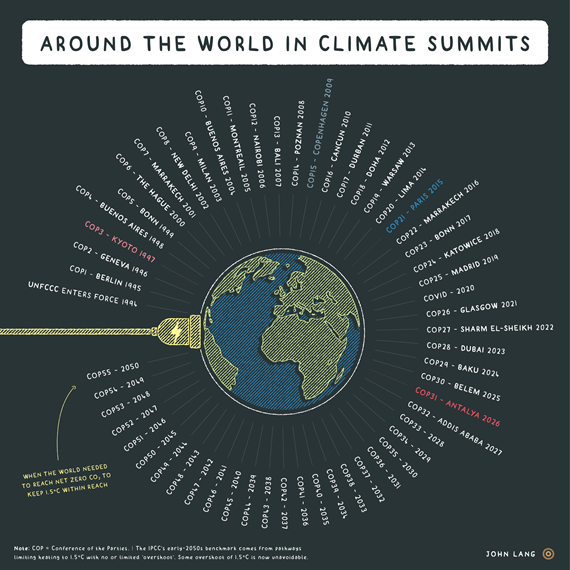
31 COPs. And counting.
... to be continued
Follow these links to dive into the other Climate Trunk rings: Science, Impacts, Economics, Political Economy, Solutions, Energy, Daily Life.
Posted by BaerbelW on Wednesday, 14 October, 2026

 |
The Skeptical Science website by Skeptical Science is licensed under a Creative Commons Attribution 3.0 Unported License. |