



 Arguments







The really big picture, in four pictures
Posted on 24 April 2026 by Guest Author
This is a guest blog post by John Lang about his new "Climate Trunk" graphics project and website. He will add one graphic per week for about 2 years rounding out the big picture of human-caused climate change graphic by graphic.
If you had to explain climate change in 10 seconds, what would you say?
Climate scientists Katharine Hayhoe and Kimberly Nicholas have long boiled it down to five phrases: It’s real. It’s us. It’s bad. We’re sure. And we can fix it.
This framing has helped millions cut through a topic swamped by jargon, acronyms and complexity. The first four Climate Trunk graphics owe a debt to that tradition.
You’ll notice below I leave one off: we’re sure. Not because scientific certainty doesn’t matter. It does. The evidence is overwhelming. Scientists have passed the gold standard of certainty on human-caused climate change: the five-sigma level. The scientific consensus is as solid as gravity – and like gravity, it doesn’t care what you believe.
I just don’t want to start on the defensive. I want to start by showing the big picture as simply as possible – ‘we’re sure’ will get its own graphic later.
With that caveat out of the way, here’s the Trunk version of the really big picture:
1. It’s real.
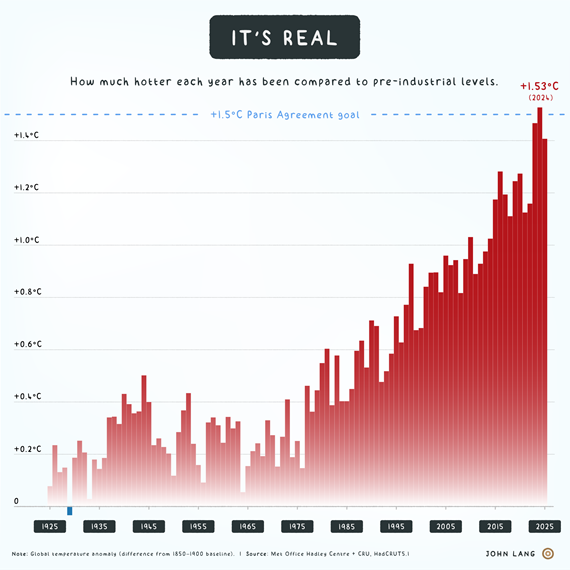
Earth is heating.
Global temperatures are rising, and faster than most people realise. The planet has heated by around 1.3°C since the late 19th century, with the bulk of that increase concentrated in the last 50 years. Land – where people tend to live – has heated by about 2°C on average already. (Ocean takes longer to heat up than land.)
In 2024, the global average reached 1.53°C above the pre-industrial baseline. That doesn’t mean the 1.5°C temperature goal of the 2015 Paris Agreement has been breached, since that threshold refers to the long-term average, not a single year. But it’s a warning that we’re inching closer.
2. It’s us.
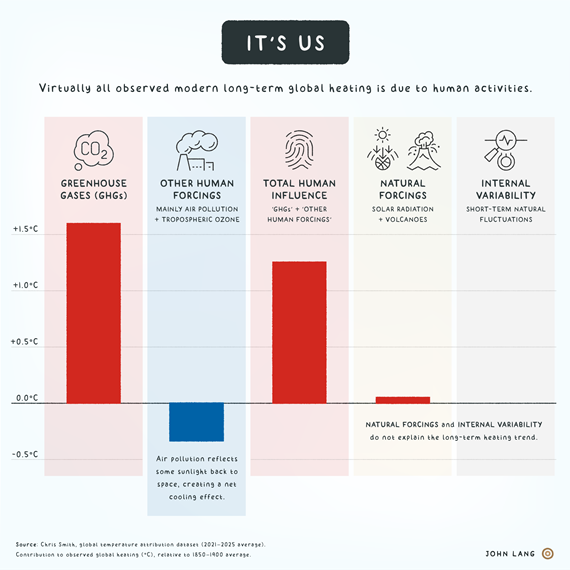
And it's 'unequivocal'.
Modern global heating is overwhelmingly caused by human activity. The best estimate of the human contribution is around 100%, and possibly a little more, because natural factors have likely had a slight cooling influence over the last 50 years or so.
Our greenhouse gas emissions, namely CO2, acts like an extra blanket, trapping more heat. Meanwhile, air pollution has removed a little of that blanket by reflecting some sunlight back to space, but only temporarily. Natural factors like the sun and volcanoes do not explain the long-term heating trend.
As the IPCC puts it: ‘It’s unequivocal that human influence has warmed the atmosphere, ocean and land.’
3. It’s bad.
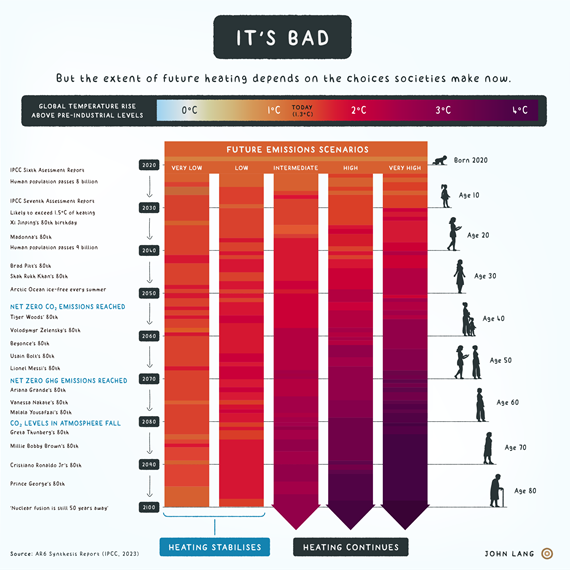
The future has not been written.
Climate change is not just a gradual rise in temperature. It is a destabilisation of the conditions under which human civilisation developed. Food systems, water supplies, infrastructure, ecosystems and political institutions were built under, and for, a relatively stable climate. That stability is now being disrupted at speed.
The risks rise with every increment of heating: more extreme heat, heavier rainfall, worsening droughts, greater strain on nature and growing odds of ‘double whammy’ shocks across societies. The future is far from pre-written, but it will branch according to the choices made by societies over the next decade or so.
4. We can fix it: net zero
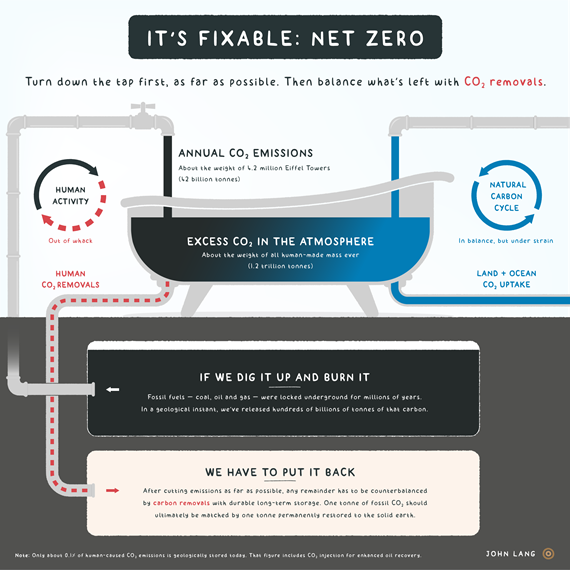
Net zero is the only way to stabilise rising temperatures.
This is the part that sometimes gets lost, between ‘it’s too late’ and ‘everything’s fine’. Or, as the late scientist Stephen Schneider put it: ‘the “end of the world” or “good for you” are the two least likely [climate] outcomes.’
We know that achieving net zero CO2 is the only way to stabilise rising temperatures, and the first step towards net zero greenhouse gases. Net zero means cutting emissions as far and as fast as possible, then using durable removals to counterbalance what’s left – the ‘residual’ emissions we can’t eliminate entirely. Net zero also means protecting the land and ocean sinks that already absorb about half of our CO2 emissions.
Durable removals will help, they have to. But emission cuts will do the heavy lifting. Cutting emissions now is almost always easier and cheaper than trying to remove them from the atmosphere later.
In a nutshell, the practicalities of net zero are almost as simple as Hayhoe and Nicholas’s five climate basics:
- replace fossil fuels with clean energy
- electrify energy systems as fast as possible
- protect, restore and strengthen land and ocean sinks
- scale up durable carbon removal to industrial levels.
The good news is the first two above are underway, and moving faster than many expected.
Clean energy is beginning to grow in line with — and at times faster than — energy demand: the key to squeezing fossil fuels out over time. Slowly at first. Then all of a sudden.
Solar has gone bananas. Together with wind, it now accounts for more than 90% of new power capacity. Clean electricity has surged past 40% of global generation, helping put a brake on CO2 emissions growth since 2015.
Yes, the norm-wrecking ball in the White House has dented investment confidence. But global spending on clean energy is roughly double that of fossil fuels – and growing. Meanwhile the Iran crisis is rewriting energy policy in real time: away from imports and volatility, and towards energy sovereignty, stability and lower fuel import bills.
As veteran energy analyst Michael Liebreich reminds us, we’re now about one-third through the energy transition in final energy terms. We're also close to a tipping point, where a China-led plateau in emissions should turn into a structural global decline.
Which brings us back to the most important of Hayhoe and Nicholas’s basics: we can fix it. We’re making progress – even if you can’t always see it.
Net zero isn’t a political slogan or culture war football. It’s physics and chemistry. And it’s the only way to stop global heating.
Want to get a notification when a new graphic gets published? Then subscribe to John Lang's newsletter!









Great job on creating nice, clearly communicating visuals. They really help tell the story. But I have a question related to point 5. The author writes,
It’s real. It’s us. It’s bad. We’re sure. And we can fix it.
... we’re now about one-third through the energy transition in final energy terms.
And yet the Keeling Curve is still accelerating upwards. From 2023 to 2024 we had the single largest recorded one-year jump in atmospheric CO2 concentrations (Climate change: atmospheric carbon dioxide).
If we are making such great strides in the energy transition, then why is the Keeling Curve still accelerating upwards?. In the end, what matters is what the Keeling Curve is doing. I encourage people to plan their futures based on what the Keeling Curve is doing.
Remember that the "wrecking ball" in the White House is there because a majority of Americans wanted him there. Apparently there are issues for many people more important than clean energy transitions.
Just be cause we theoretically can fix it doesn't mean we will have the will to fix. So far we are losing the battle, if you believe the Keeling Curve.
Evan, one thing that stands out to me about the article is the claim that we are one third through the energy transition appears a little bit misleading, or at least somewhat hyped. It appears to mean electricity generation given the surrounding context in the article. But energy isn't just about electricity generation. We certainly aren't one third through the transition to electric vehicles or zero carbon home heating. So I would guess we are more like 15% through the total energy transition at best.
Perhaps this is not really enough to show up in the keeling curve yet, given all the noise in the signal.
However I do share all your concerns. Although I'm trying to also keep a hopeful, positive attitude for my own sanity.
“We can easily forgive a child who is afraid of the dark; the real tragedy of life is when men are afraid of the light.” The child outgrows the dark with time. The adult who fears the light, however, may never choose to grow. They remain perpetually in a more profound darkness—one not of the eyes, but of the mind and soul.
I certainly appreciate bringing the truth of GHG to those wanting the big picture but it seems that positions of power bring psychopaths like moths to a flame. Sadly to further infect more darkness to the vulnerable.
When reading "we can fix it", I am reminded of an old friend's story of her attempts to improve her daughter's grammar. Her daughter would sometimes ask "can I do [something]". When the daughter was asking for permission to do something my friend did not want her doing, my friend would respond with "you can, but you may not". (My friend stopped doing this when a teacher complained to her about her daughter's attitude in class. It turned out that the teacher had once asked the daughter "Can I do [something]?", and the daughter had said to the teacher "you can, buy you may not".)
Ultimately, the point is that "can do" is not strictly the same as "will do". Something may be physically possible, but getting people to do it is another matter.
Can we cut missions and stabilize CO2? Yes. Will we? I can only hope.
"Will we? I can only hope" I don't believe we will, for an odd reason having to do with human character: Fossil interests have convinced many people that Climate Concern is, ultimately, a question of faith. As in "since God would not allow our home to become unlivable, why worry?" Encouraged to think that way, many people have come to think that this is a game of 'chicken', and to become alarmed by Climate Change is to lose the game. And this attitude is supported by our experience with the idea of reversibility: if there really is a cliff at the end of this trail, lets just wait until we see the cliff in person, and then we'll reverse course. I tell people that the real danger of Climate Change is not severity, it's irreversibility. That is, in this case, for the climate to change, first you warm a planet. Then, if you don't like the climate that results, well, then what? Reverse course? How do you unwarm a planet? And that's the part of this that people aren't thinking about. Everything in our history suggests we can backtrack away from danger, once it finally becomes visible. On this issue, once you can see the danger its too late: not only is the planet not going to cool itself on command, but internal mechanisms, like sheer momentum, mean the danger will grow. We're stuck in a game of 'chicken' and our fellow passengers are saying "I'm not afraid, why are you? Find some backbone!", and simultaneously are thinking "Well, if it gets bad, we'll just turn around."
"Well, if it gets bad, we'll just turn around."
I'm sure that's what Thelma and Louise were thinking right up to the last triumphant scene of the movie.