



 Arguments







EGU2026 - Five days of virtual learning
Posted on 9 May 2026 by BaerbelW
This blog evolved over the week of May 4 to 8, 2026 when I was adding to it from day to day as time allowed. It may still see some updates even after fully published on our homepage as some more information becomes available.
This year's General Assembly of the European Geosciences Union (EGU) took place from May 4 to 8 2026 both on premise in Vienna and online as a fully hybrid conference. This year, I had decided to join virtually, picking and chosing sessions I was interested in. This blog post is a compilation - a kind of personal diary - of the happenings in Vienna from my perspective.
All told, 21,117 abstracts were submitted for the conference back in January and this year’s programme included over 1,000 scientific sessions, 62 short courses, 16 keynote Union Symposia and Great Debates, 38 Medal and Award lectures, as well as the Job Centre, Artists in Residence, GeoCinema, Science-Policy events and much, much more.
As this post is fairly large, you can jump to the different days, via these links:
Monday - Tuesday - Wednesday - Thursday - Friday - Summary
The already published prolog blog post contains a summary of what I had planned for the week. Let's see how well - or not - the plans match reality!
Monday, May 4
The very first session I attended at this year's EGU conference was EOS1.1 Science and Society: Science Communication Practice, Research, and Reflection which started at 8:30 in the monring and lasted until lunchtime with a 30 minutes break in the middle.
Science communication includes the efforts of natural, physical and social scientists, communications professionals, and teams that communicate the process and values of science and scientific findings to non-specialist audiences outside of formal educational settings. The goals of science communication can include enhanced dialogue, understanding, awareness, enthusiasm, influencing sustainable behaviour change, improving decision making, and/or community building. Channels to facilitate science communication can include in-person interaction through teaching and outreach programs, and online through social media, mass media, podcasts, video, or other methods. This session invited presentations by individuals and teams on science communication practice, research, and reflection.
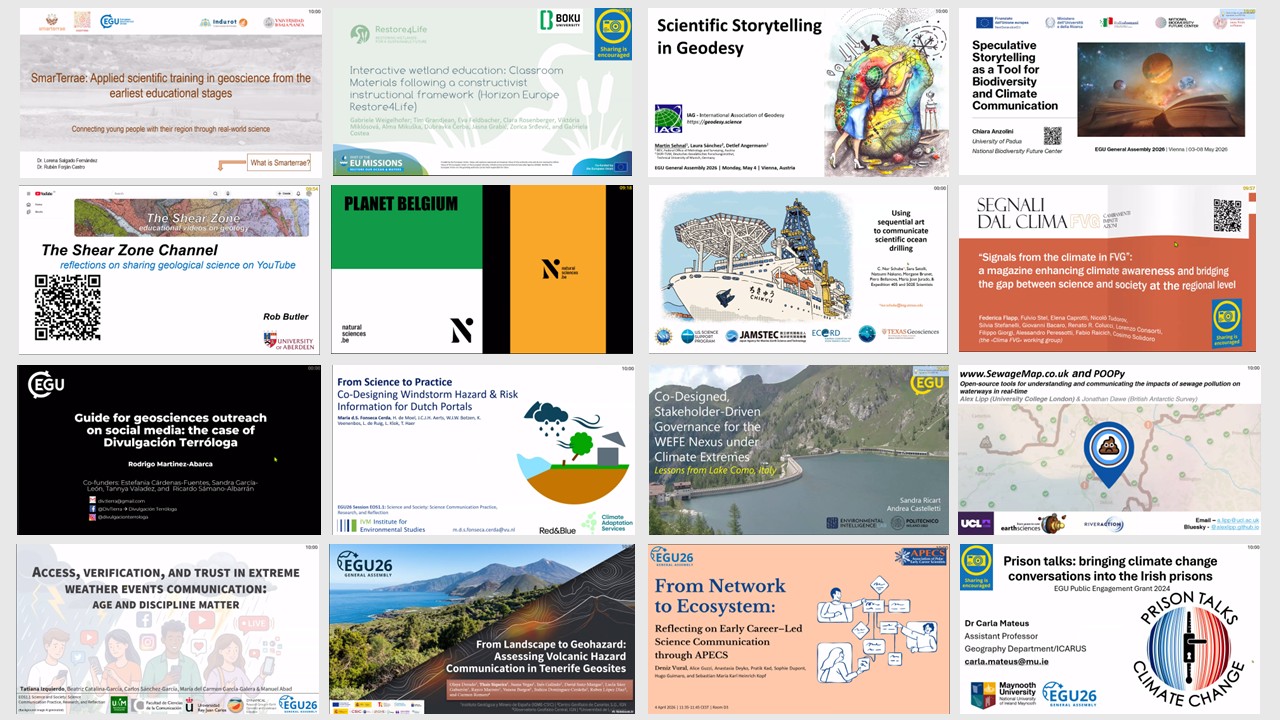
During this session we heard about many examples of science eduction and communication in various countries (Italy, Spain, Ireland, The Netherlands, Great Britain, Belgium...), settings (schools, university, public outreach, prisons...) and topics (Climate change, natural hazards, polar science, geodesy...):
- Lorena Salgado - SmarTerrae: Applied scientific training in geoscience from the earliest educational stages
- Gabriele Weigelhofer - Interactive wetland education: Classroom materials following a constructivist instructional framework (Horizon Europe Restore4Life)
- Martin Sehnal - Scientific Storytelling in Geodesy: Using Cartoons, Videos, and Digital Platforms to Reach New Audiences
- Chiara Anzolini - Speculative Storytelling as a Tool for Biodiversity and Climate Communication
- Rob Butler - The Shear Zone Channel – reflections on sharing geological science on YouTube
- Reinout Verbeke - Planet Belgium: narrating the geological odyssey of a country through multimedia storytelling
- C. Nur Schuba - Using sequential art to communicate scientific ocean drilling
- Federica Flapp - “Signals from the climate in FVG”: a magazine enhancing climate awareness and bridging the gap between science and society at the regional level
- Rodrigo Martinez-Abarca - A guide to outreach geosciences on social media: the case of Divulgación Terróloga
- Maria del Socorro Fonseca Cerda - From Science to Practice: Co-Designing Windstorm Hazard & Risk Information for Dutch Portals
- Sandra Ricart - Co-Designed, Stakeholder-Driven Governance for the WEFE Nexus under Climate Extremes: Lessons from Lake Como, Italy
- Alex Lipp - www.SewageMap.co.uk and POOPy: Open-source tools for understanding and communicating the impacts of sewage pollution on waterways in real-time
- Tatiana Izquierdo - Access, verification, and trust in extreme weather events communication: age and discipline matter
- Thais Siqueira - From Landscape to Geohazard: Assessing volcanic hazard communication in Tenerife geosites
- Deniz Vural - From Network to Ecosystem: Reflecting on Early Career–Led Science Communication through APECS
- Carla Mateus - Prison talks: bringing climate change conversations into the Irish prisons
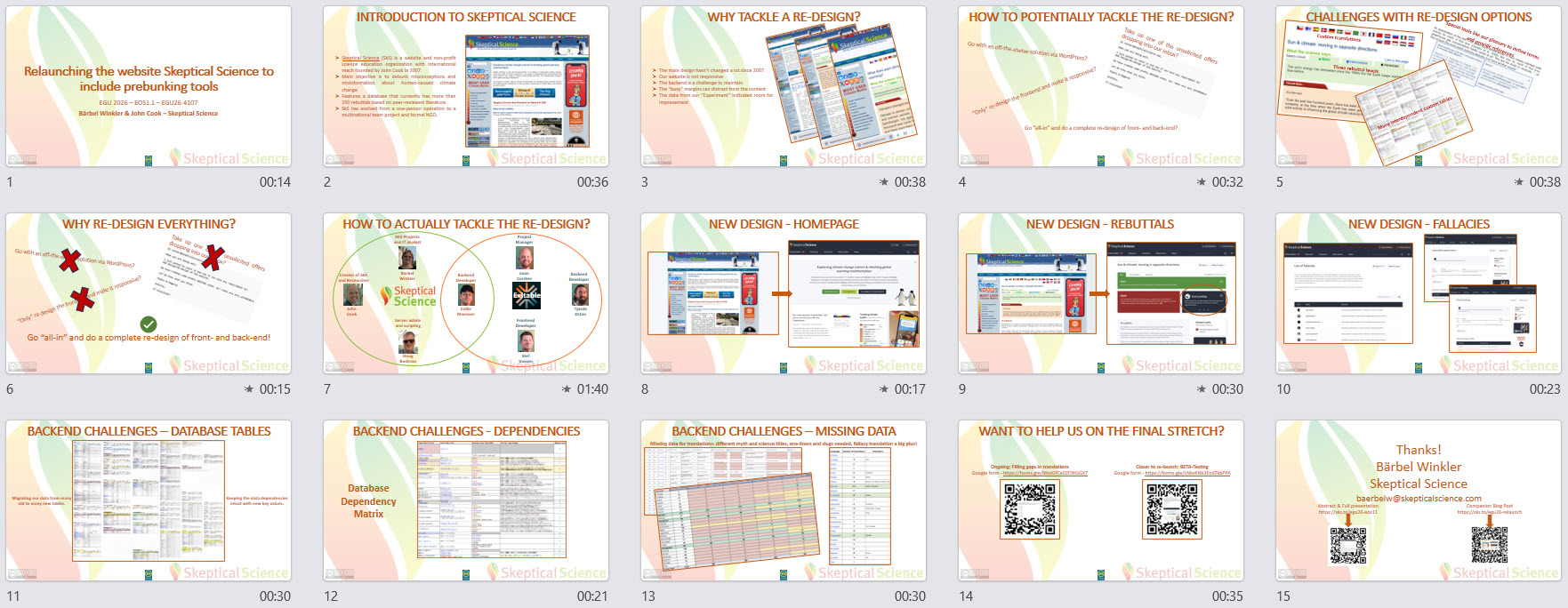
This session included my own presentation right in the middle before the coffee break where I talked about our website relaunch project as already mentioned in my prolog blog post. In the meantime, I created a "companion blog post" for my presentation which includes all the slides and accompanying text as well as a link to download the PDF-version.
The session ended for today - there'll be more tomorrow! - with Philip Heron giving the invited Katia and Maurice Krafft Award Lecture titled What we’ve learned from teaching people in prison to Think Like a Scientist. Here is a snippet from this abstract to give you some context
Scientific thinking requires the critical analysis of information, while science itself thrives on the diversity of ideas. Yet, science, technology, engineering, and math (STEM) subjects have historically struggled to be inclusive and accessible to students from underrepresented communities - meaning we often miss a diversity of voices. Furthermore, STEM subjects have often been rigid in their teaching structure, creating barriers to education for students with more specific (or unrecognised) learning needs.
To address this, our science outreach course Think Like A Scientist was designed to improve critical thinking and encourage independent thought by applying adaptive education practices to create inclusive and accessible classroom environments. The program started in 2017 and has been applied in several different settings (e.g., schools and adult learning centres), but has mainly featured in prisons around the world (including England, Canada, Australia, and Spain).
In the afternoon I joined session EOS4.1 Geoethics: Linking Geoscience Knowledge, Ethical Responsibility, and Action. This session was created by merging EOS4.1 (26 abstracts) Geoethics: Linking Geoscience Knowledge, Ethical Responsibility, and Action, EOS 2.6 (9 abstracts) From crisis to action: Education and communication for climate, ocean, overshoot and geoethics and EOS4.2 (7 abstracts) Geoscience research and collaboration in times of geopolitical crises.
Geoscientists play a key role in providing essential information in decision-making processes that consider environmental, social, and economic consequences of geoscience work. Therefore, their responsibilities extend beyond scientific analysis alone. Global challenges, such as climate change, resource management, and disaster risk reduction, push geoscientists to expand their role beyond research and to engage ethically in public efforts.
Geoethics provides a framework for reflecting on the ethical, social, and cultural implications of geoscience in research, practice, and education, guiding responsible action for society and the environment. It also encourages the scientific community to move beyond purely technical solutions by embracing just, inclusive, and transformative approaches to socio-environmental issues.
Furthermore, science is inseparable from social and geopolitical contexts. These conditions shape what research is funded, whose knowledge is valued, with whom we collaborate, and who has access to conferences. As Earth and planetary scientists, we must consider the human and environmental consequences of our work. This is especially true in Earth observation, where many satellites have both scientific and military applications, and where scientific tools have at times enabled ecocide and resource exploitation under neocolonial systems.
This session will offer insights and reflections across a wide range of topics, from theoretical considerations to case studies, foster awareness and discussion of sensitive issues at the geoscience–society interface and explore how geoethics can guide responsible behavior and policies in the geosciences.
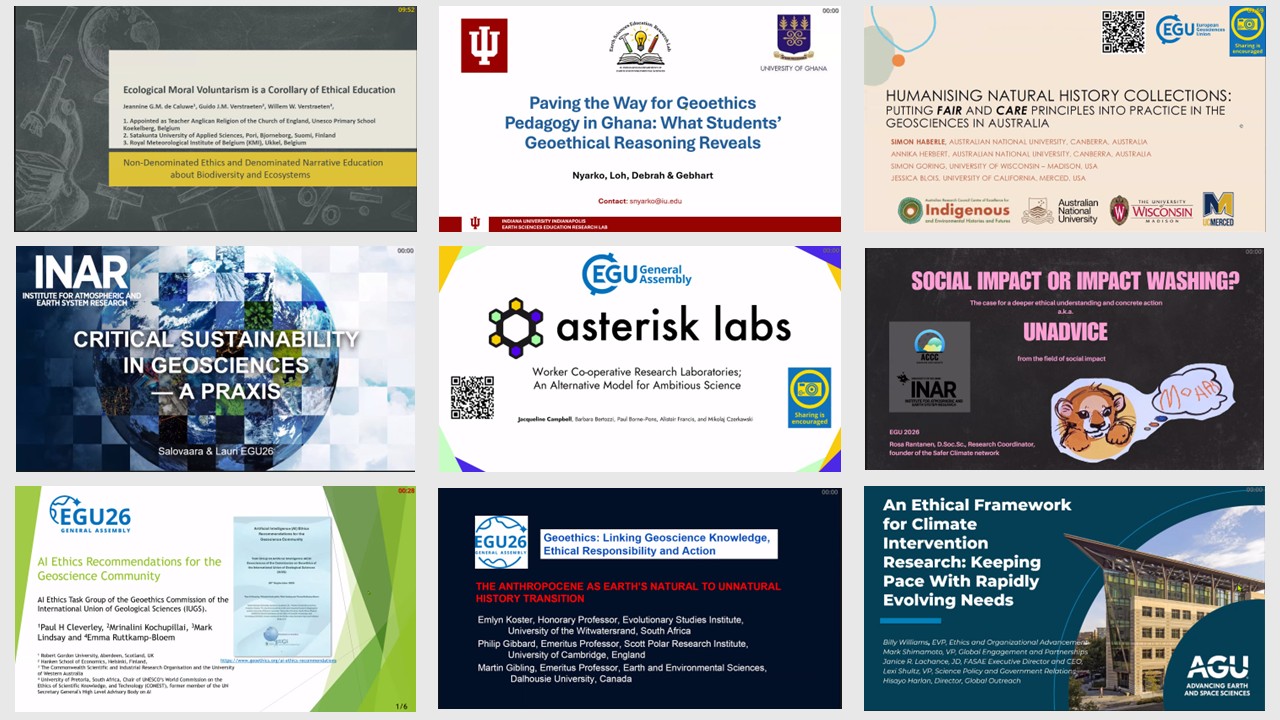
The nine presentations in the first half of the session covered a wide range of topics related to the field of geoethics. We heard about moral values in the scope of ecosystems and biodiversity, about creating a new curriculum for ethical awareness in Ghana, about respecting indegenous knowledge in Australia in the era of big data, about turning sustainability into practice, about a workers.coop in the UK creating data tools for scientists, about avoiding "impact washing", about the ethical usage of AI and LLMs, about the ongoing anthropocene debate and the needed ethical framework for climate intervention research:
- Jeannine G.M. de Caluwe - Ecological Moral Voluntarism is a Corollary of Ethical Education
- Samuel Nyarko - Paving the way for geoethics pedagogy in Ghana: what students’ geoethical reasoning reveals
- Simon Haberle - Humanising Natural History Collections: Putting CARE principles into practice in the geosciences in Australia
- Janne J. Salovaara - Critical Sustainability in Geosciences — A praxis
- Jacqueline Campbell - Worker Co-operative Research Laboratories; An Alternative Model for Ambitious Science
- Rosa Rantanen - Social impact or impact washing? The case for a deeper ethical understanding and concrete action
- Paul Cleverley - Fostering the ethical use of Artificial Intelligence in the Geosciences
- Emlyn Koster - The Anthropocene as Earth’s natural to unnatural history transition
- Billy Williams - An Ethical Framework for Climate Intervention Research: Keeping Pace with Rapidly Evolving Needs
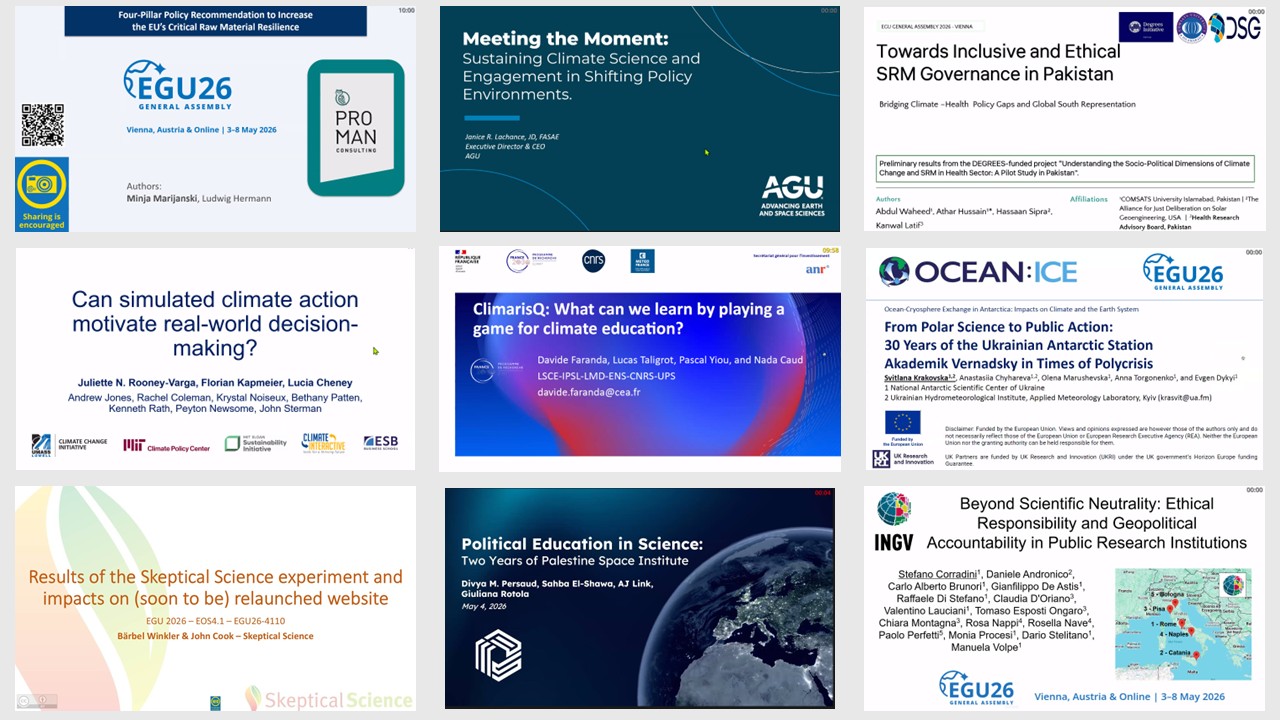
After the coffee break we heard about the EU's high dependency on critical raw materials, how AGU responds in the U.S. with science being under threat by the current administration, about solar-radiation management concerns in Pakistan, about Climate Interactive's en-Roads simulator and how its utilized, about the game ClimarisQ, about the 30th anniversary of Ukraine's Antarctic Station Akademik Vernadsky, about the Palestine Space Institute and doing science in regions of war, about different measures scientific institutions are taking (or not) in case of armed conflicts and genocide:
- Ludwig Hermann - Four-pillar policy recommendation to increase the European Union’s critical raw material resilience
- Janice Lachance - Meeting the Moment: Sustaining Climate Science and Engagement in Shifting Policy Environments
- Abdul Waheed - Towards Inclusive and Ethical SRM Governance in Pakistan: Bridging Policy Gaps and Global South Representation
- Juliette Rooney-Varga - Interactive simulation with En-ROADS spurs climate action among decision-makers
- Davide Faranda - ClimarisQ: What can we learn by playing a game for climate education?
- Svitlana Krakovska - From Polar Science to Public Action: 30 Years of the Ukrainian Antarctic Station Akademik Vernadsky in Times of Polycrisis
- Divya M Persaud - Political Education in Science: Two Years of Palestine Space Institute
- Stefano Corradini - Beyond Scientific Neutrality: Ethical Responsibility and Geopolitical Accountability in Public Research Institutions
- Shahzad Gani - Best practices for geosciences in the time of crises
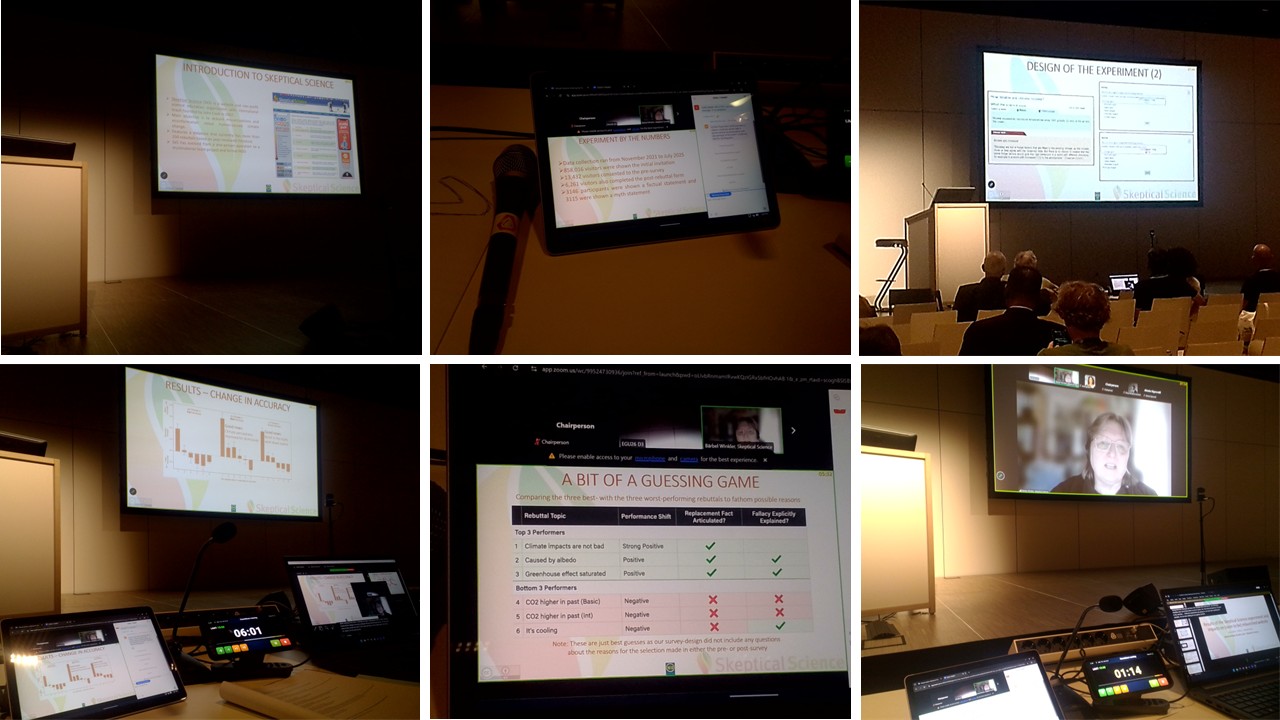
In this part of the session, I had the chance to tell participants about the results of the Skeptical Science experiment. Like with my other presentation you can read up on it in a companion article from where you can also download the PDF-version of my talk.
Before my presentation I had asked Pimnutcha Promduangsri to grab a few pictures onsite in Vienna to also get some impressions from how it looked like as seen in the conference room. Here is a compilation of some of the images Pim was kind enough to send over:
Tuesday, May 5
Tuesday morning started at 8:30 with the 2nd half of EOS1.1 Science and Society: Science Communication Practice, Research, and Reflection and lasted until lunchtime with a 30 minutes break in the middle.
In the presentations before the coffee break, the speakers told us about projects in Switzerland, Hongkong, France, Japan, Greenland, Italy, the UK and the United States. We heard about projects related to food, rainfall, soil, caves, air quality, clean water and flood hydrology and how they were used in communication and outreach activities with the public.
- Alex Valach - Community outreach using positive sensory experiences: A taste of climate change
- Hermione Mok - Communicating Food and Climate: The Role of Science Communication for Engagement
- Auguste Gires - Enhancing awareness of the geophysical environment through a multisensory rainfall experience
- Keiko Mori - Appealing to the senses, long-run workshops and exhibitions on soil for museum visitors
- Gina E. Moseley - Science communication in Greenland: Experiences from the Kalaallit Nunaat Caves and Climate Outreach Project (KINDLE)
- Marta Galvagno - Engaging young audiences in climate change: moving beyond fear through active science communication
- Carly Reddington - Visualising historical changes in air pollution with the Air Quality Stripes
- Luisa Galgani - The Italian Citizen Science Observatory: a growing association open to collaboration to foster public participation and education in water research Europe-wide
- Lisa Gallagher - Learning, creating, and sharing: A science communication framework for water and climate education
- Linda Speight - Communication within the UK flood hydrology community: bridging the gaps between science and practice

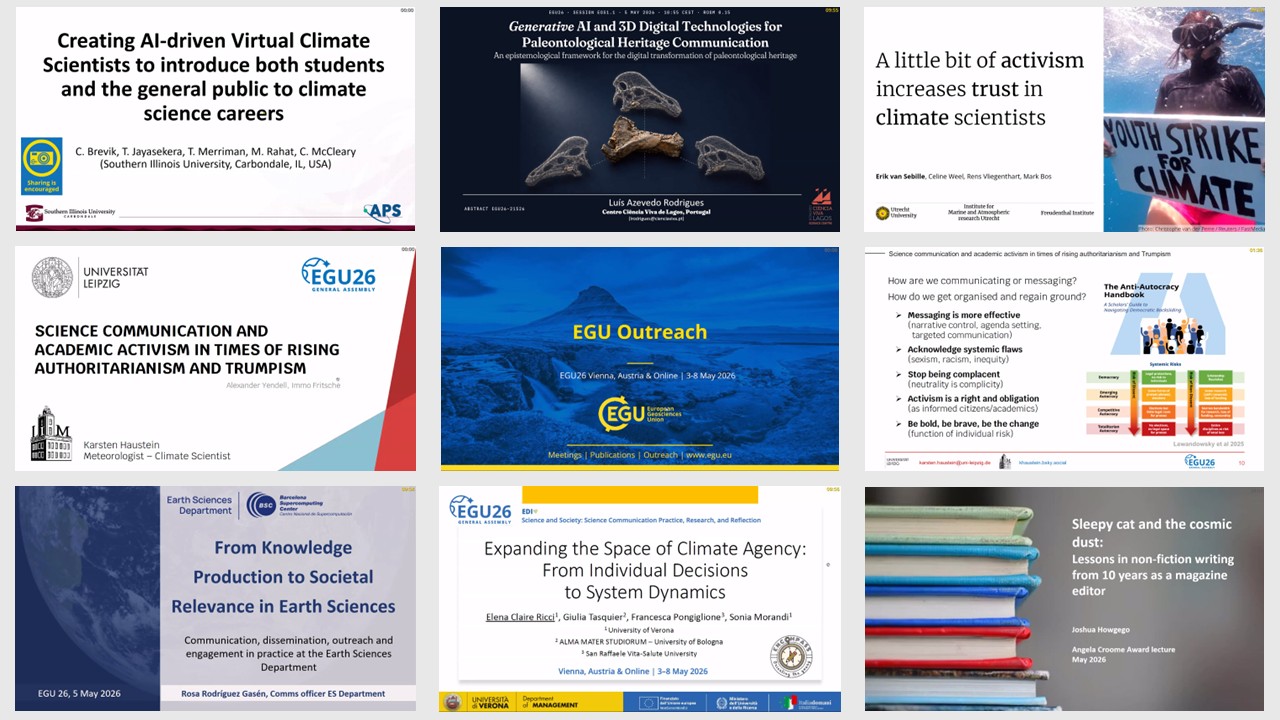
After the coffee break we heard about AI-created virtual climate scientists, how generative AI could be utilized for paleontological communication, how some activism increases trust in climate scientists, how science communication and activism is impacted by authoritarianism and how knowledge can be made relevant for society as well as for individual choices. Last but not least, Joshua Howgeg gave the Angela Croome Award Lecture in which he talked about lessons for non-ficting writing based on his experience as a magazine editor.
- Corinne Brevik - Creating AI-driven Virtual Climate Scientists to introduce both students and the general public to climate science careers
- Luis Azevedo Rodrigues - Generative AI and 3D Digital Technologies for Paleontological Heritage Communication: An Epistemological Framework and Practical Applications
- Erik van Sebille - A little bit of activism increases trust in climate scientists
- Karsten Haustein - Science communication and academic activism in times of rising authoritarianism and Trumpism
- Rosa Rodríguez Gasén - From Knowledge Production to Societal Relevance in Earth Sciences
- Elena Claire Ricci - Expanding the Space of Climate Agency: From Individual Decisions to System Dynamics
- Joshua Howgeg - Sleepy cat and the cosmic dust: Lessons for non-fiction writing from 10 years as a magazine editor - Angela Croome Award Lecture
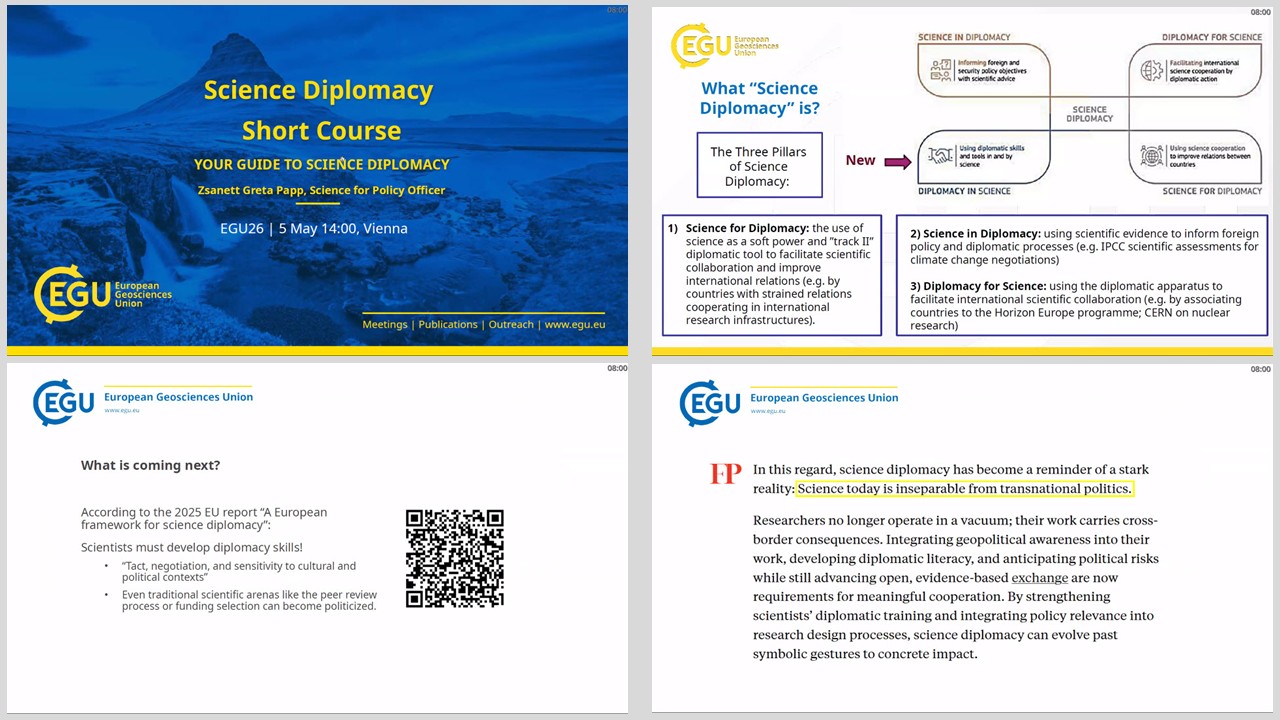
After the lunch break I joined short course SC3.4 Science Diplomacy: What is it and how to engage to learn more about the overlap between science and diplomacy. This course was convened by Lene Topp, Zsanett Greta Papp, Alfonso Acosta and Noel Baker who all gave short keynote about their connections with the topic. They were joined online by Jan Marco Müller who gave a short presentation about his path from geoscientists into science diplomacy at the European Commission.
Global challenges, such as climate change and natural hazards, are becoming increasingly complex and interdependent, and solutions have to be global in scope and based on a firm scientific understanding of the challenges we face. At the same time, Science and technology are playing an increasingly important role in a complex geopolitical landscape. In this difficult setting, scientific collaboration can not only be used to help address global challenges but also to foster international relations and build bridges across geopolitical divisions. Science diplomacy is a broad term used both to describe the various roles that science and researchers play in bridging geopolitical gaps and finding solutions to international issues, and also the study of how science intertwines with diplomacy in pursuing these goals.
During this Short Course, science diplomacy experts will introduce key science diplomacy concepts and outline the skills that are required to effectively engage in science diplomacy. They will also provide practical insights on how researchers can actively participate in science diplomacy, explore real-life examples of science diplomacy, and highlight resources where participants can learn more about science diplomacy moving forward.
Here are some of my take-aways from this course:
- Science and diplomacy are intricitely linked in that one informs the other and one is needed for the other and this goes both ways in each case
- The rise of populism and authoriatarianism are changing the landscape
- Geoscience has a lot of touchpoints with diplomacy
- Quote (Maria Leptin): "We don't ask our researchers to be diplomats - yet their excellent science naturally feeds into global policy."
- Nations retreat from multilateralism
- Nations put up barriers to international scientific collaboration
- Some challenge evidence-informed policymaking
- Scientific endeavours like turning a wetland into a protected area can have diplomatic implications if the water comes from across the border or if too much water is used for agriculture
- Right now, scientific spending often has to compete with defense spending
- Some institutions may be tempted to accept defense funding for "dual use" research
- Such "dual use research" could however make an institution's campus a military target in case of war
Resources linked in the presentation for anybody interested in learning more:
- EU Science Diplomacy Alliance
- Free online 8-module introduction course on Science Diplomacy
- 9 case studies on Science Diplomacy
- The World Academy of Sciences
- Towards a European Framework for Science Diplomacy (e.g. new EU report)
- Article: What is a Science Diplomat?
- Article: Building a Science Diplomacy Curriculum
- EGU GeoPolicy Blog: Science Diplomacy in a new Geopolitical order
- The Science Diplomat
After the afternoon coffee-break it was time for a fun but most likely challenging session for the authors: EOS1.6 - Up-Goer Five Challenge: Making Big Ideas Simpler by Talking About Them in Words We Use a Lot. The session was held in one the underground PICO sessions and unfortunately, the Zoom-sessions wasn't completely stable, so I didn't always get the full presentation.
Whether you thrill at the chance to tell taxi drivers and dinner-table companions about your research or want to hide every time someone asks, “What do you do?”, we offer an exciting and valuable challenge for you.
Inspired by the XKCD comic that describes the Saturn V Rocket using only the thousand most common words in English (https://xkcd.com/1133/), we ask speakers to present short (~5-minute) scientific talks using the same vocabulary (determined via the Up-Goer Five Text Editor: https://splasho.com/upgoer5). The talk is preferably about your own research but can also be about a general topic you are interested in.
Here are some examples for Up-Goer-Five lingo - can you guess what they describe (solutions below the image)?
- people-flying things
- sky water
- space eye in the sky
- black underground burn stuff
- computer pictures
- middle water
- cold part of the world with water
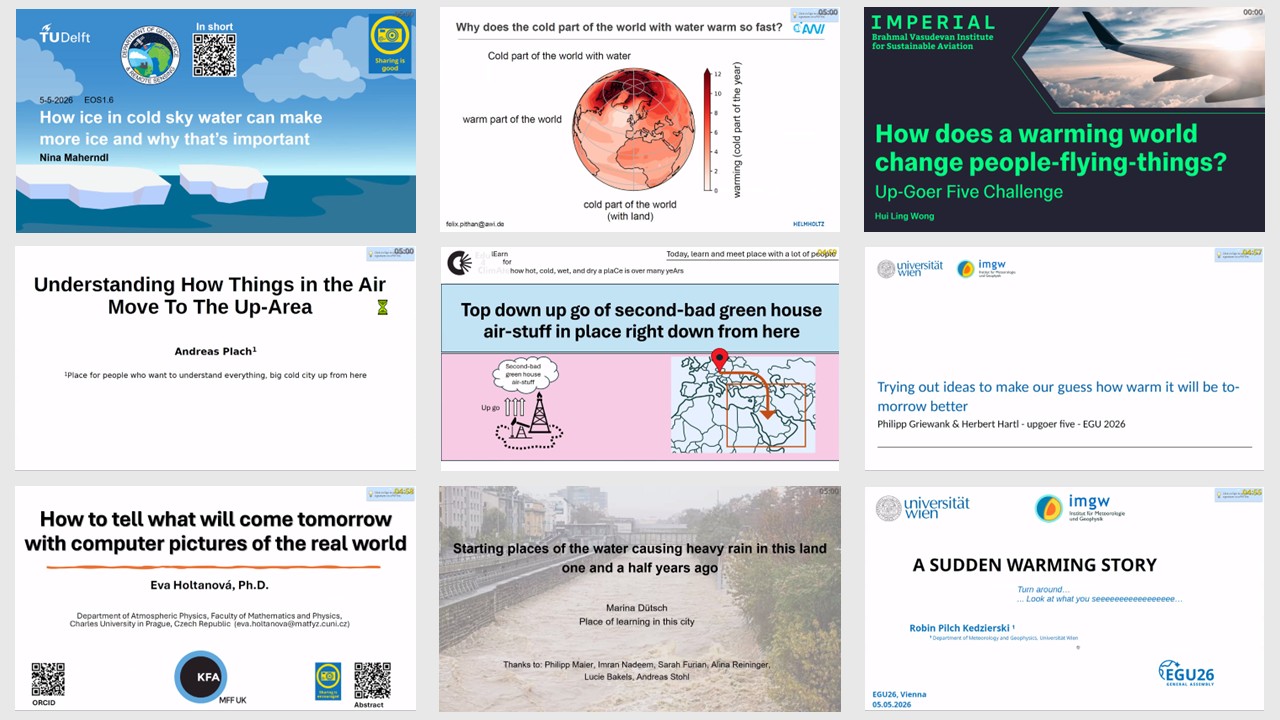
Solutions:
- people-flying things = airplanes
- sky water = rain
- space eye in the sky = satellite
- black underground burn stuff = coal & oil
- computer pictures = models
- middle water = Mediterranean Sea
- cold part of the world with water = Arctic
Wednesday, May 6
My day started with Union Symposium US6 - Climate change, morals, values and policies, convened by Noel Baker, Chloe Hill, Mario Scharfbillig, Emmanuel Salmon and Maria Vittoria Gargiulo:
The climate challenge is no longer only about understanding the Earth system, it is also about understanding ourselves as humans. As a global society, response to climate change information and climate action policies is shaped not only by scientific evidence, but also by moral values, cultural identities, religious beliefs, fears, and psychological dynamics. Attitudes that may appear irrational often reflect deeper questions of meaning, trust, and social belonging. How can scientists and governments communicate climate science in ways that resonate with diverse societies without resorting to manipulative tactics? How can decision-makers design ethical and inclusive policies that inspire meaningful action at individual, community, and societal levels?
This Union Symposium will bring together experts from multiple disciplines to explore these questions through both scientific research and practical experience. Speakers will examine the moral, psychological, cultural, and social dimensions that shape public engagement with climate change. Perspectives from religious traditions, as well as indigenous and marginalized communities, will broaden the dialogue and offer insights into how climate communication and policy can become more inclusive, trustworthy, and impactful.
The symposium started with an introduction by Dr. Mario Scharfbillig, who uses behavioural insights to improve evidence-informed policymaking and democratic processes in the EU. He first noted that there is broad global support for climate action but that this is not really well-known due to a perception gap leading people to consistently underestimate the willingness of others to act. This also holds true for politicians and there own voters.
People have different priorities dependent on whether the focus is on higher order values, personal values, values terminology, social identities or the big picture. People live in different worlds which can be caused by and/or lead to information overload, distorted reality, echo chambers or even echo platforms and a "fantasy-industrial complex".
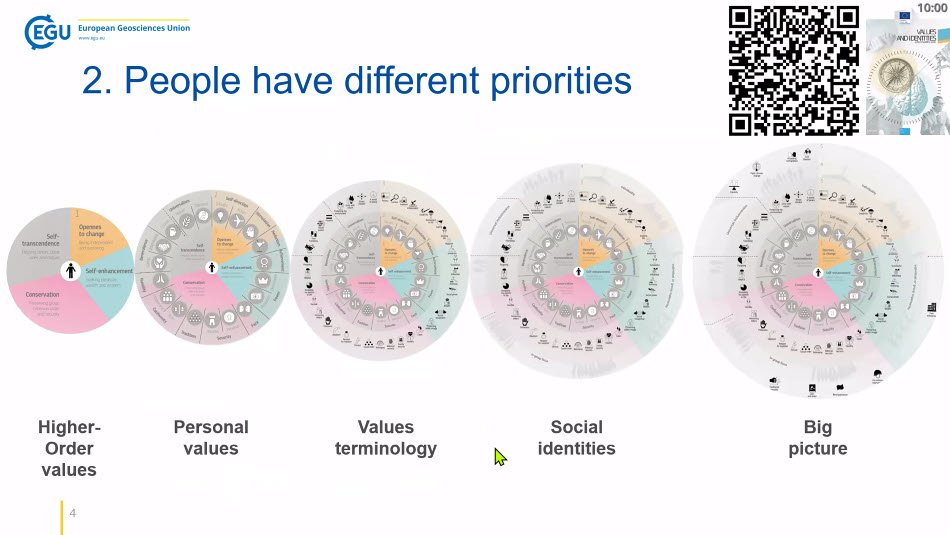
Illustration based on JRC-Publication Values and Identities - a policymaker's guide
After this introduction, each panelist gave a 10-minute keynote to "set the stage" for the subsequent discussion.
Raffaella Russo is an economist and project manager working at the science-policy intcrface, focusing on the socio-cconomic impacts of climate risks, risk perception, and adaptation strategies. She is a member Of EGIYs Climate Hazards and Risks Task Force.
She started with a quote from the European Environement Agency: "Climate change is already impacting Europeans' daily lives and will continue to do for the foreseeable future. Europe is expected to get warmer, some regions getting drier, while others wetter. These changes will not only impact our health bu also the ecosystems we depend on. The EU is preparing to live with a changing climate through various adaptation measures."
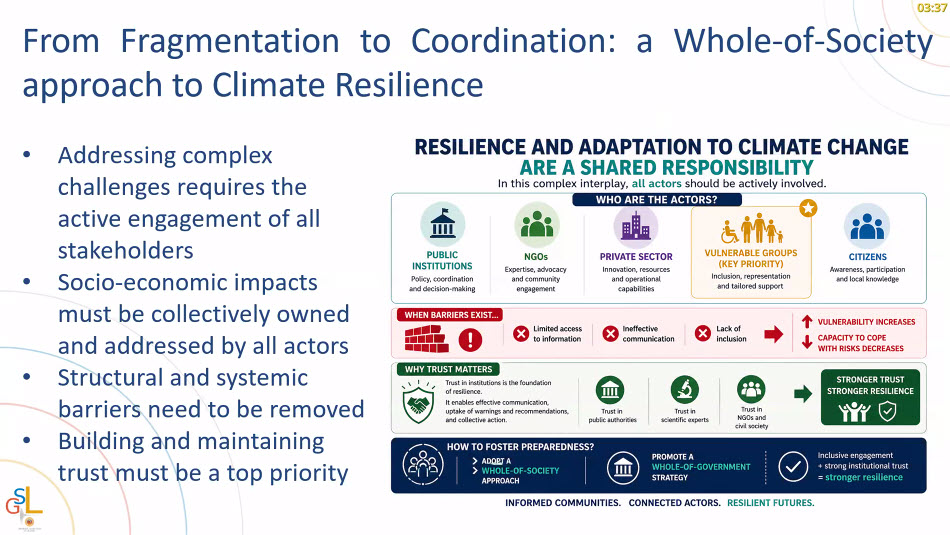
She then gave a few examples illustrating the transition from isolated shocks to recurring and compoundng events happening in Italy just between 2023 and 2025. She pointed out that - while funding from the country and EU was allocated after the 2023 Emilia Romagne flooding - there is a need to strengthen the private sector involvement in climate adaptation programming. In addition, fragmentation has to be replaced by coordination in order to reach a whole-of-society approach to climate resilience.
Eli Mitchell-Larson is a climate advocate, policy entrepreneur, and Ph.D. researcher based at the University of Oxford. Eli currently advises the Climate Pathfinders Foundation, facilitating grants to advance carbon dioxide removal and next-generation climate interventions. He previously co-founded and served as Launch Director and Chief Scientist at Carbon Gap, Europe's leading NGO dedicated to responsibly scaling carbon dioxide removal.
He laid out five hypothesis related to climate advocacy [I updated the list after watching the recording]:
- For geoscientists there are no neutral choices. Every choice we make is politically relevant.
- Climate policy-advocacy is not a monolith, it can be behind the scenes, it can be slow, it can be measured, it can be injecting expertise where needed.
- Engaging with climate policy is not as challenging or isolating as a lot of researchers may fear.
- Engaging with climate policy makes you a better scientist.
- Geoscientists are uniquely suited to be climate policy advocates.
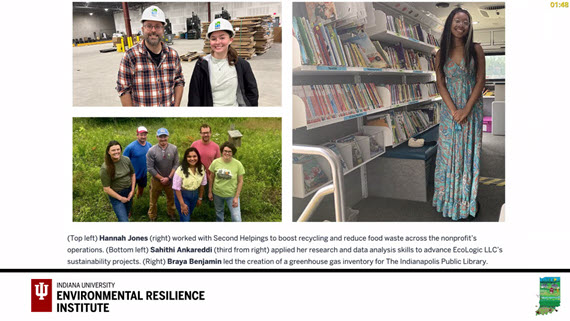
Dr. Gabriel Filippelli is the Chancellor's Professor, Director of the Center for Urban Health, Executive Directorr Environmental Resilience Institute at Indiana University in the United States. He started his keynote with an image of the Keeling Curve which is a "5-alarm fire" for scientists but doesn't really mean much for people you might meet in a train or on the street.
Individuals care about concrete instead of abstract things (e.g. fuel prices vs. polar bears) and there's therefore a need to change the message. Compare "things" like energy infrastructure on equal footing and with concrete numbers, so for example point out the noise and pollution caused by an oil refinery to that of a solar farm. You may also need to change the messenger. So, instead of having a climate scientist talk with a local community, train students to become "Climate Fellows" who can then work towards making their neighbourhood climate resilient. This also provides an opportunity for the students, many of whom later work in sustainability and environmental careers.
Emelina Corrales Cordero is a Costa Rican marine biologist, environmental consultant, and executive coach With over 20 years of experience in marine conservation and climate action. She integrates science, mindfulness—rooted in the Plum Village tradition— and leadership to support leaders navigating eco-anxiety while sustaining purposeful action. She is the co-creator of Politics of Being, author of Grandmother Ocean Speaks, and was awarded the French Senate Medal of Honor in 2025.
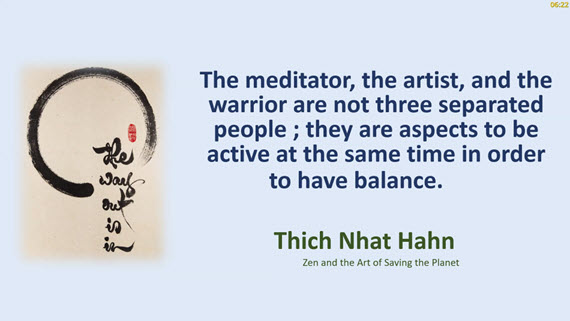
After a short meditation exercise, Emelina introduced us to "The Mediator, The Warrior and The Artist" to help with navigating geological and biological timescales. She started her keynote with a quote from Christine Wamsler et al. (2019): "Transformative change toward sustainability depends on changes in inner dimension such as: beliefs, values and worldviews.". This was followed by a quote from Zen master Thich Nhat Hahn: "There are two dimensions to life, and we shall be able to touch both. One is like a wave and we call it the historical dimension. The other is like water and we call it the ultimate dimension."
Emelina Corrales ended her keynote with reciting her poem "All Waters: The Ocean of Life" which you can read on her website.
After these diverse keynotes, the discussion was opened to questions from the audienence and many participants made good use of this opportunity. It was tricky to capture all the questions and answers, so here are just a few notes:
- How can those who protect the environment be better protected? Response was along the lines of making their voices heard, don't visit countries where activists are getting persecuted or even killed.
- Focus on dialog instead of persuation
- Ask people questions and really listen to their replies.
- What ONE advice should high school teachers give their students?
- Take care of what you do in every day life.
- Get involved and vote!
- Take them outside
- Put down the phone!
The session was recorded and if/when the video is made publicly available on Youtube, I'll add the link here. In the meantime, this compilation gives an idea of what all was covered in this symposia:
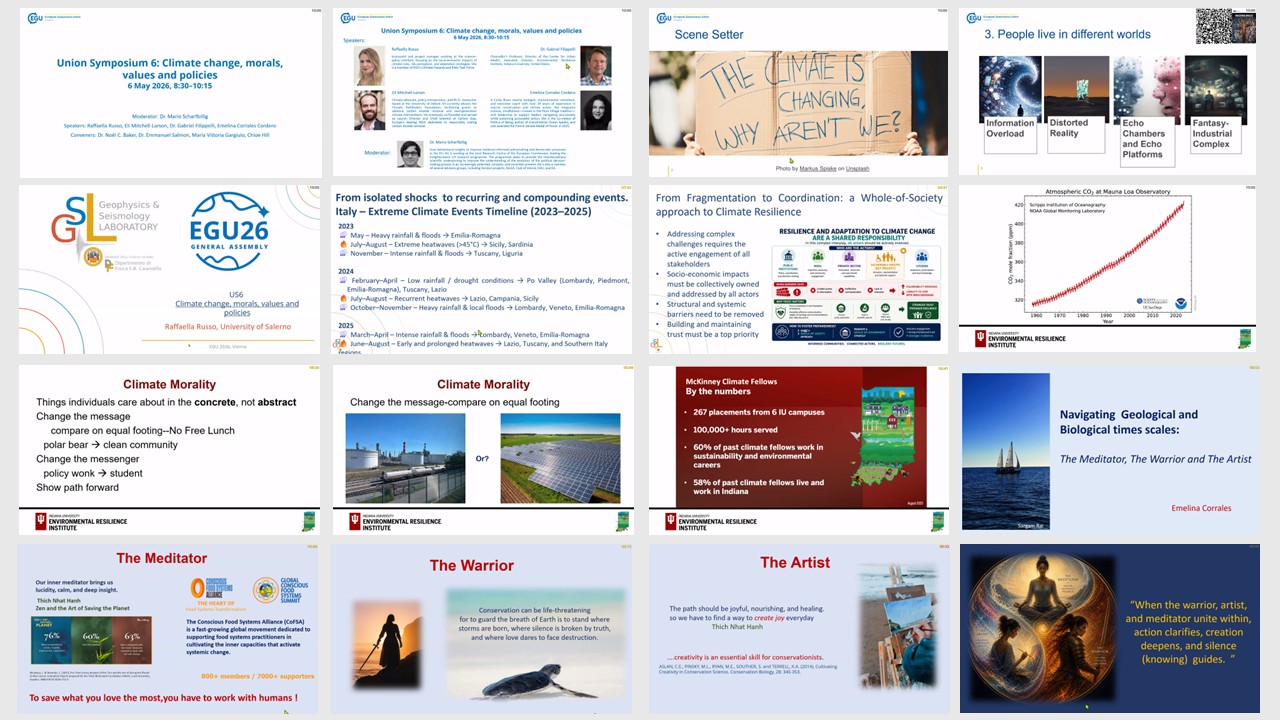
After the lunch break I had planned to join short course SC3.13 - Get your writing right: A hands-on, participatory workshop to help improve writing skills, but it turned out that this was only available onsite in Vienna, so I couldn't join it virtually. Poking around in the program for an alternative, I noticed one of the science sessions and joined ITS2.1/CL0.7 - Compound weather and climate events instead.
High-impact climate and weather events typically result from the interaction of multiple climate and weather drivers, as well as vulnerability and exposure, across various spatial and temporal scales. Such compound events often cause more severe socio-economic impacts than single-hazard events, rendering traditional univariate extreme event analyses and risk assessment techniques insufficient. It is, therefore, crucial to develop new methodologies that account for the possible interaction of multiple physical and societal drivers when analyzing high-impact events under present and future conditions. This session aims to address several challenges and topics.
These include: (1) identifying the compounding drivers, including physical drivers (e.g., modes of variability) and/or drivers of vulnerability and exposure, of the most impactful events; (2) Developing methods to better shape the definition and classification of compound events, i.e. legitimate the ‘cut-offs’ in the considered number of hazard types or variables to ultimately disentangle enough information for decision-making; (3) Understanding whether and how often novel compound events, including record-shattering events, will emerge in the future; (4) Explicitly addressing and communicating uncertainties in present-day and future assessments (e.g., via climate storylines/scenarios); (5) Disentangling the contribution of climate change in recently observed events and future projections (attribution); (6) Employing novel Single Model Initial-condition Large Ensemble simulations, which provide hundreds to thousands of years of plausible weather, to better study compound events. (7) Developing novel statistical methods (e.g., machine learning, artificial intelligence, and climate model emulators) for studying compound events; (8) Assessing the weather forecast skill for compound events at different temporal scales; (9) Evaluating the performance of novel statistical methods, climate and impact models, in representing compound events and developing novel methods for constraining/reducing uncertainties (e.g., multivariate bias correction and observational constraints); and (10) engaging with stakeholders to ensure the relevance of the aforementioned analyses.
From the description this seemed to be a scientific session which didn't require too much prior knowledge and this turned out to be true. Sonia Seneviratne introduced the topic with a longer than usual presentation for these oral sessions to explain what the purpose and main focus was. Compound extreme events happen when for example a flood event follows quickly after a drought event, or when several of these events happen close after or to each other, limiting resources for help and clean-up activities. These events can come with high costs in both lives lost and money.
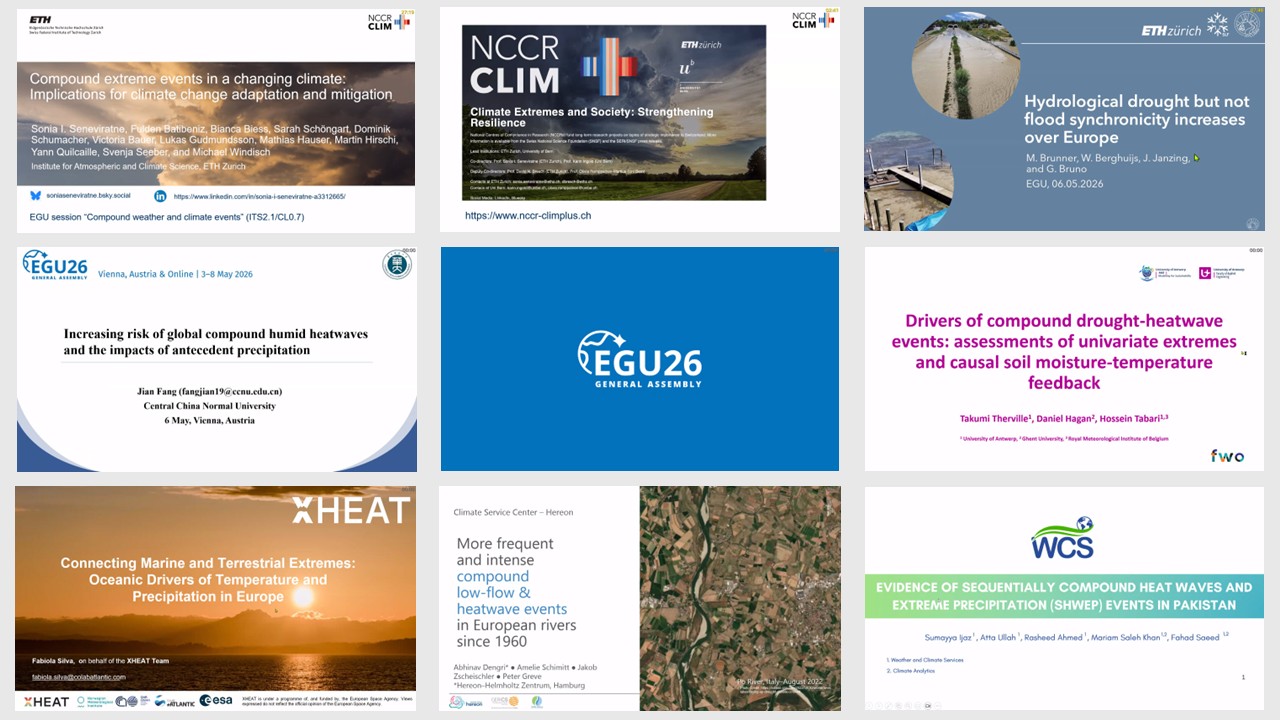
The authors for example talked about a need to adapt to larger scale drought and to ensure that water is still available where and when it is needed, about the risks extreme humid heatwaves pose for human health, wether there are detectable trends in soil moisture, how marine and terrestrial heatwaves are connected, that marine heatwaves are happening more frequently, are getting more intense and last longer, that heatwaves often coincide with river-low-flows (less water flowing downstream), that rivers can get too warm for cooling nuclear power plants, that low-flow events have from the local to a European scale and that climate extremes like heatwaves and extreme floods are happening with less time in between in Pakistan.
- Sonia I. Seneviratne - Compound extreme events in a warming climate: Implications for climate change adaptation and mitigation
- Manuela I. Brunner - Hydrological drought but not flood synchronicity increases over Europe
- Jian Fang - Increasing risk of global compound humid heatwaves and the impacts of antecedent precipitation
- Takumi Therville - Drivers of compound drought-heatwave events: assessments of univariate extremes and causal soil moisture-temperature feedback
- Fabíola Silva - Connecting Marine and Terrestrial Extremes: Oceanic Drivers of Temperature and Precipitation in Europe
- Name - More frequent and intense compound low-flow and heatwave events in European rivers since 1960
- Sumayya Ijaz - Historical Evidence of Compound Heatwave and Extreme Precipitation in Pakistan, 1980-2024
As my last session for the day I joined PICO EOS1.3 - Games for Geoscience showcasing many creative ways of how to turn science into fun and interesting learning experiences. The session was convened by Christopher Skinner, Rolf Hut, Elizabeth Lewis, Lisa Gallagher and Maria Elena Orduna Alegria. As is typical for a PICO session, presenters only had 2 minutes for their pitch during the first part of the session and afterwards moved to their individual screens for more detailed discussions.
Games have the power to ignite imaginations and place you in someone else’s shoes or situation, often forcing you into making decisions from perspectives other than your own. This makes them powerful tools for communication, through use in outreach, disseminating research, in education and teaching at all levels, and as a method to train the public, practitioners, and decision-makers in order to build environmental resilience.
Games can also inspire innovative and fun approaches to learning. Gamification and game-based approaches add an extra spark of engagement and interaction with a topic. Gaming technology (e.g. virtual reality) can transport and immerse people into new worlds providing fascinating and otherwise impossible experiences for learners.
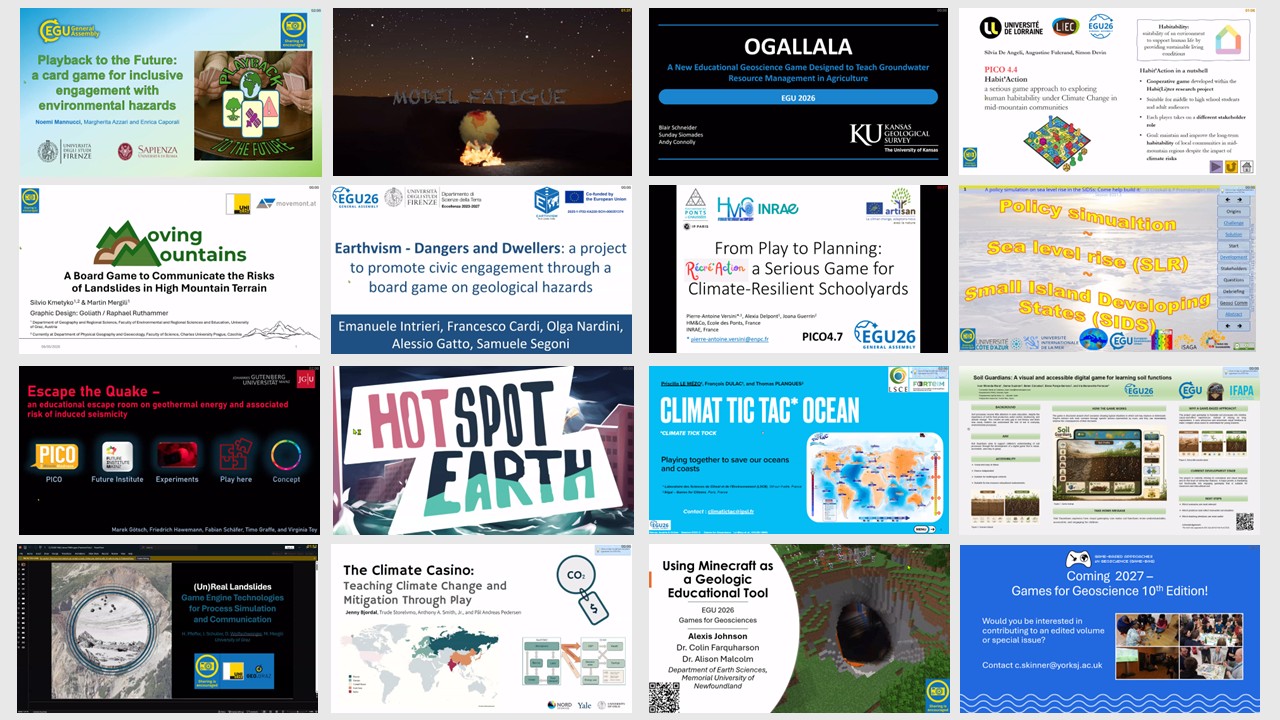
The 2-minute pitches covered all sorts of games: card games, board games, role plays, simulations, planning games, escape games and digital games. They also touched many topical areas like natural hazards (think: mud slides or earth quakes), resource management (think: aquifers in danger of drying up), climate resilient planning, policy simulations, geothermal energy, saving oceans, climate change and mitigation and more!
- Noemi Mannucci - Playback to the Future: a card game for inclusive engagement with environmental hazards
- Guillemette Legrand - Model Fatigue: role-playing climate infrastructural imaginaries
- Blair Schneider - Ogallala: A New Educational Geoscience Game Designed to Teach Groundwater Resource Management in Agriculture
- Silvia De Angeli - Habit’Action: a serious game approach to exploring human habitability under Climate Change in mid-mountain communities
- Silvio Kmetyko - Moving Mountains: A Board Game to Communicate the Risks of Landslides in High Mountain Terrain
- Emanuele Intrieri - Earthvism - Dangers and Dwellers: a project to promote civic engagement through a board game on geological hazards
- Pierre-Antoine Versini - From Play to Planning: Récré'Action, a Serious Game for Climate-Resilient Schoolyards
- David Crookall - A policy simulation on sea level rise in the SIDSs: Come help build it
- Marek Götsch - Escape the Quake – an educational escape room on geothermal energy and associated risk of induced seismicity
- Jan Steinhauser - Hotspot Earth: a climate action game
- Priscilla Le Mézo - Climat Tic Tac (Climate Tick-Tock) Ocean: playing together to save our oceans and coasts
- Ivan Miranda Moral - Soil Guardians: A visual and accessible digital game for learning soil functions
- Hanna Pfeffer - (Un)Real Landslides: Game Engine Technologies for Process Simulation and Communication
- Jenny Bjordal - The Climate Casino: Teaching Climate Change and Mitigation Through Play
- Alexis Johnson - Building Geologic Maps and Models in Minecraft for Use in Early Education
Thursday, May 7
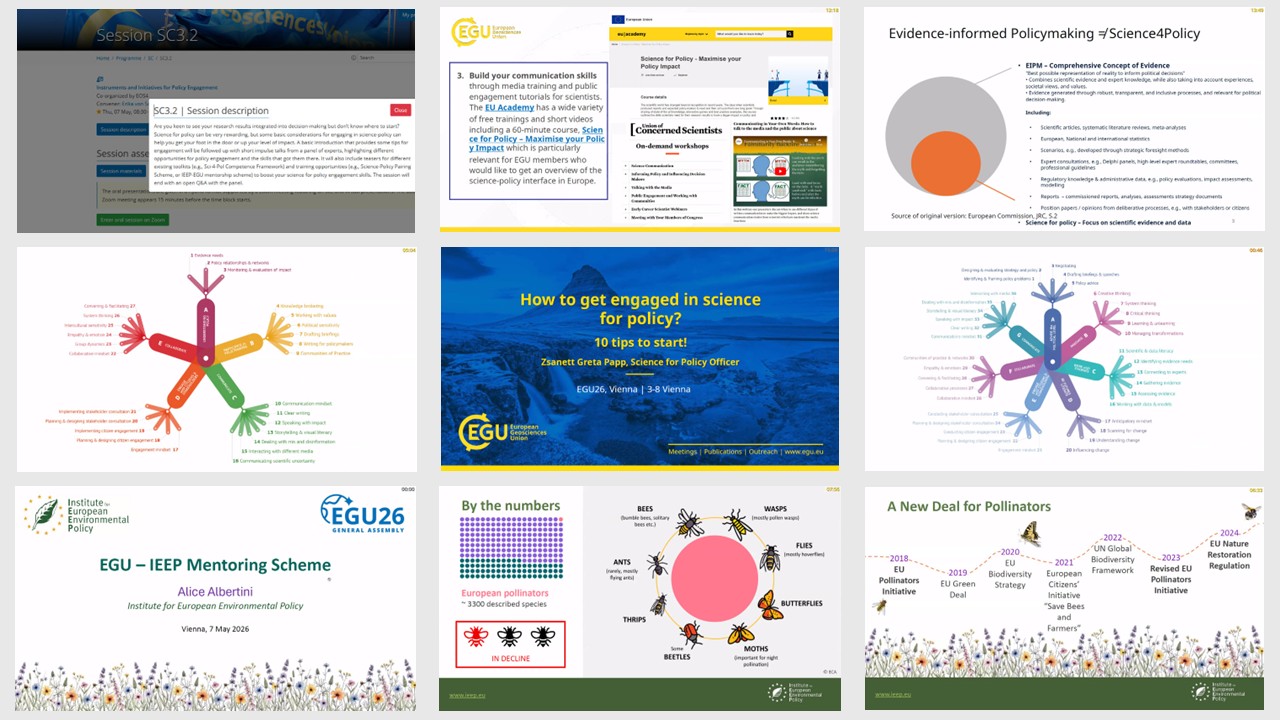
As the first session I joined short course SC3.2 - Instruments and Initiatives for Policy Engagement convened by Erika von Schneidemesser, Zsanett Greta Papp, Chloe Hill and Alice Albertini
Are you keen to see your research results integrated into decision-making but don’t know where to start? Science for policy can be very rewarding, but some basic considerations for engaging in science-policy can help you get your foot in the door or up your level of impact. A basic introduction that provides some tips for engagement will be followed up with short impulse talks from a panel of experts, highlighting different opportunities for policy engagement and the skills that got them there. It will also include teasers for different existing toolkits (e.g., Sci-4-Pol Competence Framework) and training opportunities (e.g., Science-Policy Pairing Scheme, or IEEP-EGU mentorship scheme) to boost your science for policy engagement skills. The session will end with an open Q&A with the panel.
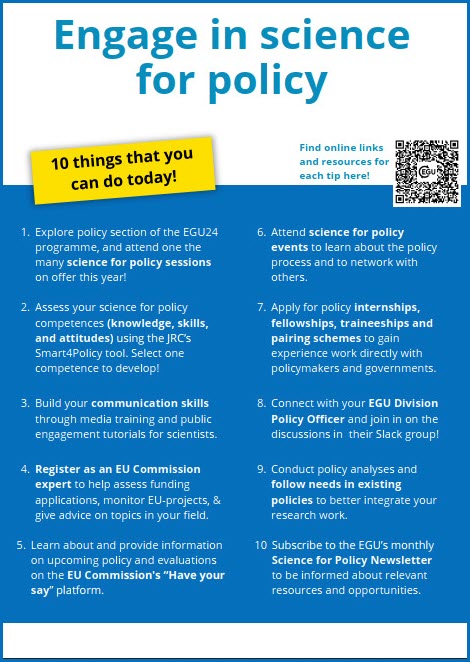
This short course started with Zsanett Greta Papp giving us an overview of what all EGU offers for scientists who might want to get into the wide field of Science for Policy. Detailed information is available in this EGU blog post from 2024: GeoPolicy: 10 things that you can do to start engaging with policymaking today and this flyer lists them all:
Florian Schwendinger then told us about his experiences with working in the field of Science for Policy. He mentioned that you need quite a lot of different competencies and that you have to be prepared for "information overload" because you'll need to collect it, sift through it and then interpret and summarize it for the policy maker you are working with. You need to be aware of the policy implications the information has and understand the context and different timelines you are working in. You need to invest time in order to build trust, you need to understand available support structures and the different attitudes involved. And most important of all: don't fall for the myth that policy makers are bound to ignore scientific findings! If you manage to make information accessible and legible for them, chances are good that they'll take it into account.
Next Nicole Arbour enthusiastically (and without slides) told us about non-traditional was to engage in Science for Policy. One of the first things she mentioned was that soft skills - contrary to what some believe - are very important in this area where science and policy overlap and interact. Active listening is especially relevant as is building a network by meeting as many people at receptions as possible (even if that is not your favorite kind of event). She for example regularly organizes what she called "Science parties" where she brings in a scientist prepared to give a 15-minute keynote - without scientifc charts or error bars - for invited policy makers. In addition, she encouraged scientists to write op-eds (you never know who reads those, but they can have a direct impact on policy), go on podcasts, join advisory boards and accept expert roles.
As the last speaker of this short course Alice Albertine explained the new mentoring program set up by EGU and the Institute for European Environment Policy (IEEP) of which she was the first mentee. This mentoring scheme is a 12-month flexible, hybrid programme for early and mid-career researchers who have completed a PhD. The objectives are to gain experience in a non-academic sector, broaden the mentee’s professional network, develop/increase an understanding of the European policy landscape, enhance their science for policy skills, and learn about how they and their institutions can increase the policy impact of their research. Activities include contributing to existing IEEP projects and publications, attend IEEP events and networking. Alice pointed out the human factor is very important and that helps to engage with many teams even those not directly linked to your project.
To learn more about Science for Policy, here are a few links:
- European Commission - Competence Framework ‘Science for Policy’ for researchers
- European Commission - Smart4Policy: Reflect about your work on policy!
- European Union Academy - Science for Policy - Maximise your Policy Impact
- EGU - Subscribe to the Newsletter
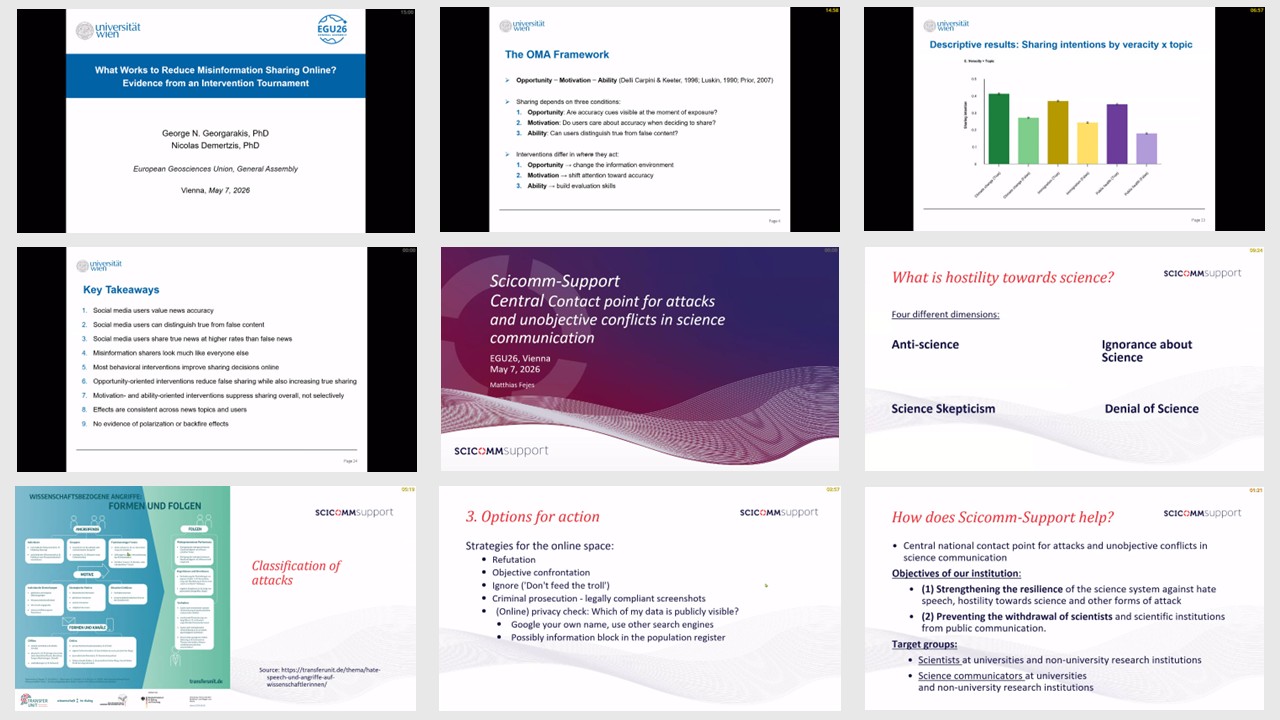
After the coffee break it was time for short course SC3.3 - New Toolkits – the destabilisation of science and what we can do about it convened by Lene Topp, Zsanett Greta Papp, Erika von Schneidemesser and Chloe Hill:
Science is increasingly under pressure from political polarisation, misinformation, and declining public trust. These dynamics not only destabilise scientific communication but also challenge the ability of researchers to engage effectively with society and policymakers. To navigate this landscape, scientists and science communicators are developing new “toolkits” – practical methods, frameworks, and strategies – that support resilience, credibility, and impact.
This short course will introduce participants to a set of emerging toolkits designed over the coming year, focusing on how researchers can strengthen the role of science in public discourse and policy. The session will explore key questions: How can scientists better anticipate and counter misinformation? Which communication strategies foster trust across diverse audiences? What can we learn from cross-disciplinary and international experiences in addressing science denial and disinformation campaigns?
The invited speakers gave short keynotes to set the stage for the course:
Sheena Cruickshank is a science communicator, immunologist, and Professor in Biomedical Sciences and Public Engagement at the University of Manchester. During the COVID-pandemic she learned a lot about how important it is to communicate science effectively and to build trust with communities you work with. She trained communicators from communities of how to translate scientific jargon and to give them the necessary vocabulary and toolkits. She also stressed the importance of what she called the "Five C's":
- Confidence and trust in the people making vaccines, the science, etc
- Complacency considers whether people feel complacent regarding risks of infection vs vaccine
- Convenience is how easy is it to get vaccinated
- Communication is about how clear the communication is and if it is in the right language and accessible
- Context considers cultural contexts and barriers like e.g. whether there is historical mistrust in a group
George N. Georgarakis is the Moritz Schlick Postdoctoral Fellow in Digital Political Communication in the Department of Communication at the University of Vienna. Together with a team he conducted research into how misinformation spreads online and what options exist to decrease sharing of false information and increase the sharing of true content. They found that a lot of misinformation is shared by actual people and not by bots, that political motivation, heuristics (mental shortcuts) and accuracy neglect are some of the reasons for this.
He mentioned various forms of interventions like debunking, pre-bunking and credibility lables, or asking people actively to not share false information. They found that the interventions didn't increase polarization with results replicated in several countries already.
Matthias Fejes is the Co-founder of Scicomm-Support, TUD Dresden University of Technology spokesperson, and member of the executive board of the German Association for University Communication. He introduced participants to the Scicomm-Support platform which is a central point of contact for scientists if they get attacked or harrassed. He explained the four different dimensions of hostility towards science, namely anti-science, ingorance about science, science skeptisim and denial of science.
He gave some pointers of how to recognize the situation (what it is, whether or not it's dynamic, what happened, who should be contacted), what the context of the situation is (social media posts, threads via phone, email or letters), which information can be found online about you, what are the options (refute, confront, ignore, criminal prosecution).
The subsequent discussion touched on topics like necessary smarter regulation of platforms; they may need to be forced to bring fact-checking back. Everybody needs to be mindful of self-care and resilience. The course ended with some tips for attacked or harrassed scientists:
- whenever available get prevention training
- be aware about how sensitive your research topic is
- draw on the academic community for support
- report incidents to police
- but pick your battles and make use of the block option online
After lunch, another short course was on the menu: SC3.10 - Elevate your Pitch: Developing Engaging Short Scientific Presentations convened by Antara Dasgupta, Hannah Cloke, Hazel Gibson and Simon Clark. This was a neat mixture of input from the conveners and a practical exercises for 1-minutes pitches with getting feedback on.
The scientific communication landscape in the digital era is rapidly becoming all about effectively delivering ideas in brief. As scientific conferences move from longer physical meetings to more condensed hybrid formats, not only are short presentations necessary for pitching yourself to senior scientists or your next entrepreneurial venture to Venture Capitalists, but also for promoting your research. The opportunities of networking rarely reveal themselves, unless you are able to tell a brief, informative, and compelling story about you and your research.
It is truly an art to engage people through these short presentations and ignite a fire in their hearts, which will burn long enough for them to remember you and reach out to you later about relevant opportunities. While practice makes perfect is the mantra for delivering power-packed short presentations, there are several tricks to make your content stand out and set yourself apart from the crowd.
In this hybrid format course, we will bring together ideas and tips from years of sci-comm experience to provide you a one stop shop with the tricks of the trade. Finally, a hands-on exercise where participants will receive structured feedback on all aspects of their talk will help solidify the learning outcomes.
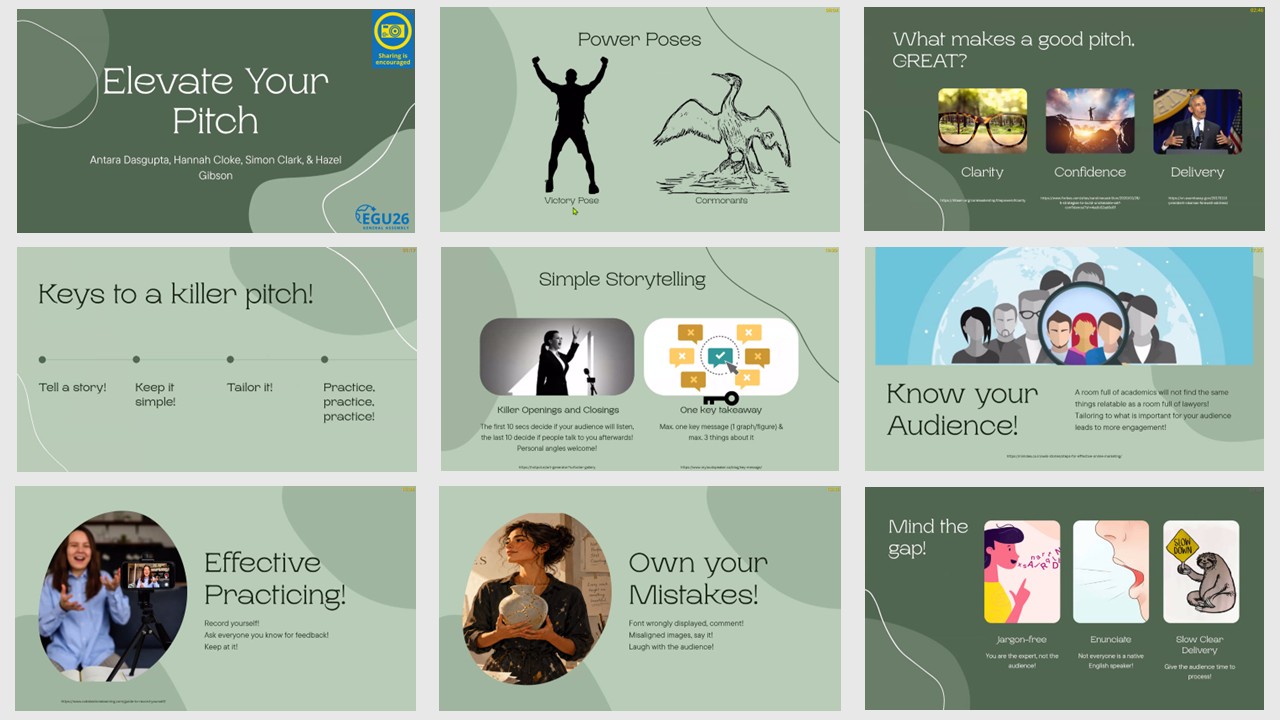
In the first part of the session, Antara Dasgupta walked us through some tips about succesful presenting:
- Ground yourself before giving a talk (try a "power pose" like "The Cormorant")
- Concentrate on a good pitch: clarity, conficence, delivery
- Simple story-telling is a key to a killer pitch, so channel your inner story teller
- Know your audience
- Record yourself for effective practicing
- Own your mistakes (everybody makes them!)
- Identify your stumbling blocks, words you have problems with and if need be replace them
- Be careful with jargon and acronyms - even fellow scientists may not know what they mean if they work in a different field
- Talk to the audience not the floor or screen
- Be careful with reading from a script as veering off from it, may trip you up
This theoretical section was then followed by an exercise where on-site participants split into pairs to prepare and practice a 1-minute pitch. Online participants were encouraged to do this as well, albeit on their own. Volunteers had a chance to give their pitches in the room after about 20 minutes preparation and some did. So, we heard from a meteorologist who keeps the planet safe by forecasting "space weather" or about how wind turbines "feel" about their job and a few more.
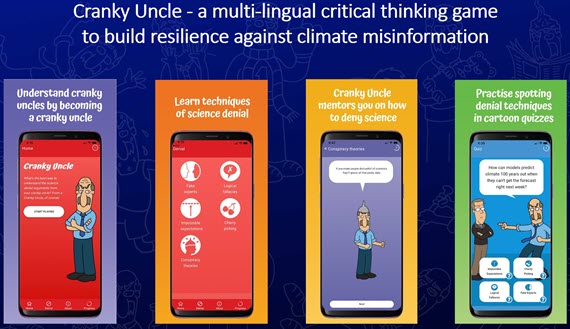
I used the opportunity for a quick pitch about the Cranky Uncle game, recycling parts from a PICO-session I gave in 2022. Based on the reactions from the room - I did hear some chuckling at the expected places - and the feedback provided, it came across quite well.
I'd like to briefly introduce you to Cranky Uncle, a critical thinking game developed by John Cook to build resilience against climate and other misinformation.
The game helps you to understand Cranky Uncles by becoming a Cranky Uncle yourself.
And you learn the techniques of science denial which are: fake experts, logical fallacies, impossible expectations, cherry picking and conspiracy theories.
All easily memorable via the abbreviation FLICC.Cranky Uncle mentors you on how to deny science by using these FLICC techniques.
You then practice spotting these techniques with the help of cartoon quizzes and other forms of quiz questions.
As you move along you build up Cranky points.
And the more cranky points you get, the more you are able to level up and see your mood get ever crankier.
To wrap up the day I joined Great Debate GDB3 - Geoengineering - Overarching Great Debate convened by Marie G. P. Cavitte, Zsanett Greta Papp, Noel Baker and Erika von Schneidemesser:
As our world approaches 1.5°C of global warming, as worldwide emissions continue to grow, and the impacts of climate change escalate, there is a general sentiment that we are running out of time. Increasingly, geoengineering concepts are being pushed into the media and policy spheres, using this sentiment of urgency to frame these concepts as “buying us time” for mitigation. There are many concepts, with the most advanced concepts including solar radiation management (marine cloud brightening, stratospheric aerosol injection mostly), sea ice thickening/brightening, sea curtains, tarping mountain glaciers, ocean fertilisation or alkalinity enhancement, as well as ocean biomass dumping, and many more. Some might target the root cause of our rising temperatures by absorbing carbon dioxide from the atmosphere, but with detrimental effects on the ecosystems impacted. Other concepts would just attenuate the symptoms of our planet, the rising global temperature.
Are geoengineering concepts a distraction from our urgent need for adaptation and mitigation? In a world where research funding, political focus on the green transition, and geopolitical order are dwindling, are we reducing our chances of reaching the highest possible mitigation ambition to stay well below 2°C and pursue efforts to stay below 1.5°C by even discussing these options? Several of the targeted ecosystems (e.g. our deep ocean, cloud-aerosol interactions, etc.) are not yet well understood at a fundamental level. Is it appropriate to advocate for their manipulation without first conducting adequate fundamental research?
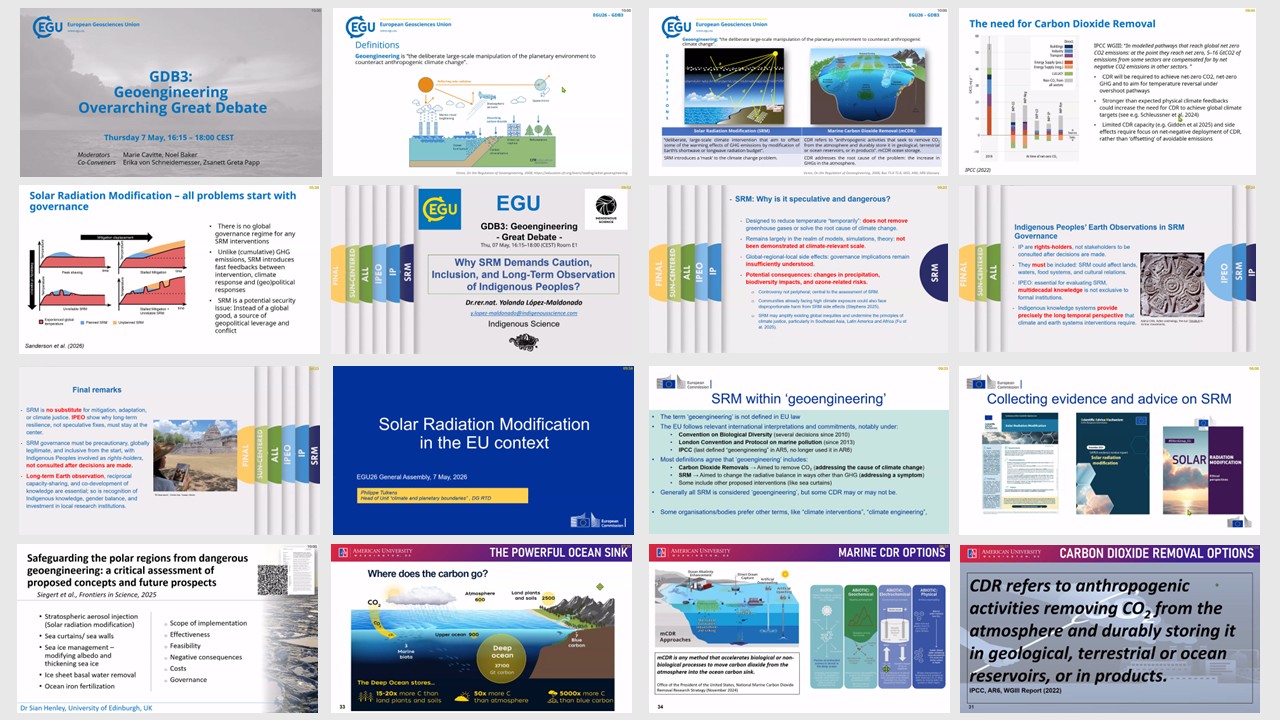
Not too surprisingly given the topic, this turned out to be a very interesting and timely session, for which the focus had been restricted to two kinds of geo-engineering: solar radiation management (SRM) and Marine carbon dioxide removal (mCDR). The debate started with 10 minute keynotes from the panelists. The information provided below is based on my notes and the slides presented:
Carl Friedrich Schleussner leads the Integrated Climate Impacts Research Group at IIASA, and is also an Honorary Professor at Humboldt University Berlin. His research spans extreme climate events, climate impact projection, tipping elements and the societal implications of climate change, with a special focus on international climate negotiations and climate overshoot.
Carl Schleussner expects that carbon dioxide removal (CDR) will become necessary in one form or the other to compensate for the very likely overshoot our continuing emissions are causing. He noted that there'll be side effects and unitended consequences and that SRM obviously doesn't fix the root cause of the problem. He also mentioned that there is no defined governance at the moment and that it could be used for geopolitical leverage and cause conflicts.
Yolanda López-Maldonado is a Maya Indigenous Earth systems scientist advancing Indigenous science in global environmental governance. Lead author of the upcoming UNEP Global Environment Outlook Report, a Review Editor for the 2nd IPBEST Global Assessment, and the founder of Indigenous Science, an Indigenous-led organization dedicated to integrating Indigenous knowledge into global scientific and diplomatic frameworks. Yolanda bridges Indigenous knowledge and global policy at the highest levels.
Yolanda López described SRM as a hypothesis about climate interventation but not a proven solution. Indigenous people nned to be involved and heard as right-holders instead of just stake-holders (if even that). Any intervention that alters the Earth system should be evaluated with a multidecadal perspective that Indigenous knowledge often provides. A globally inclusive, transparent and equitable scientific assessment process for SRM is required (UNEP 2023). Ethically, Indigenous peoples must be involved because they have a legitimate right to participate in decisions that may affect their territories and futures. If SRM is ever considered seriously, it must be governed as a planetary issue, not a technocratic fix: scientifically uncertain, ethically consequential, and inseparable from justice, Indigenous rights, and long-term observation.
Philippe Tulkens is head of the unit “Climate and Planetary Boundaries” in the Healthy Planet Directorate in DG Research and Innovation at the European Commission. His unit co-programs EU R&I activities in the areas of climate change, biodiversity, nature-based solutions and environmental observation. His unit is the EU focal point to the IPCC and EU co-focal point to the IPBES. Philippe is also the Deputy Mission Manager for the EU Mission on Adaptation to Climate Change.
Philippe Turkens stated that from an EU perspective SRM is seen as a risk and is poorly understood. A commitment to assess the risks and uncertainties, to promote international discussions which are guided by the precautionary principle is needed and a moratorium on deployment is called for.
Sian Henley is a Reader in Marine Science and Deputy Head of the Global Change Research Institute at the University of Edinburgh. Her research spans climate and environmental change in the polar oceans, both the Arctic and Antarctic, to climate change impacts on children worldwide. Sian is active at the science-policy interface with a focus on Earth’s polar regions, such as at the COPs and the UN Ocean Conferences.
Sian Henley focused on the mCDR options and none of the proposed ideas really passes scrutiny. Even if they are tried, they will most likely not have much of an impact and these thought experiments should not distract from the urgen task to decrease emissions as quickly as possible. Of the proposed options, only iron fertilization has been tried experimentally but the results were not conclusive. There is however a risk that ocean chemistry would be changed with the nature of these changes being unknown. Impacts on fisheries and therefore people in the global south could be high, so they would be the ones most affected by decisions made in the global north - possibly even without their involvement.
Wil Burns serves as the Founding Co-Director of the Institute for Responsible Carbon Removal, a research center at American University in Washington DC, and is a Professor in the School of International Service. His research focuses on the law and governance of carbon dioxide removal and solar radiation modification approaches.
Wil Burns touched on some of the same issues Sian Henley mentioned and also pointed out that decarbonization of industry has to be tackled aggressively. He still fears that some carbon removal will be needed, something the IPCC expects as well.
A lot more points were raised in the subsequent panel discussion and during the Q&A part, here are some of them:
- no governance framework exists for CDR and it doesn't fit into any of the existing climate-related frameworks
- 77 countries include CDR in their Nationally Determined Contributions (NDCs) without giving any details
- geo-engineering is complex and therefore hard to explain to policy makers
- community led and nature based solutions may be better options
- topic is sensitive
- there's no transparency of who and why is currently pushing for geo-engineering
- how to avoid falling into the trap of "technical fixes"?
- some want to deploy e.g. SRM quickly because the situation is so dire
- some say that mitigation and adaptation needs to speed up first
- CDR could be abused for coercion
- we could be opening a Pandora's box
- large-scale testing will most likely happen - w/o asking - on indigenous land or near disenfranchised communities
- how big is the risk of somebody going roque and "simply" start something? Would we even be able to detect it?
So, at the end of the debate there were perhaps more open than closed questions but it definitely was thought-provoking!
Friday, May 8
I started the last day of virtual EGU with another PICO-session: NH9.13 - Innovative Approaches to Hazards, Risk and Disaster Education and Communication convened by Bruce D. Malamud, Thomas Glade, Annika Fröwis, Faith Taylor, Caroline Michellier and Solmaz Mohadjer:
Resilience building requires effective communication, teaching and understanding of hazard and risk. Traditional outreach methods often struggle to engage diverse audiences; connect science and practice; or influence policy. Innovative approaches can address some of these challenges. For example, digital tools such as serious games, (massive) open online courses (MOOCs), simulations and immersive virtual/augmented reality can bring hazard scenarios to life. Equally, non-digital methods such as role-play, participatory mapping, classroom activities and tabletop demonstrations can foster engagement and deeper understanding of risk. This session welcomes abstracts that explore the development, application and evaluation of education and communication innovations across a spectrum: from primary through the postgraduate learning, and from public to expert engagement. We particularly welcome contributions of serious games, VR/AR simulations and digital platforms in addition to non-digital methods such as classroom demonstrations and participatory activities. Presentations that reflect on co-production with stakeholders, inclusivity and approaches for evaluating outcomes are strongly encouraged. In this session, we hope to bring together researchers, educators and practitioners to share best practice, showcase cutting-edge tools and teaching methods, and critically reflect on the role of innovation in hazard and risk education and communication. We plan on having a PICO session to ensure a lively combination of discussion and poster presentation.
The conveners had divided this 2-part PICO-session thematically. Before the morning coffee-break we heard about serious games & simulations and academic & professional eduction projects. Afterwards the themes changed to child & youth eduction, public engagement and media. Unfortunately, some of the speakers didn't make it in time to the session because there were issues with public transport in Vienna.
Initially, I wasn't quite sure if a session from the Natural Hazards (NH) science section of EGU would make much sense for me to join as I usually gravitate towards the education, outreach and policy sessions offered at the conference. However - and after taking a closer look at the submitted abstracts - this could just as well have been an EOS-session given that the talks were in fact about different education and outreach strategies in the realm of natural hazards.
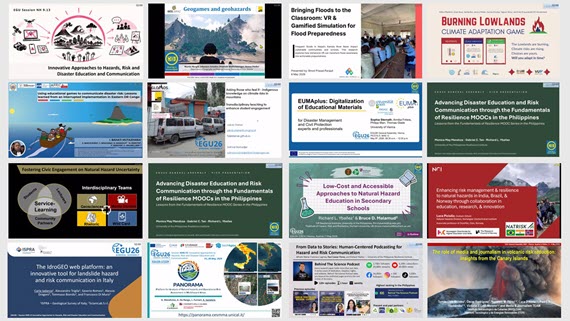
As this was a PICO-session, short 2-minute pitches followed in rapid succession during the first part of each timeblock. We heard about an online simulation game where players have to evacuate people after an earthquake without getting into landslides while doing so, about gamified flood resilience simulation and effective risk communication, about underappreciated hazards of burning lowlands, about disaster risk reduction in case of floods and wildfires, about necessary civic engangement when it comes to natural hazards, about climate-driven geohazard mitigation, about enhancing risk management through education, research and innovation, about webplatforms collecting natural hazards, about storytelling and podcasts to get the word out.
In addition to the many different topics touched upon, where these projects are done is just as varied: they could be very local (Tübingen in Germany), regional (lowlands in The Netherlands), moutaineous areas in Nepal, Pakistan, Austria, South Korea, Japan, Norway, Sweden, Austria, Italy, volcanic regions in The Democratic Republic of Congo, on the Canary Islands or the Philippines. Or they could be in virtual and synthetic worlds simulating various places.
List of presentations:
- Martin Mergili - Geogames and geohazards
- Binod Prasad Parajuli - Immersive Flood Education for Effective Risk Communication: Field-Based Testing of Virtual Reality and Gamified Simulations for Flood Preparedness in Terai region of Nepal
- Milica Mijailovi? - Burning Lowlands: A Serious Game to Evaluate Citizen Learning, Communication, and Decision-Making in Climate Adaptation
- Innocent Bahati Mutazihara - Using serious games to communicate disaster risk: Insights from interrupted implementation in Eastern DR Congo
- Jakob F. Steiner - Asking those who feel it - indigenous knowledge on climate risks in mountains: Transdisciplinary teaching to enhance student engagement
- Sophia Sternath - EUMAplus: Digitalization of educational materials for Disaster Management and Civil Protection experts and professionals
- Monica May L Mendoza - Advancing Disaster Education and Risk Communication through the Fundamentals of Resilience MOOCs in the Philippines
- Solmaz Mohadjer - Fostering Civic Engagement on Natural Hazard Uncertainty: A Service-Learning course to create an active dialogue between science and society
- Graham Lewis Gilbert - Educating for Climate-Driven Geohazard Mitigation and Management – Experience from the GEOMME International Partnership in Norway, South Korea, and Japan
- Lisa Van Well - Communicating Cascading Natural Hazards through Co-Created Visualization with Youth
- Bruce D Malamud - Low-Cost and Accessible Approaches to Natural Hazard Education in Secondary Schools
- Luca Piciullo - Halfway through the NATRISK project: Enhancing risk management and resilience to natural hazards in India, Brazil and Norway through collaborative education, research and innovation
- Carla Iadanza - The IdroGEO web platform: an innovative tool for landslide hazard and risk communication in Italy
- Alfonso Senatore - PAER: A new web platform for acquisition, storage, processing, and visualization of natural risks
- Saverio Romeo - Innovative Tools for Disaster Risk Education: Twenty Years of LARES Initiatives in Italy
- Paul Caesar Flores - From Data to Stories: Human-Centered Podcasting for Hazard and Risk Communication
- Nemesio M. Pérez - The role of media and journalism in volcanic risk reduction: insights from the Canary Island
This turned out to be the last session I documented during the week. The virtual poster session I had on my list for the afternoon turned out to contain only a few presentations from a cross-section of what had already been covered in oral sessions during the week and lasted for only 30 minutes. Some of the posters were flagged as "no pictures allowed" and some were in a format not really suitable to grab screenshots of.
Over the final lunch break of EGU26 I headed back up to the rooftop in Gather on the off-chance that somebody might come there for the last networking session I had offered to chat about Skeptical Science. While nobody came for the session itself I had a nice - if short - chat with another participant who joined EGU virtually from Australia.
Summary
As you can tell by the length of this blog post (sorry about that!), EGU kept me pretty occupied during the week. All told, I gave 2 oral presentations, joined 14 timeslots covering 4 Education and Outreach sessions (EOS) two of which were done as oral sessions and two as PICOs, 1 Natural Hazards PICO session (NH), 1 Inter- and Transdisciplinary Studies session (ITS), 4 short courses (SC), 1 Union Symposium (US) and 1 Great Debate (GDB). Joining the sessions virtually worked pretty well and only one of the PICO-sessions did have some technical issues with the Zoom-Meeting.
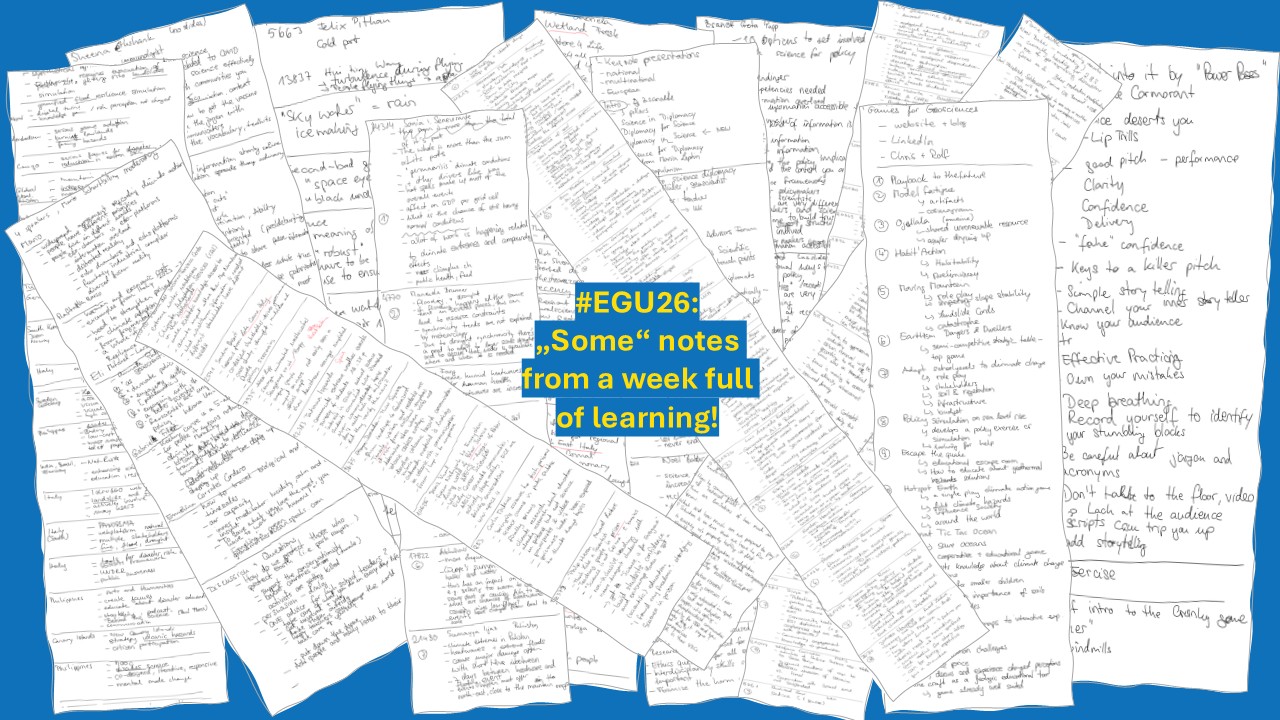
During the sessions I grabbed about 500 screenshots of which 162 made it into my visual session summaries and from there into the daily compilations. I took a lot of notes on my iPad during the sessions but fear, that I won't really be able to read my own scribbles when I look at them again in a short little while. But they did help with writing my diary, so served their main purpose quite well.
Final update from the EGU-website: "The EGU General Assembly 2026 welcomed 22,497 registered attendees, of which 20,027 made their way to Vienna from 125 countries and 2,470 joined online from 107 countries. It was a great success with 20,173 presentations given in 1,014 sessions. [...]"
To paraphrase a saying: "After a General Assembly of the European Geoscience Union is before the next one"! I plan to join EGU27 onsite in Vienna next year when the conference will happen a month earlier than this year from April 4 to 9. I'm already looking forward to the trip!









Many thanks BaerbelW for your perspective and your documented sessions. After a quick search on facts about Vienna, I too would be excited to be there in person next year! Your five days of virtual learning encompassed so many challenging and interesting topics.
These days I often get frustrated, dismayed and angry when powerful countries show malevolent behaviour. Trying to understand how "role-model" societies become so uneducated. This link from an Australian perspective really helped explain why a broad education is a necessary prerequisite to a just world. www.youtube.com/watch?v=j9MubNsh3rs