



 Arguments







EGU2026 - My plans for attending virtually
Posted on 22 April 2026 by BaerbelW
This year's General Assembly of the European Geosciences Union (EGU) will again take place as a fully hybrid conference in both Vienna and online from May 4 to 8. This year, I'll join the event virtually for the full week, participating in the hybrid sessions from the comforts of my home. I already picked most of the sessions I plan to attend and - as meet-hopping is a lot easier online than on-site - I didn't have to pay close attention to where in the conference center they happen. This year, I submitted abstracts to two sessions and both happen to be on Monday. This suits me just fine as it means, that I can freely plan the rest of my week, picking and chosing sessions piquing my interest. This blog post provides an overview of my itinerary.

Monday morning, May 4
The very first session for me at this year's EGU meeting starts at 8:30 and will be EOS1.1 Science and Society: Science Communication Practice, Research, and Reflection in which I'll have the first of my two oral presentation slots. The session has been (co)convened by Roberta Bellini, Nuno Pimentel, Megan O'Donnell, Thomas Harvey, Ashley Akingbade and Nikos Kalivitis and will include the Angela Croome Award Lecture as well as the Katia and Maurice Krafft Award Lecture.
Science communication includes the efforts of natural, physical and social scientists, communications professionals, and teams that communicate the process and values of science and scientific findings to non-specialist audiences outside of formal educational settings. The goals of science communication can include enhanced dialogue, understanding, awareness, enthusiasm, influencing sustainable behaviour change, improving decision making, and/or community building. Channels to facilitate science communication can include in-person interaction through teaching and outreach programs, and online through social media, mass media, podcasts, video, or other methods. This session invites presentations by individuals and teams on science communication practice, research, and reflection, addressing questions like:
- What kind of communication efforts are you engaging in and how are you doing it?
- What are the biggest challenges or successes you’ve had in engaging the public with your work?
- How are other disciplines (such as social sciences) informing understanding of audiences, strategies, or effects?
- How do you spark joy and foster emotional connection through activities?
- How do you allow for co-creation of ideas within a community?
- How are you assessing and measuring the positive impacts on society of your endeavours?
- What are lessons learned from long-term communication efforts?
Based on its description this seemed to be a very good session to talk about our upcoming website relaunch and it'll be my turn for not quite 10 minutes at 10:05 to do just that in my assigned oral slot. This is the abstract I submitted a few months ago:
Relaunching the Skeptical Science website to include prebunking tools
Skeptical Science is a highly-visited website featuring 250 rebuttals of misinformation about climate change and climate solutions. Many of the rebuttals are written at multiple levels—basic, intermediate, and advanced—in order to reach as wide an audience as possible. Results from a survey we've been running on our website since November 2021 indicate that there is some room for improvements in order to make the rebuttals more robust. It is therefore rather good timing that we've been working on a complete overhaul of our website which should increase the effectiveness of rebuttals in reducing acceptance in climate myths and increasing acceptance of climate facts. A key goal of misinformation interventions is to increase reader discernment, the difference between belief in facts and belief in myths. While there was overall an increase in discernment, with the decrease in agreement with myths greater than the decrease in agreement with facts, the result that belief in climate facts decreased for at least some rebuttals is unwelcome and counter to the goal of Skeptical Science. In this presentation, we'll give a sneak peek at how the new website will look like. One important new feature will be the inclusion - where applicable - of the fallacies employed by a climate myth, so that a rebuttal on the new website will then include all three elements of a successful debunking: fact, myth and fallacy. In my presentation, I'll also highlight some of the other updated or new features this website relaunch will include.
Here is a sneak peek of my drafted presentation:
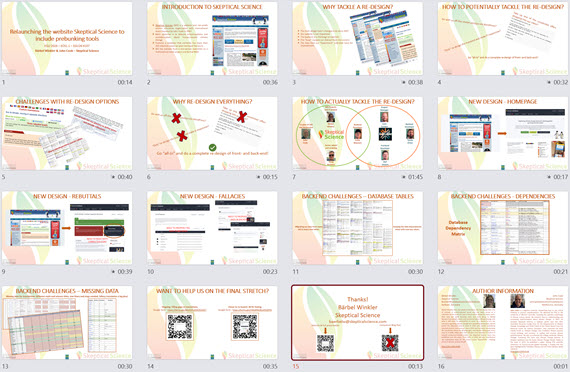
Judging by their titles and abstracts there'll be many interesting presentations in this wide-ranging session about science communication! So many abstracts were submitted that EOS1.1 was given 4 oral slots (2 each on Monday and Tuesday morning) to cover 35 oral presentations as well as 2 poster slots for a similar number of posters!
Monday afternoon, May 4
In the afternoon of EGU's first day, I'll be joining session EOS4.1 Geoethics: Linking Geoscience Knowledge, Ethical Responsibility, and Action, (co)convened by Silvia Peppoloni, Giuseppe Di Capua, Anita Di Chiara and David Crookall:
Geoscientists play a key role in providing essential information in decision-making processes that consider environmental, social, and economic consequences of geoscience work. Therefore, their responsibilities extend beyond scientific analysis alone. Global challenges, such as climate change, resource management, and disaster risk reduction, push geoscientists to expand their role beyond research and to engage ethically in public efforts.
Geoethics provides a framework for reflecting on the ethical, social, and cultural implications of geoscience in research, practice, and education, guiding responsible action for society and the environment. It also encourages the scientific community to move beyond purely technical solutions by embracing just, inclusive, and transformative approaches to socio-environmental issues.
Furthermore, science is inseparable from social and geopolitical contexts. These conditions shape what research is funded, whose knowledge is valued, with whom we collaborate, and who has access to conferences. As Earth and planetary scientists, we must consider the human and environmental consequences of our work. This is especially true in Earth observation, where many satellites have both scientific and military applications, and where scientific tools have at times enabled ecocide and resource exploitation under neocolonial systems.
This session will offer insights and reflections across a wide range of topics, from theoretical considerations to case studies, foster awareness and discussion of sensitive issues at the geoscience–society interface and explore how geoethics can guide responsible behavior and policies in the geosciences.
I'll give an oral presentation in the 2nd part of this session at 17:15 sharing the results of the "Skeptical Science Experiment", which we recently pubished a paper about in EGU's Geoscience Communication journal:
Results of the Skeptical Science experiment and impacts on relaunched website
Skeptical Science is a highly-visited website featuring 250 rebuttals of misinformation about climate change and climate solutions. The rebuttals are written at multiple levels—basic, intermediate, and advanced—in order to reach as wide an audience as possible. Since November 2021, we have collected survey data from visitors, assessing the effectiveness of rebuttals in reducing acceptance in climate myths and increasing acceptance of climate facts. A key goal of misinformation interventions is to increase reader discernment, the difference between belief in facts and belief in myths. While there was overall an increase in discernment, with the decrease in agreement with myths greater than the decrease in agreement with facts, we also found that belief in climate facts decreased for at least some rebuttals - an unwelcome result running counter to Skeptical Science’s goals. Due to the survey design and not collecting any information about why readers selected a specific option, we can only make educated guesses about what may have led to selecting a specific option. In parallel to running the experiment on our website, we have also been working on a website relaunch project which will address some of the shortcomings already identified. One new feature will be the inclusion - where applicable - of logical fallacies used in climate myths, so that rebuttals will include all three elements of a successful debunking: fact, myth and fallacy. In my presentation, I'll also highlight some of the other updated or new features this website relaunch will include.
Here is a sneak peek of my drafted presentation:
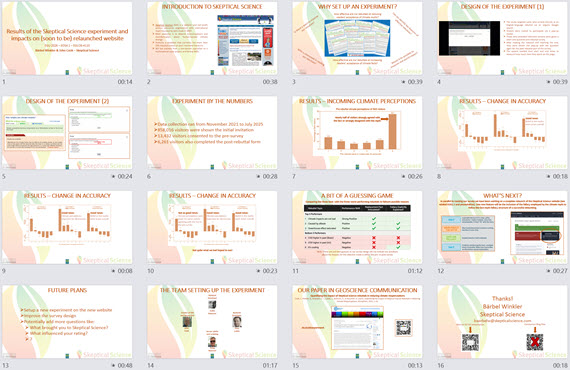
Rest of the Week
As the rest of the week is not yet cut in stone, I'll not go into any details and will only mention a few sessions I plan to join because they've been fun in previous years or because their titles and abstracts sound interesting:
- EOS1.6 - PICO session - Up-Goer Five Challenge: Making Big Ideas Simpler by Talking About Them in Words We Use a Lot (Tuesday afternoon)
- EOS1.3 - PICO - Games for Geoscience (Wednesday afternoon)
- SC3.3 - Short course - New Toolkits – the destabilisation of science and what we can do about it (Thursday morning)
When I'm not participating in sessions or busy writing about them, I may well hang out in "Gather", the virtual conference center for anybody joining onine. It's a fun set up where you can walk around as an avatar and meet others doing the same either in the virtual pster halls or even outside in a park or on the rooftop.
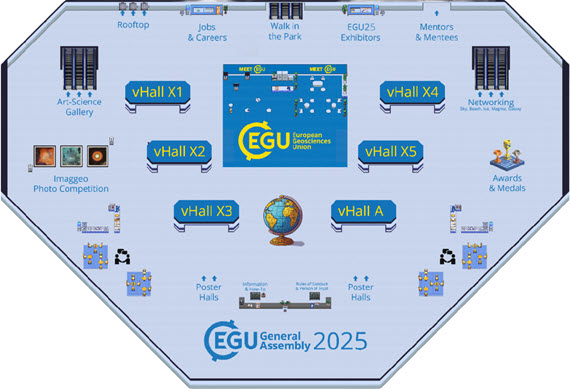
Looking at the sessions I've thus far added to my personal program, I'm fairly certain that I unfortunately will not be able to make it to all of them - especially the overlapping ones! However, one advantage of pariticpating virtually is that it's possible to quickly jump from one session to another if an interesting presentation beckons! Here is what I have planned:
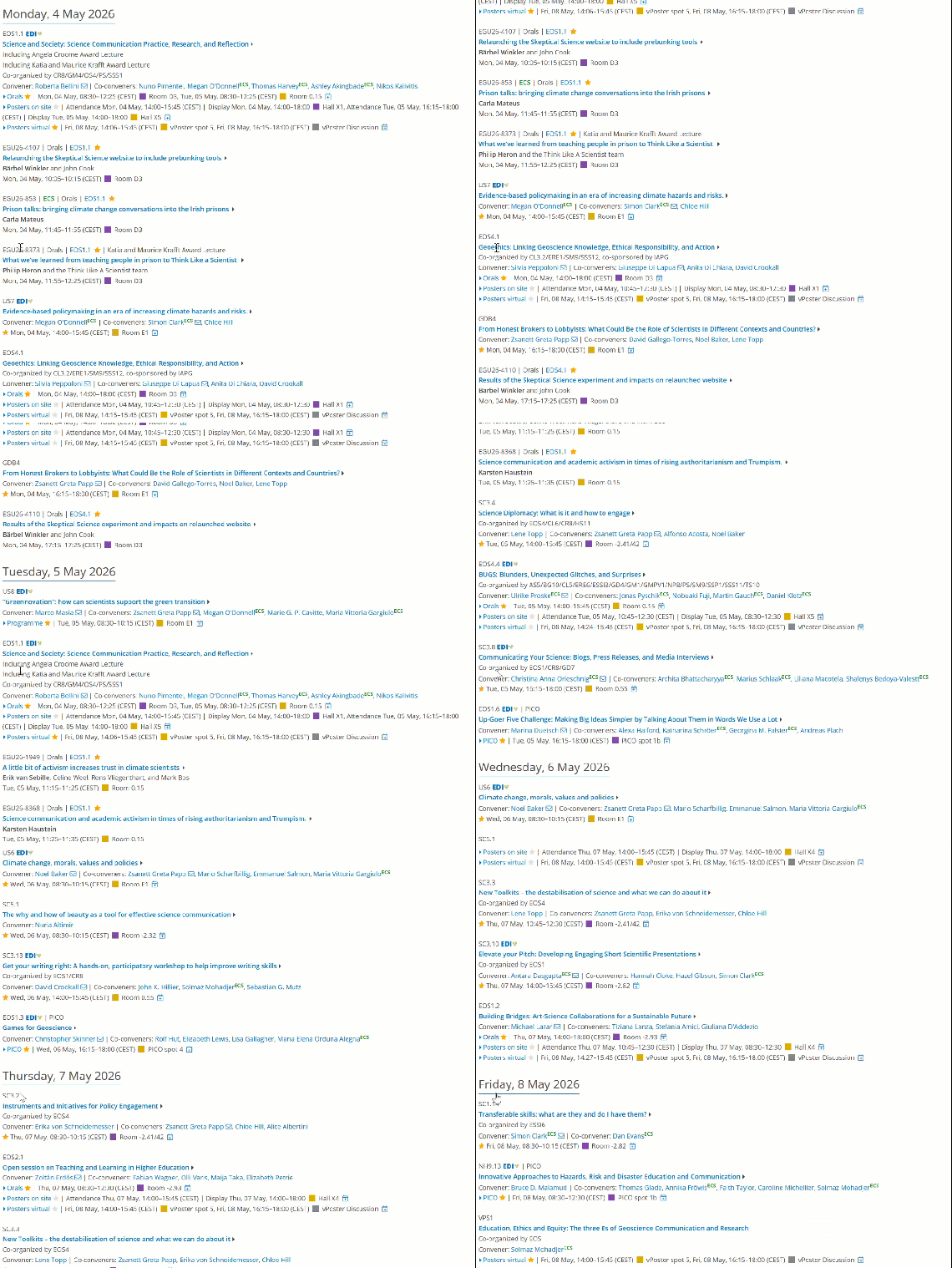
I plan to publish two companion articles about my presentations as well as a by now almost customary EGU diary. Should be fun!
To learn more about the conference, visit their website at egu26.eu!









Comments