



 Arguments







EGU2026 - Presentation about our upcoming website relaunch
Posted on 4 May 2026 by BaerbelW
As mentioned in the recently published prolog to EGU2026 article, I submitted an abstract to talk about our upcoming website relaunch. This blog post is a "companion article" to that presentation in session EOS1.1 Science and Society: Science Communication Practice, Research, and Reflection and will go into somewhat greater details than is possible in the 8 minutes available during the oral session for my presentation about Relaunching the Skeptical Science website to include prebunking tools.
Introduction
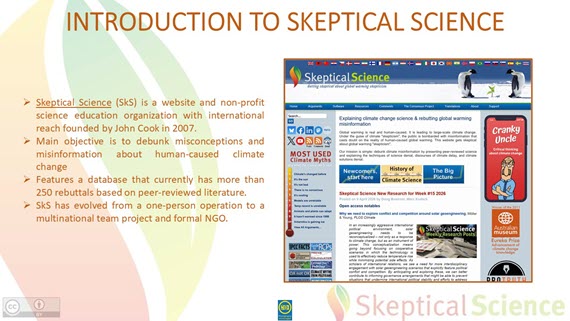
Skeptical Science (SkS) is a website and non-profit science education organization with international reach founded by John Cook in 2007. Our main purpose is to debunk misconceptions and misinformation about human-caused climate change and our website features a database that currently has more than 250 rebuttals based on peer-reviewed literature. SkS has evolved from a one-person operation to a team project with volunteers from around the globe.
Why tackle a re-design?
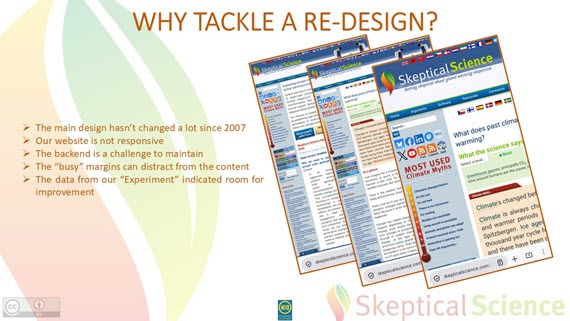
Our current design dates back to 2007 when John Cook first launched Skeptical Science. While it has seen some changes over the years as outlined in our blog series when the website had been around for 10 years, it was never substanially updated. One of the big pain points is, that the design is not responsive, causing usability issues especially on mobile devices like smartphones.
Over the years, a lot of technical debt has made the backend increasingly difficult to maintain, something that Collin Maessen has volunteered to deal with when tackling feature requests we asked for or when mandatory software updates became necessary in the website's underpinnings to keep it up and running.
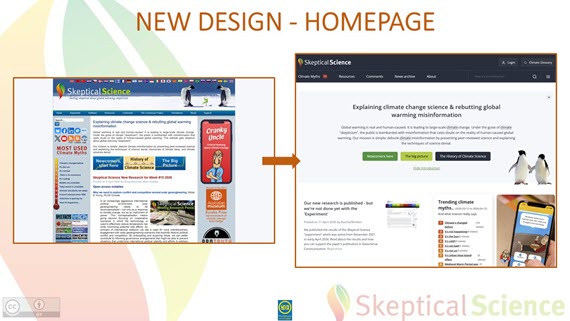
Compared to other websites, our homepage is fairly cluttered (to put it mildly!) with all the links and images in the very busy margins. These run the risk to distract from our core content, like our rebuttals, graphics or blog posts. Data from our recently concluded experiment indicated a clear need for improvement in how we deliver information.
How to potentially tackle the re-design?
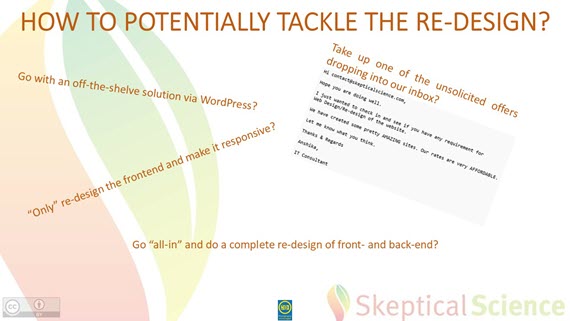
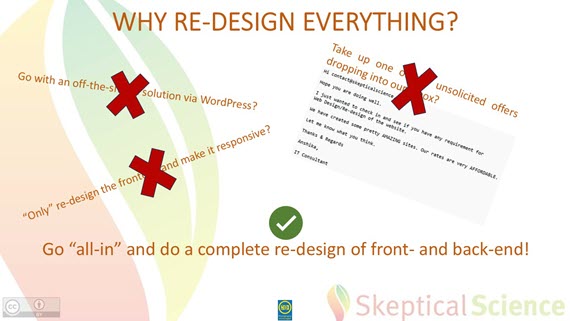
Because we knew that trying to re-design Skeptical Science would be a very big task, we became quite good at procrastination! For many years we had more questions than answers and even some soon abandoned false starts. One of the questions was, whether we could use an off-the-shelf solution like WordPress? Or, whether we could get away with "only" giving the frontend a "facelift" and making it responsive? Perhaps, one of the unsolicited offers for website redesigns, showing up in our email inbox could be an option? Or, last but not least, would we need to "go all in" and do a complete overhaul of both front- and backend?
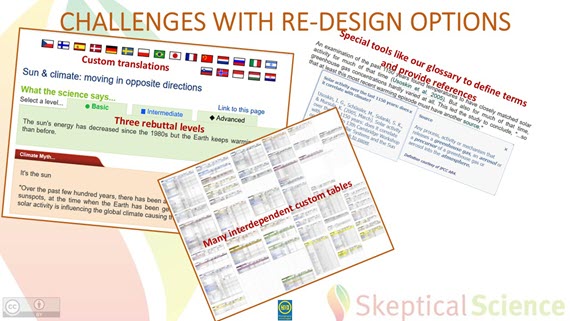
Challenges with the re-design options
If you are among our regular visitors, you'll be well aware of our fairly unique setup and very specialised tooling like our multi-level rebuttals for which translations may exist in over 20 languages. Or, our glossary which is available interactively to display definitions of terms or references to published research if enabled by our readers. And almost all of our content "lives" in dozens of interdependent database tables, some just having a few entries and others more than a million.
Why re-design everything?
By now, it will not come as a big surprise that - in order to preserve as much as possible of our functionality - we decided to go "all in" with a complete redesign of both the frontend and the backend. None of the other options seemed doable for a "brown field" approach and would - if at all - only be possible with starting from scratch and leaving much of our stuff behind. Definitely not something we wanted to do!
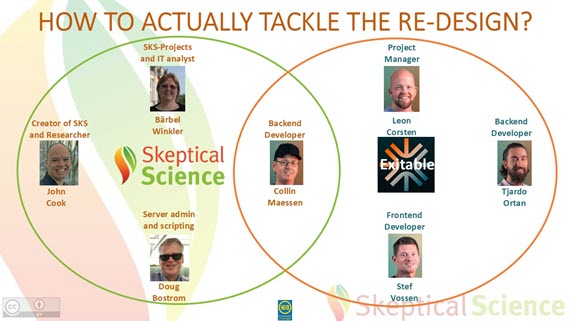
How to actually tackle the re-design?
All the way back in 2023 we set things in motion (anybody remember the "teaser" in that year's review article in the outlook section?) with a core team of volunteers:
- John Cook: founder of Skeptical Science, cognitive scientist, providing content strategy as well as input based on his misinformation research.
- Doug Bostrom: Doug has been looking after our infrastructure, servers and related machinery for many years, something we'd need to add to in the course of the project. His knowledge about data migration scripting will also come in very handy.
- Bärbel Winkler: I've been coordinating many projects for SkS and - while I have no clue about website development - have been working in IT as my actual job since 1985, so know a thing or two about programming in general and data retrieval from tables specifically.
- Collin Maessen: As mentioned above, Collin is a web developer and has been tending Skeptical Science's code base for many years, so he is very well aware of all the ins and outs of what we have now and what we'll need on the new website.
However, it wasn't realistic for us to do such a big re-design project on our own and without professional help. We therefore partnered with Exitable, a web development company located in The Netherlands. This gave us a dedicated project manager and full-stack developers, with Collin acting as the vital link between our legacy system and the professionals. It also helped - a lot! - that Collin actually works for Exitable so was ideally suited to be our "man in the middle", translating our specific needs for his colleagues!
New design - homepage
As a first step, we worked on the new website design. One goal was to drastically declutter our homepage and make sure that the focus is on the content. But, we also wanted to keep our logo and - of course! - the penguins!
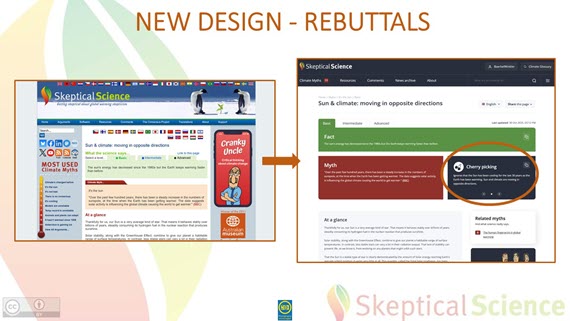
New design - rebuttals
For our rebuttal pages we'll retain the three levels as well as translation capabilities. Where applicable, a rebuttal will now also include a box for up to five fallacies employed by the myth in addition to the fact and the myth itself. This will strengthen the rebuttal's utility for debunking in that they better follow the recommended fact-myth-fallacy format of a successful debunking.
New design - fallacies
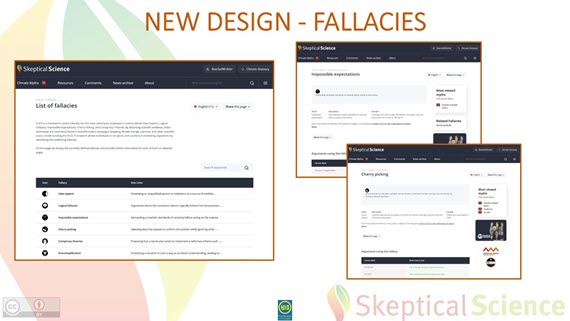
The fallacies will also get their own and dedicated section on our website after the relaunch. We'll have an overview page listing them and then one detailed page per fallacy with definition, explanation and examples. These pages will include a list of myths employing the fallacy and will become a helpful tool for both debunking and prebunking.
Backend challenges - database tables
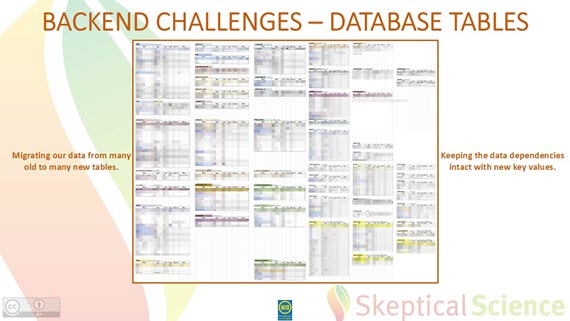
As mentioned above, our content "lives" in many interdependent tables and while the new website will have a comparable setup, the devil is in the details. One of those details is that every entry is getting a new key which is a challenge as far as ensuring data integrity is concerned during the eventual data migration from the old to the new tables. We are however also gaining quite some advantages as there'll for example no longer be a restriction on the number of co-authors a blog post can have or that translation capabilities will mirror what is available in English much more closely than on our current website.
Backend challenges - dependencies
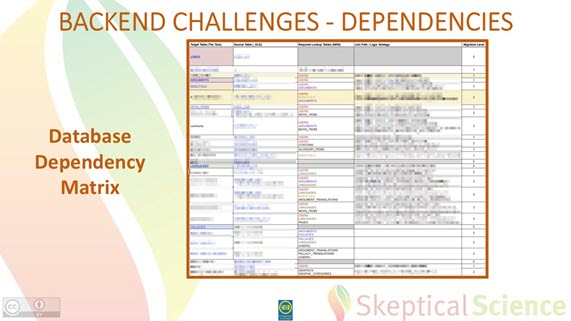
Because all of our content will get new keys, we have to take this into account during the data migration. We for example have to ensure that an entry already exists for a user who is the author of a to be migrated blog post or rebuttal. This creates a mandatory dependency in that user data will need to be migrated first and blog posts and rebuttals (and many others) can follow in subsequent steps. This whole migration process will need several "dress rehersals" to then work with minimal interference on launch day.
Backend challenges - missing data
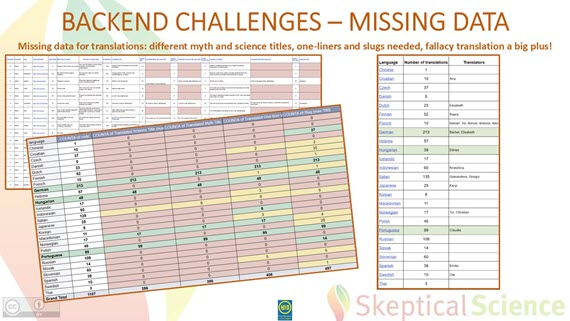
While piecing together the table mappings and dependencies it became apparent that we also have some missing data in our curent setup, especially for translated rebuttals. One example is that our translations only have one title, but on the new website we'll need one title for the myth statement and another one for what the science says. As we don't speak many of the languages we have translations for, we are not really able to tell which of the two is curently used and what the other should be.
Want to help us on the final stretch?
If you speak other languages you might want to check out the blog post published a couple of weeks ago explaining the "missing data challenge" for our translations in more details. You can also head directly to the Google form to offer your help with that ongoing task.
Closer to the not yet planned relaunch date, we'll also need some Beta-testers to try out the new frontend and its functionality and provide feedback on anything which doesn't yet work and needs fixing before we can go live. If you'd like to get involved with that, please let us know via this form. We'll then be in touch when the time comes.
You can download the full presentation in PDF-format here (3.6MB).
Reference: Winkler, B. and Cook, J.: Relaunching the Skeptical Science website to include prebunking tools, EGU General Assembly 2026, Vienna, Austria, 3–8 May 2026, EGU26-4107, https://doi.org/10.5194/egusphere-egu26-4107, 2026.









Comments