



 Arguments







Explaining climate change science & rebutting global warming misinformation
Global warming is real and human-caused. It is leading to large-scale climate change. Under the guise of climate "skepticism", the public is bombarded with misinformation that casts doubt on the reality of human-caused global warming. This website gets skeptical about global warming "skepticism".
Our mission is simple: debunk climate misinformation by presenting peer-reviewed science and explaining the techniques of science denial, discourses of climate delay, and climate solutions denial.


Skeptical Science New Research for Week #21 2026
Posted on 21 May 2026 by Doug Bostrom, Marc Kodack
Open access notables

Attribution of UK Temperature Changes to Anthropogenic and Natural Factors, Amos et al., Atmospheric Science Letters
Understanding the extent to which human activities have influenced regional climate is a key scientific and policy challenge. The UK is one of the world's best observed regions climatically, with a long and reliable temperature record that makes it an important test case for regional detection and attribution. Here, for the first time, we apply optimal fingerprinting to UK mean 2-m air temperature changes using the Estimating Equations method, HadUK-Grid observations, and CMIP6 simulations. We assess the extent to which observed UK temperature changes can be explained by natural internal variability, anthropogenic forcings, and natural external forcings. We detect a significant anthropogenic influence on warming in recent decades and identify greenhouse gases as the main driver. We also detect a cooling contribution from other anthropogenic influences in the mid-twentieth century, likely dominated by sulphate aerosols. These results update earlier UK-focused work and demonstrate that human influences, both warming and cooling, are detectable even at the national scale.
Sustained deoxygenation in global flowing waters under climate warming, Guan et al., Science Advances
Dissolved oxygen (DO), as a vital material sustaining aquatic ecosystems, has declined markedly in oceans, lakes, and coastal waters, yet unbiased understandings of changing DO concentrations in each individual river segment globally remain a challenge. Here, we estimate DO concentrations in 21,439 rivers globally between 1985 and 2023, based on Landsat observations and climatic data, and examine their patterns and trends. We find sustained deoxygenation in global rivers, at a rate of −0.045 mg liter−1 decade−1, with 78.8% experiencing fluvial deoxygenation, driven mainly by oxygen solubility and temperature. Moreover, short-term heatwaves and dam impoundment exert non-neglecting influence on these changes. Future projections demonstrate that global fluvial DO concentrations decline by 1.1% ± 1.6% under SSP1–2.6 and 4.7% ± 2.7% under SSP5–8.5 throughout the 21st century. Our study provides an unbiased baseline for escalating deoxygenation in global fluvial ecosystems that underscores targeted measures to mitigate deoxygenation threats and protect ecosystem health.
Emergent constraints on future methane emissions from global wetlands, Zhang et al., Nature Geoscience
Future methane (CH4) emissions from natural wetlands are predicted to increase due to global warming, leading to positive feedback on climate change. However, the magnitude of this increase remains highly uncertain. Here we present novel ensemble simulations of seven state-of-the-art terrestrial biosphere models to estimate wetland CH4 emissions (eCH4) during the twenty-first century. Our estimates suggest that for every 1 °C increase in global land surface temperature, there is a 24 ± 10 Tg CH4 yr−1 increase in eCH4. We also identify an emergent relationship between contemporary temperature dependence and projected eCH4. When constrained by 163 site-year eddy-covariance measurements of eCH4, we show that wetland emissions can increase by 50–60% by the 2090s relative to the 2010s under a high-warming scenario. The projected decadal increase in eCH4 from the 2010–2019 baseline to the 2030s would very likely (90% probability) offset an amount equivalent in scale to 8–10% of anthropogenic eCH4 at the 2020 level, comparable to the reductions committed under the Global Methane Pledge. However, the constraint is dominated by mid- and high-latitude observations, with limited tropical coverage, and uncertainties in projected wetland inundation contribute substantially to uncertainty in eCH4. Our findings reduce the uncertainty in projected wetland methane–climate feedback and highlight its potential impacts on methane mitigation efforts to slow global warming.
Challenges and opportunities of the full phase-out of fossil fuels under the 1.5 °C goal, Mori et al., Nature Communications
The COP28 decision called for transitioning away from fossil fuels, sparking a growing interest in their full phase-out. However, energy system transformation pathways towards a phase-out of fossil fuels, which may reduce the reliance on carbon dioxide removal to meet the 1.5 °C goal, remain unclear. Here, we employ two global energy system models to explore energy system transformations and the challenges and opportunities associated with attaining a full phase-out of fossil fuels. We found that phasing out fossil fuels by 2050 would require accelerating direct and indirect electrification, involving 1.6–1.8-fold increases in power generation compared to the conventional cost-effective 1.5 °C pathways. This transition from cost-effective to fossil fuel phase-out pathways would increase energy supply investments by up to 34% over this century and require accelerated deployment of solar and wind power, as well as electrolysers. Despite opportunities including lower reliance on carbon dioxide removal and increasing probability of returning to 1.5 °C after temperature overshoot, these additional requirements imply that international society must approach the transition towards zero-fossil energy systems with strong determination.
Scientific authority cues increase the spread of misinformation, Harrando et al., Proceedings of the National Academy of Sciences
Misinformation continues to circulate on social media, often because people unintentionally share posts without verifying their accuracy. We show that references to scientific entities, what we call Scientific Authority Cues, play an important role in this problem. Analyzing 8.7 million posts on Twitter (X), we find that these cues are associated with an increase in sharing, especially when sharing low veracity content, and when users lean politically to the right. A preregistered experiment with U.S. adults shows that attributing claims to scientific entities increases people’s willingness to share them by making claims seem more accurate. These findings reveal an important tension: Signals of scientific authority can also make misinformation more credible and thus easier to spread.
From this week's government/NGO section:
The AI Climate Hoax: Behind the Curtain of How Big Tech Greenwashes Impacts, Ketan Joshi, Beyond Fossil Fuels, Standearth, Climate Action Against Disinformation et al
The analysis collected the most prominent AI climate claims and determined a) what types of AI were referred to and b) what evidence was presented to back up those claims. The author found that 1. Most claims of climate benefit relate to ‘traditional’ AI, which has a much lower environmental impact than consumer generative AI tools. Even if these benefits are real, they are unrelated to - and dwarfed by - the massive expansion of energy use from the generative AI industry. 2. Where claims of traditional AI climate benefits are made, they tend to rely on weaker forms of evidence, such as corporate websites, rather than published academic research. Only 26% cited published academic research while 36% did not cite any evidence at all. This analysis shows that to bring the deployment of digital services in bounds with the physical limits of the planet, tech companies investing in AI should implement actual sustainability measures rather than masking ever-worsening damage to the climate and environment with vague terms and weak evidence.
Survey: U.S. and Canadian Business Confidence in Climate Action Remains Strong, Melissa Fifield, BMO Climate Institute
The fourth edition of the BMO Climate Institute Business Leaders Survey was conducted in January 2026 and included 741 respondents, including 370 in Canada and 371 in the U.S. Survey respondents include individuals in a senior role at their company (e.g. C-suite, President, Vice-President, Executive Director or General Manager) and who consider themselves to be senior decision makers. Companies range from those with at least five employees to more than 500 employees. Nearly three-quarters (73%) of respondents say they have or are developing plans to address climate-related risks, up from 69% in 2025. Extreme and unpredictable weather is a top concern for business leaders considering the impact of climate-related risks on their companies. Competitive pressure, customer expectations, and regulatory change are expected to drive further climate action. Three?fifths of respondents say AI is already used in daily operations or climate planning. Costs remain the most frequently cited obstacle to developing an effective climate plan.
101 articles in 48 journals by 751 contributing authors
Physical science of climate change, effects
Future changes of upscale ocean kinetic energy transfer under greenhouse warming, Wang et al., npj Climate and Atmospheric Science Open Access pdf 10.1038/s41612-026-01429-1
Mean State Change-Induced Differential Responses Between Strong Positive and Negative Events Reduce Indian Ocean Dipole Asymmetry Under Greenhouse Warming, Wang et al., Journal of Geophysical Research Atmospheres 10.1029/2025jd045190
What’s a ‘super El Niño’? And other El Niño questions, answered
Posted on 20 May 2026 by Guest Author
This is a re-post from Yale Climate Connections by Bob Henson
The odds are in El Niño’s favor right now.
This natural weather phenomenon, part of the El Niño-Southern Oscillation, or ENSO, occurs when warmer-than-average water extends throughout most of the equatorial Pacific Ocean just below the surface. That’s happening now. And powerful bursts of westerly wind have pushed immense amounts of warm water eastward, toward the Niño3.4 region where sea surface temperature, along with other atmospheric conditions, is used to assess the state of ENSO.
On May 14, in its monthly ENSO outlook, the NOAA/National Weather Service Climate Prediction Center gave an 82% chance that El Niño will be in place for the period May through July, which implies that it’ll be here within weeks.
How do experts know when El Niño has arrived?
El Niño conditions are declared when the atmosphere and ocean are in sync and the Niño3.4 sea surface temperature is at least 0.5 degrees Celsius (0.9°F) warmer than the seasonal average.
But just as hurricanes can and do stray from the “cone of uncertainty” at times, it’s vital to remember that El Niño can do much the same. Preparing for the prototypical outcomes is a smart move, as long as you keep in mind that forecasting the El Niño-Southern Oscillation is more a matter of probabilities than certainties.
NOAA now uses a Relative Oceanic Niño Index, or RONI, in which the Niño3.4 value is adjusted relative to the world’s tropical oceans as a whole; the goal is to keep global warming from smudging the signal of El Niño and La Niña events themselves.
Read: A new and better way to keep tabs on El Niño and La Niña
Nearly all seasonal forecast ensembles used to predict ENSO at agencies around the world now concur that the imminent event is likely to bring Niño3.4 warming of at least 1.5°C, which would push it into the “strong” category. And some of the ensemble averages are now going well above 2°C, even for the adjusted RONI index. That would put it in the ballpark of the biggest El Niño events in the NOAA database going back to 1950.
Individual ensemble members still cover a fairly broad range, with outcomes varying from a weak event to a record-stomping one, but as shown below, they’re about as close to being unanimous on a significant El Niño as you’re likely to see. (This output is mainly using the traditional pre-RONI index, which tends to run slightly hotter on recent El Niño events.)
What’s a ‘super El Niño’ – and will we get one?
Back in 2003, a group of researchers from Australia’s national science agency, CSIRO, invoked the term “super El Niño” in a Monthly Weather Review paper. They used it to describe events where the Niño3.4 departure from average was at least 3°C. The phrase has since been used more loosely around the world, especially in news articles and social media, but it’s not part of the toolbox of most professional ENSO forecasters.
“While ‘Super El Niño’ is sometimes used informally, it is not a scientific term,” said senior climatologist Felicity Gamble in a statement from Australia’s Bureau of Meteorology, which avoids the “super” moniker in its products.
The same is true of NOAA, which is going with “weak,” “moderate,” “strong,” and “very strong.” NOAA’s monthly ENSO outlooks now include month-by-month odds that a predicted El Niño event will fall into each of these four brackets. The odds of a “very strong” event peak at 37% in the November-to-January period.
Summing these categories, the odds that we will have El Niño at any strength are now greater than 90% from this summer through winter 2026-27, according to NOAA.
 Figure 1. Probabilities from NOAA’s May 14 outlook that the expected El Niño event of 2026-27 will fall into various strength categories during each overlapping three-month period through December-February. El Niño events typically build in northern summer and fall, peak in the winter, and fade by spring. Unlike La Niña, El Niño rarely persists or recurs for two or more years in a row, though that occasionally happens. (Image credit: NOAA/NWS/CPC)
Jan Null of Golden Gate Weather Services, a California-based forensic meteorologist and former National Weather Service forecaster, began using “very strong” when the 2015-16 event arrived, so he’s happy to see NOAA doing the same. As Null puts it, “Everyone sees a forecast plume that looks like the liftoff of Artemis and goes crazy, and somehow early on attached the ‘super’ superlative to it.”
Fact brief - Does electromagnetic radiation from wind turbines pose a threat to human health?
Posted on 19 May 2026 by Sue Bin Park
 Skeptical Science is partnering with Gigafact to produce fact briefs — bite-sized fact checks of trending claims. You can submit claims you think need checking via the tipline.
Does electromagnetic radiation from wind turbines pose a threat to human health?
 Electromagnetic fields (EMFs) from wind turbines are well below international exposure safety limits.
Wind turbines produce EMFs mainly from their electrical equipment. Multiple studies have found their strength to be lower than everyday exposure to many common household appliances, such as microwaves and vacuum cleaners.
In a field study at a Canadian wind farm, average magnetic fields at the base of operating turbines were around 0.1 microtesla (µT) and dropped to background levels within 2 meters. Turbines under high wind and low wind conditions emitted equivalent levels of radiation. Another 2020 study found wind turbines produced under 0.1 µT at 4 meters distance.
For comparison, an electric can opener measures about 60 µT at 6 inches but 0.2 µT at 4 feet. International guidelines set a safety reference level of 100 µT at 50 Hz, far above the turbine measurements reported in field studies.
Go to full rebuttal on Skeptical Science or to the fact brief on Gigafact
This fact brief is responsive to quotes such as this one.
Sources
Environmental Health Measuring electromagnetic fields (EMF) around wind turbines in Canada: is there a human health concern?
Radiation Protection Dosimetry EXTREMELY LOW FREQUENCY ELECTROMAGNETIC FIELD EXPOSURE MEASUREMENT IN THE VICINITY OF WIND TURBINES
World Health Organization Radiation: Electromagnetic fields
Frontiers in Human Health Wind Turbines and Human Health
Columbia Law School Sabin Center for Climate Change Law Rebutting 33 False Claims About Solar, Wind, and Electric Vehicles
Please use this form to provide feedback about this fact brief. This will help us to better gauge its impact and usability. Thank you!
Five things you need to know about El Niño’s likely comeback
Posted on 18 May 2026 by Guest Author
This is a re-post from Yale Climate Connections by Rafael Méndez Tejeda
El Niño is (probably) coming back later this year.
And this time, it’s unfolding against a backdrop of unusually warm oceans and an even warmer climate system than the last time we experienced this natural climate pattern.
Here is what you need to know about it.
What is El Niño?
The term El Niño is part of a broader phenomenon called El Niño-Southern Oscillation, or ENSO. It’s a recurring climate pattern involving changes in sea surface temperatures across the central and eastern tropical Pacific.
Copernicus, a European climate data service, reported that in March 2026, the average sea surface temperatures in the Pacific reached 20.97°C – the second-highest value ever recorded for March, which suggests a likely transition toward El Niño conditions.
The El Niño-Southern Oscillation is one of the planet’s most important natural mechanisms through which the ocean and atmosphere exchange energy and reorganize the global climate from year to year.
The phenomenon has three phases: the warm phase is El Niño, the cool phase is La Niña, and between the two lies a neutral or transitional phase, when neither dominates clearly. The changes occur in the tropical region of the Pacific Ocean, within 700 miles of the equator.
The consensus among climate models – including those from NOAA – indicates with high probability the onset and subsequent intensification of El Niño starting in fall 2026, with some models suggesting it could be an unusually intense event.
We can anticipate more heat waves with a strengthening El Niño, along with more extreme events ranging from heavy rainfall to drought. El Niño tends to intensify the subtropical jet stream, favoring wetter conditions and greater storm activity across the southern United States and northern Mexico, while the northern United States and Canada experience a relatively warmer and drier pattern, affecting snow cover and water availability. At the same time, the effects of El Niño usually reduce the frequency and intensity of hurricanes in the Atlantic Ocean.
The return of El Niño is not synonymous with climate change
El Niño is a natural phenomenon of the ocean-atmosphere system. But when it coincides with a planet already warmed by human activity, its effects can be amplified. The World Meteorological Organization warned that during the last El Niño period (2023–2024), the combination of El Niño and climate change hit Latin America and the Caribbean with greater force, worsening droughts, heat waves, wildfires, extreme rainfall, and other impacts with significant human and economic costs.
El Niño affects more than the Pacific region
Although El Niño originates in the equatorial Pacific Ocean, its effects extend to other regions of the planet through processes known as climate teleconnections – atmospheric links that allow massive cloud formations to develop as a result of the enormous evaporation generated by the warming of ocean waters.
El Niño disrupts what is known as the Walker Cell or Walker Circulation, a tropical atmospheric circulation system that transports heat, moisture, and energy on a large scale. These disturbances propagate through the atmosphere in the form of planetary waves, modifying global pressure and wind patterns. As a result, El Niño’s influence reaches the Atlantic Ocean and the Caribbean, where significant changes in regional climate occur.
Among these effects are a tendency toward drier conditions in certain periods due to descending air and a redistribution of heat that contributes to higher temperatures and more intense heat waves. In short, even though El Niño occurs far from where most Yale Climate Connections readers live, its impact is clearly felt because Earth’s climate system is interconnected, and atmospheric disturbances can travel vast distances.
During El Niño, increased variability in wind direction and speed – which inhibits hurricane formation – can act as a buffer against hurricane activity. However, hurricane formation in the Atlantic depends on multiple factors, including conditions in the Atlantic itself – such as sea surface temperatures, atmospheric moisture, and the Azores High, a large semipermanent center of high atmospheric pressure that sits over the North Atlantic near the Azores islands. And when it comes to hurricanes, we should never let our guard down completely.
 How El Niño affects hurricane formation in the Pacific and Atlantic Oceans. (Image credit: NOAA / Climate.gov)
2026 SkS Weekly Climate Change & Global Warming News Roundup #20
Posted on 17 May 2026 by BaerbelW, Doug Bostrom
Stories we promoted this week, by category:
Climate Change Impacts (10 articles)
- This critical climate system is tipping…. Or is it? DrGilbz on Youtube, Ella Gilbert, May 9, 2026.
- This summer, the American water crisis becomes real Concerns over water access are poised to consume summer in the U.S., as crises in Corpus Christi and across the Colorado River threaten to boil over. Grist, Molly Taft, May 10, 2026.
- Poll: Most Coloradans say climate change is harming human health More than 1 in 3 Coloradans say they or a loved one has experienced a climate-change related health impact, according to new survey data Colorado Sun, John Ingold, May 11, 2026.
- Why has this autumn been so hot and dry? Australia's autumn behaves as expected from climate models The Conversation, Kimberley Reid, May 11, 2026.
- 2026 Has Already Broken Climate Records. El Niño Could Break More. The increasingly likely emergence of an El Niño this summer will likely continue the year’s record-breaking weather trends and could lead to “an unprecedented year of global fire,” according to a statement from World Weather Attribution, a climate research collaboration. Eos, Grace van Deelen, May 12, 2026.
- Some climate shocks can increase the likelihood of war Researchers warn against oversimplifying climate change’s role in conflicts, but some conditions can increase the likelihood of violence. The Daily Climate, EHN Curators, May 12, 2026.
- Something startling is happening in the Gulf of Mexico Its waters are heating up twice as fast as the global oceans, with huge implications for hurricane risk. Yale Climate Connections, Jeff Masters, May 13, 2026.
- Melting of Greenland ice sheet could release large stores of methane Seismic surveys and sediment cores suggest that dozens of deep pockmarks on the sea floor were created when Arctic methane stores were disrupted by climate change after the last glacial maximum. New Scientist, Alec Luhn, May 14, 2026.
- Scientists find climate change is reducing oxygen in rivers worldwide Global warming is causing rivers to slowly lose oxygen, threatening fish and other lives. The Independent News, Seth Borenstein, May 15, 2026.
- Are we wrong about this..? Dr Gilbz on Youtube, Ella Gilbert, May 15, 2026.
Climate Science and Research (4 articles)
- Why Should You Care About Changes In Atlantic Ocean Currents? Mechanisms and impacts of a collapsing Atlantic Meridional Overturning Circulation (AMOC) explained— good to know because AMOC cessation is currently a favorite hobbyhorse of climate denialists due to it being convenently confusing. CleanTechnica, Carolyn Fortuna, May 09, 2026.
- Antarctica is melting from below and scientists say it`s worse than expected Hidden warm-water traps beneath Antarctica’s ice shelves may be speeding up sea level rise far faster than expected. ScienceDaily, iC3 Polar Research Hub, May 10, 2026.
- Drilling Into the Thwaites Glacier in Antarctica A deep read on the why, how and extraordinary challenges of obtaining deep samples of the sea level critical Thwaites glacier, with some spectacular photographs. NYT, Raymond Zhong and Chang W. Lee, May 11, 2026.
- A New Study Explains How Carbon Dioxide Cools the Upper Atmosphere-and Warms Earth Below In a new study, researchers from Columbia University describe the phenomenon’s mechanics, illuminating how it is largely determined by the way carbon dioxide (CO2) interacts with different wavelengths of light. State of the Planet, Columbia Climate School, May 12, 2026.
Skeptical Science New Research for Week #20 2026
Posted on 14 May 2026 by Doug Bostrom, Marc Kodack
Open access notables
The Perils of Climate Catastrophism: A Call to Situate Crisis and Change, Bickerstaff, Wiley Interdisciplinary Reviews Climate Change
Catastrophic imaginaries are inextricably bound to how we think about climate change and also how we respond—individually and collectively—to the urgent challenges of achieving rapid reductions in greenhouse gas emissions. This advanced review reflects on, and problematises, the power and persistence of ideas about climate catastrophe. It is argued that this politically and culturally dominant framing of imminent planetary devastation impedes and constrains action on climate change. It is a position that underlines, I suggest, a need to rethink and better situate our narratives of, and relations to, climate crisis and emergency. I pursue this argument in four parts. First, I begin by introducing and theoretically contextualizing “environmental catastrophism”. Second, and following on, I address the ways in which the problem of climate change has become synonymous with imaginaries of apocalyptic catastrophism, tracing dominant tropes and discourses. In the third step I raise interconnected perils of the catastrophic gaze for climate action: the impossibility of solving a problem framed as a predominantly totalising whole-planet challenge; defeatism that displaces action to “total” and/or depoliticising solutions; and public despair around, and alienation from, climate action. Finally, and in response to these challenges, I make the case for a situated view of climate crisis and change—one that offers and embraces imaginaries that are fundamentally partial, located and positioned.
Unseen but increasing: recent changes in risk of extreme precipitation over Southern Africa and Southeast Asia, Perez et al., Weather and Climate Extremes
There is evidence that rainfall extremes have become more intense and frequent over the last few decades, but it is difficult to assess these changes due to the limitations of our short observational records. We use the UNprecedented Simulated Extreme ENsemble (UNSEEN) approach to (1) assess changes in extreme rainfall over Southern Africa and Southeast Asia over the last 40 years and (2) identify locations that have a high chance of breaking rainfall records. We find that extreme rainfall risk has already increased since 1981 during the rainy season in both regions, including a doubling of risk in some months for many major population centers such as Phnom Penh, Vientiane, Bangkok, Hanoi, Maseru, Johannesburg, Lilongwe, and Lusaka. The pattern of increasing risk of extreme rainfall is projected to increase further in the coming 20 years in the CMIP6 ensemble; yet UNSEEN estimates of changes from the last 20 years are already greater than these future projections in the Philippines, northern Mozambique, and northern Madagascar. Finally, we compare the UNSEEN ensemble to historical records to identify places that have “soft records” and are likely to see record-setting events. These places with increasing risks but no recent extremes are labeled as “sitting ducks” in today's climate. We find that much of Mozambique, the Philippines, and Laos would be considered “sitting ducks” for extreme precipitation in at least one month of the year. Disaster risk managers should use these types of large ensembles when estimating the risk of extremes in today's climate, in order to ensure that society is prepared for record breaking events. This approach can also be used for improving engineering design estimates of rainfall return periods and for stress-testing health system and disaster preparedness.
Facilitating permanent carbon storage through risk transfers? Analyzing the insurability of the carbon leakage liability, Spencer et al., Energy Research & Social Science
Geological storage of CO2 is expected to play a role in mitigating climate change, especially for carbon capture and storage (CCS) in hard-to-electrify sectors, and for carbon dioxide removal (CDR) under net-zero targets. One challenge of geological CO2 storage is the risk that CO2 later returns to the atmosphere. Policymakers aim to address this risk by imposing leakage liabilities on storage operators, potentially also mandating insurance cover. However, whether such liabilities are insurable is still open given the undeveloped state of the insurance market for this risk. Here, we adapt the Berliner (1982) framework from insurance economics to this question, to consider actuarial, market, and social factors that might constitute barriers to insurability. Due to the lack of a loss history, we systematically use the upstream oil & gas industry as an analogy. Combining expert workshops and techno-economic estimates, we find two barriers: the possibility of correlated material failures across the industry and gradual leakages, which will likely have to remain uninsured initially (though increased experience will likely improve the situation). We also find three general preconditions for insurability: appropriate care in site selection, robust regulations for information sharing and risk mitigation, and limited coverage periods to exclude CO2 price volatility. Overall, the insurability of CO2 leakage does not appear to be a roadblock for the deployment of CCS and CDR. The future price of CO2 emissions and removals, however, remains an important uncertainty. ‘In-kind’ insurances (based on reserve CO2 units) are a possible way out.
Dust Decline Amplifies High-Cloud Ice-to-Liquid Transition and Buffers the Radiative Feedback Under Warming, Wang et al., Geophysical Research Letters
The response of the cloud phase to global warming is a critical yet poorly constrained component of Earth's climate sensitivity. While rising temperatures drive a thermodynamic transition from ice to liquid clouds, the role of ice-nucleating particles in modulating this shift remains underexplored. Here, we provide evidence that the declining trend of mineral dust in the Northern Hemisphere (NH) may act as a microphysical amplifier of this transition. Satellite observations of high clouds (
Opposing transient and equilibrium effective radiative forcing from aerosol-cloud interactions, Dagan, Nature Communications
Aerosols influence clouds, and therefore Earth’s radiation budget, through processes that operate across multiple and interacting time scales, making aerosol-cloud interactions (ACI) a persistent source of uncertainty in estimates of effective radiative forcing (ERF). Here we examine the time-dependent response of the local, convection-focused ERFACI using an ensemble of high-resolution simulations initialized from different atmospheric states and subjected to an instantaneous aerosol perturbation, together with simulations in which aerosol concentration changes with prescribed periods. We find that the transient ERFACI during the first ~ 2 days is positive, driven by rapid microphysical invigoration, enhanced high-cloud fraction, and increased longwave trapping. In contrast, the equilibrium ERFACI becomes negative as upper-tropospheric warming increases static stability and reduces anvil cloud fraction. As a result, the time-mean forcing depends on the ratio between the environmental adjustment time scale (τadj) and the aerosol-perturbation time scale (τaer). For intermediate regimes, where τaer is only moderately longer than τadj, the system exhibits pronounced hysteresis: ERFACI depends not only on the instantaneous aerosol loading but also on its recent history. These results imply that snapshot-based observational constraints and near-instantaneous-equilibrium convective parameterizations may systematically misestimate ERFACI.
From this week's government/NGO section:
Pedal to the Metal 2026. The iron and steel industry’s coal lock-in crisis, Grigsby-Schulte et al., Global Energy Monitor
The authors present the newest annual survey of the current and developing global iron and steel plant fleet. The authors examine the status of the iron and steel sector compared to global decarbonization roadmaps and corporate and country-level net-zero pledges. Included in the survey are asset-level data on 1,293 iron and steel plants in 91 countries and nearly 700 operating and proposed mines worldwide. A closing window for transition With 2030 decarbonization deadlines approaching, the global iron and steel industry is running out of time to shift away from coal-based production methods. Continued investment in coal-based capacity and underinvestment in green hydrogen threaten net-zero targets. Now more than ever, it is crucial to disrupt emissions-intensive blast furnace developments and redirect resources to iron and steelmaking technologies that align with net-zero goals.
Trust, Governance, and Climate Disasters in the Indo-Pacific, Sohail Akhtar, Toda Peace Institute
The author argues that climate emergencies generate epistemic stress: situations in which uncertainty and competing narratives disrupt shared understandings of risk and appropriate response. Drawing on recent bushfire events and subsequent reviews of disaster governance in Australia, the author shows how disagreements over climate attribution, institutional readiness, and political accountability can complicate emergency coordination and weaken public trust even where operational capacity remains strong. The author concludes with policy recommendations for Indo-Pacific governments, regional organizations, and international partners aimed at strengthening crisis communication, institutional credibility, and the capacity of democratic systems to manage contested knowledge during climate emergencies.
129 articles in 63 journals by 1077 contributing authors
Physical science of climate change, effects
Changes in Wind Extremes Shaped the Summertime Weakening of the Eurasian Subtropical Westerly Jet, Li et al., Journal of Geophysical Research Atmospheres 10.1029/2025jd045904
Critical role of low cloud feedback in irreversible sea level rise, Wang et al., Nature Communications Open Access 10.1038/s41467-026-72898-4
Higher warming predictions for 2026 and 2027
Posted on 13 May 2026 by Zeke Hausfather
This is a re-post from The Climate Brink
Back in December I provided some initial projections of where both 2026 and 2027 global mean surface temperatures might end up.
A lot has happened since then. We’ve gotten the first three months of data in for 20261 (and have a good sense of where April 2026 will end up in reanalysis data – see our Climate Dashboard for daily updates).
More importantly, models are converging on a doozy of an El Niño event developing in the latter part of 2026, with the latest multi-model median projection of a peak anomaly of 2.7C in the ENSO3.4 region of the tropical Pacific. While the prediction remains uncertain (we remain within the “spring predictability barrier” when its historically hard to predict ENSO2 development), this would put the 2026/2027 roughly on par with the “super” El Niño the world experienced in 2015/2016.
I’ve updated the models I use for both my 2026 and 2027 projections. I’ll go into the gory methodological details shortly, but the headline numbers are in the figure below: the estimate for 2026 has risen from 1.41C (with a range of 1.27C to 1.55C) to 1.46C (1.36C to 1.59C). The 2027 estimate has similarly increased from 1.57C (1.3C to 1.76C) to 1.61C (1.4C to 1.93C).
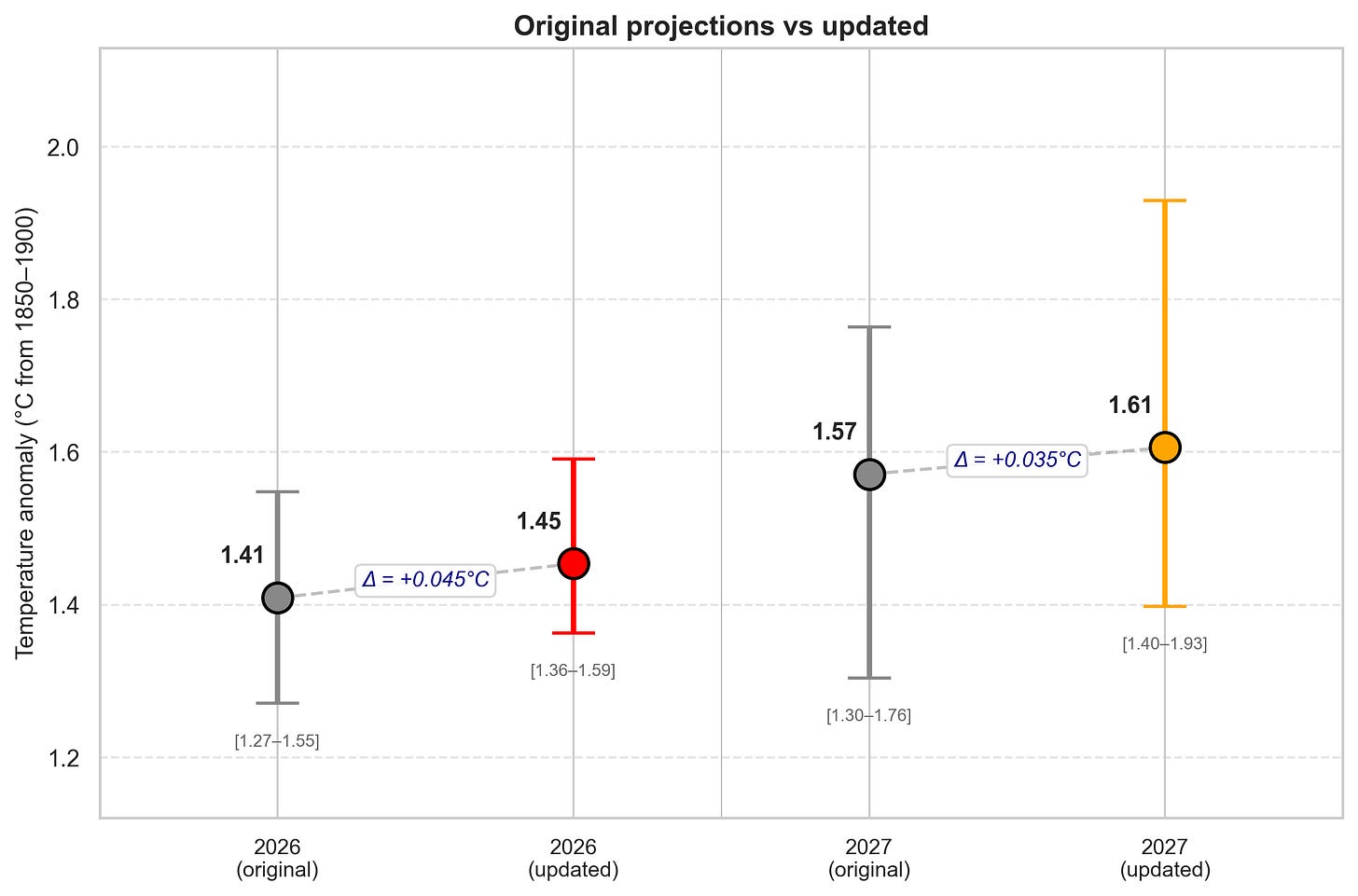
So what changed? Before the start of the year I was using a pretty simple regression model. It estimate what the annual temperature anomaly would be based on the prior year’s anomaly, the last month of the prior year, the predicted ENSO state over the next three months, as well as a year count (and year count squared) to reflect linear and non-linear aspects of the trend since 1970.
I’ve updated this to use the equation below, which includes the year count, prior year’s temperature anomaly, the anomaly over the year to date for 2026 (currently Jan-Mar), the latest month, the observed ENSO state over the year to date, and the forecasted ENSO state over the remainder of the year.3 The uncertainty in the 2026 prediction also accounts for the uncertainty in the ENSO forecast using a Monte Carlo sampling approach.4
A look back at ‘An Inconvenient Truth,’ 20 years later
Posted on 12 May 2026 by dana1981
This is a re-post from Yale Climate Connections
Al Gore’s climate documentary “An Inconvenient Truth” arrived in theaters 20 years ago, in May 2006. The film had a profound effect on the public’s awareness and understanding of climate change, a number of surveys found.
I count myself among those who were dramatically influenced by “An Inconvenient Truth.”
In 2006, the topic of climate change had not yet significantly breached the public consciousness. Despite having just embarked on a career as an environmental scientist and having recently completed my graduate studies with degrees in astrophysics and physics, I had only a vague notion about the problem of climate change before seeing the documentary.
I remember thinking as I left the theater, “If the science in this film is right, how is it possible that we’re not doing anything to stop climate change?” Answering this question put me on a path to becoming a climate journalist and educator.
The film was a watershed moment for me and countless others. It also retains cultural significance to this day. In an October 2025 episode of his podcast centered on climate change contrarianism, which has over 1 million views on YouTube, Joe Rogan and his guests mentioned Al Gore and his film a dozen times. That included Rogan’s claim that “What Al Gore predicted in this stupid movie, which is so far off. He thought we were all going to be dead today, right?”
Spoiler alert: That’s not right. Gore never said we would all be dead by now; Rogan made that up.
Read: Five ways Joe Rogan misleads listeners about climate change
For its 20th anniversary, I revisited the film. I found that its scientific overview was imperfect but predominantly accurate, and that despite worsening impacts, the world has made significant progress in addressing climate change over the ensuing two decades.
‘An Inconvenient Truth’ was right on the basic science
Many climate science experts have reviewed “An Inconvenient Truth,” including University of Washington climate scientist Eric Steig, who in a 2008 paper wrote that although the film included some oversimplifications, “The portrayal of the science of climate change in ‘An Inconvenient Truth’ is largely correct.”
Gore outlined the basic science underpinning climate change the same way I explain it to college students today: By burning vast amounts of fossil fuels, humans have increased the amount of heat-trapping carbon dioxide in the atmosphere. That pollution traps more heat in Earth’s thin lower atmosphere, warming the planet’s surface.
When the film was released, the atmospheric concentration of carbon dioxide had surpassed 380 parts per million, a level 36% higher than at any time in the prior 650,000 years.
To emphasize how high carbon dioxide levels could rise if fossil fuel consumption continued unabated, Gore climbed aboard a scissor lift.
“Within less than 50 years, it will be here,” he said, pointing to the top of a graph where projected concentrations reached around 500 parts per million.
Now 20 years later, carbon dioxide levels are approaching 430 parts per million, and as Gore suggested, remain on pace to reach 500 parts per million by 2056, barring successful efforts to slow their rise.
 Atmospheric carbon dioxide concentration over the past 800,000 years. (Data: NOAA Antarctic ice core compilation and Mauna Loa measurements. Graphic: Dana Nuccitelli)
Because carbon dioxide is the principal control knob governing Earth’s temperature, as a team of NASA climate scientists documented in a 2010 study, the carbon dioxide levels and temperature have hewed closely throughout the planet’s history. As Gore accurately explained, abrupt and dramatic spikes in carbon dioxide invariably cause global warming by trapping more heat.
Two videos about the Atlantic Meriodonal Overturning Circulation (AMOC)
Posted on 11 May 2026 by Guest Author
These videos include personal musings and conclusions of the creators and climate scientists Dr. Adam Levy and Dr. Ella Gilbert. It is presented to our readers as an informed perspective. Please see video description for references (if any).
ClimateAdam - Our Oceans Are Tipped To Collapse: Can we still act?
Climate change is driving a crucial ocean current close to collapse. As global warming heats our planet, it's slowing down the vast Atlantic Meridional Overturning Circulation - or AMOC. And scientists fear that it could reach a tipping point - effectively shutting down this ocean circulation, and causing rapid climate change and disasters across the world: brutally cold European winters; sea level surges in America; and disrupted monsoon rains. But what do we actually understand about our risks of an AMOC tipping point? How big are the risks as our climate changes? And can we still act to protect ourselves?
Support ClimateAdam on patreon: https://patreon.com/climateadam
2026 SkS Weekly Climate Change & Global Warming News Roundup #19
Posted on 10 May 2026 by BaerbelW, Doug Bostrom
Stories we promoted this week, by category:
Climate Change Impacts (6 articles)
- The ramifications of record-shattering heat on the West`s ecosystems Not only did Western US locations set new March highs but many exceeded temperature records for May, according to Climate Central scientist Zachary Lab. Grist, Christine Peterson, May 02, 2026.
- Flooding in Chicago Is Getting Worse. Here`s Why. Over the past century in Chicago, the likelihood of heavy rainstorms has increased sevenfold. Inside Climate News, Brett Chase, May 04, 2026.
- `Point of no return`: New Orleans relocation must start now due to sea level, study finds Louisiana’s cultural hotspot could be surrounded by Gulf of Mexico before end of this century, authors say The Guardian, Oliver Milman, May 04, 2026.
- Dangerous heavy rains are getting more likely and widespread Seven of the top 11 highest-volume precipitation events over the past 77 years have occurred just in the past 10 years. Yale Climate Connections, Jeff Masters, May 04, 2026.
- New Study Shows Risks of Amazon Deforestation. And Rewards of Protection. Researchers examined the combined effects of tree loss and global warming in an effort to better understand how and when an ecosystem collapse could unfold. NYT, Sachi Kitajima Mulkey, May 06, 2026.
- Our Oceans Are Tipped To Collapse: Can we still act? ClimateAdam on Youtube, Adam Levy, May 8, 2026.
Climate Science and Research (6 articles)
- Benjamin Santer: Speaking Science to Power Youtube, College of the Holy Cross, Mar 27, 2026.
- Climate scientist finds large errors in a global climate pollution database New research from Northern Arizona University found that a global greenhouse gas emissions database produced by the Climate TRACE consortium is underestimating vehicle carbon dioxide emissions in cities by an average of 70%. Phys.org, Gaby Clark, May 05, 2026.
- Climate models struggling to capture human impact on storm tracks Models are accurately capturing the impact of a warmer atmosphere holding more moisture, but struggling to represent the shift in atmospheric circulation patterns caused by human emissions, which ultimately determine where the rain falls. The Guardian, Kate Ravilious, May 06, 2026.
- Skeptical Science New Research for Week #19 2026 Our regular weekly scan of scientific, NGO and government research publications on matters pertaining to climate change. Skeptical Science, Doug Bostrom & Marc Kodack , May 07, 2026.
- Why fears are growing over the fate of a key Atlantic current Mounting evidence suggests the Atlantic Meridional Overturning Current may be nearing a tipping point, though the research is far from certain. The Daily Climate, Nicola Jones, May 08, 2026.
- Antarctic sea ice defied global warming for decades - now, hidden ocean heat is breaking through 'Antarctica was long considered a part of the climate system expected to change slowly. The speed of the recent sea ice decline has therefore come as a shock.'' The Conversation, Aditya Narayanan, May 08, 2026.
EGU2026 - Five days of virtual learning
Posted on 9 May 2026 by BaerbelW
This blog evolved over the week of May 4 to 8, 2026 when I was adding to it from day to day as time allowed. It may still see some updates even after fully published on our homepage as some more information becomes available.
This year's General Assembly of the European Geosciences Union (EGU) took place from May 4 to 8 2026 both on premise in Vienna and online as a fully hybrid conference. This year, I had decided to join virtually, picking and chosing sessions I was interested in. This blog post is a compilation - a kind of personal diary - of the happenings in Vienna from my perspective.
All told, 21,117 abstracts were submitted for the conference back in January and this year’s programme included over 1,000 scientific sessions, 62 short courses, 16 keynote Union Symposia and Great Debates, 38 Medal and Award lectures, as well as the Job Centre, Artists in Residence, GeoCinema, Science-Policy events and much, much more.
As this post is fairly large, you can jump to the different days, via these links:
Monday - Tuesday - Wednesday - Thursday - Friday - Summary

The already published prolog blog post contains a summary of what I had planned for the week. Let's see how well - or not - the plans match reality!
Monday, May 4
The very first session I attended at this year's EGU conference was EOS1.1 Science and Society: Science Communication Practice, Research, and Reflection which started at 8:30 in the monring and lasted until lunchtime with a 30 minutes break in the middle.
Science communication includes the efforts of natural, physical and social scientists, communications professionals, and teams that communicate the process and values of science and scientific findings to non-specialist audiences outside of formal educational settings. The goals of science communication can include enhanced dialogue, understanding, awareness, enthusiasm, influencing sustainable behaviour change, improving decision making, and/or community building. Channels to facilitate science communication can include in-person interaction through teaching and outreach programs, and online through social media, mass media, podcasts, video, or other methods. This session invited presentations by individuals and teams on science communication practice, research, and reflection.
During this session we heard about many examples of science eduction and communication in various countries (Italy, Spain, Ireland, The Netherlands, Great Britain, Belgium...), settings (schools, university, public outreach, prisons...) and topics (Climate change, natural hazards, polar science, geodesy...):
- Lorena Salgado - SmarTerrae: Applied scientific training in geoscience from the earliest educational stages
- Gabriele Weigelhofer - Interactive wetland education: Classroom materials following a constructivist instructional framework (Horizon Europe Restore4Life)
- Martin Sehnal - Scientific Storytelling in Geodesy: Using Cartoons, Videos, and Digital Platforms to Reach New Audiences
- Chiara Anzolini - Speculative Storytelling as a Tool for Biodiversity and Climate Communication
- Rob Butler - The Shear Zone Channel – reflections on sharing geological science on YouTube
- Reinout Verbeke - Planet Belgium: narrating the geological odyssey of a country through multimedia storytelling
- C. Nur Schuba - Using sequential art to communicate scientific ocean drilling
- Federica Flapp - “Signals from the climate in FVG”: a magazine enhancing climate awareness and bridging the gap between science and society at the regional level
- Rodrigo Martinez-Abarca - A guide to outreach geosciences on social media: the case of Divulgación Terróloga
- Maria del Socorro Fonseca Cerda - From Science to Practice: Co-Designing Windstorm Hazard & Risk Information for Dutch Portals
- Sandra Ricart - Co-Designed, Stakeholder-Driven Governance for the WEFE Nexus under Climate Extremes: Lessons from Lake Como, Italy
- Alex Lipp - www.SewageMap.co.uk and POOPy: Open-source tools for understanding and communicating the impacts of sewage pollution on waterways in real-time
- Tatiana Izquierdo - Access, verification, and trust in extreme weather events communication: age and discipline matter
- Thais Siqueira - From Landscape to Geohazard: Assessing volcanic hazard communication in Tenerife geosites
- Deniz Vural - From Network to Ecosystem: Reflecting on Early Career–Led Science Communication through APECS
- Carla Mateus - Prison talks: bringing climate change conversations into the Irish prisons
This session included my own presentation right in the middle before the coffee break where I talked about our website relaunch project as already mentioned in my prolog blog post. In the meantime, I created a "companion blog post" for my presentation which includes all the slides and accompanying text as well as a link to download the PDF-version.

Skeptical Science New Research for Week #19 2026
Posted on 7 May 2026 by Doug Bostrom, Marc Kodack
Open access notables
Emerging low-cloud feedback and adjustment in global satellite observations, Ceppi et al., Atmospheric chemistry and physics
From mid-2003 to mid-2024, a global decrease in low-cloud amount enhanced the absorption of solar radiation by 0.22±0.07 W m−2 per decade (±1σ range), accelerating the energy imbalance trend during that period (0.44 W m−2 per decade). Through controlling factor analysis, here we show that the low-cloud trend is due to a combination of cloud feedback and adjustments to greenhouse gases and aerosols (respectively 0.09±0.02, 0.05±0.03, and 0.03±0.03 W m−2 per decade), which jointly account for 74 % of the trend. The contribution of natural climate variability is weak but uncertain (0.01±0.08 W m−2 per decade), owing to a poorly constrained trend in boundary-layer inversion strength. Importantly, the observed low-cloud radiative trend lies well within the range of values simulated by contemporary global climate models under conditions close to present day. Any systematic model error in the representation of present-day global energy imbalance trends is thus likely to originate in processes unrelated to low clouds.
When Thunderstorms Reach the Stratosphere: Why Storm Structure May Matter for Climate, Cairo, Journal of Geophysical Research Atmosphere
Deep convection that overshoots the tropopause provides one of the fastest pathways for exchanging air between the troposphere and the stratosphere. Using extensive in situ observations from the dynamics and chemistry of the summer stratosphere (DCOTSS) campaign, Shepherd et al. (2026, https://doi.org/10.1029/2025JD045514) showed how storm-scale characteristics and environmental conditions shape the magnitude, depth, and pathways of stratosphere-troposphere exchange in the midlatitudes. Their analysis indicates that storms producing above-anvil cirrus plumes, as well as large mesoscale convective systems, are associated with disproportionately strong stratospheric perturbations, particularly in water vapor. This Commentary places these results in a broader context, highlights the main conceptual advances enabled by DCOTSS, and discusses remaining uncertainties while outlining priorities for future work. In particular, it argues that the main significance of these results lies not in resolving the large-scale stratospheric water vapor budget, which remains uncertain, but in helping identify which storm classes and physical pathways are most likely to matter if such impacts are to be quantified more robustly.
Record-Breaking Marine Heatwaves Across Global Coral Reefs in 2024, Yao & Wang, Geophysical Research Letters
The record-breaking annual mean global sea surface temperature in 2024 fueled extensive marine heatwaves (MHWs) across global coral reef zones, yet their spatiotemporal characteristics have not been comprehensively quantified. Here, we show that during the 2024 warm-season, MHW total days and cumulative intensity exceeded the historical mean by more than 3 standard deviations. Widespread and persistent MHWs occurred across major coral reef regions, particularly in the Red Sea, Coral Triangle, Fiji, the Caribbean, and Brazil. Most coral biogeographic provinces experienced significant increases in the frequency of Moderate, Strong, and Severe MHW categories relative to the 1985–2024 climatology. These extreme events were associated with substantial accumulation of ocean heat content in the Indo-Pacific warm pool and tropical Atlantic following the transition from the triple-dip La Niña (2020–2023) to the 2023–2024 El Niño. Regional oceanographic conditions further modulated the intensity and drivers of warm-season MHWs in 2024.
Beyond post-truth: Projecting the future trajectory of climate misinformation, Rice, PLOS Climate
Climate misinformation represents one of the most significant barriers to effective climate action in the 21st century. Building upon Yotam Ophir’s comprehensive framework in Misinformation & Society, this essay examines the evolving landscape of climate misinformation and projects its future trajectory. Ophir’s interdisciplinary approach, which integrates historical, psychological, and technological perspectives, provides crucial insights into how climate misinformation operates within broader systems of information disorder. This paper extends Ophir’s arguments by examining critical dimensions of his work, including the shift from outright denial to more sophisticated delay and deflection tactics, the role of emerging technologies including artificial intelligence in amplifying misinformation spread, and the political economy of climate misinformation characterized by asymmetric epistemic relationships. Drawing on recent research, I project that climate misinformation will increasingly manifest through narratives of technological futurism and transformation, the pretense of economic crisis through environmental catastrophe, and the social implications of international weaponized uncertainty inflamed by misinformation. The essay concludes by proposing an integrated intervention framework that reviews proposed solutions including psychological inoculation, systemic media literacy, and structural reforms to digital and online platform governance. Understanding these trajectories is essential for developing resilient communication strategies that can withstand the evolving tactics of climate action obstruction.
From this week's government/NGO section:
European State of the Climate – Report 2025, Emerton et al., World Meteorological Organization and European Union, represented by the European Centre for Medium-Range Weather Forecasts
Rapid warming in Europe is reducing snow and ice cover, while dangerously high air temperatures, drought, heatwaves and record ocean temperatures are affecting regions from the Arctic to the Mediterranean. Europe, along with many other regions of the globe, is exposed to increasing impacts – from record heatwaves on land and at sea, to devastating wildfires, and continuing biodiversity loss – with consequences for societies and ecosystems across Europe.
Climate Change in Central Finland, Kühn et al., Finnish Meteorological Institute
Climate change is progressing in Finland faster than the global average, and its impacts are already clearly observable in Central Finland. The authors examines the current state of the climate in Central Finland and the Jyväskylä region, observed changes, and the projected development of the climate throughout the current century. The assessments are based on long?term observational datasets, the latest climate model simulations, and SSP emission scenarios.
PwC’s Third Annual State of Decarbonization Report, PwC
The authors draw on AI-enabled insights of millions of data points from across thousands of corporate disclosures and related documents. Many companies changed how they talk about sustainability, but not what they do about it. Commitments were persistent even as the ground shifted beneath them. Eight in ten (82%) companies held steady or accelerated the timeline they needed for achieving their ambitions. More companies are increasing ambitions (23%) compared to those decreasing (18%). Progress held, with more organizations on track to meet their targets than in prior years.
87 articles in 49 journals by 717 contributing authors
Physical science of climate change, effects
Atlantic meridional overturning circulation slowdown modulates atmospheric rivers in a warmer climate, Mimi et al., Nature Communications Open Access pdf 10.1038/s41467-026-72555-w
Emerging low-cloud feedback and adjustment in global satellite observations, Ceppi et al., Atmospheric chemistry and physics Open Access 10.5194/acp-26-4153-2026
Climate Adam - Climate Change is Destroying Lives... Now
Posted on 6 May 2026 by Guest Author
This video includes personal musings and conclusions of the creator and climate scientist Dr. Adam Levy. It is presented to our readers as an informed perspective. Please see video description for references (if any).
Video description
Climate change isn't tomorrow's problem. It's devastating lives right now in every corner of the world. In this video I take a look at four experiences of climate change in different countries: air pollution in India, extreme heat's impact on the elderly in Japan, malnutrition's effects on the young in South Africa, and the mental health toll of the crisis in Brazil. These stories show how the crisis is already affecting us. And just how much we have to save if we choose to act to halt climate change.
Support ClimateAdam on patreon: https://patreon.com/climateadam
EGU2026 - Presentation about the Skeptical Science Experiment
Posted on 5 May 2026 by BaerbelW
As mentioned in the recently published prolog to EGU2026 article, I submitted an abstract to talk about the results of the experiment we ran on Skeptical Science to gauge the effectiveness of our rebuttals. This blog post is a "companion article" to that presentation in session EOS4.1 Geoethics: Linking Geoscience Knowledge, Ethical Responsibility, and Action and will go into somewhat greater details than is possible in the 8 minutes available during the oral session for my presentation about Results of the Skeptical Science experiment and impacts on relaunched website.
Introduction
Skeptical Science (SkS) is a website and non-profit science education organization with international reach founded by John Cook in 2007. Our main purpose is to debunk misconceptions and misinformation about human-caused climate change and our website features a database that currently has more than 250 rebuttals based on peer-reviewed literature. SkS has evolved from a one-person operation to a team project with volunteers from around the globe.
Fact brief - Were the 2022 whale deaths off the US East Coast caused by offshore wind development?
Posted on 4 May 2026 by Sue Bin Park
Skeptical Science is partnering with Gigafact to produce fact briefs — bite-sized fact checks of trending claims. You can submit claims you think need checking via the tipline.
Were the 2022 whale deaths off the US East Coast caused by offshore wind development?
The 2022 whale deaths have not been linked to offshore wind surveys or construction. Research has found no evidence of wind farms driving whale deaths, and responsibly developed wind farms avert systemic harms of fossil fuels.
Bad practices like construction during peak migration, high-speed vessels, or not monitoring whale presence can increase risk. However, established regulations such as seasonal construction limits, population monitoring, and vessel-speed rules reduce exposure. Once operating, turbine noise is significantly less disruptive than ships.
According to the NOAA, boat collisions and fishing gear entanglement account for most whale deaths, not wind turbines.
In contrast, fossil fuel drilling and burning routinely harm marine life. Oil and gas exploration uses highly disruptive sonar, oil spills kill marine animals, and emissions acidify oceans, weakening coral and shellfish. Warming causes population-level harms to marine mammals through altered migration routes and habitat loss.
Go to full rebuttal on Skeptical Science or to the fact brief on Gigafact
This fact brief is responsive to quotes such as this one.
Sources
Yale Climate Connections Wind opponents spread myth about dead whales
NOAA Frequent Questions—Offshore Wind and Whales
U.S. Department of the Interior Bureau of Ocean Energy Management Vineyard Wind 1 Offshore Wind Energy Project Final Environmental Impact Statement
The Journal of the Acoustical Society of America How loud is the underwater noise from operating offshore wind turbines?
Save the Sound Clearing the Air on Offshore Wind
Biological Conservation Population consequences of disturbance by offshore oil and gas activity for endangered sperm whales (Physeter macrocephalus)
National Audubon Society More Than One Million Birds Died During Deepwater Horizon Disaster
NOAA What is Ocean Acidification?
Columbia Law School Sabin Center for Climate Change Law Rebutting 33 False Claims About Solar, Wind, and Electric Vehicles
Please use this form to provide feedback about this fact brief. This will help us to better gauge its impact and usability. Thank you!
2026 SkS Weekly Climate Change & Global Warming News Roundup #18
Posted on 3 May 2026 by BaerbelW, Doug Bostrom
Stories we promoted this week, by category:
Climate Change Impacts (8 articles)
- Why delaying climate action now means higher seas by 2100 The Conversation, Helen Millman, Martin Siegert, Richard Alley, Apr 24, 2026.
- Next El Niño could be tipping point for a hotter climate Pacific heat pulse is temporary, but scientists warn that its climate impacts are not. Ars Technica, Bob Berwyn, Apr 27, 2026.
- The world is getting too hot to feed itself A new UN report maps how extreme heat is tearing through every layer of the global food system — and mostly overlooks the people at the heart of it. Grist, Ayurella Horn-Muller, Apr 27, 2026.
- Red Alert: India Heat Index Turns Dangerous As Viral Reddit Post Shows 42-44°C Glow Red Amidst Urban Heat Crisis Record-breaking heat and urban heat islands intensify India's heatwave crisis, posing severe health risks International Business Times, Rohit David, Apr 27, 2026.
- Europe is warming more than TWICE as fast as the global average, report reveals - as scientists warn 'climate change is not a future threat, it is our present reality' Experts say that Europe's rapid warming is driving a wave of extreme weather, heat-related deaths, and devastating wildfires. Daily Mail UK, editorial@mailonline.co.uk (Editor), Apr 29, 2026.
- Major hurricanes in the Northeast are rare. Could climate change make them common? Nuanced analysis of possible changes in hurricane behavior by expert Jeff Masters Yale Climate Connections, Jeff Masters, Apr 29, 2026.
- Surgeon warns that climate change can disrupt cancer care Wildfires, storms, and floods can lead to missed appointments and hospital closures – with life-and-death consequences. Yale Climate Connections, YCC Team, Apr 30, 2026.
- Climate Change is Destroying Lives... Now ClimateAdam on Youtube, Adam Levy, Apr 30. 2026.
Miscellaneous (5 articles)
- China`s solar exports reach "gigantic" record in March as energy crisis bites China exported a record amount of solar components and photovoltaic panels last month, as the Iran war drives stronger demand for clean energy technologies. Climate Home News, Chloé Farand, Apr 22, 2026.
- 2026 SkS Weekly Climate Change & Global Warming News Roundup #17 A listing of 28 news and opinion articles we found interesting and shared on social media during the past week: Sun, April 19, 2026 thru Sat, April 25, 2026. Skeptical Science, Bärbel Winkler, John Hartz & Doug Bostrom, Apr 26, 2026.
- World `will not see significant return to coal` in 2026 - despite Iran crisis A much-discussed ''return to coal'' by some countries in the wake of the Iran war is likely to be far more limited than thought, amounting to a global rise of no more than 1.8% in coal power output this year. Carbon Brief, Josh Gabbatiss, Apr 28, 2026.
- What fossil fuels really cost us in a world at war 'Governments are under pressure to respond to rising fuel and food costs and deepening energy poverty. It’s time for a power shift'' Climate Home News, Megan Rowling, Apr 29, 2026.
- `A study showed…` isn`t enough - scientific knowledge builds incrementally as researchers investigate and revisit questions A professor of geography offers tips on how to make skepticism genuine and useful. The Conversation, Jeffrey A. Lee, Apr 30, 2026.
Our new research is published - but we're not done yet with the 'Experiment'
Posted on 30 April 2026 by John Cook, BaerbelW, Doug Bostrom, dana1981
---> UPDATE <---
Many thanks to the 11 contributors who've contributed to this mini-campaign at time of update. We're a bit under halfway to our US $1,440 / €1,215 goal for offsetting our publication fee.
Even while geometric declines abound everywhere— including responses to fundraising appeals— we're sure there are 11 more people who can step up! A handy form for kicking in is at the bottom of this article.
13 years ago the Skeptical Science team ran a research project to quantify scientific consensus on global warming, finding that 97% of relevant climate papers agreed that humans were causing global warming. We put a call out for contributions to help us cover the cost of the journal publication fee. And we reached this goal within 9 hours! The paper went on to be tweeted by President Obama the day after publication, and was cited by Prime Ministers, Senators, Congresspeople, and late night TV comedians, not to mention winning awards and being downloaded over 1.5 million times. Not bad for a crowd-funded research paper!
Today in 2026 we’re now delighted to announce that the Skeptical Science team has just published our results from a new research project, in Geoscience Communication. Our culminating peer-reviewed research report (Cook et al. 2026) represents years of careful data collection and analysis, and is a critical step in providing real-world evidence for effective climate communication.
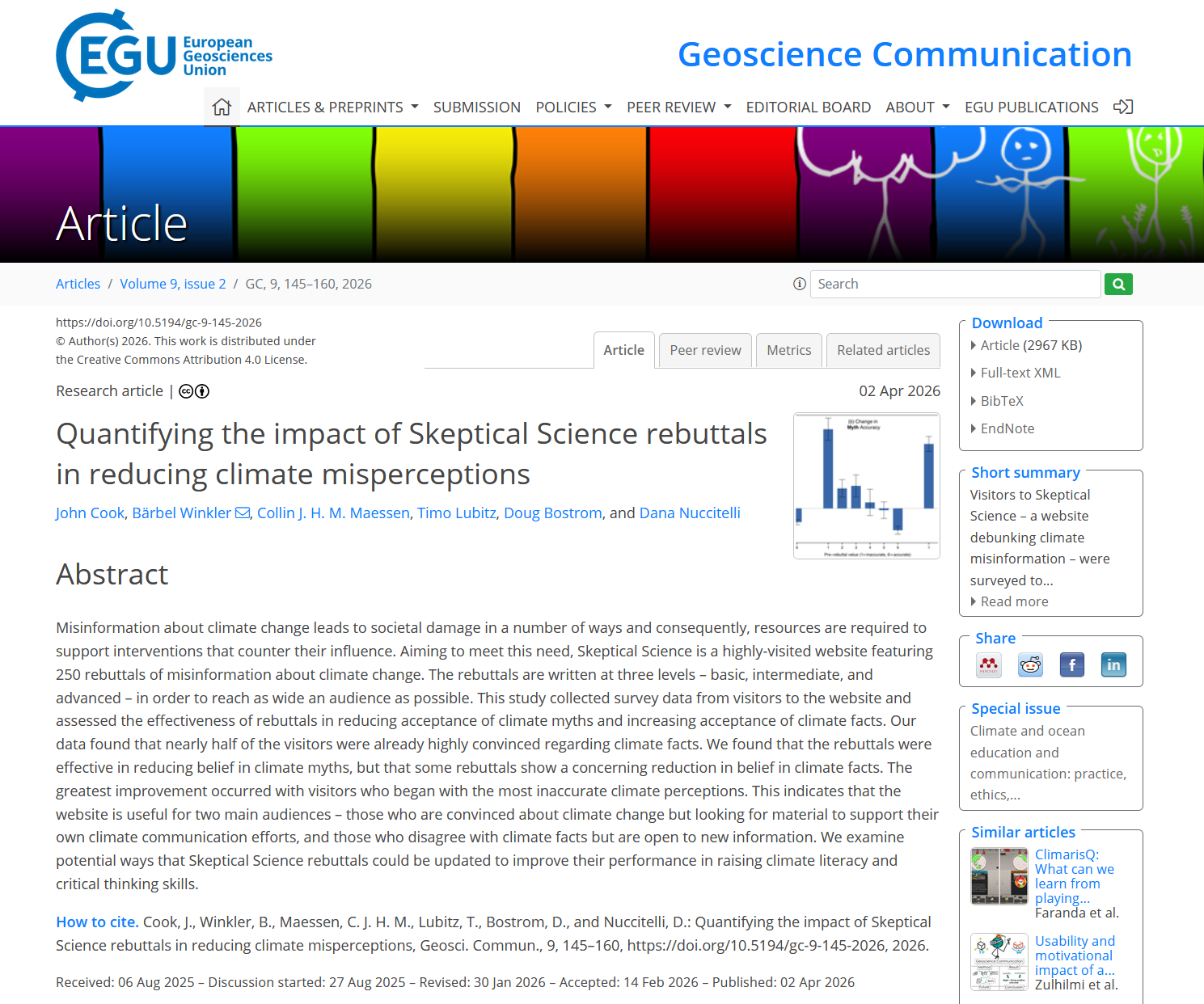
Screenshot of the abstract from our paper published in Geoscience Communication (Cook et al. 2026).
Quantifying the Impact of Skeptical Science Rebuttals in Reducing Climate Misperceptions.
We designed our study to assess the real-world effectiveness of Skeptical Science's 250+ rebuttals in reducing acceptance of climate myths and increasing acceptance of climate facts.
Over a period spanning from November 2021 to July 2025, we conducted a field experiment by collecting survey data from visitors directly on our skepticalscience.com website. Specifically, visitors who arrived at a rebuttal from a Google search in the US, UK, or Australia were invited to participate. You may even have been among readers seeing the related screens!
Skeptical Science New Research for Week #18 2026
Posted on 30 April 2026 by Doug Bostrom, Marc Kodack
Open access notables
Unprecedented 2024 East Antarctic winter heatwave driven by polar vortex weakening and amplified by anthropogenic warming, Tang et al., npj Climate and Atmospheric Science
During July–August 2024, East Antarctica experienced the most intense winter heatwave in the 46-year satellite era, with regional mean surface air temperatures across Dronning Maud Land exceeding the climatological mean by more than 9°C for 17 consecutive days. To explore the physical drivers and quantify the anthropogenic contribution to this unprecedented event, we propose a multi-model, multi-method attribution framework integrating regional climate model-based storyline attribution, circulation analogues, and large-ensemble probabilistic attribution. The results show that a pronounced weakening of the stratospheric polar vortex initiated a quasi-barotropic high-pressure anomaly, which enhanced meridional heat and moisture transport and accounted for approximately 50% of the observed surface warming. Across different models and attribution methods, synthesis of the attribution results indicates that anthropogenic warming intensified the event by approximately 0.7°C and more than doubled the likelihood of such exceptional winter heatwaves in the current climate. Probabilistic attribution further indicates that, compared to a natural climate without human influence, the likelihood of such events increases from 2–3 times today to ~6 times under moderate emissions and up to 26 times under high emissions by 2100. These findings reveal how human-induced warming is transforming even the coldest regions, with implications for ice shelf stability and predictability of future Antarctic extremes.
A recent stabilization in the lengthening of the Arctic sea ice melt season into a highly variable regime, Boisvert et al., Communications Earth & Environment
The melt season length of the Arctic sea ice is an important indicator and driver of large changes occurring in the climate system. Since 1979 the melt season has lengthened by ~40 days, driven mostly by delayed freeze onset (~ 34 days) compared to earlier melt onset (~ 7 days). However, since 2010 the melt season length has stabilized (~ 108 days), showing no consistent change over the years, instead becoming highly variable (+/− 11 days), largely driven by a loss of multi-year ice in 2000–2009 and a small change in the freeze onset (~ 2 days). There is a stark difference between the decades, where the largest changes in the melt season occurred between 2000–2009 (+ 25 days) and the smallest occurred between 2010–2023 (−2 days). This leads us to believe that, while there might be some periodicity in the processes that control the decadal variations in the melt season length, anthropogenic forcing has altered the Arctic background state and led to a new Arctic melt season that is much longer with a much thinner ice pack that is more susceptible to external forcings.
Field Observations of Sea Ice Thickening by Artificial Flooding, Hammer et al., Journal of Geophysical Research Oceans
Arctic sea ice is retreating at a high rate, also due to the positive ice-albedo feedback loop: as ice melts and disappears, it reflects less sunlight, further accelerating ocean warming. One proposed way to slow the retreat is by thickening sea ice in winter, increasing its chances of surviving summer melt. This could be achieved by artificially flooding existing sea ice with seawater pumped from below, allowing it to freeze at the surface through exposure to cold air and thicken the ice layer. However, the effectiveness of this approach remains uncertain, as numerical models show contrasting results and few field experiments have been conducted. This study examines the growth and melt of ice through spring and summer after artificial flooding covering , resulting in thickened (+26 cm) snow-covered first-year sea ice. Observations were carried out in Vallunden Lagoon (Van Mijenfjord), Svalbard, from 20 March to 24 June 2024, with flooding and intensive in situ measurements from 11–15 April. Artificial flooding significantly heated the upper two-thirds of the original 90 cm thick ice, increasing salinity. Surface albedo evolution was influenced by specific events such as slush formation, snow drift, and a major meltwater drainage event in spring. Artificial flooding resulted in thicker ice and delayed rotten ice formation by 6 days, but did not delay the disappearance of ice in summer compared to a non-flooded reference site. Experiments at other scales and locations could help reveal how local conditions and flooded area size influence results and the potential of this method.
The achievability of low-emission IPCC sea-level rise scenarios, Millman et al., Philosophical Transactions of the Royal Society A Mathematical Physical and Engineering Sciences
The Intergovernmental Panel on Climate Change (IPCC) AR6 report (2021) provides a range of projections on greenhouse gas emissions and global warming, and the consequential impact on global sea level through thermal expansion of sea water and by glacier and ice-sheet mass loss. This paper assesses the likelihood of lower IPCC sea-level rise scenarios (SSP1–1.9 and SSP1–2.6) in light of current ice-sheet observations and model limitations, alongside today’s emissions trends and current shortfall of climate commitments. We conclude that ‘low-end’ projections may underestimate the true pace and magnitude of future sea-level rise and, if we continue on today’s mid-higher emissions pathway (SSP3–7.0), sea-level outcomes of more than 1 m by 2100 should be planned for. The worst can still be avoided through rapid deep emissions reductions, but it is essential that the IPCC continues to reflect these true risks for decision-makers, with rises of more than 2 m this century and several metres thereafter a real possibility.
Audience engagement with climate change content on YouTube: an analysis of video attributes and user interactions, Aharonson et al., Frontiers in Climate
Results indicate that videos presented by scientists are significantly more likely to elicit positive audience attitudes than those presented by politicians or other public figures. Solution-focused framing is strongly associated with positive engagement, while blame-oriented framing is associated with negative responses. Additionally, threaded comment discussions show a higher proportion of positive attitudes than independent comments, suggesting that conversational interaction enhances constructive engagement. These findings highlight the importance of expertise-based communication, solution-oriented narratives, and interactive discourse in digital sustainability communication. The study contributes both methodological tools and practical insights for designing climate change communication strategies that foster informed and constructive public engagement.
From this week's government/NGO section:
Trust, Media Habits, and Misperceptions Shape Public Understanding of Climate Change, Marryam Ishaq and M. Speiser, ecoAmerica
A hidden climate majority exists. Most Americans are concerned about climate change, but they do not realize how widely that concern is shared. This perception gap (pluralistic ignorance) masks a strong hidden consensus on climate concern. Trust in information and personal concern about climate change reinforce each other. Americans who trust the information they see or hear are far more likely to be concerned about climate change (79%) — and those who are climate-concerned report higher trust. This creates a reinforcing loop between trust and concern. Media ecosystems shape climate beliefs. Where Americans get their news influences what they believe about climate and energy. While mainstream national media, local news, and social media remain the most widely used sources overall, partisan and age differences shape which sources are most relied on, which in turn shapes climate beliefs. Americans trust the information they encounter but doubt others’ ability to recognize climate misinformation. While many Americans trust the information they personally consume, they are far less confident in others’ ability to distinguish climate fact from fiction — especially when they perceive others as less concerned about climate change. Mistrust of others and misperceptions are core barriers to climate action. Rather than a lack of concern, some of the biggest barriers include eroded trust and misperceptions. Misperceptions about energy sources and others’ climate beliefs, combined with low confidence in the public’s ability to navigate climate misinformation, suppress visible engagement and slow individual and collective action.
People and Climate Change, Ipsos
As temperatures rise, the individual responsibility to act has fallen. The past 11 years have been the warmest in the modern era, but people increasingly place less responsibility in needing to act. In the last five years, all countries surveyed in the report in both 2021 and 2026 have seen falls in the proportion who agree that individuals would be failing future generations by not acting against climate change. Short-term fear is countering long-term preparation. While climate concern remains present – 59% on average across 31 countries say they country should be doing more in the fight against climate change - more immediate risks are seen as greater priorities. Our What Worries the World survey finds concern about climate change in 11th place, behind more tangible, immediate worries issues like crime, unemployment, and inflation. The energy transition is at a crossroads. Public support for transitioning to clean energy is increasingly conditional, contingent on affordability, reliability, and security trade-offs. The Ipsos Energy Transition Barometer finds one in two (50% across 31 countries) support governments prioritizing low energy prices even if emissions increase.
Climate Change and Migration from Central America: Insights from Migrants in Mexico, Kerwin et al., UC Berkeley School of Law
The authors examine how climate-related harms intersect with and exacerbate violence, exclusion, discrimination, and weak state protection to drive migration from El Salvador, Guatemala, Honduras, and Nicaragua. Drawing on interviews, desk research, and surveys with people on the move in Mexico, the authors show that climate change rarely operates as a single cause of displacement. Instead, migrants consistently describe how environmental shocks—such as droughts that destroy crops, storms that damage homes and livelihoods, and deforestation and extreme heat that undermine health and economic stability—exacerbate existing insecurity and hardship. The authors focus on Mexico as both a transit and destination country for Central American migrants impacted by these dynamics. The findings demonstrate that better understanding how climate change intensifies vulnerabilities to violence, insecurity, and loss of livelihood—and integrating that analysis into refugee and immigration representation and adjudication— can improve access to protection and to regular migration status under Mexico’s existing legal framework. The authors also offer specific recommendations to strengthen institutional responses to climate migration by the Mexican government and civil society actors to climate migration.
114 articles in 55 journals by 1150 contributing authors
Physical science of climate change, effects
Climate feedback of forest fires amplified by atmospheric chemistry, Chen et al., Nature Geoscience Open Access pdf 10.1038/s41561-026-01926-1
Differences in actual evapotranspiration and responses of pure and mixed forests to climate change on the Chinese Loess Plateau, Wu et al., Agricultural and Forest Meteorology 10.1016/j.agrformet.2026.111210
Wildfires used to ‘go to sleep’ at night. Climate change has them burning overtime
Posted on 29 April 2026 by Guest Author
WASHINGTON (AP) — Burning time for North American wildfires is going into overtime. Flames are lasting later into the night and starting earlier in the morning because human-caused climate change is extending the hotter and drier conditions that feed fires, a new study found.
Fires used to die down or even die out at night as temperatures dropped and humidity increased, but that’s happening less often. The number of hours in North America when the weather is favorable for wildfires is 36% higher than 50 years ago, according to a study published earlier this month in Science Advances.
Places such as California have 550 more potential burning hours than in the mid-1970s. Parts of southwestern New Mexico and central Arizona are seeing as many as 2,000 more hours a year when the weather is prone to burning fires, the highest increase seen in the study, which looked at Canada and the United States. The research looked at times when conditions were ripe for fire, but that didn’t mean fires occurred during all that time.
Recent big fires in LA and Hawaii burned at night
Fires that surge at night are tougher to fight and included the Lahaina, Hawaii fire in 2023, the Jasper fire in Alberta in 2024, and the Los Angeles fires in 2025, the study said. Maui’s fire ignited at 12:22 a.m.
It’s not just the clock that is getting extended. The calendar is too. The number of days with fire-prone weather increased by 44%, which effectively added 26 days over the past half-century.
It’s mostly from warmer, drier nighttime weather, with a bit of extra wind, the study authors said.
“Fires normally slow down during the night, or they just stop,” said study co-author Xianli Wang, a fire scientist with the Canadian Forest Service. “But under extreme fire hazard conditions, fire actually burns through the night or later into the night.”
And Wang said Earth’s warming atmosphere means it’s like to get worse.
Transition risk: The human cost of net zero
Posted on 28 April 2026 by Guest Author
This is a re-post from The Climate Brink by Andrew Dessler
I am finalizing a textbook on climate risk and am posting chapters as I finish them. I’d previously posted chapters about embedded energy and physical climate risk; this post is a chapter on transition risk, the economic and social risks of the transition to a clean-energy economy.
Introduction
In the context of climate risk, transition risk encompasses the economic and social risks associated with a shift towards a low-carbon economy. Such an effort would fundamentally reshape our world and create critical financial uncertainty for assets and industries tied to the old, carbon-intensive system.
Net zero
Reaching “net zero” is the ultimate goal of most climate policy. This means reducing greenhouse gas emissions as much as possible, with any remaining emissions that are too difficult or costly to eliminate are canceled out by an equivalent amount of “negative emissions” — processes that actively pull carbon dioxide out of the atmosphere. These negative emissions are the “net” part of net zero and it acknowledges the practical reality that some sectors, like long-distance air travel or ocean shipping, may be incredibly difficult to decarbonize in the near future.
What are these negative emissions technologies? The two primary methods discussed are Direct Air Capture (DAC), which uses machines to filter carbon dioxide directly from the air, and Bioenergy with Carbon Capture and Sequestration (BECCS), which involves growing crops, burning them for energy, and capturing and burying the resulting carbon dioxide. However, both technologies face significant hurdles, including high costs, large energy requirements, and, in the case of BECCS, immense land use needs that could compete with food production and biodiversity.
Once we reach net zero, global temperatures will stabilize — although they won’t recover to pre-industrial levels for tens of thousands of years. Getting the climate to actually cool on time scales we care about (decades to centuries) would would require pulling even more carbon dioxide out of the atmosphere, or deploying some type of climate engineering approach like injecting aerosols into the stratosphere.
The scale of the net zero transformation means that reaching net zero will fundamentally overhaul vast parts of the global economy. Many big sectors of our economy — energy, transportation, industry, agriculture — must be reshaped, and that reshaping will create enormous opportunities as well as painful dislocations. The transition to a low-carbon economy is not simply a matter of swapping one energy source for another; it requires rebuilding infrastructure, retraining workers, and redirecting trillions of dollars in investment.
Some industries are poised to prosper. Renewable energy is the most obvious example: in 2025, the world added over 700 GW of new capacity, and sustaining that pace for decades will require ongoing investment in manufacturing, installation, and maintenance of wind turbines and solar panels. The profits for those well positioned will be enormous.
The electric vehicle industry and its supply chains — from battery manufacturers to mining operations for lithium and cobalt — also stand to grow dramatically. Companies that build and manage electrical grid infrastructure, including new transmission lines and energy storage systems, will see surging demand. So too will firms specializing in energy efficiency, building retrofits, and emerging technologies like green hydrogen and sustainable aviation fuels. Even agriculture could see new revenue streams as farmers are paid to adopt practices that sequester carbon in soil.
Other industries, however, face serious decline. Fossil fuel producers (coal, oil, and natural gas) confront the prospect of their core product becoming obsolete, stranding assets worth trillions of dollars. Workers in these industries, from coal miners to oil rig operators, risk losing their livelihoods.
The effects extend well beyond extraction: refineries, pipelines, and petrochemical plants all face an uncertain future. The automotive sector will also see significant disruption, as the shift to electric vehicles renders the internal combustion engine and its complex supply chain of transmissions, exhaust systems, and fuel injection components irrelevant. Communities built around these industries may face economic devastation if the transition is not carefully managed.
This uneven distribution of winners and losers will create difficult economic and political challenges, particularly during the transition period. The enormous capital investment required — in renewable generation, grid modernization, EV charging infrastructure, industrial retooling, and carbon removal — must be mobilized quickly, creating the risk of supply chain bottlenecks, inflation in key materials, and financial instability. Managing this transition in a way that is both fast enough to meet climate targets and equitable enough to maintain broad public support is one of the defining policy challenges of our time.






