






Latest Posts
Archives
|
 |
Explaining climate change science & rebutting global warming misinformation
Global warming is real and human-caused. It is leading to large-scale climate change. Under the guise of climate "skepticism", the public is bombarded with misinformation that casts doubt on the reality of human-caused global warming. This website gets skeptical about global warming "skepticism".
Our mission is simple: debunk climate misinformation by presenting peer-reviewed science and explaining the techniques of science denial, discourses of climate delay, and climate solutions denial.
  
Posted on 22 January 2026 by Doug Bostrom, Marc Kodack
Open access notables

Mapping Europe’s rooftop photovoltaic potential with a building-level database, Kakoulaki et al., Nature Energy
Individual building-level approaches are needed to understand the full potential of rooftop photovoltaics (PV) at national and regional scale. Here we use the European Digital Building Stock Model R2025, an open-access building-level database, to assess rooftop solar potential for each of the 271 million buildings in the European Union. The results show that potential capacity could reach 2.3 TWp (1,822 GWp residential, 519 GWp non-residential), with an annual output of 2,750 TWh based on current PV technology. This corresponds to approximately 40% of electricity demand in a 100% renewable scenario for 2050. Already by 2030, over a half of buildings with floor area larger than 2,000 m2 could generate most of remaining capacity for the 2030 target with 355 GWp. Across member states, non-residential rooftops could cover 50% or more of their PV targets, with several exceeding 95%. The open-access building-level database offers practical tools to support better decisions, accelerate renewable energy adoption and promote a more decentralized energy system. It is also an enabler for planners and researchers to further explore energy scenarios with high renewable shares.
Here we introduce a new class of threshold-exceedance-amount metrics that consistently track changes in event frequency, duration, magnitude, area, and timing aspects like daily exposure and seasonal shift—as separate metrics, partially compound (e.g., average event severity), and as compound total events extremity (TEX). Building on daily temperature datasets over 1961 to 2024, we applied the new metrics to extreme heat events at local- to country-scale (example Austria) and across Europe, demonstrating their utility through this use. Comparing the recent period 2010-2024 to the reference period 1961-1990, we reveal amplification factors of around 10 [5 to 25] in the TEX of extreme heat over Austrian and most central and southern European regions. This degree of amplification is found to strongly exceed the natural variability, providing unequivocal evidence of anthropogenic climate change. Given their fundamental capacity to reliably track any threshold-defined hazard at any location, the new metrics can support a myriad of uses beyond this example application. These range from climate impact analyses for extremes such as heatwaves, floods and droughts to extreme events attribution, quantifying the anthropogenic share of a hazard extremity and of its damage to properties and harm to people.
Climate literacy is essential for empowering societies to respond effectively to the challenges of climate change. However, individuals often struggle to address climate issues because of their abstract nature and perceived psychological distance. This study investigates whether direct personal experiences of extreme weather events are associated with higher scores on the climate literacy measures among Polish citizens. We developed and validated, through an expert-based process, the “Big Three Climate Literacy Questions” - a concise instrument designed to capture key components of climate literacy across knowledge, skills and attitudes - and administered them in a survey of 1001 residents from regions in Poland historically affected by floods and storms. Regression analyses reveal that the mere occurrence of an extreme weather event does not significantly influence scores on the climate literacy measures. However, when such events result in severe financial or psychological consequences, they are associated with higher literacy scores (for all three dimensions of climate literacy), suggesting that the intensity of the experience can act as a catalyst for deeper cognitive and emotional engagement. We also find that individuals employed in high-emission sectors tend to overestimate their climate knowledge; nonetheless, their personal experiences with extreme weather events are still associated with higher scores on the climate literacy measures. These findings support the hypothesis that intense climate-related experiences can serve as “teachable moments", enhancing receptiveness to climate information and fostering the development of more accurate and informed climate-related beliefs—even among groups that might otherwise exhibit resistance to such messages.
From this week's government/NGO section:
WMO confirms 2025 was one of warmest years on record, World Meteorological Organization
The global average surface temperature was 1.44 °C (with a margin of uncertainty of ± 0.13 °C) above the 1850-1900 average, according to WMO’s consolidated analysis of eight datasets. Two of these datasets ranked 2025 as the second warmest year in the 176-year record, and the other six ranked it as the third warmest year. The past 11 years have been 11 warmest on record. Temporary cooling by La Niña does not reverse the monotonic trend. International data exchange underpins climate monitoring datasets for a single authoritative source of information.
Global Temperature Report for 2025, Berkeley Earth
2025 was the third warmest year on Earth since 1850. It is exceeded only by 2024 and 2023. This period, since 1850, is the time when sufficient direct measurements from thermometers exist to create a purely instrumental estimate of changes in global mean temperature. The analysis combines 23 million monthly-average thermometer measurements from 57,685 weather stations with ~500 million instantaneous ocean temperature observations collected by ships and buoys. The last 11 years have included all 11 of the warmest years observed in the instrumental record, with the last 3 years including all of the top 3 warmest.
Assessing the Global Temperature and Precipitation Analysis in 2025, National Centers for Environmental Information, National Oceanic and Atmospheric Administration
2025 ranks as the third-warmest yea Upper ocean heat content was record high in 2025. Annual sea ice extent for both the Arctic and Antarctic regions ranked among the three lowest years on record. The Northern Hemisphere snow cover extent was the third lowest on record. There were 101 named tropical storms across the globe in 2025, which was above average.
201 articles in 60 journals by 1151 contributing authors
Physical science of climate change, effects
Antarctic warming affects northern Equatorial Indian Ocean SST via oceanic tunnels, Sherin et al., Global and Planetary Change 10.1016/j.gloplacha.2026.105321
Climate and Anthropogenic Perturbations Impact Stream Geochemistry, Warix et al., Earth's Future Open Access pdf 10.1029/2025ef006512
Read more...
0 comments
Posted on 21 January 2026 by Guest Author
This is a re-post from the WMO Press Office
The World Meteorological Organization (WMO) has confirmed that 2025 was one of the three warmest years on record, continuing the streak of extraordinary global temperatures. The past 11 years have been the 11 warmest on record, and ocean heating continues unabated.
- Past 11 years have been 11 warmest on record
- Temporary cooling by La Niña does not reverse long-term trend
- Ocean warming continues unabated
- WMO consolidates eight datasets for single authoritative source of information
- International data exchange underpins climate monitoring
The global average surface temperature was 1.44°C (with a margin of uncertainty of ± 0.13°C) above the 1850-1900 average, according to WMO’s consolidated analysis of eight datasets. Two of these datasets ranked 2025 as the second warmest year in the 176-year record, and the other six ranked it as the third warmest year.
The past three years, 2023-2025, are the three warmest years in all eight datasets. The consolidated three-year average 2023-2025 temperature is 1.48 °C (with a margin of uncertainty of ± 0.13 °C) above the pre-industrial era. The past eleven years, 2015-2025, are the eleven warmest years in all eight datasets.
“The year 2025 started and ended with a cooling La Niña and yet it was still one of the warmest years on record globally because of the accumulation of heat-trapping greenhouse gases in our atmosphere. High land and ocean temperatures helped fuel extreme weather – heatwaves, heavy rainfall and intense tropical cyclones, underlining the vital need for early warning systems,” said WMO Secretary-General Celeste Saulo.
“WMO’s state of the climate monitoring, based on collaborative and scientifically rigorous global data collection, is more important than ever before because we need to ensure that Earth information is authoritative, accessible and actionable for all,” said Celeste Saulo.
WMO’s announcement was timed to coincide with the release of global temperature announcements from the dataset providers.
These include the European Center for Medium Range Weather Forecasts Copernicus Climate Change Service (ERA5), Japan Meteorological Agency (JRA-3Q), NASA (GISTEMP v4), the US National Oceanic and Atmospheric Administration (NOAAGlobalTemp v6), the UK’s Met Office in collaboration with the Climatic Research Unit at the University of East Anglia (HadCRUT.5.1.0.0), and Berkeley Earth (USA). This year, for the first time, WMO also factored in two additional datasets - the Dynamically Consistent ENsemble of Temperature (DCENT/UK, USA) and China Merged Surface Temperature Dataset (CMST).
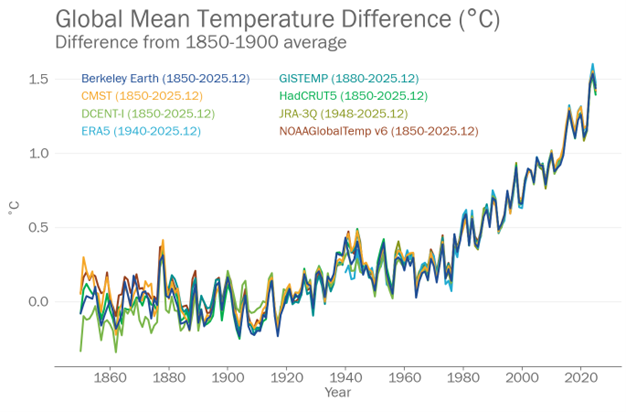
Figure 1: Annual global mean temperature anomalies relative to the 1850-1900 average shown from 1850 to 2025 for eight datasets as shown in the legend.
Read more...
0 comments
Posted on 20 January 2026 by Sue Bin Park
 Skeptical Science is partnering with Gigafact to produce fact briefs — bite-sized fact checks of trending claims. You can submit claims you think need checking via the tipline. Skeptical Science is partnering with Gigafact to produce fact briefs — bite-sized fact checks of trending claims. You can submit claims you think need checking via the tipline.
Do solar panels release more emissions than burning fossil fuels?
 Solar panels produce far less emissions than coal or natural gas. Solar panels produce far less emissions than coal or natural gas.
“Lifecycle emissions” counts all aspects of raw materials, manufacturing, transport, installation, operation, and disposal. A major National Renewable Energy Laboratory review of thousands of studies found that while some emissions are generated when solar panels are manufactured and shipped, their lifetime emissions are much lower than fossil fuels. Coal’s lifecycle climate pollution is about 23 times higher than solar power, and natural gas about 11 times higher.
Solar panels also “pay back” their upfront emissions within a few years of operation, offsetting emissions from their manufacture. Since modern panels often last 30 years or more, they will continue to provide decades of low-emissions electricity after their payback..
Go to full rebuttal on Skeptical Science or to the fact brief on Gigafact
This fact brief is responsive to quotes such as this one.
Sources
National Renewable Energy Laboratory Life Cycle Greenhouse Gas Emissions from Electricity Generation: Update
IPCC Technology-specific Cost and Performance Parameters
US Department of Energy End-of-Life Management for Solar Photovoltaics
International Journal of Advanced Research in Science, Communication and Technology Solar Panel Heat Emission and its Environmental Impact
Columbia Law School Sabin Center for Climate Change Law Rebutting 33 False Claims About Solar, Wind, and Electric Vehicles
Please use this form to provide feedback about this fact brief. This will help us to better gauge its impact and usability. Thank you!
Read more...
0 comments
Posted on 19 January 2026 by Zeke Hausfather
This is a re-post from The Climate Brink
Recently there has been quite a debate online about the extent to which opposing near-term oil and gas infrastructure – pipelines, refineries, new production – is both necessary and politically effective as a strategy to reduce US emissions. These conversations have occurred in the context of a broader pivot toward affordability as a rallying cry of the left in the US, driven by concerns around the rapidly rising cost of housing, energy, and other goods.
Matt Yglesias had a provocative piece in the NYT arguing that liberals should be less opposed to oil and gas, arguing that it might help make energy more affordable and win more conservative states and labor (without which there would be no climate policy at all). He also noted that US oil and gas is generally lower carbon than foreign alternatives in a world that is still using vast amounts of the stuff. Policies, in his view, should focus on making production cleaner by more strictly regulating methane emissions, in-sector electrification, and other best practices rather than restricting supply. Other mitigation advocates like Jesse Jenkins and Ramez Naam chimed in to support the broad thrust of his argument.
This is, it is worth pointing out, not too far from the policies pursued by both the Obama and Biden administrations, where both clean energy and domestic oil and gas production boomed (while the dirtiest fossil fuel, coal, saw a dramatic decline).
Representative Sean Casten (D-IL) posted a long rebuttal on BlueSky arguing that we’ve already overshot our climate goals, and the only way to turn things around is to keep fossil fuels in the ground. He noted that what is politically popular is not always what is right, and that sometimes politicians need to do what is necessary to meet the moment. He also notes that leakage from US gas “makes natural gas worse than coal from a global warming perspective.”
These responses broadly reflect two different schools of thought on how to best practically (and politically) achieve decarbonization goals: by reducing fossil fuel supplies, or by reducing fossil fuel demands.
The physical science is absolutely clear that to stop the world from warming we need to get global emissions of CO2 and other long-lived greenhouse gases to (net) zero. Every 220 gigatons (billion tons) of CO2 we emit warms the surface by around 0.1C, and the world is already at 1.4C above preindustrial levels today. But the specific path to limit warming – how much we focus on the reducing the supply of fossil fuels vs reducing their demand by accelerating the adoption of cleaner alternatives is very much an active debate. My personal view is that demand side policies are considerably more achievable at the moment – particularly given the new focus on affordability on the left.
I’d also note that this post is about the politics of mitigation rather than the physical science. There is no clear right answer to how to best reduce emissions, and there are many reasonable folks with differing views on the topic. We should generally try and extend grace to those we disagree with, as when it comes to policy there is no real arbiter of truth.
Read more...
0 comments
Posted on 18 January 2026 by BaerbelW, John Hartz, Doug Bostrom
A listing of 28 news and opinion articles we found interesting and shared on social media during the past week: Sun, January 11, 2026 thru Sat, January 17, 2026.
Stories we promoted this week, by category:
Climate Change Impacts (10 articles)
- As a climate scientist, I know heatwaves in Australia will only get worse. We need to start preparing now "During black summer, my daughters were too young to know what was happening. Now, amid another Australian heatwave, they deserve answers" Comment is Free, The Guardian, Opinion by Sarah Perkins-Kirkpatrick, Jan 8, 2026.
- Ocean Warming Breaks Record for Ninth Straight Year "Scientists warn the ocean’s accumulation of energy is fueling extreme weather patterns and destabilizing marine ecosystems." Science, Inside Climate News, Johnny Sturgeon, Jan 9, 2026.
- The western US is in a snow drought, raising fears for summer water supplies CNN, Andrew Freedman, Jan 9, 2026.
- ‘Profound impacts’: record ocean heat is intensifying climate disasters, data shows "Oceans absorb 90% of global heating, making them a stark indicator of the relentless march of the climate crisis" Environment, The Guardian, Damian Carrington, Jan 9, 2026.
- Himalayas bare and rocky after reduced winter snowfall, scientists warn BBC News, Navin Singh Khadka, Jan 11, 2026.
- New Climate Reports Show ‘Unprecedented Run of Global Heat’ "Data from multiple international agencies shows the reality of a rapidly warming world." Inside Climate News, Bob Berwyn, Jan 13, 2026.
- 2025: The fourth warmest year in U.S. history was full of deadly weather extremes "It was the first year in a decade without a U.S. hurricane landfall – but it still ranked third for billion-dollar disasters." Yale Climate Connections, Bob Henson, Jan 13, 2026.
- WMO confirms 2025 was one of warmest years on record "The World Meteorological Organization (WMO) has confirmed that 2025 was one of the three warmest years on record, continuing the streak of extraordinary global temperatures. The past 11 years have been the 11 warmest on record, and ocean heating continues unabated." World Meteorological Organization (WMO), Press Release , Jan 14, 2026.
- Copernicus: 2025 was the third-hottest year globally and in Europe - with two main drivers "The past 11 years have been the warmest on record globally. Europe is warming significantly faster than the global average." EuroNews, Servet Yanatma, Jan 14, 2026.
- World warming faster than forecast as pollution cuts remove hidden cooling effect "Experts have sounded the climate alarm after discovering that global temperatures are accelerating faster than predicted." EuroNews, Liam Gilliver, Jan 15, 2026.
Read more...
0 comments
Posted on 15 January 2026 by Doug Bostrom, Marc Kodack
Open access notables
Death Valley Illusion: Evidence against the 134°F World Record, Spencer et al., Bulletin of the American Meteorological Society
The world record hottest near-surface air temperature of 134°F recorded at Greenland Ranch, Death Valley, California on 10 July 1913 is demonstrated to be approximately 14°F hotter than what likely occurred on that date. Using July data from non–Death Valley stations during 1923–2024, we compute a range of temperature lapse rates diagnosed from the differences between Greenland Ranch station and the average of higher-elevation stations’ maximum temperatures (T MAX) and elevation. The range of lapse rates from those 102 years of July data is then used to estimate Greenland Ranch temperatures during the early years (1911–22). The first 2 weeks of July 1913 are shown to be spuriously hot and other years at Greenland Ranch exhibit anomalous July temperature behavior as well. Despite the establishment of a U.S. Weather Bureau instrumented shelter at Greenland Ranch in 1911, based upon historical accounts, we believe some of the shelter readings in the early years were replaced with hotter values, possibly taken from the veranda of the ranch house using a thermometer of unknown provenance. As a result of these findings, we recommend that the 134°F world record status be rescinded and that many of the Greenland Ranch temperature reports during the early years be more closely evaluated for data quality.
From this week's government/NGO section:
Groundbreaking AccuWeather® Climate Study Reveals Profound Climate Trends with Far-Reaching Impacts, AccuWeather
Temperatures have increased an average of 0.5°F (0.28°C) per decade over the past 70 years. Dew point temperatures have increased an average of 0.3°F (0.17°C) per decade over the same period, though most of this increase occurred before 1995. Relative humidity remained more or less steady until 1995, but then decreased by a significant 5.3%, or an average of 1.7% per decade. Average annual rainfall has declined 2.7% since 1995, or on average 0.9% per decade, yet the frequency of rainfall amounts greater than 4 inches in a 24-hour period have actually increased by 70%. Likewise, heavy rainfall amounts greater than 2 inches within a 24-hour period have increased by 23%.
2025 Global Climate Highlights, Copernicus Climate Change Service
2025 ranks as the third-warmest year on record, following the unprecedented temperatures observed in 2023 and 2024. It was marginally cooler than 2023, while 2024 remains the warmest year on record and the first year with an average temperature clearly exceeding 1.5°C above the pre?industrial level. 2025 saw exceptional near?surface air and sea surface temperatures, extreme events, including floods, heatwaves and wildfires. Preliminary data indicate that greenhouse gas concentrations continued to increase in 2025.
28 articles in 13 journals by 224 contributing authors
[The upstream database we normally rely upon to supply article metadata and links to accessible article copies continues to misbehave, meaning that our queue of unlisted items continues to grow even as what we output here shrinks. We are awaiting reply to a trouble ticket.]
Physical science of climate change, effects
Future Shoaling of the AMOC and Its Impact on Oceanic Heat Transport to the Subpolar North Atlantic, Lee et al., 10.22541/essoar.175883350.02498548/v1
Hot droughts in the Amazon provide a window to a future hypertropical climate, Chambers et al., Nature 10.1038/s41586-025-09728-y
Read more...
0 comments
Posted on 14 January 2026 by Guest Author
This video includes personal musings and conclusions of the creator and climate scientist Dr. Adam Levy. It is presented to our readers as an informed perspective. Please see video description for references (if any).
Video description
Global warming continues to ramp up, with 2025 one of the hottest three years we've ever observed, and probably the hottest in over 100,000 years. With these scorching temperatures, we've seen devastation in the form of natural disasters, like heatwaves, wildfires, floods, storms and droughts. So what will this year bring in terms of climate change? And how are climate scientists able to answer this before the year is even fully underway? Ultimately, though, the biggest questions for a our climate have us much to do with the political as the planetary.
Support ClimateAdam on patreon: https://patreon.com/climateadam
Read more...
0 comments
Posted on 13 January 2026 by Sue Bin Park
Skeptical Science is partnering with Gigafact to produce fact briefs — bite-sized fact checks of trending claims. You can submit claims you think need checking via the tipline.
Does clearing trees for solar panels release more CO2 than the solar panels would prevent?
Clearing trees to build solar farms does not negate their climate change benefits, because one acre of solar panels prevents far more CO2 emissions than an acre of forest absorbs.
In the U.S., replacing equivalent natural gas power with one acre of solar prevents about 175 to 198 metric tons of CO2 emissions per year.
In contrast, an average acre of forest sequesters less than 1 metric ton of CO2 per year. An acre of solar cuts roughly 200 times more CO2 than an acre of trees.
Cutting forest does release stored carbon, but even if all 304 metric tons of CO2 in a forested acre were emitted during construction, a typical solar farm would offset that within two years of operation.
Only about 4% of U.S. solar projects have been built on forested land.
Go to full rebuttal on Skeptical Science or to the fact brief on Gigafact
This fact brief is responsive to quotes such as this one.
Sources
Alliance for Climate Transition Cutting down forests just to put up solar panels will make climate change worse
Institute of Electrical and Electronics Engineers Land Requirements for Utility-Scale PV: An Empirical Update on Power and Energy Density
National Renewable Energy Laboratory Life Cycle Greenhouse Gas Emissions from Electricity Generation: Update
EPA Greenhouse Gas Equivalencies Calculator - Calculations and References
EPA Greenhouse Gas Equivalencies Calculator - Revision History
Columbia Law School Sabin Center for Climate Change Law Rebutting 33 False Claims About Solar, Wind, and Electric Vehicles
Please use this form to provide feedback about this fact brief. This will help us to better gauge its impact and usability. Thank you!
Read more...
12 comments
Posted on 12 January 2026 by dana1981
This is a re-post from Yale Climate Connections
The year that just ended saw numerous records broken on climate and clean energy.
It was the second-hottest year on record at Earth’s surface, behind only 2024. The high temperatures were shocking for a year with a La Niña event. La Niñas draw cold water up to the surface of the Pacific Ocean, and hence are relatively cool years at Earth’s surface, while El Niño events have the opposite effect. 2025 was by far the hottest year with a La Niña event.
For perspective, 1998 was a record-shattering hot year at the time because it experienced the strongest El Niño event on record, but it was more than half a degree Celsius colder than 2025. Global warming has made 1998 look so unremarkable that La Niña years today dwarf the temperature record set during the biggest El Niño event in modern history.
In fact, the past dozen years have been the 12 warmest on record, especially the past three, which were all more than 1.4°C hotter than preindustrial temperatures.
 1986-2025 global average surface temperature categorized by years with a significant La Niña cooling influence (blue), El Niño warming influence (red), neutral conditions (black), and those with a cooling influence from a recent large volcanic eruption (orange triangles). (Data: NASA. Graphic: Dana Nuccitelli) 1986-2025 global average surface temperature categorized by years with a significant La Niña cooling influence (blue), El Niño warming influence (red), neutral conditions (black), and those with a cooling influence from a recent large volcanic eruption (orange triangles). (Data: NASA. Graphic: Dana Nuccitelli)
The vast majority of the heat trapped by climate pollution is absorbed by Earth’s oceans, which have warmed even more than the planet’s surface. Nearly every year sets a new record for ocean and global heat content, and 2025 was no exception. A new study estimated that the oceans absorbed energy equivalent to detonating nearly 10 Hiroshima atomic bombs in the oceans every second of every minute in 2025.
Despite learning this year that climate change is accelerating, the U.S. government took numerous regulatory and legislative steps that will increase the country’s climate-warming pollution. And U.S. emissions reversed their long-term downward trend to instead increase in 2025.
But despite the bleak domestic picture, the rest of the world made significant climate and clean energy progress. China continued to emerge as a clean technology leader, positioning itself to overtake the U.S. as the next global economic superpower.
While these trends seem likely to continue in 2026, the U.S. Congress has the opportunity to pass major climate and clean energy legislation in the coming year – unless the Trump administration derails it.
Read more...
0 comments
Posted on 11 January 2026 by BaerbelW, John Hartz, Doug Bostrom
A listing of 28 news and opinion articles we found interesting and shared on social media during the past week: Sun, January 4, 2026 thru Sat, January 10, 2026.
Stories we promoted this week, by category:
Climate Policy and Politics (8 articles)
- Analysis: UK renewables enjoy record year in 2025 – but gas power still rises Carbon Brief, Simon Evans & Ho Woo Nam, Jan 2, 2025.
- The Year in Climate: Attacks on Science, the Start of Trump’s Second Term and Surging Electricity Demand Foreshadow a Future Filled with Uncertainty Global inaction on fossil fuel and plastic treaties, the dismantling of federal agencies and regulations and the rapid rise of data centers were just a few of the consequential stories that Inside Climate News tracked in 2025. Inside Climate News, Dan Gearino, Dec 28, 2025.
- How Trump Derailed a NOAA Pioneer’s Move From Climate Impacts to Solutions "Libby Jewett founded the U.S. ocean acidification program and had begun work on offshore wind energy. But she joined the past year’s historic exodus from the agency, the impacts of which are still not clear." Science, Inside Climate News, Marianne Lavelle, Jan 6, 2026.
- All the climate info that disappeared under Trump. And how it’s being saved. "Scientists are racing to rescue hundreds of datasets, websites and federal reports that have been deleted by the administration." ClimateWire, E&E News by Politico, Chelsea Harvey, Jan 7, 2026.
- Outrage as Trump withdraws from key UN climate treaty along with dozens of international organisations Experts decry move to leave UNFCCC as ‘embarrassing’ as president orders withdrawal from 66 international groups. The Guardian, Oliver Milman, Jan 07, 2026.
- What Top Climate Scientists Think of Trump’s Treaty Withdrawals "Though the abandonment of international agreements is 'a damn shame,' they say science will prevail." Science, Inside Climate News, Lee Hedgepeth, Jan 8, 2026.
- Q&A: What Trump`s US exit from UNFCCC and IPCC could mean for climate action The Trump administration in the US has announced its intention to withdraw from the UN’s landmark climate treaty, alongside 65 other international bodies that “no longer serve American interests”. Carbon Brief, Carbon Brief Staff, Jan 09, 2026.
- Where things stand on climate change in 2026 "Last year saw the U.S. move backward on climate while China ascended. Here’s what to expect next." Policy & Politics, Yale Climate Connection, Dana Nuccitelli, Jan 9, 2026.
Climate Change Impacts (7 articles)
- Glaciers are melting. It may reawaken the world’s most dangerous volcanoes "As the planet warms, humans could face a much more risky and explosive future." CNN, Laura Paddison & Sam Hart, Dec 30, 2025.
- Is Thwaites Still the ‘Doomsday Glacier’? "Recent research has led scientists to new conclusions about the fastest melting glacier in Antarctica. Some are reassuring, others the opposite."Is Thwaites Still the ‘Doomsday Glacier’? New York Times, Raymond Zhong, Dec 30, 2025.
- ‘These trees may not survive’: Jordan’s ancient olive harvest wilts under record-breaking heat "Extreme heat and drought has destroyed 70% of Jordan’s olive crop, endangering livelihoods of 80,000 families and a centuries-old tradition" The Guardian, Mohamed Ersan in Amman, Jan 1, 2026.
- A ‘visible signal’ of climate extremes: Why unexpected wildflower blooms have sparked concern "Experts warn that the slightest increase in temperatures can trigger early blooming in hundreds of wildflower species." Green, Euronews , Liam Gilliver, Jan 4, 2026.
- Scientists just got some ancient clues about future sea-level rise — and it’s bad news "Rock samples collected from the Greenland ice sheet’s Prudhoe Dome show it completely melted in the past 10,000 years — and could vanish again amid climate change." The Washington Post, Sarah Kaplan, Jan 5, 2026.
- Climate Change Is Quietly Rewriting The World’s Nitrogen Cycle, With High Stakes For Food And The Environment Eurasia Review, Staff, Jan 6, 2026.
- Why scientists are worried that Greenland’s Prudhoe ice dome could melt away – again "An ice dome the size of Luxembourg melted around 7,000 years ago. Is history about to repeat itself?" Green, EuroNews, Liam Gilliver, Jan 7, 2026.
Read more...
0 comments
Posted on 8 January 2026 by Doug Bostrom, Marc Kodack
Open access notables
A Long-Term Shift in Flow Regimes over the Antarctic Peninsula, Guarino et al., Journal of Climate
We present consequences of Antarctic surface warming for the stability of the lower atmosphere since the 1950s. We show that the surface atmosphere over the Antarctic Peninsula has become less stable, and that this reduced stability favors the generation of atmospheric gravity waves from the Peninsula, one of the major sources of atmospheric waves on the planet. We provide a physically based explanation (i.e., a shift in flow regimes) for the increased gravity wave forcing that we find in an unprecedented set of reanalysis products, satellite observations, and model simulations, and that we present here for the first time. Gravity wave forcing changes can have profound ramifications for the global climate, from polar vortex strength to ozone depletion and midlatitude weather.
The Evolving Decline of Landfast Sea Ice in Northern Alaska and Adjacent Waters: Results from an Updated Climatology, (preprint, ESS Open Archive) Mahoney & Einhorn
We present a new 27-year record of landfast sea ice extent in northern Alaska and adjacent waters, which uses ice chart data to extend a previous analysis based on synthetic aperture radar (SAR) imagery. This new climatology provides updated information on the decline of landfast ice in a region of the Arctic that has seen extensive losses of sea ice in recent summers. By comparing our results with early satellite data analysis from the 1970s, we find that trends in the timing of landfast ice have been ongoing for at least 50 years. Over the period 1996-2023, the landfast season shortened by 19 days/decade in the Chukchi Sea and 13 days/decade in the Beaufort Sea, primarily due to later formation of landfast ice. Also, the time between onset of freezing air temperatures and landfast ice formation is increasing, which is consistent with a coastal ocean that takes longer to freeze. While it was previously reported that the typical annual maximum width of landfast ice in the Chukchi Sea declined by 13 km between periods 1970-76 and 1996-2008, we find this retreat has slowed with a decline of 3.3 km over the course of our dataset as few areas of extensive landfast remain to be lost. Conversely, landfast sea ice extent in the Beaufort Sea had previously been found to have remained constant since the 1970s, but we find an average reduction of 2.5 km. We attribute this emergent phenomenon to a reduction in the number grounded ridges forming offshore.
Engaging the unengaged: Differential effects of AI-driven climate communication across audiences, Plechatá et al., Journal of Environmental Psychology
Despite the urgent need for widespread climate action, current communication approaches have a limited impact, especially on less engaged audiences. To address this issue, we examined the effectiveness of AI-driven climate communication in influencing pro-environmental intentions and intentions to adapt to climate change (Study 1; laboratory setting, N = 178), as well as participants’ likelihood of engaging with the communication material in the first place (Study 2; online setting, N = 295). In Study 1, both AI-driven and textual climate communication formats increased pro-environmental and adaptation intentions from pre- to post-intervention. Importantly, the effectiveness of the different communication formats depended on audience characteristics: the textual communication was more effective for highly climate-curious participants, while the AI-driven communication was more effective for individuals less curious about climate change. Study 2 further showed that AI-driven climate communication was perceived as more engaging than a comprehensive textual scientific climate report. This was particularly pronounced for participants with lower climate change curiosity and threat beliefs. We conclude that more experiential communication formats like AI-driven climate communication may help engage and impact previously unengaged audiences.
From this week's government/NGO section:
Climate Deniers of the 119th Congress and the Second Trump Administration, Kat So, Center for American Progress
The author's analysis finds that the federal government is rife with officials who deny climate change in leadership positions within the executive branch, presidential Cabinet, and Congress. This analysis considers a person a climate denier if they have stated that they believe that climate change is not real or is a hoax, stated that the climate has always been changing as a result of natural factors and that today’s warming is merely a continuation of natural cycles; claimed that the science around climate change is not settled, including attempting to dismiss the science around carbon dioxide, or that they cannot speak to the issue because they are not scientists; claimed that while humans are contributing to a changing climate, they are not the main contributors; stated that increasingly frequent and intense extreme weather events, such as wildfires and hurricanes, are not related to climate change, or claimed that climate change impacts are beneficial to humans or positive for planetary health.
Putin, Permafrost, and Propaganda, Tom Ellison, Council on Strategic Risks
Russia’s strategic interests in controlling domestic dissent, undermining NATO countries, and advancing its emissions-intensive economic model drive its information manipulation activities related to climate change and the environment. Russia deploys a variety of influence tools–ranging from state media, to social media manipulation, to domestic censorship, to witting and unwitting proxies–to advance these messages. Kremlin information manipulation intersects with climate issues in a variety of areas: undermining climate science, controlling domestic environmental activism, exploiting disasters in NATO countries, influencing the Arctic and African climate hotspots, slowing and shaping the green transition, and stoking climate polarization in Western democracies. Russian climate-related influence efforts capitalize on pre-existing grievances and divisions, often converging with far-right rhetoric, unhealthy digital ecosystems, and fossil fuel industry interests. Amid worsening climate impacts, rapid AI development, and weakened US pushback, subnational, European, and nongovernmental actors will be key to countering Russian information manipulation on climate change.
41 articles in 17 journals by 265 contributing authors
[Readers please note that as with the previous edition and due to circumstances beyond our control with an upstream publication database, this week's academic section is unusually slender. If experience is any guide, we'll see a reciprocal bulge in an upcoming edition as the database problem is corrected.]
Physical science of climate change, effects
A Long-Term Shift in Flow Regimes over the Antarctic Peninsula, Guarino et al., Journal of Climate 10.1175/jcli-d-25-0330.1
Barents Sea atlantification driven by a shift in atmospheric synoptic timescale, Hordoir et al., 10.21203/rs.3.rs-6046335/v1
Read more...
0 comments
Posted on 7 January 2026 by Guest Author
This is a re-post from Carbon Brief
The UK’s fleet of wind, solar and biomass power plants all set new records in 2025, Carbon Brief analysis shows, but electricity generation from gas still went up.
The rise in gas power was due to the end of UK coal generation in late 2024 and nuclear power hitting its lowest level in half a century, while electricity exports grew and imports fell.
In addition, there was a 1% rise in UK electricity demand – after years of decline – as electric vehicles (EVs), heat pumps and data centres connected to the grid in larger numbers.
Other key insights from the data include:
- Electricity demand grew for the second year in a row to 322 terawatt hours (TWh), rising by 4TWh (1%) and hinting at a shift towards steady increases, as the UK electrifies.
- Renewables supplied more of the UK’s electricity than any other source, making up 47% of the total, followed by gas (28%), nuclear (11%) and net imports (10%).
- The UK set new records for electricity generation from wind (87TWh, +5%), solar (19TWh, +31%) and biomass (41TWh, +2%), as well as for renewables overall (152TWh, +6%).
- The UK had its first full year without any coal power, compared with 2TWh of generation in 2024, ahead of the closure of the nation’s last coal plant in September of that year.
- Nuclear power was at its lowest level in half a century, generating just 36TWh (-12%), as most of the remaining fleet paused for refuelling or outages.
Overall, UK electricity became slightly more polluting in 2025, with each kilowatt hour linked to 126g of carbon dioxide (gCO2/kWh), up 2% from the record low of 124gCO2/kWh, set last year.
The National Energy System Operator (NESO) set a new record for the use of low-carbon sources – known as “zero-carbon operation” – reaching 97.7% for half an hour on 1 April 2025.
However, NESO missed its target of running the electricity network for at least 30 minutes in 2025 without any fossil fuels.
The UK inched towards separate targets set by the government, for 95% of electricity generation to come from low-carbon sources by 2030 and for this to cover 100% of domestic demand.
However, much more rapid progress will be needed to meet these goals.
Carbon Brief has published an annual analysis of the UK’s electricity generation in 2024, 2023, 2021, 2019, 2018, 2017 and 2016.
Record renewables
The UK’s fleet of renewable power plants enjoyed a record year in 2025, with their combined electricity generation reaching 152TWh, a 6% rise from a year earlier.
Renewables made up 47% of UK electricity supplies, another record high. The rise of renewables is shown in the figure below, which also highlights the end of UK coal power.
While the chart makes clear that gas-fired electricity generation has also declined over the past 15 years, there was a small rise in 2025, with output from the fuel reaching 91TWh. This was an increase of 5TWh (5%) and means gas made up 28% of electricity supplies overall.
The rise in gas-fired generation was the result of rising demand and another fall in nuclear power output, which reached the lowest level in half a century, while net imports and coal also declined.
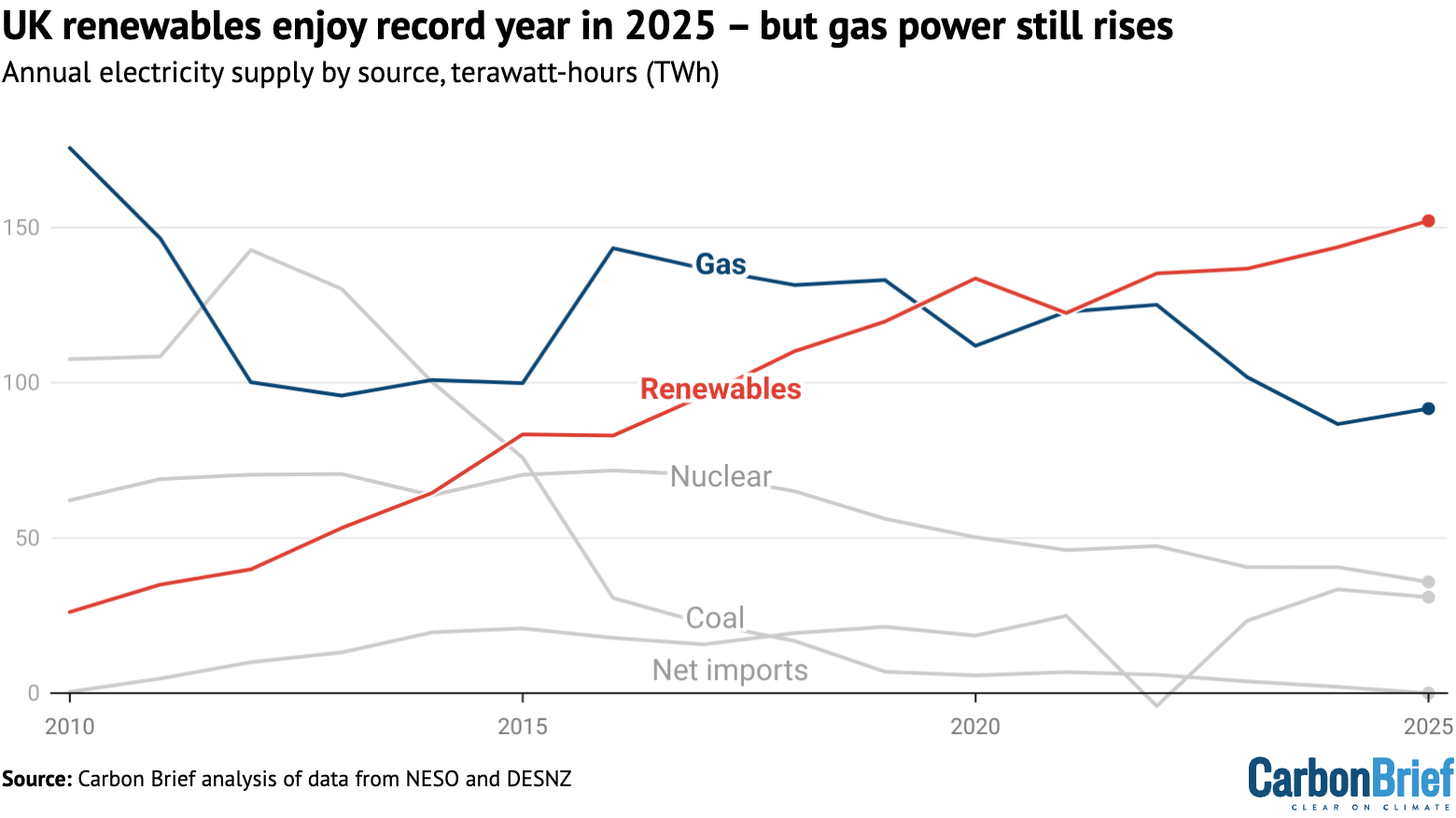 UK electricity supplies by source 2010-2025, terawatt hours (TWh). Net imports are the sum of imports minus exports. Renewables include wind, biomass, solar and hydro. The chart excludes minor sources, such as oil, which makes up less than 2% of the total. Source: Carbon Brief analysis of data from NESO and DESNZ. UK electricity supplies by source 2010-2025, terawatt hours (TWh). Net imports are the sum of imports minus exports. Renewables include wind, biomass, solar and hydro. The chart excludes minor sources, such as oil, which makes up less than 2% of the total. Source: Carbon Brief analysis of data from NESO and DESNZ.
Read more...
0 comments
Posted on 7 January 2026 by Guest Author
This is a re-post from Yale Climate Connections by Samantha Harrington
Renewable energy and climate action boomed in communities, states, and the world in 2025, despite setbacks at the federal level in the U.S, so much so that Science designated the “seemingly unstoppable growth of renewable energy” as its 2025 Breakthrough of the Year.
Climate solutions come in all shapes and sizes, and at Yale Climate Connections, we started off the year with the launch of our climate solutions hub, a page designed to help you easily identify climate actions that fit into your life. It’s a great place to find a climate-related New Year’s resolution if that’s your jam.
To close 2025 out on a high note, check out our favorite solutions stories of the year.
Sara Peach, editor-in-chief:
The solar panels Germans are plugging into their walls, by Yale Climate Connections’ radio team
In Germany, people who want to go solar can simply go to the store, buy a solar panel, and plug it in at home. These plug-in solar systems send power directly into a home through a normal wall outlet.
(Sara says, “This development makes solar panels accessible to renters. When it’s time to move, just unplug the panel and carry it to your new apartment.”)
Bill McKibben says cheap solar could topple Big Oil’s power, by Michael Svoboda
There is one big good thing happening on this planet. And that is the sudden surge in the use of what, for the last 40 years, we’ve called alternative energy, but which has now become the most obvious, straightforward way to make power.
Pearl Marvell, features editor, Yale Climate Connections en español:
He wasn’t planning to step in – until his team informed him that some immigrant enclaves were still waiting on help a month after the storm. They brainstormed a list of what families must need as winter approached: coats, heaters, blankets, generators, food, cash. When they began distributing items, many told the group that theirs was the first to offer them help.
(Pearl says, “I love this article because Yessenia wrote this story so beautifully and focused it primarily on how this community came together to help each other in times of need. I love when we can tell stories that are people-focused and then backed up by science.)
The rest of the world is lapping the U.S. in the EV race, by Dana Nuccitelli
According to an analysis by the International Council on Clean Transportation, climate pollution from global road transportation may have peaked in 2025 thanks to accelerating EV deployments around the world.
(Pearl says, “Because at least the rest of the world is going in the right direction.”)
Read more...
0 comments
Posted on 5 January 2026 by Guest Author
This is a re-post from Carbon Brief by Izzy Woolgar, director of external affairs at the Centre for Net Zero; Andy Hackett, senior policy adviser at the Centre for Net Zero; and Laurens Speelman, principal at the Rocky Mountain Institute
Electric vehicles (EVs) now account for more than one-in-four car sales around the world, but the next phase is likely to depend on government action – not just technological change.
That is the conclusion of a new report from the Centre for Net Zero, the Rocky Mountain Institute and the University of Oxford’s Environmental Change Institute.
Our report shows that falling battery costs, expanding supply chains and targeted policy will continue to play important roles in shifting EVs into the mass market.
However, these are incremental changes and EV adoption could stall without efforts to ensure they are affordable to buy, to boost charging infrastructure and to integrate them into power grids.
Moreover, emerging tax and regulatory changes could actively discourage the shift to EVs, despite their benefits for carbon dioxide (CO2) emissions, air quality and running costs.
This article sets out the key findings of the new report, including a proposed policy framework that could keep the EV transition on track.
A global tipping point
Technology transformations are rarely linear, as small changes in cost, infrastructure or policy can lead to outsized progress – or equally large reversals.
The adoption of new technologies tends to follow a similar pathway, often described by an “S-curve”. This is divided into distinct phases, from early uptake, with rapid growth from very low levels, through to mass adoption and, ultimately, market saturation.
However, technologies that depend on infrastructure display powerful “path-dependency”, meaning decisions and processes made early within the rollout can lock in rapid growth, but equally, stagnation can also become entrenched, too.
EVs are now moving beyond the early-adopter phase and beginning to enter mass diffusion. There are nearly 60m on the road today, according to the International Energy Agency, up from just 1.2m a decade ago.
Technological shifts of this scale can unfold faster than expected. Early in the last century in the US, for example, millions of horses and mules virtually disappeared from roads in under three decades, as shown in the chart below left.
Yet the pace of these shifts is not fixed and depends on the underlying technology, economics, societal norms and the extent of government support for change. Faster or slower pathways for EV adoption are illustrated in the chart below right.
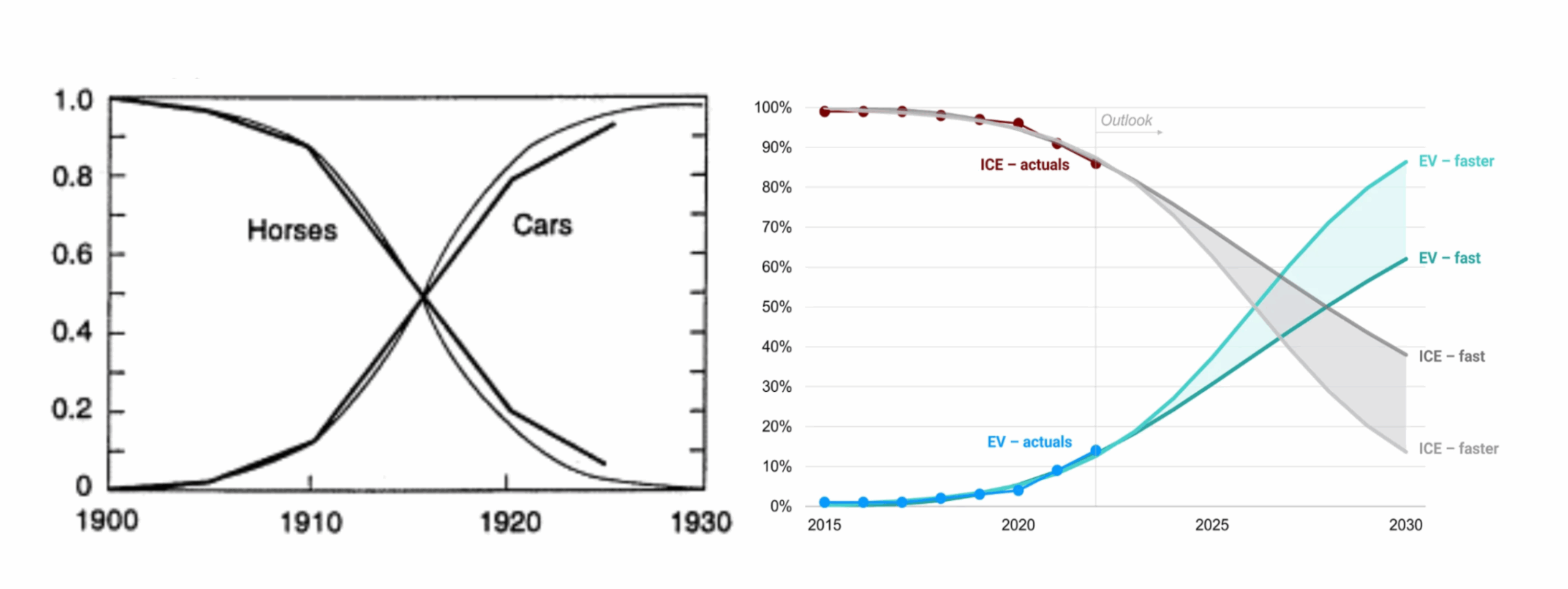 Left: The S-curve from horses to cars. Right: The predicted shift from ICE to EVs. Note that S-curves present technology market shares from fixed saturation levels to show the shape of diffusion, rather than absolute numbers; Cars were both a substitute for, and additional to, horses. Sources: Grubler (1999), Technology and Global Change (left); Rocky Mountain Institute, IEA data (2023) (right). Left: The S-curve from horses to cars. Right: The predicted shift from ICE to EVs. Note that S-curves present technology market shares from fixed saturation levels to show the shape of diffusion, rather than absolute numbers; Cars were both a substitute for, and additional to, horses. Sources: Grubler (1999), Technology and Global Change (left); Rocky Mountain Institute, IEA data (2023) (right).
Read more...
0 comments
Posted on 4 January 2026 by BaerbelW, Doug Bostrom
A listing of 28 news and opinion articles we found interesting and shared on social media during the past week: Sun, December 28, 2025 thru Sat, January 3, 2026.
Year 2025 Statistics
As this is the first news roundup of 2026 and we therefore have the complete year 2025 "in the can", we thought that you might enjoy some stats about what we shared during the previous 12 months.
All told, we shared 1470 links from about 270 different outlets, the vast majority of which provided fewer than 10 links and the bulk of shares originated from just 25 different outlets. The Top10 are: The Guardian (190), Skeptical Science (164), Inside Climate News (108), Yale Climate Connections (67), Phys.org (63), Carbon Brief (58), New York Times (54), The Conversation (52), Grist (47), CNN (38), followed by The Climate Brink, The Washington Post, DeSmog, Climate Home News and NPR. Among the shares are also 53 links to Youtube videos from different creators like ClimateAdam, "Just have a think", Dr Gilbz or Potholer54.
When looking at the categories we put most of the shared articles into Climate Change Impacts followed by - not too surprisingly! - Climate Policy and Politics and Climate Science and Research. Here is the full list for the 1470 articles shared:
| Category |
Articles |
| Climate Change Impacts |
379 |
| Climate Policy and Politics |
324 |
| Climate Science and Research |
148 |
| Public Misunderstandings about Climate Science |
118 |
| Miscellaneous (Other) |
114 |
| Climate Change Mitigation and Adaptation |
93 |
| Climate education and communication |
92 |
| International Climate Conferences and Agreements |
69 |
| Public Misunderstandings about Climate Solutions |
47 |
| Climate law and justice |
45 |
| Health aspects of climate change |
37 |
| Geoengineering |
4 |
Stories we promoted this week, by category:
Climate Change Impacts (9 articles)
- Australia makes list of 2025`s costliest climate events Sydney Morning Herald, Poppy Johnston, Dec 28, 2025.
- Heat, drought and fire: how extreme weather pushed nature to its limits in 2025 National Trust says these are ‘alarm signals we cannot ignore’ as climate breakdown puts pressure on wildlife The Guardian, Steven Morris, Dec 29, 2025.
- 2025 was one of three hottest years on record, scientists say Phys.org, Alexa St. John, Dec 30, 2025.
- Climate change could cost businesses big time The total climate-related financial risks top $6 trillion at 4,000 of the world’s large companies. Yale Climate Connections, YCC Team, Dec 30, 2025.
- An Idaho Bird Research Station Rises From the Ashes of a Wildfire The Valley Fire torched Lucky Peak in the fall of 2024. Bird researchers there are channeling their grief into study of how avians respond to climate-driven blazes. Inside Climate News, William von Herff, Dec 31, 2025.
- Now in its 25th Year, a Historic Effort to Save the Everglades Evolves as the Climate Warms Everglades restoration was designed to replenish the drinking water supply in one of the fast-growing parts of the nation. The same effort may help save South Florida from climate change. Inside Climate News, Amy Green, Jan 01, 2026.
- Hundreds of ski slopes lie abandoned... will nature reclaim the Alps? Dead ski resorts are undeniable evidence of our warming the planet, and another mess to clean up. Irish Examiner, Staff, Jan 01, 2026.
- A once-sparkling Alaskan river has turned a sickly orange color As permafrost melts, metals stored in rocks leach into the water, making it toxic for fish. Yale Climate Connections, YCC Team, Jan 01, 2026.
- Winter blooming of hundreds of plants in UK `visible signal` of climate breakdown New year plant hunt shows rising temperatures are shifting natural cycles of wildflowers such as daisies. World news The Guardian, Ajit Niranjan, Jan 02, 2026.
Read more...
0 comments
Posted on 1 January 2026 by Doug Bostrom, Marc Kodack
Open access notables
Editorial: Surviving the Anthropocene: the 3 E’s under pressing planetary issues, Sanita Lima et al., Frontiers in Ecology and Evolution
Scientists, including stratigraphists, all agree that our species has changed planet Earth in unprecedented ways. But contention exists around the actual start date and the diachronicity of the global human impact (Boivin et al., 2024). Indeed, the term “Anthropocene” is not the first attempt to name the consequences of human activities on our planet (Steffen et al., 2011), and several starting dates for the Anthropocene (from the emergence of the human species to the Great Acceleration and nuclear tests) have been eloquently defended (Logan, 2022). Furthermore, given the social and monetary aspects of the Anthropocene, terms like Capitalocene have been proposed as well (Moore, 2016). As highlighted in this Research Topic, López-Corona and Magallanes-Guijón introduce the concept of Technocene and explain why human technology must take a central place in the definition of our current period. Interestingly, the existence of so many terms trying to explain our impact on Earth could already be an indicator that we are, in fact, in a moment at which human interference is changing Earth’s natural history.
Relationships between climate change perceptions and climate adaptation actions: policy support, information seeking, and behaviour, van Valkengoed et al., Climatic Change
People are increasingly exposed to climate-related hazards, including floods, droughts, and vector-borne diseases. A broad repertoire of adaptation actions is needed to adapt to these various hazards. It is therefore important to identify general psychological antecedents that motivate people to engage in many different adaptation actions, in response to different hazards, and in different contexts. We examined if people’s climate change perceptions act as such general antecedents. Questionnaire studies in the Netherlands (n = 3,546) and the UK (n = 803) revealed that the more people perceive climate change as real, human-caused, and having negative consequences, the more likely they are to support adaptation policy and to seek information about local climate impacts and ways to adapt. These relationships were stronger and more consistent when the information and policies were introduced as measures to adapt to risks of climate change specifically. However, the three types of climate change perceptions were inconsistently associated with intentions to implement adaptation behaviours (e.g. installing a green roof). This suggests that climate change perceptions can be an important gateway for adaptation actions, especially policy support and information seeking, but that it may be necessary to address additional barriers in order to fully harness the potential of climate change perceptions to promote widespread adaptation behaviour.
From this week's government/NGO section:
Unequal evidence and impacts, limits to adaptation: Extreme Weather in 2025, Otto et al., World Weather Attribution
Every December we are asked the same question: was it a bad year for extreme weather? And each year, the answer becomes more unequivocal: yes. Fossil fuel emissions continue to rise, driving global temperatures upward and fueling increasingly destructive climate extremes across every continent. Although 2025 was slightly cooler than 2024 globally, it was some of the worst extreme weather events of 2025 that were studied, documenting the severe consequences of a warming climate and revealing, once again, how unprepared people remain. Across the 22 extreme events that are analyzed in depth, heatwaves, floods, storms, droughts and wildfires claimed lives, destroyed communities, and wiped-out crops. Together, these events paint a stark picture of the escalating risks we face in a warming world
Counting the Cost 2025. A year of climate breakdown, Joe Ware and Oliver Pearce, Christian Aid
The authors identify the 10 most expensive and impactful climate disasters of 2025. The year 2025 was marked by a series of devastating climate events, from heatwaves that pushed the limits of human survival, to record-breaking hurricanes that overwhelmed disaster response systems, and catastrophic rainfall and droughts that wreaked havoc on vulnerable communities. The report underscores the escalating cost of climate change, with fossil fuel companies playing a central role in driving the crisis. The cost of climate inaction is equally clear, as communities continue to bear the brunt of a crisis that could have been averted with urgent action to reduce greenhouse gas emissions.
2025 Climate Survey, The National Institute for Climate and Environmental Policy at Ben-Gurion University of the Negev
Levels of concern about the impacts of climate change are high across the public, but readiness to change lifestyles is low, especially when it involves personal sacrifice. The data indicate that religious affiliation explains climate attitudes in Israel more strongly than political affiliation.
44 articles in 22 journals by 242 contributing authors
Physical science of climate change, effects
Mechanisms of Projected Changes in Thunderstorm Downburst Environments Across the United States, Williams & Fieweger, 10.22541/essoar.175214727.71008323/v1
Observed and Modeled Trends in Downward Surface Shortwave Radiation Over Land: Drivers and Discrepancies, McKinnon & Simpson Simpson, Geophysical Research Letters Open Access 10.1029/2025gl119493
Read more...
0 comments
Posted on 31 December 2025 by BaerbelW, Doug Bostrom
Quite a lot has been happening during 2025 but a good chunk of it is hidden away in our "boiler room" as we were working on a complete revamp of our homepage (see the sneak peek section below).
As in previous recaps, this one is divided into several sections:
Read more...
0 comments
Posted on 30 December 2025 by Ken Rice
This is a re-post from And Then There's Physics
I thought I’d written about this before, but can’t seem to find a post. Either, my searching ability is poor, or my memory is poor. I mostly wanted to highlight an interesting YouTube video by David Kipping that illustrates why Direct Air Capture (DAC) is thermodynamically challenging. I encourage you to watch the video (which I’ve put at the end of this post) but his basic conclusion is that thermodynamic constraints mean that implementing DAC at the necessary scale would require a significant fraction of all global electricity consumption.
I wanted, however, to work through some of the numbers myself and to do the calculation of how much DAC we would need to use in a slightly different way.
A key point is that given an atmospheric concentration of 400 ppm and a temperature of 300K, it takes a minimum of 19505 J to remove 1 mole of CO2. 1 mole of CO2 is 44g, so 1 tonne of CO2 has 22727 moles. Therefore, removing 1 tonne of CO2 requires a minimum of 4.43 x 10⁸ J.
Typically, however, we emit so much that we tend to think in terms of gigatonnes of CO2 (GtCO2). Removing 1 GtCO2 would require a minimum of 4.43 x 10¹⁷ J.
Read more...
1 comments
Posted on 29 December 2025 by Guest Author
This is a re-post from Carbon Brief by Josh Gabbatiss
China’s coal demand is set to drop by 2027, more than cancelling out the effects of the Trump administration’s coal-friendly policies in the US, according to the International Energy Agency (IEA).
Global coal demand is due to grow by 0.5% year-on-year to reach record levels in 2025, according to the latest figures in the IEA’s annual market report.
Yet this will be reversed over the next couple of years, as a faster-than-expected expansion of renewables in key Asian nations and “structural declines” in Europe push coal demand down, the agency says.
While US coal demand is set to continue falling, the decline will be slower than expected last year, due to new federal government efforts to support the fuel.
However, the IEA’s upward revision of an extra 38m tonnes (Mt) of US coal use in 2027 is dwarfed by an even larger 126Mt downward revision in China’s coal use.
‘Unusual trends’
Coal demand will reach 8,845Mt around the world in 2025. This is slightly (44Mt) higher than the IEA had forecast in its 2024 coal market report.
The agency notes some “unusual regional trends” impacting this growth, including a 37Mt year-on-year increase in US coal demand in 2025 to 516Mt. This is 59Mt (17%) higher than the IEA projected in 2024.
A new suite of measures under the Trump administration have supported the short-term use of coal, including the modernisation of existing coal plants and reopening shuttered ones.
EU coal use declined at a slower pace than expected due to lower wind and hydropower output, according to the IEA. Nevertheless, the bloc “continues its structural decline” in coal demand, driven by renewables expansion, carbon pricing and coal phaseout pledges.
India saw an unexpected dip in coal consumption in 2025, linked to a strong monsoon season that increased hydropower output and curbed electricity demand.
In China, which accounts for more than half of the world’s coal use, coal demand remained roughly unchanged between 2024 and 2025, the IEA says.
Read more...
0 comments
Posted on 28 December 2025 by BaerbelW, Doug Bostrom
A listing of 28 news and opinion articles we found interesting and shared on social media during the past week: Sun, December 21, 2025 thru Sat, December 27, 2025.
Stories we promoted this week, by category:
Climate Policy and Politics (8 articles)
- Lost Science - She Tracked the Health of Fish That Coastal Communities Depend On Ana Vaz monitored crucial fish stocks in the Southeast and the Gulf of Mexico until she lost her job at NOAA. New York Times, Interview by Austyn Gaffney, Dec 18, 2025.
- Save NCAR Field notes from New Orleans, where I and 20,000 colleagues learned that Trump intends to destroy the National Center for Atmospheric Research. Deep Convection, Adam Sobel, Dec 21, 2025.
- “Destroying Knowledge”: Michael Mann on Trump’s Dismantling of Key Climate Center in Colorado Democracy Now, Amy Goodman, Dec 22, 2025.
- Trump`s shuttering of the National Center for Atmospheric Research is Stalinist | Michael Mann and Bob Ward This is the latest in the relentless purge of climate researchers who refuse to be co-opted by the fossil fuel industry The Guardian, Michael Mann and Bob Ward, Dec 22, 2025.
- Looking Back at a Historic Year of Dismantling Climate Policies The Trump administration has aggressively pulled America away from its global role in climate and environmental research, diplomacy, regulation and investment. New York Times, David Gelles, Dec 23, 2025.
- We analyzed 73,000 articles and found the UK media is divorcing 'climate change' from net zero The Conversation, James Painter, Dec 24, 2025.
- Trump`s anti-climate policies are driving up insurance costs for homeowners, say experts Tariffs, extreme weather events and the president’s funding cuts are contributing to increasing rates, sometimes by double digits. Yale Climate Connections, Marcus Baram, Capital & Main, Dec 24, 2025.
- White House pushes to dismantle leading climate and weather research center PBS News Hour, William Brangham, Dec 26, 2025.
Climate Change Impacts (7 articles)
- Arctic Warming Is Turning Alaska’s Rivers Red With Toxic Runoff A yearly checkup on the region documents a warmer, rainier Arctic and 200 Alaskan rivers “rusting” as melting tundra leaches minerals from the soil into waterways. New York Times, Eric Niiler, Dec 16, 2025.
- Washington State Faces Climate Change Reality After Storms Two weeks of “atmospheric river” deluges took a toll on business in Leavenworth, Wash., and beyond, reminding the region that a warming planet has brought new uncertainty. New York Times, Anna Griffin and Amy Graff, Dec 22, 2025.
- Report: Climate is central to truth and reconciliation for the Sámi in Finland As Finland reckons with its historic mistreatment of the Indigenous Sámi people, climate change complicates the path forward. Grist, Rebecca Egan McCarthy, Dec 23, 2025.
- Oceans are supercharging hurricanes past Category 5 Warming oceans are fueling a surge of extreme, off-the-charts storms—so powerful that scientists say it’s time to invent a whole new hurricane category. Science Direct, AGU, Dec 25, 2025.
- The Guardian view on adapting to the climate crisis: it demands political honesty about extreme weather | Editorial Over the holiday period, the Guardian leader column is looking ahead at the themes of 2026. Today we look at how the struggle to adapt to a dangerously warming world has become a test of global justice The Guardian, Editorial, Dec 26, 2025.
- Six photos show how climate change shaped our world in 2025 This year’s most notable wildfires, hurricanes, droughts, heat waves, and heavy rains were made more devastating and deadly by climate change. Yale Climate Connections, Samantha Harrington, Dec 26, 2025.
- Cyclones, floods and wildfires among 2025`s costliest climate-related disasters Christian Aid annual report’s top 10 disasters amounted to more than $120bn in insured losses The Guardian, Fiona Harvey, Dec 27, 2025.
Read more...
0 comments
|
|




The Consensus Project Website
THE ESCALATOR

(free to republish)
|




 Arguments



