





Global warming impact on tropical species greater than expected
Posted on 8 October 2010 by John Cook
The effects of global warming are already being observed in animal species throughout the world. Creatures are breeding earlier and migrating to higher latitudes or altitudes to escape the warming temperatures (Parmesan 2003). As higher latitudes are warming faster than the tropics, one would expect the impact on species in high latitudes to be greater. However, a new study Global metabolic impacts of recent climate warming (Dillon et al 2010) turns this notion on its head. The study is based on the principle that metabolic rates of ectotherms (cold blooded animals) change faster at high temperatures than at low temperatures. The tropics are already that much warmer than the Arctic - hence warming goes a long way in the tropics.
Metabolic rate is a useful metric for an organism's energetic and material needs. As a creature's metabolic rate increases, so too does it's need for food and vulnerability to starvation unless food resources increase. Higher metabolic rate means reduced energy for reproduction and increased rates of evaporative water loss in dry environments. Thus metabolic increases should alter food web dynamics, leading to elevated rates of herbivory and predation, as well as changes in the spread of insect-borne tropical diseases.
Metabolism changes when temperature changes. However, a quirk of biology is that the metabolism change is greater at high temperature than at low temperature. Warming delivers "way more of a buzz" at higher temperatures. Since 1980, the Arctic has been warming around 3 times faster than the tropics. However, the increase in metabolism in the tropics is much greater, because tropical warming took place in an environment that was initially warmer. Warming during the past three decades has had its biggest absolute impacts on metabolic rates in tropical and north temperate zones.
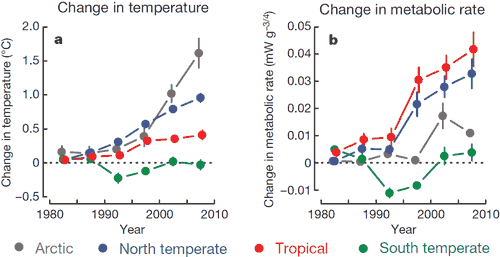
Figure 1: Global changes in temperature and in metabolic rates since 1980.
a, Changes in mean temperature (5-year averages) for Arctic, North temperate, South temperate and tropical regions. b, Predicted absolute changes in mass-normalized metabolic rates by geographical region.
Why does this matter? The tropics are the centre of Earth’s biodiversity and its chief engine of primary productivity. The potential for large impacts is highest in the tropics because the biodiversity is the highest. Consequently, relatively large effects of temperature change on the metabolism of tropical species may have profound local and global consequences.

Arguments


Hey John. I sometimes use a paper from PNAS by Deutsch et al 2007 in class in my physiology lectures as a good example of how to apply physiological principles (in this case temperature vs performance curves) to ecological problems. That paper also finds that tropical insects, and perhaps tropical cold-blooded species generally, are likely to be more susceptible to increasing temperature than temperate species, even though the temperature change is likely to be greater at high latitudes.
The reason in that case has to do with adaptation to climate variability. They show that tropical species are operating much closer to their optimum and maximal temperatures, presumably because low seasonal variability in temperature in the tropics allows them to be more finely tuned, metabolically speaking, to their environment without too much risk of experiencing lethal temperatures. Temperature species, on the other hand, operate well below their thermal optima and maxima, presumably to avoid the possibility of experiencing lethal temps. The much lower margin for error in tropical species causes their population growth to be negatively affected by predicted temperatures, while higher latitude species actually experience an increase in population growth initially in response to warming.
On the other hand, much will depend on the extent to which potential new habitats are physically accessible, the capacity of other plant and animal species forming part of their food chain to migrate with them, the extent of competition from species already present in new locations, and the extent of general habitat degradation.
Clearly, a fascinating new variable in an array of challenges for our stewardship of the planet.
The article you cited essentially models the metabolic theory of ecology, which suggests that larger species may have higher metabolic rates and that metabolic rates increase with temperature. Ectotherms which lack the capacity to regulate temperature would be especially vulnerable to increased temperatures for the very reasons you cited.
The Wikipedia reference I've given above contains the same equations for metabolic rate as a function of temperature as Dillon et al.
Entering 'temperature and metabolic rate' into Google yields over 800,000 hits. Most of the references dealt with hibernation but this article by Marshall & McQuaid (2010) was the first I came across dealing with temperature increases and metabolic rate:
Warming reduces metabolic rate in marine snails: adaptation to fluctuating high temperatures challenges the metabolic theory of ecology
The title is self-explanatory. Interestingly, the authors also note in their introductory remarks:
'Departures from the model's prediction of acute metabolic responses to temperature (the slope) have been shown for insects and arachnids...' The importance of this study lies in its demonstration of decreased metabolic rates via heart rate and oxygen consumption in aestivating (estivating) snails at temperatures between 30 and 40 degrees C.
Aestivation comprises the 'summer sleep' or torpor experienced by a range of organisms to protect against heat stress and seems to be a widespread phenomenon in organism inhabiting marginal zones.
In short, the behaviour of real organisms may differ in significant respects from what one would expect from the metabolic theory of ecology, which derives from Kleiber’s law, itself based on the posited physical and geometrical principles underpinning animal circulatory systems.
Of course, the mere fact that I've come up with one paper identifying one organism (with references to the behaviour of some other organisms) whose behaviour does not accord with the metabolic theory of ecology doesn't automatically invalidate the concerns raised by Dillon et al.
Dillon very properly cautions:
'...plenty of real ectotherms have some ability to moderate their temperatures through behavior, such as darting under rocks to escape the sun. These measures have limits though, especially for small creatures, and actual biology — not just temperature — needs investigating.
“You can’t assume that the temperature patterns tell you what the effects on biology will be,” he says.'
The Marshall & McQuaid paper nevertheless suggests that the picture may indeed be very much more complicated at least for some organisms and ecosystems.
However, the mere fact that these systems are so beautifully complex is reason enough to be wary of complacency about potential climate impacts.
The frogs and toads are also far more numerous, and more importantly, far, far larger. For a long time the frogs have been vanishing, along with the wetlands (due to over development), but this year I'm finding toads all over the yard, each of them twice as big as anything I normally see.
This is accompanied by more plant growth. Despite a serious drought, weeds, shrubs and plants are have spread to encroach on the yard like never before.
All of this is relative to my experience of the past twenty years. It's never happened before in that time.
Is it just an anomaly, or is it related to the focus of this article?
The next few years will be interesting to watch.
I know the jacarandas bloom earlier further north - I remember distinctly from an early October visit to Brisbane just twenty two years ago to be surprised to see the whole city in bloom. The visit and its timing were memorable for the fact that I passed my psychiatry exams in Brisbane and my son was born a few days earlier :-).
Admittedly, I haven't made a conscious effort to watch the timing of the shedding and flowering before this year (but I've been inspired to do so by some of the posts on this blog).
The difficulty of course lies in the fact that we tend to look out for anomalies when we worry that something may be going amiss. At any rate, I found evidence of earlier seasonal flowering in some settings here and delayed flowering in other settings here both attributed to warmer springtime conditions.
Interesting times indeed.
However, the hotel I'd checked into was called the Gateway which I thought was deeply symbolic - I passed :-) while my colleague who checked into a hotel called The Terminus failed :-(.
All very pregnant with meaning :-)
Additionally, we we had our coldest day in thirty years last June.
But 2010 seems to be tied as the warmest year on record worldwide.
I really do not want to see what might happen if there were no record cold temperatures showing up anywhere in the world.
Or is that comment related to the view of warming being like transposing music? I see so many people saying that if it's warming why can't I look forward to things being milder where I am (UK or US).
It's not supposed to be like transposing a piece of music up a third from C to E. It's more like a couple of toddlers joining you at the piano and banging discordant keys anywhere and everywhere.
From coolest September in five years: "The city had an average maximum temperature of 21 degrees, making it the coldest September in terms of daytime temperatures in three years. This is despite being warmer than the long-term norm of 20." Have the last five Septembers been the hottest five on record?
If we limit our records to a single year it will always be the coldest year.
I suspect that some of the more successful tropical species will be the ones that migrate pole-ward, as invasive species in the temperate zones.
Thank you.
The Yooper
Typo: it's --> its





