



 Arguments







Recent Comments
1 2 3 4 5 6 7 8 9 10 11 12 13 14 15 16 Next
Comments 1 to 50:
-
wilddouglascounty at 01:10 AM on 27 October 20262026 SkS Weekly Climate Change & Global Warming News Roundup #43
I will acknowledge upfront that this is purely a personal, subjective perception, but even as someone who has largely avoided mainstream media including internet social media, I'm finding that the volume and specificity of evidence about our changing climate and the subsequent dire projections are increasingly clear and are ever more dire. From Kate Marvel's new book Human Nature to the research and news summaries and videos on this and other sites, it is increasingly difficult to 1) Hear the misinformation out there still droning on and 2) knowing where to point people who are wanting more specifics about the nature and degree of the consequences of the shifting chemical composition of our atmosphere and oceans. I still point folks to this site as an excellent place to keep up and understand the situation; I'd love to hear other's choices they point to for inquisitive folks to go to for reliable, up-to-date and understandable information on the state of our climate, amidst the chaotic firehose of noise that passes as our information pipeline designed to sort out reality.
-
Bob Loblaw at 23:38 PM on 25 October 2026The History of Climate Science
Following up on comments 46-49. Note that in this week's SkS News roundup, Europe is suffering another epic heat wave that is leading to excess deaths - another 50,000. The headline is "Europe’s killer heat this summer claims 50,000 lives. Climate change blamed for two-thirds of deaths". Direct link to the AP story.
-
Bob Loblaw at 23:10 PM on 10 October 2026Skeptical Science New Research for Week #40 2026
The context of Doug's comment is that the part in italics is directed towards the people that want to disagree with the overwhelming flood of evidence that we understand a lot about climate. As more and more evidence accumulates, they would need to keep trying to argue against it - without contradicting what they said last week (or last month, etc.)
One of the contrarian tactics is to use what has been called "the Serengeti Strategy". Try to look for what they think is the weakest link (or one individual), and attack that point only. And then try to infer that this weakness is an indication that all the rest of climate science has been disproven. It's like saying that the bridge is going to fail because they found one rivet that is loose, implying that the entire structure is as bad as that one rivet.
The internal consistency point is a key one: too many times I've seen one contrarian arguing that CO2 concentrations are too small to have any effect (the "trace gas" argument), while another is arguing that the effect is so strong that adding more can't have any additional effect (the "saturated" argument). They can't both be correct. They can be (and are) both wrong. SkS used to have a page that listed such contradictions, but it became too difficult to maintain because the contrarian positions have so many contradictions.
-
Bob Loblaw at 22:51 PM on 10 October 2026The History of Climate Science
nostradamus @ 48:
"...increased duration..." seems rather benign, and it's not just the duration, but the intensity that is expected to change. And it's not just the observed changes since mid-20th century that are the concern, but the expected changes as we head towards the mid-21st century.
In the 2007 IPCC report, it is chapter 10 that deals with projections into the future. For context, there is frequent mention in the report of the 2003 European heat wave, which was a killer in many ways. Tens of thousands of deaths caused by the increased heat, by most estimates. The 2007 IPCC report gives extensive discussion of how evidence and modelling understanding had changed since the previous report. The graphic in the OP recognizes this advance in knowledge.
If you feel that "killer" may be over-the-top, what other term addresses the fact that death is part of the picture? "Deadly"? Some would make the same argument. "Dangerous"? "Catastrophic"? "Damaging"? Lots of possible choices from your favourite thesaurus, but all are subjective. All will be contested by contrarians that want to deny that there is anything to worry about.
-
nostradamus at 07:06 AM on 9 October 2026The History of Climate Science
Thanks Bob. My main objection is seeing an emotional word like "killer" as a descriptor for a heatwave on a science site. Heatwaves can change in frequency, intensity and duration. Suggest a change in the graphic to:
"Probability of increased duration of heatwaves linked to global warming."
based on "Heat waves have increased in duration beginning in
the latter half of the 20th century." from AR4 Technical Summary: -
Doug Bostrom at 06:43 AM on 8 October 2026Skeptical Science New Research for Week #40 2026
Thanks for kind thoughts about New Research.
We think of this weekly blast as having several purposes.
Not least and per Bob's remarks, "Disagree with all of this— coherently and with full internal consistency— and then again, on a weekly basis, indefinitely." Nope. Ain't gonna happen. It's impossible.
Consilience is a hard attack surface. -
Bob Loblaw at 01:07 AM on 8 October 2026Skeptical Science New Research for Week #40 2026
I particularly noted wild's use of the phrase "...a fire hose of information...".
Recently, I was in a discussion with a "contrarian" below a newspaper story with climate change implications. He kept saying things along the line of "there isn't one paper that shows a proof of the connection between carbon dioxide and increasing temperatures". He kept throwing in challenges such as "show me one. They don't exist" and "I'll wait", etc. in a grade-school level of thinking he'd come up with a gotcha question that climate science had no answer for.
Aside from the aspect of expecting "proof", his challenge was based on the sophomoric view that "climate change" is a single, simple factor. Climate is a very complex process. Temperature is just one item that is affected by increasing CO2, and there are many, many moving parts to our understanding of climate in general (let alone CO2-induced changes).
I responded at one point saying there are tens of thousands of papers in support of our understanding of climate. He responded, rejecting that position, by saying that there are many that "elude" to the connection, but none that prove it. (Yes, he used the word "elude", when he probably meant "allude".) Once again, he only demonstrated a fundamental lack of understanding of science, how complex it can be, and how many different parts need to be examined and understood. And how it is evidence that accumulates in a vast reservoir of knowledge that convinces us of the likelihood that our understanding is correct.
As Alexander Pope said:
A little learning is a dangerous thing;
drink deep, or taste not the Pierian spring:
there shallow draughts intoxicate the brain,
and drinking largely sobers us again.You can't drink at the fire hose of knowledge the same way you drink from a sippy cup.
-
Bob Loblaw at 00:45 AM on 8 October 2026The History of Climate Science
nostradamus @ 46:
Expecting there to be a single scientific definition of "killer heat waves" starts to head towards the "Impossible Expectations" end of the discussion scale. Even just defining "heat waves" is going to lead to varying definitions, depending on the purpose of the analysis. (And by "purpose" I mean the question being asked, not the answer that is sought.)
Given the time line of the graphic you are looking at, the question is "what was being said about heat waves and deaths in the mid-2000s?" The IPCC reports are your friend - one was published in 2007. Chapter 3 covers a lot of discussion, and their table 3.7 includes their general definition of "heat wave" that was used to assess extremes:
Warm spells (heat waves)
Episode of several consecutive high-temperature days/nights.
Table 3.8 of the same IPCC report discusses the confidence level associated with the detection of various changes in extremes. For heat waves, the confidence is "likely". The phrase "heat wave" occurs many, many times in that report, but they seem to have avoided using the word "death" in the report. There is one reference to a paper discussing "heat-related mortality", though.
In June of this year, SkS republished a discussion of heat-related deaths that was originally published by Andrew Dessler over at The Climate Brink. It presents several ways of determining "excess deaths".
So, there is strong evidence for a concern about increasing heat waves in the mid-2000s, and the question of this as an influence on mortality rates is not new. We know that heat can kill. The graphic states, quoting it fully:
"Probability of killer heat waves linked to global warming".
For a brief summary of the state of the science at the time, this is not an unreasonable statement of the concerns being expressed at the time.
-
prove we are smart at 22:47 PM on 7 October 2026Scientists link fossil fuel producers to the West’s worsening water shortages
Accountability for the greediest and most profitable companies in our consumer driven, monopoly creating societies? Don't hold your breathe-there is a reason old mine sites are never rehabilitated. Climate policy is a perfect example: the science is clear, but the political system gets stuck in cost‑benefit paralysis. Maybe the French kids protesting for school/education equality is reminding us, if you want real change, you have to fight the entrenched system to get it.
I'm sure the fossil fuel elites will down grade this result but belatedly a change in the accountability for fossil fuel extraction from the high court of Australia is a welcome sign, www.abc.net.au/news/2026-10-07/mount-pleasant-coal-mine-high-court-ruling/107233650
This link explains,unless we change our societies fundamentaly, worstening news for everything in earths biosphere is coming, www.youtube.com/watch?v=ejsHXeds6Y0
-
nostradamus at 03:50 AM on 7 October 2026The History of Climate Science
Thanks for your efforts to debunk the disinformation about climate change science.
In the figure above (Climate science timeline, 1960-2010) there is a reference near ~2005 to "killer heatwaves". What is the scientific definition of killer heatwaves?
-
One Planet Only Forever at 07:54 AM on 6 October 2026Skeptical Science New Research for Week #40 2026
I second wilddouglascounty’s sentiments.
I would also thank everyone who contributes to publishing the Weekly News Roundups.
The “Climate Science and Research” section of the 2026 SkS Weekly Climate Change & Global Warming News Roundup #40 includes the Planetary Health Check 2026. That document is the most recent update of the continuing evaluation of increased awareness and understanding of everything that really matters for the sustainable improvement of the future of global humanity and all of its sub-groups (down to individuals). Several of the items evaluated are specifically Climate Change Science. But there is clearly more that matters.
The following fundamental perspective (Theory – Hypothesis - Understanding) appears to explain the challenges of developing sustainable improvements for the future of global humanity, not just the challenges related to Climate Science.
Misunderstandings and lack of awareness produce damaging results for any group of humans. That applies to groups as small as couples up through business groups, political groups, sports teams, cultural groups, religious groups, and ultimately up to the entirety of global humanity.
Damage done by misunderstandings and lack of awareness of individuals or sub-groups can negatively impact All Others, not just the larger group that they are part of. Every bit of negative impact adds up.The concern is people who misunderstand things or have a lack of awareness. But the major problem is leaders and popular opinion sharers who choose to try to personally benefit from misunderstanding and lack of awareness. Those people will likely choose to avoid learning to be less harmful and more helpful to Others. And they will try to mislead others and keep others less aware rather than learning to help others learn and be more aware of how they can be less harmful and more helpful members of Humanity.
-
irhaahmed at 14:20 PM on 5 October 20262026 SkS Weekly Climate Change & Global Warming News Roundup #40
thats a great read
-
wilddouglascounty at 00:50 AM on 3 October 2026Skeptical Science New Research for Week #40 2026
Doug, Mark,
I just want to thank you both and any others involved for continuing to provide this curated list of climate related research publications--it's truly an incredible amount. In fact, if more people would see how much of a fire hose of information is being collected on the topics covered, I think more people would be compelled to push for more mitigation measures, and stop dawdling about reducing our carbon emissions.
-
One Planet Only Forever at 03:41 AM on 1 October 2026The Worst Case Is Still on the Table
plincoln24,
I believe the answer to your question has already been well presented by Andrew Dressler.
When you re-read the entire document to understand the answer to your question, I would recommend paying particular attention to what follows the following words in section 2. RCP8.5/SSP5-8.5 emissions may be implausible, but temperatures are not.
"One might reasonably wonder why we need SSP5-8.5 to estimate the upper limit of SSP2-4.5 runs. Why can’t we just use SSP2-4.5 runs to evaluate the upper limit? ..."
-
plincoln24 at 23:29 PM on 30 September 2026The Worst Case Is Still on the Table
I don't understand. If the emissions scenario of RCP 8.5 is not realistic, doesn't it just make more sense to scrap RCP 8.5 and asses high risk low probability events based on high end values for the climate sensitivity in the reasonable emissions scenarios?
-
photoMaldives at 19:07 PM on 26 September 2026Skeptical Science New Research for Week #38 2026
That's great, Doug! Many thanks for your prompt reply, and keep up the great work! :)
-
prove we are smart at 16:44 PM on 24 September 2026India’s power-sector emissions flat for two years due to clean-energy surge
"For its part, in India some 28GW of new coal capacity was newly proposed or reactivated last year, bringing the total under development to 107.3GW and under-construction capacity to 23.5GW.
The Indian government is planning to complete 85GW of new coal capacity in the next seven years, even as clean-energy expansion reaches levels that could cover all of the growth in electricity demand."
From the Carbon Brief link from the above article www.carbonbrief.org/new-coal-plants-hit-10-year-global-high-in-2025-but-power-output-still-fell
I suspect the Indian fossil fuel elites and the enormously powerful other world " Big Oil" elites will wish the Keeling Curve to never stop rising. This post by independant Australian journalists shows just a glimpse of why that curve hasn't stop rising. www.youtube.com/watch?v=-zHdB7aOjfs
"The old world is dying, and the new world struggles to be born: now is the time of monsters" is attributed to Antonio Gramsci, an Italian Marxist philosopher. This phrase reflects the transitional period of societal upheaval and uncertainty. Oh boy!.
-
Doug Bostrom at 03:42 AM on 19 September 2026Skeptical Science New Research for Week #38 2026
Thank you for your kind remarks, photoMaldives!
We indeed struggled a bit with how to present "most cited." Our tooling is a bit limited on this creaky old system.We'll have a think about how we might better thread this needle. One possibility would be to have a very discreet "Most cited in retrospect" link (in smaller font size?) to an anchor in a separate section, as non-interruptive to the eye as possible.
For any bystanders wondering "why?" about the most-cited feature, it seems important for laypeople (all of us, depending on discipline) to see what research products in various research domains gain any traction as building blocks for further progress. -
MA Rodger at 23:14 PM on 18 September 2026Factcheck: Reform UK’s 45 false or misleading claims about climate and energy
The source of the OP above, CarbonBrief, is a UK-based organisaton so for non-UK readers (and perhaps a few UK readers as well) a quick** bit of ReformUK background may be useful. (**That is as quick as I can manage -I am a UK political activist.)
ReformUK has been quite a phenomenon within UK politics in the last few years. It is the creation of Nigel Farage who has campaigned on the far-right since 1991. Initially it was a single issue - leaving the EU and his vehicle was a party called UKIP (UK Independence Party). It had no success outside the low-turnout elections for the EU parliament when the issue would fire up right-wing Tory voters enough to go out and vote UKIP or Tory when others stayed home. (UKIP got a quarter of the 2014 vote, the biggest share but not far above the two big parties.)
Particularly during the Brexit referendum Farage found his dictats hindered by rival factions undermining him. And in following years he was plagued by many wanting to turn the party further to the right and adopt toxic policies. So he left UKIP and formed the Brexit Party at the start of 2019. Farage actually owned this party which was incorporated as a private company. Farage was the major shareholder with a couple of other shareholders including millionaire Richard Tice who was the main financier.
The new party yopped the vote and gained over a third of the vote in the May 2019 EU parliament elections, this amid the turmoil of negotiating the EU exit. Both main parties did badly (a sign of things to come) but it was all rather silly with the UK on the verge of its EU exit.
Back in the real world, the Brexit Party got just 2% in the UK General Election later (December) that year.A month later, the UK legally left the EU (Jan 2020) and a year later Farage left politics, his job done. Tice became leader of the party which had become re-named ReformUK although Farage was still the party's legal owner. It slowly gained support and with the Tories floundering, ReformUK had gained about 10% support as the next General Election drew near. It was called for July 2024.
Then six weeks out from that election Farage returned to lead ReformUK again. (We now learn he was peronally gifted £5million by backers, perhaps payment to induce him to return.) They got a bit of a boost in popularity (14%) but not enough to deliver more than a handful of MPs. Importantly, while the Labour Party got a massive majority but did not 'win' the vote - it was ReformUK splitting the right wing vote that delivered for them.It was quite evident that Labour would win and soon lose support, just as the Tories did in government. This was shown in the local electons of 2025 & 2026 which got Labour into a panic. The change in Labour leadership this year has reversed that slide although ReformUK were already losing support (from last autumn) and today have dropped significant popularity (25% down from 32%).
The challenge Farage and ReformUK was always going to appear in a General Election. They certainly would not gain a majority in individual constituencies and their toxicity will result in massive tactical voting - their main opponent in each seat being supported by all to block ReformUK winning. This doesn't happen in local elections which also have lower turnouts (like the old EU parliament elections). And in parliament, MPs of all ilk aren't gonna support them being in government.
So a ReformUK government has always looked unlikely, and increasingly so as their true nature becomes plain (rather than being seen as a 'breath of fresh air'). The problem ReformUK pose is that they will continue to command significant support and other parties (mainly the Tories) will attempt to grab some of that support by adopting ReformUK policies. (This was how we got the stupid Breixt referendum in 2016.) And one of those policies now being readily adopted is the trashing of Net Zero targets and insisting high energy bills and disappearing industries are a result of said Net Zero targets.
-
photoMaldives at 20:28 PM on 18 September 2026Skeptical Science New Research for Week #38 2026
Hi guys, I love your work, and avidly follow your weekly updates. A suggestion, if I may ? I wonder if the recently introduced "Most cited from this section, published 2 years ago" entries might be better suited to a separate category of their own, at the bottom ? I ask for purely selfish reasons, as I visually scan down your list to pickout the latest papers of interest (marine, and/or Indian Ocean region), and the "Most cited" makes this more difficult. Many thanks, and keep up the great work. :)
[PS: I did try to add the sections to my adblock, but there does not seem to be a unique css class for me to target] -
Eclectic at 11:47 AM on 15 September 2026Factcheck: Reform UK’s 45 false or misleading claims about climate and energy
Prove @1 :
Yes, "Reform-UK" is a waste of time, regarding climate politics.
Have to agree about Youtube's "Belle of the Ranch" ~ who I find very informative on various U.S.A./political events.
"Belle" puts out 2 or 3 brief videos per day, typically about 4 minutes long. An intelligent woman, with a dry & droll sense of humour ~ and she seems to have good sources of information..
The videos are shot in a shed (carrying on her husband's tradition ~ and he himself has a past list of similarly intelligent commentaries, under the title of "Beau of the Fifth Column", IIRC.)
"Belle" nowadays presents as Farmer's Wife & past Military Nurse. The folksy Southern Drawl, baseball hat, and checked shirts go with the package!
Definitely good for brief updates on major current events.
-
prove we are smart at 10:42 AM on 15 September 2026Factcheck: Reform UK’s 45 false or misleading claims about climate and energy
Yes, I started to read the rest but such old debunked crap spewed out by corrupt elites was too much to finish. At least my increasing doomerism was called out by a positive and plain speaking "Belle". www.youtube.com/watch?v=IhSBPVr_h4s
-
RedRoseAndy at 02:50 AM on 6 September 2026Forget more reservoirs; should the UK just build desalination plants instead?
Offsetting CO2 Emissions with Fish
[snipped]
Professor Oswald Schmitz is quoted in ‘New Scientist’ as saying: “Fish have a “tremendous” impact on carbon storage. “Part of it is in just the sheer biomass of these animals,” he says. But bony fish also fix carbon into insoluble minerals in their intestines as part of their way of dealing with constantly ingesting seawater. “It’s a sort of rock-like substance that they poop out and that sinks to the ocean bottom really quickly.” Collectively, marine fish account for the storage of a whopping 5.5 gigatonnes of carbon each year.” (Man produces 37.41 gigatonnes of CO2 a year.) Scientists say that we used to have nine times as many fish as we do now, so there is plenty of room for a man-made increase in fish numbers by offsetting companies, if we got fish stocks up to historic levels our fish would store 49.5 gigatonnes a year, which is more than man produces in a year at the moment.
Using my method of preventing fish extinction can also, then, be a method for offsetting CO2 emissions, and even reversing global heating.
A Practical Solution To Fish Stock Depletion
Fish in the wild are being over exploited, and whole fish species face extinction. But there is an easy way of preventing these extinctions. An international law should be passed which ensures that the gonads of all fish caught are liquidized and put into water containers, the fish are usually gutted anyway so this would not be a great hardship for the fishermen. Once liquidized, artificial fertilization takes place, and after twenty four hours the fertilized fish eggs can be released into the sea. The bucket of young fish needs it’s temperature equal to the sea they are released into to prevent fry death, so standing for a length of time with the fry bucket in the sea needs a wet suit before release. When this is scaled up by offsetting organisations a less painful method will be used. Ensure that the water in your bucket is the temperature of the sea to avoid fish deaths. It does not matter where the eggs are put back because the fry of each species find their way back to the environment they originally come from.
In this way, the sea can be repopulated, and fishing can even become sustainable.
The Japanese were the first country to fish in this way, and had their Navy protect the massive shoal until the fish matured. I have only heard of it being done the once, though.
Perhaps using sonar in fishing can be banned in order to give our fish more of a chance in life.
Fish Facts
If we could multiply the global population of saltwater fish by a factor of nine, we would sequester an additional 48.4 billion metric tons of CO2 from the atmosphere every single year.
To put that scale into perspective, this represents roughly 1.3 times the total annual global CO2 emissions from all human activities combined (which sit at around 37 billion tons).
Breakdown of the Maths
The Baseline: Peer-reviewed oceanographic research demonstrates that marine fish collectively transport roughly 1.65 billion metric tons of pure carbon (C)( from the sunlit upper ocean into the deep sea annually through their faeces, respiration, and dead carcasses.
The 9x Increase: Multiplying this fish population by 9 would scale that annual biological carbon pump to 14.85 billion metric tons of carbon.
The Net Gain: Subtracting our original baseline gives us a net increase of 13.2 billion metric tons of pure carbon being moved into the deep ocean every year.
Converting to CO2: Carbon atoms bind with oxygen in the atmosphere to form CO2. Because a molecule of carbon dioxide is heavier than a single carbon atom, we multiply the weight of the carbon by a chemical ratio of 3.67 to determine the atmospheric equivalent.
Moderator Response:[BL] Off topic, self-promotion, and something you have posted in the past on other topics (where it has also been off-topic).
You are now approaching a behaviour of spamming these threads. Any further such behaviour will lead to your account being closed.
Please note that posting comments here at SkS is a privilege, not a right. This privilege can be rescinded if the posting individual treats adherence to the Comments Policy as optional, rather than the mandatory condition of participating in this online forum.
Please take the time to review the policy and ensure future comments are in full compliance with it. Thanks for your understanding and compliance in this matter.
-
Bob Loblaw at 04:17 AM on 3 September 2026Forget more reservoirs; should the UK just build desalination plants instead?
Stephen @ 1:
Since you seem to know both costs and implementation times for stopping population growth, would you care to share specifics? Are you speaking globally, or just for the UK? Do you have access to a full cost/benefit analysis? What policies or controls would you put in place to make this happen?
-
Stephen Hackney at 23:36 PM on 2 September 2026Forget more reservoirs; should the UK just build desalination plants instead?
It would be cheaper and faster to just stop population growth.
-
prove we are smart at 11:31 AM on 30 August 2026Skeptical Science New Research for Week #35 2026
Occasionally I will read a topic and I found this one of interest, government/NGO section: pressgazette.co.uk/comment-analysis/survey-reveals-gap-between-climate-change-concern-and-actual-news-coverage/ However to keep climate change awareness personal, urgent and a priority, this among many "look-up" articles may help fence-sitters realize our predicament.. thebiggestlie.wedonthavetime.org/
-
Chappo at 15:55 PM on 26 August 2026Trump’s Iran war supercharged EV sales everywhere except the U.S.
Good article Dana.
-
Johnlangab at 00:01 AM on 22 August 2026Climate Trunk - Science
Hi Douglas (?)
I like your suggestion for It's Us — let me try to clearly show that.
On it's bad, I see what you mean. They're not, they are simply hypotheticals so not to invite fatalism. It's what could happen, not what is likely to happen.
And on it's fixable, yes, point taken. I try to make that point in the write up. The graphic itself is busy as is, so let me think this one through more.
Thank you.
John -
wilddouglascounty at 00:55 AM on 20 August 2026Climate Trunk - Science
Excellent start, looking forward to your continuing to produce this "trunk." In the meantime, a little feedback on your graphics so far:
It's Us: Is the third column the result of subtracting the second column from the first? I think it must be, but it's ambiguous, and could be played with to show this more clearly. Maybe stacking the first two columns on top of each other, with an arrow pointing over to the net warming column??
It's bad: The blue Net Zero milestones listed in your timetable are presumably inserted to show when a stabilized atmosphere milestone is reached, but you have two "heating stabilized" scenarios so it is not clear to me whether those Net Zero milestones are referring to the "low" or the "very low" scenarios.
It's Fixable: It would be helpful to me to expand the "putting it back" label to parenthetically include reducing emissions, energy conservation, tree, planting, agricultural improvements, and other organic sequestration methods as well as pulling it back out of the atmosphere. Reducing emissions should always be front and center, and using the biosphere to re-absorb the excess greenhouse gases should be explicitly mentioned lest we think we have to depend on pulling it out of the air with technologies not yet invented.
Hope this helps, and keep up the good work!
-
foxydoxy at 02:02 AM on 18 August 2026CO2 effect is saturated
Response @895
[snipped]
If you cannot do this, and insist on trying to revisit the arguments CallItAsItIs made against others here, then I can only conclude that you are CallItAsItIs and want to have your posting privilege revoked yet again.
What in the world makes you believe that there aren't lots of others out there who aren't buying the SKS version of energy conservation either? You're going to have to do a lot of digging around before concluding that CallItAsItIs is me!
Moderator Response:Strike three. You have chosen the path that ends this discussion.
-
Eclectic at 00:01 AM on 18 August 2026CO2 effect is saturated
Thank you, Moderator. And your hints are noted !
And fortunately, after re-reading CallItAsItIs's extensive old comments @722 et seq., I find that I still have some popcorn left at the bottom of the ten-gallon cardboard box (to sustain me).
(b) Foxydoxy @899 :
you are digging yourself into an even deeper hole of contradictions, by suggesting that the atmospheric molecules "below the extinction altitude" are operating by different physics principles than similar molecules higher up in the atmosphere e.g. at 15-meters altitude (or 65-meters, or 2000-meters, etcetera ).
Perhaps the higher-altitude molecules are suffering from cerebral hypoxia ? . . . or are altered by some other mechanism (a mechanism as yet unknown to 21st-Century physicists) ?
Enlightenment, please, if you can.
Moderator Response:There isn't enough popcorn in the world to keep going on at CallItAsItIs's misconceptions.
Note that the contents of the post you are responding to are no longer visible to regular readers.
-
foxydoxy at 22:50 PM on 17 August 2026CO2 effect is saturated
[snip]
Eclectic @895
Say it ain't so, my friend !
Take it easy! I am not saying that those CO2 molecules can't be re-energized. If they are, however, then it must happen either below the extinction altitude or by collisions with N2 and O2 molecules. In the latter case, however, the source of the excitation energy is the combined kinetic energy of the two molecules in the collision, which in turn is part of the total thermal energy contained in the atmosphere. Now, for energy conservation in this case, the energy gained by the CO2 molecule in the transition must equal the thermal energy lost by the atmosphere in the collision. This means that if this newly excited molecule undergoes another collision (which would generally be expected in the lower parts of the atmosphere), then this molecule will once again lose its extra stored energy to thermal energy. At this point, we see that the combined effects of the excitation by collision and the subsequent loss of stored energy to thermal energy (from another collision) results into a zero-sum-gain of both thermal and IR energy.
Therefore, the only way that a net increase in atmospheric thermal energy can occur with CO2 is by absorption of 15 micron IR radiation below the extinction altitude.
Moderator Response:Strike two.
-
Eclectic at 21:14 PM on 17 August 2026CO2 effect is saturated
Moderator,
would you be so kind as to correct my typo in the first paragraph of @897.
"no more 25um radiation" ought to read as "15um radiation".
A clumsy typo indeed ~ maybe I got infected with CallItAsItIs-itis ?
Moderator Response:Note to all:
Before you spend time responding to foxydoxy,, keep in mind that his posts are likely to get deleted when he refuses to do as indicated in recent moderators notes.
-
Eclectic at 20:58 PM on 17 August 2026CO2 effect is saturated
Foxydoxy @895 (and with apologies to MA Rodger @896) :
Quote: "Wrong! — By definition of the extinction altitude, CO2 molecules above it cannot absorb any more 15um radiation, and the already energized molecules lose this additional energy within milliseconds to thermal energy via collisions with N2 and O2 molecules. At this point, of course, there are no excited CO2 molecules and therefore no more 2515um radiation." Unquote.
Forgive me, Foxydoxy, but it ALMOST looks like your above comment means that YOU think that a CO2 molecule above 10-meter altitude is ~ after being de-energized ~ then incapable of being re-energized by collisions with neighboring N2 / O2 molecules (and thereby becoming capable of again emitting a new 15-micron IR photon . . . repetitively).
Say it ain't so, my friend !
Surely even the illustrious scientist Dr CallItAsItIs would never, ever, have such a basic misunderstanding of simple physics. Surely !
Moderator Response:Typo corrected as requested.
-
MA Rodger at 20:51 PM on 17 August 2026CO2 effect is saturated
The commenter foxydoxy appears stuck on a rediculously simple misapprehension of 'conservation of energy'.
Foxydoxy appears to understand that the Earth's atmosphere cannot be treated as an Ideal Gas. (It is only about 1% argon, a mono-atomic gas that would behave like one.)
Thus as well as flying around like an Ideal Gas, the molecules in a packet of air spin and (for multi-atomic molecules) vibrate. So the internal kinetic energy of a packet of air at particular temperature includes the kinetic energy of that 'flying around' and additionally the kinetic energy of spin and of vibration. And CO2 has such a vibrational state CO2(v2). The Specific Heat Capacity of air reflects this spin and vibration energy. You do not need an external source of IR to maintain the spin and vibrations. They are effectively the product of the collisions of the gas molecules.
And so far no issue with 'conservation of energy'. The collisions can all be treated as being 'elastic'.Foxydoxy also appears to understand that external IR in the 15 micron wave band can enter a packet of air to be absorbed by CO2 causing vibration and additional CO2(v2). This IR brings energy with it into our packet of air. An energy input.
What foxydoxy struggles to accept is that the CO2(v2) can also emit IR in the 15 micron wave band. It is a phenomenon that can be readily measured!!
This emitted IR may well be re-absorbed within the packet of air but it can also shoot off to an external destination. Thus we have an energy output.What commener foxydoxy has to accept is that this energy output is not breaching any 'conservation of energy' requirement, just as the absorption of external IR and its energy input is not breaching such a requirement.
But, dear reader, assuming the raison d'être of commenter foxydoxy's presence is a Pythonesque Black Knight defence of his ridiculous misapprehension, he will not accept this explanation.
-
foxydoxy at 18:58 PM on 17 August 2026CO2 effect is saturated
All right, let's start with Bob Loblaw @724
Your error [ie. my error] is most easily seen in your statement "Above this altitude [ie. the extintion altitude], there is no more upward-bound IR energy that CO2 molecules can absorb." This simply is incorrect, because your statements completely ignore the fact that CO2 also emits IR radiation.
Wrong! — By definition of the extinction altitude, CO2 molecules above it cannot absorb any more 15um radiation, and the already energized molecules lose this additional energy within millisecs to thermal energy via collisions with N2 and O2 molecules. At this point, of course, there are no excited CO2 molecules and therefore no more 15um radiation.
------------------------------------------------
Now let's take a look at Bob Loblaw @731
Here, he shows some plots of intensity vs. wavelength of atmospheric IR radiation at different altitudes obtained from the MODTRAN program. Notice that the intensity at 15um is at least finite at all altitudes, even far above the extinction altitude. Well, good ole Bob Loblaw attempted to use this observation to refute the CallItAsItIs claims that there is no more 15um radiation available for absorption at the higher altitudes. What he missed, however, is the fact that these plots included the 220 deg K blackbody spectrum eminated from the earth in maintaining thermal equilibrium with the solar radiation. In fact, if you examine the plots carefully, you will see that the intensity at 15um "bottoms out" at about 6 W/m^2/micron (which corresponds approximately to the intensity of a blackbody emitter at 220 deg. K) and then stays there for the plots at higher altitudes. This is not at all consistent with radiation available for absorption! Also, this is the spectrum of the earth that is observed from deep, deep space, far away from any CO2.
To handle the problem of atmospheric IR absorption in a mathematically rigorous manner, one would probably need the Schwartzschild equation, but using the Beer-Lambert law without the 220 deg. K blackbody radiation from the surface gives identical results.
Well, congratulations Bob for the great sarcasm and patronization you showed toward CallItAsItIS and for your comical views on energy conservation. I must say that you have been a great entertainer even if you are also an incompetent scientist.
Moderator Response:What you should have started with is following my instructions under comment 894.
I'll make it shorter:
- Explain what CallItAsItIs gets wrong.
- or explain how your position differs from CallItAsItIs's.
If you cannot do this, and insist on trying to revisit the arguments CallItAsItIs made against others here, then I can only conclude that you are CallItAsItIs and want to have your posting privilege revoked yet again.
Any further posts that do not meet this need will have their contents deleted.
-
Cedders at 08:15 AM on 17 August 2026Wildfires are not caused by global warming
Bob. Thanks for that and pointing to the recent OWID/Hannah Ritchie explanation, which I'd missed. One other problem with the OWID charts is that they only go back to 2012, and there being a lot of interannual variability, trends in eg Greece may be unlikely to show up.
I'm afraid I didn't see any definition of wildfire in the 2016 Doerr and Santin, but imagine it is fairly broad and based on the EM-DAT database it references (but would exclude deliberate agricultural burning)?
The main point it seemed worth emphasising in a rebuttal, from your earlier post, and from Ritchie and from the Sadegh et al article I linked to earlier (see also Seydi et al. 2025 Increasing global human exposure to wildland fires despite declining burned area ) and also this news item ( "How does global burning show a decreasing trend as Europe and North America continue to grapple with wildfires? Scientists explain" ) is that Africa dominates global fire.
As you say, it would help understanding to disaggregate grass and forest and farmland (Carbon Brief says EFFIS can do this), but also different continents as different things are happening there. I don't see how it would be possible to discount a climate element in Canada's forest fires.
(The dialogue in my bulleted list was meant to be a conversation with someone contrarian relying on the global stats, probably not for a rebuttal article.)
-
Bob Loblaw at 04:31 AM on 17 August 2026Wildfires are not caused by global warming
Cedders:
The very first sentence in your Our World in Data link says (emphasis added):
A wildfire is the uncontrolled burning of vegetation, which includes the burning of forests, shrublands and grasslands, savannas, and croplands.
These are not all the same thing, and the factors and response to climate change are going to be different for all of them. They should be examined individually, not as a single ensemble.
I did not read the Doerr and Santin paper in any detail - what is their definition of "wildfire"? My first impression is that they blur the line between "not yet statistically significant" and "it isn't happening". Those are two different things to prove, and require different statistical tests. The second is not proven when the data falls short on the first. Read "What Does Statistically Significant Realy Mean?"
Issues with Our World in Data's fire information was discussed recently in the OP "Is Europe having a bad wildfire year?" A key point (setting aside its broad definition of "wildfire") is how you decide to divide up "the world" into regions. Slice it and dice it the right way, and you can make the extremes disappear by averaging them with areas not affected (for different reasons).
Questions of forest management were discussed on "Canada's boreal wildfires aren't just bad forest management". There are large tracts of land burning in Canada's boreal forests that have never had any real forest management.
Tamino has also posted on Canada's forest fire data. He finds a significant rise in area burned, even if he leaves out the 2023-2025 data (which includes two of the highest years).
-
Cedders at 02:43 AM on 17 August 2026Wildfires are not caused by global warming
I wonder if the global decrease in area burned pointed out by Scott, and answered by Bob, could be explained in the article; also whether it could be promoted to the argument taxonomy (I couldn't find it there).
There are record number of wildfires in the UK this year, yet some media personalities on Talk channels think it's a 'gotcha' to claim that wildfires are decreasing both globally and in most countries and continents. Since it is such a high-profile topic, I wonder if it is maybe another "keystone domino" like the way there are supposedly more polar bears despite Arctic ice loss than when they were being hunted to extinction.
So, it seems to me the questions to ask go something like:
- Worldwide, satellite data shows area burned by fire each year has decreased since the 1990s. (Doerr and Santin) (OWID)
- So how do you explain that? (Do you think it is that increasing temperatures are not increasing fire weather after all? Or do you think it is only a minor effect, so calling into question overstated threats of climate change?)
- Well, where are the majority of wildfires in the world?
- Africa. And what is happening there?
- Land is being converted for agriculture and fire suppressed, hence the global decline. However, that still leaves more people exposed to fire risks there.
- And in other areas, fire is used as a means to convert forest for plantations and ranching (the frontier cycle), so the amount burned depends on the degree of forest protection.
- And in developed countries, are wildfires becoming a greater risk?
- Yes, clearly in Canada, also in the Western US and Mediterranean and Arctic and now NE Europe. However Europe has the opposite trends to Africa in that fires are increasing, but exposure may be decreasing. (Sadegh et al, 2025)
- Is forest management also a contributor? Yes management practices may need to adapt, but finding a time for a safe burn now is more difficult. And human sources of ignition (vehicles, litter, outdoor fires, deliberate) can be minimised too.
- Firefighters and experts see increasingly dangerous fire conditions as a climate consequence.
There is a spectrum of events from those where we know threats are increased by fossil fuels (eg sea-level rise, heatwaves, floods, droughts) towards those where there may be no link (eg tornadoes). From what I'm reading, wildfires are towards the top end.
-
foxydoxy at 02:20 AM on 17 August 2026CO2 effect is saturated
MA Rodger @893
Congratulations! You have answered every question about the greenhouse effect while skillfully avoiding the one I was asking.
How do we get energy conservation in an elastic collision with a CO2 molecule that kicks this molecule into the higher energized state?
Moderator Response:If you can't answer that question (or realize how silly it is), then you don't know enough about energy conservation to question climate science and the greenhouse effect.
Here are the rules that will be applied to you moving forward:
- To continue commenting here, you must go back over this thread to the place I mentioned in the green moderator's box under comment 892. That starts with comment 722.
- You must read through the comments made there, and make an attempt to understand CallItAsItIs's argument, and the responses to it.
- Once you feel you understand that section of the comments, you can return here and explain why CallItAsItIs is wrong.
If you don't accept that CallItAsItIs is wrong, or you don't think his positions (and the responses) are relevant, then you will need to explain how your position is different from his.
-
MA Rodger at 22:44 PM on 16 August 2026CO2 effect is saturated
foxydoxy @885,888,890,
(1) Treating the atmosphere as an "isolated system" is missing the most basic measure of the workings of the GH-Effect. The Tsurface defines the atmospheric temperaure at ground level. The other variable which defines the size/power of the GH-Effect is the 'wavelength Ttoa', the atmospheric temperature at the altitude from which the IR of that wavelength is emitted into space. The averaged 'wavelength Ttoa' will provide the diminished IR cooling which will equal solar heating (under equilibrium). So that 'average' can be calculated from the solar input (since 2000 = +340.2Wm^-2 adjusted for albedo -99.8Wm^-2) = 241.4Wm^-2, this blackbody radiation yielding 255.4K. And over the same period Tsurface = 288K. Thus the effective GH-Effect = 32.6K (but lacking a bit in equilibruim)
This is a good starting-point for the physics of the GH-Effect.
(2) The path length of IR within the atmosphere is not a good start point for the physics of the GH-Effect. The path length of 15 micorn IR in the lower atmosphere is short (2m, 10m) but that does not hold for the full 15 micron 'band' which has longer path lengths at wavelengths towards the edges of the 'band'.
And if all the ground-emitted IR is extinguished at some elevation (be it great or small), the GHGs responsible for absorbing that IR will also (almost always because of excitation into a v2 state through collision rather than IR absorption) be also emitting said IR at the same intensity as it absorbs it.
As the atmosphere cools with altitude in the troposphere, this 'boiling' cloud of IR will diminish in intensity with height. And as pressure drops and the air thins, the path length of that diminished IR will increase. Eventually, the atmosphere thins enough to allow emissions into space. It is the temperature at that point for that wavelength ('wavelength Ttoa) that contributes to thr GH-Effect.
No need to consider the path length other than the point when it stretches out to infinity and beyond.(3) The conservation of energy thing is pretty-much taken care of. The IR from the surface is matched by the IR generated from collision in the atmosphere. Likewise a packet of air will be shooting IR up, down and sideways, all this emitting enrgy. But this IR with its Energyout will be matched by IR from surrounding packets of air and thus the Energyin. Energy-wise, all is in balance IR-wise. And because the cooling of the atmosphere is pretty constant through the troposphere, tiny difference between the emitted IRdown and absorbed IRup is matched by the emitted IRup and absorbed IRdown. (For the pedants, the diminishing IR with altitude results in an upward energy flux which is tiny, about 100x the effect of conduction which is itself famously very very tiny for air. There is also a very very tiny amount of cooling with altitude due to the increasing path length of the IR with a constant lapse rate, a cooling which suddenly will rise to significance as the emissions altitude is reached and the emitted IRup is lost to space.)
-
foxydoxy at 22:28 PM on 16 August 2026CO2 effect is saturated
Eclectic @890
Who's trying to disprove the important role of CO2 in our planet's greenhouse effect? I just want to see it evaluated correctly, and "rebuttals" to CO2 band saturation that use violations of energy conservation (such as elastic collisions of a CO2 molecule with an N2 or O2 that kicks the CO2 molecule into the energized state) not helping. I want valid, not necessarily mainstream, reasons as to why I am urged to watch my "carbon footprint".
Moderator Response:It has been evaluated correctly. The catch is that you can't see it, because your mind is under the influence of Morton's Demon and you are blocking the correct evaluation and substituting an alternate reality of your own making.
Your arguments are strongly resembling those of user CallItAsItIs, who polluted this thread nearly two years ago, starting with comment 722. That user had also been active under other names in the past, with the same misinterpretations of how and when energy is conserved, what isolated systems were.
I strongly suspect that you are yet another incarnation of those previous users. If you are not, you really need to go back to that point, read the comments, recognize that what you are saying has been said previously (and rebutted previously) before commenting again.
If you are that previous user, you are violating the Comments Policy section against using multiple identities.
-
Eclectic at 21:08 PM on 16 August 2026CO2 effect is saturated
Foxydoxy @890 :
Nevertheless, your "arguments" about absorption / collisions / emissions are not in dispute, surely !
But you fail to make any argument which disproves the important role of CO2 in our planet's GreenHouse Effect. Yes, there are other atmospheric factors which contribute to our GH Effect, yet CO2 is one of the major factors.
That the atmospheric CO2 concentration does produce such an important GHE / climate role ~ is demonstated both by the abstract physics and by the observed (by proxy) evidence of climate changes occurring during past geologic ages.
Foxydoxy, there is no serious dispute among scientists about the major role of CO2 in GHE and in climate.
But if you yourself are the new Galileo or new Einstein who has discovered an entirely revolutionary new insight into atmospheric physics ~ then please enlighten everyone immediately. But thus far you have presented nothing in that direction.
-
foxydoxy at 19:59 PM on 16 August 2026CO2 effect is saturated
Eclectic @889
You are correct that each layer does not conserve energy, but interactions such as absorption, emission, and collisions certainly do; and that is the basis for my arguments. The only times I have used the word "layer" in my comments is when I am describing the region at the bottom of the atmosphere where 15 micron photons can be absorbed by CO2 molecules for greenhouse warming.
Moderator Response:To quote Yoda: and that is why you fail.
You keep picking one small part of the interactions, and acting as if that is isolated from all other parts.
Your layer at the bottom of the atmosphere is not an isolated system.
-
Eclectic at 19:05 PM on 16 August 2026CO2 effect is saturated
Foxydoxy @888 :
You seem to be confusing yourself.
Whether an absorption layer is 1 meter deep, or 10 meters deep, or 100 meters deep ~ the layer can absorb "new" energy by several mechanisms i.e. by absorption of short-wave solar radiation (directly by dust particles ~ or indirectly per solar heating of the planetary surface and subsequent radiational or H2O-phase-shift transfers or kinetic or convectional transfers from lower or higher layers).
Each layer does not "conserve" energy, but undergoes a continual flow of energy ~ and shows a diurnal change plus longer/shorter-term changes of energy from advection, or from convection, or from H2O-phase-shifts (which in themselves lead to or precipitate [pun intended] more changes in in temperature and/or convection in various regions of that layer).
There is no steady state for any layers ~ but all is in a state of flux (of course, within certain limits that we observe in seasonal / climatic / altitudinal changes).
Atmospheric layers do not have "conservation" ~ unless your are using "conservation" in a peculiar semantic manner that sabotages plain-English communication. Indeed, perhaps that is where your difficulty may originate.
-
foxydoxy at 15:11 PM on 16 August 2026CO2 effect is saturated
Eclectic @885
You are correct in that CO2 molecules within the 10 meter absorption layer get thermally excited by collisions with neighboring N2 and O2 molecule, but energy is conserved in doing so. This means that for a collision of a CO2 molecule with another molecule (usually N2 or O2) to kick the CO2 molecule into the energized state, the combined kinetic energy of the two molecules must decrease by the amount equal to the difference in energy between the excited and original states of the CO2 molecule. If this newly energized CO2 molecule then releases a "new" 15 micron photon, and this photon is subsequently absorbed and converted into thermal energy, then this "new" thermal energy, together with the original loss in thermal energy (to excite the CO2 molecule), will result in a net-sum-zero increase in atmospheric thermal energy.
Therefore, the only way that thermal energy for CO2 greenhouse warming can enter the atmosphere is by absorption of 15 micron IR radiation within 10 meters of the surfacr.
Moderator Response:Alas, you have rapidly reached the point where moderation is needed.
You appear to have a great deal of confusion regarding "conservation of energy" and "isolated system". This also goes along with your confusion between what happens at a molecular level and what happens to a large collection of molecules. You can't keep grabbing the properties of one and then apply them as if they are properties of the other.
-
Bob Loblaw at 22:57 PM on 15 August 2026CO2 effect is saturated
foxydoxy @ 885:
I think the first thing we need to establish is that you make one horribly big mistake in the second sentence of your second paragraph. The atmosphere is not an isolated system. Everything that you say that follows from that is nonsensical. The atmosphere receives thermal energy and latent heat and IR radiation from the surface. It receives radiation from the sun. It emits IR radiation to space. It is not remotely close to an isolated system.
The argument you are starting to present looks a lot like an argument that has been made here before, by multiple accounts. But, unfortunately, not by multiple people, as one individual keeps creating new accounts to try to repeat his bogus arguments. Creating multiple accounts this way is breaking the rules of the Comments Policy. Rules you agreed to when you signed up.
I strongly suggest that you look through the comments here, to see where your argument has been presented before, and where people have pointed out the errors in that argument. Unless you actually have something new to say, you are wasting everyone's time by repeating the same errors.
-
Eclectic at 22:24 PM on 15 August 2026CO2 effect is saturated
Foxydoxy @885 :
It is not at all clear to me why you are stymied by the "10 meter extinction altitude" of the 15-micron photons emitted by the Earth's surface.
CO2 molecules within that 10 meter altitude band get thermally excited by collisions with neighboring N2 and O2 molecules, and then can re-emit (frequently!!) 15-micron photons in all directions. Some of this "new" radiation will transmit upwards into the next 10-meter layer adjacent above.
Likewise, that higher layer will radiate into the next 10-meter above that one . . . until eventually at high altitudes the air density is so low that the molecular spacing is great enough to allow some of the emitted 15-micron photons to escape the planetary atmosphere and be lost (and thus be part of the Earth's radiational spectrum lost to space).
Thus "saturation" is a rather misleading concept ~ and the real interest is the heat gradient in the layers of atmosphere (i.e. the actual Greenhouse Effect that contributes to the planetary surface temperature).
Of course, that important temperature gradient is also influenced by convection and H2O condensation and solar radiation absorption by dust particles etcetera. (The solar 15-micron emissions are rather small in this overall scheme of things.) In the grand picture, the CO2 radiations are nevertheless a very important contribution to surface climate.
-
foxydoxy at 14:30 PM on 15 August 2026CO2 effect is saturated
Bob Loblaw,
I thought it might be beneficial to both of us, and of course anyone else taking an interest in this CO2 band saturation effect, to briefly summarize my understanding of what's happening with this 15 micron band which essentially defines CO2 greenhouse warming. Please point out any misunderstandings you feel I may have.
First, we understand that we are trying to assess warming of the entire atmosphere due to CO2 absorption of IR radiation in the specified 15 micron band. This means we regard the atmosphere as an isolated system and identify all sources of 15 micron radiation entering it. At this point, understand that while CO2 absorbs and emits such radiation, it is not a source. Carbon dioxide molecules can only temporarily absorb and relay this radiation. The only source of 15 micron radiation (and in fact all atmospheric IR radiation) is the surface of the earth. Now, from measurements of CO2 absorption coefficients in the laboratory and the atmospheric concentration of CO2 near the surface of the earth, we find the extinction altitude of this 15 micron radiation to be about 10 meters. This means that, for all practical purposes, the entire band is absorbed within a 10 meter layer at the surface. The energized CO2 molecules from this absorption band then collide with N2 and O2 molecules which cause them to drop back to their original energy states. The stored energy released in the process then takes the form of increased total kinetic energy of the molecules involved in the collisions. This we identify as heat or thermal energy which causes the observed warming. At this point, it is the rules of conduction, convection, and other forms of heat transfer that decide where this heat goes and what it warms. I believe you have lots of codes and models for handling such problems. These mechanisms cannot, however, introduce more heat without a clearly identified source of energy for that heat. To do so would violate energy conservation, and at this point, we have accounted for all warming arising from the CO2 greenhouse effect.
Let us now consider the implications of the 10 meter extinction altitude mentioned earlier. In this case, all radiation within the 15 micron band is absorbed and converted into thermal energy well within the atmosphere. This means that increasing the concentration of CO2 will not result in any further absorption or warming. The supply of 15 micron photons (the source of CO2 greenhouse warming) has already been depleted by the CO2 currently present. This is what is generally called CO2 band-saturation, and it raises serious questions as to whether our "carbon footprints" have anything to do with global warming.
-
Bob Loblaw at 05:15 AM on 15 August 2026CO2 effect is saturated
foxydoxy @ 883:
There is a lot of room between individual molecule behaviour and "the entire atmosphere". I'm afraid I'm not really sure where in that vast range you are placing "macroscopic scale".
The absorption and emission of IR, transfer of energy by collisions, etc. is happening at the molecular level. The concept of temperature is not, so you can't talk about molecules cooling or warming. You need to look at a bunch of molecules for that - a big bunch.
Fortunately, you don't need to go to "the entire atmosphere" to get a bunch of molecules, though - and climate science doesn't. One m3 of air weighs over 1kg, so if you figure out how many moles that is, you can use Avogadro's constant (6.022x10²³) to figure out just how many molecules that is. (It's a bunch.)
So, macroscale discussion of these effects can be carried out for pretty small volumes of air. Climate models do not go down to the 1m3 level - but they do divide the vertical profile into a number of layers, and divide the horizontal world into a number of areas. Each box then becomes a unit for conservation of energy, total absorption, total emission, temperature, etc. Mass and energy can move from box to box, and radiation can be absorbed, emitted, or pass through (no interaction) in each box.
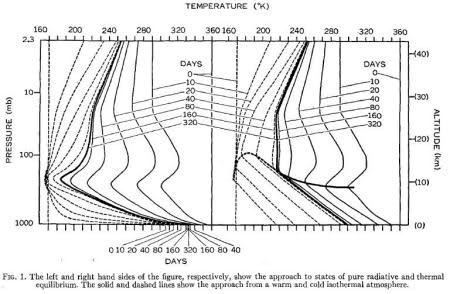
I know you will not have been able to wade through the 878 comments that came before you, but in comment 805 I discussed some of the characteristics of a one-dimensional (vertical) climate model and present a few graphics. This figure in that comment shows the results of a model as it progresses through (modelled) time to approach equilibrium. Dependent on the starting conditions, at each time step the model will warm or cool layers in response to the energy changes in that layer. (The figure is from Manabe and Strickler 1964.)
I also suggest that you look through a blog post I did a few years ago on Beer's Law, which covers some of the theoretical aspects of radiation transfer in the atmosphere. The comments provide very useful additional information.
The collisions between molecules are elastic in the sense you describe. There is no loss of energy. As MA Rodger pointed out, any molecule that has absorbed energy by absorbing IR radiation will almost always lose that energy to other molecules via collision, not the emission of radiation. That also holds true for any molecules gaining energy via collision with another molecule. If their energy level becomes higher than other molecules they collide with, they will lose energy via the next collision.
Who gains, who loses depends on the relative energy levels of the two molecules. Sometimes, a molecule will lose energy by emitting radiation, but nearly all the energy movement within the volume of air is by collision. That's why the concept of temperature (average kinetic energy of a bunch of molecules) works. Keep in mind that nearly all the other molecules that a CO2 molecule will run into are either nitrogen or oxygen. Collisions are an equal-opportunity energy transfer mechanism.
A more technical discussion (linked elsewhere in this stream, but repeated here) is over at Eli Rabett's blog.
Note that this discussion is getting a rather long way away from the topic of the OP - the myth that the CO2 effect has reached saturation.






