Subscribe in a reader


Username
Password
Keep me logged in
New? Register here


It's the sun
Climate's changed before
There is no consensus
Surface temp is unreliable
It's cooling
Models are unreliable
Ice age predicted in the 70s
Al Gore got it wrong
We're heading into an ice age
CO2 lags temperature
View All Arguments...


Latest Posts


Surface temperature records are unreliable

The skeptic argument...

In August 2007, Steve McIntyre, who operates the site climateaudit.org, noticed a strange discontinuity in US temperature data, all occurring around January, 2000. McKintyre notified NASA who acknowledged the problem as an "oversight" that would be fixed in the next data refresh. The warmest year on US record is now 1934. 1998 (long trumpeted by the media as record-breaking) moves to second place. 1921 takes third (source: Daily Tech, Climate Audit)

What the science says...

The goal of improving temperature data is something we can all agree on and on this point, the efforts of Anthony Watts and Steve McIntyre are laudable. However, their presupposition that improving temperature records will remove or significantly lower the global warming trend is erroneous.

Adjusting for Urban Heat Island effect

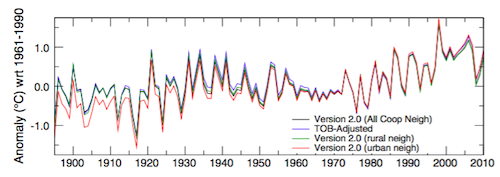
When compiling temperature records, NASA GISS go to great pains to remove any possible influence from Urban Heat Island Effect. They compare urban long term trends to nearby rural trends. They then adjust the urban trend so it matches the rural trend. The process is described in detail on the NASA website (Hansen 2001).

They found in most cases, urban warming was small and fell within uncertainty ranges. Surprisingly, 42% of city trends are cooler relative to their country surroundings as weather stations are often sited in cool islands (eg - a park within the city). The point is they're aware of UHI and rigorously adjust for it when analysing temperature records. More on Urban Heat Island...

Climate Audit and NASA's "Y2K" glitch

Steve McIntyre's discover of a glitch in the GISS temperature data is an impressive achievement. Make no mistake, it's an embarrassing error on the part of NASA. But what is the significance?

Figure 1 compares the global temperature trend from before and after adjustments. Before the error was discovered, the trend was 0.185°C/decade. After corrections were made, the trend was still 0.185°C/decade. The change to the global mean was less than one thousandth of a degree. More on NASA's Y2K glitch...

from1975.jpg
Figure 1: Global temperature anomaly before (red squares) and after (black diamonds) NASA's "Y2K" corrections (courtesy of Open Mind).

Other lines of evidence for rising temperatures

The surface temperature trends is also confirmed from multiple, independent sources:

Related Arguments

Further reading

  1. The error is 2.6 K: http://biocab.org/NOAA_vs._UAH.jpg
    [ Response: When comparing temperature anomalies, the trend is what you want to look at, not absolute values. Temperature anomaly is calculated as the difference from a baseline average. Often different temperature datasets use different baseline periods (eg - 1960 to 1990 or 1978 to 2000). However, the trend will be the same regardless of the period. In the case of the NOAA vs UAH graph, the trends are very similar. An additional complication is there is much uncertainty in satellite data regarding correcting for long term satellite drift (see our Satellite page for more info) ]
  2. I strongly suspect that periodic physical checks are needed to avoid error. Poor ventilation, not painting when needed, allowing vents to get partially or totally blocked, etc. can have a heating effect on these stations independent of UHI. The abortive attempt to hide the station locations and an awful lot of hot air floating around the Internet about how physical checks aren't really necessary makes me think that the universal commitment to quality is more theoretical on some people's part than real.
  3. Philippe Chantreau at 08:54 AM on 18 September, 2007
    John V on CA has results using "good" stations and "bad" stations (per Watts definitions) and comes to results extremely close to GISSTEMP. GISSTEMP is closest to the curve obtained withe the "good" stations. There is a post and a link on Rabett Run, you can also go directly to CA.
    [ Response: Phillipe, thanks for the comment. You can find Rabett's post here plus here's a direct link to John V's graphs on Climate Audit. What I find particularly interesting is Steve McIntyre's response:
    "...keep in mind that USHCN stations have already passed one cut of quality control. They are represented as “high quality” stations. No such representations have been made for stations in China - they may be good, they may be bad, they may have had accurate records throughout the turmoil of Chinese history, they may not. I don’t know how you’d even begin to place “confidence” in the Chinese record in the absence of such analysis."
    Eg - he concedes that in spite of all those photos of air conditioners and car parks, the US stations are actually good quality. So instead, let's go pick on China instead! ]
  4. Philippe Chantreau at 07:46 AM on 19 September, 2007
    Obviously, it is beyond unthinkable at CA that the evidence pre-existing their "scrutiny" could have any validity.

    Let us not forget what exactly the CA/McIntyre effort basic drive consists of, in summary: we do not like what the scientific research concludes on this issue, so we are going to review every single detail, fishing for anything that could lead in the direction that we favor.

    On the other hand, the actual climate research follows this basic process: study climate, by considering the physical laws governing atmospheric dynamics and their interrelations, by modeling these on supercomputers, by gathering as much data as can be obtained and carefully sorting through and analyzing that data.

    It is not very suprising that when the CA folks actually get into a scientific way to analyze data, their conclusions confirm the prior ones from real researchers.
  5. Wondering Aloud at 06:27 AM on 7 December, 2007
    If what you say is true than McIntyre's error is in conceding that the sites in the US are good. I believe what he is conceding is that they are likely to be better or at least no worse than elsewhere.
    http://wattsupwiththat.wordpress.com/

    So far, with 40% of this supposedly gold standard network surveyed, 85% of sites are showing errors in the site and operations that are likely to be > 1 degree C. In other words larger than the entire GW signal to date.

    People promoting catastrophic warming scenarios frequently refer to graphs from this very data set to support their claims. It is clear that we just can't make a useful reconstruction of surface temperatures using these sites.

    I am somewhat dismayed by the idea that modeling with supercomputers is somehow climate research. While going thru and evaluating actual data and methodology is apparently not what "real researchers" do. I could have saved so much time in grad school if I had only known that computer models were real research and the actual data wasn't.

    Modeling is a valuable tool in science but the models are not evidence in any way of what is happening in the climate. Adding the word supercomputer does not make it science, in fact quite the opposite. By the way since Cray isn't making them anymore what makes a computer super these days?
  6. How do NASA and GISS claim to remove UHI effects?

    The term Urban heat island is probably not a good one it is a land use issue not simply an urban issue. A station in NYC central park may be just fine while a station in the middle of nowhere can be bad if it is placed on asphalt next to an air conditioner exhaust.

    Last month, Energy and Environment 18:985-995, published a not very kind report by Douglass J Keenan. It shows that two well known and influential papers, that are still the basis for the IPCC claim that UHI has been removed from the global climate data sets, are in fact incorrect. In fact the word used is Fraudulent.

    While Tom Wigley has sent me some references on sea temperature that seem pretty robust, (thank you sir) the land surface temperature measurements are in serious trouble. It looks to me like at least half of the late 20th century warming signal in this data is about to vanish. We really need a data set that is not badly contaminated, that uses sites that are properly placed and maintained, USHCN is not it.
  7. Philippe Chantreau at 21:26 PM on 1 February, 2008
    It would be nice to give us a little more detail, W.A., especially considering the terminology employed (fraud). What are the papers criticized by E&E (which is itself not a peer-review science publication)? Have the authors responded to it? This journal is far from being an objective reliable source:
    http://pubs.acs.org/subscribe/journals/esthag-w/2005/aug/policy/pt_skeptics.html

    This article treats of how UHI affects observations:
    http://www.ncdc.noaa.gov/oa/climate/research/population/article2abstract.pdf

    As mentioned higher, John V has plotted the data from the "good" sites (per Watts definition) and has found very good agreement with GISSTEMP, so they must be doing something right. It is worth emphasizing that Watts'effort concentrated on micro site effects, a different problem than UHI; nevertheless, agreement was still there in the data.

    I would not venture to say that climate science dispenses from going through and evaluating actual data. This RC post is of some interest as to how the UHI effect is accounted for:
    http://www.realclimate.org/index.php/archives/2007/07/no-man-is-an-urban-heat-island/#more-454

    I believe the post references this article:
    http://www.ncdc.noaa.gov/oa/climate/research/population/article3abstract.pdf

    Is that one of the 2 criticized by E&E?
  8. Philippe Chantreau at 23:38 PM on 1 February, 2008
    Another point, mentioned by John Cook on the "More on Urban Heat Island" thread, is that there is also good agreement with satellite data and weather balloon data, both immune to the micro site effects as well as UHI. If these were really that much of a factor, there would be significant discrepancies, but all the trends are consistentt.
  9. Philippe Chantreau at 16:39 PM on 2 February, 2008
    I mistakenly included both UHI and microsite effects in the previous remark, UHI would still apply.
  10. Wondering Aloud at 03:21 AM on 8 February, 2008
    Yes satellite nad balloon data have good agreement, but isn't the important thing here that neither of them correlate well with the surface record?

    I should have sited the actual papers but I thought you'd rather look yourself now I'll have to remember to dig it back out.
  11. Philippe Chantreau at 15:53 PM on 9 February, 2008
    I don't see too much of a disagreement on this graph:
    http://tamino.files.wordpress.com/2007/08/global2.jpg
    The sources are:
    http://data.giss.nasa.gov/gistemp/
    http://www.remss.com/pub/msu/monthly_time_series/
  12. "Historic Climate Network surface stations only" That is the graphs and data sets that your post leads to Phillippe. (http://data.giss.nasa.gov.gistemp/) Exactly the portion of the data with which there is a problem. Compare to the Balloon data and the satellite data where the anomally is much smaller, and the trend much less pronounced.

    Yes the graphs from the surface data agree with the graphs from the surface data.
  13. Philippe Chantreau at 17:37 PM on 13 February, 2008
    What are you talking about? The comparison is between GISS and MSU. You say there is a problem with USHCN and by extension GISS, this graph compares the "problem data" to satellite (MSU). Did you even look at REMSS.com? Tamino's graph puts them nicely together so as to compare the trends. I don't see any significant disagreement.

    You say:
    "Compare to the Balloon data and the satellite data where the anomally is much smaller, and the trend much less pronounced."
    Graphs, sources, data, links?
  14. I don't know what you want me to look at. The giss data is clearly surface only. From what I can actually open of the remss data which appears to be similar style data sets, it is clear that the anomaly numbers in the remss data are very much lower that the giss data. for 2007 for instance they appear to be more than a half a degree C lower!

    We have been discussing the surface station data. I am not familiar with all of the ways these different data sets are compiled. I am pointing out that the USHCN has clearly got problems in their data collection end.

    Is it your contention that the balloon and satellite data show the large anomaly that the surface stations data does? The satellite and ballon data match each other well but neither is nearly as dramatic as the "surface record".
  15. Philippe Chantreau at 04:45 AM on 15 February, 2008
    That's because they are troposphere numbers. They should be like that. The trends are in agreement.
  16. Yeah but they are anomaly numbers, in other words how far they are from some mean. if surface anomaly is +.75 degrees are you saying it's ok that troposhere numbers are only +.25 degrees? Are you saying that it is ok that the surface is warming more than the atmosphere? That would directly falsify the entire greenhouse hypothesis.

    That can't be right.
  17. Philippe Chantreau at 14:34 PM on 15 February, 2008
    Are you saying that it is ok that the surface is warming more than the atmosphere? That would directly falsify the entire greenhouse hypothesis.

    Are you really sure about that?

    Did you also look at what reference period is used to compute anomalies?
  18. Yes I am 100% sure about that... if the surface warms more than the atmosphere than the atmosphere cannot be the cause as this would violate the second law of thermodynamics, think in terms of entropy and in terms of what is known as zeroeth law.

    I suspect that there must be something else in there that we aren't seeing, if they are using different reference periods for their anomaly calculations then combining them in the graphs as they have; that would be amazing incompetence so I doubt that's what it is.

    It could be what I have suggested on other threads we ought to quit using the land surface record until we get a better handle on what the heck the problems with it are. This meets enormous resistance because the warming signal from balloon measures has been so much weaker and the satellite record is so short.
  19. Back to comment 3 John V's post actually suggests that the CRN5 stations are introducing a poitive bias in the surface results since 1960. He graphs it fartherr down the page.
  20. Philippe Chantreau at 06:01 AM on 16 February, 2008
    How significant that actually is remains to be seen.

    About the satellite record:
    The T2 channel, used for troposphere measurements is influenced by the stratosphere. The T4 channel is all stratosphere.

    http://www.ncdc.noaa.gov/oa/climate/research/rss-msu.pdf
    http://climate.envsci.rutgers.edu/pdf/VinnikovGrody2003.pdf
    http://climate.envsci.rutgers.edu/pdf/TrendsJGRrevised3InPress.pdf
    http://www.ncdc.noaa.gov/oa/climate/research/nature02524-UW-MSU.pdf


    About balloons:
    http://www.sciencemag.org/cgi/content/short/309/5740/1556
  21. Philippe Chantreau at 16:48 PM on 3 March, 2008
    Re-reading through this, it seems that there may be some confusion.
    "if the surface warms more than the atmosphere then the atmosphere cannot be the cause as this would violate the second law of thermodynamics,"
    The surface is not really the surface as in the surface of a spheroid. Surface temps measurements and estimates are rather the lowest troposheric temps and should be thought of that way. Sea surface temps would probably correspond better to the idea of surface as you use it in you thermodynamic view. But any AIR temperature can not be considered as surface that way, it is always atmospheric, even if it's 2 cm off the ground.

    "if they are using different reference periods for their anomaly calculations then combining them in the graphs as they have; that would be amazing incompetence so I doubt that's what it is."
    Actually that's exactly what it is and I don't know who you mean exactly by "they." This graph:
    http://tamino.files.wordpress.com/2007/08/global2.jpg Is a compilation by Tamino to show agreement in the trends and agreement does show, in spite of having different time periods for anomaly computation.
    The reference period for GISS is 1951-1980. Obviously, the satellite record can not use this same period. Satellite records use 1979-2000, during which average temps were already higher, making warm anomalies smaller than those seen on GISS. It is not incompetence to represent these on the same graph, so long as we know what we're looking at. In fact, it is a good test of the true trend. Incompetence would lie rather in the ignorance of the difference or using the graph for interpretations that ignore these differences. Putting these on the same graph to verify identical trends is not incompetence.

    One last thing: satellite measurements are, in fact, lower troposphere measurements, a sizable layer of atmosphere, and even the T2 channel includes a strong stratospheric influence. The papers cited higher give some details on that.
  22. Wondering Aloud at 03:21 AM on 5 March, 2008
    Good job Phillipe that makes much more sense. That part is a baseline problem then and not a totally dumb one.

    Another way of saying 1979-2000 was already warming though is to say 1951-1980 was the coldest stretch in a century. Too bad GISS used this for a baseline but what can you do about that.

    Excellent first paragraph too. Though there is a lot of debate about where warming should be greatest vs where it is the greatest. I'm not sure who is right there. I think between the two things you took care of the problem I had with the anomaly numbers.

    Hurrah.
  23. Philippe Chantreau at 03:53 AM on 5 March, 2008
    Glad to help.
  24. Philippe Chantreau at 14:07 PM on 7 March, 2008
    And just as a reminder, it does not make any real difference what the ref period is.
  25. According to WikiP. there are around 4000 stations around the world that are used for collecting data. Some are well maintained and calibrated. Some are not. From a fair number of stations the data does not arrive for incorporation at the right time, or sometimes not at all. So the data set is 'adjusted'.
    On a scale of 1 - 10 how would we rate the accuracy of this data source? And how reliable does this make any model we try to construct?
    Most of the stations are land-based and the sea based ones limited to particular sea routes; this means we have less data about sea temps then land temps...despite the sea being somewhat bigger.
    What skew does that put on any resultants?
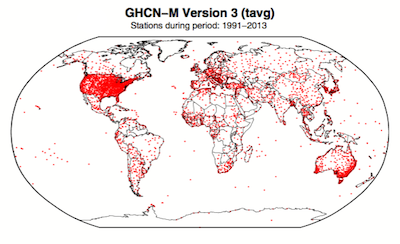
  26. On the subject of stations, I note that the number of stations used for data collection has dropped dramatically from 1990 'til present day. Coverage in (what was) the USSR and China has virtually disappeared.
    Coincident with the fall in stations the GMTemp has apparently risen.(???any connection here???)
    Look at a map of the current station locations and then tell me they are providing data that can be seriously used to construct a global model.
    Yes satellites provide additional cover but only during their overpass which is limited. Yes, their instrumentation is more accurate than land-based stations, but there are too few of them, so their 'correcting' effect on the overall dataset is diluted.
    The earth has around 510 million sqkm in surface; 150 land and 360 water. The vast majority of stations are land based and with around 4000 in use that works out to a station roughly every 38,000 sqkm. To try and model from that low level of distribution would be rejected by most reasonable people. The fact that most of these stations are actually concentrated in a much smaller area leaving HUGE areas un-monitored simply makes the data collected even more worthless for constructing any realistic model.
  27. Sorry, forgot to post the sites....Look at:

    http://science.nasa.gov/headlines/y2000/ast21jul_1m.htm

    http://climate.geog.udel.edu/~climate/html_pages/ghcn_T_stn.html

    Note the closing comments......

    "The improved temperature record will guide efforts to refine computer models of the world's climate so that the behavior of the models more closely resembles the observed behavior of the atmosphere.

    Current models suffer from several shortcomings.

    For example, clouds are not well represented by the models. The resolution of current models is too coarse for features as small as clouds, Spencer said. Yet clouds clearly play a crucial role in climate due to their influence on humidity, precipitation and albedo (the percentage of solar energy reflected back into space as light).

    "The role of clouds is still regarded as one of the biggest uncertainties in global warming predictions," Spencer said.

    The ability of plants to remove carbon dioxide from the atmosphere and the role of soils have only recently been added to the models, and scientists aren't confident yet of how the models portray these factors, Spencer said.

    "While we know that vegetation takes up some of the carbon dioxide we generate from burning of fossil fuels, how that sink of carbon will change in the future is still pretty uncertain," Spencer said.

    Climate models are also limited by the computing power available.

    "The global models would be much better if computers were much faster," Spencer said. "Instead, a lot of approximations are made to make the models simple enough to do climate simulations over the whole globe.

    "Unfortunately," Spencer continued, "we know that many of the processes that are crudely represented are quite non-linear, and so have the potential to respond in unexpected ways."

Post a Comment

Foul language, trolling, personal attacks or non-relevant links will be deleted.

You need to be logged in to post a comment. Login via the left margin or if you're new, register here.

© John Cook 2008