Subscribe in a reader


Username
Password
Keep me logged in
New? Register here


It's the sun
Climate's changed before
There is no consensus
Surface temp is unreliable
It's cooling
Models are unreliable
Ice age predicted in the 70s
Al Gore got it wrong
We're heading into an ice age
CO2 lags temperature
View All Arguments...


Latest Posts


There is no consensus

The skeptic argument...

Lots of reputable scientists are skeptical that manmade CO2 emissions are causing global warming. So claims that there's a scientific consensus is exaggerated. A widely cited series The Deniers by the National Post profiles scientists who are skeptical of anthropogenic global warming.

What the science says...

The consensus position is generally defined as "most of the global warming in recent decades can be attributed to human activities". There are several ways you can approach the debate on scientific consensus.

Scientist roll call

Much of the debate seems to consist of a show of hands and parading of credentials. On the one hand, you have assorted scientists as presented in the National Post Denier series. On the other side, you have the IPCC stating anthropogenic emissions are the predominant cause of global warming. If the IPCC is not your cup of tea, the following scientific organisations also endorse the consensus:

Academies of Science from 19 countries

The Academies of Science from 19 different countries all endorse the consensus. 11 countries have signed a joint statement endorsing the consensus position:

  • Academia Brasiliera de Ciencias (Brazil)
  • Royal Society of Canada
  • Chinese Academy of Sciences
  • Academie des Sciences (France)
  • Deutsche Akademie der Naturforscher Leopoldina (Germany)
  • Indian National Science Academy
  • Accademia dei Lincei (Italy)
  • Science Council of Japan
  • Russian Academy of Sciences
  • Royal Society (United Kingdom)
  • National Academy of Sciences (United States of America)

Additionally, the Academies of Science from another 8 countries (as well as several countries from the first list) also signed a joint statement endorsing the IPCC consensus:

  • Australian Academy of Sciences
  • Royal Flemish Academy of Belgium for Sciences and the Arts
  • Caribbean Academy of Sciences
  • Indonesian Academy of Sciences
  • Royal Irish Academy
  • Academy of Sciences Malaysia
  • Academy Council of the Royal Society of New Zealand
  • Royal Swedish Academy of Sciences

Naomi Oreskes' survey of peer reviewed scientific literature

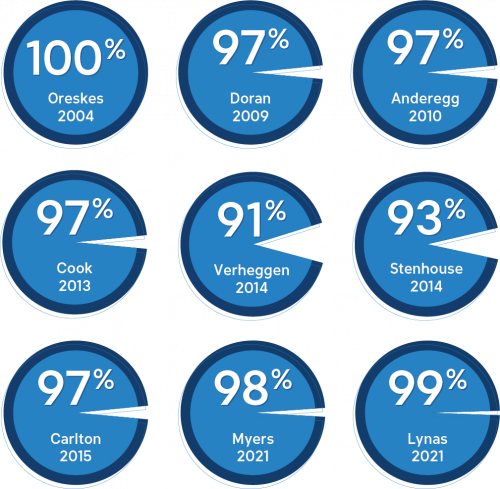
However, it's more relevant to examine peer reviewed journals - scientists can have their opinions but they need to back it up with empirical evidence and research that survives the peer review process. A survey of all peer reviewed abstracts on the subject "global climate change" published between 1993 and 2003 show that not a single paper rejected the consensus position that global warming is man caused. 75% of the papers agreed with the consensus position while 25% made no comment either way (eg - focused on methods or paleoclimate analysis). More on Naomi Oreskes' survey...

Klaus-Martin Schulte's list of studies rejecting the consensus

That is not to say there are no studies that reject the consensus position. Klaus-Martin Schulte surveyed peer reviewed abstracts from 2004 to February 2007 and claims 32 studies (6%) reject the consensus position. In these cases, it's instructive to read the studies to see whether they actually do refute the consensus and if so, what their arguments are. You can read a summary of Schulte's skeptic studies here...

Judge the science, not the person

Ultimately what matters is what a person says, not who says it (that's not to say there's people I respect and pay attention to but I don't automatically agree with everything they might say). In the global warming debate, there are smart people on both sides subscribing to polar opposite views - intelligence does not always equate to correctness. This is a debate where people often form a view then muster up the arguments (valid or not) to back up their preconception. So note the credentials but ultimately, make your judgements based on the scientific arguments.

Related Arguments

Further reading

  1. Concensus only has meaning if there is no pressure to conform in either direction. In the climate debate this is extremely far from being true. How far could we reasonably expect a questioner to go in an IPCC panel when that instantly collects a denialist label and probably guarantees a dead end to even the most able career? In the current climate it is reasonable to assume the dissent camp is at least ten times the admitted size. I know that as an admittedly uninformed questioner I get some pretty vitriolic responses from the eco faithful.
  2. Roverdc hits the nail on the head. To say there is bias in the science at this point is a wild understatement. What the public hears is claims that "all scientists except a few kooks agree that catastrophic global warming is immenent and caused by your car.". This is what they think you mean by consensus.

    Is it safe to say the real consensus is closer to the view of those so called deniers in the National Post series or to the alarmist panic that is being widely circulated through things like "An Inconvenient Truth"?
  3. Will Nitschke (www.capitaloffice.com.au) at 16:22 PM on 21 December, 2007
    The fact that there are so many Academies of Science endorsing the global warming position is probably the strongest argument for supporting it. The question to ask is how mature is this field? If the answer is 'very mature' then this type of support has high credibility. If the answer is 'immature' then it's significance is considerably less.

    Here is a link to US Senate Committee on the Environment that lists in detail 400 scientists who disagree with the anthropomorphic global warming hypothesis:

    http://epw.senate.gov/public/index.cfm?FuseAction=Minority.SenateReport

    That there are so many when we repeatedly hear on the news and radio that the actual number of dissenters is 'miniscule' will have the tendency to turn believers into sceptics.

    I would also feel more confident if the 'hockey stick' graphics that predict rapid change and global catastrophe would not all be linked back to a small handful of researchers and students who work together and presumably have the same preconceptions and modus operandi. If there are no 'hockey sticks' then the small increase in global temperature over the last century does not statistically look different from what one would expect from natural variation.
  4. that list of 400 is about as big a hoax as the "Petition Project" was.
    Here's one of many sites exposing it.
    http://gristmill.grist.org/user/Andrew%20Dessler
    would you like to try again, Mr. Nitschke?
  5. sorry about the double post, and for the unintended smarmy tone.
  6. Wondering Aloud at 06:52 AM on 16 January, 2008
    I think I'd put the list on the petition project up against the IPCC list, many of whom disagree with IPCC conclusions, any day of the week. The listed expose here paledriver is pure rubbish.

    Maybe you should investigate the actual list rather than the fake and distorted claims about it.
  7. The Marshall Institute co-sponsored with the OISM a deceptive campaign -- known as the Petition Project -- to undermine and discredit the scientific authority of the IPCC and to oppose the Kyoto Protocol. Early in the spring of 1998, thousands of scientists around the country received a mass mailing urging them to sign a petition calling on the government to reject the Kyoto Protocol. The petition was accompanied by other pieces including an article formatted to mimic the journal of the National Academy of Sciences. Subsequent research revealed that the article had not been peer-reviewed, nor published, nor even accepted for publication in that journal and the Academy released a strong statement disclaiming any connection to this effort and reaffirming the reality of climate change. The Petition resurfaced in 2001.

    They openly lied about endorsement from National Academy of Sciences, were caught, the Academy issues a statement disclaiming any connection, they re-release it again anyways, and you're foolish and gullible enough to buy it and defend it.

    Would you like me to post a sample of the signers? That would be embarrassing for you.
  8. i will anyways.........................
    The term "scientists" is often used in describing signatories. The petition requests signatories list their degree (B.S., M.S., or Ph.D.) and to list their scientific field.[3] The distribution of petitions was relatively uncontrolled: those receiving the petition could check a line that said "send more petition cards for me to distribute".

    The Petition Project itself used to state:
    “ Of the 19,700 signatures that the project has received in total so far, 17,800 have been independently verified and the other 1,900 have not yet been independently verified. Of those signers holding the degree of PhD, 95% have now been independently verified. One name that was sent in by enviro pranksters, Geri Halliwell, PhD, has been eliminated. Several names, such as Perry Mason and Robert Byrd are still on the list even though enviro press reports have ridiculed their identity with the names of famous personalities. They are actual signers. Perry Mason, for example, is a PhD Chemist.[2] ”

    In May 1998 the Seattle Times wrote:
    “ Several environmental groups questioned dozens of the names: "Perry S. Mason" (the fictitious lawyer?), "Michael J. Fox" (the actor?), "Robert C. Byrd" (the senator?), "John C. Grisham" (the lawyer-author?). And then there's the Spice Girl, a k a. Geraldine Halliwell: The petition listed "Dr. Geri Halliwell" and "Dr. Halliwell."

    Asked about the pop singer, Robinson said he was duped. The returned petition, one of thousands of mailings he sent out, identified her as having a degree in microbiology and living in Boston. "It's fake," he said.[15]


    In 2005, Scientific American reported:
    “ Scientific American took a sample of 30 of the 1,400 signatories claiming to hold a Ph.D. in a climate-related science. Of the 26 we were able to identify in various databases, 11 said they still agreed with the petition —- one was an active climate researcher, two others had relevant expertise, and eight signed based on an informal evaluation. Six said they would not sign the petition today, three did not remember any such petition, one had died, and five did not answer repeated messages. Crudely extrapolating, the petition supporters include a core of about 200 climate researchers – a respectable number, though rather a small fraction of the climatological community.[16] ”

    In a 2005 op-ed in the Hawaii Reporter, Todd Shelly wrote:
    “ In less than 10 minutes of casual scanning, I found duplicate names (Did two Joe R. Eaglemans and two David Tompkins sign the petition, or were some individuals counted twice?), single names without even an initial (Biolchini), corporate names (Graybeal & Sayre, Inc. How does a business sign a petition?), and an apparently phony single name (Redwine, Ph.D.). These examples underscore a major weakness of the list: there is no way to check the authenticity of the names. Names are given, but no identifying information (e.g., institutional affiliation) is provided. Why the lack of transparency?[17]
  9. Wondering Aloud at 13:59 PM on 21 January, 2008
    I have the article you claim was "formatted to mimic..." sitting right here. It doesn't look like it is anything of the sort. In fact it clearly lists Author and who puplished it. It looks like a review of literature type paper which...it is.

    As for mass mailing as it was done with a tiny budget it was nothing of the sort. In fact I never even got one despite being on one of the main mailing lists they supposedly used. How many copies of this supposed mass mailing did you get?


    Aren't you bothered by a clear attempt by the "enviros" to commit fraud with fake names? Shouldn't you question why they think this is needed or something to be proud of. Is it ok to be dishonest as long as they are on your side?

    A sample of 30 in which some back down (people get fired for being skeptics in this field you know)is instantly credible to you while you arm wave away 17,000

    You are pointing out 1 fake signature out of 19,000! Really? It was caught, we had thousands of Fake names on our voting list in one nearby city alone.

    You are avoiding the main issue. Consensus is not science but if it was the supposed 2500 scientists of the IPCC report have every failing you mention of the petition project and more important the people who signed the petition agreed with what it said. The same can not be said for the IPCC and its supposed 2500. Counted in that IPCC number are hundreds of non scientists, NGO reps (these are people with an agenda)and most importantly reviewers, many of whom don't even agree with the conclusions of the IPCC report. In fact most of the famous "deniers" are included in the 2500 IPCC counts.

    Someone made the mistake of asking them after the second IPCC report (surveyed participants) and found that over 60% did not agree with the summary for policy makers.

    Maybe we should stop pretending numbers and NGOs are scientists and that consensus is science. It's that claim that raises huge red flags for me.
  10. Wondering Aloud at 04:09 AM on 22 January, 2008
    Wow, that was terrible punctuation. Darn Packers
  11. I'm sorry. Are you a Packer fan?

    Picked another losing cause?


    I'm sorry again,but I couldn't help myself on that one.
    Great game though.
  12. Let's take a look at the "Inhofe 400"
    Meteorologist George Waldenberg was named.
    In response to his inclusion ,Mr. Waldenberg sent an email to Senator Inhofes' staff that began
    "Marc, Matthew:

    Take me off your list of 400 (Prominent) Scientists that dispute Man-Made Global warming claims. I've never made any claims that debunk the "Consensus".

    You quoted a newspaper article that's main focus was scoring the accuracy of local weathermen. Hardly Scientific ... yet I'm guessing some of your other sources pale in comparison in terms of credibility.

    You also didn't ask for my permission to use these statements. That's not a very respectable way of doing "research".

    One shining example. I have many more.
  13. Wondering Aloud at 07:45 AM on 22 January, 2008
    Again? now its one out of 400 and who the heck was talking about the Inhofe 400?

    The point remains it is not a popularity contest despite all the attempted score keeping by the IPCC fans. Also many of the prominent scientists counted in that score are in fact the so called deniers.
  14. the point remains that the deniers flesh out their "petitions" and "lists" with fakes, fraudulent claims, and people who in no way have made any claims against the consensus and pointedly say so.
    I've pointed out one of many, (which I've linked to above)
    And the "400" was brought up on post#3, which is why I even referred to fraudulent "Petition Project" in the first place.
  15. p.s. I'm not claiming that there's no dissent.
    Just that there IS a consensus. An overwhelming one.
  16. Wondering Aloud at 09:50 AM on 22 January, 2008
    Well that awful Inhofe 400 is now over 420 as in the time it took for you to complain about the one that didn't sign 20 more "scientists" did. But, it isn't important.

    My problem with this is, it isn't an election, you claim the skeptics inflate their numbers, maybe so, beyond question the AGW catastrophy folks inflate theirs. At least two of the best known "deniers" are IPCC lead authors. Dozens of others are listed as contributers or reviewers, several have been so disgusted with the process they withdrew and asked their names be removed. This means they are counted on both sides.

    What is that overwelming consensus? Here is what is presented as that consensus: Human CO2 emissions will cause massive catastrophic warming, It will cause disaster in the near future ruining the world for our children. This warming will lead to massive flooding, drought, wide scale starvation, wars, plagues, melting of the polar ice, flooding of huge areas of the world...


    Refer to my post number 2 above. Which is closer to the consensus? Al Gore with 23 feet of sea level rise this century or the "deniers" with 15-20 cm ?
    Al Gore with his talk of "unprecidented warming". Or the "deniers" claims that the world seems to have wamed about .6-.7 C over the last century and that may be somewhat due to human activity.

    Most of the "deniers" probably don't even have that much trouble with the consensus as stated in the first paragraph of the original post. They are vilified largely because they refuse to accept the supposed consensus I just described.

    In general I agreed with the stated consensus in the original post, though based on the recent data and the trouble with the historical record I think now I would not use the word "most".
  17. 420?
    In the original 400 I found many who were completely unqualified, some of whom are skeptical, some of whom are not. Many who are qualified who are either not actually skeptical, are skeptical only of some proposed solutions or who have actually stated their agreement WITH the consensus. The list was not made to hold up to close scrutiny.
    I imagine it's the same with the additional 20.
  18. addressing claims about the IPCC...............
    "John McLean and the NRSP

    Category: Global Warming
    Posted on: December 20, 2007 1:02 PM, by Tim Lambert

    Hey, remember John McLean? The guy who kept steering Andrew Bolt into brick walls? Well he's teamed up with Tom Harris of the NRSP to accuse the IPCC of lying about the scientific support for its reports:

    In total, only 62 scientists reviewed the chapter in which this statement appears, the critical chapter 9, "Understanding and Attributing Climate Change". Of the comments received from the 62 reviewers of this critical chapter, almost 60% of them were rejected by IPCC editors. And of the 62 expert reviewers of this chapter, 55 had serious vested interest, leaving only seven expert reviewers who appear impartial.

    First, there were much more than 62 reviewers for chapter 9. McLean and Harris have only counted the reviewers of the second order draft and ignored the more numerous comments on the first order draft.

    Second, they mislead by giving the impression that 60% of the reviewers disagreed with the IPCC, but half of the comments (572 of them!) were made by Vincent Gray, with 97% of them rejected. Only 16% of the comments by other reviewers were rejected. Gray was also responsible for most the rejected comments on the first order draft. Examples of Gray's rejected comments include:

    Insert after "to" "the utterly ridiculous assumption of"

    Insert after "Bayesian" "(or super-guesswork)"

    Insret before "Calibrated" "Bogus"

    Dave Semeniuk has a more detailed analysis of Gray's comments -- 50 of them were Gray repeatedly asking for "anthropogenic" to be replaced with "human-induced".

    Third, as Richard Littlemore points out, it is pretty dodgy for the NRSP to complain about "vested interest" when their own vested interest is so blatant. But how did McLean and Harris come up with their claim that 55 of the reviewers had "serious vested interest"? McLean gives details in a piece published by the SPPI (an oil industry funded think tank that apparently does not count as a vested interested to McLean). Scientists were declared to have a vested interest if they were an IPCC author, or an IPCC author of a previous assessment, or if any of their work was cited by the report, or if they worked for a government, or if they work for an organization that gets government funding, or if they have a "possible commercial vested interest in the claim of man-made warming". Basically that leaves amateurs like Gray and McKitrick. In one of his comments Gray asked them to cite one of his Energy and Environment papers. Fortunately it was rejected, or he would have been ruled out as well.

    John Mashey examined McLean's background and it seems that while the National Post awarded him a PhD he actually has no scientific qualifications at all, just a Bachelor of Architecture. Which makes McLean's rant against a critic, which was captured by Nexus 6 particularly funny."

    http://scienceblogs.com/deltoid/2007/12/john_mclean_and_the_nrsp.php
  19. It appears you have proved my point.
  20. it took you 23 days to come up with that?
  21. You mean I should have quickly pointed out that you had proven my point? Not allow you time to elaborate or correct?
  22. please, for my age addled mind, explain how I've proved your point.
  23. My point is the consensus, such as it is, is closer to the denialist view than the popular view of Al Gore etc.

    The claim that there is some vast number of scientists that constitute a consensus and that agree with catastrophic warming is not only not science it isn't even correct. We constantly see people pointing out IPCC to supposedly prove this supposed consensus. IPCC isnt all qualified scientists any more than any of these lists are. But more important than that, despite the fact that a pro warming bias is built into the entire IPCC process, the actual body of the IPCC report in fact supports my position rather than that of Al Gore.

    When I pointed out that the petition project and other similar things like the Heidelberg appeal all had one thing the IPCC didn't have; the consent and agreement of the people involved. (This is something lacking in the lists of academies etc. in the original post as well.) You ignored it completely as if tiny politically active committees somehow spoke for all.

    Personal attacks on a handful of people, each of which is questionable in itself does nothing to refute my stated point. It appears rather to be a deliberate attempt to obfuscate the issue.
  24. The deniers series in the National post has grown much larger. It is still a good series can you update the link so it doesn't just lead to the first 10.
  25. Yeah, Vincent Gray made a lot of noise, ergo there's no consensus.

    Genius logic!
  26. If science relied on consensus then the Earth would be the center of the universe and you would fall off the edge. Science is not about consensus, opinion is about consensus. A german physisist,Gerhard Gerlich, demonstrated (in a very long and boring paper) how there can be no greenhouse effect. Do we burn him at the stake? I have seen many explanations about how the greenhouse effect works but no proof. Is it real and can it be proven?
  27. #26
    here's a good post for you at "A Few Things Ill-Considered."

    " Definately Not Galileo
    A common theme among hardcore denialists, after slowly dragging them around to admit there is a consensus, is an appeal to the Galileo syndrome. "Galileo went against the consensus and he was right!" This is a flawed argument in the climate change debate for many reasons, and it is a Guide entry that is missing for the moment.

    I am only bringing it up now, rather than do a proper entry, because of a discussion paper by Ernst-Georg Beck that was presented on Warwick Hughes' blog (no relation to me... to Glenn Beck? I don't know). It is basically a well dressed version of the "there is no anthropogenic CO2 rise" argument. Eli Rabett took the time to take it apart in a rather thorough and scientific manner, especially given the total lack of a credible conclusion Beck arrives at. You can see the featured graph at Deltoid and read Stoat's dismissive opinion of it here.

    The irony I want to point out is that Galileo was a forward thinker, reaching into previously untrodden territory. His innovation and imagination helped him see past the prevailing state of human knowledge at the time and go into new ground. What are the denialists doing here? Digging up decades old research with results all over the place, results that lead to all sorts of impossible conclusions and then trying to claim that this is the reality and the new, consistent and refined results are the ones that are wrong. Never mind that this is what progress looks like, this is many minds working to overcome the challenges that caused prior confusion to finally achieve consistent, sensible and reliable data.

    But what if you don't like what the new data are telling you? Just chuck it and go back to the old stuff!

    Sorry, that is so not Galileo!"
    http://illconsidered.blogspot.com/2006/10/definately-not-galileo.html
  28. in response to wonderings #23
    relying on the petition project?

    The term "scientists" is often used in describing signatories. The petition requests signatories list their degree (B.S., M.S., or Ph.D.) and to list their scientific field.[3] The distribution of petitions was relatively uncontrolled: those receiving the petition could check a line that said "send more petition cards for me to distribute".

    The Petition Project itself used to state:
    “ Of the 19,700 signatures that the project has received in total so far, 17,800 have been independently verified and the other 1,900 have not yet been independently verified. Of those signers holding the degree of PhD, 95% have now been independently verified. One name that was sent in by enviro pranksters, Geri Halliwell, PhD, has been eliminated. Several names, such as Perry Mason and Robert Byrd are still on the list even though enviro press reports have ridiculed their identity with the names of famous personalities. They are actual signers. Perry Mason, for example, is a PhD Chemist.[2] ”

    In May 1998 the Seattle Times wrote:
    “ Several environmental groups questioned dozens of the names: "Perry S. Mason" (the fictitious lawyer?), "Michael J. Fox" (the actor?), "Robert C. Byrd" (the senator?), "John C. Grisham" (the lawyer-author?). And then there's the Spice Girl, a k a. Geraldine Halliwell: The petition listed "Dr. Geri Halliwell" and "Dr. Halliwell."

    Asked about the pop singer, Robinson said he was duped. The returned petition, one of thousands of mailings he sent out, identified her as having a degree in microbiology and living in Boston. "It's fake," he said.[15]


    In 2005, Scientific American reported:
    “ Scientific American took a sample of 30 of the 1,400 signatories claiming to hold a Ph.D. in a climate-related science. Of the 26 we were able to identify in various databases, 11 said they still agreed with the petition —- one was an active climate researcher, two others had relevant expertise, and eight signed based on an informal evaluation. Six said they would not sign the petition today, three did not remember any such petition, one had died, and five did not answer repeated messages. Crudely extrapolating, the petition supporters include a core of about 200 climate researchers – a respectable number, though rather a small fraction of the climatological community.[16] ”

    In a 2005 op-ed in the Hawaii Reporter, Todd Shelly wrote:
    “ In less than 10 minutes of casual scanning, I found duplicate names (Did two Joe R. Eaglemans and two David Tompkins sign the petition, or were some individuals counted twice?), single names without even an initial (Biolchini), corporate names (Graybeal & Sayre, Inc. How does a business sign a petition?), and an apparently phony single name (Redwine, Ph.D.). These examples underscore a major weakness of the list: there is no way to check the authenticity of the names. Names are given, but no identifying information (e.g., institutional affiliation) is provided. Why the lack of transparency?[17]"

    wikipedia.com

    and...........
    "Oregon Institute of Science and Medicine

    The Marshall Institute co-sponsored with the OISM a deceptive campaign -- known as the Petition Project -- to undermine and discredit the scientific authority of the IPCC and to oppose the Kyoto Protocol. Early in the spring of 1998, thousands of scientists around the country received a mass mailing urging them to sign a petition calling on the government to reject the Kyoto Protocol. The petition was accompanied by other pieces including an article formatted to mimic the journal of the National Academy of Sciences. Subsequent research revealed that the article had not been peer-reviewed, nor published, nor even accepted for publication in that journal and the Academy released a strong statement disclaiming any connection to this effort and reaffirming the reality of climate change. The Petition resurfaced in 2001."
    http://www.ucsusa.org/global_warming/science/skeptic-organizations.html
  29. and on the Heidelberg Appeal..............
    "Parts of the Heidelberg Appeal do endorse environmental concerns, such as a sentence that states, "We fully subscribe to the objectives of a scientific ecology for a universe whose resources must be taken stock of, monitored and preserved." Its 72 Nobel laureates include 49 who also signed the "World Scientists' Warning to Humanity," which was circulated that same year by the Union of Concerned Scientists (UCS) and attracted the majority of the world's living Nobel laureates in science along with some 1,700 other leading scientists. In contrast with the vagueness of the Heidelberg Appeal, the "World Scientists' Warning" is a very explicit environmental manifesto, stating that "human beings and the natural world are on a collision course" and citing ozone depletion, global climate change, air pollution, groundwater depletion, deforestation, overfishing, and species extinction among the trends that threaten to "so alter the living world that it will be unable to sustain life in the manner that we know." Moreover the Heidelberg Appeal has been, if not specifically misrepresented, at least broadly interpreted out of context, for example, by The National Center for Public Policy which asserts "The appeal warns industrialized nations that no compelling scientific consensus exists to justify mandatory greenhouse gas emissions cuts.""

    http://en.wikipedia.org/wiki/Heidelberg_Appeal
  30. Wondering Aloud at 01:34 AM on 26 March, 2008
    Yup, clearly ignoring the entire point. You continue to waste my time here. If you can't answer the main points and instead must repeatedly resort to nibbling on the fringes of the petition project it appears you are merely trying to obfuscate the issue.

    I am trying to learn things here other than your bias. You seriously are proud that there was 1 fake signature out of 20,000? Even if it was 2000 fakes you would have lost that argument wouldn't you? Please,you've proven my point to any unbiased reader.
  31. if it's such a waste of your time, stay the heck away.
    You seriously don't understand that any "fake" signatures, and there were many on both, not to mention the fraudulant article to support the "petition project", you really mean to say that you can't grasp that that in and of itself shows the desperate need to dupe the public with policy driven pseudo-science?
    you're point is on your head.
  32. and were do you get "1"?
    but please, wondering, rephrase your point for me.
    perhaps I have misunderstood?
  33. Philippe Chantreau at 15:41 PM on 29 March, 2008
    WA, I don't understand why you would even pay attention to the "my list is bigger than yours" type of attitude, which is obviously utter nonsense. Why are you trying to defend that so-called "petition project?" What does that have to do with science and evidence?

    Disputing that there is a consensus among climate scientists is downright futile. All sources of information arguing that point are non scientific (Heartland, Cato, Inhofe's office, CO2 science and all that crap). Real scientific organizations (AAAS, AGU, etc) endorse the AGW hypothesis, which is by itself an interesting fact. I find it really funny that "skeptics" both dispute the existence of a consensus and also argue that consensus is meaningless anyway, as Quietman does with a mightily inappropriate comparison.

    As for Quietman post about Gerlich's pathetic load of dung, Rabett Run has more on that than anyone really needs to know. And to answer his question, there is no doubt about the radiative properties of CO2 and the reality of the GH effect. It can be precisely measured in the lab, and if there was no GH effect, this planet would be an ice covered rock. The Gerlich paper is also funny in the sense that it denies the very existence of a GH effect at all but, later, the authors questioned about Venus go on explaining Venus' temps by GH effect from other sources than CO2. It's perfectly grotesque, a fine example of the worst BS that denialism can produce.

    The quality of skepticism here is on the way down if that's the kind of stuff we're going to talk about. Well, BTN had already set the bar so far down that we might have a margin anyway, but still.

    This my thought of the day to you, Quietman, and others. You can not apply extreme scrutiny to the CO2 hypothesis and lower scrutiny to alternate explanations. I know that it makes for a lot more work but that's the only way. If you apply the same extreme scrutiny to these other alternate explanations, what is left of them? Have you even tried (sincerely)? If not, you can not call yourself a skeptic in the true sense of the word. In my experience, if you try to take apart these alternate theories with any eagerness comparable to what "skeptics" use against the CO2 hypothesis, there is nothing left, zilch, nada. That's one reason why I'm skeptical about climate skepticism.
  34. Philippe Chantreau at 15:56 PM on 29 March, 2008
    WA: "The claim that there is some vast number of scientists that constitute a consensus and that agree with catastrophic warming is not only not science it isn't even correct."

    Here is a strawman so big, it's more akin to the Chinese straw dogs. Let's merrily burn it.

    Indeed, it's not correct at all. The SCIENTIFIC consensus is that there is warming, happening quite fast, and that the massive CO2 release from the burning of fossil fuels is a major contributor to it. That is the real consensus.
  35. Wondering Aloud at 02:07 AM on 1 April, 2008
    paledriver,

    Read from the 3rd paragraph on of my post 16. That was my point.

    I do indeed think it is clear that the public is being duped. I think it is deliberate and I think the AGW alarmists are the ones doing it.

    The "many fake signatures" is both clearly incorrect and irrelevent. By your own references over 90% were verified.

    Phillippe I don't agree with your way of stating the consensus though It isn't far enough off to argue.

    On your double standard point though, Phillippe, that is exactly the contention I have been making from the other side of the issue for a long time so it is kind of funny.

    The correct hypothesis has to defeat all the others. It has to pass the experimental test and make predictions that other hypothesis don't. Being experimentally supported is the beginning of this; that isn't enough to prove it, but at this point we haven't even got that. Being only not much worse than the other explanations is not enough. Holding the accepted theory to the highest standard is what a scientist is supposed to do. It only takes one thing to prove it wrong.

    The perhaps painful truth is CO2 has not been a major cause of climate change in the past, despite levels many times the current level. In order to believe it is about to cause huge consequences today when it never did in the past you need some pretty convincing proof or some new physical reality.

    John I am pretty impressed with how current you keep your articles references.
  36. Philippe Chantreau at 03:31 AM on 2 April, 2008
    "The perhaps painful truth is CO2 has not been a major cause of climate change in the past"

    That may be because there has not been a release of CO2 on the scale we experienced these last 150 years during the 600k years of very stable climate the planet has been through. If you try to go farther in time, there is too much uncertainty to do informative comparisons. There is nothing to prove that a massive injection of CO2 in an otherwise stable climate can not have serious consequences. And, by the way, spare me the exaggerations that have nothing to do with what the research actually shows and suggest is possible. I do not pay more attention to exaggerated claims from advocay groups, whether they're from one side of the spectrum or the other.

    And I also maintain that, if you are a true skeptic with physics background, you should be screaming bloody murder to the flat-earthers like Gerlich. If not, then you're applying a double standard far worse than anything you claim is practiced in the scientific peer-reviewed litterature.
  37. Re 23 Wondering Aloud
    'Not all that glisters is gold'
    And The Oregon Petition of Science and Medicine 'Petition Project' Review, now updated with a change in authors was neither peer-reviewed (despite explicit claims)), nor science - it was deceptive pseudo-science, deliberately formatted to appear as if it were a NAS publication (and therefore peer-reviewed).

    For an excellent insight into the Oregon Petition Document, see:
    http://tinyurl.com/nt38z

    This is from a Professor who frankly admits that he was nearly fooled by it.

    Enough people were fooled that the National Academy was inundated with calls asking if it was their new position and had to issue a news release.
    Quote
    ''The Council of the National Academy of Sciences (NAS) is concerned about the confusion cause by a petition being circulated via a letter from a former president of this Academy. This petition criticizes the science underlying the Kyoto treaty on carbon dioxide emissions (the Kyoto Protocol to the Framework Convention on Climate Change), and it asks scientists to recommend rejection of this treaty by the U.S. Senate. The petition was mailed with an op-ed article from The Wall Street Journal and a manuscript in a format that is nearly identical to that of scientific articles published in the Proceedings of the National Academy of Sciences. The NAS Council would like to make it clear that this petition has nothing to do with the National Academy of Sciences and that the manuscript was not published in the Proceedings of the National Academy of Sciences or in any other peer-reviewed journal.
    The petition does not reflect the conclusions of expert reports of the Academy.''
    End quote

    http://tinyurl.com/38nqdj

    Note: Seitz, Baliunas & Soon are all associated with the ExxonMobil funded George C Marshall Institute!
    Seitz was a solid-state Physicist.
    Baliunas & Soon are Astrophysicists.
    Arthur Robinson and his son Zachary are Chemists.

    Note that none of the authors of this purportedly climatological paper are climatologists!
  38. The updated version of this OISM 'review' was published in that well known organ of climate research - The Journal of American Physicians and Surgeons (2007).
    Little wonder that it survived peer review.

    Apparently the previous 1998 version was later published in Climate Research - A Journal that has had serious problems with its criticised peer-review process, notably under the editorship of Chris de Freitas, under whom numerous editors resigned in protest. I don't know when the 1998 version was published, or whether the Editor was de Freitas. But there seem to have been some pretty suspect papers published in CR.
  39. Philippe (36) said:

    "That may be because there has not been a release of CO2 on the scale we experienced these last 150 years during the 600k years of very stable climate the planet has been through."

    Hold on, did anyone else notice that? 600k years of very stable climate? The last 600k years has been a torrent of climatic change. So if by "stable" you mean "always changing between extremes," then yes, you are correct. Beyond that, the Earth's climate has never really been stable.

    I just had to point out that ridiculous comment.
  40. Philippe Chantreau at 11:33 AM on 16 April, 2008
    Robert, these extremes are very well constrained compared to numerous changes that happened before that period. It is fair to say that the climate of the past 600k years has been quite stable compared to the climate of times before that, because those "extremes" remain within a certain range. Even the periodicity of the changes remains overall nicely consistent. So my comment is far from being ridiculous.

    This page gives a quick glance at very long term variability:
    http://www.scotese.com/climate.htm

    I have ran many times into the argument that climate has changed to extremes in the past and they always call on paleoclimate examples from way before the ice core records, especially hot house periods of the mesozoic times, which are of little relevance to our situation.

    Besides, it is interesting to note that the 2 largest mass extinctions of the geological record happened in hot times (P/T and Cretaceous).

    It is also interesting to look at how CO2 has changed during these 600k years compared to what has happened in the (very) recent past. There is no precedent in the ice core record to such an injection of CO2. Nothing even remotely comparable to it. See this link, slide number 8.
    http://ec.europa.eu/research/environment/pdf/descriptions/raynaud_ipy_bxl07.pdf
  41. Thanks for the response.

    You say:
    "Robert, these extremes are very well constrained compared to numerous changes that happened before that period. It is fair to say that the climate of the past 600k years has been quite stable compared to the climate of times before that, because those "extremes" remain within a certain range. Even the periodicity of the changes remains overall nicely consistent. So my comment is far from being ridiculous."

    and then you say:
    "I have ran many times into the argument that climate has changed to extremes in the past and they always call on paleoclimate examples from way before the ice core records, especially hot house periods of the mesozoic times, which are of little relevance to our situation."

    This seems slightly peculiar--you use that very comparison in your first paragraph. Regardless, the last 600,000 only appears stable when compared to the vastly different time scale of the previous 600myr (such a comparison is not useful). Essentially your argument boils down to the "the last 600k years have been stable in that they are consistent in their extremes and periodicity." The belief in constant change as "very stable climate" seems misplaced.

    Then you say:
    "Besides, it is interesting to note that the 2 largest mass extinctions of the geological record happened in hot times (P/T and Cretaceous)."

    They did occur in "hot times," but the mechanism behind these extinctions is considered to be volcanism and/or meteor impact-- blocking sunlight and preventing photosynthesis. On the other hand, the Ordovician-Silurian extinction (3rd largest) occurred during the transition to one of the largest Ice Ages in the past 600myr. Anyhow, this seems irrelevant to my response (39) above. Your last paragraph also seems irrelevant--I don't disagree that CO2 is higher now than any time in the last 600kyr.

    -Robert
  42. Philippe Chantreau at 05:33 AM on 17 April, 2008
    Change alone does not make unstability. Perhaps a comparison with weather would be useful. The weather changes continuously along the year, yet we deal with it just fine so long as nothing happens like 4 months without rain or freezing in june.

    The examples of hot house as in the mesozoic times are commonly used by advocates who argue that because it has been very hot before, it's OK to go that route again now. The fact that the world and the biosphere were vastly different in these times is what makes that argument irrelevant, not the climatological elements themselves. Those advocates often argue that warmer is better, yet mass exctinctions have happened during these periods, indicating that a hot house does not guarantee against them.

    The cause of the Permian extinction is unknown. I don't know any that has been established for the Ordovician. So the volcanic/collision explanation for mass extinction applies with any level of certainty to the Cretaceous only.
  43. Philippe said:
    "Change alone does not make unstability. Perhaps a comparison with weather would be useful. The weather changes continuously along the year, yet we deal with it just fine so long as nothing happens like 4 months without rain or freezing in june."

    You have invoked two comparisons which are irrelevant: Weather and climate more than 600kya. And your last sentence seems odd--based upon other interglacials, we have been in late november for the last 2000 years and the first frost still hasn't come.

    Then Philippe said:
    "The examples of hot house as in the mesozoic times are commonly used by advocates who argue that because it has been very hot before, it's OK to go that route again now. The fact that the world and the biosphere were vastly different in these times is what makes that argument irrelevant, not the climatological elements themselves. Those advocates often argue that warmer is better, yet mass exctinctions have happened during these periods, indicating that a hot house does not guarantee against them."

    I don't know who these "advocates" are but this does not seem to be in either of my responses.

    "The cause of the Permian extinction is unknown. I don't know any that has been established for the Ordovician. So the volcanic/collision explanation for mass extinction applies with any level of certainty to the Cretaceous only."

    The cause for an ancient extinction is never "known." It has been speculated that the Permian extinction was caused by a similar event to the one that caused the Cretaceous--volcanism and/or meteor impact.
    The Ordovician-Silurian extinction occurred at the transition to one of the largest Ice Ages in the last 600myr. So while he cause is not "known," the current running theory speculates that the cause is the somewhat rapid decrease in temperatures.
  44. When you compare the last 600kyr to the previous 600myr, of course the climate looks "very stable," but that is not a meaningful comparison--it's useless. Not only is the time scale vastly different, but the mechanism for change is as well (also, time periods before the ice core record are far less certain). No great departure from extremes does not necessarily equate to "very stable climate."
  45. Philippe Chantreau at 15:34 PM on 18 April, 2008
    The weather comparison is not useless or irrelevant. Events like freezing in june or 4 months without rain are elements of instability, if they turn into a trend. Just like being in late november and still waiting for a frost to come, if it happens more and more regularly (as it has). About climate, a warming like the one seen lately, while temps should be stable in our kind of time scale, is an element of instability. A massive injection in the atmosphere of a gas ike CO2 (whose physical properties are known) is also an element of instability.
  46. My comparison using November and late frost was meant to imply that this interglacial has gone on several thousand years too long, with respect to previous interglacials.

    You say:
    "About climate, a warming like the one seen lately, while temps should be stable in our kind of time scale, is an element of instability."

    If the recent warming is an element of instability, then you have just contradicted your previous assertion that we have had 600kyr of very stable climate, because events similar to the recent warming have occurred a multitude of times in the last half a million years. The recent warming is hardly unprecedented.
  47. Philippe Chantreau at 06:50 AM on 19 April, 2008
    "The recent warming is hardly unprecedented." Even in periods of end interglacial times, when temps would be expected to slowly cooling down, as you mentioned? Even on that kind of time scale, a blink of an eye really?

    OK, but can you substantiate with references?
  48. Philippe wrote:
    "Even in periods of end interglacial times, when temps would be expected to slowly cooling down, as you mentioned?"

    Is it a "period of end interglacial time"? Well it depends on what you think causes the glacial periods--if the mechanism isn't there, then it isn't going to happen. If you believe the Milankovitch cycles are what initiates the glacial/interglacial, then we are still a ways from another glacial period. So it is not inconceivable that the planet would experience a warming at this time.

    Then he wrote:
    "Even on that kind of time scale, a blink of an eye really?

    OK, but can you substantiate with references?"

    If you want to take issue with the idea that the planet has had warming similar to the recent warming on both the time scale and in magnitude, be my guest. It would be a losing battle. As for references, all one has to do is a little searching--this interglacial, the last glacial, the last interglacial, etc. It won't be too hard to find warming of this magnitude in this time scale.
  49. All of you do realize of course that there is a very basic premise involved: If there was a consensus, there would be very little dissent. Given the extremely large amount of dissent, we must assume one of two things:
    1) there is no consensus or
    2) the consensus is not what the IPCC claims it to be.
  50. The so-called "large amount of dissent" is just a small group of people making a lot of noise again and again.

    Remember the claim that there were 19,000 scientists disputing global warming? During the New York denialist conference ("2008 International Conference on Climate Change"), it turned out there were only _19_ scientists. Looks like the number 19,000 is off by a factor of 1,000.

    As an added bogus, the logo for the denialist conference was a loudspeaker.

    -- bi, http://frankbi.wordpress.com/
  51. frankbi
    I was referring to all the peer-reviewed papers, and the blogs that link to them. Legitimate or not, there is an awful lot of dissent. The conference you mention was more like a rally from what I have read about it. I really don't consider that dissent, although a few of it's speakers did post their papers on-line. I have read many papers on-line that are skeptical but not actually in opposition to the AGW hypothesis. Do you consider these to be dissenters?
  52. Frankbi,
    I believe the number 19 originally came from Andy Revkin's Dotearth blog. Andy Revkin later said that he had gotten emails from other scientists saying that there were several dozen more in attendence. Granted, its not 19,000, but its not 19 either.

    Beyond that, the 19,000 scientists are not all in climate related field, but apparently the Scientific American did some "crude extrapolating" and found roughly 200 climate researchers in the bunch. Again, not 19,000, but still a respectable number.

    The Oregon Petition isn't worth much anyhow.
  53. Robert S:

    Well, I couldn't find any concrete mention of any figures above 19... only some mentions of climate inactivists claiming there were "hundreds" of scientists there. Given that there were ~500 people in total, I wonder why they couldn't be more specific.

    In the meantime, Heartland Institute included a list of climate skeptic "co-authors" which included Mann, Rahmstorf, Keeling, and other well-known global warming theory _proponents_. And many scientists are angry about this:
    http://tinyurl.com/6zjxy4
  54. #52, Robert S., I don't know where you got 200 climate researchers were there, but there are over 20,000 climate scientists in the U.S. alone according to the AGU, so even there were 200 in attendance, and assuming they were all skeptics, that's still only about 1%.
    That would qualify as an overwhelming consensus in my book.
  55. Wondering Aloud at 00:32 AM on 10 May, 2008
    Phillippe I don't see where you get the idea that the rate of increase of CO2 is unprecedented, or even relevent. It is supposed to be atmospheric content that makes the difference and by those standards we are not at or near anything extreme. So that argument doesn't work.

    But I guess that is another thread.
  56. since the topic in this forum is "the consensus" I thought I'd forward this
    http://www.desmogblog.com/500-scientists-with-documented-doubts...
  57. Paledriver (54),

    You misunderstood me:

    Frankbi said this "Remember the claim that there were 19,000 scientists disputing global warming? During the New York denialist conference ("2008 International Conference on Climate Change"), it turned out there were only _19_ scientists. Looks like the number 19,000 is off by a factor of 1,000."

    I responded to that point with this "Beyond that, the 19,000 scientists are not all in climate related field, but apparently the Scientific American did some "crude extrapolating" and found roughly 200 climate researchers in the bunch. Again, not 19,000, but still a respectable number."

    The 200 were supposedly from the OISM petition.

    And the link in your post at 56 is basically the same thing as frankbi's link at 53.
  58. Robert S.
    I did understand you. What I'm saying is
    #1, you don't know that the 200 that were, supposedly, there all disagree with the consensus
    and
    #2, 200 is an insignificant number when you realize that there are over 20,000 in the U.S. alone, and that this convention drew, I believe they claim, from all over the world.
  59. No, you didn't, and still do not, understand me.

    You said "I don't know where you got 200 climate researchers were there, but there are over 20,000 climate scientists in the U.S. alone according to the AGU, so even there were 200 in attendance"

    The 200 figure came from Scientific American when they looked at the OISM petition. There is nothing to attend regarding the OISM petition because it is a petition. You must be talking about the Heartland Conference.

    And I have been unable to find any concrete mention of 20,000 climate scientists in "the U.S. alone". The best I can find is an Eli Rabbett post in which Eli mentions 13,746 AGU members in climate related fields with a spread like this (quoting from Eli's blog):

    "-1956 Atomspheric
    -1564 Biogeochemistry
    -334 Cryosphere
    -751 Global climate change
    -4736 Hydrology
    -2326 Ocean sciences
    -634 Paleoclimate
    -2004 Volcanology (you can argue here if you want)"

    If you add foreign members, the number reaches 19,340. Now I understand what you are saying about the numbers, but please, don't make things up to prove your point.

    Though I never did think science was much of a popularity contest.
  60. what did I make up? My memory was a little muddy, my age perhaps, but the basic point is still there. There are about 20000ish members of the A.G.U. alone who are climate scientists, ergo 200 is about 1% or insignificant.
    And since we were talking about the conference, I naturally supposed you were too.
    It would have been better for you if you had, rather than that hoax of a petition.
  61. "what did I make up?"

    This: "there are over 20,000 climate scientists in the U.S. alone according to the AGU". Though I give you the benefit of the doubt (it is a big difference, however!)

    Anyhow, the comparison doesn't make sense --the OISM petition is Americans only, while the 20,000 includes foreign AGU members. And I don't know that I would call all of them "climate scientists": Some biogeochemists might be, majority probably are not, though they likely understand a part of the process, most volcanologists aren't climate scientists, etc... The actual number of *climate scientists* is probably much lower than 20,000 (or the 13,000 American AGU members).

    Then again, like I said above, I never thought science worked through popular opinion.

    "It would have been better for you if you had, rather than that hoax of a petition."

    I know the petition has it's problems, and it isn't exactly a major credible opposition to AGW, but I would hardly call it a hoax
  62. Apparently the number has increased for this new petition. In an article dated Monday, May 19, 2008 it says 31,000 Scientists Debunk Al Gore and Global Warming. Anyone know about this one?
  63. RobetS
    Re: "-2004 Volcanology (you can argue here if you want)"

    Probably the best of all sources listed. They have a better understanding of internal forcing than anyone else other than these groups:
    -4736 Hydrology
    -2326 Ocean sciences

    But where are the astronomers?
  64. If the Caribbean Academy of Sciences and the Royal Irish Academy endorse man made global warming can any person with a conscience still doubt? Mr Hansen from NASA's Goddard Institute thinks the doubters should be punished. Shouldn't they be given the opportunity to recant? Water boarding causes no lasting damage and requires no carbon use whatsoever, unlike burning at the stake, etc.

    Mr. Hansen let slip a prediction for the future. "All the Arctic sea ice will be gone in five to ten years." Going out on a limb, isn't he. He might be alive to reap the ricicule. I've marked my calendar: "Look for hell fire and inundation". For now, I'll keep the beach property.
  65. in response to number 62.
    this was when they claimes 17,000.....".. took a sample of 30 of the 1,400 signatories claiming to hold a Ph.D. in a climate-related science. Of the 26 we were able to identify in various databases, 11 said they still agreed with the petition -- one was an active climate researcher, two others had relevant expertise, and eight signed based on an informal evaluation. Six said they would not sign the petition today, three did not remember any such petition, one had died, and five did not answer repeated messages. Crudely extrapolating, the petition supporters include a core of about 200 climate researchers -- a respectable number, though rather a small fraction of the climatological community.".

    this from when it was first released......"The Marshall Institute co-sponsored with the OISM a deceptive campaign -- known as the Petition Project -- to undermine and discredit the scientific authority of the IPCC and to oppose the Kyoto Protocol. Early in the spring of 1998, thousands of scientists around the country received a mass mailing urging them to sign a petition calling on the government to reject the Kyoto Protocol. The petition was accompanied by other pieces including an article formatted to mimic the journal of the National Academy of Sciences. Subsequent research revealed that the article had not been peer-reviewed, nor published, nor even accepted for publication in that journal and the Academy released a strong statement disclaiming any connection to this effort and reaffirming the reality of climate change. The Petition resurfaced in 2001.".

    and more...."Of 100 names googled, only about 2 percent turn out to be scientists with any training relevant to climatology, usually physics. A small number -- about 15 percent -- were other kinds of scientists or physicians, but with no relevant training. Several in this overall pool of scientists were quite elderly. The remainder were either people with no scientific credentials whatsoever (40 percent), or names that did not appear in the search -- highly improbable nowadays if indeed such people existed."

    so the petition is clearly a fabrication.
  66. paledriver
    I was under the impression that this was a newer petition. Are you saying that this is the same one as the 20k scientists earlier in this thread?
  67. Will Nitschke
    There have been several updates to the link that you posted. Below is the latest one only.

    U.S. Senate Report: Over 400 Prominent Scientists Disputed Man-Made Global Warming Claims in 2007
    Senate Report Debunks "Consensus"
    UPDATE: More and more scientists continue to declare their dissent of the ‘consensus.’ (LINK)
    Climate Skeptics Reveal ‘Horror Stories’ of Scientific Suppression (NYC Climate Conference Report - Part One of Reports)
    March 6, 2008

    "Many prominent scientists participating and attending were very impressed by the New York City climate conference. Hurricane researcher and Meteorologist Stanley B. Goldenberg of NOAA (National Oceanic and Atmospheric Administration) in Miami praised the Heartland Instituted sponsored conference.

    “The fact is that this conference is evidence that there are numerous respected, established and in many cases world-renowned scientists who have done careful research in various areas of ‘climate change’ that sharply differ with the [UN] IPCC results,” Goldenberg told the New York Times."
  68. Qietman, if you go to the link provided by #62 you'll find it's the same old Petition Project by OISM.
    If you go to my posts 4,8,12,14 and 28 (to begin with) you'll get a start on that petition and the "inhofe 400".
  69. paledriver
    I have been following along but I did not realize that it was the same one because of the number and date. So this petition is still circulating?
  70. paledriver
    I went back and read it again. It seems to be from the same organization but it also seems to be a different petition, they mention one in 2001 with 19k+ signers, and then they talk about 31k signers with 9k+ PHDs.

    It does not really mean anything one way or the other as I don't accept consensus as proof of anything, if I did I would be Hindu or Buddist (I'm sure one of those two have a consensus).
  71. paledriver
    p.s. I put that link in 62 to see if anyone could tell me if it was the same as discussed previously.
  72. Quietman,
    you argument about consensus doesn't relate.
    In science, truth wins out over time. And over time, as more and more data comes in, the consensus on this matter grows.
    As I've said, I'm just a layman but I know that much at least.
  73. paledriver

    I'm not a scientist either, but as a research engineer I made much use of the scientific process. It does not matter how many believe a particular hypothesis is true, only the one that turns out to be right, regardless of how many backers it had. Working in the private sector, I had a lot of trouble getting some of my papers past managers who did not have a clue as to what I was talking about and believed otherwise, but once in the design staff's hands they understood and acted immediately (I have a lot of experience side-stepping managers).

    Let me give you a very good and reletively recent example:

    The late Dr. Rhodes Fairbridge studied the oceans for many years and determined that the sealevel rose and fell in cycles. It was named the Fairbridge cycle in DERISION because the consensus said he was wrong. It is now recognized to be correct and the consensus wrong.

    The hypothesis published in a science magazine in 1966 is the one explained by Dr. Riscard Mackey in his eulogy for Dr. Fairbridge. Again he went against the consensus but I think that he was correct. It was the only climate prediction made (last summer) that turned out to be correct thus far (it predicted low sunspot activity and cooling starting in 2008) and the IPCC, it seems, is finally paying some attention.
  74. paledriver
    I was rereading your post #65. Would you consider the description below qualified in climatology?

    "He obtained a B.A. in Physics and Mathematics with highest distinction in 1963, an M.S. in Astronomy in 1965 and a Ph.D. in Physics, in 1967, all three degrees from the University of Iowa."
  75. As a Ph.D. scientist, I can attest to the fact there is no consensus among scientists on global warming.

    So much so, that the American Physical Society has opened debate on the matter.

    http://www.dailytech.com/Myth+of+Consensus+Explodes+APS+Opens+Global+Warming+Debate/article12403.htm

    But facts like these seldom get in the way of religious fanatics, and anthropogenic global warming is a religion.
  76. Austerlitz
    The blog that you gave the URL for was interesting but I found the actual APS newsletter even more interesting.
  77. Quietman,

    Here is another scientist who writes some compelling arguments against the theory:

    http://www.theaustralian.news.com.au/story/0,25197,24036736-7583,00.html

    I have not checked his credentials; however, I find his arguments convincing. Of course, the Inquisition will dismiss him, as the consensus has already spoken.
  78. Austerlitz
    Thanks for the link. I have posted it at the LiveScience website in an argument that I'm having with one of the NASA guys who isn't a climatologist. Not being a scientist it's hard to be taken seriously so I appreciate the link.
  79. An outright lie about the American Physical Society

    "The newest denialist talking point
    Physicists reaffirm that human-induced GHGs affect the atmosphere
    Posted by Andrew Dessler (Guest Contributor) at 1:23 PM on 18 Jul 2008
    Read more about: climate | climate science | climate change skepticism | greenhouse-gas emissions | scientific research
    Tools: print | email | + digg | + del.icio.us | + reddit | + stumbleupon

    It goes something like this:

    The American Physical Society, an organization representing nearly 50,000 physicists, has reversed its stance on climate change and is now proclaiming that many of its members disbelieve in human-induced global warming.

    Of course that's not true. Today a statement appeared on the APS website saying:

    APS Position Remains Unchanged

    The American Physical Society reaffirms the following position on climate change, adopted by its governing body, the APS Council, on November 18, 2007:

    "Emissions of greenhouse gases from human activities are changing the atmosphere in ways that affect the Earth's climate."

    An article at odds with this statement recently appeared in an online newsletter of the APS Forum on Physics and Society, one of 39 units of APS. The header of this newsletter carries the statement that "Opinions expressed are those of the authors alone and do not necessarily reflect the views of the APS or of the Forum." This newsletter is not a journal of the APS and it is not peer reviewed.

    For a list of societies that have endorsed the mainstream position on climate change, see this post."

    http://gristmill.grist.org/story/2008/7/18/74618/8261
  80. here's those credentials for you, auster....
    "Who is 'Rocket Scientist' David Evans?
    22 Jul 08

    UPDATED: David Evans has sent along his definition of a rocket scientist. See below for details.

    This title grabbed our attention: Top Rocket Scientist: No evidence C02 causes global warming. And it should. It is a pretty bold statement and the implications would be pretty big news.

    So we decided to compile a backgrounder on 'The Top Rocket Scientist."
    Here's the research database entry on David Evans:

    No peer-reviewed articles on climate change

    According to his own resume, Evans has not published a single peer-reviewed research paper on the subject of climate change. Evans published only a single paper in 1987 in his career and it is unrelated to climate change.

    Evans has published an article for the Alabama-based Ludwig von Mises Instutute, a right-wing free-market think tank.

    Evans also published a "background briefing" (pdf) document for the Australian chapter of the Lavoisier Group, a global warming "skeptic" organization with close ties to the mining industry.

    "I am not a climate modeler"

    From 1999 to 2006 Evans worked for the Australian Greenhouse Office designing a carbon accounting system that is used by the Australian Government to calculate its land-use carbon accounts for the Kyoto Protocol. While Evans says (pdf) that "[he] know[s] a heck of a lot about modeling and computers," he states clearly that he is "not a climate modeler."

    Background

    David Evans lives in Australia and gained media attention after an article he wrote titled, No Smoking Hot Spot was published in The Australian in June, 2008.The article claims that climate change is not caused by C02 emissions because there is no evidence of "a hot spot about 10km up in the atmosphere over the tropics." Evan's claim has been thoroughly debunked by Tim Lambert, a computer scientist at the University of New South Wales.

    According to his bio, Evans claims to be a 'Rocket Scientist' and one article claims that he is a 'Top Rocket Scientist.' While Evans background does show that he has a PhD in electrical engineering, there is no evidence that he was ever employed as a rocket scientist.

    Evans answered our inquiry about his claim to being a rocket scientist with the following explanation:
    In US academic and industry parlance, "rocket scientist" means anyone who has completed a PhD in one of the hard sciences at one of the top US institutions. The term arose for people who *could* do rocket science, not those who literally build rockets.Thus the term "rocket scientist" means someone with a PhD in physics, electrical engineering, or mathematics (or perhaps a couple of other closely related disciplines), from MIT, Stanford, Caltech, and maybe a few other institutions.

    I did a PhD in electrical engineering at Stanford in the 1980s. Electrical engineering is your basic high tech degree, because most high technology spawned from electrical information technology. I specialized in signal processing, maths, and statistics.

    The definition provided by Evans would appear to be at odds with the conventional use of the term 'rocket scientist' which according to various sources is "One specializing in the science or study of rockets and their design." For example, here's an entry on Answers.com about Hermann Oberth a famous Rocket Scientist who published a book about rocket travel into outer space in 1932 and is considered one of 3 founding fathers of modern rocketry and astronautics.

    Evans also claims to be "building a word processor for Windows." DeSmogBlog contacted Microsoft Corp. and they have confirmed that he does not work for Microsoft Corporation."
    http://www.desmogblog.com/who-is-rocket-scientist-david-evans
  81. paledriver
    You are talking about two peoples seperated by a common language. American connotation varies state to state and even city to city and you nit pick over the connotation of a word used on the opposite side of the world. A little strange I would say. He used the slang meaning of a rocket scientist in a way that an American would not but how is this term normally used in Australia? Maybe John can tell us.
  82. PS Publishing peer reviewed papers does not a scientist make.
  83. Paledriver,

    There was no outright lie about the APS. No one said their position changed (a strawman argument); rather, that there is debate. Granted, it turns out it was a subset of the APS, but it is still part of the APS.

    Here is the link from the APS website: http://www.aps.org/units/fps/newsletters/200807/editor.cfm

    Partially quoted herein:
    "With this issue of Physics & Society, we kick off a debate concerning one of the main conclusions of the International Panel on Climate Change (IPCC), the UN body which, together with Al Gore, recently won the Nobel Prize for its work concerning climate change research. There is a considerable presence within the scientific community of people who do not agree with the IPCC conclusion that anthropogenic CO2 emissions are very probably likely to be primarily responsible for the global warming that has occurred since the Industrial Revolution."

    Personally, I think you do your self a disservice quoting a smear site (desmogblog.com) that only seeks to discredit and personally attack those who argue against anthropogenic warming. Arguing semantics about "rocket scientist"? Contacting Microsoft Corp. because he says he is "building a word processor for Windows"? Is this disgraceful behavior all the Inquisition has to offer?
  84. I missed that windows comment entirely. Writing a program for windows is not the same as writing for microsoft. It means to run on the windows O/S rather than on a unix or Linux or Mac O/S. Most likely using an MS language for compatibility like visual basic.
  85. Consensus: lit. to think alike or to be in general agreement with others.
    If most people think the same thing then it has got to be true hasn't it?
    Even when what they think is based on an incomplete understanding of the thing they are discussing?
    But hey, everybody is entitled to an opinion surely?
    And doesn't that include scientists on both sides?
    As stated by someone else..consensus is NOT science.
    Opinion is NOT science.
    Science is about hard, repeatably demonstrable, irrefutable, facts.
  86. "... very probably likely to be primarily ..." ... that sure convinces me!

Post a Comment

Foul language, trolling, personal attacks or non-relevant links will be deleted.

You need to be logged in to post a comment. Login via the left margin or if you're new, register here.

© John Cook 2008