



 Arguments









How the IPCC is more likely to underestimate the climate response
What the science says...
| Select a level... |
 Basic
Basic
|
 Intermediate
| |||
|
Numerous papers have documented how IPCC predictions are more likely to underestimate the climate response. |
|||||
Climate Myth...
IPCC is alarmist
"Unquestionably, the U.N. Intergovernmental Panel on Climate Change (IPCC) was formed to build the scientific case for humanity being the primary cause of global warming. Such a goal is fundamentally unscientific, as it is hostile to alternative hypotheses for the causes of climate change." (Roy Spencer)
At a glance
The Intergovernmental Panel on Climate Change (IPCC) is a United Nations body founded in 1988. Its purpose is to inform governments about the status of our scientific knowledge with regard to our changing climate. In order to accomplish this role, it gathers and summarises evidence, producing an Assessment Report (AR) every few years. Each AR is an up-to-date account of the impacts and risks of a changing climate. However, because it takes 6-7 years to bring an AR to publication, by the time one is produced, the science is already moving ahead - as is the climate. The laws of physics wait for nobody.
It is important to clear up a couple of serious misunderstandings about the IPCC that are often encountered in online discussions. Firstly, the IPCC does not conduct original scientific research. That includes modelling. But how often do we see commentators ranting about 'IPCC models'?
In fact, climate models are managed by multiple modelling groups around the world. Together, these groups form the Coupled Model Intercomparison Project (CMIP). In AR6, published in 2022-23, the latest generation CMIP6 output was featured. The modellers, however, did the modelling, not the IPCC.
The above example illustrates the depth of confusion that is out there. The confusion was sown by the same merchants of doubt who created and distributed all the other denialist talking-points that we deal with here at Skeptical Science.
A second frequently-cast aspersion is that the IPCC is alarmist, exaggerating the threat of climate change to cause needless worry or panic. Let us repeat: it merely collates what the science is saying. And what the science is saying is very worrying.
We have understood the heat-trapping properties of certain gases such as water vapour, methane and carbon dioxide for more than 100 years. Yet we have raised the concentration of atmospheric carbon dioxide from a pre-industrial level of ~280 parts per million (ppm) to 420 ppm (in 2023). That is a 50% increase.
A CO2 level of 420 ppm last occurred on Earth during the middle of the Pliocene division of geological time, some 3.5 million years ago. Back then, the Polar ice-sheets were much smaller and vegetation distribution, detailed by the fossil record, differed dramatically from that of today. As an example, mixed woodlands were able to grow in Arctic Siberia, where today there is just stunted tundra. Sea levels were metres higher than today's. In AR6, the IPCC summarises, in its typically non-dramatic language:
"While present-day warming is unusual in the context of the recent geologic past in several different ways, past warm climate states (i.e. the Pliocene) present a stark reminder that the long-term adjustment to present-day atmospheric carbon dioxide concentrations has only just begun. That adjustment will continue over the coming centuries to millennia."
If you're not worried about the threat of climate change, then you haven't been paying attention.
Please use this form to provide feedback about this new "At a glance" section. Read a more technical version below or dig deeper via the tabs above!
Further details
Roy Spencer, an advisor to evangelical lobby-group the Cornwall Alliance, is our myth-provider in this instance. He is insinuating that the IPCC has an agenda that distorts the reports they produce. Specifically, that the IPCC exaggerates what the science says in favour of anthropogenic global warming. It's a frequently encountered argument from climate science deniers who know that there is a sector of the populace receptive to conspiracy-theories that they can play. Yet those same deniers offer no credible evidence to support it.
Some critics go even further down this road, implying that the IPCC actively suppresses science that doesn’t support the theory that climate change is being caused by human activities. In response to this, one has to ask, "what science". If a bundle of poor, demonstrably error-ridden papers in dubious journals is the answer (it is), then that's why such material doesn't pass muster. And there are a fair few such journals out there, some created purely to misinform.
So: to the IPCC. It was founded in 1988 in order to collate a broad range of scientific research into the climate and our effects on it and to summarise the science for policymakers. It's a UN body, bringing together the World Meteorological Organization (WMO) and the United Nations Environment Programme (UNEP). The science they summarise has already been published. That means it is straightforward for a scientifically-literate reader to follow the references. They can compare the primary science with the IPCC reports and check them for consistency.
Another criticism of the IPCC is in the opposite sense - that they are too conservative. To a lay-person, this may seem reasonable on the grounds that a proportion of the people who finalise IPCC reports are government representatives, not scientists. These represent 195 member-states and as we know, governments prefer the status quo wherever possible. In the early decades of the IPCC there was also resentment about the disproportionate representation of climate scientists from OECD countries. This was discussed in a very readable paper following the release of the Fourth Assessment Report (AR4) (Hulme & Mahony 2010).
Are the IPCC too conservative? In AR4, the global sea level rise prediction amounted to 18-59 centimetres over the 1990-2090 period, plus an unspecified amount that could come from the Greenland and Antarctica ice-sheets. That prompted robust criticism from within the glaciology and oceanography communities. A central theme to the critique was that sea level rise was clearly accelerating and that the acceleration was not taken into account (e.g. Rahmstorf 2010).
That criticism has continued into recent years. There is discussion of how decision makers would benefit from the reframing of IPCC terminology. After all, it is important to avoid unintentionally masking worst-case scenarios (Siegert et al. 2020). Prominent climate scientist James Hansen has called this issue ‘scientific reticence’.
However, others (e.g. Solomon et al. 2008) have argued that AR4 stated that no consensus could be reached on the magnitude of the potential fast ice-sheet melt processes that some suspect could lead to 1–2 m of sea-level rise this century. At the time of AR4, these feasible but relatively data-poor processes were not included in the quantitative estimates. This takes us into the territory of uncertainty.
What is not perhaps appreciated by the general public is how science deals with uncertainty. Uncertainty in science is what drives it along, since any uncertain area deserves thorough investigation. This is the case even where a phenomenon is well-understood - such as the core fact that CO2 without doubt warms the planet. It's the details, the minutiae, where the uncertainty problem rears its head.
Here's an example of uncertainty and how it's handled. We can answer different questions with different levels of certainty. For example, how do we reply if asked, "how much is glacier X going to retreat by 2100?" We look at the data and see if the current rate of retreat is documented. If so we have a baseline. But we are still uncertain how emissions will pan out in the future. Therefore we plot a forward extrapolation of the current rate, plus a range of possible outcomes if emissions accelerate at one end, stay the same or plummet at the other. These were originally expressed as Representative Concentration Pathways (RCPs). Four such pathways were used for the IPCC Fifth Assessment Report (AR5), published in 2014. The pathways describe different climate change scenarios, depending on the amount of greenhouse gases emitted in the future. They are named after a possible range of radiative forcing values in the year 2100: RCP 2.6 = 2.6 Watts/square metre, with RCP 4.5, 6, and 8.5 having a similar structure, with RCP the worst case scenario of a continued fossil fuels binge.
Since AR5, this structure has been revised into Shared Socioeconomic Pathways (SSPs; fig. 1).
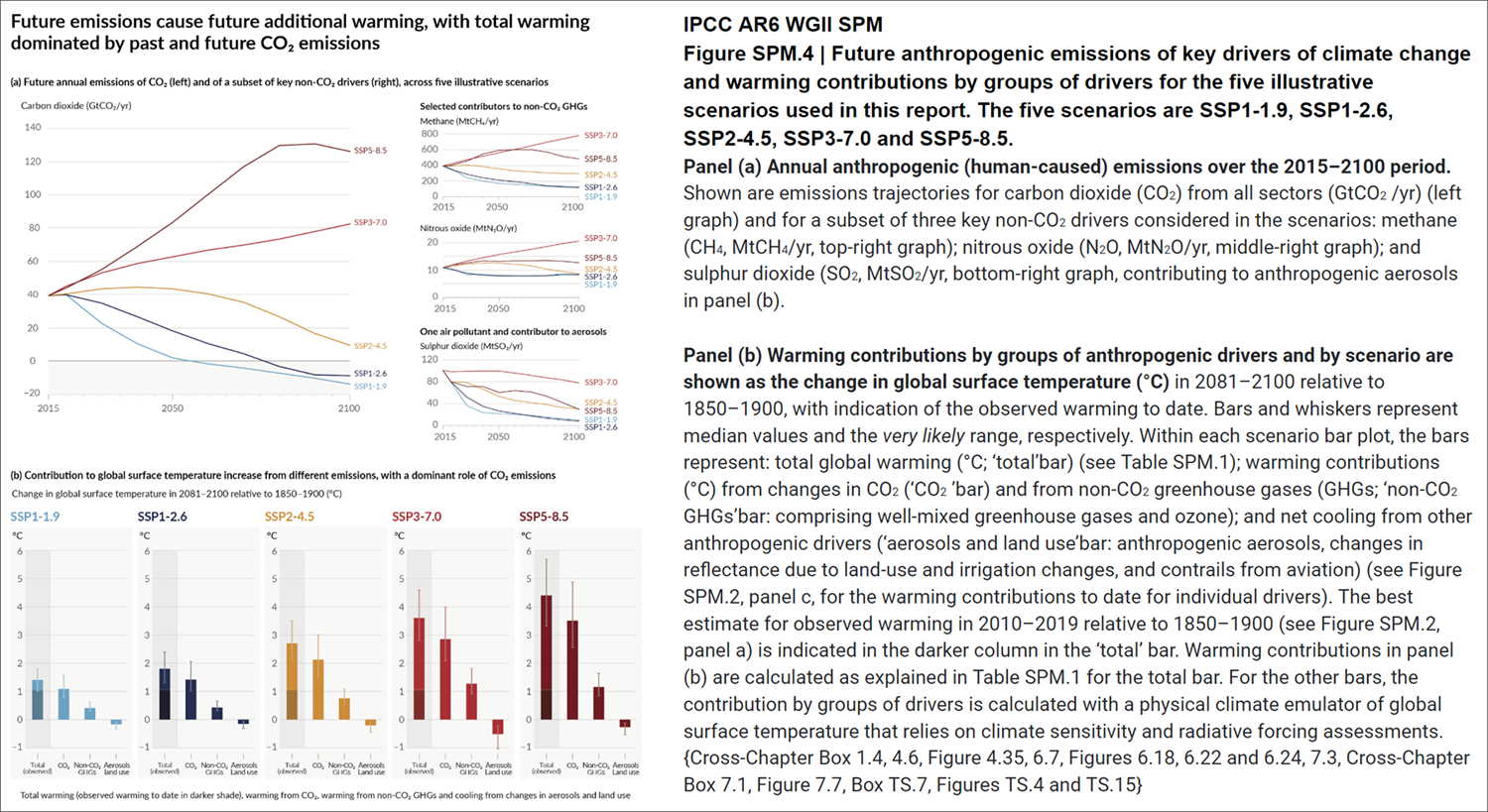
Fig. 1: emissions trajectories on the different Shared Socioeconomic Pathways (SSPs), from IPCC AR6 WGI SPM box SP1.
Reports released by the IPCC over the years have used a very specific terminology to express the certainty level of specific outcomes, tabled in fig. 2, again from AR6.
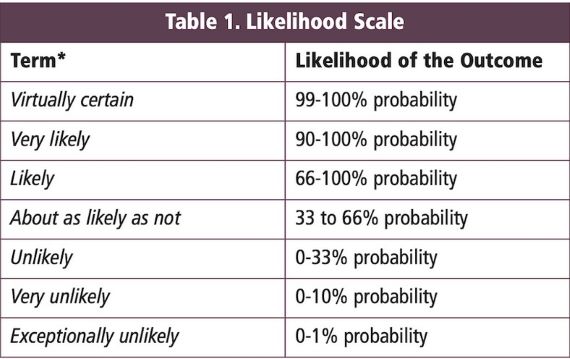
Fig. 2: currently-used IPCC language to express levels of uncertainty. Advice on how to describe risk for IPCC authors can be found here (PDF).
Other questions are a lot harder to answer because there are so many independent variables involved. But what about possible future events that carry a vague but non-negligible probability of occurring? A good example is the rapid collapse in the coming decades of the West Antarctic Ice Sheet. In IPCC terminology, such a high-impact event would be labelled as “unlikely” or “very unlikely” in the cited time-frame. The question therefore has to be, "do these terms used by the IPCC convey the right message to policymakers?" Scientists, for whom such terminology is everyday, are different to policymakers. There's the risk that the latter will react to such words by thinking, "oh that's okay then, not going to happen on my watch".
Language clearly matters here because we're dealing with different people who have differing reference frames. Climate scientists tend to work with decades to centuries whereas palaeoclimatologists deal with tens of thousands to millions of years. But politicians typically think in terms of years to decades at the most. The next election cycle is what matters to a lot of them, with some honourable exceptions.
Furthermore, there are serious risks associated with language because of the way the media interprets statements. In particular, a recent study into media treatment of part of AR6 found that denialist responses to IPCC output are largely confined to TV channels and other media with a right-wing worldview (Painter et al. 2023 - open access). The trouble is that the right-wing media is a formidable machine with a lot of reach. There is certainly a case for plain speaking here in order to counter their messaging.
Clearly there is always room for improvement in any organisation and the IPCC is no exception to that rule. But claims that the IPCC is alarmist are not supported by evidence. If anything, the published criticisms from the peer-reviewed literature suggest the opposite. The IPCC may - in certain areas - be erring on the side of caution.
Last updated on 5 November 2023 by John Mason. View Archives







[DB] Hot-linked URL.