





Subscribe in a reader


Username
Password
Keep me logged in
New? Register here


It's the sun
Climate's changed before
There is no consensus
Surface temp is unreliable
It's cooling
Models are unreliable
Ice age predicted in the 70s
Al Gore got it wrong
We're heading into an ice age
CO2 lags temperature
View All Arguments...


Latest Posts


Tuesday, 18 December, 2007

Has solar cycle 24 begun?

Being a bit of a solar geek, I take great interest in the fact that magnetic activity has been spotted on the sun's surface that may signify the beginning of solar cycle 24. A new solar cycle begins when sunspots appear with opposite magnetic polarity compared to the previous cycle. They also appear at high latitudes, around 25 or 30 degrees. The region that appeared last week fits both criteria - high latitude and magnetically reversed. The only problem is there is no sunspot (a fairly large stumbling block). The region is just a bright knot of magnetic fields but if the fields coalesce into a dark sunspot, Solar Cycle 24 will be considered to have officially begun.

see caption

What is the significance? The sun goes through 11 year cycles - it was last hottest around 2001 and solar activity has been gradually falling since until the current solar minimum. Cycle 23 ended earlier in 2007 and no sunspots have been observed for a number of weeks. Cycle 24 was predicted to begin around March 2008 so if it's started, it's slightly ahead of schedule. This may indicate a stronger cycle - generally, faster cycles equate to more intense solar activity. But it's still too early to call (particularly considering the false alarm in August 2006).
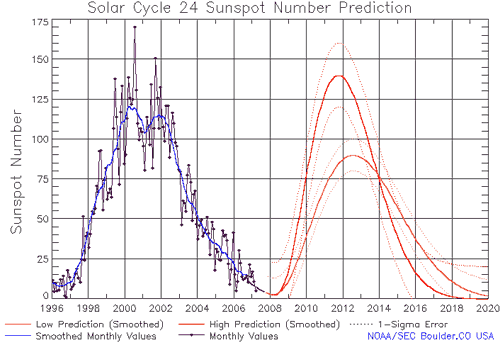
The one thing we know is over the next 5 years, solar activity will continue to rise, peaking around 2012. Tung 2007 estimates the solar cycle contributes around 0.18°C to global temperatures (more on Tung's work...). In other words, from 2001 until present day, falling solar activity reduced the global warming trend by 0.18°C. And over the next 5 to 6 years, the warming sun will add 0.18°C to global temperatures, roughly doubling the global warming trend. The only positive I can take from this is several years from now, at least we won't have to listen to the "global warming stopped in 1998" argument any longer.

UPDATE 6 Jan 2008: the first sunspot of Solar Cycle 24 has been observed and the NOAA Confirms Start of New Sunspot Cycle.

UPDATE 25 Mar 2008: And I thought I was a solar geek. For every scrap of up-to-date solar data, you can't go past www.solarcycle24.com which contains all the latest goss on the sun. If a sunspot is to be found, you'll hear it first there!

.

Posted by John Cook at 00:00 AM

Comments

  1. Philippe Chantreau at 05:59 AM on 25 December 2007
    Sorry John, this OT, but I was wondering why you have no topic on the ubiquitous claim from skeptics that more CO2 is good for plant growth and will more than compensate for other inconveniences? Sorry again for the OT comment.
    [ Response: This is covered somewhat in Positives and Negatives of Global Warming. The general gist is that while there are some positives to global warming (increased CO2 enhancing plant growth, increased agriculture in higher latitudes, etc), the negative impacts from global warming far outweigh
    the positives. ]
  2. Philippe Chantreau at 10:14 AM on 27 December 2007
    Thanks John, I added some interesting links on that thread, hope they show up OK (the medmail ones are kind of funky). The idea of CO2 fertilization is far from being a "fact" on which future yields can be reliably estimated.
  3. There is not only an 11 year solar activity cycle, there are cycles running at periods of about 75, 300, and 1100 years. The cycles are not precise, but they continue with predictability. If you add up all the cycles, you get quite a complicated picture of ups and downs. Global climate tracks that complicated curve with remarkable reliability. This is nothing new, hundreds of papers have been published on the subject.

    What is new is proof of the physical mechanism that relates solar activity to global climate. The mechanism is that solar magnetic storms deflect cosmic rays. Cosmic rays strike particles in the atmosphere causing them to form nucleation centers, which in turn increases cloud cover. Cloud cover reflects the sun and causes cooling. So, few sunspots means a cold earth. For example, the Little Ice Age was a long period with very few sunspots. CO2 lags the temperature change because as the oceans warm they hold less dissolved CO2.
  4. Yes, John, you are absolutely right. If warming resumes after an almost decade-long "plateau" (Pachauri promised to look into it), most reasonable skeptics may well join the AGW camp by 2015. No big deal. But what if the opposite happens?
    [ Response: If the opposite happens, I'll be embarrassed but delighted to be wrong :-) ]
  5. Wondering Aloud at 03:16 AM on 8 February 2008
    We are on opposite sides here. I am freezing my ... off and warming would be such a relief. Getting to work at -22 is just not much fun.

    This winter is threatining to break low temperature and total snowfall records across the American heartland and I hope it's only La Nina.
  6. 2007-2011 are the "test" years for "The solar inertial motion hypothesis" which predicts that the period from about 2010 to 2040 will be one of relatively severe cold throughout the world. - Richard Mackey, Journal of Coastal Research SI 50 955 - 968 ICS2007 (Proceedings) Australia ISSN 0749.0208
  7. Wondering Aloud at 01:18 AM on 26 March 2008
    We apparently had some cycle 23 sunspots on Sunday.
  8. Quietman:

    The current rate of the sun's conveyors has slowed to a crawl which predicts sunspot activity 20 years from now:

    http://www.physorg.com/news66581392.html

    "...For more than a century ... the speed of the belt has been a good predictor of future solar activity... [ 2022 could be ] off the bottom of the charts."

    The shift to SC 24 might be slower than normal because the sun's internal conveyor mechanism appears to be running at 3/4 speed.

    Another thing to consider is the strong positive correlation of decreased solar luminance & far colder continental temperatures (hence this harsh past winter). Hansen authored a paper in 2001(?) predicting slowed continent-warming westerlies during periods of lower solar luminance / sun spot activity. When solar heating drops by 1 degree C over the oceans, continental winters become markedly more severe.

    I remember it took some coaxing a couple of years back to convince IPCC modelers to revise their predictions to account for our current solar minimum.

    We'll know by 2015 what SC 25 has in store for us.

    /leebert
  9. leebert
    "The solar inertial motion hypothesis" of Dr. Mackey is based on work by the late Rhodes Fairbridge. He published in 2007 around the same time that the weather forcasters were calling for a warm 2007-2008 winter due to AGW. His paper predicts a definate cooling to counter AGW in ssc24 and then colder in ssc25.
  10. Wondering Aloud at 00:54 AM on 13 May 2008
    Now you're scaring me.
  11. 16th August...still no sunspots..(www.spaceweather.com)
    Looking forward with interest to see what 2008/2009 GMT is.
  12. Warm winter 2007 -2008; couldn't possibly have anything to do with perihelion being Jan 3rd could it? That the difference in insolation between perihelion and aphelion is around 6 -7%?

Post a Comment

Foul language, trolling, personal attacks or non-relevant links will be deleted.

You need to be logged in to post a comment. Login via the left margin or if you're new, register here.

© John Cook 2008





