





How we know global warming is happening, Part 2
Posted on 2 October 2009 by John Cook
In our last post, we determined whether global warming was still happening by adding up all the heat content of the climate system. Murphy 2009 performed this analysis and found that that planet has been accumulating heat up to 2003. Unfortunately their data ends there as the ocean data they used from Domingues 2008 stops at the end of 2003. So how do we find out what's happened from 2003 until now? Unfortunately, there is no time series (that I know of) of the planet's total heat content up to present time. However, we do have the next best thing.
Global hydrographic variability patterns during 2003–2008 (Schuckmann 2009) analyses ocean temperature measurements by the Argo network, constructing a map of ocean heat content down to 2000 metres (H/T to Chris for bringing it to my attention). This is significantly deeper than other recent papers that focus on upper ocean heat, only going down to 700 metres. They constructed the following time series of global ocean heat:
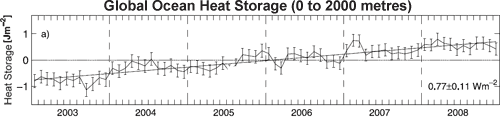
Figure 1: Global ocean heat anomaly (0–2000 m), measured in 108 Jm-2. Anomaly is defined as the deviation from the average heat content over 2003 to 2008.
Globally, the oceans have still been steadily accumulating heat right to the end of 2008. Combined with the results of Murphy 2009 who finds the planet accumulating heat right to 2003, we now see a picture of unbroken global warming. Over the last 5 years, the oceans have been absorbing heat at a rate of 0.77 ± 0.11 Wm?2.
So what is our planet's total energy imbalance? Indulge me as I perform some rough back-of-a-napkin calculations. Murphy 2009 found that about 5.6% of the planet's energy imbalance went into the land and atmosphere. In other words, 94.4% of global warming goes into the oceans. So if the ocean is absorbing 0.77 ± 0.11 Wm?2, this puts the total energy imbalance at around 0.82 ± 0.12 Wm?2. This is a slight underestimate as Murphy 2009 included ocean heat down to 3000m (remember this is back-of-a-napkin stuff).
How does this value compare to other estimates of energy imbalance? Hansen 2005, using ocean heat data, calculated the planet's energy imbalance around 2003 to be 0.85 Wm?2. Trenberth 2009 examined satellite measurements of incoming and outgoing radiation for the March 2000 to May 2004 period and found the planet accumulating energy at a rate of 0.9 ± 0.15 Wm?2.
All these estimates are consistent with each other. Most importantly, all find a statistically significant positive energy imbalance. The empirical data has spoken. Cancel the global cooling party. Global warming is still happening.

Arguments


The graph covers 6 years which equals to 6*365.25*24*60*60 seconds = 189345600 seconds(A)
Eyeballing the graph it looks as though the six year period has seen an ~1.5*10^8 Jm-2 increase.(B)
Dividing B by A gives us ~0.79W-m2(pretty close to the 0.77) storage in the oceans, but the oceans are only ~70% of the Earth's surface. This gives us 0.56Wm-2 averaged over the surface of the Earth.
I wonder if we're comparing apples to oranges.
Cheers, :)
http://earthobservatory.nasa.gov/Features/OceanCooling/
It seems there was bad data from the XBT floats and theArgo floats, one giving consistently high results the other consistently low. Cross checking with ERBES data ( which are not consistent with CERES) and correcting the float data gave a very different picture of ocean heat content.
Also there is extensive info on Argo float position and coverage etc plus data at:
http://wo.jcommops.org/cgi-bin/WebObjects/Argo.woa/wa/
If we’re comparing this value with the value estimated by Hansen et al (2005) for example (0.85 W.m-2 in 2003), we should probably consider the fact that the sun was radiating energy at around 1 W.m-2 more (top of solar cycle) than in 2008/9 (smack bottom of solar cycle). If we consider the effect on absorbed solar radiation at the surface, this amounts to a (temporary!) reduction near 0.175 W.m-2 (1 x 0.25 spherical geometry x 0.7 albedo) now, compared to 2003. So we should probably be comparing 0.6 W.m-2 to something quite a bit less than 0.85 W.m-2 (something around 0.75 W.m-2 perhaps).
So the heat uptake data determined by Schuckmann 2009 is of a similar order to that determined by Hansen et al 5 years ago. It is somewhat lower than the value determined by Trenberth (2009); however there must be significant uncertainty in these values. The main point is that current data is increasingly at odds with the notion (see blogosphere ad nauseum!) that the oceans are cooling. They’re not. The evidence supports the rather straightforward expectation that a positive radiative imbalance results in absorption of heat and global warming.
The oceans represent an enormous buffer as they absorb and emit heat more slowly than the land or atmosphere.
It seems to me that we should not expect an immediate correlation between atmospheric cooling and ocean cooling. There will be a time delay.
Presently SST data suggests a diminution or even cessation in the warming trend dating from around 2003 which should eventually be reflected in the data for ocean temps.
I'm not aware of any direct comparison available for both sets of data...Chris..any suggestions?
I concur that the warming for that period seems to be more like 0.6Wm-2 rather than the 0.82 number mentioned above by John Cook.
I just wanted to make sure I was reading it right.
Cheers, :)
why do you average the heat absorbed by the ocean over the whole earth?
Cheers, :)
All: see IPCC WG I, Section 5.2.2.3,Implications for Earth's Heat Balance, p.8 of the PDF, an especially Figure 5.4, which has a great chart that shows the heat takeup of various Earth elements, with error bars. Of course, there is newer data,but this is a great, an publicly-accessible summary, an that one chart eliminates a lot of silliness.
Volcanoes aren't there, because undersea volcanoes are essentially irrelevant: they just don't produce enough heat to be interesting. Of course, big surface volcanoes cane relevant, but only when (like Pinataubo), they send enough sulfate aerosols high enough to cool the Earth.
"Undersea volcanoes" are what I'd call M2 memes propagated by the usual blogs to confuse the unwwary. I.e., to see that they are wrong, you need to know just a little bit of climate science.
(John: maybe it's worth augmenting your volcanoe discussion with a bit about undersea volcanoes, if you don't want to give that it's own item.
Are you sure that link to the IPCC report is correct? If you have links to data on undersea volcanoes, please do post them - would be much appreciated.
Also, you would expect the heat content is a lagging indicator of energy induced. So even if the current leveling off of temperature reflects a reduction in the cause of global warming, you wouldn't pick it up in the heat content until you got to levels where it created a cooling environment.
Our climate system is governed by a relatively simple principle: when the planet is in energy imbalance, global temperatures change. Eg - when you add heat to the system, it warms. How much the global temperature changes is determined by climate sensitivity.
Of course, even while the planet is accumulating heat, it's possible for the surface temperatures to show short term cooling trends due to the exchange of heat between ocean and atmosphere. For example, over the last few years, we've transitioned from El Nino conditions to La Nina conditions which has had a slight cooling effect on surface temperatures.
This internal variation is like a noisy signal imposed upon the long term warming signal. But some have interpreted several years of cooling as a sign that global warming has stopped and we've now entered a long term cooling period. By noting that the planet is still in energy imbalance, we are reminded that global warming is still happening.

Re heat content lagging energy induced, satellite measurements of energy in and out give us a relatively instantaneous picture of the planet's energy imbalance - they also find more energy coming in than escaping back out to space.
No one doubts that the earth has warmed over the last 30 years, and Dr. Roy Spencer has published graphs recently showing that at present the oceans are gaining heat.
Six years is not a particularly meaningful trend, and the real question is how much? There is no indication of catastrophic warming in this data. Temperatures are rising slower than any IPCC scenario.
While I would love to focus my energies on the more reasonable skeptic arguments, practicality dictates I also must pay attention to the most popular ones.
It would be nice if no one doubted that, but those of us who spend time browsing through the skeptic blogosphere have seen people make exactly that claim plenty of times. Likewise, people also question whether CO2 is actually increasing, whether humans are responsible for that increase, and whether there's any connection between CO2 and warming.
Yes, all of those seem like illogical and easily answered questions, but many people do get confused on these points. Ameliorating that confusion is the reason for this site's existence.
TH continues: Six years is not a particularly meaningful trend, and the real question is how much? There is no indication of catastrophic warming in this data.
The point of this is not to extrapolate from a six-year trend. The point is to show that even during a period when the surface air temperature has been temporarily more or less flat, ocean heat content has continued to rise.
I don't think anyone predicted catastrophe by 2010. Unfortunately the climate system and our economic system both have a great deal of inertia, so it's important to start making changes now so as to prevent catastrophe further down the road.
Temperatures are rising slower than any IPCC scenario.
The IPCC doesn't make six-year or eight-year predictions, because in any such period the trend will be obscured by normal interannual variability.
As Ned replied, in fact lots of people doubt it. You can see a partial list of links to public statements of doubt, on the "Links for 'It's Cooling' argument."
You can see links to skeptic statements for all the arguments on this Skeptical Science site, in the "Global Warming Arguments, Sorted by Argument" page. An easy way to get there is to click the "Links" link in the blue horizontal bar at the top of every Skeptical Science page. For example, the "It's Cooling" branch of that tree page has a whole bunch of sub-branches that are more specific skeptic arguments, and each of those (if you click on them) has a similar page of links to pro- and con- public statements.
http://wattsupwiththat.com/2010/03/05/february-uah-global-temperature-anomaly-little-change/
This argument is a straw man. You are arguing with yourself.
By the way, it's not nice to move goalposts. Originally you made the sweeping claim that ""No one doubts that the earth has warmed over the last 30 years." When I pointed you to a handy list of such doubts, you drastically narrowed your claim to only the satellite records.
A lot of Cook's links are bogus. For example, the National Post article was just quoting Josh Willis at NASA who said ocean temperatures are declining. Take it up with NASA if you disagree.
Once again, none of the mainstream skeptic sites dispute the satellite lower troposphere record. In fact Christy and Spencer are considered trusted sources there.
- UAH Global Temperature Anomaly for June 09 ~ ZERO
- Svensmark: “global warming stopped and a cooling is beginning” – “enjoy global warming while it lasts”
- January 2008 – 4 sources say “globally cooler” in the past 12 months
- The Sun Defines the Climate – an essay from Russia
The point here is that while the more credible global warming skeptics such as Lindzen or Spencer (eg - publishers of peer-reviewed research) don't deny global warming is happening, there are many skeptics who do. Just a few weeks ago at a family get-together, an uncle said to me "I hear a few scientists are saying it's been global cooling over the last few years". This is not restricted to crank uncles either. Several Australian federal politicians have been heard to express similar views that global cooling is now happening.So regardless of whether mainstream skeptic sites dispute that global warming is happening (and the above links indicate otherwise), the fact remains that many people are being persuaded that global cooling is happening. You haven't been misled by this argument and that's a credit to you. But people less informed than yourself are being misled by these falsehoods. This misconception cannot be left unchallenged.
http://www.woodfortrees.org/plot/gistemp/from:1880/plot/gistemp/from:1880/trend
GISS is the surface record from Dr. Hansen. It shows 0.8C warming for the last 130 years, or 0.6C per century.
http://www.woodfortrees.org/plot/gistemp/from:1880/plot/gistemp/from:1880/trend
there are not that many temperature datasets, you can take for granted that we all know them.
P.S. a secular linear trend can be acceptable only when there's nothing more we can say on the parameter under study. This is definitely not the case for temperature and related forcings.
I was referring to GISS and you responded with a comment that skeptics don't trust ground based measurements - when obviously I do.
so you should deduce that my comment did not refer to your latest but to the second latest comment. More explicitly, i find a bit weird that "none of the mainstream skeptic sites dispute the satellite lower troposphere record" while questioning surface temperature datasets.
GISS (1.7) does show a steeper trend than UAH (1.2) since 1979.
you quote strange number. UAH offically quote 0.132 °C/decade while from GISS annual averages I get 0.16 °C/decade. And UAH is only one of the two satelite datasets, RSS giving 0.15 °C/decade.
I do not see much of a difference considering that they do not even measure the same thing.
http://data.giss.nasa.gov/gistemp/paper/gistemp2010_draft0319.pdf
The graph I linked shows the divergence between GISS and UAH.
Hansen's reference is a generic assesment: "We conclude that there has been no reduction in the global warming trend of 0.15-0.20°C/decade that began in the late 1970s.".
I'd suggest to quantify the "divergence" you keep linking from woodfortrees if you do not trust my number for GISS and their own number for UAH.
UAH: +0.132
HADCRUT: +0.156
RSS +0.156
NCDC: +0.162
GISS: +0.163
Amusingly, if you round them to two places, all except UAH are 0.16. In any case, there's not exactly a huge gap here.




