



 Arguments







Is Antarctic ice melting or growing?
Posted on 4 October 2008 by John Cook
I recently received an email asking how could I state Antarctica was melting when it's currently showing record sea ice cover. Actually, the email didn't frame the question quite that politely (I was accused of being a liar and an alarmist). Nevertheless, it brings up an interesting point. How could Antarctica be overall losing mass if in 2007, it showed the highest amount of sea ice extent since satellite measurements began? Firstly, we must distinguish between land ice and sea ice. This post looks at the state of Antarctic land ice - the next post will look at sea ice.
Gravity measurements of Antarctic land ice mass
Measuring changes in Antarctic land ice mass has been a difficult process due to the ice sheet's size and complexity. However, over the last few years, the Gravity Recovery and Climate Experiment (GRACE) satellites have been able to comprehensively survey the entire ice sheet. Using measurements of time-variable gravity, Velicogna 2007 determined mass variations of the entire Antarctic ice sheet from 2002 to 2005. They found the overall mass of the ice sheet decreased significantly, at a rate of 152 ± 80 cubic kilometers of ice per year (equivalent to 0.4 ± 0.2 millimeters of global sea-level rise per year). Most of this mass loss came from the West Antarctic Ice Sheet. Figure 1 displays Antarctica's ice mass from 2002 to 2005 - the red crosses is their best estimate with the dotted line the linear trend.
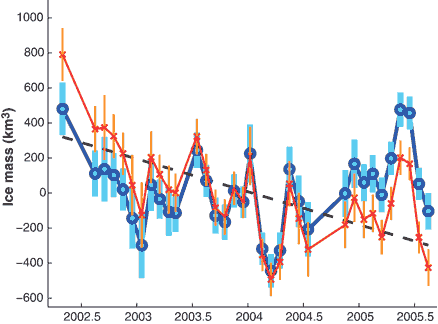
Figure 1: GRACE monthly mass solutions for the Antarctic ice sheet for April 2002 to August 2005. Blue circles show results after removing the hydrology leakage. Red crosses show results after also removing the PGR signal. The latter represent our best estimates of mass variability. Also shown is the linear trend that best fits the red crosses.
Also illuminating is Figure 2 which contrasts the mass changes in West Antarctica (red) compared to East Antarctica (green):
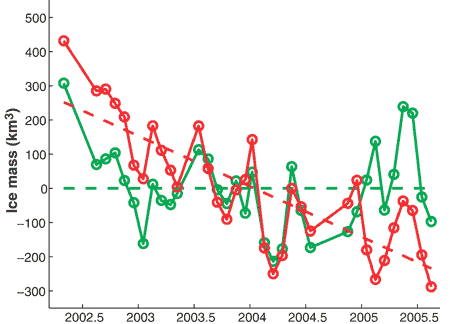
Figure 2: Monthly ice mass changes and their best-fitting linear trends for WAIS (red) and EAIS (green) for April 2002 to August 2005.
Most of the Antarctic mass loss comes from Western Antarctica with a mass loss of 148 ± 21 km3/year. The mass loss from East Antarctica is 0 ± 56 km3/year. Because of its relatively large uncertainty, it's uncertain whether East Antarctica is in mass balance or not.
Why is Western Antarctica losing ice mass while East Antarctica is relatively steady. The hole in the ozone layer above the South Pole causes cooling in the stratosphere. This increases circular winds around the continent preventing warmer air from reaching east Antarctica and the Antarctic plateau. The flip side of this is the Antarctic Peninsula in Western Antarctica has "experienced some of the fastest warming on Earth, nearly 3°C over the last half-century".
The more interesting puzzle is that of Antarctic sea ice which has increased since satellite measurements began in 1978. Many assume this is because the Southern Ocean around Antarctica must be cooling. This is surprisingly not the case - the Southern Ocean has been warming at a rate greater than other ocean basins. So what's the answer to this paradox? Stay tuned...


 0
0  0
0






Comments