



 Arguments









What's causing Arctic amplification?
What the science says...
Decline in sea ice is the major driver of Arctic amplification. This is evidence by the pattern of atmospheric warming over the Arctic. Maximum warming occurs over the surface during winter while less surface warming is found in summer when heat is being used to melt sea ice. This pattern is consistent with sea ice amplification.
Climate Myth...
Melting ice isn't warming the Arctic
'The University of Melbourne study claims are not supported by the available data. The authors seem to have jumped right into statistical analysis without proposing a physical mechanism that works. Heat flows across differences in temperatures, yet the winter water temperature under the ice is fixed at -2C. Thus elevated winter air temperatures should actually cause a reduction in heat flow out of the ocean. Whatever is driving increases in winter Arctic temperatures is not heat coming out of the Arctic Ocean, which is covered with insulating ice.' (Steve Goddard)
The warming trend in the Arctic is almost twice as large as the global average in recent decades. This is known as Arctic amplification. What's the cause? Changes in cloud cover, increases in atmospheric water vapour, more atmospheric heat transport from lower latitudes and declining sea ice have all been suggested as contributing factors. A new paper The central role of diminishing sea ice in recent Arctic temperature amplification (Screen & Simmonds 2010) (here's the full paper) examines this question. The title is a bit of a give-away - the decline in sea ice is the major driver of Arctic amplification.
The vertical profile of Arctic warming (i.e. - how much warming occurs at different altitudes) gives us insight into the underlying cause. If atmospheric heat transported from lower latitudes was the major driver, more warming would be expected at greater heights. On the other hand, if retreating snow and sea ice cover was the major cause, maximum warming would be expected at the surface. Figure 1 shows the simulated warming expected in each season if declining sea ice was the major cause of warming.
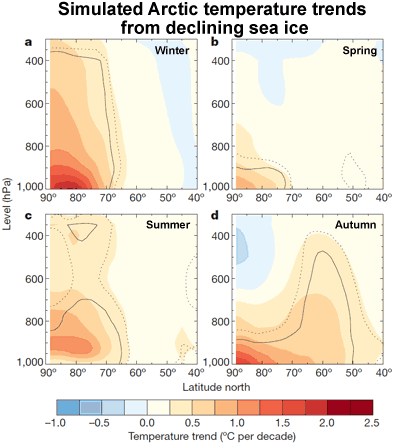
Figure 1: Temperature trends linked to changes in sea ice. Temperature trends over the 1989–2008 period averaged around circles of latitude for winter (a), spring (b), summer (c) and autumn (d). The trends are derived from projections of the temperature field on the sea ice time series.
Using higher resolution temperature data supplemented with updated satellite measurements, Screen 2010 analyse the observe warming trend in each season. What they find is maximum Arctic warming at the surface and that warming lessens with height in all seasons except summer. This vertical structure suggests that changes at the surface, such as decreases in sea ice and snow cover, are the primary causes of recent Arctic amplification.
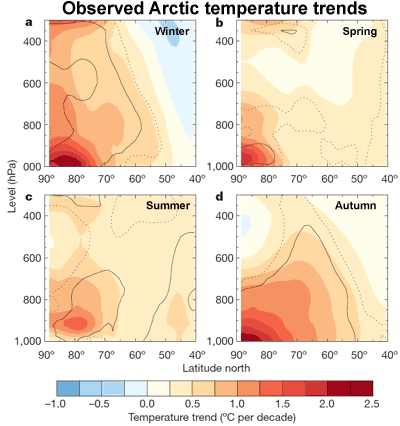
Figure 2: Observation of temperature trends, 1989–2008. Temperature trends averaged around circles of latitude for winter (December–February; a), spring (March–May; b), summer (June–August; c) and autumn (September–November; d). Red shading indicates that the lower atmosphere has warmed faster than the atmospheric column as whole. Blue shading indicates that the lower atmosphere has warmed slower than the atmospheric column as a whole.
The surface warming is modest in summer because energy is used to melt remaining sea ice and warm the upper ocean. The majority of the winter warming is associated with changes in sea ice cover even though the sea ice declines at this time of the year are relatively small. During summer, the atmosphere loses heat to the ocean whereas during winter, the flux of heat is reversed. Reduced summer sea ice cover allows for greater warming of the upper ocean but atmospheric warming is modest. The excess heat stored in the upper ocean is subsequently released to the atmosphere during winter.
Another potential contributor to amplified warming that's investigated is changes in cloud cover. Spring is the only season that exhibits significant trends in Arctic average cloudiness and the trend is negative. However, decreased cloud cover is expected to cause surface cooling because clouds have a warming influence in spring. Thus no evidence is found of cloud cover changes contributing to recent near-surface Arctic warming.
Changes in atmospheric water vapour content may amplify Arctic warming. However, specific humidity trends are found only during summer and early autumn. The pronounced warming in winter and spring are not accompanied by increases in humidity. In fact, the evidence suggests part of the humidity increase is driven by enhanced surface moisture fluxes associated with sea ice reductions.
The empirical evidence from the past two decades reveals that declining sea ice cover and thickness have been great enough to enhance Arctic warming during most of the year. The emergence of strong ice–temperature positive feedbacks increases the likelihood of future rapid Arctic warming and sea ice decline.
Last updated on 26 June 2010 by James Wight. View Archives







Arctic amplification is the phenomenon where changes in the net radiation balance due to greenhouse gas levels, for instance, tend to produce a larger increase in temperature near the poles than the planetary average.
Sea ice helps to keep the Arctic atmosphere cold. Its whiteness reflects much of the Sun's energy back to space, and it physically insulates the Arctic atmosphere from the underlying Arctic Ocean. With less sea ice, the refrigerator door is left open-darker open water is exposed, which readily absorbs the Sun's energy in summer, heating the ocean and leading to even more melt. With less sea ice there is also less insulation, so that heat from the ocean escapes to warm the atmosphere in the autumn and winter.
What are the main reasons that can cause the Arctic to heat faster? How it impacts human life?