





Part One: How do ice sheets lose ice?
Posted on 14 July 2010 by robert way
Guest post by Robert Way
Some individuals have a distinct predisposition towards creating illogical arguments. Certainly most of you are now familiar that Watt’s Up With That (WUWT) is often the mechanism through which these faulty arguments are delivered. Recently it became all too clear that Steven Goddard and his camp were going to be hauling out a new argument from their cupboard and that they had every intention of using it as much as possible. The argument which is shown here and has been used again here is that absolute air temperatures throughout most of Antarctica are below 0°C (and will likely remain that way) therefore significant ice losses on the Continent cannot occur. This sort of argument might work well with those already positioned to believe whatever the disinformation factory (WUWT) churns out but for fear of the unsuspecting public becoming tainted, it needs to be addressed. I must begin by asking for your patience as we go back in time to a world where bloggers read papers and supported their ideas with critical appraisal and this weird group of things called facts…
To begin, this will be a three part series with this post consisting mainly of basic glaciology to help people understand why glaciers lose mass.
Glaciers are large viscous masses of ice which creep naturally through a process called internal deformation. This “creep” or movement is caused by gravity and the weight of accumulated snow and ice forcing the ice to deform like plastic.

(Figure 1: Midtsdalsbreen,
Glaciers gain mass through accumulation of snowfall and through re-freezing of meltwater but lose mass (termed ablation) through surface melt, basal melt, sublimation and iceberg calving (Figure 2, right). The accumulation of ice primarily occurs in the glacier’s accumulation zone and ice loss generally originates in the glacier’s ablation zone (Figure 2, left).
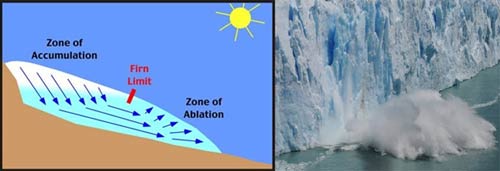
(Figure2, accumulation/ablation zones, www.physicalgeography.net, image of calving glacier on right)
For an ideal glacier, ice flow through a cross-section must exactly balance the accumulation and ablation taking place (Benn and Evans, 1998, 142). The difference between the total gains and losses measured over a specified time refers to the mass balance. Mass balance is usually measured over the course of a year which computes the sum of all the annual accumulation and ablation (Benn and Evans, 1998, 75). The velocity at which a glacier moves whereby its Mass Balance is 0 represents the point at which its inputs (through accumulation) equals its outputs (through ablation) and is termed the Balance Velocity (Figure 3).
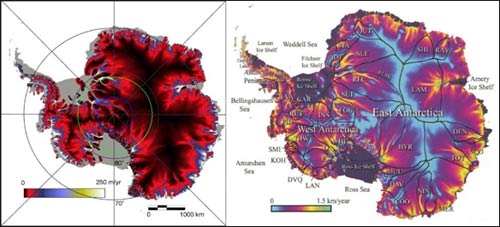
Figure 3: (Left) Balance Velocities for Antarctica as illustrated in Bamber et al (2009). (Right) Actual velocities across the ice sheet as measured by Rignot and Thomas (2002).
As every individual basin is rarely in balance, the actual velocities of glaciers/ice streams across
The question of balance velocities brings us to one of the most important points of this post. When a glacier is in balance or flowing at its balance velocity, net mass will remain balanced. However, when a glacier accelerates while near or at its balance velocity, the outputs resultantly increase but the inputs do not, thereby shifting the glacier regime to one of negative mass balance or net ice loss. This situation is particularly important because accelerated ice flow is the key method through which the Antarctic ice sheets incur a net ice loss. Accelerations such as these occur through two primary mechanisms. The first of which is caused by water reaching the bed of a glacier which results in less frictional forces opposing glacier movement. This mechanism has been observed in Greenland as being caused by increased surface melt water reaching the glacier's bed resulting in accelerated ice flow (Bell 2008).
The second mechanism refers to when the forces at the downstream terminus of a glacier or ice stream are disturbed or altered. This can occur through removing buttressing ice shelves or by shifting the glacier’s grounding line (point where glacier ice reaches floatation). The presence of an ice shelf provides a longitudinal compressive force which slows the flow of ice streams. If removal of this compressive force occurs, velocity of ice streams increase. This has been observed directly by Scambos et al (2004) and Rignot et al (2004) through both visual observations (Scambos) and radar interferometry (Rignot).
In terms of a grounding line retreat, progressive ungrounding of ice can be caused by thinning of the glacier. This inland shift of the grounding line can reduce the glacier's resistance to flow subsequently increasing the longitudinal strain rate of ice and thereby resulting in further acceleration and vertical thinning. The increased vertical thinning can then further enhance grounding line retreat completing the cycle. Grounding line retreats in Antarctica also tend to allow for warm sea water to penetrate deeper into ice streams and contribute to ablation through basal melting. This process can result in increased glacier velocities and subsequent inland thinning as more ice is being pulled from the accumulation zone (
We should all now at least remotely understand that mass balance changes in
I would like to thank Professor and Renowned Glaciologist Jon Ove Hagen for helping proofread all three parts of this post.
References
Benn, Douglas & Evans, David. (1998). Glaciers and Glaciation. Oxford University Press Inc. 1-734.
Rignot, E., Casassa, G.,Gogineni, P.,Krabill, W., Rivera, A. & Thomas, R. 2004. Accelerated ice discharge from the
Scambos, T., Bohlander, J.A., Shuman, C.A. & Skvarca, P. 2004. Glacier acceleration and thinning after ice shelf collapse in the Larsen B embayment,
Shepherd, A., Wingham, D. & Rignot, E. 2004. Warm ocean is eroding West Antarctic ice sheet. Geophysical Research Letters, 31, 1–4.
NOTE: This blog post has been adapted into a response to the skeptic argument "Antarctica is too cold to lose ice".

Arguments


Can I suggest that John moves the article "Peer reviewed impacts of global warming" into a more visible place? I think it is one of the most useful articles on this site, comparing peer-reviewed impacts of warming both good and bad, and it deserves more attention. Personally I think it should be up there with the two blue boxes on the home page, but that's just my opinion.
Also, the version of this article on the iPod app, called "Global warming is good", doesn't show up on the unless you search for it. Again, I think it's one of the most important pages and should be as visible as possible. Can something be done about that?
Thanks!
Does increased glacial calving actually make any significant difference to sea ice extent/area?
I actually have not looked into that question but I could make an assumption that where sea ice forms primarily from salty ice and then becomes desalinized over time, it is maybe more difficult for it to form in high calving regions because the water is usually quite "freshened" with the inflow of land ice.
What does "buttressing ice shelves" mean?
And "glacier’s grounding line (point where glacier ice reaches floatation)?"
I really like the cross section in figure 2 (pictures are great conveyor of these sorts of things), but those terms aren't in the image.
And what is a "longitudinal compressive force?"
With your conclusion that this second mechanism is important to Antarctica, these details are key to understanding your post, so if someone can elaborate on this, or point to something that provides more details, it will help.
"Buttressing ice shelves" and "Longitudinal compressive force": Ice shelves hanging onto the edge of the glacier and surrounding areas hold back the glaciers ('cause there's an ice shelf in the way!), applying the "longitudinal compression", i.e. pushing back against the glacier. This slows glacial movement.
"Glacier's grounding line": Once the glacier gets far enough out into the water to float, wave action helps crack it and calve it, which means that the glacial ablation increases sharply there (fast ice loss).
So a possible reduction of spreading comes from reduced back pressure? That makes sense, but how would it cause reductions in thinning and longitudinal extension? I would think those would increase with lowered friction.
I have in fact read up on these papers a little and I find them both very interesting. Particularly Jenkins (2010) as the ridge is something that was previously not understood. I wish there was some paleoclimatic way to be able to ascertain an estimate as to how long the ice remained on the ridge as that would potentially tell us when the last significant retreat was.
I do have to apologize as there was perhaps too much lingo being used here. One of the main ideas of the post is to create a less technical one over the next few weeks so that there can be a post for the general public and one for those really looking to get in depth. I did try to reduce the jargon however and tried to stay away from getting too complicated in my descriptions. I had a friend proofread who identified many things I had to change in order to make it appeal to more of a viewership.
Note I also changed the name to Why do ice sheet lose mass because I feel it is more appropriate. Glacier mass loss would require much more in depth of an analysis for proper understanding.
KR as the glacier goes afloat of course friction is reduced which reduces longitudinal compression and hence tends to increase speed. At the dame time as the glacier goes afloat it loses a principal driving force, gravity, this leads to reduced velocity. And of course it can spread out due to the reduced friction and longitudinal compression. This tends to lead to even more reduction of velocity as thinning and divergence of flow reduce longitudinal extension.
You have a point. I think I worded that phrase very cumbersomely, i will try to rectify it.
I think I have fixed the issue and made my wording more clear.
Even when he was confronted with the facts, goddard utterly failed to acknowledge his lack of comprehension on how Antarctic glaciers lose mass, or how quickly their flow might accelerate, despite your evidence and patient explanations to the contrary. He was insistent that it would take thousands of years for a glacier to even respond to a change propagating 700km from the coast, based on the utterly bizarre concept that the ice would only respond to the change when it had actually flowed all the way to the coast!! I'm imagining an easing traffic jam - you start to accelerate an awfully long time before you pass the accident, no? Such simple concepts are lost on misinforming D-K's like goddard.
The general thing is that it's always necessary to push back against those deliberately misinforming the public - you did a great job in responding directly, and this post continues that excellent work.
This is NOT science! This is NOT skepticism. I know those who don't accept AGW don't like the term denier, but for the life of me I can not think of a term that better describes the activity that Steven Goddard partakes in.
Steven Goddard writes: "Dr. Walt Meier at NSIDC has convinced me this week that their ice extent numbers are solid. So why the large discrepancy between their graphs and the UIUC maps? I went back and compared UIUC maps vs. NASA satellite photos from the same dates last summer. It turns out that the older UIUC maps had underrepresented the amount of low concentration ice in several regions of the Arctic. This summer, their maps do not have that same error. As a result, UIUC maps show a much greater increase in the amount of ice this year than does NSIDC. And thus the explanation of the discrepancy.
"it is clear that the NSIDC graph is correct, and that 2008 Arctic ice is barely 10% above last year - just as NSIDC had stated."
And I love the declaration at the end of the article itself :
The author, Steven Goddard, is not affiliated directly or indirectly with any energy industry, nor does he have any current affiliation with any university.
With regard to the latter assertion, I think the following phrase puts it best : 'No sh*t, Sherlock !'
Sorry to go technical! It isn’t mentioned if Autosub was using a low frequency sub bottom sonar, but my first thought is use one to track any more recent and older sediment layers on a vertical “section” through the sea bed across the ridge and see if the older layers where the ice was “impacting” give us some small clues. The high res bathymetry may also tell us when there have been extended periods of debris dumping on the sea bed at the edge of the glacier, and any newer sediment overlay may again allow us to roughly estimate timing of this.
it would be nice then to at some point see if the authors had came across any of that or if they were working on it at all.
I have been reading some of the posts over at WUWT with a kind of fascinated horror.
Slightly off topic but still interesting wrt to what is happening in the Antarctic is an absolute howler by Steve Goddard at the end of "AGW Mathematics", the second post you link to.
After showing how the main body of Antarctica hasn't really warmed, he says 'Must be the Ozone? I’m curious how one gets to be a “climate expert.”'. Presumably sarcastically. Obviously Steve doesn't keep up with the science enough (or if he does he chooses not to mention it).
Because recent research suggests it is the Ozone. Or rather the lack of it. Antarctica is surrounded by a westerly air flow called the Southern Hemisphere Annular Mode (SAM). And the SAM has reportedly been stronger during summer for the last 30-40 years, tending to isolate Antarctica from outside weather systems. And research released last year suggests that this is being caused by the Ozone Hole. With less UV being absorbed in the stratosphere, more reaches the lower atmosphere, more energy. And this has had the effect of strengthening the SAM during Summer. Hence the warming such as it is in Antarctica has tended to be more in Winter & Spring.
So the Ozone hole really does cause it Steve!
Here is a link to a discussion about this over at RC.
http://www.realclimate.org/index.php/archives/2009/10/putting-the-recent-antarctic-snowmelt-minimum-into-context/
I have few questions and observations.
1) I thought this was nice largely because it doesn't actually mention AGW. I suspect that all these processes you describe are true at all times irrespective of whether humans are pumping CO2 into the sky or not. For example since the end of the Little Ice Age one could argue that velocities have been constantly changing, mainly increasing to give us an interrupted 200 or 300 years of mass loss to global land ice, at least the first half of that time period had absolutely nothing to do with AGW.
2) I read the Bell review. There's a lot of "ifs" and "maybes" and "possiblies" and "mights". I might (probably will) get blasted along the lines of the previous post about partial science but I just wondered to what extent we actually know what's going on at the base of a glacier? These are hypothesizes or proven theories?
3) Again I get from the Bell review that glacier velocity can be affected by a multitude of things some of which have absolutely nothing to do with whats going on on the surface or AGW. And it is not necessarily possible to tease out the impact from all these different processes. I wonder why we always seem to return to AGW for the explanation of mass loss? He also suggests there isn't necessarily a direct relationship between incresed
4) Although you mention the flawed arguments of WUWT and Goddard at the start you don't seem to actually address them. Surely if we are looking at the impact of AGW on glaciers then that still requires increased surface melt to affect velocities. Melt is dependant on air temperature which at least suggests on Goddard is looking in the right area? maybe this is all in part 3 in which case save it for then.
#29 HumanityRules
(1) Yes, of course these processes operate all the time, but what can change over time are the rates. For example, if temperature is held constant over a few years, but the ice shelf buttressing a glacier breaks up, the glacier will speed up, moving toward a negative mass balance. Or, increased precipitation could result in a positive mass balance even if flow increases.
(4) As pointed out in the main post, surface melt is only one of the components, and not the most important one for Antarctica. To complete the circle and address Goddard's argument: that fact means that Goddard's argument that significant ice loss is impossible because the average surface temp remains sub-zero (C) is totally wrong.
http://gsabulletin.gsapubs.org/content/121/11-12/1711.abstract
Excerpt from the abstract: "There is no compelling evidence for a Little Ice Age readvance in Maxwell Bay."
Why do we keep coming back to AGW to explain mass loss. In some cases we are measuring ablation and accumulation. Where I monitor glacier mass balance winter precipitation has risen, and glacier balance has fallen, these glaciers do not calve, thus increased melting is the mechanism. Given our ability today to measure melt extent, not quite yet ablation rate from satellite imagery, we are developing a good ability to quantify relative annual ablation in Greenland. For Greenland the key to acceleration of outlet glaciers and hence mass loss is not melt or meltwater lubrication, it is ,a href="http://www.realclimate.org/index.php/archives/2008/10/what-links-the-retreat-of-jakobshavn-isbrae-wilkins-ice-shelf-and-the-petermann-glacier/">outlet glacier acceleration, given the simultaneous nature of the acceleration of at least 34 Greenland outlet glaciers, the cause is not local or random. We understand the mechanics, thinning reduces back force, which increases velocity, calving and retreat.
Yes, there is similar from previous missions. I should explain that I am part of the extended AUV instrumentation team though I did not design the specific Autosub sonars (or process the data). Part of my work is looking at instrumentation packages for smaller AUVs, as funding is a major hurdle to getting information like this about paleo changes in ice extent, and smaller is cheaper. I’m guessing you’ve seen this but for the benefit of others the sort of data I’m discussing is nicely shown in the Scott Polar Research Institute information on Autosub.
Thank you for your kindness,
1) Without detailed paleoclimatic knowledge of glacier velocities we cannot make any assumptions. That being said it is important to note as mspelto pointed out that what we do know is that glacier velocities have significantly increased across many regions on both ice sheets. In Pine Island Bay velocities have nearly doubled in the last 20 years. This evidence points to more than just velocities fluctuating over time.
2) The Bell Review is a good paper and there are many others. Frankly I could of pointed to papers which discussed each topic directly but that is overly time consuming when a Review such as Bell’s exists. Overall I can say that scientists are never going to make definitive statements without 100% certainty. If Bell at some point made statements with that certainty, then he would be blasted the one time where things don’t work as he explained. The effects of buttressing and grounding line retreat are well known though and have been measured tangibly. Rignot et al. 2004 and Rignot et al. 2008 b are two papers I can think of that are interesting on the topic.
3) The hypothesized link to AGW is through changes in wind patterns bringing warming ocean water into the regions where glaciers occur. Essentially the consensus view is that it is the oceans which are causing the grounding line retreats and ice losses in the most dynamic regions. Just a theory but yet evidence supports it. If current Antarctic losses are caused by AGW or not is irrelevant because if we cause oceans to warm in the future we know that it will have effects on ice sheet mass balance. Once again, no certainties but pretty good estimates.
4) Part three will address your concerns and note that melt isn’t the primary mechanism that glacier accelerations occur in Antarctica. Melt is an important thing to consider in other regions however.
Think of it this way: starting with a balance of $0 you deposit $10 in your bank account and when you check your balance you see $15 available. Your $10 is there and some unknown (rich uncle? bank error?) has gifted you with $5. The $10 you expected to find is present, leaving a separate puzzle to be solved.
By the way, did you know your chosen handle here violates the comments policy and thus technically speaking all of your remarks should be deleted? Give a thought to changing it or resign yourself to possible frustration with having your comments reliably appear in public on this site.





