



 Arguments







The chaos of confusing the concepts
Posted on 22 January 2010 by Jacob Bock Axelsen
Guest post by Jacob Bock Axelsen
One skeptic claim is that if weather is chaotic, then surely the climate must also be chaotic because "climate, of course, is very-long-range weather". This view seems to logically render all skeptic non-human-causes of global warming worthless, since all predictions would be equally futile. As everybody knows, weather is both chaotic and strongly seasonal. Air temperatures undergo significant daily variations, at times varying unpredictably by more than 20°C in a given location within a few days. Climate indeed varies non-linearly, but this has not prevented scientists from making good predictions. Here, we peek into chaos and why climate is rather predictable over both decades and centuries
In 1963 Edward Lorenz was studying the patterns of rising warm air in the atmosphere. It was known at the time that air could start to move if it came into contact with a warm object. The properties of air are such that it expands a lot when heated, it is a good insulator and it flows with relative ease - technically speaking, it has a high Rayleigh number. Think of a large hot air mass in the atmosphere as rising like a hot air balloon in the shape of a mushroom cloud (!). Based on known hydrodynamics Lorenz derived a set of simplified equations for this movement and found something amazing. For certain values of the parameters, the overall movement of the atmospheric air was oscillating unpredictably (Lorenz 1963):
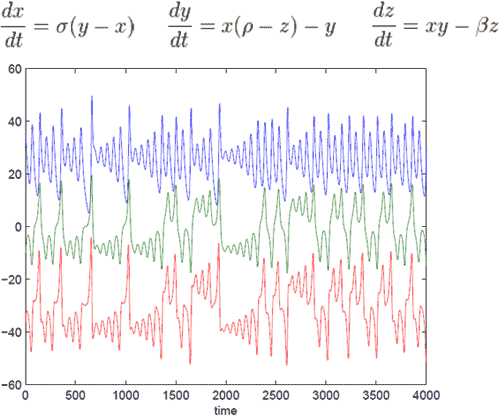
Figure 1: The simplified Lorenz phase space equations of air convection (top) and some numerical solutions (below, separated for clarity).
A major concern was that for small changes in starting conditions the system would always have an unpredictable outcome. This was the discovery of deterministic chaos and we knew there and then that we would never know the weather more than 10 days ahead without using disproportionate computing power with very little pay-off. Naturally, scientists knew about chaos from studying turbulence, which is not both smooth (deterministic) and unpredictable.
When Lorenz looked closer at his graphs, something exciting happened. A peculiar regularity emerged when he plotted the curves against each other: they were attracted to something never leaving a boxed volume. It was strange, because it was not a simple shape, but rather an entire subspace of points strangely smeared into three dimensions.
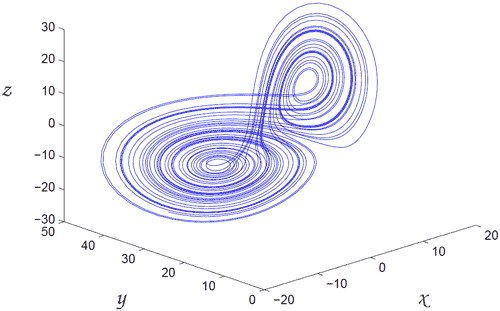
Figure 2: The numerical solutions of Lorenz' equations plotted in the same coordinate system. The curves are functions of time, so imagine them as a roller coaster tracing an invisible object called a strange attractor.
Even stranger, the structure is occupying not just a two dimensional surface but something which is more than two dimensional and less than three dimensional: it is two-dimensional plus a fraction. It exists in a so called fractal dimension. It never truly intersects itself thus committing every trajectory to infinite solitude. The object was therefore aptly dubbed a strange attractor.
A closer look reveals where the unpredictability arises. The blue and the magenta curves are closely following each other for a time. Suddenly the magenta curve takes a wild hike and quickly finds itself far away from its companion curve. This is known as sensitivity to initial conditions, which is seen in everyday weather.
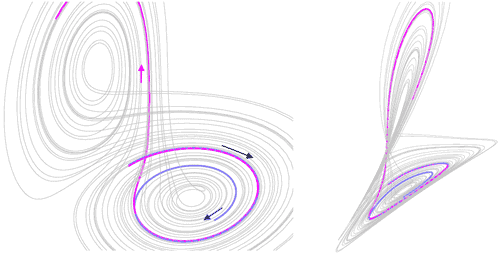
Figure 3: Illustration of deterministic chaos. Imagine two systems started at slightly different initial conditions. They will follow each other closely for some time, but within a short time our ability to predict them breaks down (front and side view of the Lorenz attractor).
This is what skeptics claim must happen in climate as well. Beyond variations in the solar cycles, airborne particle numbers and volcanic eruptions, most variability in the climate is due to changes in heat transfer between the atmosphere and the oceans. Water has a smaller Rayleigh number than air making it hard to obtain fully developed chaos in ocean currents. However, oceanic climate indices (the heat transfer) can exhibit small-scale chaos as we shall see below.
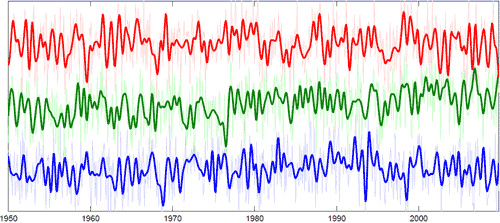
Figure 4: Ocean cycles. North Atlantic Oscillation (blue), East Atlantic pattern (green), West Pacific pattern (red) (NOAA)
Looking at three of the leading climate indices we recognize the same problem that Lorenz faced. Therefore, the climate system as a whole does exhibit some inherent minor unpredictability. However, even though the El Niño of 1998 was a whopping 10% of the total heat content anomaly since 1950, it passed quickly. The greenhouse effect, on the other hand, works throughout the period.
Returning to the temperature record (normalized to the period 1950-1980) we can now put names on things. Chaotic influences from oceans and volcanoes etc. makes both weather more unpredictable and creates the unpredictable part of the 'wiggles' around the average trend in climate. The climate is definitely non-linear, but also not chaotic in this plot.
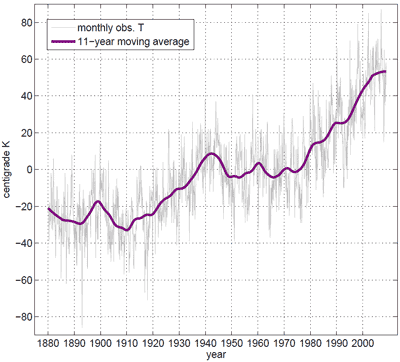
Figure 5: GHCN & HADISST1 global temperature record. The moving average is performed with a lowess filter.
On the timescale of decades, every planetary object has a mean temperature mainly given by the power of its star according to Stefan- Boltzmann’s law combined with the greenhouse effect. If the sources and sinks of CO2 were chaotic and could quickly release and sequester large fractions of gas perhaps the climate could be chaotic. If the Earth's orbit was affected by a moon of comparable mass to the planet itself, then the orbit and thus the Solar forcing could cause some amount of chaos in the climate. As it turns out the Moon is relatively small and actually stabilizes the rotation axis, which is considered a favorable condition for life on Earth.
To sum up, the weather is chaotic because it can run free, climate is on a leash. Pull the leash hard enough and the climate responds.
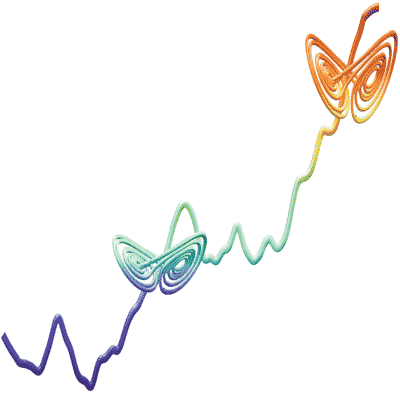
Figure 6: Artistic rendering of the rising global temperatures carrying a small, slightly growing Lorenz attractor up along with it.
Jacob Bock Axelsen is MSc in biophysics and PhD in complexity studies, both from the Niels Bohr Institute, Copenhagen. He has worked twice as a visiting scientist in USA and subsequently as a postdoctoral fellow at the Weizmann Institute of Science. He is a contracted physicist at Centro de Astrobiologia in Madrid. His interest in climate science is purely non-professional.


 0
0  0
0






Comments