





The e-mail 'scandal' travesty in misquoting Trenberth on
Posted on 10 April 2011 by villabolo
"The fact is that we can't account for the lack of warming at the moment and it is a travesty that we can't." -Kevin Trenberth
Trenberth's statement was quoted completely out of context by those who orchestrated the fake 'Climategate' scandal. The statement is distorted to mean that there is no global warming. That is not the case.
Trenberth's job is to track exactly how much energy is reaching us from the sun, and how much of that warming has been absorbed by the air, land, oceans, and melting ice. He also calculates how much is reflected or radiated from each of these places. The more global warming there is, the more energy is absorbed by all these places.
Therefore, Trenberth was talking about where some of the warmth has gone, not that there is a lack of warmth. The illustration below shows what the situation is. Please note the lack of information from the deep oceans.
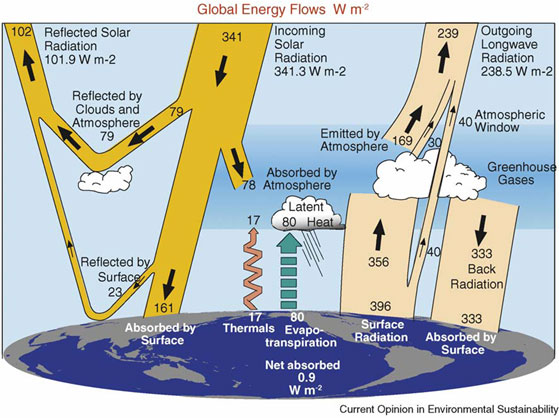
Figure 1. The global annual mean Earth’s energy budget for the March 2000–May 2004 period in W/m2. The broad arrows indicate the schematic flow of energy in proportion to their importance. From Trenberth et al.a
The situation can be easily explained by the following analogy.
Suppose you are an accountant for a major corporation which grossed 1 billion dollars last year, then increased to 1.1 billion dollars this year. This would be a 100 million dollar increase from the previous year. Your job is to find out where and how all the money was spent. You take into account every detail such as salaries, benefits, purchases, etc.. Ideally, your goal as an accountant is to account for every dollar spent or left over as profit. Realistically you can be off by a small amount without worry.
Imagine, however, that 5% (55 million dollars) is unaccounted for. That would be serious. You know that the company has been making more money but where did it go? Was it due to waste or mismanagement of company resources? Is there someone stealing the money?
Suppose now, that the accountant sends an e-mail saying, "I cannot account for the missing money and it's a shame."
Now imagine a person who wants to defame the company. He hacks into the e-mail and quotes the accountant out of context by claiming that the company is actually not making more money.
When Trenberth said, "...we can't account for the lack of warming..." he meant the same thing as that accountant. Just substitute the word "warmth" for "money".
He could not accurately determine the Earth's complete global energy budget because the instruments we have to measure the ocean's warming only go down to 900 meters (little over 1/2 mile) and oceans can be several thousand meters deeper than that. Because of that, we will not be able to account for all the energy absorbed by the oceans until we place measuring instruments deeper than they are now. However, our measurements of how much energy from global warming is flowing through our atmosphere, land, and melting ice, are well known.
a. Trenberth KE, Fasullo JT, Kiehl J; Earth's global energy budget. Bulletin of American Meteorological Society 2009, 90:311-323.

Arguments


?? I don't understand this sentence - what do you mean ? the atmosphere stores only a tiny amount of energy, and it's constantly changing - GW is certainly *not* a permanent storage of energy in the atmosphere !
I agree. I think Villabolo probably meant to say that:
"Our measurements of how much energy is in our
atmosphereclimate system are accurately known, however."Although I might contend that even that statement might not be 100% true, b/c we do not have comprehensive measurements from the deep oceans.
The point is that people have grossly distorted and spun Trenberth's original statement for ideological purposes, and that is indeed a travesty. Contrarians and skeptics would improved their pitiful credibility is they could acknowledge as much first before nit picking (as I am sure they will do on this thread). So commenter @1, do you agree with how people distorted and spun Dr. Trenberth's comment? Let us get that out of the way first.
"Suppose you are an accountant for a major corporation which grossed 1 billion dollars last year, an increase from the previous year. Your job is to find out where and how that money was spent. You take into account every detail such as salaries, benefits, purchases, etc.. Ideally, your goal as an accountant is to account for every dollar spent or left over as profit. Realistically you can be off by a small amount without worry.
Imagine, however, that 10% (100 million dollars) is unaccounted for. "
The issue here is that we don't know exactly how much the Earth has gained so the "1 billion dollars" is not known actually.
I am obviously talking about this specific comment made by Dr. Trenberth. Sad that you cannot bring yourself to acknowledge that this specific comment has been abused by the likes of yourself. Come on surprise me and do so :)
I don't care about people misinterpreting Trenberth's sentence, neither about people saying incorrectly that Jones' "trick" was to try to hide the decline of instrumental temperatures. A lot of people are speaking about climate without understanding the slightest aspect of radiative transfer, of thermodynamics, without knowing what an error bar is, or an effective temperature , not to speak of principal components analysis, limit cycles, or spatio-temporal chaos.Also I'm not either a deep specialist of all that, I think my general knowledge is much higher than the average one, and I don't think being "like" people you're speaking of.
[snip]
Thanks, I'm pleasantly surprised. Just to clarify for others, those "some people" to whom you refer are 'skeptics' of AGW.
I am not sure there is a real solution to this. The fiasco is a good example of why private communications between scientists are not necessarily suitable for public release. But alas, the wider public does not understand that what is said in a private context may be understood completely differently when repeated outside it.
You're right; I made a mistake in wording. I was going to enumerate those portions of our climate system where we have accurate measurements.
The sentence should have read: "Our measurements of how much energy goes into the atmosphere, land, and melting ice are accurately known, however."
But now that I see a certain clumsiness in that statement, I may change it to: "Our measurements of how much energy is going everywhere else are well known, however."
A question to anyone. Which of the above corrections do you think is the best statement?
But it lacks the rhetorical 'punch' needed to compete with the disinformation machine: ..."
With the possible exception of the title, it may be a bit too mildly worded. JC, though, has brought up my tendency to be emotive so I've been playing it cool.
Don; your point well taken. I have changed the statement to emphasize that point.
"
The sentence should have read: "Our measurements of how much energy goes into the atmosphere, land, and melting ice are accurately known, however.""
Oh, yes, sure ! I know it accurately. On average , it's zero. It seems that you don't really understand that GW is a change in fluxes and not in stored energy. May be we should discuss a little bit more about that, scientifically speaking.
In Trenberth's own words:
"Energy may be stored for some time, transported in various forms, and converted among the different types, giving rise to a rich variety of weather or turbulent phenomena in the atmosphere and ocean. Moreover, the energy balance can be upset in various ways, changing the climate and associated weather."
Also, Trenberth says:
"This paper tracks the effects of the changing Sun, how much heat went into the land, ocean, melting Arctic sea ice, melting Greenland and Antarctica, and changes in clouds, along with changes in greenhouse gases. We can track this well for 1993 to 2003, but not for 2004 to 2008. It does NOT mean that global warming is not happening, on the contrary, it suggests that we simply can't fully explain why 2008 was as cool as it was, but with an implication that warming will come back, as it has. A major La Niña was underway in 2008, since June 2009 we have gone into an El Niño and the highest sea surface temperatures on record have been recorded in July 2009."
And 2010 was tied with 2005 for the warmest year on record.
More here and here.
"The sentence should have read: "Our measurements of how much energy goes into the atmosphere, land, and melting ice are accurately known, however.""
"It seems that you don't really understand that GW is a change in fluxes and not in stored energy."
Gilles, I am not a scientist but I am well aware of your point. The illustration in my post makes it obvious. I have changed the statement once more to:
"However, our measurements of how much energy from global warming is circulating through our atmosphere, land, and melting ice, are well known."
Does the word "circulating" convey the sense of flux more accurately? If not, how would you suggest that I phrase it?
It seems that the issue we're discussing here is one of precise phrasing as opposed to understanding of basic principles.
"It seems that the issue we're discussing here is one of precise phrasing as opposed to understanding of basic principles."
Indeed; and anyone who has communicated by email - even scientific issues, let alone before the implications of FoI sunk in - knows they very can rarely phrase every point with legal precision. On the one hand, if you tried, you'd get nothing else done; on the other hand it's unnecessary when communicating with a colleague. (That's even true for discussions on blogs.)
Critique at this level of pedantry is only really reasonable for folks who are outside the scientific debate and who are looking for trouble - rather than insight.
"Figure 1. The global annual mean Earth’s energy budget for the March 2000–May 2004 period in W/m2. The broad arrows indicate the schematic flow of energy in proportion to their importance. From Trenberth et al.b"
How can you consider that discussing the accuracy of global energy budget is off topics ? why do you erase my comments about it, and my opinion about the real meaning of Trenberth's quote ?
"Moderator : the only figure of this post has the following legend :
"Figure 1. The global annual mean Earth’s energy budget for the March 2000–May 2004 period in W/m2. The broad arrows indicate the schematic flow of energy in proportion to their importance. From Trenberth et al.b""
Gilles; thank you for pointing out a typo in my footnote. It's been fixed.
Gilles you'll be happy to know that I changed the word, in the last statement of my rebuttal, from "flowing" to "circulating".
The word "flowing" in my opinion would have sufficed, since it means virtually the same as "circulating". I changed it, anyways, to match the word that was specifically used in the illustration's footnote; as you yourself emphasized.
Do you find this satisfactory?
The Trenberth email can easily be interpreted as referring to a long-term cooling trend that we cannot explain at the moment, but with a bit more context it becomes clear that "at the moment" is referring to a cool 2008.
Only 2 clicks away from this article is one by Trenberth:
"The global mean temperature in 2008 was the lowest
since about 2000 (Figure 1). Given that there is continual
heating of the planet, referred to as radiative forcing, by
accelerating increases of carbon dioxide (Figure 1) and
other greenhouses due to human activities, why is the
temperature not continuing to go up?"
"Was it because a lot of heat went into melting Arctic sea
ice or parts of Greenland and Antarctica, and other
glaciers? Was it because the heat was buried in the ocean
and sequestered, perhaps well below the surface? Was it
because the La Nin˜ a led to a change in tropical ocean
currents and rearranged the configuration of ocean heat?
Perhaps all of these things are going on? But surely we
have an adequate system to track whether this is the case
or not, do we not?
Well, it seems that the answer is no, we do not. But we
should!"
It's hardly news when a scientist says "more research is needed"!
Glaciers are generally white, and should therefore be least affected by IR, and yet these are the hailed global warming canaries. What gives?
Do you find this satisfactory?"
short answer : no, because it's wrong. We don't know well the energy flowing in what you're citing, at the required accuracy to test the models.
But worst of all, your claim clearly shows a lack of basic knowledge. Glaciers are near white because they reflect nearly all wavelengths of visible light. But like all forms of water, they are very strong absorbers of IR radiation with an emissivity/absorptivity around 0.98. It is very difficult to believe you have been around this forum as long as you have without picking up this simple fact. What gives?
To add to Tom's point, and clarify:
First, being white makes something reflective of visible light. That does not immediately extend to all wavelengths (e.g. the infrared), and in fact H2O in all forms (solid, liquid, vapor) has many ways of absorbing IR, more so than most molecules.
Second, as Tom pointed, out, the warming comes from the surrounding air, not the sunlight.
And to elaborate on that last point, understand that a glacier is not just a static hunk of ice. It is a more complex "living system of ice".
Ice is added at the top, in the form of snow, deposited on a mountain peak at altitudes that are below freezing. The weight and pressure from the ice compacts it, and gravity tugs it so it very slowly flows down the mountainside -- basically a river of ice. Eventually it will flow down to an altitude where the temperature is above freezing, and the ice at the tail of the glacier melts.
That's the basic formula: add snow at the top, change it to ice, slowly flow downhill, and reach an altitude where it is warm enough to melt.
So a glacier can grow in one of two ways, by adding more precipitation at the head, or reducing the heat (and so lengthening) the tail. It can shrink and disappear with the opposites... either stop feeding the head with snow, or melt the tail at a higher altitude (shortening the glacier).
Interestingly, in many cases AGW may in theory increase precipitation and add to glaciers, but overall the dominant effect is a global rise in temperature, which will in turn shorten the glaciers at their tails.
Likewise, if our accountant were to see sales receipts of $100 and only see $90 of deposits in the bank, he might say that he cannot account for the $10 lack of funds in the bank. The lack of funds in the bank is real even if it turns up in someone's briefcase.
Cheers, :)
"Glaciers are warmed primarily by ambient air temperature"
...otherwise known as heat transfer via convection...
Your bank balance is steadily decreasing, but you don't know where the money is going and that is a travesty. Does that mean you aren't losing money after all?
Try using something physical that can be measured. The litre of fuel that one receives from a service station is only a nominal litre. Try measuring it on a cold day and then a hot day.
The 650 grams of a loaf of bread, or the 500 grams of a slab of butter are only accurate within a certain range pertaining to the applicable allowances.
Are any departures from the nominal measures real even if they are not normally accounted for?
Try using something physical that can be measured."
Like, say.... money?
Rather like the accountant trying to run a billion pound company with a 100k system.
If making the analogy to measuring physical properties then that would require the measuring of the length, breadth and thickness of each note, then each bundle, then each stack, before being able to determine whether it can all be accounted for or not.
DNFTT.
Well, I'll happily concede that my phrase, "Glaciers are warmed primarily by ambient air temperature" misses the point. The rest of my comment stands, however, and you are still wrong.
There is a technical possibility that the consensus theory on global warming is in error; but showing that it is cannot be done by simply ignoring the mountain of evidence showing the theory to be true.
The energy budget deals with figures, and the figures given tell us about a net absorb of 0.9W/m2. A quick calculation tells us that if absorbed only by the oceans, the temperature of waters would raise some 0.003°C by year. That's why part of the imbalances of a whole score could hide unless systematic and exhaustive records of deep ocean waters' temperatures are kept -that is the travesty; that is what Trenberth was talking about-.
On the other hand, if the same net absorption of 0.9W/m2 was dealt only by the atmosphere, temperature would raise 0.007°C by day! That's the key buffering effect of Earth oceans that together could add to a moon with more than 1100km of diameter. It's the stirs and shakes of such inertial mass which allows to speculate with decadal oscillations and reversals of trends by using any measurement, correlating any pair of variables and letting that any central limit theory do the trick.
Our resident fifth columnists --dressed in day-glo clothes-- simply put the important aside and start their duels of nouns -glaciers and canaries- or adverbs -nobody knows "exactly"-. Words like a waterfall, designed to hide the total lack of figures.
"most heat transfer from the atmosphere to the surface is via back radiation"
So 1000 ft above an ice field (maybe in a balloon over Greenland), all I see is ice from horizon to horizon. The ice is melting now due to back radiation (according to this brilliant theory). Furthermore, I am being told that ice reflects mostly visible light, so the air I am surrounded by is now slightly warmer due to the IR coming off the ice below me interacting with the anthropogenic CO2 content. This same heat then makes its way back down, and melts the ice that much more.
This, unfortunately, is what you are telling me.
In a way, yes. The way you present it is muddled and confused, and full of absolutes as if the system were as simple as adding salt to water and measuring the change in boiling point.
But...
The ice is melting partly due to heat absorbed from visible light (most, but not all, of which is reflected -- that which is not reflected is absorbed as heat).
It's also melting partly due to the air temperature above the ice.
The fact that the ice reflects visible light has little to do with the air around you being warmer, as air is primarily transparent to visible light (with the exception of moist air, but as you are at altitude over Greenland, it is likely to be dry there).
To understand this properly, you need to study a bit about quantum mechanics, molecular degrees of freedom (i.e. rotational, vibrational and translational energy), and a bunch of other topics in physical chemistry and atmospheric physics.
It's not as hard as it sounds, though, outside of the fact that no one (that I know of, yet) has really put all of it together in one place. You have to look around, and learn bits and pieces here and there.
But it's no where near as magical (or confusing, or contrived) as you seem to feel (based on the tone of your post).
Try educating yourself thoroughly on how energy is transferred into and through the atmosphere, and this will make sense.
To give a more direct answer to that specific question, no, the glaciers aren't (and don't need to be) melting as a direct effect of IR to be the GW canaries.
If you go back and read my comment 27 about the basic mechanics behind a glacier, you will realize that glaciers are very dependent upon two factors, precipitation above the snowline, and where the snowline actually is at the tail of the glacier. It's actually more complicated than that (as there are many factors that affect the speed of flow of a glacier, etc.), but for our purposes this is good.
Year to year or month to month or day to day the snowline is going to change somewhat, but not enough to impact a mighty glacier, not unless the change is consistent.
But if the change is consistent, if temperatures have really warmed by X˚ above what they used to be, then the snowline on average is going to retreat in concert with the temperature change. That in turn means that the tail of the glacier is going to retreat.
So a retreating glacier is a sign of a regular, ongoing, local rise in temperature.
A lot of retreating glaciers, all over the world, are the sign of a lot of regular, ongoing, local rises in temperature, which in aggregate equate to a regular, ongoing, global rise in temperature.
And that's what makes them the canary in the coal mine. They're not canaries for anthropogenic or CO2 induced warming per se, but they are an inarguable sign of any global warming (as if the satellite record, land based observational records, ocean records, changes in the Arctic ice melt seasons and extents, and changes in flora and fauna behavior due to earlier springs and later falls weren't already enough other canaries to convince most reasonable people).
That’s what Trenberth’s statement was about: we know the warming must be somewhere (we observed it entering through the system boundaries), but we can’t locate (part of) it – where did it go ?
Interpreting it as "the theory is right but the measurements are wrong" is obviously only one possibility - the other being quite admissible.
The "observed" warming is only indirectly followed by the variation of average surface temperature, but it is only an indirect and somewhat inaccurate proxy for the global energy content (which is the only conserved quantity). A piece of evidence is shown by the fact that during intense El Niño/la Niña events, like in 1998, 2005, or 2010, the average surface temperature experience "huge" variations of 0.5°C or more, corresponding to several decades of "average" trend, in only some months - but of course the energy content of the Earth has not been able to vary so much , so rapidly ! so average surface temperature is *not* a precise indicator of global energy content.
Okay, and Trenbirth said, "The fact is that we can't account for the lack of warming at the moment and it is a travesty that we can't."
So we can conclude that Trenbirth does not know where some of the warming has gone.
Working with your theme park analog, AWG has to do with a queue that is forming at the exit turnstiles, (perhaps they are interviewing each child for a survey). They are still "technically in the park", but by nightfall the average number of kids is the same.
In earlier posts, I was grilled for proposing the idea that heat is flowing northward to the poles from warming mid latitudes. This was the purpose of the parody and please do not take it personally. My thesis has and will always be that industrial waste heat is the main culprit to global warming and your response has made this obvious without your even realizing it. Thanks.
Who has ever said that it was? The energy content of the globe is found in a number of places some of which are accurately measured (surface and oceans down to 700 metres) and others which cannot be accurately measured with today's technology (deep oceans).
You are incorrect when you state that we cannot measure energy in and out. We can. Incoming energy has been measured for some time and outgoing energy has recently been measured using satellites. In addition to measuring the amount of out going energy a finger print (spectral analysis) shows that the missing energy corresponds to the wave length of EM radiation which is absorbed by green house gases. Thus your argument is completely fatuous.





