





What were climate scientists predicting in the 1970s?
Posted on 19 August 2010 by John Russell
This post is the Basic version (written by John Russell) of the skeptic argument "Scientists predicted ice age in the 1970s".
In the thirty years leading up to the 1970s, available temperature recordings suggested that there was a cooling trend. As a result some scientists suggested that the current inter-glacial period could rapidly draw to a close, which might result in the Earth plunging into a new ice age over the next few centuries. This idea could have been reinforced by the knowledge that the smog that climatologists call ‘aerosols’ – emitted by human activities into the atmosphere – also caused cooling. In fact, as temperature recording has improved in coverage, it’s become apparent that the cooling trend was most pronounced in northern land areas and that global temperature trends were in fact relatively steady during the period prior to 1970.
At the same time as some scientists were suggesting we might be facing another ice age, a greater number published contradicting studies. Their papers showed that the growing amount of greenhouse gasses that humans were putting into the atmosphere would cause much greater warming – warming that would a much greater influence on global temperature than any possible natural or human-caused cooling effects.
By 1980 the predictions about ice ages had ceased, due to the overwhelming evidence contained in an increasing number of reports that warned of global warming. Unfortunately, the small number of predictions of an ice age appeared to be much more interesting than those of global warming, so it was those sensational 'Ice Age' stories in the press that so many people tend to remember.
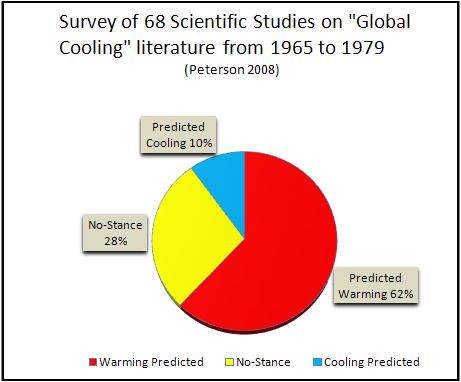
The fact is that around 1970 there were 6 times as many scientists predicting a warming rather than a cooling planet. Today, with 30+years more data to analyse, we've reached a clear scientific consensus: 97% of working climate scientists agree with the view that human beings are causing global warming.
Note: we're currently going through the process of writing plain English versions of all the rebuttals to skeptic arguments. It's a big task but many hands make light work. If you're interested in helping with this effort, please contact me.

Arguments


Staying put and possibly winning a Darwin Award would seem to preclude further evolving...
The Yooper
If Man has affected climate, why does it appear so insurmountable to fix? And if fixing it is so easy, what exactly is the "alarm" about?
There was a time when we blamed such things on the "gods"... now we are confusing a sense of control with unabated hubris.
When you're in a car heading towards a cliff it is quite easy to step on the brakes. When the guy driving is insisting that there is no cliff... yes that could cause a bit of alarm.
1. The political and economic power of fossil fuel companies and those aligned with them.
2. The very long lifetime of CO2 in the atmosphere.
3. The fact that we're just now, finally, starting to talk seriously about undoing over two centuries of man made CO2 emissions.
"Fixing" the climate mess is conceptually very simple, but in practical terms it's a nightmare of politics, economics, and the need to keep supplying energy (primarily electricity and transportation) in decarbonized forms.
One "insurmountable" part is that we not only "affected climate" (past tense), as you put it. We are still affecting it (present tense) and we will keep on affecting it (future tense). Even if we stop emitting extra CO2 and other GHG's today, we will still see approximately 0.6°C warming during the next few decades, due to climate time lag.
Another “insurmountable” part is to stop almost 7 billion people from using cheap fossil fuels, where the really hard part is to stop the industrialized part of the world from using fossil fuels. I am sure that it is possible to move over to clean and renewable energy, without losing quality of life. There will be a few people who will lose quality of life since they have invested in the fossil fuel business, but there will also be others who will increase their quality of life from the new jobs that will be created around renewable energy. It will, however, take time and effort to do so. And since we might not have too much time on our hands (that’s the “alarm”), I think we better put in a whole lot of effort. But that is just how I believe the future will be like.
Your metaphor is a good one (and humorous), except I am afraid there is actually no one in the driver seat, which is what I meant by "hubris" (philosophically speaking).
Marcus 7,8
Normally there are two or more sides to a story, and I have been open to discussing the possibilities, but it sounds like (for you) there is only one side, and everyone has to believe it. It is curious therefore that you say I belong to a cult.
How is it "hubris" to simply point out the obvious *fact* that human activity is generating over 5 billion tonnes of *net* emissions in the atmosphere per annum (compared to nature, with *net* emissions of less than 10,000 tonnes per annum)? How is it hubris to point out the obvious *fact* that-since the Industrial Revolution-atmospheric concentrations of CO2 have increased by over 100ppm, after having been *stable* for at least the last 10,000 years prior? How is it hubris to point out the simple *fact* that global temperatures have risen by more than 0.5 degrees in the last 60 years-in spite of a drop in Total Solar Irradiance-at *exactly* the same time as the largest increase in anthropogenic CO2 emissions in the last 250 years? How is it hubris to point out the fact that all of this is *entirely* consistent with our understanding of the role of CO2 in the *natural* Greenhouse Effect, & how increased levels of CO2-from human activity-will impact on it? More to the point, how is it "cult-like" to arrive at a point of view based on analysis of *all* the available evidence-as compared to accepting a point of view simply because someone else-without any evidence to back it up-has told you its the case?
You are the man! The human race is so full of its own self importance. A hundred million years from now we will be extinct, the planet will be just fine and it will be really hard to find any sign that mankind even existed.
Shelly understood when he wrote Ozymandias.
Since you dont believe its hubris, I suggest as an individual you not wait for the entire planet get on board. An easy one might be using a clothes line to dry your clothes (if you arent already doing that). If you have room for a garden, start planting vegetables. Sell your car, and when you ride your bike to the store, make sure you buy local products only. I am still not convinced that using solar panels doesnt trap heat that would otherwise reflect back into space, but you can still do your share by reducing energy consumption, turning off lights at night, etc, but the hardest one I imagine is going to be computer down time.
Humanity's efforts to change the planet are pretty feeble compared to what has already been achieved by other life forms.
For example, have you ever wondered where the oxygen we breathe came from? Do a little studying and perhaps you will see humanity in a new perspective.
Having consciously taken steps to reduce your carbon footprint, does this not reflect ideological posturing? In my own case, I'm just trying to survive as best as I can. My only ideology with respect to the possibility of global warming has been to preserve my own personal sense of objectivity. I have conceded more than once that GHG can affect climate, however this is different from saying that CO2 is causing global warming.
You know very well for instance that energy cannot be created or destroyed. You also know that two thirds of the surface of the Earth is covered with water, and that the Earths atmposphere is proportionally thin as the skin of an apple. You know that the extra CO2 man has produced constitutes only 100 ppm above natures 250 ppm. You explain yourself that a GHG problem has been accumulating for the last 100 years, yet you also know that temperature signals are buried in the noise of global statistics. Even the current article explains that thirty years ago, the science indicated we were possibly heading to an ice age. Yet regardless of all this information, you perceive me as being insidious because I question AGW.
As you say, "Wow!"
As you say, "Wow!""
No, you need to read the article properly, especially sentences like this :
At the same time as some scientists were suggesting we might be facing another ice age, a greater number published contradicting studies.
(My emphasis)
I need to read the article "properly"?
"...some scientists suggested that the current inter-glacial period could rapidly draw to a close, which might result in the Earth plunging into a new ice age"
"...some scientists were suggesting we might be facing another ice age"
We choose to see what we choose to see. I assume by reading the article properly you mean I can only be in agreement with the author. I am sorry, but this time the cherry tastes delicious.
Even the current article explains that thirty years ago, the science indicated we were possibly heading to an ice age
Do you see what careful reading can allow you to discover ?
To help, it's the difference between 'some scientists' (which is why I highlighted those words previously, in fact) and 'the science'.
Yes ?
Since 1988 the meme (thank you Michael Mann & the IPCC) has been "Catastrophic Anthropogenic Global Warming".
The underlying argument for CAGW is the increase in the concentration of carbon dioxide in the atmosphere. The pre-industrial concentration appears to have been ~280 parts per million (ppm) compared to the modern 387 ppm. Thus we may have added ~100 ppm of CO2 to the Earth's atmosphere, or 0.1% by volume.
Living organisms created so much oxygen that the iron salts in the oceans were converted to insoluble iron oxides that now appear as ore beds. Eventually, the dissolved iron salts were depleted so free oxygen began to build up in the atmosphere, leading to the modern concentration of >20%.
Compare the achievement of ancient life forms to the puny achievements of humans who added ~0.1% to the atmosphere.
Personally, I support John Cook and the rest of you who want to reduce CO2 emissions but you need to develop a "big picture" perspective that does not exaggerate human capabilities.
There I go again, with the metaphors. Can't help myself...
You see, unlike you, I have been more than willing to countenance a *NATURAL* cause for recent global warming, but the fact remains that the evidence for a *NATURAL* cause has been sadly lacking from your side of the debate. Instead, your side continues to engage in cheap political stunts & the demonization of the entire scientific community! Its not *hubris* to be concerned about how our alteration of the planet's atmosphere-in a short space of time-will impact on our climate, but it is the height of naivety to keep claiming its natural when you have absolutely *NO EVIDENCE* on which to base such an assertion!
There is no such thing as "the science", however it is good to be aware that some people think that way. Thanks for the warning.
You got me very wrong including my insertion there about hubris. We could turn the whole thing around however and perhaps even veer towards the correct "topic". That would be a question like, "could man provoke an ice age?". Supposely all those sulfur based aerosols helped cooling, not to mention what all that nuclear testing did. All these questions seem very difficult and who knows, maybe we were going into an ice age until we "fixed" one problem to only get another. I have a hard time not seeing hubris as a big stumbing block, but I think you did not understand the remark. It is not to say we cant mess up the entire planet, we can, and we are doing this just fine. The hubris has to do with wanting to believe we have all the answers, when in reality the problem is much more complex than we think.
How has said that they have all the answers ?
And the only hubris I have ever seen on this site has been from so-called skeptics claiming that they know better than scientists who spend their working lives on the problems and complexity that is Climatology, and claiming that their pet theory has never been thought of before and is a better answer than AGW. There never seems to be any complexity involved when the so-called skeptics make their bold assertions - they have usually come up with the answer while surfing the Net and discovered secret knowledge from playing around with figures and seeing patterns that no-one else has !
The source of the carbon that humanity is adding to the atmosphere is fossil fuels. You talk about the last three centuries so use a bit of imagination and ask yourself how much will be left of the fossil fuel reserves in 2300 if we continue on our present course of industrialization and population growth.
Long before the CO2 gets to 1,000 ppm fossil fuels will be so scarce (hence expensive) that they will be limited to special applications. We will be forced to depend on nuclear power and in particular the Thorium cycle. If we are clever enough we may even develop fusion power plants. The CO2 problem will have solved itself.
Erratum from an earlier post. I said that mankind had added 0.1% to the atmospheric CO2 concentration. Mea culpa, I lost a decimal place and the correct figure is ~0.01%.
I've added the red lines showing where we are now, about 0.6 deg in the upper figure (Fig 1, which starts in 1880) and 0.5 deg in the lower (starts in 1950). Looks like whoever made those predictions was spot on in Fig 1, but a bit conservative in Fig 7. However, we are well above the 'natural climate variability noise,' so you gotta give it some credit.
The paper? Climate impact of increasing atmospheric carbon dioxide. Check the link to see the authors.
REVIEWS OF GEOPHYSICS, VOL. 12, NO. 3, PP. 447-493, 1974
doi:10.1029/RG012i003p00447
Climate modeling
Stephen H. Schneider & Robert E. Dickinson
On page 487 they write:
"The stratosphere couples to the troposphere through radiation and dynamic processes. For example, the radiative convective model of Manabe and Wetheraid shows that changes in stratospheric temperature (because of perturbations in the concentration of water vapor or carbon dioxide (CO2) concentrations) are generally accompanied by smaller (about one-fifth as large) tropospheric temperature changes of opposite sign [Schneidear and Coakley, 1974]."
Right. Fortunately we happen to know stratospheric temperatures fairly well since 1979, because they can be derived from satellite microwave measurements performed in a single narrow bandwidth channel.
It is RSS channel TLS (Temperature Lower Stratosphere, MSU 4 [57,950 MHz, bandwidth 220 MHz] and AMSU 9 [57,290.344 MHz, bandwidth 330 MHz]). As lower atmosphere is pretty opaque in this frequency band and high up, where it gets thin enough to gradually become transparent, there is not much stuff between the uppermost "visible" layer (it's lower stratosphere, about 17 km high) and the satellite, one does not need a sophisticated computational model with input from multiple sources to derive proper temperatures from radiance data. Therefore I can believe satellite temperature history reconstruction for this particular layer (for lower layers it gets rather complicated).
The effect of two large volcanic eruptions (El Chichón, 1982 and Pinatubo, 1991) are clearly visible. They make the Stratosphere warmer (and the surface cooler, as Schneider 1974 states).
There is a slight cooling trend in this 31 year long record, although discounting eruptions, it is probably less pronounced than indicated in the figure (-0.314 K/decade). It is also quite interesting, that the decrease occurs in a step-like fashion, with steps coincident with eruptions, but being fairly constant in between, even increasing slightly. It suggests some connection between volcanic activity and stratospheric cooling. There may be an overshoot in the response function with a long relaxation time.
Anyway, according to Schneider 1974, whatever caused the stratospheric temperature drop, it is accompanied by smaller (about one-fifth as large) tropospheric temperature changes of opposite sign. Therefore the troposphere must have warmed at a 0.0628 K/decade rate during this time.
That translates to 0.195°C warming of the troposphere since 1979. Unfortunately it is inconsistent with the GISS Surface Temperature Analysis which shows about 0.6°C for the same period.
0.2 C warming since 1979 also is inconsistent with other land surface temperature data sets, with thermal infrared satellite measurements of sea surface temperatures, and with the microwave lower troposphere temperature trends.
Do you mean the radiative convective model of Manabe and Wetherald Schneider and Dickinson based their 1974 understanding of the climate system was faulty?
Exactly what made it off the mark by a factor of 3?
On the other hand, we have a blog comment by BP who sees something in a citation of a 1974 paper by Schneider & Dickinson that contained a reference to another 1974 paper by Schneider & Coakley which in turn referred to a 1967 paper by Manabe that, BP assures us, must imply that the world has actually only warmed by 0.2C.
Righto, I'll put that on my list of things to look into.
:-)
we have a blog comment by BP who sees something in a citation of a 1974 paper by Schneider & Dickinson that contained a reference to another 1974 paper by Schneider & Coakley which in turn referred to a 1967 paper by Manabe that, BP assures us, must imply that the world has actually only warmed by 0.2C
No. I just wanted to point out either something was fundamentally wrong with a model leading climate scientists relied on in the mid 1970s or our temperature measurements are flawed.
Either ... or. There is no third possibility. It's plain logic.
You say it was the model, which assumed constant relative humidity, therefore water vapor and cloud feedbacks increased with increasing temperature. For doubling of the CO2 content this extremely sensitive model had the effect of raising the temperature of the atmosphere by about 2.3°C. Somewhat lower than current estimates, but close enough.
Still, this influential one-dimensional model, which produced convincing results and constituted an important step toward the ultimate goal of designing realistic three-dimensional climate models, which was also used to study the radiative properties of the stratosphere providing reasons to reject proposed supersonic transport (SST) airplanes, missed the relation between stratospheric and tropospheric temperature trends by a factor of three. Why?
I think we could all learn a lot by having a technically correct answer to this question.
"No. I just wanted to point out either something was fundamentally wrong with a model leading climate scientists relied on in the mid 1970s or our temperature measurements are flawed."
You're going to have to spell it out unambiguously. What do you mean by "something"? Vague insinuations are not good enough, please be more specific.
And just for good measure, remember that your recent posts are contaminated with language showing that you consider your preconceptions more important than the actual evidence (e.g. overstating hypotesis as findings). So if you want to be taken seriously, I suggest that you are very very careful indeed with the way that you explain what this "something" could be.
Please. This is the second time recently that you have put words in my mouth that I do not say (see also here).
I generally choose my words carefully here and would appreciate it if you would not rearrange them to suit some rhetorical game of your own.
BP writes: Either ... or. There is no third possibility. It's plain logic.
A third possibility would be that your interpretation of Manabe via Schneider & Coakley via Schneider & Dickinson is incorrect.
It's not exactly like no one has thought about the radiative-convective fluxes between the troposphere & stratosphere since 1974. I haven't heard any concern that the calculated MSU TLS temperature trends are in deep irreconcilable conflict with atmospheric models. Maybe people are really concerned about this, in which case I would assume there would be references to it in the literature post 1974, and in sources that can be cited a bit more directly than your convoluted chain of telephony here.
sources that can be cited a bit more directly than your convoluted chain of telephony here
Here is the original Manabe paper.
Vol. 24, No. 3 Journal of Atmospheric Science, May 1967, pp. 241-259.
Thermal Equilibrium of the Atmosphere with a Given Distribution of Relative Humidity
Syukuro Manabe and Richard T. Wetherald
Fig. 12 (Vertical distribution of radiative convective equilibrium temperature for various values of water vapor mixing ratio in the stratosphere) and Fig. 16 (Vertical distribution of temperature in radiative convective equilibrium for various values of CO2 content) show a possible cause.
The layer of stratosphere channel TLS (57 GHz) is sensitive for may be too low (peak sensitivity at 17 km), the divergence grows large only above it. Do we have upper stratosphere temperature time series?
That is exactly one of the things I was skeptical about in your chain of reasoning, given that the trends at different heights in the stratosphere are quite different (at higher altitudes CFC-associated ozone depletion also complicates the analysis of temperature trends, something that wasn't anticipated in 1967). See Randel et al 2009, fig. 19:
Figure 19. Vertical profile of temperature trends for 1979–2005 derived from each of the individual SSU and UAH MSU4 satellite data sets, averaged over 60°N–°S. Vertical bars denote the approximate altitude covered by each channel, and horizontal bars denote two-sigma statistical trend uncertainties. Results are also shown for trends derived from radiosonde data averaged over 60°N–°S.
The solar cycle also has a much stronger impact on stratospheric temperatures.
The data from the mid to upper stratosphere are not as reliable as those from the lower stratosphere, for a number of reasons. They do show strong cooling (around 0.5C/decade in the middle stratosphere, even more at higher altitudes), but it seems to happen in a curious stepwise fashion that I'm not sure anyone has completely explained:
Figure 18. Time series of near-global average temperature anomalies derived from SSU data, for each individual channel (as noted). Data for channels 26x and 36x are shifted for clarity.
I am agnostic about the causes of that stepwise downward pattern. I wouldn't be surprised if it turned out to be partially due to an interaction between the CO2-induced cooling trend, stratospheric ozone, and the 11-year solar cycle (which as mentioned above has a stronger effect on stratospheric temperatures). On the other hand I also wouldn't be surprised if it was partially due to problems with the intercalibration of different SSU sounders on different spacecraft. Given all the uncertainty in the SSU record, I have generally been reluctant to draw much in the way of conclusions about temperature trends there, other than that they superficially seem to be more or less in agreement with what we expect.
Randel et al. (2009) and Shine et al. (2008) seem to be very relevant (and very readable).
it seems to happen in a curious stepwise fashion
Steps are synchronous with major volcanic eruptions.
Thompson et al. 2009
Also note that expected greenhouse gases cooling in the lower stratosphere is much lower than the observed trend:
"The resulting analyses reveal that the distinct drops in
global-mean stratospheric temperatures following the
transient warming due to the eruptions of El Chichon
and Mount Pinatubo are linearly consistent with con-
current drops in ozone. We note that the several-year
period after the eruption of Mount Pinatubo is unique
in the global ozone record, insofar as it is the only pe-
riod in which concurrent ozone decreases are observed
across, not only the tropics and NH midlatitudes, but
also SH midlatitudes. The analyses further suggest that
the weak rise in global-mean temperatures between the
eruption of El Chichon and Mount Pinatubo is consis-
tent with the concomitant weak rise in ozone, and the
results clarify that the seemingly mysterious rise in
global-mean stratospheric temperatures since ;1993 is
consistent with increasing stratospheric ozone juxta-
posed on global-mean cooling of ;0.1 K decade.
Observations reveal that the substantial cooling of the global lower stratosphere over 1979–2003 occurred in two pronounced steplike transitions. These arose in the aftermath of two major volcanic eruptions, with each cooling transition being followed by a period of relatively steady temperatures. Climate model simulations indicate that the space-time structure of the observed cooling is largely attributable to the combined effect of changes in both anthropogenic factors (ozone depletion and increases in well-mixed greenhouse gases) and natural factors (solar irradiance variation and volcanic aerosols). The anthropogenic factors drove the overall cooling during the period, and the natural ones modulated the evolution of the cooling.
the results clarify that the seemingly mysterious rise in global-mean stratospheric temperatures since 1993 is consistent with increasing stratospheric ozone juxtaposed on global-mean cooling of 0.1 K/decade
I still don't get it. After the recovery from the Pinatubo event lower stratosphere temperatures go with no trend whatsoever.
At the same time there is no clear trend in ozone either. Some recovery is seen indeed after Pinatubo, but then it started to decrease again (after 1998, even more so after 2003).
For the same period GISS Surface Temperature Analysis shows at least 0.32°C warming for Global Annual Mean Surface Air Temperature.
According to the Manabe model, we should have five times as much cooling (that is, -1.6°C) in the upper stratosphere. Even if sensitivity characteristics of TLS are taken into account, one would expect at least twice as much cooling in lower stratosphere than the warming rate of the surface. It would mean 0.64°C in the one and a half decades considered (-0.43°/decade).
If Thompson 2009 is followed in that current lack of temperature decrease in lower stratosphere is due to an increase of ozone (in fact it is not), the -0.1°C/decade they find as a residual still seems to be far too small.
It would imply a 0.08°C warming of the surface in 15 years, that is, 75% of the observed warming should come from something else than GHGs (UHI? soot?).
The problem with this solution is climate sensitivity would be less than 1°C/doubling of CO2, that is, water vapor/cloud feedback is strong negative, which contradicts computational climate models.

Bolin and Bischof, 1970 Variations of the carbon dioxide content of the atmosphere in the northern hemisphere
Six years of measurements (1963-1968) of carbon dioxide in the troposphere and the lower stratosphere are presented. The data reveal an average annual increase of the CO2 content of 0.7 +/- 0.l ppm/year, while during this time the annual industrial output has increased from about 1.9 ppm to 2.3 ppm/year.
...
Accepting 35% as being the most likely net increase in the atmosphere as compared with the total output yields 332 ppm for 1980 and 371-378 ppm for year 2000 if using the values for CO, output based on the OECD estimates.
And the 2000 annual CO2 average was: 369.4ppm




