





What's in a trend?
Posted on 13 July 2010 by muoncounter
Guest post by muoncounter
Over at a popular denialist site, folks are chatting about how hot it was during June. But they reassure one another that it’s really OK: the trend in the latest UAH Lower Troposphere temperature anomaly data remains well below the nominal trend of 0.2C per decade. And after all, the June 2010 anomaly was less than the 1998 peak, which suggests no warming at all!
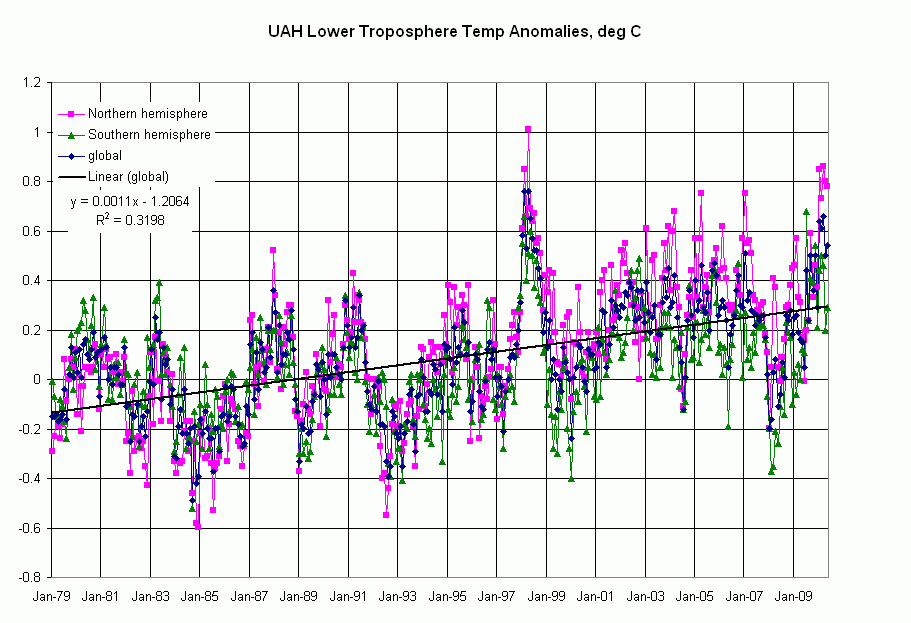
The UAH data are available in text form here. At the bottom of each column in the text file, there’s a value given for ‘Trend’. The graph below shows the data for global (dark blue), northern hemisphere (pink/purple) and southern hemisphere (dark green). The value given for the Global Temperature Trend is 0.14 degC/decade, which is in good agreement with the slope of the best fit line shown.
Link to the full scale graphic
These monthly data are quite noisy, as indicated by this line’s appallingly low R^2 of 0.32. We can quickly create an annual average, which is shown with annual minimum and maximum in the following graph.
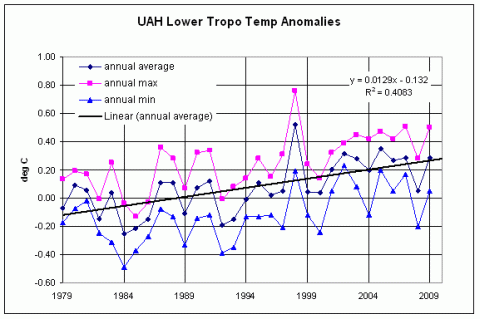
Same trend, but still noisy (if only 1998 hadn’t been so darned hot). But with this trend, it will be 50 years before the temperature anomaly passes through a measly 1.0 degree C.
During the same time period as the UAH temperature data, atmospheric CO2 (MLO, annualized) increased by approximately 50 ppm, representing a trend of 17 ppm/decade. Doubling atmospheric CO2 will supposedly lead to a 3 degree C increase in global temperature, but at this rate, even that won’t happen for another 150 years or so.
It’s all good; we can sip another frozen margarita from the comfort of our inflatable pool chairs.
Side note: In my prior life in the oil exploration business, we often played “trendology”: If you didn’t know anything about a particular oil producing area, you could start by drawing lines between existing oil fields. Sometimes this actually worked and you found a new field “on trend,” but in those days (the late 70s-early 80s), the trends told us that the price of oil would be heading towards $100/bbl by mid1986. In case you weren’t there, it bottomed around $12 that year.
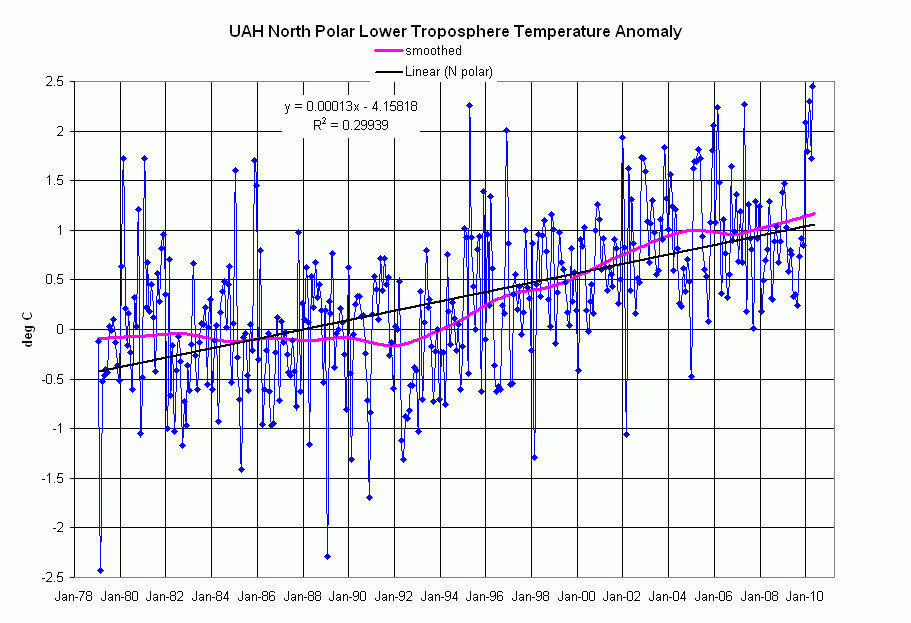
It is in the north polar data (where Official Trend value given in the UAH data file is an unhealthy 0.47 deg/decade), that a different picture emerges.
Link to full size graphic
Link to graph with plus/minus standard deviation overlays
The single best fit line shown, with another appallingly low R^2, matches that Official Trend. The curve shown in pink, however, is a fit obtained by use of the LOESS utility for Excel, available free here. LOESS or LOWESS is a locally-weighted fit utilizing subsets of the data to produce a smooth curve. The smoothing strength is user-controlled. Please note that I haven’t done any comparative smoothings; the pink curve was a first try. Although I haven’t scrutinized the algorithm, it looks similar to what we called “adaptive fitting,” often used in the oil business to generate contour maps from sparse data.
What do we observe from the LOESS curve? For the first 13 years in the data set, the curve is nearly flat. Beginning in 1992 and running for approximately 12 years, there is a sustained slope representing an Alarming Trend of 0.9 deg/decade; after a two year flat spot (approx 2005-07), we’re back on nearly the same trend!
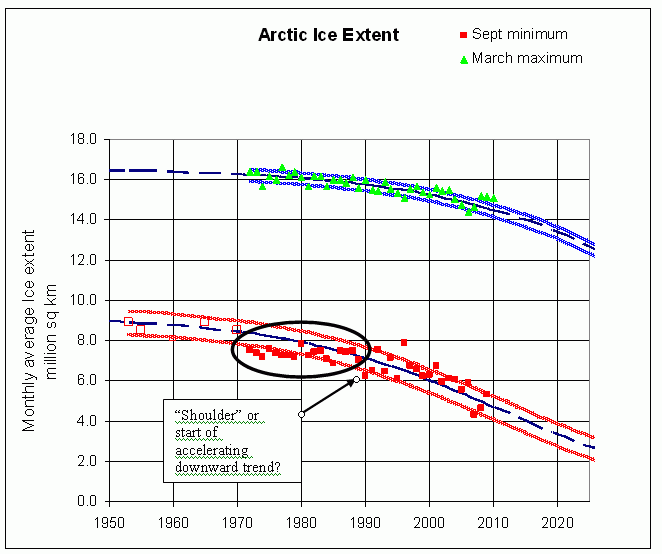
Seasonal Arctic sea ice extent data for the corresponding period are shown below; ignore the curves on this graph for a moment. The minimum ice extent data points from the 1970s to 1990 (points inside the oval) are nearly flat; is the “shoulder” at 1990 the beginning of a real response to this Alarming Trend? Even the deniers realize that there’s some rapid ice melt this year.
link to the full scale graphic
Is the Alarming Trend, 90% higher than the Official Trend, responsible for the accelerating arctic ice melt documented here and here? These observations beg the following questions, which I pose to the community at large:
- Why were the temperature anomalies (and the ice extent) so flat during the 70s and 80s?
- What mechanism might have set the northern latitude temperatures on such an Alarming Trend from 1990 on?
- How do we get the people who report such things to stop using a single straight line trend to describe a complicated, long term data set?
In case you doubt the importance of question 3, consider this: In the UAH text file, a monthly data set lasting 31 years, there are approx 370 points for each column. Try this experiment: Project any column forward from its last point for the remainder of 2010 using an arbitrary value, say 0.1 deg/month (yes, you get a ridiculous value for December 2010, but this is an example). Fit a straight line to the entire column, including your projection. The slope you get will not vary from the Official Trend by one significant figure; the data set is dominated by the 'inertia' of all those earlier points.
To further illustrate how badly “Trend” misrepresents a data set: Here is the GISS temperature anomaly, with what would be reported as its Official Trend (a paltry 0.06 deg/decade) and a LOESS smoothing (red curve). The slope at the tail end of the LOESS curve is approximately 0.15 deg/decade, a reasonable match to the slope we obtained earlier from the UAH LT global data (green points in this comparison graph). Lines of slope 0.15 deg/decade are overlain for reference.
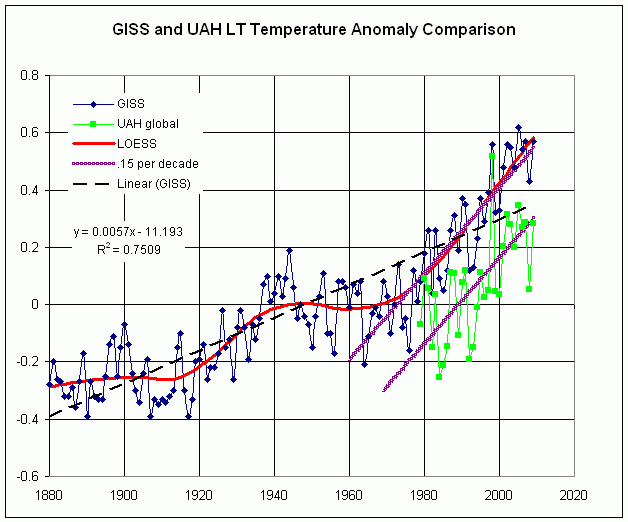
Link to the full scale graphic
Makes you feel good when two different datasets agree on the rate of global temperature increase; I guess there’s something to this global warming after all.

Arguments


http://dotearth.blogs.nytimes.com/2010/03/22/new-light-shed-on-north-pole-ice-trends/
As was the case in 2007, ice up there can change as much through motion as melting, Arctic scientists tell me.
Other than that, this is an interesting post, muoncounter - thanks, it provides another perspective on trends.
In it he suggests that two thirds of the recent arctic warming is due to this shift in the climate patterns of the earth. Maybe one third GHG.
Specific to your 3 questions
1) 1970-1980 represent the point when the AMO index was at it's lowest and just beginning to rise.
2) 1990 is the point at which the detrend arctic and antarctic temp records cross which suggests a point when the extra warming from shift in climate regimes rather than increases in GHG really kicked in. Post 1990 warming is the sum of GHG and AMO effects.
3) [cynicism on] straight lines allow for simple singular explanations for trends. Complicated trends demand complicated explanations [cynicism off]
The large block of decades old ice along the northern edge of the Canadian archipelago and Greenland broke up and started to drift out of the arctic. Prior to that this had been a massive block which endured year after year and served as a 'plug' forcing most of the younger / thinner ice to remain in the arctic basin each year. Warming got severe enough to break up the plug and now we're seeing accelerated ice loss. Even without further warming we'd see the arctic continue to decline because that solid plug is gone and won't come back until temperatures drop below where they were circa 1990 and stay there.
Exactly the type of thing I was looking for! Thanks.
#2, #3: I don't like removing months here and there. Rather, the ninos/ninas appear as short term events, which (IMO) need to get filtered out to see long term behavior. One thing I did, but did not include here, is a graph of the global data with the straight line trend subtracted out. There is a very distinctive sawtooth pattern with a 4-6 year period and that annoying spike in '98. But these are removed by the curve fit, which is not unlike a moving average.
#4: See the last graph. Tweaked or not, UAH and GISS show the same overall pattern for the last 30 years. Or is that what you mean by 'tweaked'?
#5: I looked at UAH's South polar record; it's basically flat (with even a slight downward look). Nowhere else but in the Arctic does one see such numbers as the Official Trend (0.47) or the Alarming Trend (0.9).
HR, the Antarctic down/Arctic up is highly asymmetric. Must be more to it than a 180 phase shift. Are you suggesting some sort of heat flow from south pole to north pole, which seems anti-thermodynamic?
As for <CYNICISM></CYNICISM> (why isn't that an HTML tag?), sure. It seems to be a human tendency to see lines in everything, even when they may or not be there. I once had to explain to an oil company executive why straight lines on a map were not really straight over long distances because, err, the earth isn't flat. Have you ever shown anyone a 'right triangle' on a globe, consisting of 2 longitudes and a latitude? Easy picture to draw, but what about those 2 90 degree angles?
But the UAH data are posted by a science group at a university; why can't they assume their audience is college educated and can handle the mathematical equivalent of 'big words'? By providing a single 'trend', are they not creating a false impression? Especially among the "Details? We don't need any stinking details!" crowd.
Non-geologists don't seem to realize that ice events are discontinuous. Ice dams form and hold ice or water back until a semi-catastrophic break occurs. The regime after that break may be totally different from what it was beforehand. Yet another reason why a single 'trend' isn't just misleading, its incorrect.
but apparently the text interpreter thought it is!
The asymmetry is there because of the GHG trend. Once this trend is removed from the arctic and antarctic the symmetry looks good. Have a look at the paper if you can get passed the paywall.
I'm not exactly why you're picking on UAH for using single trend lines. it seems like SOP for climate science.
Its not so much 'picking on', as it is citing UAH as a specific example. I saw the blogpost about this past June's temperatures, which mentioned UAH specifically and used their straight line trend as a standard. Prior to reading that, I've seen straight line fits all over, but mostly disregarded them.
#11: "but you can't say much about the global climate trends looking at a few months or years."
All too true. However, when you see a pattern that persists on a 15 year time scale abruptly change, you have to wonder whats going on.
Here's a graph of AMO and SOI straight off the PSD data selection plotter.
Here are UAH N hemi ocean LT temps with a smooth curve extracted in the same manner as the polar data in this article. Similarly, I found a long term trend in the AMO time series.
Here are UAH S hemi ocean LT temps with the same curve fit and a long term trend extracted from the SOI.
The two ocean oscillations are certainly out of phase (most of the time); they reach their respective extrema in the late 80's and their long term trends do indeed cross over from time to time. But when the AMO started down, the N hemi LT temps kept going up. And when the SOI started up, the S hemi LT temps also went up. Where's the connection?
You read the paper? Mail John, he has a copy.
These graphes whole hemispheres? Chylek is looking at only high latitudes, poles.
The other thing though, is that none of these results (whether RSS or UAH) can properly account for the role that this decade's deep solar minimum has played on the trends. With Solar Activity picking up again this decade, I think it's fair to say that the trend will probably climb to +0.18/decade (or higher) for a 1979-2019 graph.
And Dr. Spencer? He can look at this graph
Despite UAH appearing to be noisier, there doesn't seem to be lots of difference. The slope of the straight line shown equates to 0.16 deg/decade, as Marcus states above (#15). Linear trend of RSS' North polar data (actually N60-N82.5 lat) gives a slope of 0.34 deg/decade.
Like it or not, in the data the deniers often cite, the North pole is getting hotter faster. To state otherwise is to ignore the evidence. Not an interpretation of the evidence, but the actual evidence. No hype, no hysteria. "Just the facts, ma'am."
Problems with one paper don't necessarily carry over into others. But I would probably be a bit more careful when reading a new paper by Chylek, given that history.
What would those indications be?
This! is the first complete decade of a cooling period?
Personally I'd be really pleased if this was right. But I do hope the last few summers here are not representative of a "cooling period".
is nowshould be upon us. As was pointed out here two years ago, the PDO lacks any long term information about global temperature rise.#22: "I do hope the last few summers here are not representative of a "cooling period"."
Same here. If this is cool, hot will be really ugly.





