



 Arguments







Working out future sea level rise from the past
Posted on 9 February 2010 by John Cook
Predicting future sea level rise is tough. A growing contributor to sea level rise is ice sheets that break off into the ocean. However, ice sheet dynamics are non-linear and difficult to predict. The IPCC 4th Assessment Report essentially ignores ice sheet dynamics, predicting sea level rise of 18 to 59 cm by 2100. More recent research accounting for accelerating ice sheets predict sea level rise of 75 cm to 2 metres by 2100 (Vermeer 2009, Pfeffer 2008). Even these latest predictions admit they may not fully predict the non-linear aspect of ice sheet dynamics. However, there is another way to determine future sea level rise that neatly sidesteps the complexities of non-linear dynamics. Look at how sea level has responded to temperature change in the past.
The last interglacial around 125,000 years ago is a period of special interest. The Earth's orbital eccentricity was more than twice the current value, meaning the orbit was more elliptical. This caused warmer summer temperatures than current conditions. Sea surface temperatures at the equator were about 2°C warmer than pre-industrial levels. Ice cores from Greenland and Antarctica find polar temperatures were about 3 to 5°C warmer than today.
Thus the last interglacial provides an insight into where our climate is currently headed over the next century and beyond. A global compilation of sea level indicators from reefs, corals and sediments were used to estimate global sea level during this period. The result was that it's very likely (95% probability) that sea levels were at least 6.6 metres higher than today. It's likely (67% probability) that sea levels exceeded 8 metres (Kopp 2009).
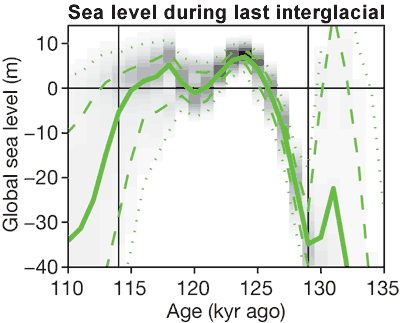
Figure 1: Probability density plot of global sea level during the last interglacial. Heavy lines mark median projections, dashed lines the 16th and 84th percentiles, and dotted lines the 2.5th and 97.5th percentiles (Kopp 2009). Global sea level of 0 represents current sea level.
Independent analyses of the last interglacial paint a similar picture. A number of studies have found sea levels during the last interglacial much higher than modern levels, all concluding that ice sheets are very sensitive to temperature change (Blanchon 2009, Overpeck 2006, Rohling 2007). It's important to note that this doesn't mean sea levels will rise 6.6 metres by 2100. It takes time for the ice sheets to respond to warming and there is still much uncertainty over exactly how quickly sea levels will reach such levels.
Nevertheless, the bottom line is the global warming expected over the next century will take us to temperatures that in the past raised sea levels over 6 metres higher than current levels. This is a sobering fact for the millions of people concentrated on coastlines.









The increase in sea level rise is even starker when all the water impounded in reservoirs is also taken into account (Chao 2008):
By the way, the results of the Church 2008 paper have been available on the "sea levels aren't rising" page since I posted on the topic in May 2009. What I should've done was link to that page in my responses to #10 and #17 - I have now corrected that oversight.