A thoughtful conservative perspective on climate
Posted on 29 December 2011 by Tom Smerling

Peter Wehner has impeccable conservative credentials, having served under Reagan, George H. W. Bush, and most recently, as deputy assistant to Pres. George W. Bush. He resides at the "Ethics & Public Policy Center," a neo-con think tank.
After a long look at the evidence, Wehner concluded that the scientific consensus on climate is correct. He wrote two interesting posts titled "Conservatives and Climate Change," in the neo-con magazine Commentary, which prides itself in intellectual conservatism.
Wehner makes a nod to scientific uncertainties and the potential dangers of excessive government intervention, and he firmly rejects alarmism. Climate hawks will find plenty to argue with, but these caveats are worth considering because a) most have some merit, and b) they clarify exactly where many conservatives get stuck. If we don't address conservative reservations and fears directly, we're failing to get at the roots from which science denial stems.
More importantly, Wehner explicitly separates the question "Is it happening?" from "What should we do?" -- in itself a major step forward -- and for the most part he accepts the science. His gutsy stance is particularly welcome following the recent recantations by born-again climate agnostics Romney, Gingrich and Huntsman.
Check out these excerpts (The full posts are here at Part I & Part II)
"The world is getting warmer. The warming is almost certainly caused, at least in large part, by human activity. And rising temperatures could pose a future risk, though how significant of a risk is open to interpretation. . . This is not a liberal invention; it’s physics.
Conservatives should be part of that conversation. There’s an intellectually credible case to be made that it’s unwise to embrace massive, harmful changes to our economy in the face of significant uncertainties . . . [yet] to acknowledge global warming does not necessarily lead one to embrace Al Gore’s environmental agenda.
But rather than offer constructive ideas on how to deal with global warming, some conservatives simply deny global warming has occurred. Their concern is that admitting global warming is real opens the door to government restriction on liberty, so it’s simply better to keep the door bolted shut. . .
[Yet] the problem for those who deny global warming is empirical: Earth’s temperatures have increased and human activity has contributed to it. To deny this is to deny reality, to subordinate truth to ideology. And in the long run that can only damage conservatism."
It seems to me that anybody who cares about climate should listen respectfully and engage with people like Wehner who say it is time for conservatives to join the conversation about market-based solutions, rather than pretend that the problem doesn't exist.
Neo-cons are a particularly interesting group in this debate, because they pride themselves on intellectual honesty. If enough people like Wehner speak up, it makes it easier for rank-and-file conservatives to accept the science without feeling they are betraying their identity or their cause.
That's exactly why climate misinformers will try to quickly squelch Wehner for breaking ranks -- and why advocates of an evidence-based approach should rally to his defense. Check out the comments below his Commentary posts. Amidst the usual skeptical talking-points and misperceptions about uncertainty, you'll see other commenters stating openly that their main concern is government overreach, and expressing a degree of open-mindedness when they state "I need more evidence" or "I'm still unconvinced."
Isn't this exactly the audience we need to be engaging with?
[Update 12/22/11: The debate continues to rage at Commentary online. Editor Jonathan Tobin answered Wehner by arguing that "Conservative Skepticism is Rooted in Environmentalist Hysteria." Oddly, Tobin tossed in some of the flimsiest arguments possible ("Warming may be good") and indulged in the very hyperbole and ad-hominism that he accuses the "warmers" of. Wehner replied immediately, with another carefully-reasoned, thoughtful piece that -- citing the IPCC, National Academies of Science, and the US Climate Science Program -- urges conservatives to focus less on the other sides' perceived behavior and more on "those stubborn facts" about climate. See "Conservatives and Climate: Facts Should be Our Guiding Star."]
(This is a cross post from ClimateBites, posted 12-20-11.)

Arguments


It's still good to see these Commentary articles, but let's make sure they are characterized correctly.
You can see for yourself by checking out the website of the Republicans for Environmental Protection (RFP).
In fact, a link to SkS’s own, “The Scientific Guide to Global Warming Skepticism” is prominently displayed on the front page of the RFP’s website.
http://www.npr.org/2011/12/24/144231819/ousted-by-tea-party-rep-inglis-looks-back
And case in point of the inability of people to separate "is it happening?" from "what should we do?": The editor argues against an article saying that warming is happening by saying but warming may be good.
It should be http://www.commentarymagazine.com/2011/12/23/climate-change-conservatives/
BW, in addition to Tobin's challenge, be sure to check out Wehner's excellent response, both linked at this follow-up post to the one above:
A thoughtful conservative -- challenged
@3 Steve L Good point about not lumping all neo-cons, conservatives and Republicans together. What would you suggest as a more accurate way to characterize Wehner and neo-cons vis-a-vis conservatives?
@7 VoxRat re: Inglis. Inglis did not lose "because he acknowledged the reality of AGW," at least according to those closest to the race.
According to Bob Jones U poli Sci prof Linda Abrams, "it was a sequence of things'...over four years."
Which of his many breaks with conservative orthodoxy cost him the most? The article concludes: "The answer may well be "D, all of the above," plus a general sense that he wasn't reflecting voters' mood along with the option of a credible candidate that hadn't appeared before, Abrams said."
It is far easier for conservatives to just deny AGW than to try and fight all the increasing spending, taxing regulations and subsidies to Democrat causes that will be proposed in its name. So they will do it.
{ - off topic political statements snipped -}
Hence:
Decepticon.
If anyone knows a way to demonstrate to them the consequences of their stupidity policies, yesterday would be an excellent time to lay it out.
Suddenly I think I understand how AGW deniers must feel when confronted with proof that their understanding of 'reality' is flawed in some way. I've gotten too used to these people being 'wrong' about everything... science, economics, foreign policy, social issues (though those are more in the realm of opinion). The last time I really agreed with something they did was when W Bush spoke out against anti-muslim bigotry in the US... and I couldn't believe he was on the right side of that either.
That said, I think I'm on solid ground saying this guy is the exception rather than the rule. The idea that rational scientific discussion about AGW, evolution, anything environmentally related, et cetera could flourish in any major branch of US 'conservatism' (as much a misnomer as 'skeptics' IMO) seems more than far-fetched.
nice subversive use of the 'al gore' dog whistle in the excerpt; talking to them in their own language!
Because American politics is so polarised due to fear of the media and big corporations, then writing an article about a conservative politicians views about climate science makes the article political.
But the problem isn't with the article, the problem is with American politics and that is why the article is justified.
Statistically there should be more American conservatives that agree with AGW, the fact that there isn't suggests that more than just facts are distorting the stats.
Speaking as an American, Republican-voting conservative who agrees with climate science and AGW, the issue more properly is not that there isn't more American conservatives that agree with AGW. There are ample conservatives who believe in the science (what little they know of it).
The real issue is that they are not in a position of authority and that they do not speak out. The rank and file American conservative is more preoccupied with job security, keeping the lights on and feeding hungry mouths that depend on them.
It is thus their elected representatives that have kowtowed to the "special interests" (that have a vested interest in the status quo) that comprise the real stumbling block.
When you cannot stop the avalanche then preventing the snowballs from rolling downhill that causes the avalanche is the agenda being prosecuted by the lobbyists.
Yeah, I got the impression from that NPR piece it was due to the AGW thing, but now that you mentioned it, I read up elsewhere and see that there were other issues.
The polls say otherwise.
"their elected representatives that have kowtowed to the "special interests""
Who was it that said we get the kind of government that we deserve? de Tocqueville:
... a democracy could see "a multitude of men," uniformly alike, equal, "constantly circling for petty pleasures," unaware of fellow citizens, and subject to the will of a powerful state which exerted an "immense protective power".
That is an accurate description of the current state of our government; just substitute 'corporate greed' for 'state.'
Basically, I think the recent marketing strategy of the conservative/republican leadership (since ca 1994) has increasignly been to elicit broad populist distrust of targeted issues that can be characterized as elitist, intellectual or liberal. These issues are characterized as attempts to impose a different set of core values on "regular people" or that they reflect self interest on the part of the elite (implicitly at the expense of the regular folk through taxes, regulation).
The focus on specific ersonalities (Gore, Hillary, Pelosi, Obama) allows them to paint movie villains that fit these preconceptions neatly and provide a focus for distrust. "Scientists", with their white coats, crazy hair and evil laughs, are easy targets too. Linking these personalities to specific issues then becomes a form of branding by association. AGW, Al Gore and Dr. Frankenstein become inseparable.
It's a strategy that can be applied to a large range of issues with relative ease because it builds on a set of preexisting inclinations and a few carefully crafted characterizations developed over a long period of time. Especially in the current economic climate, it effectively generates anger and activism among the rank and file, while also serving monied special interests that fill the campaign coffers. Its quite brilliant from a purely strategic point of view. The democrats try to mimic it, but I think their rank and file are less susceptible to this approach.
The problem is that this broad brush strategy generates such wide ranging cynicism about intelligent discourse and such political and social polarization that any basis for policy discussion and compromise gets "boxed in" by partisan fervor, even within the party itself. Also, because the strategy seems to be based primarily on locating convenient targets that elicit both populist distrust of the other party and special interest dollars, reality and policy positions can easily become divorced from each other. Eventually both things make it hard for the leadership to lead in a meaningful way.
Personally, I think we're seeing the downside in congress and in the Republican primary race right now. The need to resort to transparent tricks like referring to the rich only as "job creators," also highlights the inherent tensions in this appraoch. I'd like to think it will eventually force a reconsideration or recalibration of strategies that will enable conservatives to see the point of embracing the science behind AGW and other issues. But that could be slow.
Some see the Earth essentially as a gift to mankind - one that deserves stewardship and respect, but is essentially for our benefit. On the other hand, some see humans as interlopers mooching off the Earth - so the Earth should be protected from bad human activity.
Both viewpoints have their irrational extremes - blatant environmental abuse for petty profit on the one hand, and wholesale abuse of human rights on the other...
If you must make a judgement call, just compare a two of examples: Exxon Valdez spill (~250,000 sea birds, ~3,000 sea mammals) to the banning of DDT in 1972 (~90,000,000 premature deaths, billions suffering from malaria)...
I believe this dichotomy in viewpoint underpins the difference in the conservative vs. liberal response to AGW.
Some see fossil fuels (and nuclear...) as a opportunity to benefit mankind - quite a bit of evidence would be needed to convince them to abandon the use without an attractive alternative. The other viewpoint would easily accept that something that benefits humans must be adverse to the environment... and must be stopped.
Nonsense.
This is the same kind of ridiculous fiction we regularly see applied to global warming. The 'ban' in 1972 prohibited the use of DDT for agricultural spraying in the United States. How has that caused millions of deaths / billions to suffer malaria? Spraying for public health reasons, i.e. to control malaria, remains legal in the U.S. to this day and the 'ban' never involved any form of spraying outside the US.
"Some see the Earth essentially as a gift to mankind - one that deserves stewardship and respect, but is essentially for our benefit. On the other hand, some see humans as interlopers mooching off the Earth - so the Earth should be protected from bad human activity."
Actually, I think most environmentalists see it more in terms of 'do not foul your own nest'.
Paul Krugman’s “Republicans against science” (Views, Aug. 30) states that “odds are that one of these years the world’s greatest nation will find itself ruled by a party that is aggressively anti-science, indeed anti-knowledge.”
This line reminds me of the great H.L. Mencken’s words in the Baltimore Evening Sun in 1920: “As democracy is perfected, the office represents, more and more closely, the inner soul of the people....On some great and glorious day the plain folks of the land will reach their heart’s desire at last, and the White House will be adorned by a downright moron.”
Woodrow Wilson was president at the time; to be followed by Warren Harding, Calvin Coolidge and Herbert Hoover. We all know what happened next.
Peter W. Gerrard, Kehlen, Luxembourg
Letters to the International Herald Tribune
Politics and Science
This report is an excellent summary, providing a context for some of the political struggles on the larger stage.
Our biggest challenges are: (1) State budget crises that will severely limit environmental agencies’ capacity to implement and enforce the Clean Air Act, Clean Water Act and other environmental laws; (2) Unprecedented ideological opposition to environmental progress among too many state legislators across the Midwest; and (3) The public’s focus on job creation and retention rather than environmental and other quality of life issues.
This is an example of the principle that "All politics is local":
Politicians must appeal to the simple, mundane and everyday concerns of those who elect them into office. Those personal issues, rather than big and intangible ideas, are often what voters care most about...
Climate change will remain 'big and intangible' - until we figure out a way to make it personal; and that's a tall order, as this year of disastrous weather was very personal indeed.
As for that DDT issue, why did you believe the version that you just tried to regurgitate here? How much did you research it?
Concerning those who supposedly see fossil fuels as an opportunity to benefit mankind, it is patent that the amount of evidence they would need to change their viewpoint is infinite. That seems to be especially the case for those who sit at the top of the pyramid of "benefit."
http://mtkass.blogspot.com/2010/10/forget-climate-change.html
thank for sharing Menken's thoughts, so prescient of contemporary drift of our democracies toward populism. An unwelcome corollary of populism is that who's in office or in charge of something do not take any responsability because he's just representing the will of the people. What Menken ironically call the perfection of democracy actually is the end of it.
“Capitalism vs. the Climate”, The Nation (USA) magazine, Nov 28, 2011 print edition.
Click here to access this in-depth and thought-provoking cover story by Naomi Klein.
Wehner goes on to claim: "There's an intellectually credible case to be made that it's unwise to embrace massive, harmful changes to our economy in the face of significant uncertainties based on incomplete knowledge of how the climate system will respond in the middle part of the 22nd century." As long as we're talking about 'uncertainties': where does the unanimous conservative 'certainty' of 'massive, harmful changes to our economy' come from? The most credible accounting of these changes, the Stern Review, places the cost at 2% of global GDP, which is 1/5th to 1/20th the cost of doing nothing. And that was before photovoltaic costs started plunging.
This is what kills me about this 'conversation' we are having with American conservatives. We're so happy to find one of them admitting that AGW is real that we'll publish his claim that until we know, with certainty, what the climate will be 140 years from now, it would be 'unwise' to impose 'certainly harmful' green technologies on poor Americans. Regarding conservative actions over the last 15 years (deregulation of banking, disinterest in derivative and housing bubbles, invasions over 'certain WMD', Supply-Side economics) the most inevitable certainty of all has been the certainty of AGW, the one certainty conservatives still doubt! Wehner, like most of his ilk, plays fast and loose with the concept of 'certainty', and their record is not exactly good.
it seems that after BEST the minds in USA and elswhere are changing. See also the excellent article of Susan Hassol at the AGU-Fall meeting 2011 (http://vimeo.com/33298236 ) - I am eager to experience when the GERMAN EIKE is changing their attitudes :)
I agree ... that global warming is a manageable risk, not an existential crisis. And I have argued that there are significant uncertainties on how the climate system will respond a century or more from now. But for some on the right ... to insist that AGW is a hoax, the product (more or less) of a massive conspiracy, is, I believe, damaging to conservatism. That is something I do care about.
This is not about what is damaging to one part of the political spectrum. What you should care about is the fact that inaction due to these perceived uncertainties is exactly what will turn 'manageable risk' into existential crises.
Contemporary liberalism can do as it will. But for conservatism, facts–those stubborn facts–need to be our guiding star.
When have facts ever been the guiding star in any ideological debate? Look no further than the tripe put out by the all-conservative-all-the-time American Enterprise Institute, who happily liken those who understand and accept AGW science to a religious cult:
All the trappings of religion are there. Original sin: Mankind is responsible for these prophesied disasters, especially those slobs who live on suburban cul-de-sacs and drive their SUVs to strip malls and tacky chain restaurants.
Yep, those stubborn facts. Some guiding star.
Perhaps more than anything, Mr. Wehner and others like him, coming from the "left", prove that more than ever, it's time for a true Independent 3rd Party.
I do not hold with the Humpty Dumpty theory of word mastery, as apparently you do. Instead I use words according to their meaning, and according to its meaning, "extremist" is pejorative and vilifying.
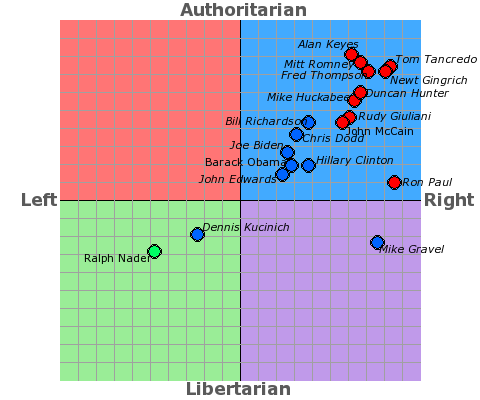
I am equally inclined to use dichotomies according to their correct meaning. On the basis that Lenin and Trotsky occupied the extreme left of the political spectrum, it is very clear that main stream US politics occurs within a range from center left to a very hard right. (Note this spectrum reflects economic policy, and not the authoritarian-libertarian scale.)
(See politicalcompass.org)
Finally, agreement with Mr. Wehner, and certainly not qualified agreement in no way indicates that you are left of center. His stated position in the articles in question amounts only to a qualified acceptance of the science, and scientific fact knows no politics. The most left wing policy position Mr Wehner espouses is the view that,
Next you'll be asking for credit as a radical lefty because you did not disagree with all of George W Bush's expenditure to help rebuild New Orleans after Hurricane Katrina.

"Furthermore, I agree with many, though not all of his points. It this age of political polarization, with the world being cast in black & white terms..."
Not the world. Mainly just the US.
I have yet to see an explanation of how a high carbon tax and rebate (e.g. proposed by Hansen) would harm the economy. It would also require a tariff based on the carbon intensity of imports. I think economic harm could come from the political process especially horse trading on tariffs.
Second, such a scheme would result in a switch to renewable energy/nuclear power generation which have a higher base cost (excluding externalities) than the current fossil fuel mix. Because they are low to zero carbon emission technologies, they would not generate money for the rebate even though their higher costs will feed into the overall cost of electricity. In fact, the more successful the scheme is, the lower the carbon tax contribution to the overall increase in power costs, and hence the lower the rebate as a proportion of increased costs.
Of course, some of the initial adjustment to higher energy costs will be through increased energy efficiency. Further increased usage of renewables may bring unit costs down so that production costs of energy are below current levels. So it is possible a carbon tax could result in a net benefit economically. But probably it will result in a small cost.
Still, we probably shouldn't laud any conservatives who accept climate change as real and human caused. It would lower their standing among other conservatives.
Perhaps we need to separate 'old' (pre-Thatcherite) conservatives from the modern version. A true conservative was, I believe, originally someone who was skeptical and resistant to change. A good many of them could be reasoned with, however, and would accept change if it was made clear that the facts overwhelmingly supported that change.
The conservative movement in North America has largely been taken over by people who simply won't accept the data. So I don't see them as conservative in the original sense. Data contrary to their POV are viewed as lies, part of a conspiracy against what they see as the truth. Thus any scientists who produce such data must be part of the conspiracy. The same is true for any economists who dare suggest (with data) that tax cuts are not always a good thing and that public intervention is sometimes a good thing.
I wonder if this ability to dismiss data traces back to the postmodernist philosophy that invaded universities back in the 60s. Ironically, it was introduced by people of a decidedly leftist view, but it quickly spread throughout much of academia and then into the mainstream. Too bad we can't set the clock back and squash it before it spread.
I am not sure that libertarians and true conservatives really have much in common. Libertarians are fine examples of where postmodernism can take you. As are the neocons. Both are really radicals, not conservative at all.
Until something is done to weaken the hold that postmodernism has on public discourse, depending on the facts as a winning strategy is unlikely to be very successful.
But the very fact of aggreeing with that is perceived as leaning "left." That's very alarming. This is truly a behavior that was normally reserved to religious dogma.
I wish I could say that the left is not guilty of comparable errors in different areas, but these can be found.
The biggest enemy of mankind in the 21st century may very well be ideology. In the 20th century, ideologies, possibly for the 1st time, killed more people than micro-organisms. Tens of millions of people, between the 2 world wars battlefields, Staline, Franco, etc, etc. Now we've balked a little at the savagery of these manifestations, but others are creeping up on us.
If we don't stop being so enamored of our beautiful ideological constructs that we have to force-fit reality in them by all sorts of self-fooling methods, we don't stand a chance as a species in the long term.
It is not coincidence that the Republican Party cultivated just those Christians as a constituency over the last two decades of the 20th century, and that now the Republican Party is the bastion of anti-science sentiment in the US. Nor is it a coincidence that Europe in which that (strictly heretical) brand of Christianity was never strong is largely immune to the anti-science rhetoric of deniers. Indeed, Europe provides an interesting test case on this point, for Europe was the bastion of post-modernism as the US was the bastion of Christian Fundamentalism.
Please note that my comments are not an attack on Christianity per se, but only a comment on a branch of Christianity that has departed far from the teachings of Jesus.