Global warming on Mars, ice caps melting
The skeptic argument...
Mars is warming
"Some people think that our planet is suffering from a fever. Now scientists are telling us that Mars is experiencing its own planetary warming: Martian warming. It seems scientists have noticed recently that quite a few planets in our solar system seem to be heating up a bit, including Pluto.
What the science says...
| Select a level... |
Basic
|
Intermediate
| |||
| Mars is not warming globally. | |||||
It is hard to understand how anyone could claim global warming is happening on Mars when we can’t even agree what’s happening on the planet we live on. Yet they do, and the alleged reasoning is this; if other planets are warming up, then there is some solar system-wide phenomena at work – and therefore that it isn’t human activity causing climate change here on Earth.
The broadest counter argument depends on a simple premise: we know so little about Mars that it's impossible to say what trends in climate the planet is experiencing, or why changes occur. We do have information from various orbiting missions and the few lander explorations to date, yet even this small amount of data has been misunderstood, in terms of causal complexity and significance.
There are a few basic points about the climate on Mars that are worth reviewing:
- Planets do not orbit the sun in perfect circles, sometimes they are slightly closer to the sun, sometimes further away. This is called orbital eccentricity and it contributes far greater changes to Martian climate than to that of the Earth because variations in Mars' orbit are five times greater than the Earth.
- Mars has no oceans and only a very thin atmosphere, which means there is very little thermal inertia – the climate is much more susceptible to change caused by external influences.
- The whole planet is subject to massive dust storms, and these have many causal effects on the planet’s climate, very little of which we understand yet.
- We have virtually no historical data about the climate of Mars prior to the 1970s, except for drawings (and latterly, photographs) that reveal changes in gross surface features (i.e. features that can be seen from Earth through telescopes). It is not possible to tell if current observations reveal frequent or infrequent events, trends or outliers.
A picture is worth a thousand words, but only if you understand what it is saying
The global warming argument was strongly influenced by a paper written by a team led by NASA scientist Lori Fenton, who observed that changes in albedo – the property of light surfaces to reflect sunlight e.g. ice and snow – were shown when comparing 1977pictures of the Martian surface taken by the Viking spacecraft, to a 1999 image compiled by the Mars Global Surveyor. The pictures revealed that in 1977 the surface was brighter than in 1999, and from this Fenton used a general circulation model to suggest that between 1977 and 1999 the planet had experienced a warming trend of 0.65 degrees C. Fenton attributed the warming to surface dust causing a change in the planet's albedo.
Unfortunately, Fenton’s conclusions were undermined by the failure to distinguish between climate (trends) and weather (single events). Taking two end points – pictures from 1977 and 1999 – did not reveal any kind of trend, merely the weather on two specific Martian days. Without the intervening data – which was not available – it is impossible to say whether there was a trend in albedo reduction, or what part the prodigious dust storms played in the intervening period between the first and second photographs. Indeed, when you look at all the available data – sparse though it is – there is no discernable long term trend in albedo.
At this time, there is little empirical evidence that Mars is warming. Mars' climate is primarily driven by dust and albedo, not solar variations, and we know the sun is not heating up all the planets in our solar system because we can accurately measure the sun’s output here on Earth.
Last updated on 21 August 2010 by gpwayne.

Arguments


Basic
Intermediate


Which begs the next question - how would they know this without taking a sediment sample on Mars?
Answer: they got one with the the Mars orbital satellite.
It has long been known that Milankovitch cycles are the best fit to the available evidence for historic glaciation-deglaciation cycles on Earth. The energy source, the Sun, is extra-terrestrial but there is no evidence that it got brighter or dimmer in proportions apt at changing our climate and in any case, that is not what Milankovitch cycles are. As far as I can recall, the energy received changes because of the planet getting closer, farther, or being oriented slightly different, which is a function of its orbit and precession; in that sense, extra-terrestrial is a little misleading, since these qualities could really be called intrinsic to the planet.
The point of the paper cited by papertiger is that Earth and Mars' Milankovitch Cycles could be resonant. I wonder if anyone has tried to obtain some level of confirmation from pure celestial mechanics calculation. In any case, it is interesting but quite irrelevant to the current terrestrial warming, which does not correlate well with neither Milankovitch nor with the so-called Martian warming. That Martian warming is really a re-warming back to the kind of weather seen by the Viking crafts, and the Earth should now be heading for cooler climate if only Milankovitch was at play.
In fact, there some quite viable hypothesis that explain how non-TSI manifestations of solar activity cause dust storms on Mars (by the way those are possible for the Earth as well). Obviously there is still to little data to confirm or reject them. By don't "get rid of" Mars just yet. Mars is actually quite good "test case" for the anthropogenic vs. natural warming debate. As a planet it is quite similar to the Earth in many important aspects and it is as close as ti the Earth as it gets in the solar system. Some of the main advantages for a possible "Mars test case" are: 1. There is no human activity there to influence the Marsian climate in any way, so we can discount that factor 2. there is no ocean to provide huge termal inertia, so solar effects will be much more immediate, 3. Marsian day is almost identical to Earth's day, 4. Marsian atmosphere is similar Earth's mid upper atmosphere, so this simplifies estimation of the solar effects quite a bit.
The geometrical effects that you mention (orbit's eccentricity, axis tilt) are quite easy to correct for, much easier that cloud structure in the current climates for example.
You do not specify what viable hypothesis explain how non-TSI manifestations of solar activity cause dust storms on Mars, so I can not address that, but I do not agree with your idea that the Martian atmosphere is a good test bed to allow observation of the effect of human activity. Off the top of my head, here are 4 major differences and, in my opinion, each one is enough to invalidate such a comparison without a large amount of research (i.e. several continuous martian weather stations).
1) No magnetosphere so there is a direct ionization of atmospheric particles.
2) I would disagree with your comparison about pressure. If you are looking at total atmospheric pressure, then Mars is more like the stratosphere. If you are talking about partial pressure of CO2, then the surface of Earth is the best we can get, but that is even too low. In any case, both of these do not produce some of the more important effects such as pressure broadening of the CO2 absorption spectrum.
3) There is no water to speak of and thus the vertical thermal transport associated with water does not exist.
4) Finally, the drivers also seem to be much different. Dust storms are a key part of the Martian climate as are sublimation winds from the poles. These have no equivalent on earth.
Regards,
John
"Mars has one of the highest orbital eccentricities of any planet in our solar system which causes much greater seasonal changes than on Earth."
OK, but has the orbit of Mars changed in the last 30 years or the last 100 years to explain the extra warming? If the answer is 'yes' can you explain why and how? If the answer is 'no' then doesn't that point to an extra-planetary explanation? It seems in your article you begin by ruling out the sun, then suggest you're going to offer alternate explanations, then fail to do so. Yes the storms can cause the warming, but what is causing the extra turbulence in the atmosphere leading to the storms?
Pluto has not been observed through a complete orbit yet, arguing about its "climate" is pointless. The observations match expectations from its seasonal cycle and the albedo changes seen since the 50s (likely due to collection of space materials). Furthermore, if the Sun could really throw out the energy to affect Pluto so much, we would be frying.
There is no convincing evidence that Jupiter's "climate" (once again more a figure of speech than a observed reality) is prone to be affected by variations in TSI so minute that we had to have satellites around Earth to actually mesure them.
Among the inner planets, Venus, most likely to show changes due to its proximity to the Sun and huge greenhouse effect is not showing any warming.
We have a handful of probes on Mars and an orbiter. Mars is the planet we probably know the most about besides Earth. And even with that equipment we can only get the faintest idea of what's going on with the temps there on Mars. Or other planets for that matter.
We have laughably few samples of temps on other planets as compared to the astounding array of data on our own Earthly climate trends.
It's absurd to claim with any confidence that we know for certain that other planets or moons are warming or cooling, when we have relatively little data about them -- all the while ignoring our vast armada of land and sea-based temperature probes right here on Earth (not to mention orbiting satellites).
Should we dismiss the data we have on our own planet's temperature trends because of a smattering of temperature measurements on any other planet? Which data-set do you think would be more reliable? The one we have here at home, of course. Because we have many, many more sources and samples, and over a longer period of time.
We know far more about the temperature trends on our own planet than on any other planet, and yet certain people use highly questionable speculations about other planets' temperatures to try to dismiss the dta trends we see here at home.
To use this data (or records from other planets) as reliable evidence of anything more solid than the temperature sampling we have for Earth, is on its face absurd.
I would also like to say that there's too much attention paid to Earthly CO2 alone. Methane and Nitrous Oxides may be at least as problematic. Most of this comes from livestock production. Certainly, getting them under control first will give us more return on investment, and quicker too.
Read the article again. Lots of dust (in 1977) made Mars slightly cooler, and less dust (in 1999) made the planet slightly warmer. On both Earth and Mars, more dust = cooler.
I hope this helps.
On Earth we have buoys, drifters, and satellites measuring the temperature of the oceans; met stations and satellites measuring the temperature of the land surface; boreholes measuring temperatures beneath the surface; and satellites and balloons measuring temperatures in the atmosphere.
That's orders of magnitude more information than we have about temperatures on any other planet.
Same picture, a bit more stylishly presented.
It shocks me that after close to three years, numerous rewrites, you still haven't come close to refuting my original comment.
Noel wrote Noel, you are very, very incorrect, as dsleaton and Matthew pointed out to you.
There is no basis for your claim that Mars "is several degrees C cooler than it otherwise should be." More details on why the water vapor feedback is so much smaller on Mars than on Earth are in David Archer's book "Global Warming: Understanding the Forecast", pages 71-72. If you don't want to buy the book or borrow it from your library, you can watch his class lectures for free.
If you insist on details, here is just one of several examples of calculations that Mars should in fact be the temperature it is:
Forget, et al. (1999).
A general-reader-comprehensible overview of modeling the Martian atmosphere purportedly is provided by Stephen R. Lewis's article "Modelling the Martian Atmosphere, though all but the first page is behind a paywall.
If you really, really, want to understand the difference between Mars and Earth, get ahold of this book when it comes out (probably December 2010); it will have a workbook and computer models you can run: "Principles of Planetary Climate" by Ray Pierrehumbert.
http://www.sciencedaily.com/releases/2011/04/110421190450.htm
Large dry ice deposits in Mars's South pole, that look as if they are currently in a dispersal phase - sublimating into the atmosphere as CO2.
Turning to StanislavLem's comment about other solar phenomena causing dust storms on Mars, reasoning that those are "possible" on Earth as well, is anybody putting forth a cogent theory that dust storms on Earth actually are happening, that they follow the patterns of dust storms on Mars, and that they impact Earth's climate in a significant way?
Is there a general consensus that the only actual significant heat energy from the sun is from TSI, even if other solar phenomena might have other impacts (gravitational/magnetic?) that could indirectly affect climate?
In saying that, I am not ruling out that an empirical close correlation in climate trends between Mars and Earth could persuade me that there is something to the solar effects theories, but my impression from the comment thread is that there has been no clear showing that the trends on Mars and Earth have been parallel.
"The secular increase in temperature seen during the
period 1977–1983 has reversed."
http://www.boulder.swri.edu/~layoung/eprint/ur149/Young2001Uranus.pdf
I brought this up at WUWT a few years ago when this meme was being trotted out more often, and the responses were that Uranus has particular orbital characteristics that might account for its 'anomalous' climate behaviour.
When I replied that other planets may likewise have characteristics particular to them that account for (apparent) warming, no one responded.
It's just an invention that denialists use to try to mislead gullible people with something that sounds believable without all the facts.
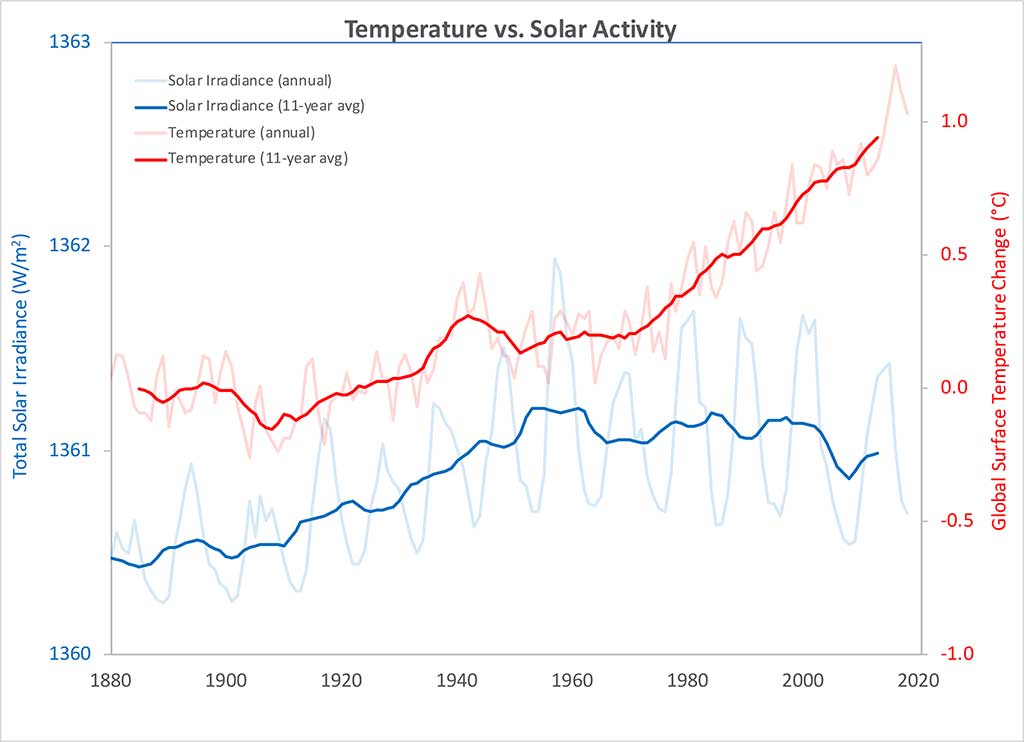
Whatever other planets are doing, in spite of the Sun's output having been at its lowest for years, our Earth is still warming.
But one slight problem - I have been watching Mars since a young lad in the Apollo moon landings.
Look at the photos of Mars in the 1970's - big beautifol really obvious ice caps. Now look at Mars - pathetic small and mostly non-existent ice caps. Why?
[snip]
Mars, 1873:
Mars, 2007:
So from 1873 to 2007, Mar's NH polar cap has approximately the same size, while its SH polar cap has greatly expanded.
But what about images like this:
According to AGW denier, Nasif Nahle, this is a ...
Except, when I look at the pictures, I see the large expansion of the SH polar cap from 1995-2001, followed by its contraction. I also see the initial contraction of the NH polar cap, followed by its expansion, after which it is hard to say what it does because it is hidden behind the limb of the planet.
Clearly, the polar caps of Mars are very dynamic. The rapidity with which they change their extent can be seen in this montage showing the NH cap over a period of six months:
As we know, by 2001,it had already regained its lost extent, and no doubt lost it again before regaining it in 2007.
AGW deniers, like Nahle, are attempting to portray images of seasonal variation as proof of global warming on Mars. But if you look at all the evidence, its easy to see through their parlour trick.
This is really big news, or at least it was in 2003: Mars is melting
Like Earth, Mars has seasons that cause its polar caps to wax and wane. "It's late spring at the south pole of Mars," says planetary scientist Dave Smith of the Goddard Space Flight Center. "The polar cap is receding because the springtime sun is shining on it."
The south pole is indeed more dynamic:
The coincidence of aphelion with northern summer solstice means that the climate in the northern hemisphere is more temperate than in the southern hemisphere. In the south, summers are hot and quick, winters long and cold.
Seasons! Who'd have thought that?
First from the Mariner missions in 1969:
The two images where taken be separate craft on flybys, within six days of each other in 1969.
Then from the Viking program in 1980:
Viking even produced a mosaic map of Mars, showing the massive polar ice caps that existed just 30 years ago:
If you think I am laughing at the intellectual bankruptcy of deniers like Nahle who try to flog this dead horse, you are right.
Thinking 'outside the box' is a school not often visited by some. In all the discussions of planetary global warming (i.e. Earth, Mars Jupiter, Saturn, Pluto) very little attention is given to our solar system's travel above, below, and around the galactic plane on its cyclical route round the Galaxy. (approx 240k+ years). Conditions along the path are hard to predict since historic records are only now being established. Therefore any theories or calculations of planetary temperatures from volcanic, atmospheres, rings of dust, or human intereactions, etc. must include calculations of the density and position of materials encountered along our solar systems path and its interactions with the Sun's activities. These conditions make it extremely difficult to predict any astronomical algorithm's absolute forecasting the reason for Earth's warming trends. In other words, the best thought humans put forth probably has not reached a definite answer in totallity to the question, "Why is Earth warming?"
Whether travels on the galactic path had anything to do with past climate change is harder to decide, but we can see clearly that it has very little to do with post-1970 climate change. Why? because we have good measurements of the climate determinants. The only "space" factor affecting climate is TSI, whether from change of angle, change of solar luminense or "space dust". This is accurately measured by satellites since 70's and is stable if not decreasing (see "its the sun" argument), and yet the earth warms. Why look to weird, unknowable, out-there sources of warming when there is a perfectly reasonable, physically plausible solution coming right out of the smoke stack? Or to put it another way, we have measurably increased the energy flux onto the surface of the earth with increased GHGs. What mechanism do you propose by which this would not cause warming?
We have NOT been measuring the other planets temperatures systematically since the 70's.... and I did not state the the majority of EARTH warming does originate with our mismanagement of the planet. I was only stating that IF other planets in our system might all be experiencing warming, then we should look at other possibilities be they "weird" or undiscovered!
Novemdecellist @33, there is a very simple reason to think that our motion through the galaxy has very little do do with current changes in climate. Specifically, it will take us 1360 years to travel just one light year at our current rate of travell. In the direction we are travelling, there are no nebulae to obscuring local stars, so we know the nearest nebula to be many light years away. Apparently the nearest nebula of any sort, L134, is around 300 light years away, and not in our direction of travel.
It follows from this that the radiation, and molecular density of the space through which we are travelling has not changed appreciably in hundreds of thousands of year; and will not change appreciably for hundreds for thousands more years except in the cases of nearby supernovas. And if it is not changing, it is not the cause of change.
And also worth noting (as this and articles on other planets show) that real evidence for climate change on the other planets is somewhat lacking. See the intermediate versions.
Also worth noting are the astronomers - who spend their careers looking at the stars, including spectral and intensity measurements. If we had entered a nebula (that was somehow unobserved at a distance) the reduction in starlight over the last 40 years would have been quite noticeable. Not to mention spectral changes in sunlight, measured either from the surface or from satellite.
Given a complete lack of evidence for a hypothesis of interstellar dust/climate interaction, I would classify it on the same level as "climate elves".
Novemdecillist... Is there something to give you indication that others are not thinking outside this particular box? I would suggest that scientists have made careers out of looking into a wide range of boxes to see if there could possibly be other explanations for what they see. In fact, other planets warming would be one of the first in a long series of other boxes researchers would check into.
Tom Curtis #29:
If all the photos in your figure 3 were taken close to opposition (when Mars is closest to the Earth), each of them must have been taken about 780 days later than the previous one, or one Martian year plus 93 days. That is like taking photos of the Earth with 415 days intervals or 50 days later every year.
Based on the surface markings it seems to me that the photo from 2001 must have been taken close to northern hemisphere autumn equinox on Mars, corresponding to late September on Earth.
That means that the photos from 1995, 1997 and 1999 roughly corresponds to late April, mid June and early August respectively (spring and summer in NH), while the photos from 2003 and 2005 corresponds to early November and late December (spring and summer in SH).
In other words, the changes in this photo sequence are simply caused by the seasons, and have nothing to do with any climate change on Mars!
I wonder how this guy Nasif Nahle would explain away that?
HK @40, you raise a very good point. It is likely that most of the differences between polar cap size in Mar's observations will be due to seasonal cycles, something Nahle has failed to consider (along with the majority of the evidence on the changes in the size of Mars's icecaps over time.
Thank you for a quick response, Tom!
Yes, it is meaningless to use photo sequences like that as proof of climate change on Mars unless the photos are taken close to one Martian year (687 days) apart. In the 2005 photo, the south polar cap (mostly frozen CO2) had been exposed to the midnight sun for nearly 6 months. No wonder it had almost disappeared!