



 Arguments









Are we heading into a new Ice Age?
What the science says...
| Select a level... |
 Basic
Basic
|
 Intermediate
| |||
|
Worry about global warming impacts in the next 100 years, not an ice age in over 10,000 years. |
|||||
We're heading into an ice age
"One day you'll wake up - or you won't wake up, rather - buried beneath nine stories of snow. It's all part of a dependable, predictable cycle, a natural cycle that returns like clockwork every 11,500 years. And since the last ice age ended almost exactly 11,500 years ago…" (Ice Age Now)
At a glance
In something like a Day after Tomorrow scenario, the idea that a new ice-age was just around the corner was the subject of a book, a DVD and a website created in 2002. The author was a retired architect, by the way. Fortunately for us, both the movie and the quote above are figments of someone's fertile imagination. But let's have a quick look at ice-ages and what makes them tick, after which we hope you will agree that the notion that another ice-age is just around the corner is nonsensical.
Ice-ages, also known as glacials, are cold periods that occur in a cyclic fashion within an Icehouse climate state. Earth's climate has been mostly of the Hothouse type (no Polar ice-sheets). However, on occasion it has cooled down into Icehouse, as has been the case in the last few million years. There are regular variations in Earth's orbit around the Sun, taking place over tens of thousands of years. These affect the amount of Solar radiation reaching our planet. During the Icehouse state, such variations can lower and raise planetary temperature sufficiently to trigger swings between cold glacials – when ice-sheets expand towards the Equator – and mild interglacials – when the ice retreats back polewards.
To give an idea of the time-scales involved, Europe and North America have seen glacials and interglacials come and go repeatedly over the last 2.5 million years, this being known as the Quaternary Period of geological time. The last glacial period started 115,000 years ago and the Last Glacial Maximum (LGM), when the greatest ice extent was reached, was around 22,000 years ago. The current interglacial – also known as the Holocene, commenced 11,700 years ago.
A general pattern may be seen here with a long cooling down towards Glacial Maximum but a relatively quick warming into an interglacial. The speed of the warming-up part of the cycle is due to climate feedbacks. Removal of pale, reflective snow and ice cover revealing the darker ground beneath allows more solar heat energy to be soaked up. Melting of permafrost releases carbon dioxide and methane. These and other feedbacks serve to amplify the warming effect, speeding it up.
However, our burning of fossil fuels has happened on such a vast scale that we have blown such factors apart. The atmospheric concentration of CO2 has risen well above the 180-280 ppm range typical of recent glacial-interglacial cycles. The current level, getting on for 420 ppm, is more typical of the mid-Pliocene. That was a geological epoch that happened around a million years before the start of the Quaternary. Mid-Pliocene ice-sheets were much smaller than those of the present day. Rather than being due another glaciation, we can expect a continued transition towards mid-Pliocene conditions.
Please use this form to provide feedback about this new "At a glance" section, which was updated on May 27, 2023 to improve its readability. Read a more technical version below or dig deeper via the tabs above!
Further details
Because our current interglacial (the Holocene) has already lasted approximately 12,000 years, it has led some to claim that a new ice age is imminent. Is this a valid claim? No.
To explore this topic further, it is necessary to understand what has caused the cyclic shifts between ice ages and interglacials during the Quaternary period (fig. 1). Such shifts are in part a response to regular changes in the Earth’s orbit and tilt, which affect the amount of summer sunlight reaching high northern latitudes and were described by the Milankovitch Cycles, first proposed in the early 20th Century by Serbian mathematician Milutin Milankovitch (1879-1958). For more about Milankovitch cycles this NASA page offers lots of graphics and explanations.
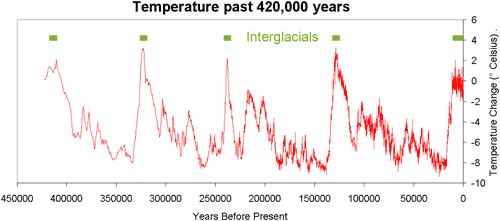
Figure 1: Temperature change through the late Quaternary from the Vostok ice-core, Antarctica (Petit et al. 2000). The timing of warmer interglacials is highlighted in green; our current interglacial, the Holocene, is the one on the far right of the graph.
When incoming sunlight declines in the high north, the rate of summer snow and ice-melt declines and the ice sheets begin to grow. When incoming sunlight increases, the opposite happens. So where are we in these cycles today? Changes in both the orbit and tilt of the Earth do indeed indicate that – were they singularly responsible for climate shifts - the Earth should be slowly cooling. However, recent research shows that is too simple. That's because we now have analyses of ice-cores going back 800,000 years or more. We have devised ways to use stable isotope ratios of various elements in things like fossils and we have developed many other proxy methods for telling us more about conditions in the relatively recent past that the Quaternary represents.
A number of irregularities in glacial-interglacial cycles have been determined, for example times when interglacials were skipped when orbital patterns suggest they should have happened. (Koehler and Van de Wal 2021). Such research has also been aimed at resolving the question of why Earth's 41,000 year obliquity cycle was a strong driver of glacial-interglacial transitions up until around one million years ago. Since then, glacials have instead typically lasted for much longer - around 100,000 years.
The importance of feedbacks within Earth's climate system has been increasingly recognised as the decades have gone by. A good example is the speed of transition from glacial to interglacial, which is relatively rapid because certain very effective climate feedbacks are involved. One such feedback involves albedo, defined as the ability of different bodies to absorb or reflect sunlight (e,g, Thackeray and Fletcher 2016).
Albedo is expressed on a scale of 0 (black body, absorbs everything) to 1 (white body, reflects everything. Fresh snow has a high albedo of as much as 0.9, whereas the muck revealed when old snow and ice cover melts has a much lower one in the range 0.2 to 0.4 – it can absorb lots more solar energy. So melting snow and ice leads to more heat energy retention, amplifying the warming (Fig. 2).
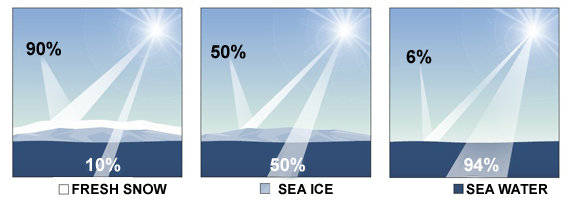
Fig. 2: Albedo feedback explained. Freshly-fallen snow is highly reflective of incoming sunshine, so that most of the solar energy is simply bounced back towards space. Bare sea ice can potentially absorb about half of the incoming energy, so if conditions become warmer, causing the snow to melt, there’s more energy retained on Earth. If the sea ice melts too, then almost all of the incoming solar energy is absorbed by the much darker surface of the sea. So an initial warming directly results in further warming. Graphic: John Mason.
Another feedback happens when permafrost gets thawed out, since the ground is then able to release previously trapped CO2 and methane. During a glacial, the extent of permafrost is vast, so as it thaws, the release of such gases occurs on an enormous scale – again, amplifying the warming.
Researchers have also modelled ice-sheet dynamics, investigating how the sheets behaved as they melted, for example. It has been found that the shorter-lived, lower latitude Northern Hemisphere ice-sheets that existed prior to one million years ago were much thinner and therefore easier to melt. So ice-sheet dynamics looks to have a role in the much longer freeze-ups of the past million years. This all goes to show that glacial periods arise through a whole lot of factors interacting with one another, of which orbital cycles are but one, albeit important, cog in the gearbox and are not necessarily able to drive the climate system from one state (glacial) to another (interglacial) in total isolation (e.g. Bintanja and Van de Wal 2008; Berends et al. 2021).
Talking of cogs in the gearbox, we are another – and a big one. Our intentional disturbance of carbon reservoir rocks – what we do when we seek, extract and burn the fossil fuels – is unique in the geological record. It's a one-off in the planet's 4.56 billion year long history and while the consequent overloading of atmospheric CO2 levels is still insufficient to take Earth back into a Hothouse state yet, it is perfectly adequate to prevent another glaciation any time soon.
Last updated on 27 May 2023 by John Mason. View Archives








Climate Myth...