



 Arguments







More ice loss through snowfall on Antarctica
Posted on 16 December 2012 by John Hartz
This is a reprint of a news release posted by the Postsdam Institute for Climate Impact Research (PIK) on Dec 12, 2012.
Stronger snowfall increases future ice discharge from Antarctica. Global warming leads to more precipitation as warmer air holds more moisture – hence earlier research suggested the Antarctic ice sheet might grow under climate change. Now a study published in Nature shows that a lot of the ice gain due to increased snowfall is countered by an acceleration of ice-flow to the ocean. Thus Antarctica’s contribution to global sea-level rise is probably greater than hitherto estimated, the team of authors from the Potsdam Institute for Climate Impact Research (PIK) concludes.
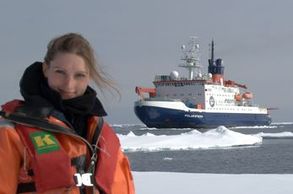
Ricarda Winkelmann, lead-author of the new study, on a research trip to Antarctica with "Polarstern" of the Alfred-Wegener-Institute for Polar and Marine Research. Photo: M. Martin/PIK
“Between 30 and 65 percent of the ice gain due to enhanced snowfall in Antarctica is countervailed by enhanced ice loss along the coastline,” says lead-author Ricarda Winkelmann. For the first time, an ensemble of ice-physics simulations shows that future ice discharge is increased up to three times because of additional precipitation in Antarctica under global warming. “The effect exceeds that of surface warming as well as that of basal ice-shelf melting,” Winkelmann says.
Snow piling up exerts pressure on the ice, thus it flows faster to the coast
During the last decade, the Antarctic ice-sheet has lost volume at a rate comparable to that of Greenland. “The one certainty we have about Antarctica under global warming is that snowfall will increase,” Winkelmann explains. “Since surface melt might remain comparably small even under strong global warming, because Antarctica will still be a pretty chilly place, the big question is: How much more mass within the ice sheet will slowly but inexorably flow off Antarctica and contribute to sea-level rise, which is one of the major impacts of climate change.”
Since snowfall on the ice masses of Antarctica takes water out of the global water cycle, the continent’s net contribution to sea-level rise could be negative during the next 100 years – this is what a number of global and regional models suggest. The new findings indicate that this effect to a large extent is offset by changes in the ice-flow dynamics. Snow piling up on the ice is heavy and hence exerts pressure – the higher the ice the more pressure. Because additional snowfall elevates the grounded ice-sheet but less so the floating ice shelves, it flows more rapidly towards the coast of Antarctica where it eventually breaks off into icebergs and elevates sea level.
“Sea-level is rising – that is a fact”
A number of processes are relevant for ice-loss in Antarctica, most notably to sub-shelf melting caused by warming of the surrounding ocean water. These phenomena explain the already observed contribution to sea-level rise.
“We now know that snowfall in Antarctica will not save us from sea-level rise,” says second author Anders Levermann, research domain co-chair at PIK and a lead author of the sea-level change chapter of the upcoming IPCC’s 5th assessment report. “Sea level is rising – that is a fact. Now we need to understand how quickly we have to adapt our coastal infrastructure; and that depends on how much CO2 we keep emitting into the atmosphere,” Levermann concludes.
Article: Winkelmann, R., Levermann, A., Martin, M.A., Frieler, K. (2012): Increased future ice discharge from Antarctica owing to higher snowfall. Nature [doi:10.1038/nature11616]


 0
0  0
0






Comments