





Murry Salby - Confused About The Carbon Cycle
Posted on 13 August 2011 by Rob Painting
Every year humans release about 30 billion tons of carbon dioxide (CO2) into the atmosphere through the burning of fossil fuels, such as coal and oil. This is causing the Earth to warm by disrupting the biological (fast) carbon cycle, and is therefore increasing the Greenhouse Effect. Although there are large annual fluctuations in carbon dioxide, as it is exchanged back-and-forth between the atmosphere, oceans, soils, and forests, just under half of human emissions (the airborne fraction) remain in the air because the oceans, soils and forests are unable to absorb all of it. As a result, carbon dioxide has been steadily accumulating in the atmosphere.
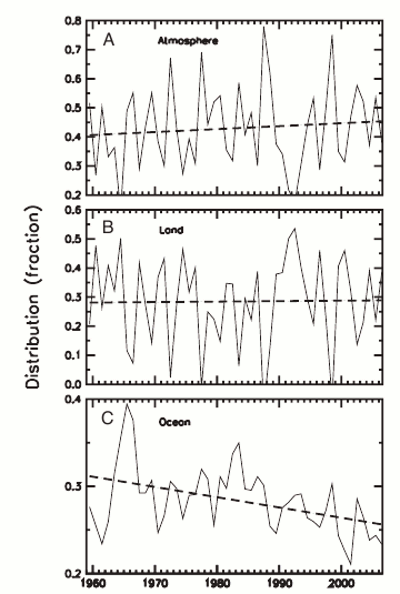
Figure 1 - Fraction of the total human emissions (fossil fuel burning & land use change) that remain in the: a) atmosphere, b) land vegetation and soil, c) the oceans. From Canadell (2007)
Murry Salby, a professor at Macquarie University in Sydney, Australia, has an upcoming paper that attempts to pin the current rise in carbon dioxide on rising temperatures. Having listened to a podcast of a talk Salby gave at the Sydney Institute earlier this week, he demonstrates a remarkably poor understanding of the carbon cycle, and his hypothesis seems to stem from this fundamental misunderstanding.
Salby's carbon cycle confusion
Professor Salby refers to a number of graphs in his talk, but I have been unable to track down copies of these, therefore we'll have to rely on what I'm able to glean from the podcast, and given it's length, I'll only address some of the more obvious mistakes. At the beginning of the talk Salby states:
"current CO2 values are 380pmmv"(parts per million by volume)
Not an encouraging start that he cites the atmospheric CO2 concentration as it was in 2005, rather than the 393 parts per million by volume (ppmv) it currently is in 2011. Not a fatal flaw of course, but not encouraging either.
"Net annual emission has an average increase of about 1.5ppmv per year. We're on the right planet. That's the annual average increase you just saw. But it varies between years, dramatically by over 100%. From nearly zero in some years to 3ppmv in others. Net global emission of CO2 changes independently of of the human contribution"
At this point the accentuation and drama in Salby's voice make it sound as though he has stumbled onto something momentous, something no one else has noticed before. On the face of it, it seems preposterous that the army of scientists that have worked on carbon cycling over the years could have missed something so glaringly obvious. No, of course they haven't.
As discussed in the first paragraph of this post (and evident in Figure 1), the natural flux of CO2 in and out of natural systems varies from year-to-year. This flux is 20-30 times larger than the annual contribution by humans, but this balances out in the long-term. This variability is driven largely by El Nino and La Nina in the tropical Pacific, which shifts rainfall patterns over much of the world and is associated with warming and cooling of equatorial waters in the Pacific. The change in seawater temperature, and episodic upwelling of carbon-rich deep water, significantly affects the uptake and outgassing of CO2 from the oceans, and of course rainfall variation greatly affects plant growth.
The upshot is that land vegetation takes up more CO2 during La Nina, and expels more CO2 during El Nino. In the ocean, the opposite trend occurs - El Nino leads to more CO2 absorption, and La Nina is when the oceans give up more CO2 (Figure 2).
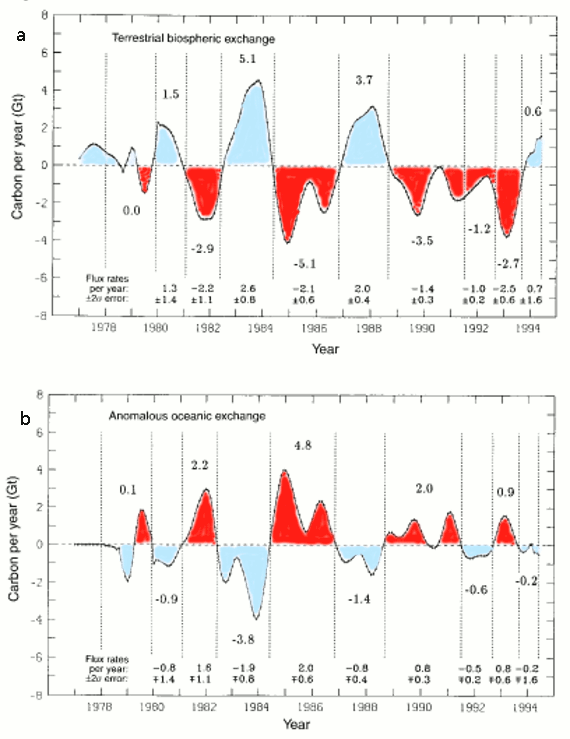
Figure 2 - (a) time trend in the exchange of CO2 by land-based vegetation (& soil microbes) with the atmosphere. (b) same - but for exchange of CO2 by ocean with atmosphere. Red indicates El Nino and blue La Nina phase. See Keeling (1995).
There is simply no reason why the annual fluctuation should match the human contribution. At least Salby doesn't explain why he expects this to be the case.
Having now convinced himself that short-term net CO2 has nothing to do with the human contribution, Salby therefore deduces long-term net CO2 must also be unrelated to human emissions. He goes on to derive a formula for CO2 rise associated with temperature. Salby claims a good match back to 1960 but therefafter it deviates from actual CO2 measurements by 10ppmv. By 1880, prior to atmospheric CO2 sampling, he estimates atmospheric CO2 at 275ppmv with a whopping uncertainty of 220 to 330ppmv!
In order to explain the deviation between the surface temperature record and his calculated atmospheric CO2 level, Salby blames the surface temperature record as being unreliable. As for his calculated trend disagreeing with the ice core record for the year 1880 (i.e the CO2 in air, from that period, trapped in ice cores) he 'disses' the ice core record claiming it to be only a 'proxy'. Which is news, I'm sure, to respected ice core experts like Dr Richard Alley.
You will note that every time the data disagrees with Salby's 'model', he trusts his 'model' over the data. Which contravenes the 'skeptic lore' that models are worthless and must be bashed, and only data should be trusted.
Q&A time - try not to shoot yourself in the foot!
The question & answer session at the end of Salby's talk throws up a few more comments that just reinforce that he has strayed into a field of science which he just simply doesn't understand. Witness:
"I think it's a pitfall that people look at the ice proxy of CO2 and take it literally. It's not atmospheric CO2, and I don't believe it's CO2 that was even in the atmosphere when that piece of snow was layed down"
This is nonsense. Perhaps Professor Salby should have acquainted himself with glaciology research before making such comments, because CO2 from ancient air trapped in the ice cores is precisely what is measured, albeit with some uncertainty in dating some sections.
"CO2 after the turn of the (21st) century continued to increase, in fact if anything slightly faster, but global temperature didn't. If anything it decreased in the first decade of the 21st century. Now I'm confident the IPCC (Intergovernmental Panel on Climate Change) will come up with an explanation, in fact they've come up with several"
It's here we need to back the truck up a bit. Salby's entire premise is that CO2 in the air directly dependent upon temperature - increase temperature and you increase CO2. Yet here he argues that CO2 can increase without an accompanying increase in temperature. Which contradicts his 'model'. By this time Salby is too focused on 'dissing' the IPCC to notice his own incoherency, and none of the audience picks up on this either.
Note that SkS recently discussed the 'noughties slow-down' in global temperature here and here.
If the curve fits
Seasoned readers will notice similarities between this Salby claim and a Lon Hocker rebuttal here at SkS last year. But the whole premise seems to follow along the lines of other recent flawed works tendered by Roy Spencer and Craig Loehle & Nicola Scafetta. That is: find some tenuous statistical relationship between two sets of data, and use these to assert the mainstream scientific establishment is wrong. The fact that there is no physical basis for the statistical relationship, or it doesn't fit within the well-established scientific framework, or is contrary to numerous other sets of data, never seems to warrant attention by "skeptic" scientists. It should, because of the implications one can draw.
So what does this work by Salby imply, if it were true? From what I can gather from Salby's podcast, a 0.8°C change in average surface temperature is supposed to lead to about 120ppmv change in CO2. Therefore we can work backward in time to estimate what he reckons atmospheric CO2 would be at the time of the last Ice Age (glacial maximum), a time when global temperatures were about 4-6°C cooler than now . Today atmospheric CO2 is about 393ppm, so with 4°C cooling you already have a negative value for CO2 when we re-trace our steps back to the last ice age. Therefore all plant-based life on Earth must have died (and all the animals that depended on them) according to Professor Salby. And the Earth froze solid too.
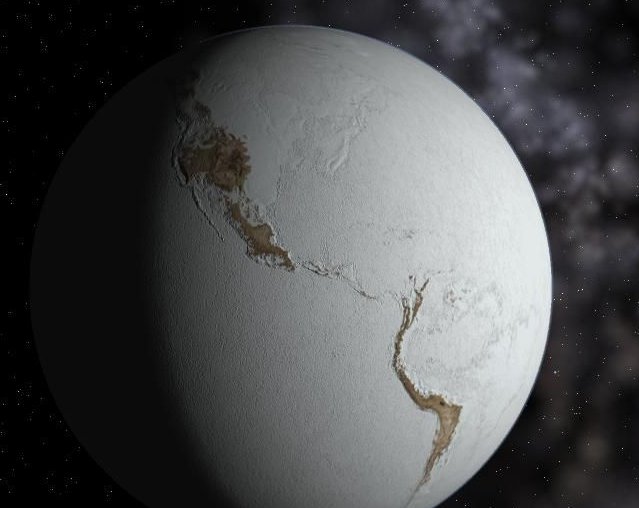
Figure 3 - the last Ice Age according to Murry Salby? Fictional image from celestiamotherlode.net
Science - a description of reality, but YMMV
Without viewing Salby's calculations on the temperature/net global CO2 relationship, it's not possible to provide the 'killer blow' to his assertions; however, I don't believe that's necessary, considering the many flaws in Salby's work and fundamental reasoning.
The gradual increase in atmospheric CO2 is less than the total emissions of CO2 from human sources, so by elementary deduction, the excess must be going into the oceans, forests and soils, the other components of the fast carbon cycle.
A tell-tale signature of human fossil fuel emissions is the large fraction of CO2 being driven into the oceans. According to Henry's Law, we would expect the oceans to absorb more CO2 as the air above it becomes increasingly saturated with CO2. In other words the CO2 must be coming from a source external to the fast carbon cycle. This is supported by measurements showing that CO2 is accumulating in the ocean, and is reflected in the declining oceanic pH, showing the ocean is actually gaining CO2 over the long-term, not losing it, as Salby seems to believe.
We also know that the world's land vegetation has increased in mass - through re-growth in forests in the Northern Hemisphere, and CO2 fertilization of tropical forests. So that is gaining carbon too, and the areas affected are so large, we would expect them to have an effect on atmospheric CO2 levels at a global scale.
There are a host of other problems with Salby's 'model', such as the ice core record, and where the warming came from in the first place, but there's no need to go into these details when the fundamental premise of Salby's argument is so clearly wrong.
This blog post has been used as a rebuttal to the climate myth "Murry Salby finds CO2 rise is natural" which can be found at http://sks.to/salby

Arguments


The article needs a graph though.
C.D. Keeling, R.B. Bacastow, A.F. Carter, S.C. Piper, T.P. . Whorf, and co-authors, 1989: A three-dimensional model of atmospheric CO2 transport based on observed winds: 1. Analysis of observational data. In: "Aspects of Climate Variability in the Pacific and the Western Americas" (Peterson D.H., ed., Geophysical Monograph, 55, American Geophysical Union), 165 - 236.
In Japan, Junkichi Nemoto, a former long-range weather forecaster and a writer of popular essays about weather and climate, included the story of Keeling et al. (1989) in his book in 1994. He quoted a figure which shows that temperature leads CO2 concentration by about one year, or a 1/4 cycle period, of the ENSO cycles. Long-term trends have been removed before making the plot.
Then, Atsushi Tsuchida, a staunch AGW denier, a former physicist, an anti-nuclear-power activist and a thinker who promoted the view of the environment in terms of concepts of non-equilibrium steady-state thermodynamics (I think that he should be praised for this achievement in the 1970s-80s) picked up the relationship and claimed that the growth of atmospheric CO2 content (since 1960s-70s till present) is a result and not a cause of global warming.
Around 2006, he and Kuniaki Kondo, an engineer (by the way, there are many Kondos including able climate scientists), made some analysis. They found good simultaneous correlation between the annual increase of the atmospheric CO2 concentration (compilation by Scripps Institution of Oceanography via CDIAC, USA [link]) and the anomaly of global mean surface air temperature (compilation by Japan Meteorological Agency (JMA), a previous version of what is available [here], where the base period was 1971-2000). They extrapolate the linear relationship and claimed that the change of CO2 concentration would be zero if the global mean temperature anomaly were -0.6 deg. C (base 1971-2000).
Kondo and Tsuchida wrote a paper (in Japanese) and submitted to "Tenki", the bulletin of the Meteorological Society of Japan (MSJ). After peer reviews, the editorial board of Tenki rejected the manuscript. Their rejected paper and related materials can be found somewhere in a web site maintained by Kondo (Japanese only). Tsuchida sued MSJ claiming that rejection was politically motivated. The courts ruled against Tsuchida, but he tries again with modified claims. I think that MSJ would have passed their paper if they just mention interesting relationship between changes of CO2 concentration and temperature without making an egregious claim that the global warming is not anthropogenic.
By the way, JMA has made more careful analysis. On one of their web pages, though the main text is Japanese only, there are figures with English captions. See "Fig. 2.1.2.3". The upper two panels are now well-known relationship between the CO2 increase and ENSO. The bottom panel shows simultaneous correlation between the CO2 increase and the mean surface air temperature over the tropical (30 S - 30 N) land area. The correlation broke down for a while after the volcanic eruption of Pinatubo in 1991.
Frankly Salby's behaviour has been disgraceful. It's only merit has been showing, but the speed with which they have accepted his results as ground breaking and undoubtedly true without access to the supporting data, that the "skepticism" of many well known deniers is only a mask for refusing to deal with reality.
Ask yourself this; had you ever heard of him before this brouhaha? I know I hadn't. Now he's being mentioned in lots and lots of blogs. He's a celebrity among the ill-informed and ignorati. Judith Curry thinks he's the Bee's Knees, and he may just be the David she's been looking for to kill the AGW Goliath. Look at the efforts that are being expended to counter him; surely this means the Team is scared, right? They must silence him now, and when his claims get torn apart and attract no favorable attention among climate scientists, he'll know he's a new Galileo. They laughed at him, remember? When they laugh at Salby it will be the same thing! He just knows it!
JMTC
[DB] It would be best for everyone to refrain from such introspection into Salby's motivation.
It is he who is trumpeting his "results" far and wide whilst with holding the data he used so as to prevent direct refutation. He has even gone to the extent of refusing to supply copies of his charts to interested persons on the basis that there is an "embargo" on their publication, while showing them to uncritical audiences, thus breaching the "embargo" himself.
Haven't contrarians made an enormous fuss about actual climate scientists "refusing" to release their data? And here we find them cheering on an actual, obstinate refusal to share data which is at the heart of open scientific inquiry.
(1) If CO2 in the atmosphere is controlled by natural factors and human emissions are not a factor, how does Salby account for the enormous amount of human-emitted fossil CO2 (30 Gt annually)? It has to go somewhere. If Salby cannot convincingly account for it (and show his working), there is no reason to accept his conclusions. Climatologists espousing the mainstream/consensus position can account for fossil fuel CO2 emissions as well as natural sources & sinks, and they can show their working.
(2) It is my understanding that in the past, CO2 increases tracking temperatures were the result of oceanic CO2 outgassing following warming; it would follow in this case that the ocean pH would increase (alkalinization) as the oceans warmed. We find, however, that ocean pH is decreasing even as the oceans warm, which makes more sense in the context of warming following CO2 increase.
Certainly nothing of scientific merit.
What is telling is that for years some prominent "skeptics" have been lying to us-- for example, Anthony Watts proprietor of the pseudo-science site WUWT is now peddling Bastardi's nonsense which includes Salby's refuted hypothesis. What is odd is that very Watts takes strong exception to being labelled a "denier". It it is clear that his bluster (i.e., Anthony's) is just a facade to his denial and all these years he has been lying when he claims to be a "skeptic". That, or Watts has now finally jumped from being a "skeptic" to a full-blown denier of the theory of AGW.
The underlying foundation of the theory of AGW, is as the name suggests that we are almost entirely responsible for increasing CO2 (and other GHGs), so to deny that or not accept that is to be a denier of AGW. So anyone who supports Watts or his site is now also by extension a denier of the theory of AGW. EOS.
PS: Perhaps Salby can explain to us how we humans have managed to increase CFCs (measured in ppbv), N20, low-level O3 and other species that are not temperature dependent, while not managing to increase CO2?
If a "denier" does not accept the AGW argument, and an "advocate" preaches the AGW doctrine and does not accept any natural cause, and a "sceptic" is on-the-fence/unsure/undecided, then what do you call someone who accepts that humans can change the climate but not to the levels claimed?
It IS possible to "deny" the mantra but not be a "denier".
[DB] Dale, denier in this context is being used for those who deny observable data and trends (indeed, to the point of saying blue is green and the sun orbits the Earth).
At this point, those who say that "this is what the science says" and back it up with links to peer-reviewed published literature are hardly preaching doctrine. That you phrase it in that context is revealing as to the ideology underlying your position. It is a false equivalency to say that in this scientific dialogue that there are "two sides", unless you mean one side that is backed by 200 years of science and physical observations and the other side which is basically saying "no it isn't" without anything to support their nay-saying.
In that regard and context, yes, they are deniers and denialists. QED.
Note further that the resident skeptics who regularly inhabit SkS are nowhere to be found on a thread like this and in the various ongoing discussions with Mr. Cotton; that would violate the "Skeptic's Code". Aargh.
If you have relatively solid reasons for riding the fence, I'd like to hear them. Every day I hope someone presents evidence that throws doubt on the seriousness of this problem. Your reasons, however, can't be "just because." They have to be worked through critically, and the scientific community is the best place to do that work.
"preach"? Come now, let's not wander down that bizarre road. After all, if I decided to be a skeptic (or, rather, a so-called skeptic) about the sun rising tomorrow, and you defended the idea of the sun rising tomorrow, you'd be on the same ground as your imagined "preacher." The theory that predicts a rotating Earth and the short-term continued active sun is the best fit for the physics and observations. So too is the theory of AGW for recent warming. Hardly a religion.
The terms "preach" and "doctrine" do not specifically have religious definitions. To preach is to urge or publicly proclaim (which is exactly what the IPCC "Summary for Policy makers" does as well as scientists in front of Govt hearings), and a doctrine is a position in a branch of knowledge or belief. These terms fit very tightly with AGW, as the position of the branch of knowledge is proclaimed publicly through the urgings of scientists and the IPCC. Doctrine is also the term used for Govt agreements on an International level, which as far as I'm concerned what a lot of all this is about, how we deal with this at a global level.
Also, Albatross wrote "The underlying foundation of the theory of AGW, is as the name suggests that we are almost entirely responsible for increasing CO2 (and other GHGs), so to deny that or not accept that is to be a denier of AGW." That humans alter the climate is no argument. That the Earth has warmed is no argument. The extent to which humans are responsible for the warming, IS the argument. The term "almost entirely responsible" is the real unknown in climate science. The system is so complex that our understanding of how climate inter-relates is still really just scratching the surface. To say that humans are "almost entirely responsible" for climate change is, IMO, a bit silly considering the power of nature to alter its own course, and the fact we still really don't know how each part of the system inter-relates and feeds back on itself. To not acknowledge these facts is a form of denial itself.
[DB] "the fact we still really don't know how each part of the system inter-relates and feeds back on itself"
When you say "we" you really mean "I". The people who've made a profession of studying climate science actually have a pretty good handle on all of the things you mention. That you characterize it as being (in large part) uncertain merely demonstrates that you haven't put much time and energy into its study.
Albatross, being a working scientist in the field, speaks from a point of strength of knowledge about the subject.
Per Dictionary.com:
preach
1. to proclaim or make known by sermon (the gospel, good tidings, etc.).
doc·trine
[dok-trin]Cherrypick! The full definition your cut from (google dictionary):
Publicly proclaim or teach (a religious message or belief) -- emphasis added
This is not how science is communicated.
Not really, Dale. Atmospheric composition is well established. The physics of the components are well-established. Cyclical processes are well-understood. Long-term cycles are less well understood, but the range of possible basic mechanisms has been narrowed considerably.
"To say that humans are 'almost entirely responsible' . . ."
I believe the claim was that humans are responsible for the increase in CO2. Do you not find this to be likely with a very high level of confidence? If so, why not?
" . . . for climate change is, IMO, a bit silly considering the power of nature to alter its own course,"
Yikes, talk about religion. If nature can alter its own course without recourse to its physical 'laws' then we can toss the entire project of science right now. This is why religion and science truly cannot co-exist, unless the deity/ies is/are constrained by their own initial laws.
"and the fact we still really don't know how each part of the system inter-relates and feeds back on itself. To not acknowledge these facts is a form of denial itself."
We have a very firm grip on this, Dale. Are you suggesting that we stop trying to learn more? Because if you're suggesting that 150 years of our best efforts have ended up fruitless, you truly have a lot to learn. Grab a textbook, dude.
You've provided nothing resembling a defense of Salby. Your short initial comment was responded to by DM, and you've done nothing but hem-haw and dance around since. What do you think of Salby's work, Dale? Do you accept it?
"That humans alter the climate is no argument. "
But that is the very point that Salby is denying. Salby is claiming that our CO2 emissions are not driving CO2 levels. So he is stating from the outset that we cannot affect global temperatures by emitting CO2, b/c he believes that we are not responsible for the increase in CO2 or the warming that he alleges has caused the increase in CO2. Therefore he is denying the reality that is the theory of AGW, and so is anyone (like Watts) who agrees with his hypothesis.
With that all said, I gather from your odd posts (and the quote) that you agree that the theory of AGW is real. Good.
This thread is about the fatal flaws Salby's hypothesis, so please do not try and drag us all off-topic by being argumentative or floating red herrings or making strawman arguments.
And DSL @24 asked you a very pertinent question about Salby's work-- do you accept it? I'll add another, do you, trying to be truly skeptical, see any potential flaws in his reasoning? Answer those directly (no obfuscating or hand waving) and you'll be staying on topic.
But I have listened to Salby's podcast. Not only does he not present evidence for such an extraordinary mechanism - he does not even argue for its existence. Rather he argues that the existence of a short term correlation between CO2 and temperature proves that the cause of the short term variation is also the cause of the long term trend. That is known to be a fallacious argument, and he presents nothing else.
That leaves Salby not in the position of a discoverer of perpetual motion, but rather in the position of somebody purporting to disprove Special Relativity who has not bothered to adduce relevant evidence. It is certainly logically possible that he is correct. It is also logically possible that I should win 50 million dollars on the Lotto this weekend, and far more likely.
But as I've said above, I'll wait to see his data before hanging or lauding him.
The mass balance argument demonstrates beyond reasonable doubt that the natural environment has been a net sink and has opposed, not caused, the rising trend in atmospheric CO2 for at least the last fifty years.
This point shows that natural variability of the carbon cycle cannot explain the long term trend. Unless you can address this point, your comments on Salby's paper have already been refuted, so please stop repeating them.
p.s. sorry for the shouting, but Dale doesn't seem to be listening to this particular point.
That essentially means you disagree with the non-skeptic community who loudly proclaimed the alarming
Blockbuster: Planetary temperature controls CO2 levels — not humans
and the very insightful
Wow.
Have you expressed your skepticism (or at least your advice to withhold judgement until seeing the actual evidence) to cool off these hot-blooded alarmists? Or do you only express the cool logic of skepticism here?
that humans are "almost entirely responsible" for climate change is, IMO, a bit silly, considering the power of nature to alter its own course
To be a fair and balanced skeptic, one would have to withhold judgement on that until the data demonstrating a means by which nature alters its own course are presented. Did I miss it?
Well Dale has missed the fact that the data unambiguously shows that even if such a mechanism existed, it clearly hasn't "altered its own course".
A physical object altering its own course would seem to violate Newton's First Law, which requires an outside causal agent. One could speculate based on limited observation that a string pendulum, for example, alters its own course (it does not) and perhaps generalize to 'all oscillating systems alter their own course.' Hence, since weather patterns appear to oscillate, they must be altering their own course.
But the natural tendency of such systems is to run down (a pendulum will stop, a spring-driven watch must be rewound); at least one Law of Thermodynamics guarantees this. So I have difficulty with an ongoing trend - especially one that may be increasing in magnitude rather than winding down - operating without some external forcing giving it a push.
If nature alters its own course, wouldn't it therefore be in violation of its own laws?
However, in either case, the mass balance argument proves beyond reasonable doubt that the environment is anet sink and has been opposing the increase not causing it.
That's another vital point: Natural systems respond in a manner to oppose change (example - Lenz' Law).
If increasing temperature produces CO2 and increased CO2 increases temperature, we must be living on Venus. And if you buy that, I have a perpetual motion machine for sale on eBay.
That is an over generalization. What can be said confidently is that natural systems do not typically have unstable feedback loops, where a feedback loop is unstable if it has a gain of <-1 or >1.
However many natural systems do have feed backs with a gain >0 but <1. Mean Global Temperature is one of them, with increased temperature bringing about changes that tend to increase temperature, but by less than the initial increase. CO2 is another, with increased CO2 leading to increased temperature, which leads to increased CO2 in the atmosphere, which leads to increased temperature. In this case the gain is <<0.5, but >0.
The importance of a gain less than 1 is that any feedback with a gain less than 1 will self damp so that the initial signal is amplified, but you do not get a run away feedback.
Of course, I'm pretty sure you know all this, and just got carried away.
"Albatross, affecting the climate is not just limited to CO2"
Really? I and climate scientists had no idea. Need remind you that here, in this post, we are concerned (or rather Salby is) with the what is driving the rapid increase in CO2 levels. Please stop playing games-- it is transparent and not constructive.
You do not have to see Salby's data, or presume anything. Based on the information at that he has volunteered Salby is sunk. You know the premise of his hypothesis-- based on what we have long known about the carbon cycle, do his musings make you the least bit skeptical of his claims? It seems not.
Now perhaps he is a lousy communicator (doubtful, he has published in reputable journals before) or has not volunteered some critical information, or perhaps he has just gone "emeritus"-- we will see. But a true skeptic should be raising his or her eyebrows when they hear something like what Salby is claiming. Not going "Wow!" like Judith Curry did, or posting it at WUWT as the the definitive death blow to the theory of AGW as Watts unskeptically and uncritically did (without caveats) when he gave Bastardi a platform and a megaphone-- well death blow is how "skeptics" and those in denial about AGW there are interpreting Bastardi's very, very confused diatribe in which he makes specific reference to Salby's hypothesis.
If climate cannot alter its own course (according to you), then how do ice ages come and go?
Climate can change either direction by itself, and HAS does this many times in the history of Earth. The possibility that some natural occurrence could cause the last 200 years of warming is real. Or is your argument only applicable where you see fit?
So you are rejecting Salby's theory when you have not even seen the evidence? Isn't a sceptic (as is continuously said here over and over) one who analyses the body of evidence before making an informed decision? Thus if you're making up your mind before seeing Salby's evidence, ( -Snip- )
As for me, I want to see his data so I can analyse the full body of evidence to make an informed decision.
[DB] Please have a care with the inflammatory tone and rhetoric. The next comment constructed in this fashion will simply be deleted.
As I have pointed out, the fact that the annual rise in atmospheric CO2 being greater than annual anthropogenic emissions proves that the natural environment is a net carbon sink, and hence is opposing the long term trend, not causing it. Of course the carbon cycle includes mechanisms that cause atmospheric CO2 to rise, the point is that we know this is not actually happening; if both man and the natural environment were net sources of CO2 then atmospheric CO2 levels would be rising faster than anthropogenic emissions, but this is observed not to be the case.
As to your comment to Albatross, people are liable to get exasperated if you repeatedly ignore what they are telling you. Again you ignore the fact that the mass balance problem means that the rise in CO2 can only be anthropogenic. No other explaination can be reconciled with the data (unless UFOs are stealing CO2 from the atmosphere, which I would regard as somewhat unlikely). If you can't understand that very simply point, you are not in a position to make an informed decision.
"Climate can change either direction by itself, and HAS does this many times in the history of Earth. The possibility that some natural occurrence could cause the last 200 years of warming is real. Or is your argument only applicable where you see fit?"
Sure Dale, but what *caused* the climate to change and start/end those Ice Ages?
Sure Dale, it is *possible* that "some natural occurrence could cause the last 200 years of warming" but unless you can explain what that natural occurrence is and why CO2 does not cause warming then you have nothing to back up your position.
I'm taking my son swimming for half an hour or so, but I'll be back shortly for the next step.
I was being sarcastic when I said "I and climate scientists had no idea". And for someone who mused up thread that " an "advocate" preaches the AGW doctrine and does not accept any natural cause", you ought to develop a thicker skin, especially should you wish to engage in a rigorous scientific debate with scientists. Besides, I'm not sure what I misinterpreted, please elaborate.
"So you are rejecting Salby's theory "
It is not a theory, it is a hypothesis. Please note the very important difference. And it is not only me who is highly skeptical of his hypothesis, nothing fanatical there (please cease with the strawmen), and for the record he has provided (limited) evidence.
It will be interesting to see whether or not Salby's results are reproducible or if he will share his data.
pbjamm, since we already know that warming and CO2 can change naturally, shouldn't the burden of proof lie on proving humans have caused all of the recent increase? I haven't seen that proof beyond a shadow of a doubt. We can say "some" is due to humans, but to say "all" or "almost entirely" is not totally proven as far as I can see. Not when new natural sources of CO2 keep being found such as all those underwater volcanoes not known about previously, or the recent finding that tropical forests which respond to increased CO2 by growing more are causing more CO2 to be released from the soil than originally thought.
a) Re "shouldn't the burden of proof lie on proving humans have caused all of the recent increase?". Had you been familiar with the scientific literature on this subject, you would know that multiple, independent lines of evidence indicate that our emissions are responsible for the rapid increase CO2. There will be a post on this very topic in coming days.
b) I find it off that you find Salby's hypothesis tenable, whereas the other "warmist" scientists have to prove (alas one cannot "prove" anything in science) "beyond a shadow of a doubt". Quite the double standard.
c) You are now clearly trolling.
In that context, Milankovitch cycles, together with the appropriate oceanic circulation pattern and the associated feedbacks (thank you,Tom Curtis -- I did overgeneralize) combine to provide a forcing mechanism.
Science demands explanations. The way some folks use 'natural cycles' can be interpreted as if they are really saying 'I dunno.'
""all" or "almost entirely" is not totally proven as far as I can see."
You do not get to use 'its not proven' as a block; if you expect anything to be 'totally proven,' you'd better go into a different line of work.
And with that, we stray far from the topic at hand.
SkS explanation: "As discussed in the first paragraph of this post (and evident in Figure 1), the natural flux of CO2 in and out of natural systems varies from year-to-year."
Funny. Your objection to the 'SkS explanation' seems to be completely false.
Dale: "That is where I disagree, and that I think there is more variance."
What is the evidence that suggests more natural variance? Why do you think this? You keep saying this, in one form or another, but you never provide a theory and evidence to explain it. You just say it. If I held you to your own standards--"beyond a shadow of a doubt"--your baseless "I think" would fail miserably.
Note: Keep in mind that what lies "beyond the shadow of a doubt" is the bludgeon of ideology. Science tries not to wander beyond the shadow. If you're looking for absolute truth, go to church, mosque, or temple (or the earlier Francis Fukuyama).





