





Climate of Doubt Shines a Light on the Climate Denial Movement
Posted on 27 October 2012 by dana1981
As we previewed earlier this week, the US Public Broadcasting Station (PBS) Frontline aired a program called Climate of Doubt on October 23rd, 2012. For those who missed it, you can (and should) watch the program here (also on YouTube):
Watch Climate of Doubt on PBS. See more from FRONTLINE.
Climate of Doubt was an excellent, well-researched, insightful, informative, revealing, and worrying program, investigating why the USA is further away from serious climate action today than we were five years ago. John Hockenberry does a masterful job interviewing a number of prominent figures in the climate denial movement, including Fred Singer, Christopher Monckton, and James Taylor, essentially giving them the opportunity to defend their behavior, which often resulted in revealing their underlying motivations.
For anyone wondering why climate denial is so much more prevalent in the USA than most of the rest of the world, Climate of Doubt is a must-see program, detailing the political and misinformation messaging tactics of the climate contrarian movement, as well as their secretive funding sources. The two main contrarian strategies interweaved throughout the program involved denying the scientific consensus on human-caused global warming, and exaggerating climate uncertainties. While the contrarians and "skeptics" have long ago lost the scientific battle, they have thus far won the public relations battle through an orchestrated misinformation campaign, and clearly take great pride in having successfully delayed implementation of any significant climate policy and ushered in a temporary era of climate silence in American politics. The main lesson to be learned here is that communicating the scientific consensus to the American public to refute the 'no consensus' myth should be climate realists' #1 priority - more on this in future blog posts.
The program also interviews a number of prominent climate scientists, including Gavin Schmidt, Katharine Hayhoe, and Andrew Dessler. These scientists discussed the intimidation tactics (which we at Skeptical Science are somewhat familiar with) and misinformation strategies of the climate denial movement. One of these strategies has been frequently dissected here at Skeptical Science. As the program put it (at approximately the 18 minute mark),
"Scientists have a name for this; they call it 'Going Down the Up Escalator.'"
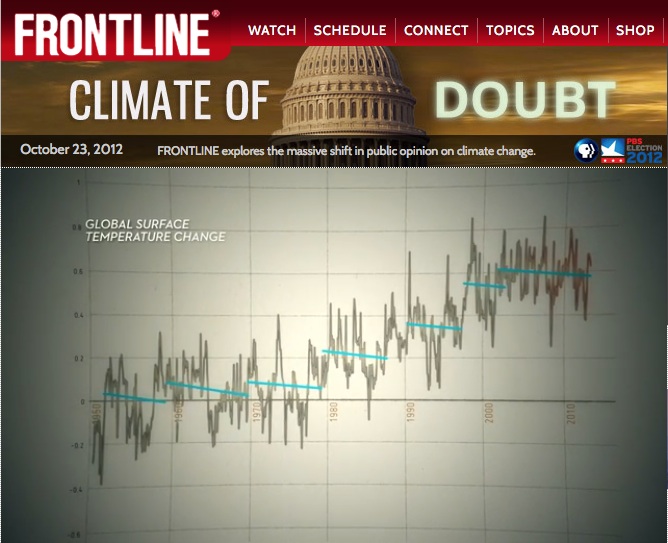
Skeptical Science readers will of course recognize this graphic and Escalator title:
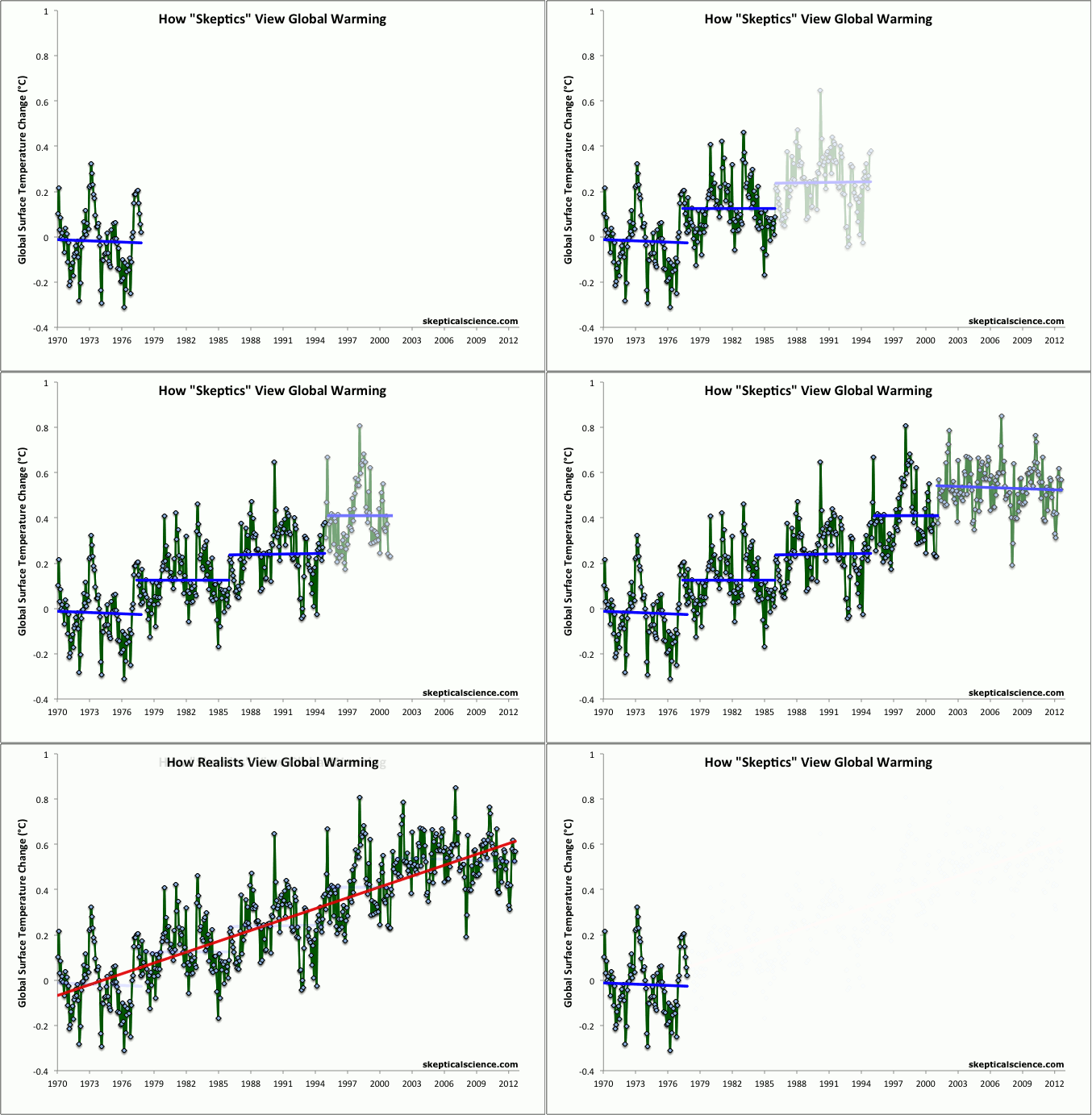
The program could also have benefitted from a discussion of the results of Foster and Rahmstorf (2011), who used multiple linear regression to statistically remove various short-term surface temperature influences, revealing the underlying steady long-term human-caused warming trend.
Perhaps the one flaw in the program was that it created the impression that the climate contrarians have won the policy battle. As Chris Mooney notes, while this is true over the 5-year window examined in the program, their significant political gains have only occurred over the past few years, and American public acceptance of the reality of human-caused global warming has already begun to rebound. Although some have criticized the program for not going into greater depth about the major consequences of climate change that we face as a result of our climate inaction, we feel that Frontline made the best use of the limited time available for the program, and we can only hope that follow-up programs of this quality will be forthcoming.
The effectiveness of the program is particularly clearn in light of the fact that the climate denialists are already in full blown damage control mode, with no less than four response blog posts from various right-wing think tanks published at a major player in the climate denial movement, WattsUpWithThat, over just a span of two days. We will have more on these attempts at denial damage control in the near future.
Overall if you haven't watched the program you should, and if you watched it you should do so again, but invite a friend, relative, or neighbor to join you in order to spread the word. Climate of Doubt shines a light on the motivations and tactics of the climate denial movement, and while they have very little in the way of constructive scientific contributions, we can learn a lot from their messaging strategies.
The science is clear; these are the people fighting to destroy a liveable climate for future generations. We can't let them succeed.

Arguments


In terms of the Australian political landscape over the last five years, which is of course not the same as the US situation, I'd say that climate contrarians have won the battle.
Oh, we managed to get a price put on carbon, but only after the original scheme was kiboshed by a negative publicity campaign, and only after the federal government overthrew its prime minister. Worse is the fact that the eventual carbon price has endured withering unwarranted criticism, and the promise of elimination by the Coalition whose entire platform is based on the notion that a carbon price is not necessary, and that it is government policy that determines whether or not refugees and asylum searchers decide to come the the country by boat.
On the conservative side of Australian politics there is, in addition to a Federal Opposition peopled with rabid human-caused climate change deniers promising to rescind the carbon price, the Queensland State Government that has abolished its Climate Office, and the NSW State Government which has removed the need for reference to IPCC sea level projections when planning coastal developments. To say nothing of the governments across the country falling A over T in an effort to flog as much coal as can be dug out of the ground as quickly as possible.
Scrape beneath the surface of the decision-making that has led to these outcomes, and there is a swath of denialist campaigning. And as things stand, the lobbying has been sufficiently successful that we will likely see the most aggressively denialist parties ever win federal government next year, setting both Australia and the world up for more delay at a time when action is perhaps the most cricial that it will ever be.
Clearly, there was more than a reaction to climate change going on there. I think the emotional shock of losing to a Northern Democrat, and a black one at that, galvanised all sorts of toxic reactions among the Republican base, and the climate contrarians were able to climb on that band-wagon, powered also by the effects of the recession. God knows what will happen if (hopefully, when) they lose again.
In the UK, there are climate contrarians in the Conservative Party, which leads the Government in coalition with the Liberals. But the battle is mainly being fought behind closed doors, and the battlefield is more over renewable energy subsidies and carbon caps than the science, which attracts little in the way of negative comment - except from the Daily Mail, the Conservative Daily Telegraph, or (sometimes) Murdoch's Sunday Times.
I only half agree with John Brookes #2 - I think the contrarians have won on public policy because the politicians are weak, and too willing to take the line of least resistance in a period of economic hardship. But I think public opinion is broadly coming round to the idea that global warming action cannot be postponed for much longer - mainly because the signs of climate change are becoming too obvious to be suppressed.
shoyemore #2 - saying 'except from...' and then naming probably the three most influential newsapapers in the UK is not so comforting. UKIP (roughly equivalent to the Tea Party, at least in levels of lunacy) are having a corrosive effect on the quality of politics here. Mainstream Conservatives are genuinely scared of losing votes to this extreme and there looks to be an increasing move to keep those voters in the fold. What's depressing to see is how willing politicians, who previously worked within a consensus on climate change, are to abandon their principles for cheap votes.
Overall they are afraid to explain something to people which can not be explained in 1 minute.
And because of the media it is not getting better, they should do more to expose the "sceptics"
Videos from potholer & Greenman explain the basics in a way most educated people can understand, they should be shown on public television every week, maybe with a discussion between "sceptics" and scientists afterwards for 25 minutes on that subject alone.
Of course Teaparty & co. (in Netherlands PVV) will tell this is the MSM and there is no room for debate and the videos are biased....
I live in Ireland, so am not that well versed in the sales of UK newspapers.:) At least the TV stations in these here islands are mostly free from deep denialism.
The UKIP clearly did not lighten it's attacks on climate science since Monckton jumped ship, or was pushed.
Denialism seems to be strongest in the English-speaking countries. Is is because that there wealth has such a big say in politics? Or is it just because that is what we focus on?
In Canada, the Harper government seems to be a continuation of George W. Bush - paying lip service to science, but in practice ignoring it. That may be even worse than the public denial that can be openly called to account.
I really liked the show, and though the interviewer did a masterful job.
@ Bernard J. When looking at whose ahead in policy terms, vis-a-vis Australia or the US, I would have to say Australia. Simply because Australia's national parliament has managed to pass laws taxing CO2 emissions. The laws have been in place for some time, and the sky has not fallen in, as predicted by the opposition. If the opposition were to become the government, they would certainly try to overturn those laws, but may find unscrambling the egg no easy task.
In the US though, congress looks as far away as ever from getting up a carbon tax or an emission trading scheme. A state of affairs not helped by the slow recovery from the GFC. Whatever the imperfections of the Australian scheme, at least the national government has taken the first tentative steps, to de-carbonise Australia's economy.
I had the same thought, but I think overall it was a good program. It seemed to cover much of the same ground covered in the excellent book 'Merchants of Doubt'. The difference between a book and a TV show is that people don't just pick up a book in the middle and read a few pages, whereas it's easy to catch a TV show in the middle without knowing the pretext. Not to mention a 300 page book can go into far more detail than a one hour show.
So anyone who happened to stumble across the program may have fallen into the trap you mention. But I think for people watching the show in its entirety, it would be easy to see the myths and obfuscation for what they are (I hope). A picture is worth a thousand words, and the escalator is one of the best ever. If it were up to me, I'd show that the entire time a contrarian is talking!
I strongly disagree. To talk about consequence or dabble in the potential of prediction plays into the hands of contrarians who are already heavily invested in conflating the science of what is happening with the fears of what will happen.
One of the biggest and often used talking points involves linking model predictors that have failed and use those to suggest that current metrics should be discounted.
I think we need to keep the horse before the cart and concentrate on the evidence that indicates. Once that is well established and the outliers of denial are squashed it will be easier and more fruitful to get the public and the policy makers on board the amelioration express.
At some point the "skeptics" will simply fade away, embarrassed to talk about their previous beliefs.
While I would really love to believe that, one look at the Creationist Museum in Kentucky leads me to believe they will always be there. No matter the evidence, personal belief just trumps rational thought in a lot of cases.
I haven't seen the program yet, I intend to this weekend. If it is as good as is being claimed here, I'll be sharing it far and wide here in Canada. Tragically, our proximity to the US has really helped in allowing the misinformation campaign to spread north. A discouragingly large portion of the Canadian public is now skeptical or denying climate science, and while there is mounting opposition to the country's black eye, the tar sands, and its associated pipelines, this more commonly stems from wishing to protect the regional evironment rather than the global climate
@shoyemore, I'd currently say that the Harper government is worse than the G.W. Bush administration on the climate front. Bush at least acknowledged the threat of global warming and climate change, whereas Harper - to the best of my knowledge - has never done so. Worse yet, Canada is now actively engaged in disrupting attempts at climate action and we have the pathetic point of being the only country to withdraw from Kyoto.
True, the "professional skeptics" that feed the "general public skeptics" will fade away at some point, but I think they will never do it in shame because they don't actually believe the vast majority of what they say IMO. I think they know climate change will be bad, but they themselves, and there societal peers, are situated to grow old and pass on without having to deal with the consequences. If my opinion is right, then the emotion to feel any real remorse is absent from these people.
James Taylor, interviewed in "Climate of Doubt", today in the Wall Street Journal writes about how science supports his contention that global warming will actually be good for Africa. There are links in Taylor's peice to the supporting science. One is a USGS study on water cycle intensification - it takes only 10 minutes to read it and see that Taylor is wrong that it supports his contention that global warming will be good for Africa: the "general public skeptic" will never do that, he/ she will just trust the "professional skeptic", after all he linked a USGS paper ...Better stop, starting to ramble and just getting depressed about it.
OK, point taken regarding Taylor.
And thanks for this post.
While watching Climate of Doubt I thought there should have been more explanation of why the scientific case of the "septics" is so lacking in credibility. But after thinking about it more I realized that in a one hour show you can only address so much: And like other commenters here I think PBS did a very good job exposing how the Heartland, etc was all about politics/worldview instead of rational discussion. The show was a good prod to any open minded viewers to view skeptically the "skeptics".
This is my first post here and I'm going to get right to the point. I'm not trying to detract from this site by sending someone somewhere else, because I have used the material from this site, particularly images, to battle against ignorance and have respect for this site. My appeal is a simple request for scientists or anyone with concern about our climate to go to contrarian sites and speak their minds. This call to do battle on other sites, like WUWT, is contrary to the comforts of home, where people agree about reality and I don't suggest a person should spend much of their time there, but I know from experience that Denialista sites can be beaten. It's been my experience that to fight those Phillistines, there's a jawbone of an ass laying everywhere and I don't suggest giving them Samson time.
Let me warn you, don't use the words deny, denier or denialist on their sites! You have to use your imagination and come up with another way to express yourself. They like to moderate and play a game that denialist has something to do with the Holocaust. I also warn you to not get caught in the trap of stupidy, where it's easier to think up something dumb than use reason. You're on their turf and they know the jawbones of asses are everywhere.
Back to the point of this post! Scientists, concerned citizens, I beg you to do battle on this ignorance. I don't want you to dedicate your life to it, but just give a few moments of your day. Start up an account and just voice your opinion on their comments.
Thank you!
"Denskepticog" works for me. :-)
It's good to be told in your old age that the global temperature is declining and the arctic sea ice will rebound. I'm still waiting to hear Santa Claus is real and the Tooth Fairy is going to pay up with interest. It's good in my old age to think I haven't left a screwed up mess of a planet for my children to inherit and deal with.
There may be a chance in the next three years for certain governments, including my own, to be shocked enough by events and put away their interests in the arctic, like a child getting bored with a new toy. It's human nature to always want more of something we can't take care of and we can only hope sanity gets it's day. If we allow that arctic sea ice to melt away, we can kiss every city that is near a coast good-bye. That means no more Washington, DC and London.
What hope is there if someone can hold such an office yet can't be bothered to study the most important item in their brief?
It starts with quite libertarian and wealth-centric priorities, which in turn are the basis for objections to any action on climate change. With those objections established, they are immediately convinced that the science is wrong. Their route to that conclusion completely bypassed an investigation of the facts as a factor in the conclusions they reach.
At that point the science is - dare I say it - an inconvenience, and becomes their arena of choice for (a) cherry-picking to support a confirmation bias and (b) a place to try to sow doubt. Their mind is already made up.
The effort to develop meaningful climate action is a task akin to religious conversion, rather than reaching scientific conclusions. Ugh.
I appreciate your call to action. A lot of regular posters on this site do engage with the sketpics (typo, but then I decided I liked it!) elsewhere.
I had to stop, because it was adversely affecting my mood. I have no idea whether or not I swayed any of the 'undecided' as a result of my trek through a hundred thousand lines of snark.
My hat goes off to John Brookes, who has been doing it almost daily over at JoNova's site for what must be at least 2 years.
Also to one "Adam Smith" who 'won the game' by being banned for somehow responding to almost every silly meme perpetrated in several dozen threads. He was so effective and prolific that the denizens decided he must be a team of individuals from GetUp, the ALP or (presumably) Endor.
"I had to stop, because it was adversely affecting my mood."
I'm sure we can all empathise with this, and I've little doubt this is an active, albeit possibly subconscious, strategy employed by those who want to shut down debate. I know from talking to people who are deeply concerned about climate change how many of them avoid comment threads because they find them too depressing.
I wonder if there's call for a basic 'how to cope with internet climate discussions' guide, particularly for people who don't spend the necessary hours reading up on the details of the science to be confident responding to the more technical misinformation. I know how helpful it is just to have a bit of support at times and I think if more people gave moral support it would help to tip the balance.
I think there are a few simple things that can make a difference which anyone can do. Just starting off with clicking recommends can help. Some other ideas: asking for evidence for unsupported claims (and following this up if not forthcoming or if evidence provided is questionable), pointing out contradictions - not necessarily scientific ones but just in terms of tone, pointing out when questions haven't been answered, pointing out when more points have been thrown in before others have been addressed etc. etc.
I'm sure there must be many people who have time to make a difference but are reluctant to take part because of the reactions any commenting draws. Anything to encourage more people to weigh in.
Pre-1980's the risers were lower and the treads longer. For the 80's and 90's the risers get higher and the treads shorter.
The IPCC projections for the future projected an even higher step for the coming decades.
But for the 2000's the riser got a lot shorter than the 80's and 90's and the tread a lot longer than ever.
Since the IPCC made that projection in 2000 (not 1980) thats raises a good deal of concern right out of the box. Might have been a well hit ball but the batter stumbled on home plate.
Seems to me until the next step comes its matching what many scientists have been saying about an oscillating climate possibly suggesting less warming for the future than projected.
Obviously one such step is not very convincing to somebody already convinced, but it is a bit of problem for convincing those who are not convinced.
This has been my problem anyhow. I am schooled in investigation, auditing, and statistics. I have used this skill in 3 entirely different technical/scientific fields so while I know little about climate I do understand a statistical argument for climate.
When I first became interested in this topic, and who would not? Especially somebody who has dabbled in passive solar heating design such as myself. Anyway I went to the so-called bible and read IPCC AR3. I was surprised at the reliance on historic weather patterns and Ben Santer's fingerprinting being front and center in the attribution chapter with virtually nothing from science. (I realize that science has some stuff but its not organized into a soup to nuts documentation). Auditors are frequently confronted by both forms of evidence. If its technical an independent expert is found. If its statistical or historical the auditor tests that and recommends adjustments based upon his tests.
Actually there is practically no soup to nuts science/physics discussion of climate change in the whole of the AR3 document.
So if the bible says so climate change has to be primarily based on historic warming. Thus the recent change in step height and width has to be very concerning to the authors of the attribution chapter.
This is why I stepped in on the Curry discussion. There is no explanation for what is happening and it has to be seen as uncertainty.
It would be a disservice to readers if the IPCC were to merely adjust the historic temperature attribution by adding in new entirely new historical arguments. Auditors generally don't allow that as consistency is important. Such an approach is like stepping back 12 years.
Begging for an answer is why that step is so low and so long especially at a time in the face of alleged extreme climate forcing the other way.
So I hope everybody seriously takes this as the question "Why?" as opposed to a lecture.
Sure somebody can draw linear trends through the data and call it natural variation. Thats one answer but I know statistically it results in less certainty and the amount of less certainty is in no way affected by drawing a linear trend.
Likewise Roy Spencer at his blog has been drawing a 4th order polynomial fit that is just another view of the trend, not superior, not inferior. Spencer though acknowledges his trend is for "entertainment purposes only" and doesn't offer it as an argument. Statistically speaking he is right on the mark about that.
[DB] Part of your problem is insisting on arguing from ignorance. You refer to AR3 while the AR4 has been out for 5 years and AR5 is being drafted.
At Skeptical Science, thousands of threads exist dealing with virtually everything to do with climate science...and the denial of it by skeptics and the like. This thread specifically deals with Climate of Doubt Shines a Light on the Climate Denial Movement. If you would care to break up this long comment into more appropriately-specific subjects, utilization of the Search function will certainly locate for you specific threads where those bits will be more on-topic. And likely have already been dealt with, either by the OP of those threads or in the comment threads to the posts.
Also, please acquaint yourself with the Comments Policy of this website (linky adjacent to every comments box).I apologize for getting too wordy and out of topic in my last response so I rewrote it below. Feel free to erase the previous post so I am in compliance with your posting policy. I have read the policy and will try to adhere to it.
_______________________
The climate escalator graphic is pretty revealing.
Especially in the video screenshot version.
Pre-1980's the risers were lower and the treads longer. For the 80's and 90's the risers get higher and the treads shorter.
The IPCC projections for the future projected an even higher step for the coming decades.
But for the 2000's the riser got a lot shorter than the 80's and 90's and the tread a lot longer than ever.
Seems to me until the next step comes its suggesting or matching what many scientists have been saying about an oscillating climate possibly suggesting less warming for the future than projected.
Obviously one such step is not very convincing to somebody already convinced, but it is a bit of problem for convincing those who are not convinced.
Somebody can draw various trends through the data and point out all sorts of interesting stuff. But statistically the less these curves comply with each other the more uncertainty that suggests.
Regarding statistical trends Roy Spencer at his blog has been drawing a 4th order polynomial fit that is just another view of the trend, not superior, not inferior. Spencer though acknowledges his trend is for "entertainment purposes only" and doesn't offer it as an argument.
The fact that you are trying to draw inferences from the perceived change in appearance of those trends suggests you have rather missed the point, which was this: you can't infer anything when the period is too short because the signal is swamped by noise.
I'd also like to point out that those trends were deliberately cherry-picked to maximise the effect, and that your "observations" completely fall over as soon as a different temperature series is picked, as with the original escalator graphic. In that case you could argue that because the cherry-picked trends have greater negative slope from the early 80s to the mid-90s and that it's harder to find such negative trends now, warming has actually accelerated.
But if you really want to analyse the data, rather than drawing inferences from the shapes of trends that were cherry-picked for dramatic effect, I suggest you ask yourself the following question:
Is there any evidence that the global warming trend has slowed in the last decade or so compared to its previous trend during the 90s?
As a statistician you can calculate the trend prior to 1997, say; then see whether the data since 1997 fits within the 95% confidence interval of that prior trend extrapolated to today. (Of course you need to account for autocorrelation in order to calculate the 95% confidence intervals.) Do that with each of the global temperature data sets. Assuming you find that the answer is "no", then ask yourself:
If there is no statistically significant evidence of a change in trend since 1997, how can we say that global warming has slowed?
Regarding 4th order polynomials -- of course that's inferior. If the data is noisy, you don't make it easier to capture the underlying behaviour and make useful predictions by giving your model more degrees of freedom! Every additional parameter has to be shown to be justified. Adding a linear term to a model of global temperatures since the 1970s, for example, clearly results in a better model than a model that simply has a constant temperature term. But models with more parameters will be worse according to the Akaike information criterion for that period in time. Over longer periods, when other factors come into play, then additional parameters may be justified.
There's another important reason for a linear trend that's not just based on the statistics -- it's called Physics. We expect a linear increase due to the exponential increase in CO2 emissions coupled with the logarithmic nature of CO2 concentrations on temperature. From knowledge of the problem itself we can predict what model should work best.
Roy Spencer knows this as well, which is why he says it's for "entertainment purposes only" and doesn't offer it as an argument. If he didn't know it was inferior, as you apparently don't, then he wouldn't have to say that, he could defend it.
It's easy to construct a higher-order polynomial that shows temperature about to embark on a precipitous increase, but I doubt you'll find anybody here posting one "for entertainment purposes only". Something to think about.
You take a long enough trend, and compute a proper linear trend line. If you break the trends up, you do it for valid, physical reasons following rules that you establish before you begin carving, not after.
This is all about playing games with numbers, and it's a waste of everyone's time.
There is only one thing that the numbers consistently and indisputably say, and that is that the climate is warming steadily and dangerously. If that warming seems to have slowed, then there are only two possibilities. One is that a number of negative factors are combining to minimize the warming for a time. This would be very, very bad if people accept it as an excuse for inaction, because there will inevitably be another period where temperatures "catch up," and people will be stunned by what that means.
Alternately, we could be finding that the rate of warming is slower than expected. The setting of the thermostat is still the same. We have at this point committed ourselves to about 1.4˚C of warming, no matter what we do, and because of our lack of progress in reducing emissions, since we can't simply go "cold turkey," many argue that when you consider the future emissions that we cannot avoid, we are already committed to a temperature rise of well beyond 2˚C.
So if we're committed to such a rise, but the rise is slower than expected (either only in the short term, due to temporary, negative factors, or over the long term, due to the "sluggishness" of the system), in either case we are in very bad shape if people continue to use that to argue for inaction.
Because the reality is that regardless of pace, we are committed to a dangerous increase in the earth's climate, and the longer we delay, the worse the end result will be, no matter how long it takes.
People need to wake the F up.
Well yes. The surface stations.
I think its normal that the number of people who think the globe has warmed and that mankind is in someway responsible is going to fluctuate with the weather.
You can number me in that group. I am not particularly strong on the man-caused question but give the choice between yes and no I would have to pick yes.
Its the number of people who think something should be done about it thats below 50%. And you can put me in the category of being in the minority there was well.
For instance I think solar water heating systems with demand water heating should be mandated for new construction and I think persons looking at newly constructed homes should consider paying a bit more for a home with excess insulation and radiant heating systems running off of solar heating panels either as a primary source of heat, with or without supplementation. Though that's probably a little expensive to mandate.
So apparently I am in the minority with you guys on the question of doing something, but probably differ on what should be done.
But lets not argue statistics. Lets keep this simple and relevant to public opinion. Statistics is really off topic here I think.
(-SNIP-)
Well, no -- and that's the point. The surface station records show a flattening in the past decade or so that makes it look like the long term warming trend might have slowed when viewed in isolation, but the whole point of the escalator graphic is that this has occurred many times in the past and every time it turned out that the underlying global warming trend kept right on going, so we need to figure out if this time is any different. (The point of the Foster and Rahmstorf graphic right below it is to highlight this fact and make it easier to discern the trend in less time by removing the influence of exogenous factors, effectively improving the signal:noise ratio.)
My question was "Is there any evidence that the global warming trend has slowed?".
To answer that question you need to assess the statistical significance of the recent apparent change in trend. The whole point of "arguing statistics" is to make sure we're not being fooled by what we think we see in the data. If you don't want to argue the statistics or put the effort in to working out whether recent surface station records signal a reduction in trend then you can't go around claiming that they indicate less warming in the future than projected.
If you do want to go around making that claim (???) then you have no choice but to do the work to see if the data supports that claim. After all, how can you make that claim without already knowing it's true from having analysed the data?
The question about whether we should act and what should be done is completely besides the point and the subject of other posts here.
If you look only at a short period of land surface temperatures, the noise drowns out the signal, so it is not a useful metric, unless you want to obfuscate the evidence.
(-SNIP-)





