Home Arguments iPhone App Recent Comments Translations Links Support SkS

Twitter RSS Posts RSS Posts RSS Posts RSS Posts

to support
Skeptical Science
iPhone app

Download
Android app

Download
Nokia app

Download


It's the sun
Climate's changed before
There is no consensus
It's cooling
Models are unreliable
Temp record is unreliable
It hasn't warmed since 1998
Ice age predicted in the 70s
We're heading into an ice age
Antarctica is gaining ice
View All Arguments...


Username
Password
Keep me logged in
New? Register here
Forgot your password?

Latest Posts

Archives


CO2 is not a pollutant

The skeptic argument...

CO2 is not a pollutant

'To suddenly label CO2 as a "pollutant" is a disservice to a gas that has played an enormous role in the development and sustainability of all life on this wonderful Earth. Mother Earth has clearly ruled that CO2 is not a pollutant.' (Robert Balling)

What the science says...

While there are direct ways in which CO2 is a pollutant (acidification of the ocean), its primary impact is its greenhouse warming effect. While the greenhouse effect is a natural occurence, too much warming has severe negative impacts on agriculture, health and environment.

We commonly think of pollutants as contaminants that make the environment dirty or impure. A vivid example is sulphur dioxide, a by-product of industrial activity. High levels of sulphur dioxide cause breathing problems. Too much causes acid rain. Sulphur dioxide has a direct effect on health and the environment. Carbon dioxide, on the other hand, is a naturally occuring gas that existed in the atmosphere long before humans. Plants need it to survive. The CO2 greenhouse effect keeps our climate from freezing over. How can CO2 be considered a pollutant?

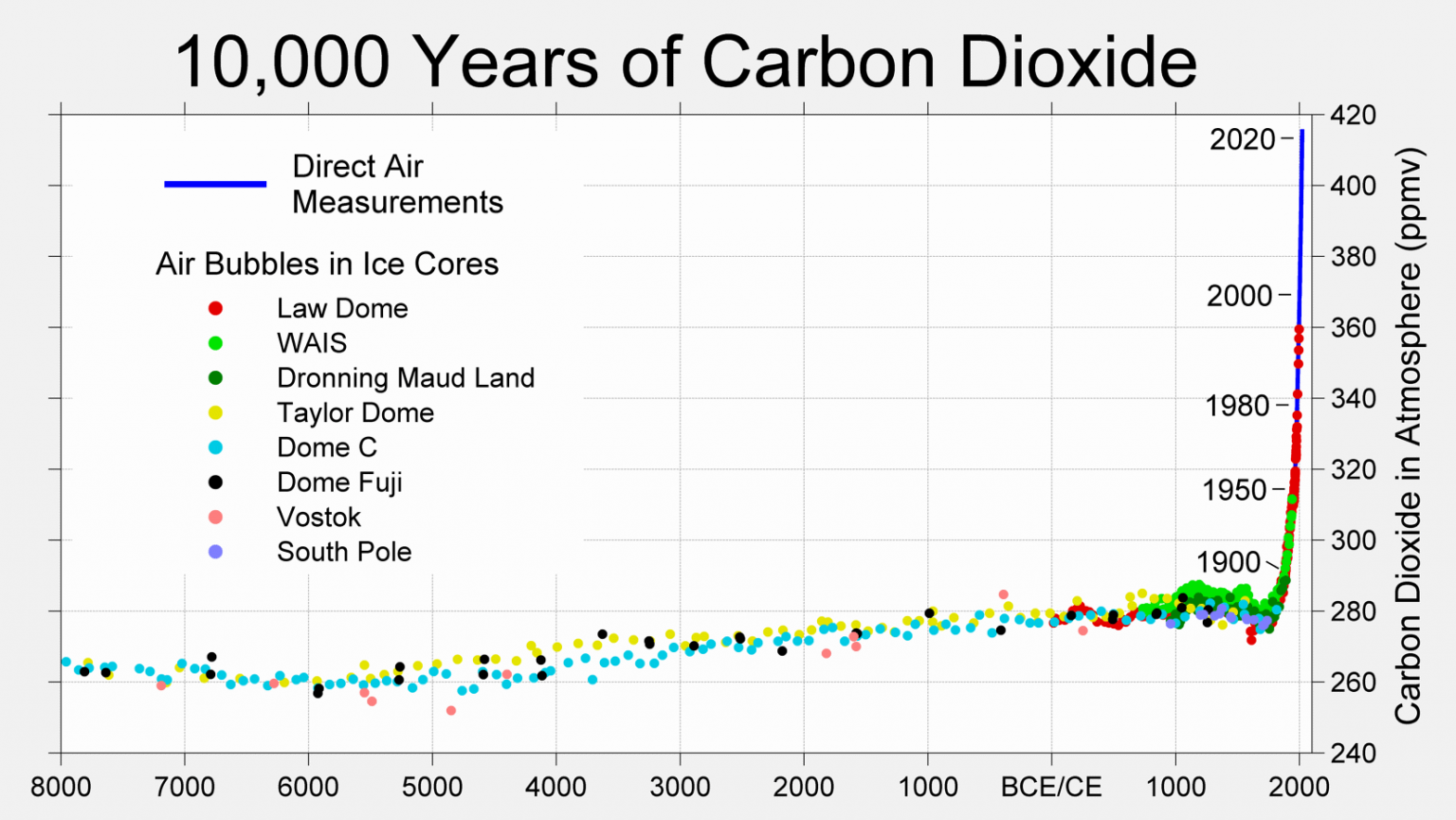
A broader definition of pollutant is a substance that causes instability or discomfort to an ecosystem. Over the past 10,000 years, the level of atmospheric carbon dioxide in the atmosphere has remained at relatively stable levels. However, human CO2 emissions over the past few centuries have upset this balance. The increase in CO2 has some direct effects on the environment. For example, as the oceans absorb CO2 from the atmosphere, it leads to acidification that affects many marine ecosystems. However, the chief impact from rising CO2 is warmer temperatures.


Figure 1: CO2 levels (parts per million) over the past 10,000 years. Blue line from Taylor Dome ice cores (NOAA). Green line from Law Dome ice core (CDIAC). Red line from direct measurements at Mauna Loa, Hawaii (NOAA).

Rising CO2 levels causes an enhanced greenhouse effect. This leads to warmer temperatures which has many consequences. Some effects are beneficial such as improved agriculture at high latitudes and increased vegetation growth in some circumstances. However, the negatives far outweigh the positives. Coast-bound communities are threatened by rising sea levels. Melting glaciers threaten the water supplies of hundreds of millions. Species are becoming extinct at the fastest rate in history.

How we choose to define the word 'pollutant' is a play in semantics. To focus on a few positive effects of carbon dioxide is to ignore the broader picture of its full impacts. The net result from increasing CO2 are severe negative impacts on our environment and the living conditions of future humanity.

Printable Version  |  Link to this page

Related Arguments

Further reading

For a good overview of CO2 acidification, read Ken Caldeira's What Corals are Dying to Tell Us About CO2 and Ocean Acidification.

Comments

Comments 1 to 12:

  1. Plants can't grow any better than their limiting factor, which might be not CO2, but nitrogen, water, light,....

    Even if they do grow "better," the betterment often is not to the advantage of farmers; for example, the extra mass can go into non-consumable woody stalk, which makes the crop more expensive to process than any extra grain/fruit value.

    And weeds such as poison ivy and kudzu respond much "better" to increased CO2 than do many crops, but "better" is not better for people, and not better for plants that those weeds compete with.

    For details see the U.S. Department of Agriculture's report on climate change.
  2. Some plants grow worse at higher temperature, offsetting gains from CO2 spurring growth. Examples are in tables in the USDA report I linked to in my earlier comment.
  3. This comment is my response to a question by gallopingcamel on another thread. This topic is off-topic for that thread, so I'm responding in this thread.

    The Duke FACE experiment (Free-Air CO2 Enrichment) of artificially fertilizing trees with CO2 is an important one. Its results are consistent with other experiments on other plants: Plants' growth is limited by whichever nutrient or other condition is in shortest supply or detrimentally high supply, or by inherent physiological limits. A plant whose growth is limited by water supply isn't going to grow more if you give it more CO2, or more sunlight, or more soil nutrients. If initially the CO2 supply is the limiting factor, then giving the plant CO2 will let it grow faster only until some other factor that was sufficient for the previous growth rate becomes the bottleneck for the higher growth rate. Farmers and gardeners know this, which is why they don't waste money by giving plants too much of any one thing. Even greenhouses whose air is spiked with CO2 don't have 100% CO2 atmospheres.

    "Detrimental conditions" include temperatures that are too high. Even if a plant has sufficient other nutrients and conditions to allow it to take advantage of extra CO2 to grow more, if that CO2 is accompanied by higher temperature, the temperature can slow growth. The net growth then will depend on the balance of the enhancement from CO2 and the detriment from temperature.

    But even if you keep all the nutrients and conditions in synch, there are inherent physiologic limits to growth rate. All plants in the world today have evolved for, or been bred for, approximately the current CO2 levels. There was no survival advantage of being able to use more CO2 than was available.

    Not all plants respond the same to increased CO2 levels. For example, the Aspen FACE experiment (different from the Duke pine tree FACE experiment) found that "aspen grow much faster in response to elevated carbon dioxide, [but] similar effects have not been observed in other trees species, notably oak and pine."

    And aspen in moist soil take advantage of additional CO2 by growing faster, but aspen in dry soil do not. In contrast, loblolly pines react oppositely: They grow more with extra CO2 only during dry years, not during normal or wet years.

    The bottom line is that
    "Forests will continue to be important to soak up anthropogenic carbon dioxide," says [the aspen FACE experiment's] Waller. "But we can't conclude that aspen forests are going to soak up excess carbon dioxide. This is going to plateau."

    "Aspens are already doing their best to mitigate our inputs," agrees Cole. "The existing trees are going to max out in a couple of decades."


    The Duke pine FACE experiment's Schlesinger said:
    Based on available evidence from the Duke experiment, “I’d be surprised if the forests of the world will take up more than one-third of the carbon dioxide from fossil fuel emissions in the year 2050, which is what our experiment simulates,” he predicted.


    More information on biologic carbon sequestration, with a number of links to even more info, can be found on an EPA page. Wikipedia has a broader page.
  4. muoncounter at 07:25 AM on 1 April, 2010
    Tom#3:

    These references seem to suggest those 'limiting factors' to potential sequestration are significant and supportive of your quotes under 'the bottom line'.

    From an older issue of Nature:
    "Doubts concerning the potential of natural vegetation for sustained response to rising CO2 have arisen from experiments on infertile soils, where the stimulus to growth was curtailed by mineral nutrient limitations. Here we present evidence that mineral nutrient constraints on the fertilizer effect of elevated carbon dioxide can also occur on fertile soil "

    Also from Nature:
    "Soil carbon was lost at subambient Ca, but was unchanged at elevated Ca where losses of old soil carbon offset increases in new carbon. ... differences in sensitivity of carbon storage to historical and future Ca and increased nutrient limitation suggest that the passive sequestration of carbon in soils may have been important historically, but the ability of soils to continue as sinks is limited."

    From Frontiers in Ecology and the Environment:
    "research suggests that the fertilization effect is limited by nutrients and air pollution, in addition to the well documented limitations posed by temperature and precipitation. This review suggests that existing forests are not likely to increase sequestration as atmospheric CO2 increases."
  5. Apologies to the Moderator. I posted in the wrong place as a result of not properly familiarising myself with the layout,prior to posting.
    #
    AWoL at 07:28 AM on 29 June, 2010
    I'm just a vet, though believe it or not, I can remember Boltzman's Constant from our old Physics lectures, so I like to believe that I inhabit the ranks of the scientific semi-literate.

    My question is, if the Earth has an arbitrary average temperature of circa 15degC and the temperature of space is 270degK ie -270degC, then what's the problem? Anything that stems the ferocious heat loss to the exterior, surely has to be a good thing? Surely the correct thing to do is to pump CO2( or more potent greenhouse gases) into the atmosphere in order to keep the planet as warm as possible?
    What a nutty idea , I hear you say, but in reply I say....-270degC, out there. Not much chance of too much warming when you're up against that. It's bloody cold out there!
    #
    scaddenp at 08:14 AM on 29 June, 2010
    Awol - "as warm as possible". Why not even more potent GHGs then and get us to Venus-like temperatures? Well obviously because we want planet to be around the temperatures we evolved to live in. However, this debate isnt really about what would be an optimal temperature but is about how fast we are changing it. Think of your farm animals and about how easily farmers are able to cope with rapid climate change. We have huge urban centers and complex food production systems that have developed in stable climate. Rapid change is not good for them. Ask how farmers on the great deltas are going to cope with coast erosion and salt incursion as sealevel rises as well. Over a 1000 years (ice cycle type change) possible. Over 100 years - hmm.

    AWoL replies
    scaddenp has given an answer of sorts,but I have to say I'm not entirely satisfied.
    The Venus comparison is no good as there is a lot of controversy over the workings of the Venusian atmosphere.Most agree that it is not comparable to Earth, and in fact the greenhouse effect of CO2 plays but a small part in explaining the high surface and atmospheric temperatures on that planet.

    Regarding the consequences of the overheated planet which you envision. Why all the doom and gloom? In the deltas that you mention, could not the farmland, assumimng that there is any, be replaced with fish-farming and shellfish production? People could live on man-made islands as have been constructed in Dubai.In Japan and Hong kong hasn't there been considerable land reclamation? Then there's the Dutch and their dykes.Isn't nature herself lending a hand in the creation of new land ie the Surtseys and the Icelandic Westmann Islands. Isn't isostatic rebound still underway from the last ice age? Or has that come to a stop?
    With regard to agricultural production, I can't help feel that you are miles off the beam. Wasn't it Herschel the astronomer, that correlated increased sunspot activity with lower grain prices? Everything starts from plants. What's good for plants is good for animals which is good for people.Plants like the heat,given adequate water, and they positively love CO2.

    Where you, scaddenp,see doom and disaster, I see formerly barren territories transformed into luxuriant swards and dense woodlands, inhabited by contented happy people.
    That's the bit I don't get. Why is climate change, ie getting hotter, always accompanied by doom and disaster when if anything it is more likely to be accompanied by happiness and prosperity? Any changes are not going to happen overnight, so there's plenty of time to react.And never before have people been able to move so rapidly, and easily establish new settlements, thanks to the extra power to their elbow of readily combustible,energy-dense hydrocarbons.Markets and the intiative of adaptable people will solve any problems far more effectively than any number of governmental organisations.

    The Sahara was once green. There was no UN in those days.The people didn't die, but moved, adapted and went forth and multiplied......and very good at multiplication they were ..... a bit too good, for their own good, I sometimes think.
  6. doug_bostrom at 04:50 AM on 30 June, 2010
    Quite a bit of unsupported speculation there, AWoL. Other people with skills specific to the various spheres of knowledge you touch upon draw different conclusions.

    Anyway, with regard to unchecked formerly insignificant pollutants emerging from burgeoning cultural intensity we have lessons from the past to draw upon. Government (us, acting in concert) ends up owning solutions nobody else can or will provide.

    For a specific example of effective solutions to pressing need arising from inadvertent effects of commercial activity in combination with exploding demand see the example of cholera and typhoid emerging in London and other developing urban systems. A key feature of this story is that established commercial forces nearly invariably resisted attempts to solve the fundamental causes of these diseases, leaving the public in the form of government eventually forced to insist by agreed-on coercion.
  7. AWoL, regarding the benefits of CO2 itself for plants, see the comments before yours on this thread. Click on the links within those comments for supportive details.

    Regarding your other contentions, see the broader post It’s not bad, which lists positives versus negatives of not just more CO2 for plants to consume, but of all the effects of higher CO2 levels, including warming and ocean acidification.
  8. Peter Hogarth at 05:12 AM on 30 June, 2010
    AWoL at 04:22 AM on 30 June, 2010

    "What's good for plants is good for animals which is good for people"

    Joseph Priestley might have had something to say about this!
  9. This post is a continuation of a discussion at the thread "Watts it like at a climate skeptic speakers event?" in response to
    post 104, Marcus at 09:41 AM on 23 June, 2010.
    The Marcus post remains at that thread whilst my reply was selectively deleted. I have copied the Marcus post here to provide some continuity, it follows after my response.

    My response:-
    The most obvious point being overlooked is that the limitations listed are not new, nature has RARELY provided ideal conditions, some would swear never.
    The less than ideal conditions have been there ever since agriculture was first developed, especially, ESPECIALLY, in Australia in the regions similar to where the Horsham FACE trial was conducted which not only simulated higher CO2 levels, but HOTTER and DRIER conditions as well. So far 3 trials have been done over 3 years, 3 below average years, and are ongoing.

    A couple of points :-
    (1)Seed yield increased significantly whilst seed protein fell slightly EXACTLY as has always has happened under natural conditions. Nothing new there.
    (2)Protein yield per hectare INCREASED meaning the process of producing more food from less land can continue.
    (3)Increased non-grain biomass assists in improving soil carbon content. To increase soil carbon content by 1 tonne per hectare, an extra 4.4 tonnes of dry matter per hectare has to be returned to the soil.
    (4) Irrespective of CO2 levels, higher outputs require higher inputs of water and nutrients. ALWAYS HAS.
    However indications are that under higher CO2 levels, water utilisation efficiency is INCREASED.

    ----------------------------------
    Marcus at 09:41 AM on 23 June, 2010
    Sorry moderator, but I just can't let John D's latest comments go by without a response.

    You seriously don't get it-do you John? Nobody here has claimed that-under ideal conditions-CO2 *can't* be a plant food. What they've claimed is that its not that simple because (a) global warming won't provide for ideal conditions & (b) that it is nitrogen, water & trace elements that are more limiting factors on plant growth than CO2 abundance.
    For all your talk, you've not managed to answer several key questions which are:

    (a) under ideal conditions, can increased CO2 levels enhance plant biomass for the long-term, given acclimation?

    (b) even ignoring acclimation, can increased CO2 levels enhance plant biomass given a warmer & drier environment?

    (c) will increased vegetative biomass, from increased CO2 levels, automatically translate into significantly greater seed yields?

    (d) does increased quantity of edible biomass automatically translate into increased *quality* of edible biomass.

    (e) will increased CO2 levels impose any additional costs on farmers? (very important given the slim margins on which most farmers operate).

    Based on the evidence provided by the *one* FACE trial you've linked to, I'd say the answer is that, (a) though increased CO2 can provide short-term increases in total biomass (under ideal conditions) acclimation might eventually erode those benefits; (b) that though there was a significant increase in total plant biomass, this wasn't translating into significant increases in seed yield for most varieties & (c) that seed quality (in terms of protein content) was decreased, but total nitrogen demand from the plant was increased. As someone who actually deals with farmers on a regular basis, if you were to try & promote that to farmers as a *benefit* from increasing CO2 emissions, they'd probably laugh in your face-rightly pointing out that ideal conditions are already hard to come by, that seed yield & seed quality are all that's ultimately important, & that they would be ill-equipped to afford the significant increase in fertilizer costs that this enriched CO2 environment would demand.
    -----------------------------------
  10. AWOL - lets ignore the completely hilarious non-physical stuff about venus. The point I was making is that you cant live on venus, there IS an upper bound on temperature and if you chose enough of powerful enough GHG, then we turn earth that way too. The MAIN point I was making is that RATE of change is the cause for concern - too fast for ecological systems to cope with. Current rate of change is too fast, let alone the projected future rate of change. Its the rate that is the problem. Your happy scenario might play out over 1000s of years and as for comments on deltas, I assume you dont live on one. This is fantasy stuff. Ask yourself why all the existing drowned deltas are the happy places you imagine and they drowned with sealevel rates much slower than current and projected.

    As for CO2 is plant food. Please see other comments in this thread and some reputable science. CO2 does not magically gives the plants extra water or nutrients.
  11. Well thanks for the replies.

    Doug Brostron makes a good point in favour of government with respect to cholera in London. However, when governments get involved in commercial activity they invariably mess up. The Russian cotton industry and the disaster of the Aral sea and the dismal performance of collectivisation. But you're right, and I shall have to add public health to the short list of those things that governments are good at.

    Regarding the effect of CO2 on plants and particularly crops. I checked and indeed much of which you say is true, especially in already drought prone marginal areas. However northern latitudes are expected to benefit. At least in the short- term. There could be problems later, if temperatures rise......but only if temperatures rise.Unfortunately throughout most of those articles, the assumption is made that because CO2 is going up and temperature is going up, then the two are inextricably linked.
    Whilst there are warnings about a decline in seed quality, growers in Holland are pumping CO2 into greenhouses to obtain increased output in the order of 20-30%. Benefits fall off after 1000ppm and indeed higher levels are harmful. If anyone says, as I have done up to now, that plants can't get enough of the stuff, then that is indeed plain wrong. However I have heard it said, that it will be very difficult to get above 600ppm(atmospheric) even with no brakes applied to hydrocarbon consumption.True or false?
    So far I haven't come across any complaints about CO2 enhancement being a waste of time and money.
    If world output is going to be affected, water availability and temperature would seem to be bigger factors than CO2 levels. Obviously there are going to be changes, and winners and losers, but overall won't things carry on much as they are?

    Scaddenp makes the point about rapidity of change. An example or two, if poss please? Can't say I've noticed very much different here in Britain and the continent. Drought seems to be problem in Australia... but what's unusual about that? And while we're at it, where are the drowned deltas? I thought I was fairly well clued up on Geography, but maybe not. Maybe, when making a statement, you could provide an example or two?
  12. ScienceDaily (May 9, 2003) states that higher levels of CO2 may allow forests to grow in arid areas that once were unsupportive of trees.

    This information comes from studies in the Negev, one of the driest places on earth.

    "Plants need carbon dioxide for photosynthesis, which leads to the production of sugars. But to obtain it, they must open pores in their leaves and consequently lose large quantities of water to evaporation. The plant must decide which it needs more: water or carbon dioxide. Yakir suggests that the 30 percent increase of atmospheric carbon dioxide since the start of the industrial revolution eases the plant’s dilemma. Under such conditions, the plant doesn’t have to fully open the pores for carbon dioxide to seep in – a relatively small opening is sufficient. Consequently, less water escapes the plant’s pores. This efficient water preservation technique keeps moisture in the ground, allowing forests to grow in areas that previously were too dry."

    In fact one proposal suggests that all the world's industrial release of CO2 could be absorbed by planting trees in the deserts of the world and in particular the Sahara. Haaretz Tue, July 27, 2010 Israeli ecologists could help stop global warming.

Post a Comment

Political, off-topic or ad hominem comments will be deleted. Comments Policy...

You need to be logged in to post a comment. Login via the left margin or if you're new, register here.

Link to this page

© Copyright 2010 John Cook Links | Translations | About Us | Contact Us