Subscribe in a reader


Username
Password
Keep me logged in
New? Register here
Forgot your password?


It's the sun
Climate's changed before
There is no consensus
It's cooling
Models are unreliable
Surface temp is unreliable
Ice age predicted in the 70s
We're heading into an ice age
It hasn't warmed since 1998
Antarctica is cooling/gaining ice
View All Arguments...


Latest Posts


Global cooling in 2007 - has global warming ended?

The skeptic argument...

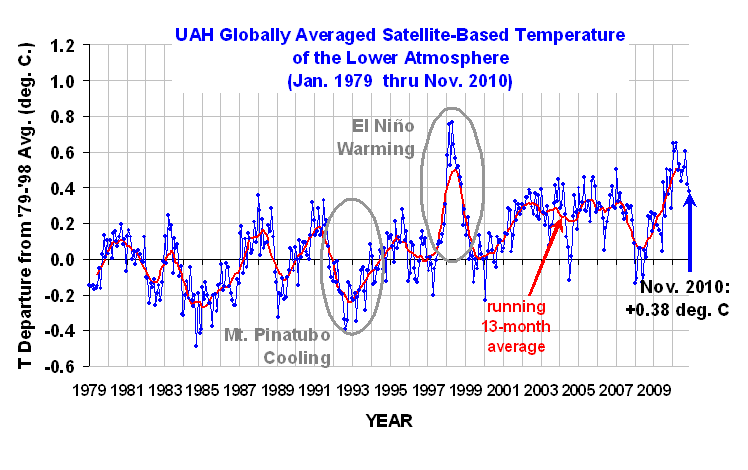
January 2008 capped a 12 month period of global temperature drops on all of the major well respected indicators. HadCRUT, RSS, UAH, and GISS global temperature sets all show sharp drops in the last year (source: Watts Up With That).

What the science says...

2007's dramatic cooling is driven by La Nina which historically has caused similar drops in global temperature and should recede in mid-2008.

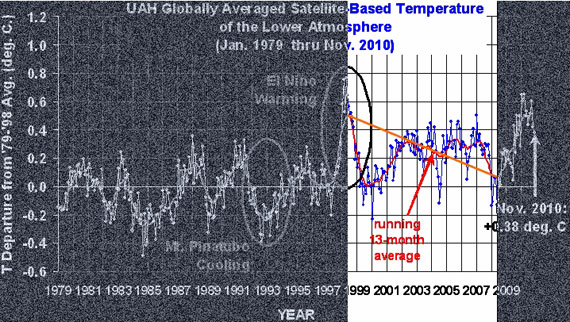
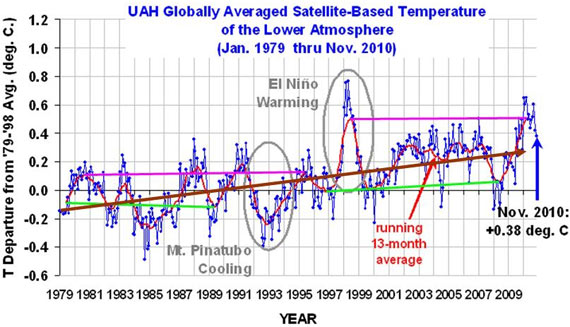
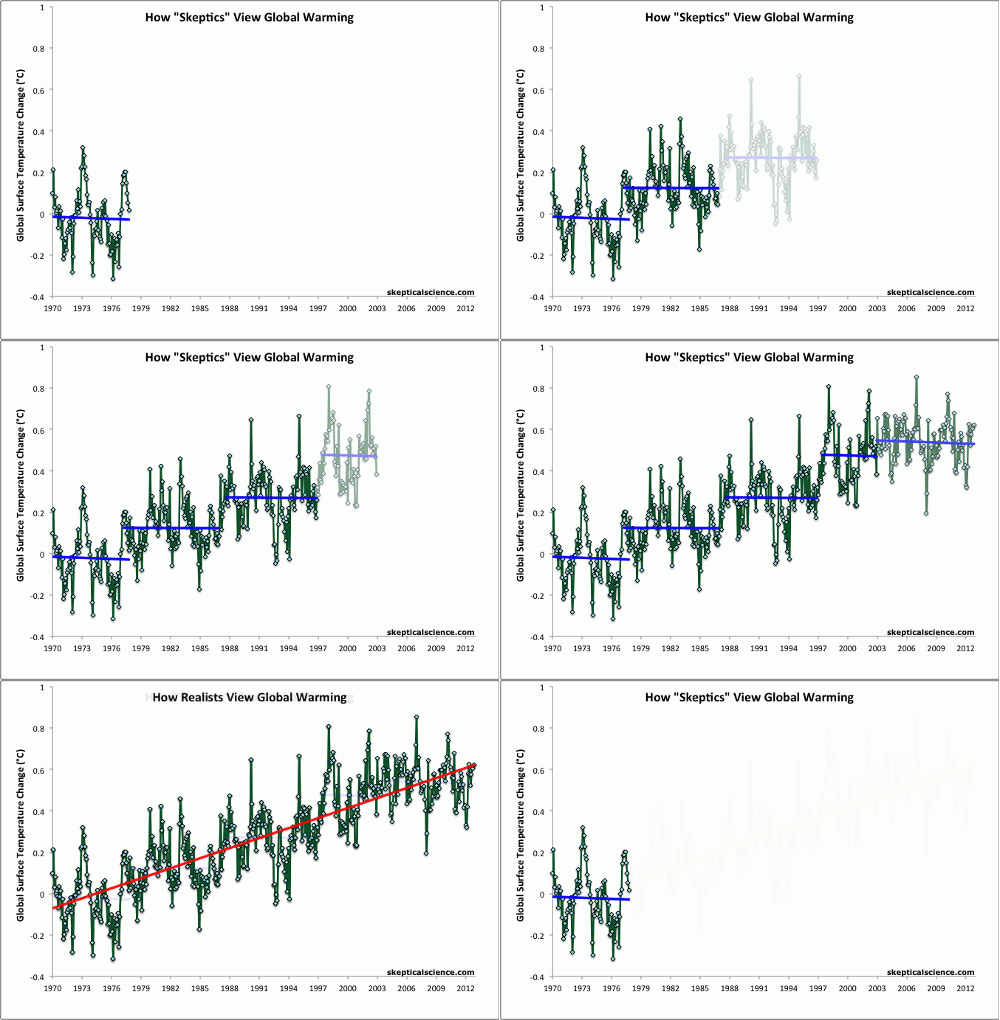
The flaw in this interpretation is in drawing conclusions about long term climate change over a relatively short period of 13 months. Particularly when a large portion of that cooling occured over one month (January 2008). Only over a period of years to decades can you confidently discern climate trends. Otherwise, you run the danger of mistaking weather for climate.

Nevertheless, several important questions remain - what's causing this sudden cooling and is it the start of a long term trend?

Is the sun driving global cooling?

The general consensus among skeptic blogs is that diminished solar activity is the cause. The sun is currently at solar minimum - cycle 23 just ended and cycle 24 is having trouble kicking along. It's as cool as it gets in the solar cycle.

However, a temperature drop of 0.6°C would require a dramatic reduction in Total Solar Irradiance (TSI). According to theoretical calculations at Atmoz, TSI would need to fall to 1347.65 W/m2 to produce a global cooling of 0.6°C. In other words, 13 W/m2 less than current levels. This is ludicrously large considering the solar cycle varies only around 1.3 W/m2.

Alternatively, Camp 2007 adopts an empirical approach to calculate solar influence on global temperature. He determines the solar cycle contributes 0.18°C cooling to global temperatures as the sun moves from maximum to minimum. Employing back of a napkin calculations, TSI would need to fall roughly 4.3 W/m2 to provide 0.6°C of cooling.

Either way, TSI needs to drop considerably to be considered the driver of 2007 cooling. So what has the sun been doing over the last few years?


Figure 2: TSI Composite and Sunspot Numbers (graph courtesy Greg Kopp).

Satellite measurements show no dramatic drop in TSI over the past several years. Instead, the solar cycle is following its usual 11 year cycle, flattening out as it reaches solar minimum. So if not the sun, what's causing the cooling?

La Niña - the likely culprit

Currently, the Pacific Ocean is in a La Niña phase. During La Niña, cold waters upwell to cool large areas of the equatorial Pacific Ocean. This has the effect of cooling the atmosphere. During the La Niña episode of 1999, global temperatures dropped around 0.5°C.

The Southern Oscillation Index (SOI) is a measure of La Niña. Positive SOI corresponds to a La Niña phase. In 2006, the Pacific Ocean was in El Niño phase (negative SOI). However, in late 2006, El Niño subsided and in mid 2007, crossed into La Niña phase. La Niña peaked around January 2008 and is the strongest La Niña since 1999. In the Eastern Pacific, sea-surface temperatures are about two degrees colder than normal over an area the size of the United States.


Figure 3: Southern Oscillation Index (graph courtesy bom.giv.au).

Printable Version

Further reading

Comments 1 to 25 out of 38:

  1. Ok, so the argument is that La Niña is bringing cooler water to the surface, which means that less heat is being transferred from the oceans to the atmosphere resulting to the lack of recent warming. Makes sense. However, the reduced transfer of heat from the oceans should logically then be accelerating the rise in ocean temperatures. Problem is that there hasn't been any recent rise in ocean temperatures:

    http://www.npr.org/templates/story/story.php?storyId=88520025

    The Argo system, the best data available, is showing no rise in ocean temperatures at all (indeed, a slight cooling) since it was deployed in 2003. This data raises a lot of questions. If the heat isn't in the atmosphere, and it's not in the oceans, where is the Global Warming heat supposed to be?
  2. @Periander:

    1. Argo only measures to 2km. Oceans are much deeper than that.
    2. If La Nina is bringing cooler water to the surface, you would *expect* that Argo would show a cooling at the surface.
  3. "Oceans are much deeper than that." Quite the generalization there. Many are, many are not. Neverthe less are you arguing that all the heat is finding its way to the deep deep depths of the ocean without leaving a trace in the top 2 kilometers? That's quite a sequestration mechanism there! Can you provide me with details?
  4. 5meocmp

    Argo shows an averaged temperture for various zones. You need to look at maps that contain smaller snapshots to see the changes wrought by both El Nino and La Nina.

    The effect actually begins as a localized cooling (La Nina) or heating (El Nino) along the Peru-Chile (or South American) subduction zone. The change in ocean surface temperature over the zone causes changes in both ocean currents and wind direction* (*towards the Andes mountains or away from them).

    This type of phenomena is not restricted to El Nino/La Nina but occurs in lesser degrees all around the "Ring of Fire". Since these changes in the subduction zone are reflections of what is occurring in the mantle it follows that the tidal movements in the mantle are the actual cause of a very strong climate driver.

    As we know that tidal effects are heavily influenced by gravitational pull of large extraterrestrial objects we can show that there is significant climate forcings from our neighbors in the solar system. To what degree remains a question.

    See the arguments in "Its the Sun" for references.
  5. John
    You may recall that I had mentioned that the solar activity causing changes to the magnetic field rang a bell but I cound not put my finger on it. Well I just did in my last comment. It is starting to come together.
  6. Periander
    The heat transferred in an El Nino is from the earth itself, indirectly through the ocean. It's a form of vulcanism known as a subduction zone (see comment 4).
  7. Will Nitschke (www.capitaloffice.com.au) at 03:13 AM on 24 May, 2008
    Ok over the last 10 years the temperature has cooled slightly, or stayed about the same, or maybe even warmed slightly. But whatever the real outcome, the assertion that we are going through a radical period of accelerated warming and are on the verge of a climactic catastrophe (tipping point), sounds very very dubious a statement indeed... but isn't this the concept that inspires all the work that goes into a website such as this?
    [ Response: Personally, the inspiration for this website is not about catastrophes or end of the world stuff. I'm more concerned about the incremental changes that will and are impacting society - decreasing food production in low latitude countries which are least able to adapt, decreasing water supply which will only be exacerbated over time. Sure, there is some hysterical doomsday alarmism out there (from both sides). But for those lacking the foresight to care about the world they hand over to future generations, this is something that will affect us now and over the next decade. ]
  8. Will Nitschke
    As a skeptic I find this site the most open minded of all the climate blogs I have visited, especially when compared to our American sites. I find the links and graphs especially useful and highly recommend this site to others who often comment on the web.
  9. If the La Nina is moving cooler water to the surface, then it stands to reason that warmer waters are moving to the depths. Is there a flaw in my reasoning?
  10. Lee
    Logical assumption. The upwelling flow, warm or cold, effects ENSO and the Air currents, hence weather and climate.
    The resulting flows within the ocean I have not looked into but it would be interesting to know. Anyone?
  11. Quietman

    If I were to chose a collarobator to make a discovery, I might choose you. Open minds tend to prevail in science.

    What I see that is difficult about understanding the climate is that there appear to be 10 variables, all dependant on the others. In basic Physics, theories are easy to test because there were only a few variables, all easily measured and constrained.

    No such situation exists with climate and weather. The complexities are more like String theory or Chaos theory.

    And, Quiteman, you are correct about the sites. Most sites are more Political Science, that science.

    Tom
  12. "But for those lacking the foresight to care about the world they hand over to future generations, this is something that will affect us now and over the next decade."

    Are we debating science or philosophy? Facts or wishful thinking?
    "What is happening and how it may affect the earth" and "Do we want this to happen" are two different issues depending on whether you are human or not. As soon as you ask a question like that you move from 'hard' sciences to Behavioural sciences to How I Feel About Life And All That. Not science.
    There are probably thousands of lifeforms out there only too happy to see CO2 levels going up with the temperature. Others that don't. Where did we get the right to decide what the future of this planet and it's associated lifeforms should be? From just being the 'dominant' species? We talk about the kind of planet we want to hand down to our descendants but nobody has put up a specification as to what that might be. And if you did, there will be a load of people disagreeing with you.
    Change will happen, with or without us burning off fossil fuels. The real question is Will there be a catastrophic event as a result of our activities and How do make sure we survive it?
    Just as we have had to find ways round the problems our ancestors gave us, so will our descendants have to do the same. If we can make it easier for them, fine. But our basic imperative is to make sure man as a species survives. Isn't that what evolution is all about?
  13. Mizimi
    You make some very good points. Unfortunately if we are correct in our argument for natural causes there are no "fixes" and this whole carbon (CO2) issue will ruin the industrialized world as we know it. It is already having a very damaging effect on several countries.
  14. QM: I understand the quandary we are facing; if AGW is a reality then unchecked it will have disastrous consequencies for us all. Equally,trying to control AGW effects ( unless you limit controls to the more advanced nations) will inevitably have just as serious consequencies for developing nations. So who decides who gets hurt?
    So I see both scenarios as compelling reasons to get the science right before taking any action.
    "When in doubt, do nowt", or as I think you said in another post..."doing nothing is an option"

    Industrialised societies as we know them will end if we do not develop viable alternatives to fossil AND nuclear fuels simply because we will run out of them sooner or later. That seems to me to be a much greater ( and certain) problem than whether we survive a few degrees rise in temperature. Yes life might be a bit more difficult and unpleasant, but survivable by just about everybody. A global industry collapse ( with war as a precursor)will probably not be survivable.
  15. I don't believe doing nothing is an option. While I doubt we will run out of fossil fuel for along time yet, the cost of extracting it is increasing while the demand for it is also increasing rapidly. So doing nothing and sticking your head in the sand is not really a bright idea. And why should anybody think that employing alternative forms of energy will cause the world's economies to crash? Surely doing nothing is going to cause that much more quickly?
  16. Running out of fossil (and Nuclear) fuel is a certainty.
    BUT before we ever reach that point - however far away that may be - an energy 'war' will start,( arguably has already started)and it will escalate as the energy required to extract these fuels approaches the energy derived from them.
    Concerns about the effect of a slight rise in temperature over the next century and the consequences thereof are irrelevent in this context: our civilisation will survive the predicted global warming scenario, it will not survive if we do not develop alternative energy sources that are independant of fossil fuels.
    "Doing nothing" refers to direct action to reduce CO2 emissions; I would argue it is better to do nothing in that context and spend the money 'saved' on exploring and developing alternate energy sources. (Which has the long term effect of reducing CO2 from FF's )
  17. Running out of fossil fuel is a certainty. Reserves of fuel on current usage will run out in a few hundred years if "Green" movements continue to restrict drilling in "sensitive" areas.
    I am probably wrong but I often wonder where all this fossil fuel came from.

    Back in my school days (35 years ago) I was taught that is was from the Dinosaur days.

    The Earth was much hotter, Plants grew much lusher ( More CO2) .

    There was abundant Plant life that grew and died and rotted in swamps eventually forming Oil.

    This will not happen today. This planet is cold. It has been 11,500 years since the last Ice Age. The next Ice Age is due. We need millions of years of heat and increased CO2 to give the Earth a fighting chance.
  18. Running out of fossil fuel is a certainty. Reserves of fuel on current usage will run out in a few hundred years if "Green" movements continue to restrict drilling in "sensitive" areas.
    I am probably wrong but I often wonder where all this fossil fuel came from.

    Back in my school days (35 years ago) I was taught that is was from the Dinosaur days.

    The Earth was much hotter, Plants grew much lusher ( More CO2) .

    There was abundant Plant life that grew and died and rotted in swamps eventually forming Oil.

    This will not happen today. This planet is cold. It has been 11,500 years since the last Ice Age. The next Ice Age is due. We need millions of years of heat and increased CO2 to give the Earth a fighting chance.
  19. Where is the evidence that the next ice age is due?
  20. Mizimi:Concerns about the effect of a slight rise in temperature over the next century and the consequences thereof are irrelevent in this context: our civilisation will survive the predicted global warming scenario,...

    This 'slight' rise in temperature could be enough to raise sea levels by seven metres just from Greenland alone in the next hundred years.

    Even in 2008, 634 million people live within 10km of coasts.

    Do you see that as irrelevant?
  21. Samboc & sandy
    The next ice age can not begin until after the current one ends. We ARE IN an ice age, Ice Age 4 known as the Neogene-Quarternary Ice Age. This is an interglacial period within the confines of Ice Age 4. In other words this is colder than normal and slowly returning back to earth normal (hot). Before you ask what is normal, you should know that all 4 of the ice ages only constitute about 10% of the earths history (but a much higher percent, maybe 40%, if you only count from the beginning of life). That means that 90% of the earths history (or about 60% of its inhabited history) is a HOT earth (but habitable despite extremely high CO2 levels ay times). The information is available at both government and university sites. I suggest becoming familiar with the scientific terminology at these sites and then look at the graphs of paleoclimates. The alarmists like short terms, 30 years rather than say 50 or 100 and for paleoclimates no more than a few hundred thousand years rather than millions because it makes AGW look pronounced and they can't account for high temps and low CO2 or low temps with high CO2 because it does not fit their models or their agendas.
  22. Sandy Winder:
    In the context of the survival of civilisation, yes I do see it as irrelevent. That does not mean I am not concerned!
    Bubonic plague killed over half the population of Europe in the 14th century (estimated 35 million people) and a quarter of the worldwide population. The population in Europe recovered within a century.
    The 634 million you mention represent 10% of the world population so the effect of that 7 metre rise ( even if it killed them all) would have less effect on civilisation than the bubonic plague.
    The timescales are roughly the same..100yrs, the difference is that we have the ability circumvent the effects of rising sea levels so the net outcome will not threaten civilisation.
    It depends on what your perpective is, survival of the individual or survival of the species; marked global cooling would be a lot more difficult to survive than the equivalent level of global warming.
  23. QM: Well stated!! ( although I still see a downward trend in paleoproxy record!)
    Mankind in general ( and politicos in particular) is often very myopic when it comes to 'proving' a current view is THE right one. It is interesting to note the shift in emphasis from Global Warming to Climate Change.
    You can't argue against one of these...guess which?
  24. Mizimi
    You are correct, the overall slope is negetive. I am referring to the current slope of the past 5 million years as positive.
  25. Re #23

    The notion that one can change reality or somehow diminish real world implications with semantics is a dismal notion...it's politics, not science. The world is warming..the evidence indicates that the massive enhancement of greenhouse gases is a dominant causal factor....our understanding of the climate system and its response to enhanced greenhouse effect indicates that we're very likely to get a considerable amount of additional warming. That's "global warming"...and it's already causing "climate change"...

    As for the "shift in emphasis" from "Global Warming" to "Climate Change", much of that "shift" has come from the sectors of the political spectrum, especially in the US, that has had such a degrading effect on the entire US sociopolitic during the last several decades:

    So, for example, it was Frank Luntz, the Republican party strategist, that urged Republican candidates in a memo some years ago, to use the phrase "climate change" rather than "global warming", because (in his words):

    "Climate change is a lot less frightening than global warming".


    At that time, Luntz's aim was to misrepresent the science and to play the "uncertainty" game ("there's no proof that cigarette smoke causes cancer"..."there's no proof that aspirin enhances the liklihood of Reyes syndrome in children".."there's no proof that CFC's denude high altitude ozone concentrations" etc. etc. ad nauseum). Happily, like an awful lot of people that combine politics with at least a semblance of honesty, Luntz has shifted his viewpoint, such that he said in an interview a couple of years ago:

    "It's now 2006...I think that most people would conclude that there is global warming taking place and the behaviour of humans is affecting the climate..."

    The take home messages are, first, that the natural world sadly doesn't bow to ones' political pursuasions (see King Canute's political advisors!), second, that on the supposed use of semantics to politicise/downplay real world consequences, one should be a little more careful in assessing where the politicizations are coming from....

    ....and third, if one considers that it is appropriate to misrepresent and deliberately misunderstand the science in pursuit of political agendas, one might consider who is actually benefitting from one's contrived misrepresentation...one might discover at some future time that one was being treated as a chump to service someone else's agenda!

1  2  Next

Post a Comment

Foul language, trolling, personal attacks or non-relevant links will be deleted.

You need to be logged in to post a comment. Login via the left margin or if you're new, register here.

© Copyright 2009 John Cook