



 Arguments









Was Greenland really green in the past?
What the science says...
| Select a level... |
 Basic
Basic
|
 Intermediate
| |||
|
The Greenland ice sheet is at least 400,000 years old and warming was not global when Europeans settled in Greeland 1,000 years ago |
|||||
Climate Myth...
Greenland was green in the past
“CfA's Sallie Baliunas […] refers to the medieval Viking sagas as examples of unusual warming around 1003 A.D. ‘The Vikings established colonies in Greenland at the beginning of the second millennium, but they died out several hundred years later when the climate turned colder,’ she notes.” (William Cromie)
At a glance
The past 2024 years - i.e. everything AD - are referred to by archaeologists as the Common Era (CE). Decades ago, long before the refinements and data-coverage of modern science, the CE was divided into a series of climate epochs. Among these were the 'Mediaeval Warm Period' (MWP), from around 800-1200 CE and the 'Little Ice-Age', from 1200-1850 CE.
Each of these epochs has the origin of its name in older paleoclimatic evidence from the Northern Hemisphere and particularly Europe. But things have moved on. We now know that unlike modern global warming, the MWP was regional in its nature. A particularly warm region was the Northern Atlantic, including southern Greenland.
Icelandic sagas tell how, in 982 CE, Erik the Red was sentenced to exile from Iceland for three years. He had been involved in an escalated dispute with a neighbour that had culminated in several deaths. With a band of fellow Vikings, he set sail towards Greenland. Erik's party landed and settled near the mouth of Tunulliarfik Fjord, which has the modern Innuit settlement of Narsarsuaq at its head. This part of Greenland is a largely ice-free enclave today, situated in the SW part of the island, some 200 km from its southern tip. Legend tells how Erik came up with the name, 'Greenland', in order to attract further settlers. Apparently the ploy worked.
With hundreds of settlers arriving in the SW of Greenland, a mixed economy developed. It was based on combined pastoral farming, hunting and fishing. Livestock were kept mostly for milk, cheese and butter. Meat instead came mostly from hunting, both locally and in seasonal expeditions further north. These longer forays visited areas in which walrus, narwhal and polar bears were abundant. Hides and ivory became export commodities, allowing maritime trade with the rest of Europe, in return for iron, timber and other essentials.
A few centuries into this colonisation, the regional climate deteriorated. Ice-sheets readvanced. Recent research has also shown that sea-levels rose, too. It may seem counter-intuitive, but when ice sheets grow, nearby coasts often drown. Two things work together to cause this: the larger gravitational pull of all the extra ice on the sea surface and the subsidence of Earth's crust due to the added weight of that ice. One recent study has suggested over 200 square kilometres of coastal land - where the settlers would have had many of their farms - were lost. Geophysics has detected remains of some of the settlements, now beneath the waves.
Progressive sea-level rise, likely in tandem with social and environmental factors such as famines, epidemics and harsher weather, took its toll. The Inuit, who had arrived in around 1200 CE, remained in Greenland through the severe cold of the Little Ice Age but by around 1500 CE, the Vikings had vanished for good. Climate change drove them out.
That's what happened to the Vikings. But regional and global climate change are different things. Regional historic change has little bearing on the global events that are happening right now.
Please use this form to provide feedback about this new "At a glance" section. Read a more technical version below or dig deeper via the tabs above!
Further details
Greenland, the large island situated to the east of Canada between the Arctic and Atlantic oceans, is only green in part. About 80% of the island is covered by the Greenland ice sheet, variably from 400,000 to 800,000 years old.
In the year 982 CE, Viking explorers, mostly operating out of Iceland, began to establish settlements along the south-west coast of Greenland. So what were the conditions like back then? There is evidence that the settled areas, at low levels proximal to fjords, were warmer than today. Driftwood and birch woodlands (Gauthier et al. 2010) provided both timber and fuel - at first. This warmth coincided with the period known as the Medieval Warm Epoch (Lamb 1965), also known as the Medieval Climatic Anomaly or the Medieval Warm Period (MWP), which we will discuss below.
According to the Icelandic sagas, Erik the Red gave Greenland its name, in an attempt to lure settlers in search of land and the promise of a better life. This early bit of estate-agency apparently worked. However, the opportunity may not have been as good as it sounded. The size and age of the ice sheet, which is more than 3 kilometres thick in places, dictates that settlements would have been limited to those relatively small areas in the southern part of the island, with proximity to the coast.
Warming during the MWP was not global
During the MWP, some regions, most notably in the North Atlantic and parts of Europe, were at least as warm as today. However, other regions were colder. Overall, the evidence indicates that global temperatures during this period were similar to those at the middle of the 20th century. The MWP is explored in more depth here.
Not only was Greenland mostly covered in ice when Vikings settled there, but also the relatively warm conditions at the time were not a global phenomenon (fig. 1). This strongly contrasts with what we see today, with observed warming that is truly global in nature.
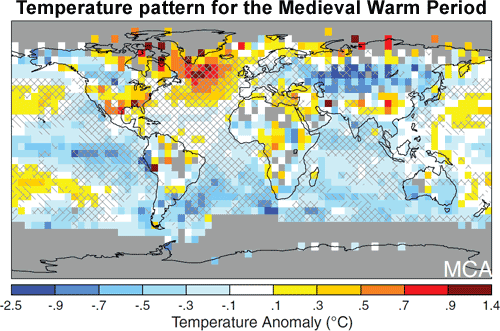
Figure 1 - Reconstructed surface temperature anomalies for the Medieval Warm Period (950-1250) compared to a 1961-1990 reference period. (Source: Mann et al. 2009)
We can compare this with a similar reconstruction looking at surface temperature anomalies for 2022. This clearly shows the global nature of recent warming.
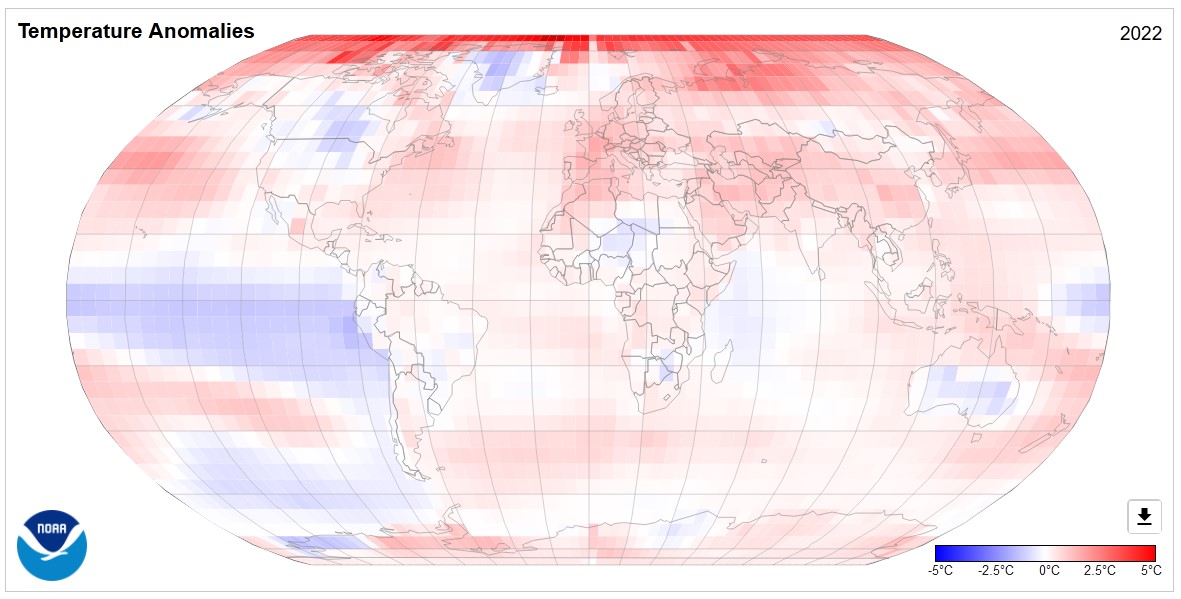
Figure 2 - Surface temperature anomaly for 2022, relative to the 1991-2020 mean. Source: NOAA.
Natural versus man-made climate change
Warming can be the result of a number of factors, so that causes of past climate change are not necessarily implicated in current climate change and vice-versa. For instance, the MWP was characterised by relatively high solar activity, low volcanic activity and possible changes in ocean circulation patterns. These factors can explain both the scale and pattern of warmth at that time. However, they cannot explain recent warming. More to the point, in the absence of our major carbon cycle perturbation, changes in natural factors would probably have led to cooling in the past few decades. This contrasts with the multiple lines of evidence pointing to the role played by humans in recent warming, as set out by the graphic in Fig. 3 below.
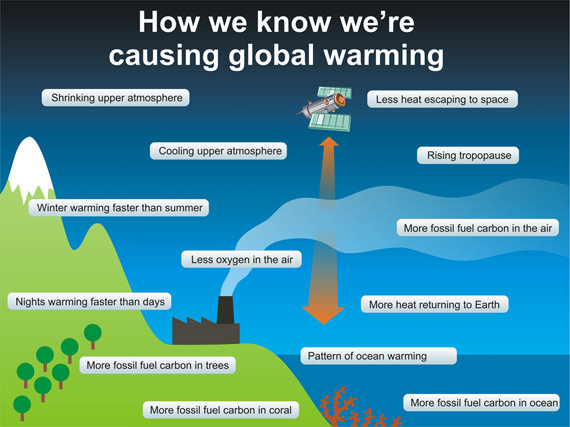
Fig. 3: evidence for anthropogenic global warming - staring us in the face everywhere we look.
What went wrong for the Vikings? Climate change.
Greenland is unlikely to have been radically different just over 1,000 years ago, since much of the ice sheet is at least 400,000 years old. The island was indeed locally green and supported agriculture for a few centuries in localised coastal regions. Nevertheless, around 80% of it would have been just as uninhabitable as it is today. The small area in the SW that was colonised did benefit from the MWP, a strictly regional climate phenomenon.
Ironically, it was climate change that degraded the settlements and had driven the last Vikings out by 1500 CE. The period leading up to this abandonment saw climatic deterioration, as evidenced by highly variable oxygen isotope ratios in local lake sediments (Lasher & Axford 2019). Oxygen isotope ratios are used as a reliable proxy for temperature. This instability marked the cooling into the Little Ice Age and expansion of the southern Greenland ice-sheet. There is evidence that the ice-expansion led to crustal subsidence in the settled area. Gravity-driven sea level rise would also have occurred along proximal coasts (Borreggine et al. 2023). Both phenomena would have caused the loss of good agricultural land. Drowned Viking settlements - or parts thereof - occur in places along the coastline.
The Little Ice Age was also a regional phenomenon. Such regional changes are often examples of internal climate variability, in which existing heat is moved from one part of the climate system to another. That differs from changes in external forcing - such as amounts of Solar irradiance or greenhouse gas levels - that instead change the total amount of heat in the whole system. Nevertheless, as evidenced by what happened to the Vikings, even internal variability can have its impacts.
Last updated on 12 February 2024 by John Mason. View Archives








By the way, I don't seem to hear about volcanic activity in the Arctic & Antarctica areas but you won't hear about that in the mainstream green media. There was an underwater active volcano found in the Sandwich Islands near Antarctica. There was a volcano that went off in Iceland; has any of the data mentioned that? Theres bound to be some volcanic activity going on and thats usually hot. Another thing the Arctic & Antarctica use to be semi tropical. Things change[DB] You already posted on these off-topic issues here. You were responded to immediately afterwards. Please read those responses. If you have any questions on those responses, place those questions there, not here.
Off-topic struck out.
The Saga of Erik the Red - Icelandic Saga Database
1880, English, transl. J. Sephton, from the original 'Eiríks saga rauða'.
Now, afterwards, during the summer, he proceeded to Iceland, and came to Breidafjordr (Broadfirth). This winter he was with Ingolf, at Holmlatr (Island-litter). During the spring, Thorgest and he fought, and Eirik met with defeat. After that they were reconciled. In the summer Eirik went to live in the land which he had discovered, and which he called Greenland, "Because," said he, "men will desire much the more to go there if the land has a good name."
MWP was global. Handwaiving it away and reconstructing a map in an effort to show it was not global isn't evidence. I will grant that, although there is evidence it was global, perhaps that's open to investigation; hence my first adament comment it was global should be rephrased.
Of course, so should all claims it was not global as well...:)