



 Arguments







Monckton Misrepresents Scientists' Own Work (Part 1)
Posted on 21 February 2012 by dana1981, Alex C, Tom Curtis
 On 19 July 2011, Monckton debated Richard Denniss, a prominent Australian economist, author and public policy commentator. During that debate, Monckton delivered his usual Gish Gallop, repeating a number of long-debunked myths and misrepresenting climate science research. A few days later, we at Skeptical Science detailed the various Monckton misrepresentations in the debate.
Monckton has recently responded to our comments, defending his debate arguments. However, Monckton's defense amounts to little more than additional misrepresentations. As John Cook recently alluded to, we will proceed to examine the mishmash of Monckton misrepresentations that ensued.
Monckton addresses John Cook throughout his response even though the Skeptical Science post was written by dana1981 (Dana Nuccitelli), as clearly indicated at the top of the post. Unfortunately as we'll show here, this careless reading of the Skeptical Science post is symptomatic of Monckton's constant problems misreading - and consequently misrepresenting - the climate science literature (as we'll see here in Part 1), specific situations (Part 2), and reality in general (Part 3).
The most interesting responses to Monckton's presentations have involved demonstrations that he has misrepresented climate scientists' work (i.e. by John Abraham and Tim Lambert). Here we will see that Monckton continues with this unfortunate habit.
Monckton Misrepresents Climate Sensitivity
In his recent blog post on Watts Up With That (linked above), Monckton claims there is no consensus regarding how much warming increased atmospheric CO2 will cause - also known as "climate sensitivity." This is simply untrue. Both the 2007 IPCC report and Knutti and Hegerl (2008) included literature reviews, examining climate sensitivity estimates using a wide range of methods, data, and timeframes. In both literature reviews, the clear consensus was that climate sensitivity is between 2 and 4.5°C for doubled CO2 (Figure 1).
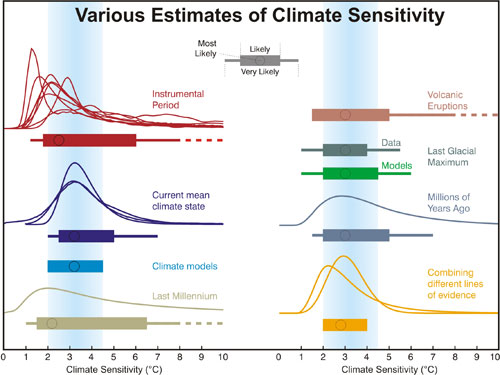
Figure 1: Distributions and ranges for climate sensitivity from different lines of evidence. The circle indicates the most likely value. The thin colored bars indicate very likely value (more than 90% probability). The thicker colored bars indicate likely values (more than 66% probability). Dashed lines indicate no robust constraint on an upper bound. The IPCC likely range (2 to 4.5°C) and most likely value (3°C) are indicated by the vertical grey bar and black line, respectively (adapted from Knutti and Hegerl 2008)
In disputing this consensus, Monckton lists a few papers which he purports demonstrate that climate sensitivity is low. In some cases he has misrepresented the papers, as they make no assertions about climate sensitivity whatsoever. In other cases, he references papers by the same few "skeptics" which subsequent research has demonstrated are flawed.
Douglass et al. (2004): attempted to estimate the climate sensitivity to changes in solar irradiance, and found a sensitivity parameter of 0.63°C per W/m2. This equates to 2.3°C warming for a 3.7 W/m2 radiative forcing (the forcing caused by a doubling of atmospheric CO2). This sensitivity is within the IPCC range (2 to 4.5°C), and thus this paper does not support a low sensitivity argument.
Douglass et al. (2007): deals with tropical troposphere temperatures and does not even discuss climate sensitivity. Monckton also mischaracterizes the 'hot spot' as a fingerprint of human warming - it is not. Monckton also fails to mention the statistically flawed methodology in this paper, identified by Santer et al. (2008).
Coleman and Thorne (2005): like Douglass (2007), deals with tropical troposphere temperatures, not climate sensitivity.
Shaviv (2005): has concluded that climate sensitivity is low because galactic cosmic rays have contributed substantially to global temperature changes. Shaviv's conclusions are contradicted by virtually every other study on the subject of galactic cosmic rays.
Tsonis et al. (2006): fake skeptics frequently misrepresent this paper, claiming, like Monckton, that it attributes much of the recent warming to natural variability. In reality the paper specifically discussed natural variability superimposed on an anthropogenic warming trend. Moreover, a paper by co-author Swanson (2009) noted that if the climate is more sensitive to internal variability than currently thought, this would also mean climate is more sensitive to imposed forcings like CO2, and is thus an argument for high climate sensitivity.
Wentz et al. (2007): dealt with precipitation, not climate sensitivity. The paper finds that while atmospheric water vapor has increased as expected, precipitation has increased more than predicted by climate models. Note that Monckton wrongly claims Wentz et al. concluded evaporation has risen 3 times faster than expected; water vapor was on par with expectations, and it was precipitation that has risen faster than expected. The potential effects regarding global warming (and implicitly climate sensitivity) are unclear, as stated in the paper (in fact the paper does not even mention climate sensitivity). Monckton claims that because precipitation has increased roughly 3 times faster than climate models expect, this means climate sensitivity is 3 times lower than expected. This conclusion is wholly unjustified; even if we knew the implications of increased precipitation on climate sensitivity, the hydrological cycle is quite obviously not the only global warming feedback.
Paltridge et al. (2009): is a paper about specific humidity which draws no conclusions about climate sensitivity. Paltridge himself also noted that while their paper found decreasing specific humidity, it relied on problematic radiosonde (weather balloon) data. Subsequent research using satellite data has demonstrated that specific humidity is increasing as expected.
Douglass & Christy (2009): was published in Energy&Environment, which is not considered a legitimate peer-reviewed journal. The paper attempted to estimate climate sensitivity based on just lower troposphere temperatures in the tropics, which could be described as 'cherry picking' convenient data. This is also the third Douglass paper referenced by Monckton.
Lindzen and Choi (2009): relied on short-term data with conveniently chosen starting and ending points, using data from only the tropics. Monckton also failed to mention that several subsequent papers have demonstrated that this paper is flawed and its conclusions regarding low climate sensitivity are unsupported.
Spencer and Braswell (2010): this paper essentially suggested that cloud cover changes will act as a strong negative feedback and offset global warming. Monckton neglects to mention that Dessler (2010) found that the global cloud feedback is likely positive, and does not appear to be strongly negative. A number of other studies have also suggested a positive cloud feedback.
Spencer and Braswell (2011): subsequent research has demonstrated that Spencer and Braswell were not testing climate sensitivity, but rather models' ability to reproduce the El Niño Southern Oscillation. Monckton also neglecte to metion that Spencer and Braswell omitted inconvenient data from their published results, as shown by Dessler (2011). Thus like Lindzen and Choi, their conclusions regarding low climate sensitivity are unsupported.
Loehle & Scafetta (2011): this paper used an oversimplified climate model which fails to reproduce past climate changes, overestimated the natural contribution to 20th Century warming, and confused equilibrium with transient climate sensitivity, amongst its numerous fundamental flaws.
Overall, amongst the 12 papers which Monckton claims support low climate sensitivity, 5 do not even discuss climate sensitivity, 1 suggests climate sensitivity falls within the stated IPCC range, 1 tries to blame global warming on galactic cosmic rays, 1 was published in Energy&Environment, and 4 have been debunked by subsequent research and/or are riddled with fundamental flaws.
Even ignoring the fundamental flaws and subsequent research, Monckton has only identified 6 papers which actually suggest climate sensitivity is low, as compared to the dozens of papers identified in Knutti and Hegerl (2008) which are consistent with the IPCC climate sensitivity range.
In some of these papers, the implications for climate sensitivity (if any) is unclear (e.g. the 'hot spot' and greater than expected precipitation); however, Monckton is in no position to make those determinations himself. If the scientists themselves do not draw any conclusions about the implications of their research on climate sensitivity, Monckton should not misrepresent their research by drawing unsupported conclusions.
Monckton Misrepresents Economic Effects of CO2 Limits
In our original post, we pointed out the consensus amongst economists with expertise in climate that CO2 limits will help the economy (Figure 2), because climate mitigation is cheaper than adaption (Figure 3).
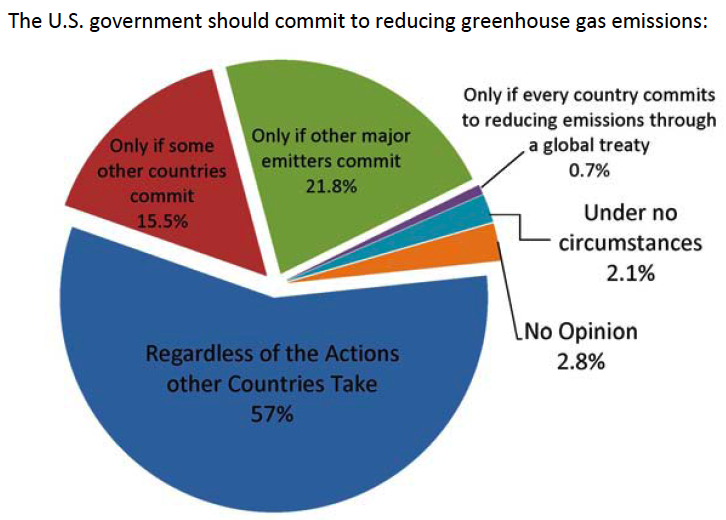
Figure 2: New York University survey results of economists with climate expertise when asked under what circumstances the USA should reduce its emissions
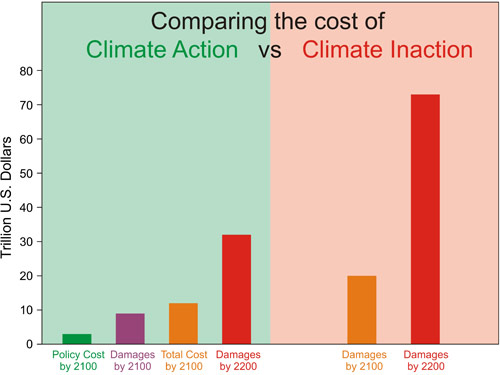
Figure 3: Approximate costs of climate action (green) and inaction (red) in 2100 and 2200. Sources: German Institute for Economic Research and Watkiss et al. 2005
Monckton begs to differ, citing economics reviews by Tol (2009) and Lomborg (2007). However, Lomborg (2007) appears to be a reference to Lomborg's book rather than a peer-reviewed paper. Tol (2009) is indeed a peer-reviewed overview of some climate economics research, but contrary to Monckton's claims, it concludes:
"A government that uses the same 3 percent discount rate for climate change as for other decisions should levy a carbon tax of $25 per metric ton of carbon (modal value) to $50/tC (mean value). A higher tax can be justified by an appeal to the high level of risk, especially of very negative outcomes, not captured in the standard estimates (Weitzman, forthcoming)."
"There is a strong case for near-term action on climate change, although prudence may dictate phasing in a higher cost of carbon over time"
Monckton has misrepresented Tol by claiming that his research concludes the costs of climate action will exceed the costs of inaction - Tol quite clearly concludes a carbon tax would be beneficial in this paper. Tol's review also relies heavily on the work of Nordhaus, who has similarly been misrepresented by the fake skeptics, and who also has concluded that reducing CO2 emissions will save money and benefit the economy. Note also that Tol and Nordhaus are two of the most conservative economists in their estimates of the costs of climate change, and yet they both support carbon pricing mechanisms; a fact which clearly supports the economic consensus in support of carbon limits.
Monckton Misrepresents Ice Cores and the Met Office
In discussing whether the Earth's climate is generally stable or unstable, Monckton made a number of incorrect claims about the Younger Dryas event. For example, he referenced Antarctic temperatures, when the event is actually observable in Greenland, not Antarctic ice core records. The temperature change Monckton refers to also occurred over a span of approximately 40 years, not 3 years, as Monckton asserts.
Regardless, Monckton's original argument that there just can't be a 5°C global surface temperature warming "overnight" (over approximately 250 years, in our case) simply has no basis in reality. Given a sufficiently large radiative forcing, there is no physical reason why this warming could not occur. Monckton also misrepresents the UK Met Office, claiming:
"We now have confirmation from the UK Met Office that there has been no “global warming” to speak of for 15 years."
Monckton did not provide a source to support this assertion, but he may refer to the David Rose Daily Mail article which made similar claims. The UK Met Office responded to that article, saying (emphasis added):
"This article includes numerous errors in the reporting of published peer reviewed science undertaken by the Met Office Hadley Centre and for Mr. Rose to suggest that the latest global temperatures available show no warming in the last 15 years is entirely misleading."
It would seem that Monckton has quite misrepresented the Met Office as well. The HadCRUT3 data set does show relatively little surface warming over the past 15 years (0.02°C), but that timeframe also just happens to start at the beginning of the largest El Niño in the past century (thus choosing it as a starting point is cherry picking, as illustrated in The Escalator). Moreover, we know that HadCRUT3 has a cool bias, and will soon be replaced with HadCRUT4, which - among other revisions - will include more temperature data in the Arctic (the fastest-warming region). Even cherry picking the convenient 1997 starting date, temperature data from NASA GISS shows 0.14°C surface warming despite virtually every non-greenhouse gas temperature influence acting in the cooling direction over that period.
The Met Office also would not say there has been no global warming, because Met Office scientists would not ignore the vast majority of the heat that is going into the oceans (i.e. Figure 4).
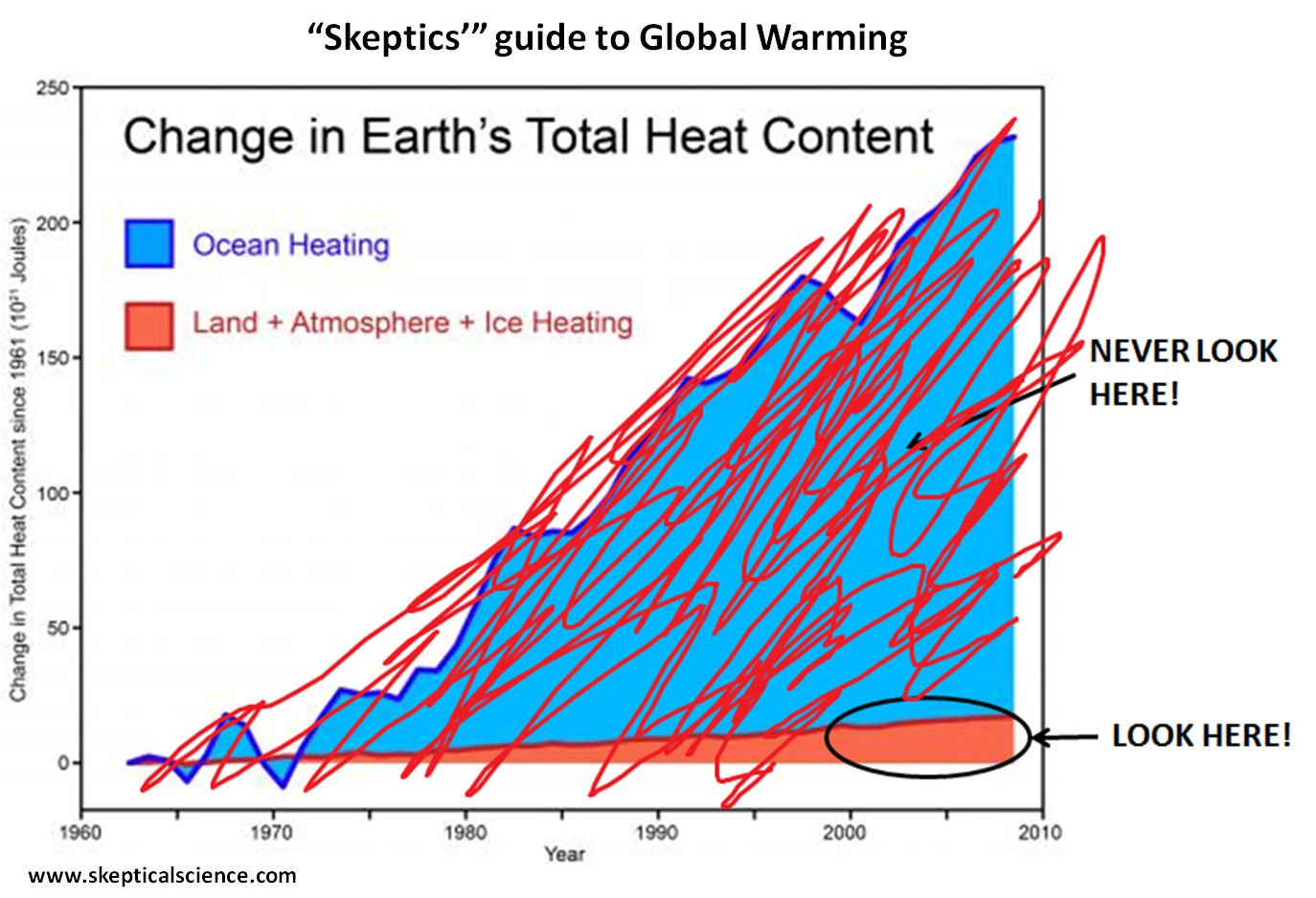
Figure 4: Total global heat content, data from Church et al 2011. Crossed-out data are ignored by Christopher Monckton, but not by the Met Office scientists.
In Part 2 we will examine further Monckton misrepresentations of scientific research, reports, and other specific situations in his response to our critique of his factually-lacking debate performance.


 0
0  0
0 Later he apologized saying:
But later still he qualified that apology by saying:
Now this is very simple. The difference between what Monckton purported to do in the first instance, and what he later claims he did is this:
In the first instance, he appears to apologize for his saying things that were offensive.
His later qualification makes it plain that he is apologizing for it becoming known that he made offensive remarks.
On the very best interpretation, he is apologizing for the offense but not the offensiveness of the remarks, ie, he is apologizing that his remarks caused offense because they became known, but not apologizing for the remarks being offensive, for as he claims, whether or not they are offensive is purely a matter of convention, differing among different groups.
Assume, for the moment, the best interpretation. In that case the claim to apologize "unreservedly" is a bald faced lie. If you qualify unreservedly, you qualify without reservation, and the claim that his remarks are not offensive per se, but only offensive by perception among some groups is certainly a reservation. So large a reservation as, IMO, to make the apology meaningless.
What is more, Monckton is not entitled to this generous interpretation of his remarks. If you are sorry for something, you try not to do it again, but shortly after his damning admission of the reservations in his "unreserved apology" he said on a public platform:
So, far from being regretful of suggesting somebody was a fascist, he now identifies an entire organization as a fascist organization. And if he had no regrets about calling people fascists, then he cannot have sincerely apologized for it. At most, to the extent that his apology was genuine, it was an expression of regret over the inconvenience of being found out.
And just so that we are fully aware of the true moral depths of this loathsome man, having riled the crowd up against the ABC, and having specifically mentioned by name an ABC reporter who he knew to be in the crowd, saying that she had asked "... deliberately offensive questions", with the consequence that that ABC reporter was jostled and jeered by the crowd, and possibly would have had worse if not for a few honourable people.
Later he apologized saying:
But later still he qualified that apology by saying:
Now this is very simple. The difference between what Monckton purported to do in the first instance, and what he later claims he did is this:
In the first instance, he appears to apologize for his saying things that were offensive.
His later qualification makes it plain that he is apologizing for it becoming known that he made offensive remarks.
On the very best interpretation, he is apologizing for the offense but not the offensiveness of the remarks, ie, he is apologizing that his remarks caused offense because they became known, but not apologizing for the remarks being offensive, for as he claims, whether or not they are offensive is purely a matter of convention, differing among different groups.
Assume, for the moment, the best interpretation. In that case the claim to apologize "unreservedly" is a bald faced lie. If you qualify unreservedly, you qualify without reservation, and the claim that his remarks are not offensive per se, but only offensive by perception among some groups is certainly a reservation. So large a reservation as, IMO, to make the apology meaningless.
What is more, Monckton is not entitled to this generous interpretation of his remarks. If you are sorry for something, you try not to do it again, but shortly after his damning admission of the reservations in his "unreserved apology" he said on a public platform:
So, far from being regretful of suggesting somebody was a fascist, he now identifies an entire organization as a fascist organization. And if he had no regrets about calling people fascists, then he cannot have sincerely apologized for it. At most, to the extent that his apology was genuine, it was an expression of regret over the inconvenience of being found out.
And just so that we are fully aware of the true moral depths of this loathsome man, having riled the crowd up against the ABC, and having specifically mentioned by name an ABC reporter who he knew to be in the crowd, saying that she had asked "... deliberately offensive questions", with the consequence that that ABC reporter was jostled and jeered by the crowd, and possibly would have had worse if not for a few honourable people.







Comments