





Not So Cool Predictions
Posted on 4 January 2011 by dana1981
Claims have recently surfaced in the blogosphere that an increasing number of scientists are warning of an imminent global cooling, some even going so far as to call it a "growing consensus". There are two major flaws in these blog articles, (i) there is no scientific basis for claims that the planet will begin to cool in the near future, and (ii) many of the listed scientists are not predicting global cooling.
Global Cooling? Seriously?
In the face of the immense amount of evidence that the anthropogenic warming signal is driving the long-term temperature trend, it's hard to believe that any scientists would be predicting that this trend will suddenly reverse despite ever-increasing human greenhouse gas emissions. For example, according to NASA GISS, 2009 was tied for the second-hottest year on record, and 2010 will likely be the hottest in the past 130+ years. The first decade of the 21st century was the hottest decade on record, the evidence is overwhelming that humans are the dominant cause of the warming trend, climate scientists have even quantified the anthropogenic warming, and heat continues to accumulate in the planetary system:
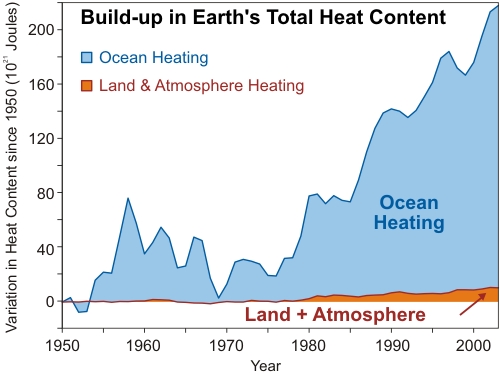
Figure 1: Build-up in total Earth Heat Content since 1950. The data comes from Figure 6b in Murphy 2009. The ocean data was taken from Domingues et al. 2008
With all of this evidence that humans are causing rapid global warming with no end in sight, one has to wonder how on Earth any scientists would suddenly predict imminent global cooling.
Who Are these Scientists Predicting Cooling?
Some of the names listed in the blog above have been predicting imminent cooling for years now, like Don Easterbrook, Syun Akasofu, Habibullo Abdussamatov, Joe D'Aleo, and Nicola Scafetta. Many of these and other names on the list are not climate scientists, which is no doubt why the blogs claim that an increasing number of scientists as opposed to climate scientists are predicting imminent cooling.
One also has to wonder how long the planet must continue to warm while these individuals predict imminent cooling before they lose credibility. Don Easterbrook, for example, has predicted that we should see a global cooling of 2 to 5°F (1.1 to 2.8°C) from 2000 to 2030 based on a shift in the Pacific Decadal Oscillation. We're now one-third of the way into this supposed cooling period and the planet has warmed approximately 0.1°C. The accuracy of this prediction is not looking good.
Several other listed scientists have predicted that we should expect global cooling due to solar effects, like Scafetta, Abdussamatov, Landscheidt, Archibald, and D'Aleo. However, consider the fact that the longest solar cycle minimum in a nearly century just ended, and as mentioned above, the past two years have been among the hottest in the instrumental temperature record. Solar activity has been flat for the past 50 years, and yet the planet warmed approximately 0.6°C during that period. And now we're expected to believe that solar activity is not only going to significantly dampen the anthropogenic warming signal, but cause substantial cooling? These claims strain credulity.
Perhaps the worst part of these blog articles is that they attribute global cooling predictions to numerous scientists who have not made such claims. Let's look at some of the names on the list.
Mojib Latif
Dr. Latif predicted that between 2010 and 2020, the planet would warm approximately 0.4°C, and has said we risk "an unprecedented warming in the history of mankind if no measures are taken to cut global carbon dioxide emissions."
Noel Keenlyside
Dr. Keenlyside is the lead author on the Latif study referenced above which predicted 0.4°C warming from 2010 to 2020.
Anastasios Tsonis and Kyle Swanson
Regarding the supposed global cooling prediction in their study, Swanson has written "If this hypothesis is correct, the era of consistent record-breaking global mean temperatures will not resume until roughly 2020....What do our results have to do with Global Warming, i.e., the century-scale response to greenhouse gas emissions? VERY LITTLE, contrary to claims that others have made on our behalf....humanity is poking a complex, nonlinear system with GHG forcing – and that there are no guarantees to how the climate may respond."
Mike Lockwood
The Lockwood quote supposedly about global cooling simply discusses that decreased solar activity may impact winter weather in Europe, and has nothing to do with global temperatures whatsoever. Lockwood has performed numerous studies concluding that the Sun is not responsible for a significant amount of the recent global warming, and has not predicted global cooling.
James Overland
As with Mike Lockwood, the James Overland quote in question refers to winter weather, in Europe and the USA. Dr. Overland has neither predicted global cooling, nor disputes anthropogenic global warming. In fact, in the article linked above, Overland discusses how rapidly the Arctic is warming due to anthropogenic global warming, and that this will cause shifting weather patterns, leading to the snowy and cold winters in Europe and the USA. Not only is Overland not predicting global cooling in this article, he is explicitly talking about global warming.
There are likely other examples of supposed global cooling predictions being misattributed to climate scientists, but the examples listed above alone represent 20% of the list. Most of the other 'scientists' listed are not climate scientists, but rather meteorologists, engineers, astronomers, etc. And many of the other quotes refer to local weather rather than global temperatures.
Summary
There appear to be very few examples of climate scientists predicting imminent global cooling on this list. Perhaps that's because climate scientists understand that humans are and will continue to be causing rapid global warming for the foreseeable future. The few scientists who are predicting cooling have generally been doing so for several years, and are going against a very large body of scientific evidence that the planet will continue to warm rapidly.
This post is the Intermediate rebuttal (written by Dana Nuccitelli [dana1981]) of the skeptic argument "We're headed into cooling".

Arguments


Mistake.
The good side of all this is that this time they're risking to predict something. At least this is falsifiable.
"Many of these and other names on the list are not climate scientists"
Heck, several of them they are not even scientists, and others are emeritus (and those in the know are aware what often tends to happen when a prof. goes emeritus). Is D'Aleo a real, practicing scientist? Or Corbyn, or Bastardi for that matter? I would argue that the the aforementioned are not scientists.
Have any of them published their claims in a in a reputable peer-reviewed journal?
When one excludes the wanna be scientists, the non-climate scientists and the emeriti-- just who is one left with?
http://www.pas.rochester.edu/~douglass/papers/KD_InPress_final.pdf
While many of his postings are totally meaningless or worse, this seems to clearly say that there is no heat buildup in the oceans, for the last 8-10 years of so. Of course that is not a very long time period, but it makes sense to me that there there would be amore consistent rise in temps in the oceans than on land.
Maybe John someone here can comment of the accuracy/meaning of these results
A big clue here is the author "Douglass". I would not place too much weight on the paper.
IMHO, a far more objective and credible paper on the state of the OHC is a paper by Lyman et al. (2010), which is discussed here.
There is also a good overview here, in the 2009 State of the Climate report. Here is a link to the relevant chapter.
Albatross #5 - personally I don't think you're left with any, but I took that statement out of the post, because it's rather subjective who you consider a real 'climate scientist'. Scafetta for example - personally I think he does rather shoddy work, and technically he's a solar physicist, but you could make an argument for calling him a climate scientist, because he has published in peer-reviewed journals on solar effects on the climate.
tonydunc #6 - I think the abstract of the paper tells you all you need to know - "Using only 2003–2008 data from Argo floats..." So basically they're looking at only *upper* ocean heat content data, only over a 5 year period, and only from Argo floats. Cherrypicking at its finest.
A lot of the names above (and more) are in this table: http://www.eecg.utoronto.ca/~prall/climate/skeptic_authors_table.html
Every "skeptic" list that I've ever seen has been padded with cranks and incompetent hacks. The above list is no exception.
A couple of quick examples:
John Coleman? He's with KUSI here in San Diego, and he's cartoonishly clueless. I've seen him in action on TV several times. His current knowledge of climate-science wouldn't get him a passing grade in a middle-school science class.
Timothy Ball? A complete, over the top, tinfoil-hat crank. Strong words, admittedly, but fully supported by the evidence. See this link for some of that evidence: http://www.canadafreepress.com/index.php/article/31141
Excerpts
Roy Spencer & John Christy did the same thing for about a decade with the MSU satellites when it was obvious there was a spurious cooling signal in their datasets.
And of course we still have no way of measuring the deep ocean in it's entirety. With many politicians willing to bury their heads in the sand over global warming, funding for a deep ocean monitoring network may be a bit hard to come by.
Also, Easterbrook! I hadn't paid him much attention before, but late last night somebody used his arguments about modern temps/the Holocene on me and I had reason to look into him. His claims of "cooling" periods over the 20th century remind me of this so much it's almost not funny. Turns out I'm not the only person who thinks his graphs smell funny:
One
Two
Three
He seems unusually weaselly. I hadn't really heard about him until last night, so maybe I'm just being unduly influenced by hasty Googling. Anybody have the story on Dr. Easterbrook?
The short story is that Easterbrook is bad news-- no doubt about it. Gareth Renowden has thoroughly debunked Easterbrook's latest nonsense in his latest post here.
It seems that at least one "skeptic" did not resolve to absolve from distorting in 2011. In fact, they are starting right where they left off.
Wheels, these antics are all a desperate attempt to keep people distracted from the reality that the the climate system is accumulating heat, and to trying and sow the seed that the planet is in fact not heading for 2-4.5 C warming, but instead "cooling". Easterbrook and the microWatts crowd are clearly in denial about AGW. The psychology of all this is fascinating, if not utterly depressing.
Regards,
Geoff Thomas.
That is the theory, I've not seen any evidence to back it up though, can you point me in the direction of any articles relating to this? There is evidence to suggest a slowing of the meridional overturning circulation of about 30% but no change to the Gulf Stream, as far as I'm aware.
Cooling temps in Europe and North America are more likely to come from changes in Arctic air circulation (due to the rapid warming there) than a slowdown of the thermohaline.
On the other hand IPCC 2007 (AR4) admits some big uncertainties in the aerosol/cloud issue (see the diagramm in chapter 2 of AR4 on radiativ forcing) which could exactly counteract the influence of CO2 and other GHG's ... There seems to be some further research activity underway at CERN with project CLOUD ... Anybody has heard of the outcome of this project??
For the time beeing the warming by greenhouse gasses seems to have been compensated by other factors. The El Niño of 2010 has not been able to break the record temperatures of 1998 (according to the HadCrut data set, which seems to be the least unrealiable). This could have been caused by the very long solar minimum, but nobody knows for sure. If the next solar maximum will be very low - as many solar scientists expect - the climate of the next 10 years could bring new surprises.
“Scientists should not make any predictions about the climate”
If the existence of unknown factors would stop scientists from studying a subject and making predictions, no science could ever be developed. Chaotic systems can be studied, just like any other system. It is true that it is much harder (or sometimes even impossible) to make accurate detailed predictions for a chaotic system, nevertheless it is often possible to draw general conclusions. Climate scientists have predicted global warming, and thus far, they seem to be right.
Regarding climate change we have to do what we do with all risks: assess the risk, based upon the incomplete knowledge we have, and act accordingly.
Ignoring the knowledge we have and conclude: “we don’t know and we will never know” is perhaps a comforting thought for some people, but it is not a very scientific attitude. I don’t think this attitude can be classified as “skeptic”. I therefore propose to use the term: “climate ostrich” henceforth.
*Most* (all?) real systems are chaotic in some degree or fashion. That something is chaotic and hence unpredictable *in detail* is not the same thing as being unpredictable *in broad*.
If you turn on the cold and hot taps to your bathtub and begin filling it, the detailed water motions in the tub are quite chaotic and impossible to predict making the precise motion and temperature of a specific location in the tub unpredictable over more than a few seconds at a time. That doesn't mean that (if the stopper is in) the tub isn't going to fill up at a quite predictable rate and with a quite predictable average temperature at any given moment.
You should read an old essay by Isaac Asimov for the Skeptical Inquirer titled "The Relativity of Wrong".
The world-wide pattern of warming is fairly close to predictions as well, except the changes seem to be happening just a tad faster than some people expected, mainly because we've chosen the higher emissions path while many people thought we'd act sooner to cut emissions.
It would be nice if it were more like economic predictions where people take action when there are dire economic predictions so that they don't eventuate as often. If we all took enough action quickly enough, we might avert the worst case scenarios. At the moment the worst case seems to be the one we're choosing to follow, given that predictions are based on assumptions about emissions.
I thought brave skeptics proved the CRU data to be fraudulent in the Climategate scandal?
Why is it that "skeptics" now all hail the CRU data to be the most accurate? This seems odd, what has changed?
Could it have something to do with the fact that CRU don't cover the high Arctic, thus omitting the region that has warmed the fastest, by far, causing a rather large cold bias in the data?
"How on earth has the CRU dataset all of a sudden become more reliable than the much beloved UAH dataset (that is even run by a skeptic). I thought brave skeptics proved the CRU data to be fraudulent in the Climategate scandal?"
A most excellent point. Northing new though-- cherry-picking, contradiction and internal consistency appear to be the bread and butter of wannabe skeptics.
Let me analyze your comment:
You are using an extended list of buzzwords in a density that is not very common to see (chaotic system, Kelvin's fallacy, El Niño, unreliable datasets, solar minimum) along with your favorite epistemological horse "nobody knows" in a context of add campaigning ("the climate of the next 10 years could bring new surprises" Wow! How deep and precise! And you'll be the most surprised among us)
Daniel Baley already set straight your idea of El Niño playing tag as the pursuer and 365-day-long 2010 becoming a warm-to-be year but no. I don't share Daniel's opinion about 2010 being the warmest during the instrumental record. In fact, what I think is worse, it's probably going to be the second many things, not only warmer.
You used the buzzwords 'chaotic system' to "extrapolate" the laymen-level meaning of 'chaotic' and substantiate your argument. Your innuendo is that being the flush of a toilet a chaotic system the water can jump and smash all the s*** in your head as 'nobody knows' and the water flowing by the drainage is not an option for this chaotic system. It looks like 'nobody knows' unless you authorize them to know. I don't think so.
About the buzzword use of a buzzword concept -the portmanteau 'Kelvin's fallacy'-, you twisted its basic render "rejection in the lack of an explanatory theory" with your see-how-ironic-i-look "assumption that there are no unknown unknowns". Don't agree? Provide then proper links to Kelvin's fallacy. Links with academical value.
I will leave aside -by the moment- all the straw you gather to set a fire.
Scientists should not make any predictions about the climate. No cool predictions, no warm predictions, because the climate is unpredictable. It is a chaotic system with many unknown and ununderstood factors.
Or to put it another way, climate is chaotic and cannot be predicted. Been there, done that.
Please do us all a favor and search this site for your pet "skeptical" arguments before posting them. If you must post despite the rebuttals, please do it on the correct thread.
Scientists should not make any predictions about the climate. No cool predictions, no warm predictions, because the climate is unpredictable. It is a chaotic system with many unknown and ununderstood factors. The illusion that the climate can be predicted is an example of Kelvin's fallacy: the assumption that there are no unknown unknowns.
Casino managers should not make any predictions about revenue. No loss predictions, no profit predictions, because any particular gambler's winnings/losses are unpredictable. A casino is a chaotic system with many unknown and ununderstood factors. The illusion that the a casino's earnings can be predicted is an example of Kelvin's fallacy: the assumption that there are no unknown unknowns.
I have found that the majority of those seriously studying climate science are much more cautious about such claims. That's why most climate scientists talk about "range of possibilities". While a climate scientist may not be able to specify the exact nature of what the future ramifications of climate change might be, he/she can certainly predict with confidence based upon the preponderance of evidence that change can be expected. And I've never run across a serious scientist who would dispute that there are unknown unknowns.
I can use a weather forecast as an example. A forecast is nothing more than a prediction based upon certain knowns that are subject to the influences of unknowns. So if a forecast calls for a high of 30C and the actual temperature at that location for that day registers at 32C, does this mean that we should have no confidence in the forecasts being produced? Certainly not. Therefore I submit that Kelvin's fallacy does not apply here.
Tell that to all those Europeans who schedule month-long vacations each and every July or August ...
Okay, I'm going back to bed now. No point in doing anything because I can not have certainty about anything I'm going to do today.
//Sarcasm off//
I can hardly count the places I've read about uncertainties or lectures I've listened to on uncertainties related to climate change. Some here will remember that I did a count of the number of times the word "uncertainty" was used in the WG1 report of AR4 (the number was larger than the number of pages in the report). All of life is a game of how we act upon uncertainties. The uncertainties related to climate are low enough that we should, as a broader society, be making concerted efforts to avoid the potential outcomes that we face.
From the standpoint of uncertainties, this is a no-brainer.
And what are they basing their made-up consensus on, if it's not temperature readings - those same temperature readings that were previously so unbelievable that they had to come up with all sorts of strange criticisms, ranging from urban heat, to fraud, to conspiracy. Now, though, those temperature readings are being abused to try to give them what they want to see.
But which temperature readings do they trust these days ? It used to be Spencer and Christy's satellites but now, because they are showing too much heat for the so-called skeptics' liking, they are falling back on CRU's figures - the ones that were previously accused of fraud, etc - because they don't include the warm regions of the Arctic...and are therefore more likely to show lower temperatures. Possibly.
Can anyone actually keep up with these people anymore ?
The mind boggles.
we've actually just had the coldest night recorded -27 degree's, and actually i dare say cooling is the thing we should worry about, it poses a far greater danger.
Do you understand the difference between local weather and global average temperature?





